


1 Introduction
The requirement that syllables be parsed into feet is one of the best-motivated requirements in phonological theory. Beyond their role in helping to establish stress patterns, feet play an important part in a variety of phenomena. Asymmetries between iambic and trochaic stress systems in rhythmic lengthening, rhythmic shortening and quantity-sensitivity would all be difficult, if not impossible, to capture in the absence of iambic and trochaic feet (Hayes Reference Hayes1985, Reference Hayes1995, Prince Reference Prince1990, Kager Reference Kager1993, van de Vijver Reference Vijver1998, Hyde Reference Hyde2007).Footnote 1 Feet are often crucial in defining the domains of segmental rule application (Leer Reference Leer and Krauss1985, Nespor & Vogel Reference Nespor and Vogel1986, Rice Reference Rice1992, Hayes Reference Hayes1995, Vaysman Reference Vaysman2009, Gordon Reference Gordon and van Oostendorp2011). Foot structure often plays a central role in capturing differences in the behaviour of vowels in unstressed syllables (Kager Reference Kager1989, Dresher & Lahiri Reference Dresher and Lahiri1991, Bye Reference Bye1996, Hermans Reference Hermans and van Oostendorp2011). These are just a few of the possible citations (see Hayes Reference Hayes1995, Gordon Reference Gordon and van Oostendorp2011 and Hermans Reference Hermans and van Oostendorp2011 for partial summaries).
The requirement that feet be binary – either bimoraic or disyllabic – is also well motivated. Many languages explicitly reject feet built on a single light (monomoraic) syllable, preventing such syllables from being stressed if they cannot be paired with another, but no language explicitly rejects feet built on a single heavy (bimoraic) syllable (Prince Reference Prince1980, McCarthy & Prince Reference McCarthy and Prince1986, Hayes Reference Hayes1995). In languages that prohibit words containing fewer than two moras, the minimal word restriction is typically a straightforward consequence of a minimal foot restriction (McCarthy & Prince Reference McCarthy and Prince1986, Hayes Reference Hayes1995). In many cases of reduplication, size restrictions on the reduplicant can be explained if it must contain a binary foot (McCarthy & Prince Reference McCarthy and Prince1986).
Since the parsing and minimality requirements are both so well motivated, it would be somewhat surprising if they were responsible for any significant shortcomings in the theory's predictions. Yet this is exactly the situation that obtains in most recent proposals in metrical stress theory, including symmetrical alignment (McCarthy & Prince Reference McCarthy and Prince1993), asymmetrical alignment (Alber Reference Alber2005), rhythmic licensing (Kager Reference Kager2001, Reference Kager2005; see also McCarthy Reference McCarthy2003 and Buckley Reference Buckley2009) and iterative foot optimisation (Pruitt Reference Pruitt2008, Reference Pruitt2010). The shortcomings arise not because of the parsing and minimality requirements themselves, but because of the particular options that the proposals employ to satisfy these requirements for inputs with an odd number of syllables.
Together, the parsing and minimality requirements demand that syllables be exhaustively parsed into binary feet. Achieving exhaustive binary parsing for even-parity inputs is a simple matter. Each syllable is grouped with an adjacent syllable to form a disyllabic foot, as in (1a), so that none is left over. Achieving exhaustive binary parsing for odd-parity inputs, however, is not so straightforward. After as many syllables as possible are grouped into disyllabic feet, there is a still a single syllable left over, as in (1b).
(1)

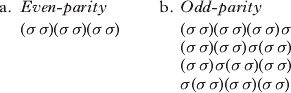
There are essentially three options for accommodating the leftover syllable of an odd-parity input in a way that achieves exhaustive binary parsing. First, if the odd-parity input contains a heavy (bimoraic) syllable in an odd-numbered position, the heavy syllable can be parsed as a monosyllabic foot, with the remaining syllables parsed into disyllabic feet, as in (2a). Second, the odd-parity input can be converted into an even-parity output, as in (2b), either by inserting a single syllable or deleting a single syllable, so that each output syllable can be included in a disyllabic foot. Finally, the leftover syllable from an odd-parity input can be included in a disyllabic foot that overlaps another disyllabic foot, as in (2c) (here and elsewhere H = heavy; L = light).
(2)
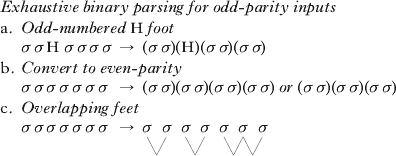
While the option in (2c) is somewhat unconventional, since it involves improper bracketing, it is actually the options in (2a) and (b) that lead to the shortcomings associated with the parsing and minimality requirements. In fact, the unconventional option is the key to avoiding these shortcomings. If the theory does not allow feet to overlap, pathological patterns emerge, and they emerge in such numbers that they dominate the predicted typology.
I will refer to the set of pathological predictions that can arise in an effort to achieve exhaustive binary parsing (without overlapping feet) as the odd-parity input problem (OPIP). The OPIP can be usefully divided into two sub-problems. The odd heavy problem (OHP) arises when an odd-numbered heavy syllable is parsed as a monosyllabic foot to achieve exhaustive binary parsing, as in (2a), and the even output problem (EOP) arises when the odd-parity input is converted to an even-parity output to achieve exhaustive binary parsing, as in (2b).
1.1 Monosyllabic feet and the odd heavy problem
The first option for achieving exhaustive binary parsing for odd-parity inputs is to parse an odd-numbered heavy syllable as a monosyllabic foot, as in (3). When an odd-numbered heavy syllable is parsed as a monosyllabic foot in an odd-parity output, the substrings on either side of the heavy syllable are even-parity, and can easily be divided into disyllabic feet. Since the heavy monosyllabic foot is bimoraic, it is binary like the disyllabic feet, and exhaustive binary parsing is achieved.
(3)

Achieving exhaustive binary parsing in this fashion results in the OHP, a peculiar type of quantity-sensitivity arising in what is otherwise a quantity-insensitive system. An output form will parse a single heavy syllable as a monosyllabic foot only if it is odd-parity and only if the heavy syllable occupies an odd-numbered position.
(4)

To illustrate, in a truly quantity-insensitive system, we expect stresses to occur in the same position in all forms – regardless of the number of syllables, regardless of the presence or absence of heavy syllables and regardless of the position in which heavy syllables occur. If stress occupies every even-numbered syllable from the right in a quantity-insensitive system, as (5) illustrates, then it occupies every even-numbered syllable from the right in both even- and odd-parity forms, regardless of whether or not they contain heavy syllables and regardless of the position in which heavy syllables might arise.
(5)
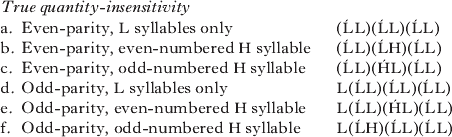
In a system afflicted with the OHP, however, stresses do not occur in the same positions in all forms. As (6a–e) illustrate, they occupy the same positions in even-parity forms, in odd-parity forms containing only light syllables and in odd-parity forms where heavy syllables occur only in even-numbered positions. However, (6f) shows that the stress pattern shifts in odd-parity forms with odd-numbered heavy syllables.
(6)
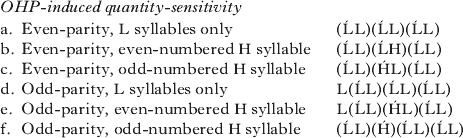
In general, the OHP can alter a stress pattern in two ways, both of which are illustrated in the contrast between (6d, e) and (6f). First, the OHP can produce exhaustive parsing in a subset of odd-parity forms – the subset with an odd-numbered heavy syllable – in systems that otherwise exhibit underparsing. When there is no odd-numbered heavy syllable, the leftover syllable is left unparsed. When there is an odd-numbered heavy syllable, the leftover syllable is parsed as a monosyllabic foot. Second, the OHP can disrupt directional parsing effects. When odd-numbered heavy syllables are present in an odd-parity form, directional devices cannot position the leftover syllable in the same place that they would locate it when odd-numbered heavy syllables are absent.
There are no descriptions of patterns with either of these properties in the literature on quantity-insensitive stress (see the typology presented in Gordon Reference Gordon2002, for example). This is unsurprising, since languages with these properties could hardly be classified as quantity-insensitive. There are also no descriptions of patterns with either of these properties in the literature on quantity-sensitive stress (see the typology presented in Hayes Reference Hayes1995, for example). To the best of my knowledge, then, there are no attested patterns where odd-parity forms alternate between underparsing and exhaustive parsing on the basis of the absence or presence of an odd-numbered heavy syllable.Footnote 2 Also to the best of my knowledge, there are no attested patterns where odd-parity forms alternate in displaying directional parsing effects based on the presence or absence of odd-numbered heavy syllables.Footnote 3
1.2 Faithfulness violations and the even output problem
The second option for achieving exhaustive binary parsing for an odd-parity input is to convert it to an even-parity output. The length of the string is altered, either by adding a syllable, as in (7a), or deleting a syllable, as in (7b). In either case, the result is an even-parity output string that can be evenly divided into disyllabic feet.
(7)
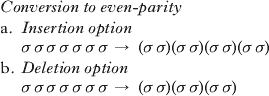
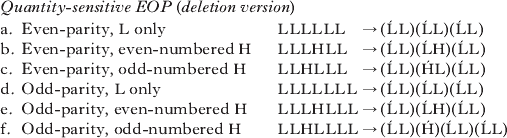
Achieving exhaustive binary parsing in this fashion results in the EOP, which arises in two forms. The less aggressive version exhibits a peculiar quantity-sensitivity that complements that of the OHP. It achieves exhaustive binary parsing for odd-parity inputs that do not contain odd-numbered heavy syllables by converting them to even-parity outputs. For odd-parity inputs that do contain odd-numbered heavy syllables, however, exhaustive binary parsing is achieved by parsing one of these syllables as a monosyllabic foot, as described in §1.1. In this less aggressive version, then, the EOP applies just to odd-parity inputs that escape the OHP. The result is a type of language where the only odd-parity outputs are those that contain odd-numbered heavy syllables.
(8)
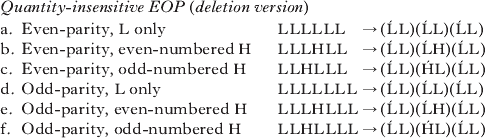
A more aggressive EOP arises in approaches where there is a separate syllabic minimality restriction in addition to the moraic minimality restriction (as in Hewitt Reference Hewitt1994 and Alber Reference Alber2005). The ability to require that feet be at least disyllabic, rather than just bimoraic, makes the EOP quantity-insensitive. All odd-parity inputs are converted into even-parity outputs, regardless of the presence or location of heavy syllables. The result is a language with only even-parity surface forms.
(9)
Whether it arises in its quantity-sensitive version or its quantity-insensitive version, the result of the EOP is an unattested language. There are no attested patterns where the possibility of an odd-parity output depends on the presence of an odd-numbered heavy syllable, as predicted under the quantity-sensitive EOP. There are also no attested patterns that allow only even-parity forms on the surface, as predicted under the quantity-insensitive EOP. This is true despite the fact that parsing and minimality requirements can clearly cause faithfulness violations. They cause faithfulness violations in enforcing minimal words – insertion in Hixkaryana (Derbyshire Reference Derbyshire1985, Hayes Reference Hayes1995), for example – but they do not cause faithfulness violations in longer forms. (For this reason, the EOP cannot be avoided simply by assuming a universal ranking of faithfulness over parsing and minimality.)
1.3 A solution: improper bracketing
Allowing disyllabic feet to overlap is the final option for satisfying the parsing and minimality requirements simultaneously, and it is the only option that avoids the effects of both the OHP and the EOP. Under this option, the leftover syllable is parsed into a disyllabic foot that overlaps another disyllabic foot, as in (2c). Since parsing in this fashion is insensitive to the presence or location of heavy syllables, it avoids the OHP. Since the odd-parity input remains odd-parity on the surface, it also avoids the effects of the EOP.
Whether or not pathological predictions emerge, then, depends on which of the three options the theory allows, and this depends to a great degree on the theory's assumptions concerning prosodic layering. In the discussion just below, I outline the differences between two approaches: weak layering (Itô & Mester Reference Itô and Mester1992) and weak bracketing (Hyde Reference Hyde2001, Reference Hyde2002, forthcoming). As we shall see, weak layering allows heavy syllables to be parsed as monosyllabic feet, as in (2a), and allows adjustments in length from input to output, as in (2b). Because these are the only options for achieving exhaustive binary parsing in weak layering accounts, all such accounts are susceptible to the two sub-problems of the OPIP. In contrast, the weak bracketing approach allows these same options, but it also allows feet to overlap, as in (2c). In allowing feet to overlap, weak bracketing provides an option for achieving exhaustive binary parsing that results in neither the OHP nor the EOP. Providing this option allows the options that are the source of the OHP and the EOP to be harmonically bounded, and the OPIP simply does not arise.
In the sections that follow, we turn to a more detailed examination of the issues raised above. In §2, we see how the parsing and minimality requirements lead to the OPIP under standard optimality-theoretic weak layering accounts, examining the effects of the OPIP on the typology predicted by symmetrical alignment. Although more recent weak layering accounts, including asymmetrical alignment and rhythmic licensing, also exhibit OPIP effects, its effects under symmetrical alignment are actually the least exotic and will provide the simplest illustrations. (For a detailed discussion of OPIP effects in the asymmetrical alignment and rhythmic licensing approaches, see Hyde Reference Hyde2008, forthcoming.) In §3, we see how the OPIP is avoided under an optimality-theoretic weak bracketing account. In §4, I address the possibility of avoiding the OPIP through a serial weak layering approach, iterative foot optimisation. Though its effects are rather different, iterative foot optimisation cannot avoid the OPIP as long as it retains the structural assumptions of weak layering.
2 Odd-parity inputs and weak layering
Most current approaches to metrical stress theory adopt the assumptions of weak layering, which provides two options for dealing with the leftover syllable of odd-parity outputs: the syllable can remain unparsed, as in (10a), or it can be parsed as a monosyllabic foot, as in (10b).
(10)

The option that is selected in a particular language depends on the relative importance of the parsing and minimality requirements as determined by the ranking of the two constraints that implement those requirements. The constraint responsible for the parsing requirement is Parse-σ, given in (11a). Parse-σ simply requires that all syllables be parsed into feet. The constraint responsible for the minimality requirement is FootBinarity (FtBin), given in (11b). In this form, which is relatively standard in OT analyses, FtBin requires that feet be either disyllabic or bimoraic. The smallest types of feet allowed by FtBin, then, are those consisting of two light syllables and those consisting of a single heavy syllable.
(11)

Under the idealised condition where all syllables are treated as if they were light – an idealisation frequently adopted in discussions of quantity-insensitive stress patterns – Parse-σ and FtBin always conflict in the competition between odd-parity output candidates. If FtBin dominates Parse-σ, the leftover syllable remains unparsed. If Parse-σ dominates FtBin, however, the leftover syllable is parsed as a monosyllabic foot. As we shall see next, in examining the predictions of symmetrical alignment under this idealised condition, the conflict is crucial in allowing weak layering accounts to predict an appropriate range of stress patterns.
Following the discussion of the idealised condition, we turn our attention to symmetrical alignment's predictions when differences in syllable weight are taken into account. Under these more realistic conditions, the crucial conflict between Parse-σ and FtBin is lost for odd-parity outputs that contain an odd-numbered heavy syllable. The peculiar quantity-sensitivity of the OHP emerges, and it infects the predicted typology to such a degree that it is clear that symmetrical alignment (and other OT weak layering accounts) cannot possibly predict a reasonably accurate typology of stress patterns.
2.1 The idealised predictions of symmetrical alignment
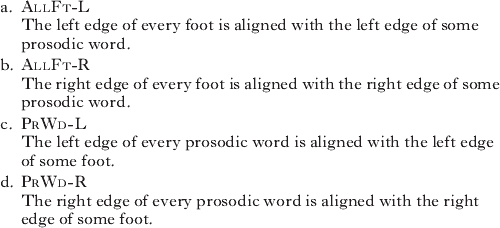
In addition to Parse-σ and FtBin, symmetrical alignment employs a set of four alignment constraints, given in (12). The alignment constraints produce directional parsing effects by determining the position of leftover syllables – whether unparsed or parsed as monosyllabic feet – within the prosodic word. AllFt-L and AllFt-R apply to every foot in a prosodic word, drawing each towards the designated edge of alignment. They are primarily responsible for establishing general directional orientations for feet. PrWd-L and PrWd-R apply to just one foot in a prosodic word. Their primary function is to create exceptions to general directional orientations.
(12)
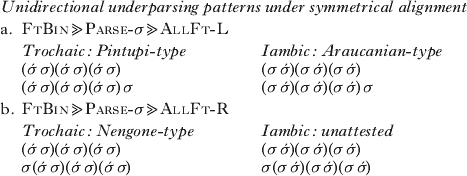
Of the twelve basic patterns that symmetrical alignment predicts (when the effects of syllable weight are not considered), two-thirds can be found in attested quantity-insensitive languages. Symmetrical alignment produces the patterns in (13) and (14) when AllFt-L and AllFt-R rank high enough that their ability to establish general directional orientations results in simple unidirectional patterns. The patterns in (13) emerge when FtBin dominates Parse-σ, so that the leftover syllable of odd-parity forms is left unfooted. Notice that the alignment constraints have the effect of pushing stray syllables away from the designated edge of alignment. In drawing feet toward the left edge, AllFt-L pushes the unparsed syllable to the right. In drawing feet to the right edge, AllFt-R pushes the unparsed syllable to the left.Footnote 4
(13)
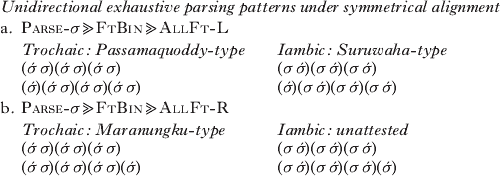
The patterns in (14) emerge when Parse-σ dominates FtBin, so that the leftover syllable in an odd-parity form is parsed as a monosyllabic foot. Alignment constraints have a different effect on monosyllabic feet than on stray syllables, drawing them towards the designated edge of alignment (Crowhurst & Hewitt Reference Crowhurst and Hewitt1995). AllFt-L draws monosyllabic feet to the left edge, and AllFt-R to the right edge.Footnote 5
(14)
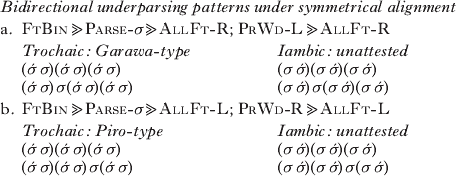
In addition to its eight unidirectional patterns, symmetrical alignment predicts the four bidirectional patterns in (15). When the ranking FtBin≫Parse-σ creates a stray syllable in odd-parity forms, PrWd-L and PrWd-R can create exceptions to the general directional orientations established by AllFt-R and AllFt-L respectively. When PrWd-L dominates AllFt-R, as in (15a), the former anchors a single foot at the left edge, and the latter draws the remaining feet to the right, stranding the unparsed syllable just to the right of the initial foot. When PrWd-R dominates AllFt-L, as in (15b), the former anchors a single foot at the right edge, and the latter draws the remaining feet to the left, stranding the unparsed syllable just to the left of the final foot.Footnote 6
(15)
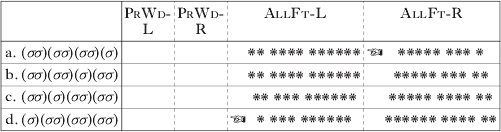
While we might expect that conflicting alignment would also produce bidirectional patterns involving monosyllabic feet, this turns out not to be the case. It can position unparsed syllables in medial positions, but it cannot position monosyllabic feet in medial positions. The reason, as (16) illustrates, is simply that PrWd-L and PrWd-R lose their ability to create exceptions to general directional orientations in exhaustive parsing systems. Since there are always feet at the prosodic word edges when parsing is exhaustive, PrWd-L and PrWd-R cannot distinguish between the relevant candidates. The candidates satisfy both constraints, regardless of the monosyllabic foot's position, so it is left to AllFt-L or AllFt-R to determine its location. If AllFt-L is higher-ranked, the monosyllabic foot occurs at the left edge, as in (16d). If AllFt-R is higher-ranked, it occurs at the right edge, as in (16a).Footnote 7
(16)
To summarise, when the effects of heavy syllables are not actually considered, symmetrical alignment predicts twelve basic quantity-insensitive patterns, eight of which are attested. It produces unidirectional patterns in both underparsing and exhaustive parsing systems, but produces bidirectional patterns only in underparsing systems.
2.2 Symmetrical alignment and the odd heavy problem
When differences in syllable weight are actually considered, all weak layering accounts exhibit OHP effects. Depending on the devices used to produce directional parsing effects, however, the particular manifestation of the OHP varies from account to account (see Hyde Reference Hyde2008, forthcoming). The symmetrical alignment version of the OHP is described in (17).
(17)
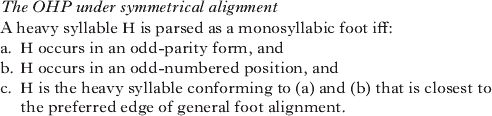
In the symmetrical alignment version, a heavy syllable can be parsed as a monosyllabic foot in any odd-numbered position, but the alignment constraints AllFt-L and AllFt-R decide between them when multiple options are available, as shown in (18).
(18)
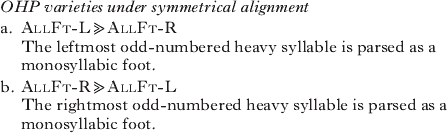
The reason that AllFt-L and AllFt-R alone determine the position of the heavy monosyllabic foot is that a monosyllabic foot always results in exhaustive parsing. Recall that the other two alignment constraints, PrWd-L and PrWd-R, lose their influence when parsing is exhaustive.
To illustrate how the symmetrical alignment version of the OHP emerges, consider first the unidirectional underparsing ranking FtBin≫Parse-σ≫AllFt-L. In odd-parity forms containing only light syllables, this ranking produces the basic odd-parity parsing pattern in (19), where the final syllable is left unparsed.
(19)

In forms containing odd-numbered heavy syllables, however, as (20) indicates, the same ranking parses one as a monosyllabic foot, giving preference to the leftmost when more than one is available.
(20)
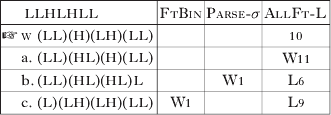
The first thing to notice in (19) and (20) is that underparsing rankings produce an alternation between underparsing and exhaustive parsing based on the weight of odd-numbered syllables. If the odd-numbered syllables are all light, as in (19), an underparsing pattern emerges. When one or more of the odd-numbered syllables is heavy, as in (20), an exhaustive parsing pattern emerges. The second thing to notice is that the monosyllabic foot in (20) may or may not appear in the same position as the unparsed syllable in (19). It is constructed on the leftmost odd-numbered heavy syllable, and any odd-numbered heavy syllable might end up being the leftmost, depending on the position of the others. The result, then, is that the basic directional parsing pattern is perturbed.
Now consider the exhaustive parsing ranking Parse-σ≫FtBin≫AllFt-R. In odd-parity forms containing only light syllables, it produces the basic odd-parity parsing pattern in (21), where the final syllable is parsed as a monosyllabic foot.
(21)

In forms containing odd-numbered heavy syllables, however, as indicated in (22), the same ranking parses one of the heavy syllables as a monosyllabic foot, giving preference to the rightmost when more than one is available.
(22)

Although there is no alternation between underparsing and exhaustive parsing under an exhaustive parsing ranking, the perturbations of the basic directional parsing pattern reveal the OHP's influence. Any odd-numbered heavy syllable may be parsed as a monosyllabic foot. It need not be final, as in (21). It only needs to be the rightmost of the odd-numbered heavy syllables present in the form.
Similar results emerge when odd-numbered heavy syllables are present under each of the symmetrical alignment rankings discussed in §2.1. Underparsing rankings, whether unidirectional or bidirectional, alternate between underparsing and exhaustive parsing in odd-parity forms, based on the weight of odd-numbered syllables. They also show perturbations in directional parsing, based on the same consideration. Exhaustive parsing rankings always produce exhaustive parsing patterns. They do not alternate between exhaustive parsing and underparsing. They do, however, exhibit perturbations in directional parsing consistent with the OHP.
When we consider the potential effects of heavy syllables, then, symmetrical alignment has significant problems of both undergeneration and overgeneration. It fails to produce a single attested quantity-insensitive pattern, but produces twelve unattested quantity-sensitive patterns (summarised in §1 of the online supplementary materials).Footnote 8 Note that the OHP is responsible for both problems. The OHP patterns that emerge when the effects of syllable weight are actually considered effectively replace the quantity-insensitive patterns predicted under the idealised condition where syllable weight is not considered.
2.3 Symmetrical alignment and the even output problem
Having examined the effects of the OHP under symmetrical alignment, we turn now to the effects of the EOP, the prediction that odd-parity inputs can be converted to even-parity outputs to achieve exhaustive binary parsing. Recall that the EOP comes in two versions, and that which versions are possible under a given approach depends on the particular formulation of the minimality requirement. The quantity-sensitive version, but not the quantity-insensitive version, arises when the only minimality requirement in the grammar involves bimoraic minimality, as in the standard definition of FtBin in (11b). The quantity-sensitive EOP affects only those forms that escape the OHP. The result is a language where the only odd-parity surface forms are those that contain odd-numbered heavy syllables. The quantity-insensitive version arises, in addition to the quantity-sensitive version, when the grammar contains a separate disyllabic minimality requirement, distinct from the bimoraic minimality requirement, as in the foot-minimality constraints in (23) (from Hewitt Reference Hewitt1994).
(23)
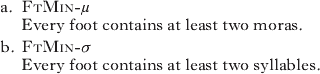
In cases where the syllabic minimality requirement is enforced, the only way to achieve exhaustive binary parsing is to add a single syllable to the odd-parity input or subtract one from it, converting it to an even-parity output. The result is a language with only even-parity surface forms.Footnote 9
2.3.1 Symmetrical alignment and the quantity-sensitive EOP
The quantity-sensitive EOP arises in weak layering accounts under the standard formulation of FtBin, where the only minimality requirement concerns bimoraic minimality. The quantity-sensitive EOP is more limited than the OHP, in that its emergence depends on the rankings of the faithfulness constraints in (24).
(24)

As (25) demonstrates, the OHP affects all odd-parity inputs with odd-numbered heavy syllables, regardless of the ranking of Parse-σ, FtBin, Max and Dep. Since the odd-parity input contains an odd-numbered heavy syllable, the heavy syllable can be parsed as a monosyllabic foot, and there is no need to violate faithfulness to achieve exhaustive binary footing.
(25)
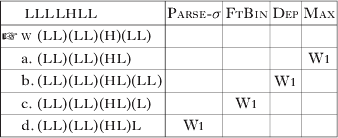
For all other odd-parity inputs, however, the quantity-sensitive EOP emerges when Parse-σ and FtBin both dominate either Max or Dep.
When Parse-σ, FtBin and Dep all dominate Max, Max is violated and a single syllable subtracted to achieve exhaustive binary parsing on the surface. (26), for example, contains no odd-numbered heavy syllables. Parse-σ and FtBin exclude the faithful candidates, (b) and (c), because they must either leave a syllable unparsed or parse a light syllable as monosyllabic foot. Since the higher-ranked Dep excludes the candidate where a single syllable has been added to the odd-parity input, (a), the optimal candidate is the one that achieves exhaustive binary parsing by deleting a single syllable at the expense of low-ranked Max.
(26)
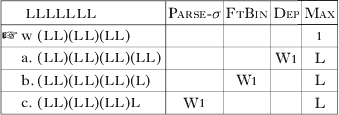
When the rankings of the faithfulness constraints are reversed, so that Parse-σ, FtBin and Max all dominate Dep, Dep is violated and a single syllable added on the surface.
To summarise, in addition to the twelve patterns which exhibit the OHP only, symmetrical alignment predicts eight patterns where the quantity-sensitive EOP emerges alongside (these patterns are summarised in §1 and §2 of the online supplementary materials). The combined patterns make sensitivity to the weight of odd-numbered heavy syllables conspicuous in a new way, as an alternation between odd- and even-parity outputs. When an odd-numbered heavy syllable is present, the output for an odd-parity input is still odd-parity. When no odd-numbered heavy syllable is present, however, the output is even-parity.
2.3.2 Symmetrical alignment and the quantity-insensitive EOP
We turn now to the idea that the FtBin constraint should be split into two constraints, one that establishes a disyllabic minimal foot and one that establishes a bimoraic minimal foot, as in (23). The advantage of a separate syllabic minimality requirement is that it would allow symmetrical alignment to obtain a subset of the necessary quantity-insensitive patterns, partially addressing the undergeneration problem. The disadvantage is that a separate syllabic minimality restriction not only fails to address the overgeneration problem, but actually makes matters worse by introducing the quantity-insensitive EOP.
Of the possible rankings of FtMin-μ, FtMin-σ, Parse-σ, Max and Dep, the rankings that yield quantity-insensitive underparsing patterns are those where Max, Dep and FtMin-σ all dominate Parse-σ. The languages produced under such rankings fail to exhibit the effects of the OPIP.
(27)
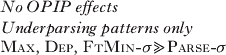
As (28) demonstrates, Max and Dep exclude candidates where a syllable has been subtracted or added to achieve exhaustive binary footing, ensuring that no EOP effect arises. FtMin-σ excludes the candidate where a light syllable is parsed as a monosyllabic foot, but it also excludes the candidate where an odd-numbered heavy syllable is parsed as a monosyllabic foot, ensuring that no OHP effect arises. The optimal candidate leaves a single syllable unparsed, in violation of the low-ranked Parse-σ. Though (28) demonstrates this with leftward alignment, any of the underparsing patterns in (13) and (15) might emerge, depending on the ranking of the alignment constraints.
(28)
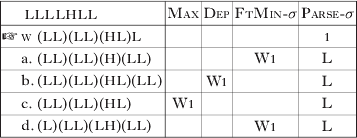
Given the ranking in (28), then, symmetrical alignment would be able to produce both the iambic and trochaic versions of the unidirectional underparsing patterns (illustrated in (13)), and both the iambic and trochaic versions of the bidirectional underparsing patterns (illustrated in (15)). The result would be eight quantity-insensitive patterns overall, six of which are attested. Note, however, that it still could not produce quantity-insensitive exhaustive parsing patterns (illustrated in (14)). The ranking FtMin-σ≫Parse-σ is crucial in avoiding the effects of the OPIP, but it also ensures that any pattern that emerges will be an underparsing pattern. The idea of adding a separate syllabic minimality restriction, then, has only limited success in addressing the undergeneration problem of symmetrical alignment.
Although it could produce a subset of the attested quantity-insensitive patterns, symmetrical alignment would still suffer the effects of the OHP and the quantity-sensitive EOP, because the disyllabic minimality requirement could not simply replace the well-motivated bimoraic minimality requirement. The bimoraic minimality requirement would still be present in the constraint set, potentially influencing the outcome even when it is low-ranked. Whether or not the OHP is accompanied by the quantity-sensitive EOP depends on the ranking of Max and Dep relative to Parse-σ and FtMin-μ. The OHP emerges unaccompanied by the quantity-sensitive EOP when Max and Dep both dominate either Parse-σ or FtMin-μ, as in (29).
(29)
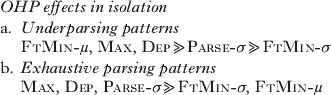
The OHP arises in conjunction with the quantity-sensitive EOP when both Parse-σ and FtMin-μ dominate either Max or Dep, as in (30).
(30)
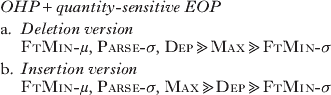
Finally, rankings that conform to (31) yield the effects of the quantity-insensitive EOP, resulting in languages with only even-parity surface forms. The rankings are those where FtMin-σ and Parse-σ both dominate either Max or Dep. Note that the ranking of FtMin-μ is not crucial in this context. It could be positioned at any point in the rankings in (31), without affecting the result.
(31)
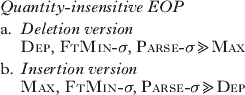
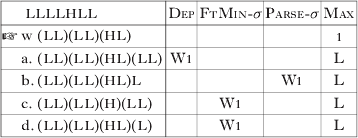
As (32) demonstrates, when Dep, FtMin-σ and Parse-σ all dominate Max, as in (31a), the result is a language that deletes a syllable from all odd-parity inputs, even when they contain an odd-numbered heavy syllable. FtMin-σ excludes candidates with monosyllabic feet, as in (32c, d), ensuring that OHP effects do not arise, and Parse-σ excludes candidates with unparsed syllables, as in (32b). The remaining candidates either add or subtract a syllable to achieve exhaustive binary parsing. Dep excludes the candidate that inserts a single syllable, leaving the candidate that subtracts a single syllable to emerge as the winner.
(32)
Similarly, when Max, FtMin-σ and Parse-σ all dominate Dep, as in (31b), the result is a language that adds a syllable to all odd-parity inputs. (The quantity-insensitive EOP patterns predicted under symmetrical alignment are summarised in §3 of the online supplementary materials.)
Before moving on, a final reason that a separate syllabic minimality requirement is not a viable solution to the issues addressed here is that it is not particularly well motivated. In Hewitt's (Reference Hewitt1994) account, for example, FtMin-σ is conspicuous for not playing any significant role in the analysis. This should not be surprising. As Hayes (Reference Hayes1995) notes, quantity-insensitive languages that allow bimoraic syllables seem never to categorically prohibit heavy monosyllabic feet. Even in those cases where the minimal word is disyllabic, rather than bimoraic, it can be accounted for with a bimoraic minimal foot, an extrametricality/non-finality effect or a combination of the two.
3 Weak bracketing
Weak layering approaches, such as symmetrical alignment, require that the leftover syllable of an odd-parity form remain unparsed or be parsed as a monosyllabic foot. Given these options, parsing and minimality requirements can only be satisfied simultaneously for an odd-parity input by parsing an odd-numbered heavy syllable as a monosyllabic foot or violating a faithfulness constraint to make the form even-parity on the surface. Making changes in our basic assumptions about prosodic layering, however, also changes the options available for achieving exhaustive binary parsing in odd-parity forms.
Weak bracketing takes a different approach to the layering irregularities that the grammar uses to deal with the leftover syllable of an odd-parity form. Under weak bracketing, a leftover syllable can be parsed as a monosyllabic foot, as in (33a), or it can be parsed into a disyllabic foot that overlaps another disyllabic foot, as in (33b).
(33)
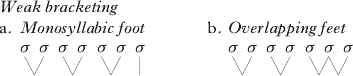
As in weak layering accounts, the ability of a monosyllabic foot to achieve exhaustive binary parsing depends on the weight of odd-numbered syllables. The ability of overlapping feet, however, does not. Overlapping feet result in exhaustive binary parsing regardless of the weight of the syllables involved.
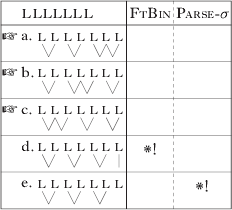
(34) and (35) show that the addition of the overlapping feet option makes both the existence and position of heavy syllables irrelevant to a form's ability to achieve exhaustive binary parsing, a result sufficient to eliminate the OHP. As (34) illustrates, even when an odd-parity output consists of all light syllables, overlapping feet allow it to achieve exhaustive binary parsing. An overlapping configuration parses three syllables into two disyllabic feet. With an even number of syllables remaining, it is a simple matter to parse the rest of the string into disyllabic feet as well. As a result, FtBin and Parse-σ are satisfied simultaneously. As we shall see below, alignment constraints are primarily responsible for determining the ultimate position of overlapping feet, for distinguishing among (a)–(c), for example.
(34)
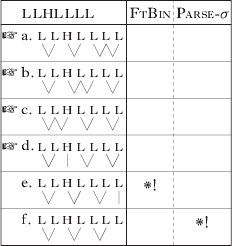
As shown in (35), parsing an odd-numbered heavy syllable as a monosyllabic foot when one is available does not present an alternative superior to overlapping feet. Parse-σ and FtBin can be satisfied simultaneously by parsing an odd-numbered heavy syllable as a monosyllabic foot, as in (d), but they can also be satisfied simultaneously by parsing three syllables of any weight into two overlapping feet, as in (a)–(c). Since the overlapping feet can be freely positioned by alignment and other relevant constraints without the interference of weight-based restrictions, and will be preferred to forms with a heavy monosyllabic foot as a result, syllable weight affects neither parsability nor parsing directionality. When odd-numbered heavy syllables are present, then, exactly the same pattern emerges as when they are absent.
(35)
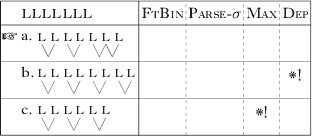
Similar considerations allow weak bracketing to avoid the EOP. As (36) indicates, since overlapping feet can achieve exhaustive binary parsing for any odd-parity form, even those containing only light syllables, there is no advantage to be gained by converting an odd-parity input to an even-parity output, either through deletion or insertion. Overlapping feet allow Parse-σ and FtBin to be satisfied simultaneously while remaining faithful to the odd-parity input. Inserting or deleting a syllable simply creates a gratuitous Dep or Max violation.
(36)
Under weak bracketing, then, overlapping feet provide a way to achieve exhaustive binary footing for any odd-parity input without making parsing sensitive to syllable weight or converting the odd-parity input into an even-parity output. This allows the theory to avoid both aspects of the OPIP – the OHP and the EOP – altogether. The accomplishment means very little, however, if the set of patterns that weak bracketing does predict are not a reasonably close match to the set of attested patterns. As it happens, weak bracketing does predict a reasonably close match, being particularly strong in the area of iambic–trochaic asymmetries. Since these predictions have been discussed elsewhere at length (see Hyde Reference Hyde2002, forthcoming), I will consider them only briefly here.
3.1 Creating stress patterns under weak bracketing
To provide a basic picture of how the weak bracketing approach creates stress patterns, the account includes four constraints that require alignment between the head syllables of feet and prosodic words. AllHds-L and AllHds-R influence the position of every head syllable, drawing each towards the designated edge of the prosodic word. Hd-L and Hd-R influence the position of a single head syllable, insisting that one occur at the designated edge of the prosodic word.
(37)
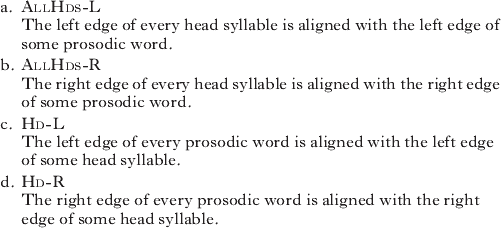
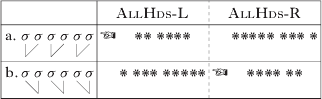
The head-syllable alignment constraints in (37) are primarily responsible for determining foot-type and parsing directionality. When highly ranked, AllHds-L and AllHds-R control both. The influence of AllHds-L and AllHds-R over foot-type is most easily seen in even-parity forms, where parsing directionality is not an issue. As (38) demonstrates, AllHds-L prefers trochaic feet, and AllHds-R prefers iambic feet. (In the examples that follow, a vertical association line indicates the head syllable of the foot.)
(38)
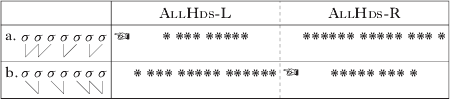
Their influence over parsing directionality is most easily seen in odd-parity forms, as in (39). AllHds-L creates leftward trochaic parsing, preferring to position the overlapping feet employed to parse the leftover syllable at the left edge. In a similar fashion, AllHds-R creates rightward iambic parsing.
(39)
AllHds-L and AllHds-R lose their influence over foot-type, however, when dominated by the appropriate version of the remaining two alignment constraints: Hd-L and Hd-R. When Hd-L dominates AllHds-R, for example, Hd-L insists on trochaic feet. The effect is most easily seen in even-parity forms, where parsing directionality is not an issue, as in (40).
(40)
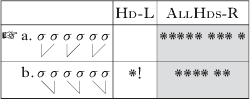
In odd-parity forms, as in (41), Hd-L insists on trochaic feet, but the lower-ranked AllHds-R still draws the feet to the right edge. The result is rightward trochaic parsing, with overlapping feet positioned at the right edge.
(41)
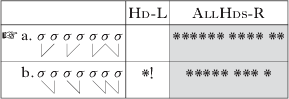
In a similar fashion, the ranking Hd-R≫AllHds-L yields leftward iambic footing.
Alignment constraints, then, are primarily responsible for the positions in which overlapping feet occur. The interactions of other constraints, however, determine how overlapping feet map to the metrical grid. Following Selkirk (Reference Selkirk1980), the traditional view of the relationship between prosodic categories that project to the metrical grid and the grid entries projected is that they stand in a one-to-one correspondence. Though there is still a fundamental relationship between prosodic structure and grid entries under weak bracketing, the relationship is somewhat looser than it is in more conventional approaches. The account departs from the traditional view in two ways. The first is that a prosodic category can fail to correspond to a grid entry. A foot, for example, may be stressed or stressless, as illustrated in (42).
(42)
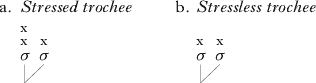
Note that even when a foot is stressless it still has a head syllable, as indicated by the vertical association line. Though head syllables are not always associated with stress, when stress occurs it must occur on a head syllable.
The second departure is that overlapping prosodic categories may be stressed separately but they may also share a stress. In (43a), there is a foot-level grid entry for each foot in the overlapping configurations. In (43b), however, the two feet share a foot-level entry.
(43)

Mappings where feet and stress stand in the traditional one-to-one correspondence and mappings where they do not are all made possible by the formulation of the constraints that require prosodic categories to map to the metrical grid. Since the constraints are violable, it is possible to have stressless prosodic categories when they are appropriately low-ranked. Since the constraints only require that each instance of a prosodic category be associated with a grid entry, without the additional requirement that the association be unique, it is possible for two instances of a prosodic category to share an entry, if the categories overlap. The constraint that requires feet to correspond to foot-level entries is given in (44).
(44)

When MapGM is satisfied, each foot will be stressed. When the constraint must be violated, however, a foot may emerge without a stress. In regular layering configurations, where feet do not overlap, the requirement that each foot have a foot-level grid entry within its domain means that there must be a unique entry associated with each individual foot. In configurations where feet do overlap, however, the two feet can both satisfy the requirement simply by positioning an entry over the shared syllable, as in (43b). While the constraint can also be satisfied by associating a unique grid entry with each foot, as in (43a), a unique entry is not strictly necessary.
Gridmark sharing can arise, for example, in an effort to simultaneously satisfy MapGM and *Clash, a constraint that prohibits adjacent stressed syllables.
(45)

As (46) indicates, drawing head syllables towards the left edge of the prosodic word creates a trochaic pattern with overlapping feet at the left edge in odd-parity forms. If the overlapping feet each have a unique stress, as in (46b), the result is adjacent stressed syllables in violation of *Clash. If clash is avoided by leaving one of the feet stressless, as in (46a), the result is a violation of MapGM. The gridmark-sharing configuration of the winning candidate in (46) satisfies MapGM and *Clash simultaneously.
(46)
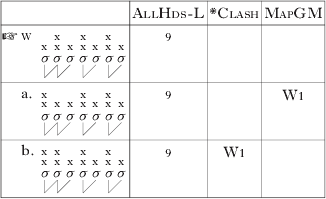
Similarly, drawing head syllables towards the right edge would create an iambic pattern with overlapping feet at the right edge in odd-parity forms. When MapGM and *Clash are satisfied simultaneously, the overlapping feet map to the grid in a gridmark-sharing configuration. The result is a pair of patterns, illustrated in (47), that exhibit neither clash nor lapse. Both are quantity-insensitive, and both are attested.
(47)
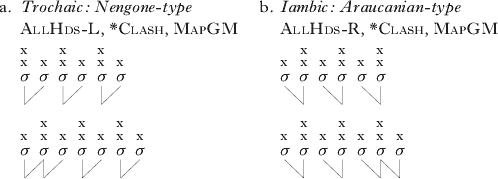
As we saw in (41) above, ranking Hd-L above AllHds-R positions a single head syllable at the left edge while drawing all others to the right. The result is rightward trochaic footing, with a pair of overlapping feet at the right edge in odd-parity forms. Given the positions of the head syllables in this circumstance, MapGM can only be satisfied by associating each foot with a unique stress. This means that overlapping feet must map to the grid with a separated gridmark configuration, as illustrated in (48a). Note that no two head syllables are adjacent in this pattern, so there is no danger of clash, and *Clash plays no role in the distribution of stress.
(48)
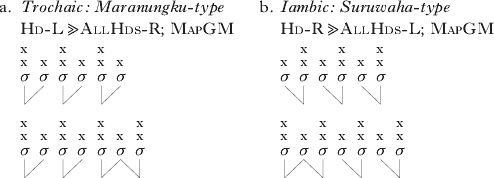
Similarly, ranking Hd-R above AllHds-L positions a single head syllable at the right edge, while drawing all others to the left. The result, illustrated in (48b), is an iambic pattern with overlapping feet at the left in odd-parity forms, also mapped with a separated gridmark configuration. The result, then, is two additional patterns that exhibit neither clash nor lapse. Both of the patterns are quantity-insensitive, and both are attested.
Up to this point, the patterns predicted by the weak bracketing account all exhibit perfect binary alternation. To introduce clash and lapse in appropriate positions, the account also requires asymmetrical InitialGridmark (InitialGM; Prince Reference Prince1983, Hyde Reference Hyde2002) and Non-finality (Non-fin; Prince & Smolensky Reference Prince and Smolensky1993), given in (49).
(49)

Including InitialGM in the constraint set allows the account to produce trochaic patterns with clash and lapse in appropriate positions near the left edge in odd-parity forms. In (50a) a clash occurs at the left edge; in (50b) a lapse occurs just to the right of the initial stress.
(50)
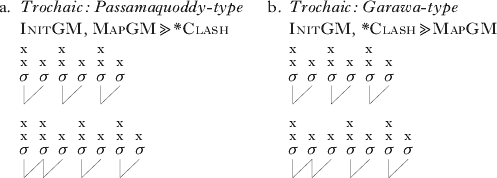
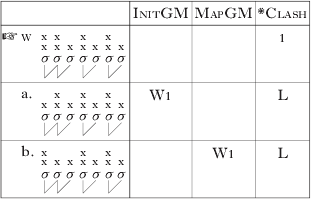
The patterns in (50) have the same leftward trochaic footing as the pattern in (47a), the result of a high-ranking AllHds-L. In the patterns in (50), however, the initial stress required by InitialGM excludes the possibility of mapping the overlapping feet to the grid with a gridmark-sharing configuration and thus the possibility of satisfying *Clash and MapGM simultaneously. When MapGM is satisfied at the expense of lower-ranked *Clash, as demonstrated in (51), the result is the clash configuration of the (50a) pattern.
(51)
When *Clash is satisfied at the expense of a lower-ranked MapGM, as demonstrated in (52), the result is the stressless foot of the (50b) pattern. Note that the stressless foot results in a lapse just after the initial stress.
(52)
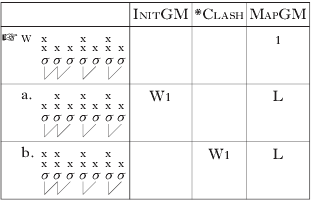
Since InitialGM is asymmetric, affecting only the left edge of the prosodic word, it cannot be used to produce mirror-image iambic versions of the patterns in (50). Since the iambic mirror images are unattested, this is the desired result.
The addition of Non-fin to the constraint set also allows the account to produce additional attested quantity-insensitive patterns. For example, it allows the account to produce trochaic patterns that have a lapse at or near the right edge in odd-parity forms. In (53a) a lapse occurs at the right edge, and in (53b) just to the left of the rightmost stress.
(53)
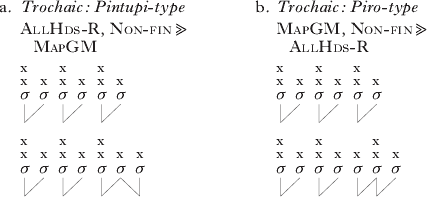
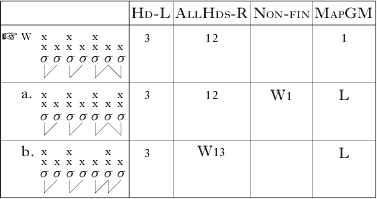
Like the pattern in (48a), the patterns in (53) arise from Hd-L≫AllHds-R, the ranking that yields rightward trochaic footing. In the patterns in (53), however, high-ranked Non-fin excludes the possibility of stressing a final head syllable and thus the possibility of satisfying AllHds-R and MapGM simultaneously in odd-parity forms. When AllHds-R dominates MapGM, the rightmost head syllable remains in final position, as demonstrated in (54), but the final foot is left stressless. The result is the final lapse configuration of the (53a) pattern.
(54)
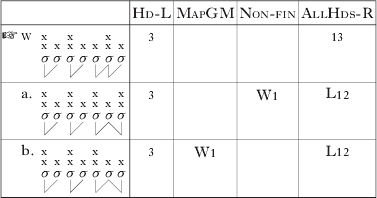
When MapGM dominates AllHds-R, however, the final head syllable shifts to the left, making it possible to map the final two feet to the grid in a gridmark-sharing configuration. The result is a lapse just before the rightmost stress, as in the (53b) pattern.
(55)
Since Non-fin's asymmetrical formulation prevents it from creating similar lapse configurations at the left edge of the prosodic word, it cannot be used to produce iambic mirror images of the patterns in (53). Since the iambic mirror images are unattested, this is the desired result.
From the examples above, we can see that the differences between individual stress patterns are not completely determined by the positions of overlapping feet in the weak bracketing approach. Instead, they are determined both by the positions of overlapping feet, as determined by alignment constraints, and by the way in which the overlapping feet map to the metrical grid. The positions of the properly and improperly bracketed feet in (47a) and (50a, b) are the same, but the stress patterns are different, the differences being due to interactions between requirements that all feet be stressed, that the initial syllable be stressed and that clash be avoided. Similarly, properly and improperly bracketed feet are positioned in the same way in (48a) and (53a, b), but different stress patterns emerge. In this case, the differences are due to interactions between alignment, the requirement that all feet be stressed and the requirement that the final syllable be stressless.
Though the brief sketch presented above provides only an incomplete picture of weak bracketing, it does indicate that overlapping feet can be mapped to the metrical grid in a way that produces an appropriate range of stress patterns. Most importantly, we have seen that weak bracketing avoids both aspects of OPIP – the OHP and the EOP – altogether. The reason is simply that overlapping feet allow all odd-parity forms to achieve exhaustive binary footing regardless of the weight of the syllables involved. As a result, there is never a need to parse an odd-numbered heavy syllable as a monosyllabic foot or to violate faithfulness constraints to make the form even-parity.
3.2 Additional motivation for overlapping feet
Despite the ability of the weak bracketing approach to avoid the OPIP, the non-standard structures that the approach employs are controversial. Overlapping feet have never been a component of a mainstream linguistic theory. The rejection of the configuration is long-standing and seems to be unanimous. For example, Liberman (Reference Liberman1975), Itô & Mester (Reference Itô and Mester1992) and Kenstowicz (Reference Kenstowicz1995) have all explicitly rejected improper bracketing with respect to prosodic categories, and it may require more than their ability to avoid the OPIP to challenge such a firmly held assumption. We shall see below, however, that there is abundant support for improper bracketing.
Despite its absence in theories of prosodic structure, improper bracketing has emerged in numerous other contexts. It plays a role in the theories of musical rhythm advanced by Cooper & Meyer (Reference Cooper and Meyer1960) and Lerdahl & Jackendoff (Reference Lerdahl and Jackendoff1983). Lerdahl & Jackendoff's account is especially significant, because of its similarity to theories of linguistic rhythm. In morphology, haplology can be considered to be a case of improper bracketing, where two morphemes share a segment or string of segments. This is especially clear in the coalescence analyses of Lawrence (Reference Lawrence and Haraguchi1997) and de Lacy (Reference de Lacy, de Lacy and Nowak2000). Kenstowicz's (Reference Kenstowicz1995) analogy between affricates and overlapping feet suggests that an affricate's specification as both [+continuant] and [−continuant] is a case of improper bracketing. Two feature specifications on the same tier share a timing slot, just as two feet would share a syllable. Itô & Mester (Reference Itô and Mester1992) argue that their ban on improper bracketing should not be taken to prohibit the segmental ambisyllabicity most often associated with gemination and flapping. Finally, the notion of multi-dominance in syntax is very similar to improper bracketing. Most recently, Chomsky (Reference Chomsky2001), Starke (Reference Starke2001) and Chen-Main (Reference Chen-Main2006) have argued that it is possible for a single syntactic node to be dominated by more than one parent node.Footnote 10 To the evidence supporting the use of overlapping feet, then, we can add the effectiveness of employing similar structures in analyses in other domains.
While their ability to avoid the OPIP and their ability to predict an appropriate range of quantity-insensitive stress patterns (given the additional components of the weak bracketing approach) provide ample evidence for the use of overlapping feet in metrical stress theory, it may also be possible to detect the presence of overlapping feet independently of these considerations. As an example, consider a lengthening phenomenon that arises in the odd-parity forms of Yidiɲ (Dixon Reference Dixon1977a, Reference Dixonb) and Wargamay (Dixon Reference Dixon, Dixon and Blake1981). As (56) illustrates, in the iambic Yidiɲ, where stress appears on every even-numbered syllable from the left, the penultimate syllable is lengthened in odd-parity forms.Footnote 11 There is no similar lengthening in even-parity forms.
(56)

In the trochaic Wargamay in (57), stress occurs on every even-numbered syllable from the right, and the peninitial syllable is lengthened in odd-parity forms. Again, there is no similar lengthening in even-parity forms.
(57)

An analysis of the lengthening effect requires two components. There must be a device to produce the necessary lengthening, and there must be a method for selecting the desired syllable. A weak layering approach, which would assign odd-parity forms the relevant structures in (58), provides neither. (The lengthened syllable is underlined.)
(58)
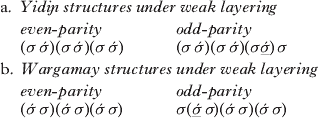
First, the weak layering structures provide no way to distinguish the lengthened syllable from most other syllables, so it has no method to select the appropriate syllable. It is not possible, for example, to provide a distinction based on stressed positions generally. Although the lengthened syllable is stressed, many other syllables are also stressed, and these do not undergo lengthening. It is also not possible to provide a distinction based on the position of primary stress in particular. There are two reasons. First, in Yidiɲ, there is no indication that primary stress is penultimate. Dixon denies that any one stress is more prominent than the others, and Hayes (Reference Hayes1995: 25) cites Kenneth Hale (personal communication) in suggesting that the leftmost stress is primary. Second, even if lengthening happened to coincide with the primary stress of odd-parity forms, primary stress could not be associated with lengthening in either language. Even-parity forms would also have primary stress, but they do not undergo lengthening. The only other straightforward option seems to be a distinction based on footing, but this is impossible for similar reasons. Although the lengthened syllable is footed, so are most other syllables, and these do not undergo lengthening. Although the lengthened syllable occurs in a peripheral foot in particular, syllables in the peripheral feet of even-parity forms do not undergo lengthening. The second problem for a weak layering account is that its structures do not provide for a lengthening device. Since footing is iambic in Yidiɲ, iambic lengthening may seem like an obvious candidate.Footnote 12 This option is unattractive, however, because it would not be the typically general effect observed in the canonical cases.
Overlapping feet allow the weak bracketing approach to overcome these difficulties. In addition to the stressed/unstressed distinction, weak bracketing provides an ambipodal/non-ambipodal distinction. Odd-parity forms would be assigned the relevant structures in (59). Notice that the lengthened syllable occurs in the intersection of two overlapping feet in both cases.
(59)
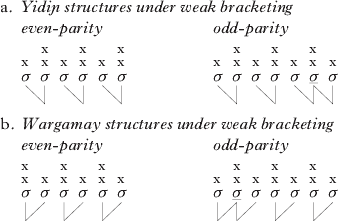
The weak bracketing approach can distinguish the lengthened syllable from other syllables, because it is the only syllable that is ambipodal. It also provides for a lengthening device. The analysis is based on an analogy between consonants that belong to two syllables and syllables that belong to two feet. It has been suggested numerous times in the literature that ambisyllabic consonants can be interpreted as phonetically long in some languages (e.g. true geminates in Persian) and can be interpreted as phonetically short in other languages (e.g. flapping in English).Footnote 13 My suggestion here is that ambipodal syllables are subject to similar interpretations. They may be interpreted as phonetically short in some languages, as in most of the cases of intersection discussed above, and they may be interpreted as phonetically long in others. Interpreting ambipodal syllables as long allows overlapping feet to account for the lengthening effects in Yidiɲ and Wargamay analogously to the way in which ambisyllabicity accounts for gemination.
4 Iterative foot optimisation
It has recently been argued that iterative foot optimisation, a weak layering approach implemented within the framework of Harmonic Serialism (Prince & Smolensky Reference Prince and Smolensky1993, McCarthy Reference McCarthy2007), addresses many of the issues associated with the OPIP. In carefully examining the predictions of iterative foot optimisation, however, we can see that this is really not the case. Though iterative foot optimisation manifests the effects of the OPIP differently, it manifests them just as thoroughly as other weak layering approaches.
4.1 The idealised predictions of iterative foot optimisation
Though it adopts the same structural assumptions as symmetrical alignment and employs the same set of constraints, iterative foot optimisation is implemented within Harmonic Serialism, and the procedures for deriving surface forms differ in important ways. It should not be surprising, then, that there are also important differences in its predictions. Under the idealised circumstance where the effects of syllable weight are not considered, iterative foot optimisation produces sixteen basic binary stress patterns, only half of which can be found in attested quantity-insensitive languages. It predicts four more basic patterns than symmetrical alignment, then, and each of the additional patterns turns out to be unattested.
Like symmetrical alignment, iterative foot optimisation predicts the unidirectional patterns in (60) and (61), but there are slight differences in the crucial rankings involved. When the underparsing ranking FtBin≫Parse-σ creates a stray syllable in odd-parity forms, as in (60), the alignment constraints locate the stray syllable just as they do in symmetrical alignment. AllFt-L pushes it to the right edge, and AllFt-R pushes it to the left edge.
(60)
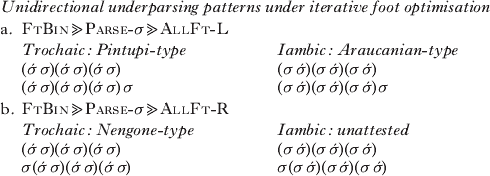
When the exhaustive parsing ranking Parse-σ≫FtBin creates a monosyllabic foot in odd-parity forms, as in (61), however, the effect of the alignment constraints appears to be different than in symmetrical alignment. AllFt-R appears to push the monosyllabic foot to the left edge, just as it would a stray syllable, and AllFt-L appears to push the monosyllabic foot to the right edge, just as it would a stray syllable.
(61)

At first glance, then, alignment seems to have a more uniform effect on unparsed syllables and monosyllabic feet under Harmonic Serialism than it does under Optimality Theory, pushing both away from the designated edge of alignment. A more careful examination, however, reveals that this is not really the case. In Harmonic Serialism, constraints do not evaluate all possible output candidates in a single step. Instead, only candidates with at most a single difference from the input are considered. The output then becomes the input to the next evaluation, and candidates with at most a single difference from the new input are evaluated. The output then becomes the new input, and the process is repeated until the optimal output is the faithful candidate.
For iterative foot optimisation, this essentially means that feet are added one at a time and there is an evaluation after each addition to determine the foot's size and position. For example, the left-oriented underparsing pattern of (60a) is the result of the four-step derivation in (62). In the first step, at most a single foot is added to the input form to produce candidates for evaluation. FtBin and Parse-σ ensure that the output contains a foot and that it is disyllabic. AllFt-L draws it to the left edge of the prosodic word, pushing any stray syllables to the right. In the second and third steps, FtBin and Parse-σ again ensure that a disyllabic foot is added. AllFt-L locates it next to the foot constructed in the previous step, pushing any stray syllables to the right. In the final step, the ranking FtBin≫Parse-σ ensures that the leftover syllable – the final syllable, in this case – remains unparsed.
(62)
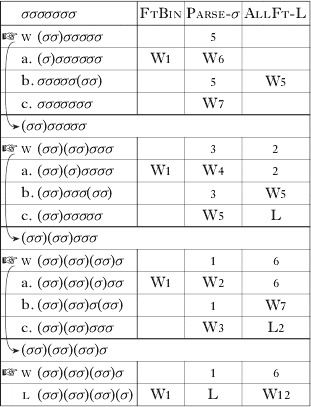
The left-oriented exhaustive parsing pattern of (61a) arises from the derivation in (63), whose first three steps are identical to those in (62). In each of the first three steps, Parse-σ and FtBin create a disyllabic foot, and AllFt-L draws it as close to the left edge as possible, pushing any stray syllables to the right. As in (62), this leaves just the final syllable unparsed at the end of the third step. The difference is in the fourth step. In (63), the ranking Parse-σ≫FtBin ensures that the leftover syllable is parsed as a monosyllabic foot.
(63)
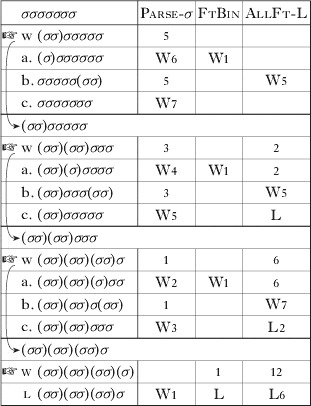
In comparing the derivations in (62) and (63), we can see that the effects of alignment on unparsed syllables and monosyllabic feet have not really changed at all from those in symmetrical alignment. The difference in iterative foot optimisation is that alignment never actually influences the positions of monosyllabic feet directly. In the first three steps in both derivations, AllFt-L draws a disyllabic foot to the left and pushes the unparsed syllables to the right. In the final step, when the position of the leftover syllable has already been determined – it is final, in this case – alignment has no influence. It is not until this point, however, that the ultimate parsing status of the leftover syllable is decided. In (62), the leftover syllable remains unparsed. In (63), it is parsed as a monosyllabic foot. The unparsed syllable and the monosyllabic foot both end up in the same position, then, but only because alignment is actually positioning unparsed syllables in both cases. This is an important point to keep in mind, because it is also the reason that iterative foot optimisation predicts four more unattested patterns than symmetrical alignment.
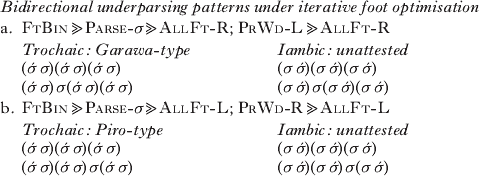
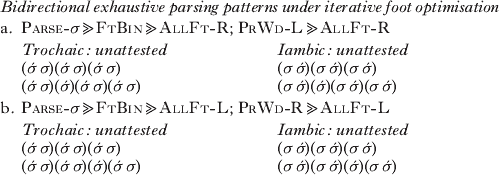
In addition to the eight unidirectional patterns in (60) and (61), iterative foot optimisation predicts the eight bidirectional patterns in (64) and (65). Although its bidirectional patterns emerge under rankings similar to those employed in symmetrical alignment, iterative foot optimisation not only produces bidirectional patterns in underparsing systems, but also produces bidirectional patterns in exhaustive parsing systems. Since the exhaustive parsing versions are all unattested, this is not a desirable result.
When the underparsing ranking FtBin≫Parse-σ creates a stray syllable in odd-parity forms, as in (64), PrWd-L and PrWd-R can create exceptions to general directional orientations, much as they do in symmetrical alignment. The ranking PrWd-L≫AllFt-R positions the stray syllable just to the right of the initial foot, as (64a), and the ranking PrWd-R≫AllFt-L positions it just to the left of the final foot, as in (64b).
(64)
Similar patterns emerge, with a monosyllabic foot replacing the stray syllable, under the exhaustive parsing ranking Parse-σ≫FtBin. The ranking PrWd-L≫AllFt-R positions the monosyllabic foot just to the right of the initial foot, as in (65a), and the ranking PrWd-R≫AllFt-L positions it just to the left of the final foot, as in (65b).
(65)
To better understand why iterative foot optimisation predicts bidirectional exhaustive parsing patterns, we can consider the derivation responsible for pattern (65a). In the first step in (66), Parse-σ and FtBin ensure that a disyllabic foot is added to the input form. PrWd-L draws it to the prosodic word's left edge, pushing the unparsed syllables to the right. In the second step, a second disyllabic foot is added. In this case, however, AllFt-R draws it to the right edge, pushing the unparsed syllables towards the initial foot. In the third step, a final disyllabic foot is added, and AllFt-R positions it just to the left of the final foot, leaving only the post-peninitial syllable unparsed. In the final step, had FtBin been ranked above Parse-σ, the leftover syllable would have remained unparsed, and a bidirectional underparsing pattern would have emerged. Since Parse-σ dominates FtBin, however, the leftover syllable is parsed as a monosyllabic foot, and a bidirectional exhaustive parsing pattern emerges.
(66)

Since it is the only difference between symmetrical alignment and iterative foot optimisation, the latter's serialism is easily identifiable as the source of the four additional bidirectional patterns. In symmetrical alignment, parallel evaluation determines a leftover syllable's position and parsing status simultaneously. A leftover syllable that ultimately emerges as an unparsed syllable is positioned as an unparsed syllable, and a leftover syllable that ultimately emerges as a monosyllabic foot is positioned as a monosyllabic foot. Since alignment can locate monosyllabic feet in only a subset of the positions in which it can locate unparsed syllables, symmetrical alignment predicts fewer exhaustive parsing patterns than underparsing patterns. In particular, it predicts both unidirectional and bidirectional underparsing patterns, but only unidirectional exhaustive parsing patterns.
In iterative foot optimisation, serial evaluation determines a leftover syllable's position and its parsing status at different stages of the derivation. During the stages of the derivation in which alignment constraints determine its position, the leftover syllable is always unparsed. It is only after its position has been fixed that the ranking between Parse-σ and FtBin determines whether it will remain unparsed or be parsed as a monosyllabic foot. Since alignment never influences monosyllabic feet directly, its more stringent restrictions on the positions of monosyllabic feet are never felt, and they can occur in every position in which unparsed syllables occur. Not only do unidirectional patterns with unparsed syllables have corresponding patterns with monosyllabic feet in the same position, then, but bidirectional patterns with unparsed syllables also have corresponding patterns with monosyllabic feet in the same position.
4.2 Iterative foot optimisation and the odd heavy problem
The idea that iterative foot optimisation avoids the OHP turns out not to be true. Iterative foot optimisation exhibits the characteristic quantity-sensitivity described in (67a) and (b), but with the additional restriction given in (67c). To be parsed as a monosyllabic foot, a heavy syllable must be the last syllable in the course of the derivation to have its parsing status settled.
(67)

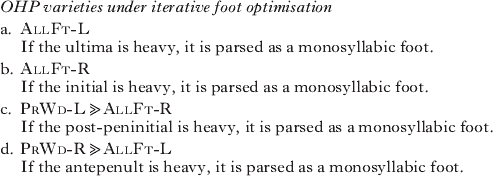
In the derivation of an odd-parity form, there are four syllables which might be the last to have their parsing status addressed – the initial, the post-peninitial, the antepenult and the ultima – depending on the preferences of the alignment constraints. This means that the OHP has four distinct types under iterative foot optimisation, rather than the two distinct types that it has under symmetrical alignment.
As (68) indicates, when AllFt-L is the highest-ranked alignment constraint, the ultima is the last addressed, so only the ultima can be parsed as a monosyllabic foot. When AllFt-R is the highest-ranked, the initial syllable is the last addressed, so only the initial syllable can be parsed as a monosyllabic foot. The post-peninitial syllable is the last to be disposed of when PrWd-L dominates AllFt-R, so only the post-peninitial syllable can form a monosyllabic foot. Finally, the antepenultimate is the last addressed when PrWd-R dominates AllFt-L, so only the antepenult can form a monosyllabic foot.
(68)
As an example, consider underparsing rankings, the rankings where FtBin dominates Parse-σ. In odd-parity forms with a light final syllable, the ranking FtBin≫Parse-σ≫AllFt-L produces the unidirectional parsing pattern in (69), where the final syllable remains unparsed.
(69)

As (70) illustrates, however, in odd-parity forms with a heavy final syllable, the final syllable is parsed as a monosyllabic foot. In examining the different steps of the derivation in (70) and those that follow, notice that it is never advantageous to parse a heavy syllable as monosyllabic foot unless the heavy syllable is the only syllable left unparsed.
(70)

In the first step in (70), there is a choice between creating a disyllabic foot and a heavy monosyllabic foot, but the grammar is obliged to construct the former type at this point. Both types satisfy FtBin and AllFt-L. Because a disyllabic foot allows one more syllable to be parsed, however, reducing the number of Parse-σ violations, a disyllabic foot is selected. Only in the last step, where the rightmost syllable alone remains unparsed and a disyllabic foot cannot be constructed, does it become possible to parse a heavy syllable as a monosyllabic foot. It is only here, then, where we see the OHP's quantity-sensitivity emerge. If the final syllable had been light, as in (69), it would not have been advantageous to parse it as a monosyllabic foot.
Though both exhibit the effects of the OHP, then, the results are slightly different under iterative foot optimisation than they were under symmetrical alignment. Recall that symmetrical alignment produces a perturbation of the basic directional parsing pattern as well as an alternation between underparsing and exhaustive parsing. In iterative foot optimisation, we see only the alternation between underparsing and exhaustive parsing. There is no perturbation of the basic directional parsing pattern. The monosyllabic foot in (70) occurs in the same position – final position – as the unparsed syllable in (69). Since there is no perturbation of basic directional parsing, the quantity-sensitivity of the OHP is obscured in exhaustive parsing patterns. The same syllable will be parsed as a monosyllabic foot whether it is heavy or light. (The OHP patterns predicted under iterative foot optimisation are summarised in §4 of the online supplementary materials.)
The difference in OHP effects in symmetrical alignment and iterative foot optimisation arises from their different derivational perspectives. The ability of odd-numbered heavy syllables to perturb parsing directionality in symmetrical alignment can be traced to the equal consideration given to all odd-numbered heavy syllables for parsing as a monosyllabic foot. The equal consideration is a direct consequence of symmetrical alignment's parallelism. Evaluation under symmetrical alignment simultaneously considers all output candidates with monosyllabic feet constructed on heavy syllables, not just candidates with monosyllabic feet in the position where the leftover syllable normally occurs in the basic pattern. While this allows appropriately positioned odd-numbered heavy syllables to perturb the basic pattern, it also limits the specific OHP types under symmetrical alignment to two: one where the leftmost odd-numbered heavy syllable is parsed as a monosyllabic foot, and one where the rightmost is parsed as a monosyllabic foot.
In contrast, the serial iterative foot optimisation does not compare all possible surface forms to see whether or not it would be advantageous to construct a heavy monosyllabic foot in a position other than the one in which the leftover syllable occurs in the basic pattern. It first determines where the leftover syllable will appear, and then it decides whether or not it would be advantageous to construct a monosyllabic foot in that position. While this prevents heavy syllables from perturbing basic directional parsing patterns, it also has the effect of doubling the specific OHP types under iterative foot optimisation to four: one for each position where the leftover syllable might appear in the basic pattern of an odd-parity form.
Since it emerges under both parallelism and serialism, neither derivational perspective can be the source of the OHP. Since symmetrical alignment and iterative foot optimisation place different additional restrictions on the position of heavy monosyllabic feet in their particular versions of the OHP, however, their derivational perspectives clearly do play a role in how the OHP is manifested.
To summarise, then, when we consider the effects of heavy syllables, we see that iterative foot optimisation also suffers from the effects of the OHP. The OHP negatively affects the predictions of iterative foot optimisation in two ways. The first is that it exacerbates iterative foot optimisation's overgeneration problem. Overgeneration in iterative foot optimisation was already substantial, given the predicted, but unattested, bidirectional exhaustive parsing patterns, and the prediction of several unattested quantity-sensitive patterns only makes matters worse. The second is that the OHP gives iterative foot optimisation a substantial undergeneration problem. It cannot produce a single quantity-insensitive underparsing system.
4.3 Iterative foot optimisation and the quantity-sensitive even output problem
As in symmetrical alignment, the quantity-sensitive EOP only applies in iterative foot optimisation to odd-parity forms that escape the OHP. Under iterative foot optimisation, however, the quantity-sensitive EOP results in twice as many unattested patterns. The reason is simply that the EOP can accompany twice as many specific manifestations of the OHP.
Iterative foot optimisation's deletion version of the quantity-sensitive EOP arises in rankings where Parse-σ and FtBin both dominate Max. The ranking of Dep is not crucial.
(71)

Consider the effects of the ranking (with rightward alignment) in (72) and (73) at the point in the derivation where the leftover syllable's parsing status is determined. As (72) illustrates, the OHP, rather than the EOP, emerges in forms with an appropriately positioned heavy syllable – in this case, the initial syllable.
(72)
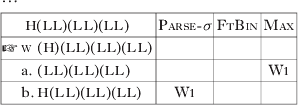
In (73), however, we see that a syllable is deleted in forms that lack an appropriately positioned heavy syllable. If the syllable is left unparsed, it violates high-ranked Parse-σ. If the syllable is parsed as a monosyllabic foot, it violates high-ranked FtBin. In the end, deleting the syllable is the best option, as it satisfies FtBin and Parse-σ simultaneously.
(73)
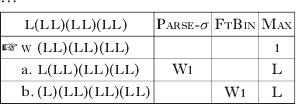
The reason that the ranking of Dep is not crucial in this context is that high-ranking Parse-σ and FtBin both discourage syllable insertion in the final step. Adding another stray syllable would increase the violations of high-ranked Parse-σ. Adding a syllable to an existing disyllabic foot (making the foot ternary) would create a violation of FtBin. It is impossible to create a new foot to accommodate the inserted syllable, as in (74), because a candidate can differ in only one respect from the input. A new syllable and a new foot represent two differences. There is simply no advantage to be gained, then, from a Dep violation.
(74)

It is only advantageous to insert a syllable when it can be added to an existing monosyllabic foot, and this circumstance helps to determine the rankings under which the insertion version of the EOP emerges. The last unparsed syllable of an odd-parity form will only be parsed as a monosyllabic foot when Max and Parse-σ both dominate FtBin. A syllable will then be added to the monosyllabic foot when all three constraints dominate Dep.
(75)

The tableaux in (76) and (77) illustrate the effects of the ranking (with rightward alignment), starting at the point in the derivation where the parsing status of the leftover syllable is determined. (76) shows that the OHP, rather than the EOP, emerges in forms with an appropriately positioned heavy syllable – once again, the initial syllable.
(76)
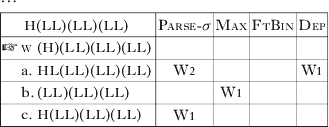
As (77) illustrates, a syllable is inserted in forms that lack an appropriately positioned heavy syllable. At the point in the derivation where the input has a single light syllable left unfooted, the syllable cannot be left unparsed in the output without violating high-ranked Parse-σ, and it cannot be deleted without violating high-ranked Max. To satisfy both, it is parsed as a monosyllabic foot at the expense of FtBin. This allows for an additional step. In the final step, the ranking FtBin≫Dep ensures that a single syllable is added to the monosyllabic foot, making the foot disyllabic and the overall form even-parity.
(77)
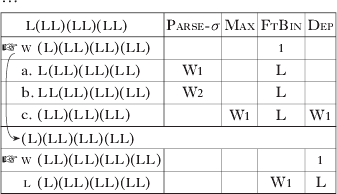
In addition to patterns that exhibit the OHP only, then, iterative foot optimisation predicts eight patterns where the OHP is accompanied by the insertion version of the quantity-sensitive EOP, and eight patterns where the OHP is accompanied by the deletion version of the quantity-sensitive EOP. (See §5 of the online supplementary materials for a summary of the OHP + EOP patterns.)
4.4 Iterative foot optimisation and the quantity-insensitive even output problem
Under an approach where the standard FtBin constraint is split into separate moraic and syllabic minimality requirements, iterative foot optimisation exhibits predictions similar to symmetrical alignment, but there are also some important differences. First, iterative foot optimisation predicts the same range of quantity-insensitive patterns as it does under the idealised conditions discussed in §4.1.
Rankings of FtMin-μ, FtMin-σ, Parse-σ, Max and Dep that conform to (78) result in quantity-insensitive patterns, with directional orientation being determined by lower-ranked alignment constraints.
(78)
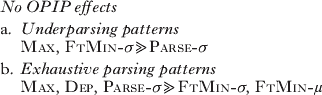
Separating the moraic and syllabic minimality requirements, then, solves the undergeneration problem in iterative foot optimisation, while it only partially solved the problem in symmetrical alignment.
The underlying overgeneration problem of iterative foot optimisation is much more substantial than that of symmetrical alignment, however, and the additional syllabic minimality restriction only makes matters worse. Like symmetrical alignment, iterative foot optimisation still predicts languages that exhibit the OHP in isolation, languages that exhibit the OHP accompanied by the quantity-sensitive EOP and languages that exhibit the quantity-insensitive EOP. Iterative foot optimisation, however, also predicts languages with variations of EOP patterns not found under symmetrical alignment. These additional patterns are discussed in more detail below.
OHP effects emerge unaccompanied by EOP effects under rankings of FtMin-μ, FtMin-σ, Parse-σ, Max and Dep that conform to (79). When no heavy syllable occupies the appropriate position in an odd-parity form, the result is an underparsing pattern. When a heavy syllable does occupy the appropriate position, however, the result is an exhaustive parsing pattern.
(79)

Rankings that conform to (80) result in a combination of the OHP and the quantity-sensitive EOP. When an odd-parity form has a heavy syllable in the appropriate position, the heavy syllable is parsed as a monosyllabic foot. All other odd-parity forms are converted to even-parity forms on the surface.
(80)
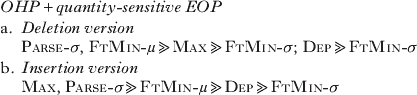
Finally, rankings that conform to (81) result in the quantity-insensitive EOP, where languages have only even-parity forms on the surface.
(81)
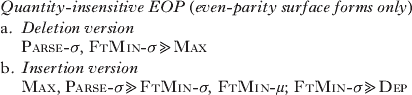
Up to this point, then, the pathological OPIP predictions arising under iterative foot optimisation are very similar to those arising under symmetrical alignment. Iterative foot optimisation's serialism makes it possible, however, to produce two variations of the EOP that are not possible under the thoroughly parallel symmetrical alignment. First, rankings that conform to (82) combine underparsing with the insertion version of the quantity-insensitive EOP.
(82)

Odd-parity forms that lack heavy syllables in the appropriate position emerge with underparsing patterns, and remain odd-parity on the surface. Forms that do contain a heavy syllable in the appropriate position add a syllable and emerge as even-parity on the surface. The usual complementary relationship of the OHP and the EOP becomes overlapping. Rather than applying only to forms that escape the OHP, the EOP in this case applies only to forms that might otherwise have been affected by the OHP.
Consider the ranking in (82) at the point in the derivation for an odd-parity input where only the leftover syllable's parsing status remains to be determined. If the leftover syllable is light, as (83) demonstrates using a form with leftward alignment, it remains unparsed. It is impossible to parse the syllable as a monosyllabic foot to satisfy Parse-σ, due to the higher-ranked FtMin-μ, and it is impossible to delete a syllable to satisfy Parse-σ, due to the higher-ranked Max. Finally, adding a syllable at this point only creates an additional violation of high-ranked Parse-σ, and a new syllable and a new foot cannot be added simultaneously. The faithful candidate with the single unparsed syllable is optimal.
(83)
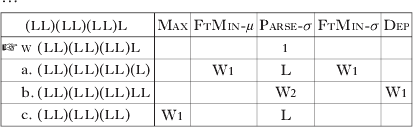
If the leftover syllable is heavy, however, as in (84), the same ranking allows it to be parsed as monosyllabic foot, and this allows for an additional step. In the final step, a syllable is inserted at the expense of low-ranked Dep to satisfy the higher-ranked FtMin-σ. The optimal output for the odd-parity input in this case is an exhaustively parsed even-parity form.
(84)
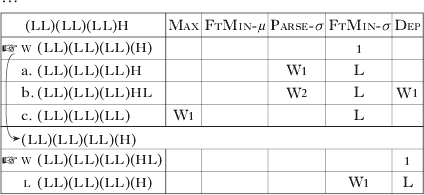
Though forms with leftward alignment were used to illustrate in (83) and (84), the crucial rankings in (82) can combine the insertion version of the quantity-insensitive EOP with any one of iterative foot optimisation's basic underparsing patterns, depending on the ranking of the alignment constraints. (The results are summarised in §6 of the online supplementary materials.)
The second variation possible under iterative foot optimisation, but not under symmetrical alignment, is one that combines the deletion version of the quantity-sensitive EOP with the insertion version of the quantity-insensitive EOP. For odd-parity inputs with a light leftover syllable, the leftover syllable is deleted. For odd-parity inputs with a heavy leftover syllable, an additional syllable is added. The result, emerging under rankings consistent with (85), is a language with only even-parity surface forms.
(85)

Consider the ranking in (85) at the point in the derivation for an odd-parity input where only the leftover syllable's parsing status remains to be determined. As (86) demonstrates, if the leftover syllable is light, it is deleted. The higher-ranked Parse-σ is satisfied at the expense of the lower-ranked Max. Adding a syllable only creates an additional violation of Parse-σ, and a new syllable and new foot cannot be added simultaneously, so Parse-σ cannot be satisfied at the expense of Dep.
(86)
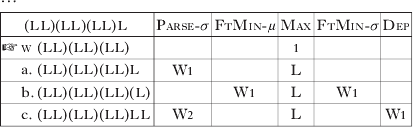
If the leftover syllable is heavy, however, as in (87), the same ranking allows it to be parsed as monosyllabic foot, and this allows for an additional step. In the final step, a syllable is inserted at the expense of the low-ranked Dep to satisfy the higher-ranked FtMin-σ.
(87)
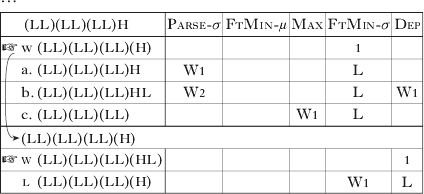
Though the effects of alignment constraints are not necessarily obvious on the surface, they determine the positions of the heavy and light syllables that are key to determining whether deletion or insertion occurs. With leftward alignment, the key position is final, as in (86) and (87). With rightward alignment, the key position would be initial. When PrWd-L dominates AllFt-R, the key position would be post-peninitial. When PrWd-R dominates AllFt-L, the key position would be antepenultimate. Considering each of these situations to constitute distinct patterns yields eight additional unattested languages (summarised in §6 of the online supplementary materials).
While a separate syllabic minimality restriction solves the undergeneration problem in iterative foot optimisation, then, it does not address its underlying overgeneration problem. It also results in all the same OPIP-related predictions found in symmetrical alignment, plus two variations not found in symmetrical alignment.
5 Summary and concluding remarks
The requirement that syllables be parsed into feet and the requirement that feet be binary are two of the best-motivated requirements in phonological theory. Since they are both well motivated, it is somewhat surprising that they appear to be responsible for significant shortcomings in the theory's predictions. As we have seen, however, this is exactly the situation that obtains in approaches that adopt the structural assumptions of weak layering. These include symmetrical alignment, as well as more recent proposals such as asymmetrical alignment, rhythmic licensing and iterative foot optimisation.
Together, the parsing and minimality requirements demand exhaustive parsing of syllables into binary feet. There are essentially three possibilities for achieving this result for odd-parity inputs. First, if the odd-parity input contains a heavy syllable in an odd-numbered position, the heavy syllable can be parsed as a monosyllabic foot, with the remaining syllables parsed into disyllabic feet. This is the option that leads to the odd heavy problem, the first sub-problem of the odd-parity input problem. Second, the odd-parity input can be converted into an even-parity output, either through insertion of a single syllable or through deletion of a single syllable, so that each syllable in the output can be included in a disyllabic foot. This is the option that leads to the even output problem, the second sub-problem of the OPIP. Finally, the leftover syllable from an odd-parity input can be included in a disyllabic foot that overlaps another disyllabic foot. This is the only option that avoids the OPIP altogether. Weak layering accounts, such as those mentioned above, exhibit the effects of the OPIP because they only allow the first two options. A weak bracketing account avoids the OPIP because it also allows the third option.
The article focused on the manifestations of the OPIP in two weak layering accounts: the parallel symmetrical alignment and the serial iterative foot optimisation. In §2 we saw that symmetrical alignment predicts a reasonable range of quantity-insensitive binary stress patterns, when the effects of syllable weight are not actually considered, though it has a significant overgeneration problem. When the effects of syllable weight were considered, however, we saw that symmetrical alignment manifests the effects of both the OHP and the EOP. The effects were so pervasive that symmetrical alignment could not predict a single attested quantity-insensitive pattern, resulting in both a substantial undergeneration problem and an even more substantial overgeneration problem. While the addition of a separate syllabic minimality requirement partially addressed the undergeneration problem, it only exacerbated the overgeneration problem.
In §4, we saw that iterative foot optimisation also predicts a reasonable range of quantity-insensitive binary stress patterns, when the effects of syllable weight are not actually considered, though its overgeneration problem is even more significant than that of symmetrical alignment. The more serious overgeneration problem was a direct result of iterative foot optimisation's serialism. When the effects of syllable weight were considered, we saw that iterative foot optimisation also exhibits the effects of the OPIP, though its manifests them differently than symmetrical alignment, resulting in both a significant undergeneration problem and an even more substantial overgeneration problem. While the addition of a separate syllabic minimality restriction addresses the undergeneration problem in iterative foot optimisation, it exacerbates the overgeneration problem, yielding even more pathological predictions than symmetrical alignment under the same conditions.
Since the effects of the OPIP were pervasive in both symmetrical alignment and iterative foot optimisation, the discussion has clearly demonstrated that neither serialism nor parallelism is the source of the OPIP. Symmetrical alignment and iterative foot optimisation share the same structural assumptions and the same set of constraints. They differ only in their derivational perspective, iterative foot optimisation being implemented in the framework of Harmonic Serialism and symmetrical alignment being implemented in the framework of Optimality Theory. If the OPIP could be shown to arise in one but not the other, then the derivational perspective of the offending account would be identified as its source. Since we saw that the OPIP arises in both, and that it contributes significantly to the inadequacy of both, the source of the OPIP must be something that symmetrical alignment and iterative foot optimisation have in common, either their weak layering structural assumptions or their shared set of constraints.
In §3, we saw that a weak bracketing approach avoids the OPIP altogether, indicating that the weak layering assumption common to symmetrical alignment and iterative foot optimisation are the source of the OPIP. We also saw that, unlike symmetrical alignment and iterative foot optimisation, the weak bracketing approach produces a reasonably accurate range of quantity-insensitive binary stress patterns when the effects of syllable weight are actually considered.



