

The construct of sociosexuality or sociosexual orientation refers to individual differences in willingness to engage in sexual relations without closeness or commitment (Simpson & Gangestad, Reference Simpson and Gangestad1991). The term was coined by Kinsey to portray the individual differences in sexual permissiveness (Kinsey, Pomeroy, & Martin, Reference Kinsey, Pomeroy and Martin1948). To measure sociosexuality, Simpson and Gangestad developed the Sociosexual Orientation Inventory (SOI). The SOI has seven items: two about the participant's past sexual behaviour, two about expected future behaviour and two about general attitudes regarding sex in relation to emotional commitment. It measures sociosexuality along a single broad dimension: high scores reflecting an unrestricted sociosexual orientation and low scores reflecting a restricted sociosexual orientation. Research has showed systematic individual differences in sociosexuality (Simpson, Wilson, & Winterheld, Reference Simpson, Wilson, Winterheld, Harvey, Wenzel and Sprecher2004). The SOI has enjoyed broad popularity as a core individual difference measure (Lippa, Reference Lippa2009). Schmitt (Reference Schmitt2005) found that the SOI is reliable and valid across cultures.
Notwithstanding its wide popularity, the Sociosexual Orientation Inventory has been criticised at conceptual and psychometric levels. At the conceptual level, doubts about the unidimensionality of the sociosexuality have appeared (Jackson & Kirkpatrick, Reference Jackson and Kirkpatrick2007). At the psychometric level Penke (Reference Penke, Fisher, Davis, Yarber and Davis2010) advances an outline of the criticisms: ‘sometimes low internal consistency, multifactorial structure, skewed score distribution, open response items that invite exaggerated responses, multiple alternative methods that yield incoherent results, and the formulation of one item (number 4) that makes the SOI inappropriate for singles’ (p. 622). In order to circumvent these criticisms, Penke and Asendorpf (Reference Penke and Asendorpf2008) developed the revised Sociosexual Orientation Inventory (SOI-R), which measures three dimensions of sociosexuality: past behaviour in terms of number of casual and changing sex partners, attitude towards uncommitted sex, and sexual desire for people with whom no romantic relationships exists. The SOI-R contains nine items, four selected from the SOI and five developed for this new measure. The three components of global sociosexual orientations are interrelated, as Penke and Asendorpf noted: ‘the sociosexual behavior results from the individual degree of desire for uncommitted sexual relationships and the attitude toward sociosexuality that an individual partly acquired during socialization and communicates in social settings’ (p. 1115). Studies carried out using the SOI-R point to its reliability and validity (Penke & Asendorpf, Reference Penke and Asendorpf2008). The SOI-R scale being, for social psychologists, a useful tool, it was considered convenient to have a validated Portuguese version. Portuguese is the official language in 10 countries, spoken by about 250 million individuals.
Therefore, the purpose of this study was to adapt the SOI-R into the Portuguese language and to explore its psychometric properties. The psychometric properties of the scale will be examined by means of confirmatory factor analysis, internal consistency, and validity. In particular, we expect to corroborate the original three-factor structure of the SOI-R (Behaviour, Attitude, and Desire), and its internal consistency. To determine the validity, relationships between sociodemographics, religiosity, political orientation, self-esteem, and satisfaction with sex life will be examined. These variables were selected because they are conceptually related to sociosexuality. We analysed the criterion validity using measures such as relationship status and number of sex partners foreseen in the future. We assessed discriminant validity using ideological and psychological variables, expecting that any observed associations should not be very large and the pattern of correlates will differ by sex.
Method
Participants
A total of 549 participants (274 males and 275 females) with ages ranging between 18 and 75 years (M = 38.73; SD = 17.77) took part. Regarding their education level, 60.8% of the participants had completed tertiary education, 33.0% secondary education, and 6.2% primary education. Regarding occupation, 39.5% were employees, 47.7% students, 3.8% unemployed, 5.6% retired, and 5.6% preferred not to say. In all, 61.9% of participants were single, 21.9% married, 11.1% lived together, 3.3% divorced, and 1.9% widowed. Mean religiosity on a 9-point scale (1 = not at all, 9 = very religious) was 3.66 (SD = 2.42), and mean political orientation on a 9-point scale (1 = very right wing, 9 = very left wing) was 5.11 (SD = 1.76). All participants were born and raised in Portugal.
Measures
Sociosexual Orientation Inventory — Revised
The SOI-R was developed by Penke and Asendorpf (Reference Penke and Asendorpf2008). The SOI-R measures three dimensions of sociosexuality: (a) sociosexual behaviour, (b) sociosexual attitude, and (c) sociosexual desire. Sample items are as follows: (a) Behaviour — for example, ‘With how many partners have you had sexual intercourse on one and only one occasion?’; (b) Attitude — for example, ‘Sex without love is OK’; and (c) Desire — for example, ‘How often do you experience sexual arousal when you are in contact with someone with whom you are not in committed romantic relationship?’ The scale has nine items, three for each subscale. Participants answered on a 9-point Likert type scale. Higher scores in the SOI-R reflect an unrestricted sociosexual orientation, whereas lower scores reflect a more restricted orientation. Penke and Asenforpf (Reference Penke and Asendorpf2008) provide evidence of the psychometric qualities of the SOI-R. For example, the authors reported that: (a) the reliability coefficients were good; (b) confirmatory factor analyses supported the scale's proposed three-factor model; and (c) as expected, scores on the SOI-R correlated positively with scores on measures of sensation-seeking, masturbation frequency, and sex drive. In designing the Portuguese version of the SOI-R, the guidelines suggested in the literature on cross-cultural methodology were used (Brislin, Reference Brislin and Brislin2000): independent/blind/back-translation, proficient translation, and small-scale pretests.
Self-esteem
To evaluate self-esteem a single-item measure was utilised (Robins, Hendin, & Trzesniewski, Reference Robins, Hendin and Trzesniewski2001). Respondents were asked how much they agreed with the item: ‘I am someone who generally has high self-esteem’ (1 = not at all to 5 = very much). This single-item measure of self-esteem is valid (Robins et al., 2002) and proxy for the 10-item Rosenberg (Reference Rosenberg1965) scale that is more traditionally utilised.
Satisfaction With Sex Life Scale
The Satisfaction With Sex Life Scale was previously developed by Neto (Reference Neto2012) and has five items. A sample item is ‘In most ways my sex life is close to my ideal’ (1 = strongly disagree to 7 = strongly agree). Higher scores indicate greater sex life satisfaction. Neto (Reference Neto2012) provides evidence attesting to the measure's reliability and validity. The Cronbach's standardised alpha of this measure for the current study was .91.
Furthermore, socio-demographic information was obtained, including age, sex, occupation, educational status, marital status, relationship status, number of different sexual partners foreseen in the future, religious piety and political orientation, both reported on a scale of 1 (not at all religious/very right wing) to 9 (very religious/very left wing).
Procedure
Participants were approached by three research assistants in the Lisbon area at a range of venues, including railway stations, shopping centres, and community groups. They were instructed to obtain as mixed and representative sample as possible in terms of sex and age. The refusal rate was about 20%. The research was performed in agreement with the current legal and ethical norms in the country. The respondents were told that there were no right or wrong responses to the questionnaire and their responses would be confidential. No remuneration was given to any of the participants.
Data Analyses
The first purpose of this research was to analyse the internal structure of the SOI-R. To this end, confirmatory factor analysis (CFA) was performed. In order to evaluate internal consistency, reliability and homogeneity, two measures were used: inter-item correlations and Cronbach's α. Analyses of variance were performed to test socio-demographic effects. Criterion and discriminant validity were also tested by means of the Pearson product-moment correlation coefficient between SOI-R and external measures. All data were analysed using IBM SPSS statistics version 19, except for the CFA, for which we utilised Statistica (SEPATH). We used an alpha level of 0.05 for all statistics.
Results
The Structure of the SOI
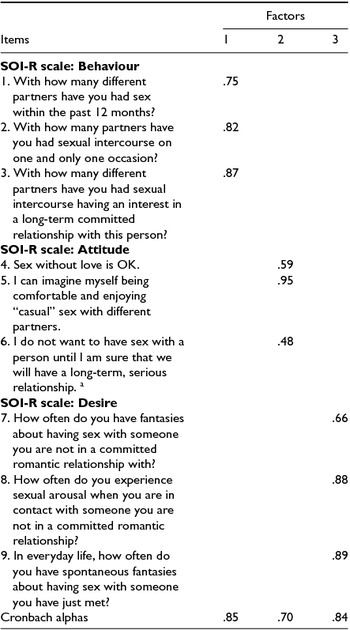
Confirmatory factor analysis was performed on the raw data (correlation matrix, maximum likelihood estimation). The model tested was the correlated three-factor model found by Penke and Asendorpf (Reference Penke and Asendorpf2008). All path coefficients were significant, and the values of the fit indices were satisfactory (GFI = .95, CFI = .96, χ2/df = 4.78, RMR = 0.06, RMSEA = 0.07; Bentler, Reference Bentler1990; Browne & Cudeck, Reference Browne, Cudeck, Bollen and Long1993). (See Table 1).
Correlated Three-Factor Model Tested and Results of the Confirmatory Factor Analysis Cronbach Alphas

Note: a This item is reverse coded.
Internal Consistency Reliability
In order to establish the internal consistency of the SOI-R scores, we examined Cronbach's α and used item-total correlations. For sociosexual behaviour, the Cronbach standardised α was 0.85, and corrected item-total correlations ranged from 0.60 to 0.75. The mean interitem correlation coefficient had a value of 0.66. For sociosexual attitude, the Cronbach standardised α was 0.70, and corrected item-total correlations ranged from 0.41 to 0.65. The mean interitem correlation coefficient had a value of 0.44. For sociosexual desire, the Cronbach standardised α was 0.84, and corrected item-total correlations ranged from 0.60 to 0.78. The mean interitem correlation coefficient had a value of 0.64. For the global sociosexual index, the Cronbach standardised α was 0.87, and corrected item-total correlations ranged from 0.44 to 0.74. The mean inter-item correlation coefficient had a value of 0.42. In sum, these results confirm the internal consistency of the SOI-R scores.
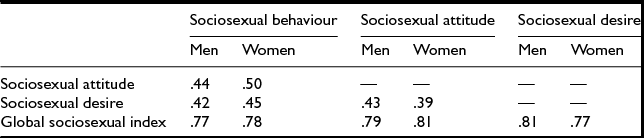
Table 2 shows the interrelation of the subscales and the global sociosexuality index. Pearson's correlations between the subscales were moderate, whereas the subscales showed strong correlation with the global index.
Pearson's Correlations of the Subscales and the Total Score of the SOI-R

Note: p < .001 for all correlations.
Sex Differences, Age, and Level of Education
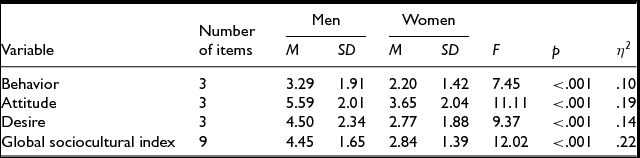
In light of previous reports of sex differences in sociosexuality, we ran an analysis of variance (ANOVA) to scrutinise whether there were significant sex differences in the subscales of the SOI-R and the global sociosexual index (Table 3). In agreement with expectations, the three subscales (behaviour, attitude, desire), as well as the global sociosexual index displayed significant sex differences; males scored higher than females.
Descriptive Statistics and Sex Differences of the Sociosexuality Measures

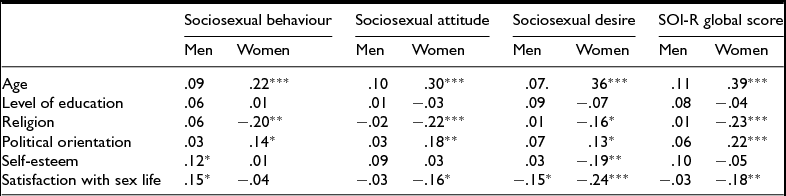
In Table 4 we can observe the interrelation of socio-demographic (age and level of education), and the SOI-R scores. The age of women correlated positively and significantly with the sociosexual behaviour, sociosexual attitude, sociosexual desire and the global sociosexuality scores, whereas for men no correlation was significant. This means that with increasing age women showed more unrestricted sociosexual orientation. The level of education of both men and women did not correlate significantly with the sociosexual orientation.
Pearson's Correlations of Socio-Demographic, Ideological and Psychological Variables and Subscales and the Total Score of the SOI-R

Note: *p < .05, **p < .01, ***p < .001.
Validity
Criterion validity was examined by analysing the relations between current romantic relationship status and number of anticipated sexual partners in the next 5 years. In order to test the effects of relationship status on the global sociosexuality index, we ran a 2 (sex) × 2 (relationships status) univariate analyses of variance (ANOVAs), with the SOI-R total score as dependent variable. Sex, F(1, 507) = 126.01, p < .001, η2 = .20, and relationship status, F(1, 507) = 20.30, p < .001, η2 = .04, had significant effects on the global sociosexual index, whereas their interaction was not significant, F(1, 507) = 1.78, p > .05, η2 = .00. For both men and women, the global sociosexual index was lower in participants involved in a romantic relationships (M = 3.38; SD = 1.74) than in those not involved (M = 4.07; SD = 1.65).
Subsequently, we performed a 2 (sex) × 2 (relationship status) multivariate analysis of variance (MANOVA) with the SOI-R dimensions as dependent variables. The MANOVA showed a significant sex effect, Wilks’ lambda = .79, F(3, 501) = 45.53, p = .001, η p 2 = .21. A significant relationship status was also found, Wilks’ lambda = .90, F(3, 501) = 19.45, p < .001, η p 2 = .10. The interaction sex × relationhip status was not significant, Wilks’ lambda = .99, F(3, 501) = 2.46, p > .05, η p 2 = .02.
As the MANOVA was significant, univariate ANOVAs for each SOI-R facet across sex and relationship status were performed. The main effect of the sex was significant on the Behaviour, F(1, 528) = 50.53, p < .001, η2 = .09, Attitude, F(1, 532) = 103.56, p < .001, η2 = .16, and Desire facets, F(1, 523) = 80.11, p < .001, η2 = .13. The main effect of the relationship status was not significant on the Behavior facet, F(1, 528) = .03, p > .05, η2 = .00, but the main effects of Attitude, F(1, 532) = 11.85, p < .001, η2 = .02, and Desire facets, F(1, 523) = 43.20, p < .001, η2 = .08, were significant. Both sexes involved in a relationship displayed more restricted attitudes and desires than those not involved in a relationship.
We correlated scores on the SOI-R with self-reported expected number of sexual partners during the next 5 years. As one would expect, the total number of sexual partners correlated positively and significantly with all facets of sociosexuality (Behaviour: men r = .48, women r = .43; Attitude: men r = .34, women r = .38; Desire: men r = .63, women r = .58), as well as with the global sociosexual index: men r = .63, women r = .58. Participants higher in sociosexuality anticipated to have more sexual partners than did participants lower in sociosexuality and our data portrayed a similar picture for both sexes.
To examine discriminant validity, we analysed the relation between the SOI-R and ideological and psychological scores. The pattern of correlations is clear concerning the ideological variables (see Table 4). Religion of women correlated negatively and significantly with the sociosexual behaviour, sociosexual attitude, sociosexual desire and the SOI-R scores, whereas for men no correlation was significant. This means that more religious women exhibited less unrestricted sociosexual orientations. Concerning political orientation for women, positive and significant correlations were found with the sociosexual behaviour, sociosexual attitude, sociosexual desire, and the global sociosexuality scores, whereas for men no correlation was significant. This means that more left-wing women displayed more unrestrictive sociosexual orientations.
For men, self-esteem and sociosexual behaviour were positively and significantly associated and for women an inverse association was observed between self-esteem and sociosexual desire (i.e., women reporting more sociosexual desire also evidenced lower self-esteem). The satisfaction with sex life of men correlated positively and significantly with sociosexual behaviour, that is, higher sex satisfaction, more unrestricted sociosexual behavior. For women, satisfaction with sex life correlated negatively with sociosexual attitude, sociosexual desire and the SOI-R global scores; for men, satisfaction with sex life was negatively correlated only with sociosexual desire.
Discussion
The aim of this research was to obtain empirical evidence regarding the psychometric properties of a Portuguese version of the revised Sociosexual Orientation Inventory across the adult life span. The factor structure, reliability, and validity of the SOI-R were scrutinised.
The present study evinced that the Portuguese version of the Sociosexual Orientation Inventory Revised (SOI-R) has the same three-factor structure suggested by Penke and Asendorpf (Reference Penke and Asendorpf2008). Therefore, this study supported the idea that sociosexuality does not constitute a unitary construct but has different facets. The SOI-R also displayed satisfactory internal consistency and adequate item-total correlations.
We also replicated previous sex differences in sociosexuality. Current findings displayed that men scored higher than women in all subscales as well as in the global score. These results are consonant with previous research, supporting the contention that men should be more unrestricted than women (Simpson & Gangestedt, Reference Simpson and Gangestad1991; Schmitt, Reference Schmitt2005; Lippa, Reference Lippa2009; Sprecher, Treger, & Sakaluk, Reference Sprecher, Treger and Sakaluk2013; Meskó, Láng, & Kocsor, Reference Meskó, Láng and Kocsor2014; Neto, Reference Neto2015). According to Penke and Asendorpf (Reference Penke and Asendorpf2008), this sex difference is ‘the best replicated finding in the sexuality literature’ (p. 1116). It has been argued that this consistent sex difference in sociosexuality reflects different selection pressures encountered by males and females during their evolutionary history (Buss & Schmitt, Reference Buss and Schmitt1993).
Age was related to sociosexuality, but only in women. In women, older age was associated with more global unrestricted sociosexuality, and also with all its dimensions. Level of education and sociosexuality were unrelated. Prior findings concerning the relations between sociosexuality, and age and level of education are mixed (Simpson et al., Reference Simpson, Wilson, Winterheld, Harvey, Wenzel and Sprecher2004; Penke & Asendorpf, Reference Penke and Asendorpf2008; Jankowski, Diaz-Morales, Vollmer, & Randler, Reference Jankowski, Diaz-Morales, Vollmer and Randler2014; Zheng, Zhou, Wang, & Hesketh, Reference Zheng, Zhou, Wang and Hesketh2014). Future research is needed to clarify their relations.
To evaluate the criterion validity of the SOI-R, the relation between sociosexuality and relationship status was examined. As expected, unrestricted participants, relative to restricted ones, tended to be less involved in a romantic relationship. Another avenue for evaluating criterion validity was to compare the SOI-R scores with results concerning the number of sex partners anticipated. As expected, unrestricted participants, relative to restricted ones, also tended to anticipate a higher number of sexual partners in the near future.
The pattern of correlations found supported the assumption that the correlations might differ between the sexes of the participants (Neto, Reference Neto2015). Globally, the correlates of the SOI-R scores tend to support that ‘SOI variation may have different implications for men and women’ (Clark, Reference Clark2006, p. 1322). In other words, current findings point out to a complex demonstration of the discriminant validity of the construct of sociosexual orientation.
Previous research showed that more religious and ‘right-wing’ people tend to be more conservative in their worldviews (Simpson & Gangestadt, Reference Simpson and Gangestad1991; Hatfield & Rapson, Reference Hatfield and Rapson1995; Le Gall, Mullet, & Shafighi, Reference Le Gall, Mullet and Shafighi2002; Simpson et al., Reference Simpson, Wilson, Winterheld, Harvey, Wenzel and Sprecher2004). Concerning the correlates between sociosexuality and ideological variables, the current findings differ between the sexes; no associations were found for men, but significant associations were found for women. Findings suggest that unrestricted women tend to be less religious. For women, all facets of sociosexuality also correlated positively with political orientation; a greater preference for ‘left-wing’ was shown in more unrestricted women.
Psychological correlates of the SOI-R showed a more complex pattern. Current findings showed that sociosexual behavior was positively related to self-esteem in men, whereas the association was not significant in women. These findings are in agreement with Clark's (Reference Clark2006) study; however, Clark has considered SOI as a unitary construct. Clark argued that ‘SOI does not capture the same quality-contingent tactical variation in women that it does in men’ (p. 1325). Consonant with this perspective, sociosexual desire scores were negatively associated with self-esteem in women. In the same vein, Townsend (Reference Townsend1995) observed that unrestricted females tended to feel emotionally vulnerable.
We also expected that a specific satisfaction domain, satisfaction with sex life (Neto & Pinto, Reference Neto and Pinto2015), should be related to sociosexuality. For women, the findings tend to support that the more unrestricted the sociosexual orientation, the lower the sex satisfaction. For men, the findings concerning sociosexual desire were similar to those of women; in contrast, men showed that the higher the sex satisfaction, the more unrestricted the sociosexual behaviour.
Although our sample comprised a wide age range and had balanced sex composition, this study possessed some limitations that should be noted. First, although the SOI-R has shown good psychometric characteristics, ‘the validity of a measure is never proven’ (Russell, Peplau, & Cutrona, Reference Russell, Peplau and Cutrona1980, p. 479), so it is necessary to learn more about the validity and reliability of the SOI-R; in particular, by future exploration of test-retest reliability. An additional limitation is that the present study was based on self-report measures. In spite of the aforementioned limitations, the present study can aid our understanding of close relationships. Most of the research on sociosexuality has focused on college students. The research on the relationships between ageing and sociosexuality is scarce. Investigating the experience of older individuals is important as people live longer lives.