INTRODUCTION
Harpacticoida in Korea are known from marine, brackish and freshwater habitats, with free-living benthic, planktonic, invertebrate-associated benthic and planktonic representatives. A contemporary overview by Song et al. (Reference Song, Park, Kwon, Ryu and Khim2012) enumerates 88 species and subspecies belonging to 23 families and 58 genera from Korean marine and brackish waters. Most of the taxa were collected from littoral macroalgae, while only 11 species originated from intertidal and shallow subtidal mudflats. The first report of harpacticoids found in sediment samples is that of Song & Chang (Reference Song and Chang1995) who reported three species, viz. Onychocamptus bengalensis (Sewell, 1940), Neotachidius parvus Huys et al., 2005 and Tachidius discipes Giesbrecht, 1881, during a faunal study of the benthic copepods of Jindo Island. Of the 11 species from mudflats only three species belonging to the family Cletodidae sensu Por, Reference Por1986 (see Bodin Reference Bodin1997): Limnocletodes behningi Borutzky, 1926, L. angustodes Shen & Tai, 1963 and Kollerua longum (Shen & Tai, 1979), were reported by Lee & Chang (Reference Lee and Chang2007) from coastal salt marshes and estuaries using a dip net.
In 1899, Thomas Scott described a rare harpacticoid, Cletodes perplexa (=Acrenhydrosoma perplexum) collected from the vicinity of Smith Bank, Moray Firth, Scotland. After Scott's original description (Scott, Reference Scott1899) Lang (Reference Lang1944) established a new genus, Acrenhydrosoma, and also provided known records from Norway, Sweden and England.
Gee (Reference Gee1999) re-described the species based on specimens from the UK Natural History Museum and established two new genera, Dyacrenhydrosoma and Paracrenhydrosoma. Subsequently, Gee & Mu (Reference Gee and Mu2000) recorded the new genus Neoacrenhydrosoma from mudflats of the Bohai Sea, China, and they suggested a species group of related taxa, the Acrenhydrosoma-complex, on the basis of the structure of mouth appendages, the shape of P5 of both sexes and the female genital field.
The present contribution deals with the detailed description of a new species, Paracrenhydrosoma kiai sp. nov., collected from subtidal muddy bottoms using SCUBA equipment. This represents the first marine cletodid species described from Korea.
MATERIALS AND METHODS
Sediments were obtained from the muddy bottom at Jangmok (South Sea Research Institute of Korea Institute of Ocean Science and Technology), Geoje Island (Figure 1) by SCUBA diving. Sediment samples were fixed in 5% neutral formalin, and then preserved in 80% ethanol. In the laboratory the sediment samples were thoroughly rinsed through a 38 μm sieve and meiofauna was further considered for analysis from these samples. Harpacticoid copepods were sorted, using an Olympus SZ11 stereomicroscope. Specimens were cleared and dissected in lactic acid, dissected parts were mounted on slides using lactophenol as mounting medium. Preparations were sealed with transparent nail varnish. All drawings were prepared using a camera lucida on an Olympus BX60 differential interference contrast microscope equipped with Nomarski optics.
Study area and sampling site in Jangmok, Geoje Island, Korea.

The descriptive terminology is adopted from Huys et al. (Reference Huys, Gee, Moore and Hamond1996). Abbreviations used in the text are: Ro, rostrum; CR, caudal ramus; ae, aesthetasc; exp, exopod; enp, endopod; P1–P6, first to sixth thoracopod; exp (enp)-1 (2, 3) to denote the proximal (middle, distal) segment of a ramus. The term acrothek is used to denote the two setae and one aesthetasc complement found apically on the distal antennulary segment. Type series are deposited in the collection of The Natural Institute of Biological Resources (NIBR), Incheon, Korea. Scale bars in all figures are in micrometres (μm).
RESULTS
SYSTEMATICS
TYPE MATERIAL
Holotype (NIBRIV0000261531): one female dissected on 12 slides. Allotype (NIBRIV0000261532): 1 male dissected on eight slides. Paratypes (NIBRIV0000261533): seven females and two males preserved in alcohol. All samples are from the type locality collected by Dr Jongseong Ryu on 1 June 2005.
TYPE LOCALITY
Jangmok (South Sea Research Institute of Korea Institute of Ocean Science and Technology), Geoje Island, Korea, 34.59.37N 128.40.25E, 10 m depth, muddy bottom.
ETYMOLOGY
The species is named after the KIA Motors Corporation, since they provided the vehicle for collecting animals from the first author's (Dr Sung Joon Song) graduate course.
Female (Holotype)
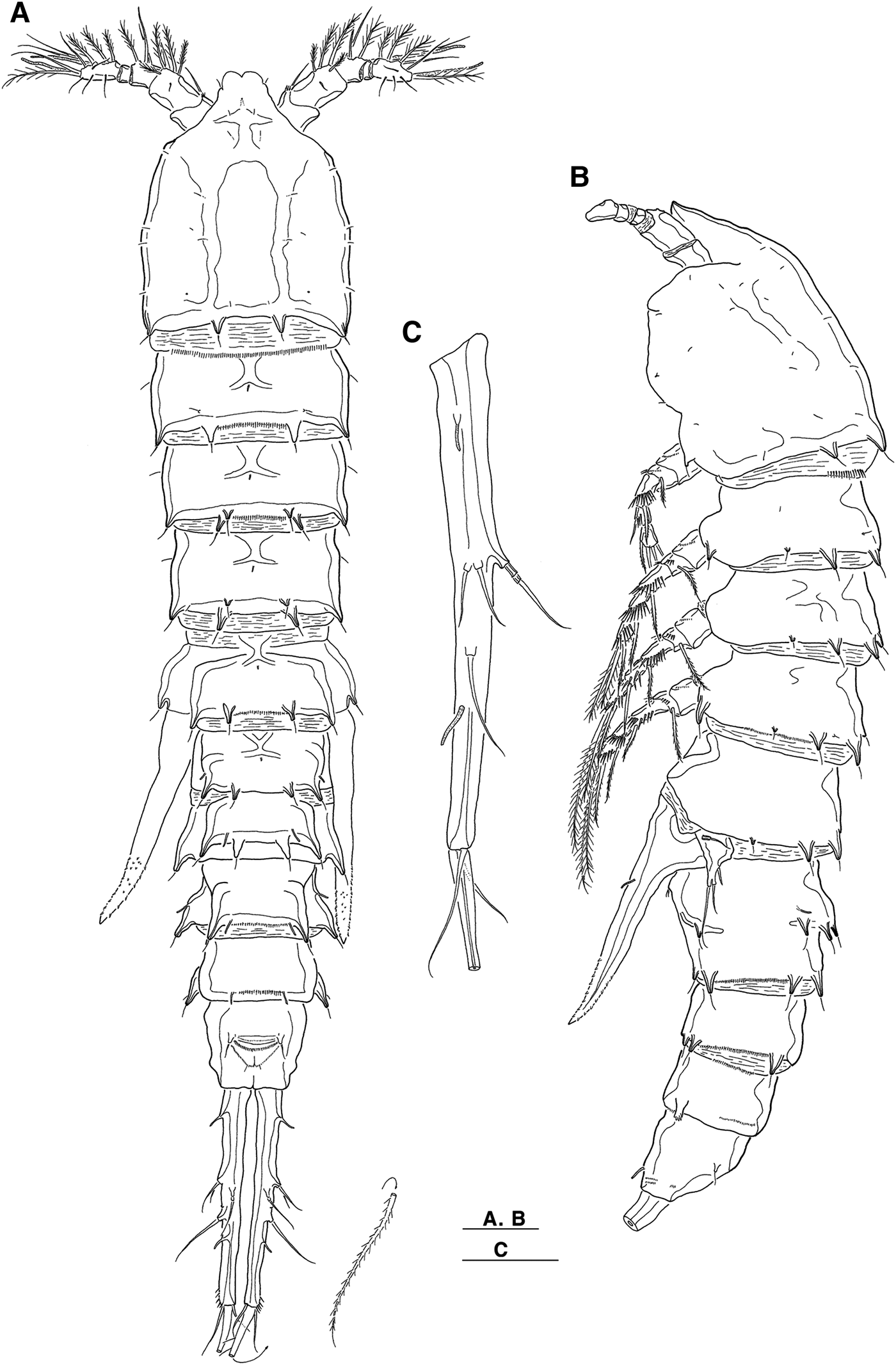
Total body length 635–810 μm (mean = 704, N = 8), measured from the anterior margin of the rostrum to the posterior margin of the caudal rami. Largest width measured midlength of cephalosome, 137–171 μm (mean = 171, N = 8). Urosome gradually tapering posteriorly. Cephalothorax bell-shaped, with few integumental sensilla on surface as in Figure 2A, B; lateral margin bilobed with few sensilla; posterior border smooth with four small sensillum-bearing socles. Rostrum (Figures 2A, B, 3C) prominent, bifid, directed downward, with a pair of subapical sensilla. Pedigerous somites with six sensillum-bearing socles on dorsal surface and at posterior margin.
Paracrenhydrosoma kiai sp. nov., female paratype: (A) habitus, dorsal; (B) habitus, lateral; (C) left caudal ramus, lateral. Scale bars: A, B = 50 μm; C = 30 μm.
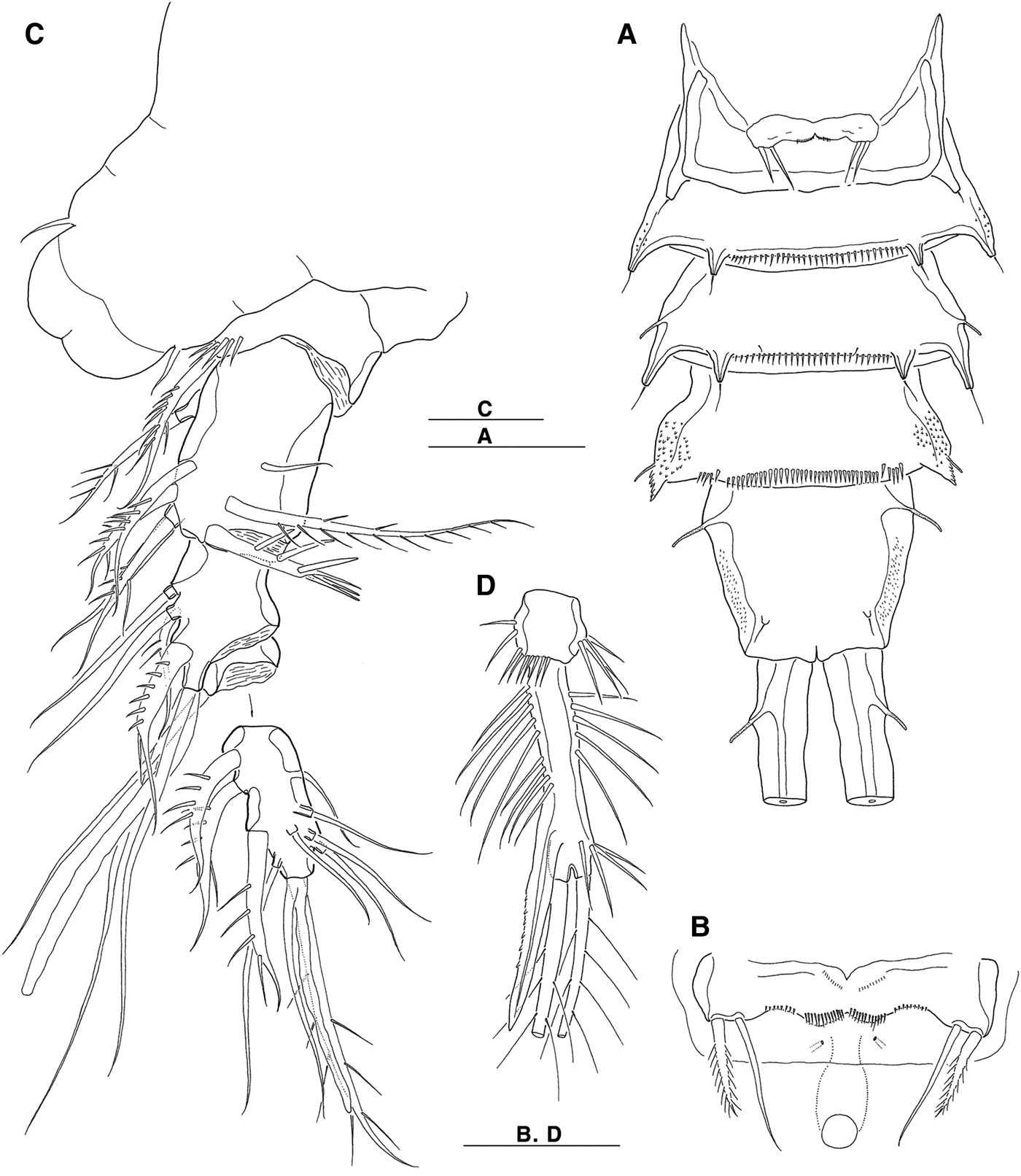
Paracrenhydrosoma kiai sp. nov., female paratype: (A) urosome (excluding P5 bearing somite), ventral; (B) genital field; (C) rostrum and antennule. Male paratype; (D) P3 endopod. Scale bars: A, D, E = 20 μm; C = 50 μm.
Urosome (Figures 2A, B, 3A) five-segmented, comprising P5-bearing somite, genital double-somite and three free abdominal somites. All urosomites with smooth posterior margin. P5-bearing somite with four sensillum-bearing socles and with tiny setule row along posterior margin. Genital double-somite (Figures 2A, 3A) about 1.4 times wider than long, with transverse surface ridges dorsally and laterally, indicating original segmentation, and with setule row along posterior margin, ventrally. P6 (Figure 3A) represented by one bipinnate outer seta and one long bare inner seta on single plate over gonopores. Copulatory pore (Figure 3B) large, opening on surface of posterior half of genital double-somite. Two small pores below P6-bearing single plate. Third urosomite (Figure 3A) with tube pores and sensillum-bearing socles. Fourth urosomite with tube pores and tiny setules on outer surface. Anal somite (Figures 2A, 3A) slightly wider than long with two sensillum-bearing socles dorsally and ventrally, respectively; with tiny spinule rows dorsally. Anal operculum semicircular, with short setules along posterior margin.
Caudal ramus (Figure 2C) elongate, cylindrical, tapering posteriorly, about 7.5 times as long as basal width and with two tube pores; setae I and II bare, implanted at 45% of basal line, seta III on middle, setae IV–VI situated distally, and seta VII tri-articulate, flanked by setae I and II.
Antennule (Figure 3C) short and robust, five-segmented; segment 1 small with bare seta distally; segment 2 longest; segment 3 with aesthetasc fused basally to bare seta on pedestal distally; segment 4 shortest. Setal formula as follows: 1-[1 pinnate], 2-[7 pinnate + 1 bare], 3-[2 pinnate + 3 bare + (1 + ae)], 4-[1 bare], 5-[3 pinnate + 6 bare + acrothek]. Apical acrothek consisting of one pinnate and one bare seta and one aesthetasc.
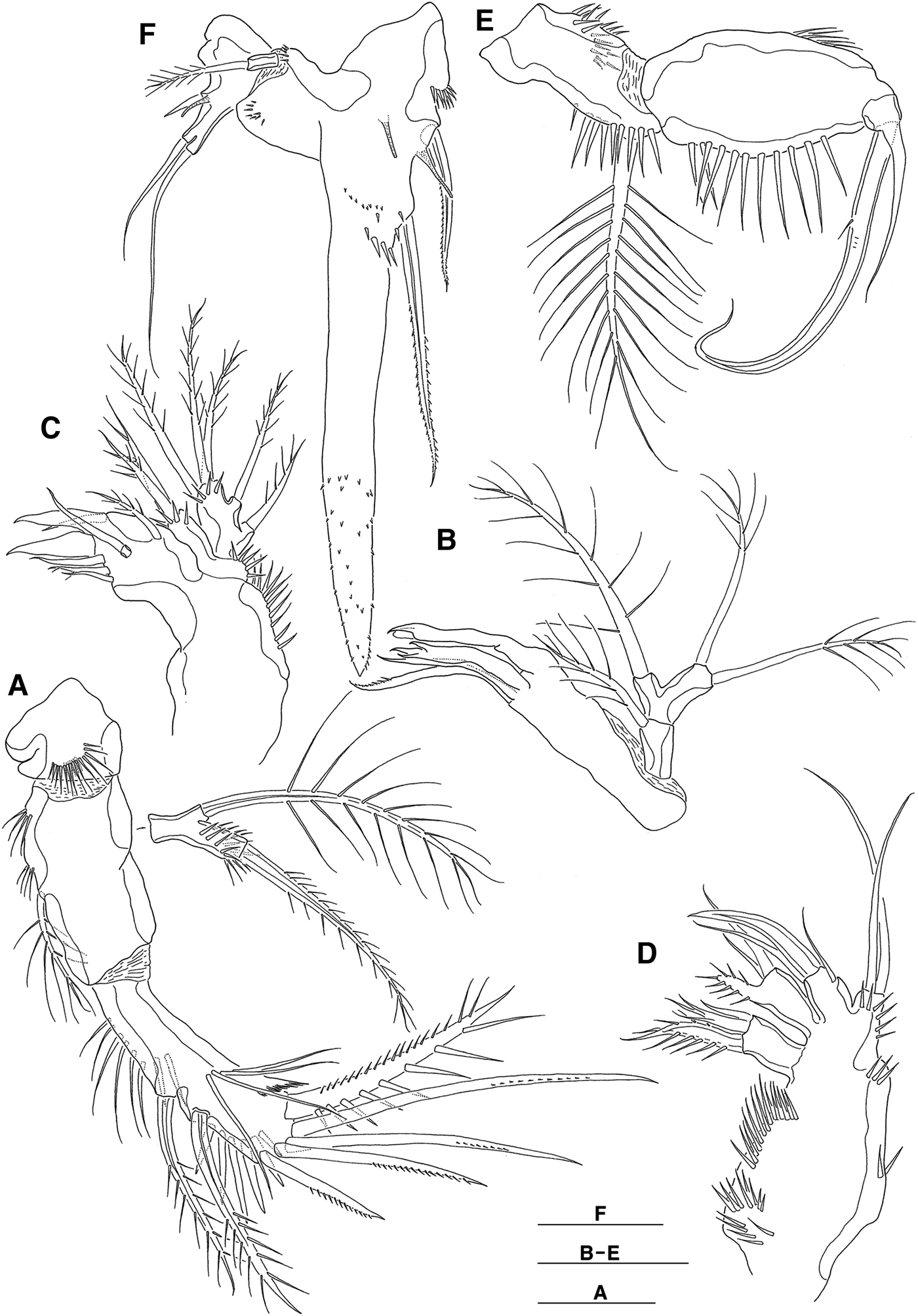
Antenna (Figure 4A) three-segmented, comprising coxa, allobasis and free endopodal segment. Coxa consisting of two lobes on inner margin, with spinular row on surface. Allobasis slightly shorter than endopod, with two clusters of spinules on inner margin and abexopodal seta on middle of segment. Endopod with long spinules along inner margin and one transverse hyaline frill subapically. Lateral armature consisting of two spines and four long bare setae; distal armature consisting of four unipinnate setae and one strong spine bearing short spinulus along outer margin and long spinules on inner margin. Exopod 1-segmented with many setules on distal half and two long setae.
Paracrenhydrosoma kiai sp. nov., female paratype: (A) antenna; (B) mandible; (C) maxillule; (D) maxilla; (E) maxilliped; (F) P5. Scale bars: A–E = 20 μm; F = 30 μm.
Mandible (Figure 4B) with well-developed gnathobase bearing several long multicuspidate teeth distally and one pinnate and one long seta in dorsal corner as figured; surface without ornamentation. Palp 2-segmented; segment 1 longer than wide with one plumose seta; segment 2 biramous, bearing one plumose lateral seta and two long subdistal plumose setae.
Maxillule (Figure 4C). Praecoxa with row of spinules on outer distal corner. Arthrite well-developed, with two strong spines, four setae, and two anterior surface setae (one bare articulate seta and one bipinnate seta). Coxa with row of outer spinules, bearing two pinnate setae. Basis and rami completely fused to a single palp with two lateral, one subdistal and two distal bipinnate setae.
Maxilla (Figure 4D). Syncoxa with three pairs of spinules and two endites each with 1 bipinnate spine and two setae. Allobasis drawn out into pectinate claw; accessory armature consisting of one anterior seta and one posterior seta. Endopod represented by small protuberance bearing two long bare setae.
Maxilliped (Figure 4E). Well-developed, subchelate. Syncoxa with spinular rows as figured and one seta with long setules along both margins. Basis elongated with strong spinular row along palmar margin and a few outer spinules subdistally. Endopod represented by an apically curved claw, minutely pinnate in distal quarter; accessory armature consisting of one long bare seta.
P1 (Figure 5A). Praecoxa with row of small setules posteriorly. Coxa with two rows of spinules and several rows of minute spinules on anterior surface. Basis with spinulose process on distal margin between exopod and endopod, with bipinnate and plumose seta on inner and outer corners, respectively. Exopod three-segmented, slightly longer than endopod; exp-1 with outer spinules, and one outer bipinnate spine; exp-2 slightly shorter than other segments with spinular rows on both margins, with one bipinnate outer spine; exp-3 longest, with two bipinnate outer spines and two setae distally. Endopod two-segmented; enp-1 short, as long as wide, with rows of spinules on both margins; enp-2 elongate, with outer spinular row and short inner spinules, with one plumose inner seta, one plumose distal seta and one unipinnate outer spine.
Paracrenhydrosoma kiai sp. nov., female paratype: (A) P1; (B) P2. Scale bars: A, B = 20 μm.
P2 (Figure 5B). Praecoxa with spinular row on anterior surface. Coxa wider than long with two spinular rows on anterior surface. Basis much wider than long, with spinules near outer seta and one spinular row between exopod and endopod, and with one bare outer seta. Exopod three-segmented and subequal; exp-1 with long spinules on outer margin and two short spinular rows on middle and distal surfaces, with one bipinnate outer spine; exp-2 with spinules on both margins, with one bipinnate outer spine; exp-3 with several long outer setules and one long inner setule, with two bipinnate outer spines and two long setae distally. Endopod two-segmented, reaching end of exp-2; enp-1 similar to that of P1; enp-2 elongate with long setular rows on both margins and subdistal, with two long plumose setae distally.
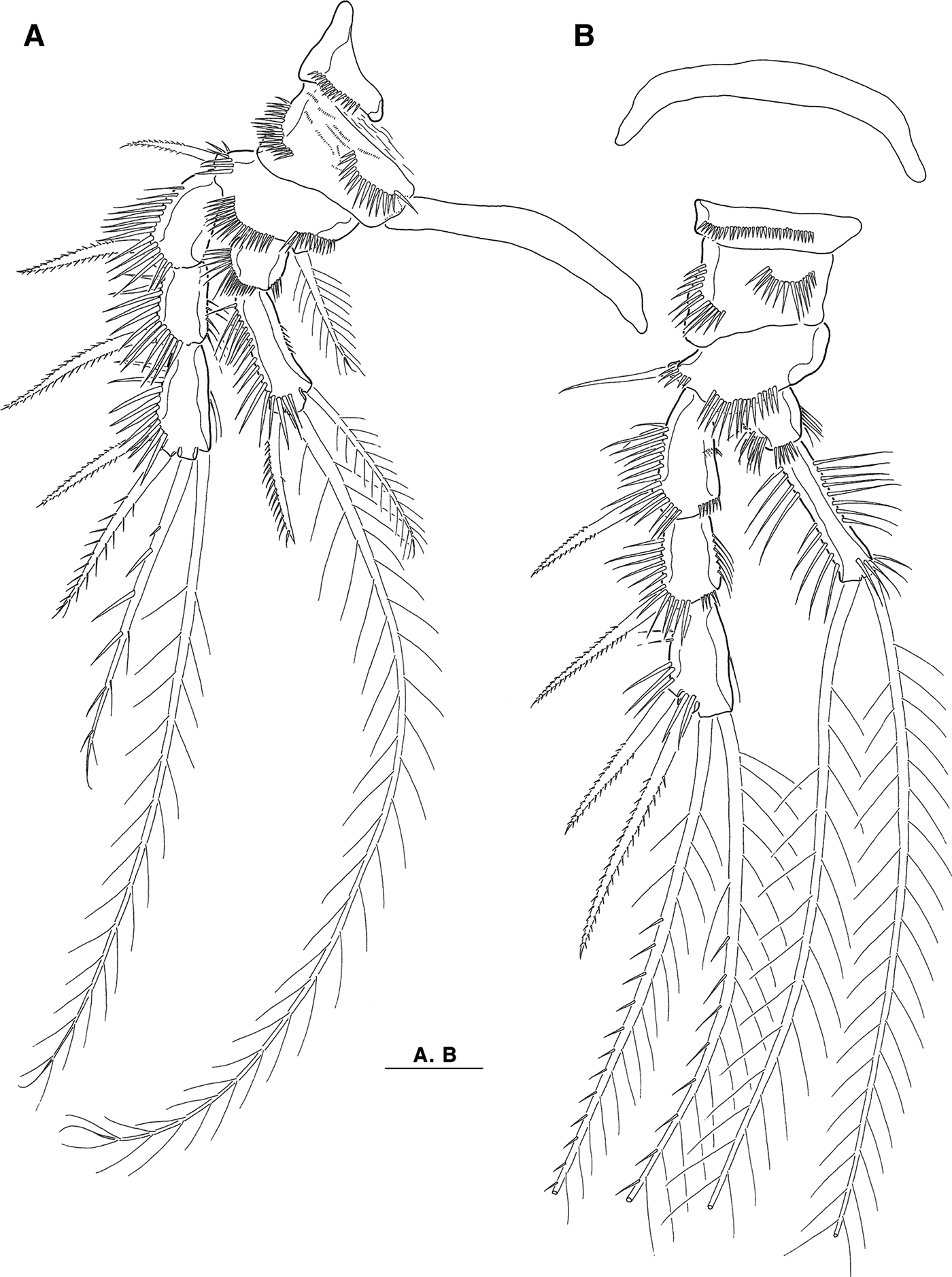
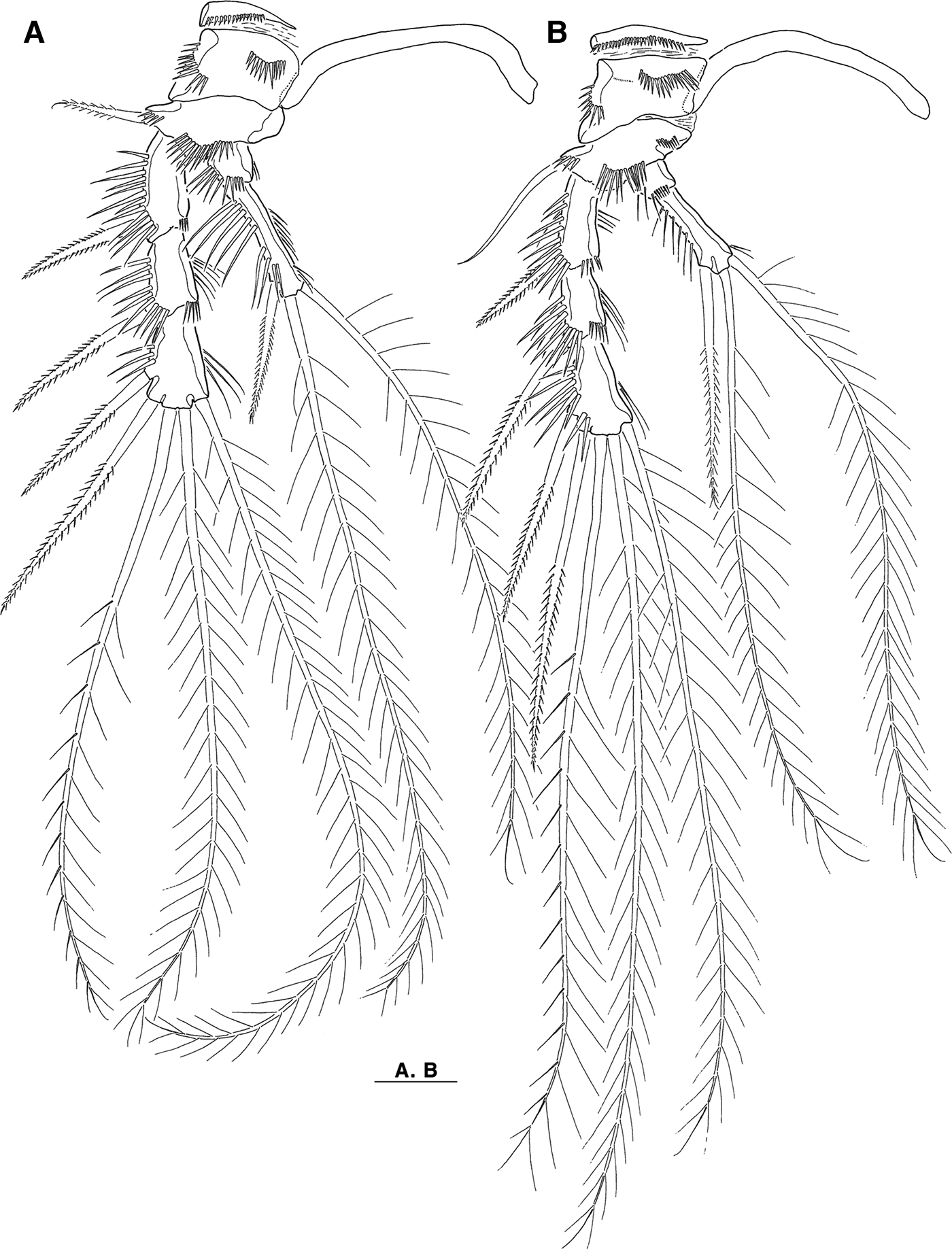
P3 (Figure 6A). Praecoxa small with spinular row distally. Coxa slightly wider than long with two spinular rows on anterior surface. Basis much wider than long, with spinules near outer seta and one spinular row between exopod and endopod, and with one bipinnate outer seta. Exopod three-segmented; exp-1 with long spinules on outer margin and one short spinular row on inner corner, with one bipinnate outer spine; exp-2 with spinules on both margins and distal, with one bipinnate outer spine; exp-3 widened distally, with three long setules on both margins, respectively, with two bipinnate outer spines, two distal plumose setae and one plumose inner seta. Endopod two-segmented, reaching end of exp-2; enp-1 similar to that of P2; enp-2 elongate with long setules on both margins, with one bipinnate outer spine two long plumose setae distally.
Paracrenhydrosoma kiai sp. nov., female paratype: (A) P3; (B) P4. Scale bars: A, B = 20 μm.
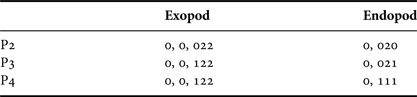
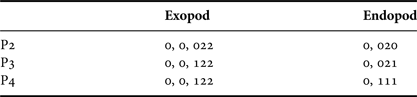
P4 (Figure 6B). Praecoxa with spinular row distally. Coxa slightly wider than long with two spinular rows on anterior surface. Basis much wider than long, with spinules near outer seta and two spinular row between exopod and endopod, and inner surface and with one bare outer seta. Exopod three-segmented; exp-1 and exp-2 similar to those of P3; exp-3 widened distally, with long setules on both margins, with two bipinnate outer spines, two distal plumose setae and one plumose inner seta. Endopod two-segmented, reaching middle of exp-2; enp-1 small, with two long outer setules and one short setular row distally; enp-2 elongate with long setular rows on outer margin and inner corner, with one bipinnate outer spine, one plumose seta on distal and inner margins, respectively. Armature formula of P2–P4 as in Table 1.
Setal formula of swimming legs of Paracrenhydrosoma kiai sp. nov.
P5 (Figure 4F) with completely separated baseoendopod and exopod. Baseoendopod with long and stout process reaching end of 4th urosomite, with small spinules on inner surface as figured; with two tube pores on middle surface and inner margin, and with two inner spines; cylindrical peduncle bearing basal bipinnate outer setae. Exopod swollen, bilobed, outer margin with one tube pore, one small outer spine, and two distal bare setae.
Male (allotype)
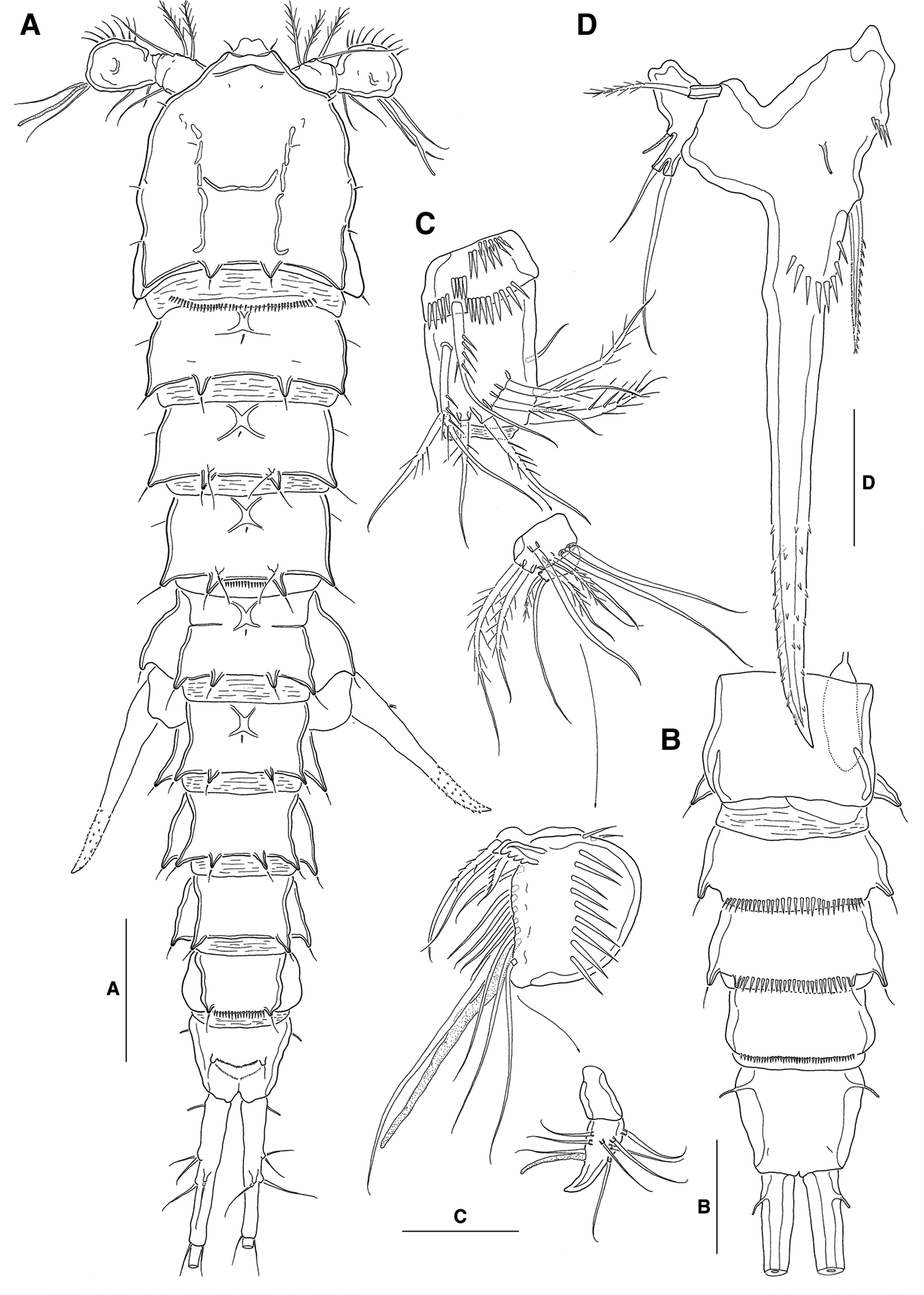
Total body length 567–651 μm (mean = 625, N = 3), measured from anterior margin of rostrum to posterior margin of caudal rami. Largest width measured at middle of cephalic shield 118–130 μm (mean = 123, N = 3). Prosome (Figure 7A) four-segmented, comprising cephalothorax and three free pedigerous somites. Cephalothorax with few integumental sensilla on surface as figured; lateral and posterior margins as in female.
Paracrenhydrosoma kiai sp. nov., male paratype: (A) habitus, dorsal; (B) urosome (excluding P5 bearing somite); (C) antennule; (D) P5. Scale bars: A, B = 50 μm; C, D = 30 μm.
Urosome (Figure 7B) six-segmented, comprising P5-bearing somite, genital somite, 3rd–5th urosomites and anal somite. Third and 4th urosomites with posterior setular row ventrally, 5th urosomite with posterior setular row dorsally and ventrally, anal somite similar to that of female.
Caudal rami (Figure 7A, B) elongate, cylindrical, tapering posteriorly, slightly shorter than in female, about 6.5 times as long as basal width, all seven setae similar to that of female.
Antennule (Figure 7C) seven-segmented; subchirocer, with geniculation between segments 5 and 6; segment 1 with outer spinules as shown, and with one pinnate seta; segment two longest with eight pinnate and one small bare seta; segment 3 with four pinnate and four bare setae; segment 4 shortest with one pinnate small and one long bare seta; segment 5 distinctly swollen with row of strong spinules on anterior surface; proximal inner margin protruded with two pinnate and one bare seta; palmar margin with dentate process, nine bare setae and aesthetasc; segment 6 elongate without ornamentation; segment 7 hook-shaped with eight bare setae and one aesthetasc in total.
Antenna, mouth appendages, and P1, P2, P4 as in female.
P3 (Figure 3D). Exopod as in female. Endopod, two-segmented; enp-1 more swollen than that of female, with spinules on inner, outer and distal margins; enp-2 modified with long setule rows along both margins, with one modified styliform outer spine bearing small spinules along outer border, and with two plumose setae apically.
P5 (Figure 7D). Rami distinct as in female except for lack of tiny spinules on proximal third surface and on outer margin, basendopod with one seta (two in female), and two setae (one spine and two setae in female).
DIFFERENTIAL DIAGNOSIS
Paracrenhydrosoma kiai sp. nov. is distinguished from its congeners as follows: rostrum with bifid tip and the mandible carries two-segmented palp with four setae in total. Caudal ramus elongate, cylindrical, about 7.5 times as long as wide with two tube pores. Male P3 has modified endopod: enp-1 slightly swollen, enp-2 with styliform outer spine and with two plumose apical setae. P5 has completely separated rami and a long and stout process in both sexes. Female P5 has two spines and two tube pores on baseoendopod, and two setae, one spine and one tube pore on exopod. Male P5 has one spine and one tube pore on baseoendopod, and two setae and one tube pore on exopod.
KEY TO THE SPECIES AND SPECIES GROUPS OF THE ACRENHYDROSOMA-COMPLEX
1. P2–P4 with three-segmented exopods………2
P2–P4 with two-segmented exopods………Neo acrenhydrosoma zhangi
2. P3 enp-2 with three setae………3
P3 enp-2 with two setae………Dyacrenhydrosoma breviseta
3. P1 enp-2 with three setae………4 (Paracrenhydrosoma)
P1 enp-2 with two setae………Acrenhydrosoma perplexum
4. P3–P4 exp-3 with four setae………5
P3–P4 exp-3 with five setae………6
5. Ro with rounded tip, mandibular palp one-segmented, female P5 exp with two long and one minute setae………P. oceaniae
Ro with bifid tip, mandibular palp two-segmented, female P5 exp with two long setae………P. cornuta
6. Ro with bifid tip and madibular palp two-segmented………P. kiai sp. nov.
Ro with slightly emarginated tip and mandibular palp one-segmented………7
7. CR about 3.0 times longer than width, mandibular palp with three setae………P. karlingi
CR about 8.0 times longer than width, mandibular palp with four setae………8
8. Male P3 enp-2 with a modified spine bearing pinnules on both margins, female P5 exp with two long and one minute setae and one spine………P. maccalli
Male P3 enp-2 with a modified spine with pinnules on outer margin, female P5 exp with two long setae………P. normani
DISCUSSION
The genera Acrenhydrosoma Lang, Reference Lang1944, Dyacrenhydrosoma Gee, Reference Gee1999, Paracrenhydrosoma Gee, Reference Gee1999 and Neoacrenhydrosoma Gee & Mu, Reference Gee and Mu2000 constitute a defined lineage among the genera currently assembled in the family Cletodidae T. Scott, 1904 sensu Por, Reference Por1986. The strongly modified endopodal lobe of the fifth leg in both sexes, the position of the exopods in the fifth legs when present, and the armature of the female sixth legs separate these four genera from all other known cletodids. The Acrenhydrosoma-complex is largely defined by a series of apomorphic conditions of the fifth leg. Indeed, at least two autapomorphic character states are recognizable for this appendage: (1) the striking similarity of shape and dimension of the leg in the two sexes; and (2) the extension and narrowing into a mucroniform structure of the endopodal lobe.
Based on this combination of characters the new species described from Korea is allocated to this lineage. It is placed within the genus Paracrenhydrosoma for it shares with all members of the genus the shape of its rostrum, mandibular palp with four setae, the absence of a pseudo-operculum on the preanal somite, segmentation of swimming leg rami and setal formula of the first leg.
Despite the obvious resemblances of the Svalbard species to the four species presently belonging to Paracrenhydrosoma, differences are observed in the rostrum, male endopod P3, P5 and caudal ramus. Paracrenhydrosoma kiai sp. nov. differs particularly from its congeners in the bifid rostrum, the long caudal ramus, an exceedingly long baseoendopodal mucroniform process of female P5 that reaches the end of the fourth urosomite and a modified P3 endopod of male.
As in P. kiai sp. nov. there seems to be an unmodified seta on the 2nd antennulary segment in P. normani Gee, Reference Gee1999 and apparently also in P. karlingi (Lang, Reference Lang1965) according to the original illustration. The number of elements on the segment 2 of the female of P. karlingi appears to be seven instead of eight. Neoacrenhydrosoma zangli Gee & Mu, Reference Gee and Mu2000 has an antennulary armature formula similar to that of the species described here. However, both of these characters could be the results of errors made in the original description and need to be verified by re-examination of N. zhangi and P. karlingi.
Among all species belonging to the Acrenhydrosoma-lineage the general antennal morphology is similar. However, three antennal types are recognizable according to the abexopodal allobasis armature: (1) with a single seta located in the proximal (basal) half, as in Neoacrenhydrosoma zhangi; (2) with a single seta arising in the distal (endopodal) half of the segment, as in Acrenhydrosoma perplexa, Paracrenhydrosoma maccalli and P. normani; and (3) completely devoid of setal elements, as in Dyacrenhydrosoma breviseta.
With the exception of Neoacrenhydrosoma zhangi, which completely lacks an exopodite (Gee & Mu, Reference Gee and Mu2000) the female fifth leg exopodite is similar in all other members of the Acrenhydrosoma-lineage. The quadrate expansion bears either three (Acrenhydrosoma perplexa) or two (the other species) setae in the female. Paracrenhydrosoma oceaniae bears three exopodal elements: two apically and one outer laterally. In this respect, the fifth leg exopodite of P. oceaniae resembles that of A. perplexa more than that of P. normani or P. maccalli.
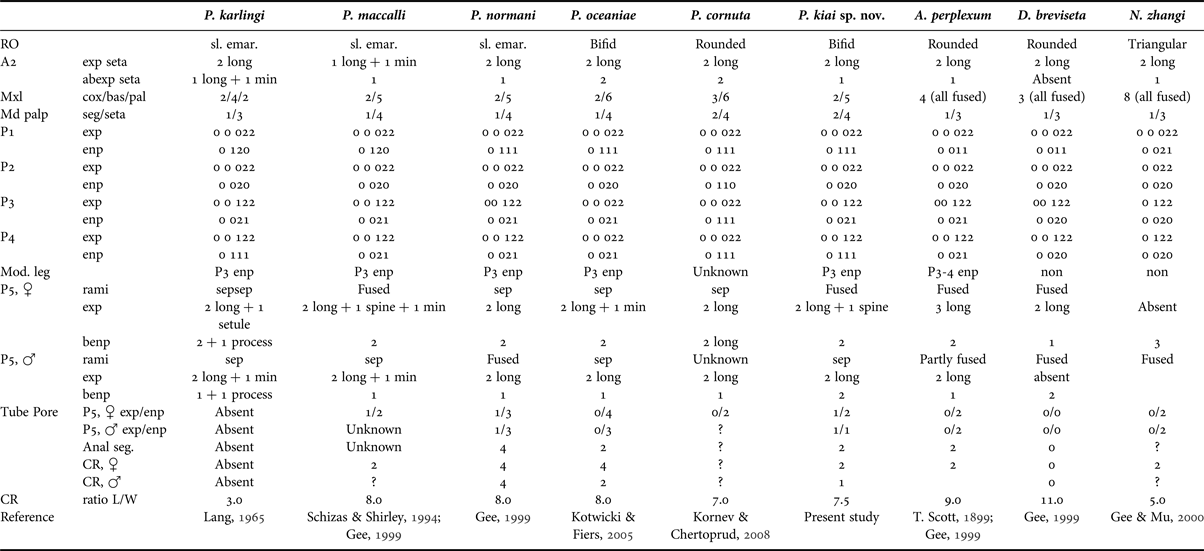
The new species P. kiai sp. nov. is most similar to P. karlingi, P. macalli and P. normanni (with these congeners it shares the setation of P2, P3 exp and P4 exp) (Table 2). Paracrenhydrosoma kiai sp. nov. shares next with P. oceaniae, P. macalli and P. normani the modification of the P3 enp (with the seta formula 0021—the same in Enhydrosoma hopkinsi). Paracrenhydrosoma kiai sp. nov. is least similar to P. cornuta, sharing the mandibular apomorphy of two segments and four setae; this character is not shared with any other representative compiled in Table 2. When other genera are compared with P. kiai sp. nov., then A. perplexum is most similar; both species share among other characters particularly the modified P3 enp in males (the P3 enp is not modified in D. breviseta nor N. zhangi, but is modified together with P4 enp in A. perplexum and modified in all other known representatives of Paracrenhydrosoma) and two long setae on A2 exp (shared also with D. breviseta and N. zhangi). Enhydrosoma hopkinsi is more similar to A. perplexum, D. breviseta, N. zhongi (sharing the following synapomorphies: Md palp seg./setae 1/3; Mxl fused or absent) than to C. hartmanae which shares the least number of characters with the remaining taxa (Table 2).
Morphological characters of the species within the Acrenhydrosoma-complex (for full species names, see text).
*, sl. emar., slightly emarginate; min, minute; sep., separated; mod., modified; abex., abexopodal; cox, coxa; bas, basis; pal, palp; seg, segment; CR, caudal ramus; RO, rostrum.
With the addition of the Korean species to the genus Paracrenhydrosoma, six species: P. kiai sp. nov. (present contribution), P. karlingi (Lang, Reference Lang1965), P. maccalli (Schizas & Shirley, Reference Schizas and Shirley1994), P. normani Gee, Reference Gee1999, P. oceaniae Kotwicki & Fiers, Reference Kotwicki and Fiers2005, P. cornuta Kornev & Chertoprud, Reference Kornev and Chertoprud2008, are now unified within this taxon. However, P. oceaniae displays several plesiomorphic character states, viz. the female antennule with eight setae on the second segment, the antenna with a proximal and a distal element on the abexopodal margin, and the leg 5 exopodite not fused with the baseoendopodite. This contrasts fundamentally with the more advanced aspect of these appendages in two of the previously described species (P. maccalli and P. normani). Paracrenhydrosoma oceaniae is clearly a member of Paracrenhydosoma in which it takes a basal position. Crucial in the unravelling of the phylogenetics of this taxon is P. karlingi. The exact nature of several appendages of this species has to be reexamined.
According to Por (Reference Por1986) representatives of the family Cletodidae share the life habit of actively burrowing in mud, occurring mainly in the shallow and sublittoral, often sandy and muddy bottoms. Most representatives of the Acrenhydrosoma-complex are also known from mud, silt or clay, except for P. karlingi which is known from the tide pools and coarse sand of Monterey Bay, USA (Figure 8). And all members of the complex have been collected from shallow or subtidal waters (0–40 m depth), while P. oceaniae have been reported from deep water (265 m depth) of Kongsfjorden, Svalbard in the Arctic. All of them commonly occur worldwide, but are fairly restricted to the northern hemisphere.
World distribution of the Acrenhydrosoma species complex.
FINANCIAL SUPPORT
This research was financially supported by the Discovery of Korean Indigenous Species Project, NIBR (National Institute of Biological Resources). This research was a part of the project titled ‘Development of Korea Operational Oceanographic System (KOOS)’ and was supported by ‘Long-term change of structure and function in marine ecosystems of Korea’ funded by the Ministry of Oceans and Fisheries, Korea. Finally, this work was also supported by National Research Foundation of Korea Grant (NRF-2013R1A1A2A10011073). We thank Dr Kyu-Tae Lee (Neoenbiz Co. Ltd) for partial financing support for sampling.