Introduction
The elderly population is the fastest growing segment of North American society (Statistics Canada, 2008; U.S. Census Bureau, 2008). It is estimated that the proportion of the population aged 75 and older will increase by approximately 50 per cent in both the United States and Canada by the year 2030. Advancing age is associated with an increased prevalence of both chronic disease (Moore, Rosenberg, & Fitzgibbon, Reference Moore, Rosenberg and Fitzgibbon1999) and disability (Statistics Canada, 2003), and taken together, these factors result in increasing numbers of seniors living in the community who are experiencing declining health and function. Although most seniors are able to manage independently, some require physical assistance from another person to accomplish their essential activities of daily living (ADL), of which there are two types: personal ADL (PADL) and instrumental ADL (IADL). PADL activities, which are essential for self-care in everyday life, include bathing, dressing, transfers (such as from a bed to a chair), toileting, and walking. IADL activities are necessary for maintaining a household and functioning in the community, and include housework, meal preparation, and traveling to places that are beyond walking distance from the home (Spector, Katz, Murphy, & Fulton, Reference Spector, Katz, Murphy and Fulton1987).
When people become disabled, they typically try to adapt to their disability and remain independent in ADL. Such adaptations include using assistive devices, changing the way they perform tasks, or modifying their environment. However, even after such adaptations, some people may still require physical assistance from another person to complete their necessary ADLs. It is the failure to receive any or sufficient assistance that creates the situation of unmet need.
As a result of the growing elderly population, unmet need has become an area of increasing research interest. Cross-sectional studies of older adults have identified many correlates of unmet need, the most consistent of which is disability (Allen & Mor, Reference Allen and Mor1997; Desai, Lentzner, & Weeks, Reference Desai, Lentzner and Weeks2001). With more severe disability, the likelihood of having unmet need increases markedly (Mor, Reference Mor, Allen and Mor1998). Other factors shown to be associated with unmet need include older age, female sex, living alone, poor social support, and having a low income (Allen & Mor, Reference Allen and Mor1997; Desai et al., Reference Desai, Lentzner and Weeks2001; Otero, de Yebenes, Rodriguez-Laso, & Zunzunegui, Reference Otero, de Yebenes, Rodriguez-Laso and Zunzunegui2003; Walter-Ginzburg, Guralnik, Blumstein, Gindin, & Modan, Reference Walter-Ginzburg, Guralnik, Blumstein, Gindin and Modan2001).
The four factors of age, sex, income, and living alone are interrelated and highlight the differences between men and women in the final years of their lives. The traditional role of men from an earlier generation was that of breadwinner and handyman; women’s role included being housekeepers and homemakers. Consequently (and despite possessing the physical ability), many elderly men are either unwilling or lack the skills to perform housekeeping and meal preparation. For such men, these IADL tasks are usually performed by their wives. Moreover, men are more likely to have a chronic disease associated with high mortality than are women (Lahelma, Martikainen, Rahkonen, & Silventoinen, Reference Lahelma, Martikainen, Rahkonen and Silventoinen1999). As their health and functional abilities worsen, the men’s needs are usually met by the care their wives provide. Women, on the other hand, are more likely to survive their husbands and typically end up living alone with limited financial resources. Nearly one half (46%) of single and widowed Canadian women aged 65 and older have incomes below the poverty line (National Council of Welfare, 2004). Thus, older women are more often “exposed” to the possibility of unmet need.
Unmet need is also associated with a variety of negative consequences that can affect the health and well-being of elderly people with disability. These range from relatively minor consequences, such as feeling distressed because housework is not done, to major consequences, such as being unable to eat or drink when hungry or thirsty (Allen & Mor, Reference Allen and Mor1997; LaPlante, Kaye, Kang, & Harrington, Reference LaPlante, Kaye, Kang and Harrington2004; Newcomer, Kang, Laplante, & Kaye, Reference Newcomer, Kang, Laplante and Kaye2005; Sands et al., Reference Sands, Wang, McCabe, Jennings, Eng and Covinsky2006). Negative consequences are not rare. Allen and Mor (Reference Allen and Mor1997) found that nearly one quarter (24.5%) of subjects who were disabled in performing transfers (i.e., moving from a chair to a bed, or from a chair to a wheelchair) had fallen, while 14.2 per cent of subjects disabled in performing meal preparation reported having been unable to eat when hungry. These consequences may lead to reductions in quality of life and physical health, as well as to an increased need for health services. Many elderly people with unmet need continue to perform the tasks for which they need assistance, despite both the difficulty of doing so and the potential for injury to themselves (Allen & Mor, Reference Allen and Mor1997).
Although findings to date provide a portrait of the typical person with unmet need, the picture is far from complete, and many questions remain. The majority of research on unmet need has focused on demographic characteristics and physical health, overlooking psychological factors such as depression and anxiety. We believe the association of mental health with unmet need is as important to investigate as the association of physical health. Disabled persons who have a positive attitude and good coping skills can enjoy a high quality of life, whereas the quality of life of depressed or anxious people is often reduced, regardless of their physical health.
We are not aware of any previous examinations of the association of ADL unmet need with psychological factors as the main association of interest, although three studies have investigated one aspect of psychological functioning, specifically depression as a variable of secondary interest (Allen & Mor, Reference Allen and Mor1997; Otero et al., Reference Otero, de Yebenes, Rodriguez-Laso and Zunzunegui2003; Sands et al., Reference Sands, Wang, McCabe, Jennings, Eng and Covinsky2006). Allen and Mor (Reference Allen and Mor1997) found that community-dwelling disabled adults aged 65 and older living in the United States who reported any unmet need in personal activities of daily living, such as bathing or dressing, had, on average, statistically significantly higher scores on the Mental Health Index-5 depression scale than did those with all their PADL needs met. Otero et al. (Reference Otero, de Yebenes, Rodriguez-Laso and Zunzunegui2003) studied adults aged 65 and older living in the community in Leganes, Spain, and found that, compared with those who were not depressed, those who were depressed were twice as likely to have unmet monthly needs relating to heavy housework, transportation, and managing a budget [Odds Ratio 1.99 (95% CI: 1.09, 3.62)]. These same depressed adults, however, were significantly less likely to have unmet need with PADL tasks [Odds Ratio .24 (95% CI: .09, .52)]. In contrast, Sands et al. (Reference Sands, Wang, McCabe, Jennings, Eng and Covinsky2006) found no association between unmet need and concurrent depression in a study of community-dwelling PADL-disabled seniors aged 75 years and older living in the United States.
The conflicting findings of these three studies only raise more questions about the association of unmet need with psychological factors. Moreover, these studies also limit their exploration of psychological factors to depression which is only one possible psychological response to, or cause of, unmet need. Anxiety, another relevant feature, may also be important, particularly if seniors are fearful of falling when performing difficult tasks, are frightened about the possibility of placement in a nursing home if they express a need for help, or are apprehensive about having strangers come into their home to assist them. Investigation of psychological factors should be broadened to examine psychological distress, which is conceptualized as having four components (Ridner, Reference Ridner2004). In addition to anxiety and depression, psychological distress can manifest as irritability as well as cognitive problems that impede a person’s judgment and ability to think clearly, such that a person has difficulty following simple instructions, misinterprets obvious information clues, or has difficulty remembering information and facts that are actually known well.
This research is a first step in understanding the association between psychological distress and unmet need and, by extension, psychological distress and met need. Investigating these associations will improve our understanding of unmet need and may help to identify ways to promote the physical and mental health of disabled seniors. We initially set out to explore this association in both men and women. Because of the differences between men and women in the final years of their lives, we stratified our analyses by sex (Canadian Institutes for Health Research, 2010). However, in the stratified analysis, the small number of men with unmet need resulted in insufficient power, and so we report here our findings for women only. The objective of this research, therefore, was to examine the concomitant association between unmet need and psychological distress among elderly women living in the community. We hypothesized that unmet need, but not met need, would be positively associated with elevated psychological distress in elderly community-dwelling women.
Methods
Source of Data
We conducted a secondary analysis of data collected as part of the Montreal Unmet Needs Study (MUNS), a population-based prospective cohort study designed to investigate self-reported unmet need for community-based services among the Montreal elderly (Quail et al., Reference Quail, Addona, Wolfson, Podoba, Levésque and Dupuis2007). Subjects were recruited by Léger Marketing, a marketing research firm that conducts regular weekly telephone surveys of the general Quebec population using random-digit dialing (Leger Marketing, 2010). From this survey list, recruiters phoned 4,775 households containing a person aged 65 or older. The recruiters reached 4,420 households and identified 1,300 people who met the following eligibility criteria. Subjects had to be 75 years of age or older, be living in the community, be able to speak English or French, and have no more than mild cognitive impairment as determined by a score of 14 or more on the telephone-administered cognitive screening Mini-Mental State Examination as part of the Adult Lifestyles and Function Interview (Roccaforte, Burke, Bayer, & Wengel, Reference Roccaforte, Burke, Bayer and Wengel1992). Of these 1,300 eligible seniors, 946 (72.8%) agreed to participate in the MUNS, and their names were forwarded to the MUNS study coordinator who arranged a face-to-face interview. Of the total, 107 seniors changed their mind about participating in this research or could not be reached, resulting in 839 (64.5%) seniors (576 women and 263 men) who were interviewed by trained study interviewers between February 2001 and March 2002.
During the interview, participants were asked about their demographic and socioeconomic characteristics, as well as disability and unmet need, physical health and nutrition, psychosocial characteristics, and their use of and attitudes towards home care services. Participants were also asked for permission for the researchers to obtain information on prescribed drugs and health services utilization contained in the government-managed Régie de l’Assurance Maladie du Quebec (RAMQ) prescription drug and medical services databases, and the Maintenance et Exploitation des Données pour l’Étude de la Clientèle Hospitalière (MEDECHO) hospitalization database. A total of 530 women (92.0%) and 253 men (96.2%) gave permission for linkage from 1999 to 2005. Interview data were validated by two independent researchers and study subjects were contacted via telephone to clarify missing or nonsensical information. As a result, less than .1% of data are missing for all variables. The MUNS received approval from the Ethics Committee of the Jewish General Hospital, l’Institut universitaire de gériatrie de Montreal and the McGill University Institutional Review Board.
Measurement
Psychological Distress
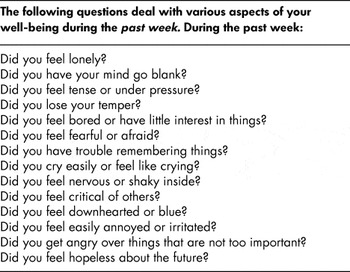
The official language of Montreal is French although a substantial proportion of Montreal residents speak English as their first language, and so we chose l’Indice de détresse psychologique de Santé Québec (IDPESQ-14) to measure psychological distress (see Table 1). The IDPESQ-14 index has been validated in both French and English for construct, criterion, and predictive validity and has a Cronbach’s alpha value of .89 (Préville, Boyer, Potvin, Perrault, & Légaré, Reference Préville, Boyer, Potvin, Perrault and Légaré1992). The IDPESQ-14 is a 14-question scale that assesses the frequency of specific feelings and symptoms of psychological distress over the past week. Responses to each of the 14 questions are limited to one of four categories with a numerical value assigned to each response (“never” = 0, “occasionally” = 1, “fairly often” = 2, and “very often” = 3).
Index of psychological distress of Santé Québec

0 = Never; 1 = Occasionally; 2 = Fairly often; 3 = Very often
Response scores to the 14 questions are summed, divided by the maximum score possible (42), and multiplied by 100 to create a 0 to 100 point scale; a higher score indicates a higher level of psychological distress. We transformed the raw ordinal scores into a linear interval-level scale using the Rasch measurement model (Bond & Fox, Reference Bond and Fox2007), an approach others have used to construct interval-level scales from ordinal scales (Covic, Pallant, Conaghan, & Tennant, Reference Covic, Pallant, Conaghan and Tennant2007; Hsueh, Wang, Sheu, & Hsieh, Reference Hsueh, Wang, Sheu and Hsieh2004; Pallant & Tennant, Reference Pallant and Tennant2007; Sheehan et al., Reference Sheehan, DeChello, Garcia, Fifield, Rothfield and Reisine2001). The transformed psychological distress scores ranged from –4.6 to 2.7, where a higher score indicates more severe psychological distress.
Disability and Unmet Need
We based our definition of disability on the World Health Organization’s (WHO), conceptual model of disability. This model identifies disability as a negative consequence of the interaction between an individual and their environmental (World Health Organization, 2002). The WHO model recognizes that even though individuals may not be able to perform an ADL in a “normal” way, they may still be able to perform the task independently by using an adaptive device, such as a cane when walking, or by modifying the task. In this situation, they are still independent in the activity, and so, for our research, we defined these people as not being disabled. It is only when subjects reported they were not able to complete the task, even in an adapted way, that we identified them as disabled and as having a need for physical assistance from another person.
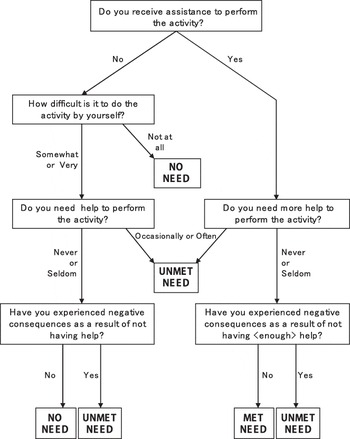
To determine if the person needed physical assistance to perform an ADL and if that need was met or unmet, we used an algorithm created by Allen and Mor in Reference Allen and Mor1997 (see Figure 1). The algorithm simultaneously determines a person’s ability to perform specific daily activities and the perceived adequacy of any assistance received from another person. We modified the algorithm so that an individual who experiences difficulty when performing a PADL or IADL but reports having no need was categorized as “no need.” This contrasts with the original Allen and Mor algorithm which categorizes such individuals as having “met need.” Our modification seemed appropriate because it is not possible to have met need when no assistance is received.
Modified algorithm to determine need for assistance (adapted from Allen & Mor, Reference Allen and Mor1997)

Using the algorithm to guide the interview, we first asked MUNS participants about their need for physical assistance from another person to complete six PADL (dressing, bathing, indoor mobility, transfers, toileting, and feeding) and three IADL (meal preparation, housekeeping, and transportation to places beyond walking distance from the home) tasks. Study participants who reported having a need for physical assistance to complete any of these nine tasks were identified as being disabled. For every IADL or PADL in which a person was disabled, the person was further identified as having met or unmet need.
Thus, on the basis of our modified algorithm, participants were identified as having unmet need in a PADL or an IADL if they reported:
– needing help but not receiving any; or
– receiving help, but needing more help; or
– experiencing a negative consequence of not having any, or enough help. Negative consequences included falling, having to wear dirty clothing, or being unable to eat or drink when hungry or thirsty.
Once each participant’s level of need (i.e., no need, met need, or unmet need) was ascertained for each PADL and IADL, we aggregated the findings into counts of met and unmet PADL and IADL need. Very few participants had all three IADL needs either fully met or completely unmet, and so we collapsed the IADL unmet need and the IADL met need categories as 0, 1, and 2 or more. Similarly, the limited number of participants with multiple PADL needs led us to collapse these categories as well: PADL unmet need was categorized as 0, 1, and 2 or more, and PADL met need was categorized as 0 and 1 or more. A common way to model disability in statistical analyses is as a count of ADLs in which study participants are disabled.
We used this approach, but took it one step further by subdividing disability into its four constituent components; that is, counts of IADL unmet needs, IADL met needs, PADL unmet needs, and PADL met needs. Taken together, these four categories represent the total number of ADLs in which a person requires physical assistance (i.e., total disability). For example, a woman who is disabled in five ADL could have her information modeled in the following way: 2 IADL unmet needs, 1 IADL met need, 2 PADL unmet needs, and 0 PADL met needs. In this way, it is possible to adjust for disability (2 + 1 + 2 + 0 = 5) while separating out the individual effects of IADL and PADL met and unmet needs with psychological distress.
Co-variates
We selected known or suspected correlates of psychological distress to include in our statistical models based on the literature (Couture, Lariviere, & Lefrancois, Reference Couture, Lariviere and Lefrancois2005; Kempen, Jelicic, & Ormel, Reference Kempen, Jelicic and Ormel1997; McEwan, Donnelly, Roberston, & Hertman, Reference McEwan, Donnelly, Roberston and Hertman1991; Paul, Ayis, & Ebrahim, Reference Paul, Ayis and Ebrahim2006; Schieman & Turner, Reference Schieman and Turner1998; Yang & George, Reference Yang and George2005) and categorized these correlates into three basic types: (a) demographic, (b) psychosocial, and (c) health-related characteristics. We included the demographic characteristics of age, marital status, education, place of residence, and income. We identified a person as having a low income by using Statistics Canada’s low-income cut-off points (Statistics Canada, 2005).
We examined four psychosocial factors that may influence psychological distress: (a) mastery, (b) self-reported satisfaction with social support (no, yes), (c) negative interactions with other people, and (d) current use of psychotropic drugs. Mastery is the extent to which persons feel in control over their environment (Pearlin & Schooler, Reference Pearlin and Schooler1978) and has been shown to improve adaptation to stressful events, including health problems (Kempen et al., Reference Kempen, Jelicic and Ormel1997) and functional decline (Kempen et al., Reference Kempen, van Heuvelen, van Sonderen, van den Brink, Kooijman and Ormel1999). Mastery was assessed using Pearlin’s personal mastery scale (Pearlin & Schooler, Reference Pearlin and Schooler1978), a widely used scale with good construct validity (Pearlin, Lieberman, Menaghan, & Mullan, Reference Pearlin, Lieberman, Menaghan and Mullan1981) and internal reliability (Kaplan & Boss, Reference Kaplan and Boss1999). The scale is composed of seven statements about the perception of control. Responses to each statement are limited to one of four categories with a numerical value assigned to each response (“not at all” = 1, “to a small extent” = 2, “to some extent” = 3, and “to a large extent” = 4). Cumulative scores range from 7 to 28, with a higher score indicating higher personal mastery.
Social support was included because positive social support can act as a “stress buffer” and reduce psychological distress (Hays, Kasl, & Jacobs, Reference Hays, Kasl and Jacobs1994; Krause & Jay, Reference Krause and Jay1991). Furthermore, satisfaction with social support is influenced by both the amount of social support one receives and negative interactions that may occur during socialization (Krause & Jay, Reference Krause and Jay1991). Negative interactions with other people were assessed by our asking a series of questions about the occurrence of such interchanges over the past six months. Scores range from 4 to 16 with a higher score indicating an increasing frequency of negative interactions. The use of psychotropic medications was included because it can affect psychological distress. It was determined using the government-administered RAMQ prescription drug database. Subjects were identified as current users of such medications if they filled a prescription for anti-depressant medication corresponding to American Hospital Formulary Service (AHFS) code 28:16:04, or for anti-anxiety medication corresponding to AHFS code 28:24:08, in which the course of treatment overlapped with the date of the baseline interview.
Five health-related characteristics were included: (a) body mass index (BMI), (b) self-rated health, (c) risk for malnutrition, (d) burden of chronic disease, and (e) previous use of urgent health services. Self-reported height and weight were used to compute BMI. Self-rated health (SRH) was assessed in two ways: current SRH (very good or good, fair, or poor) and SRH compared with one year ago (same, better, or worse). Nutrition was assessed using the Elderly Nutrition Scale (ENS), which identifies a person as being at low, moderate, or high risk for malnutrition. The ENS has a sensitivity of 78 per cent and 77 per cent for identifying a person at moderate and high risk of malnutrition, respectively; an overall specificity of 77 per cent; and good reliability (Payette, Guigoz, & Vellas, Reference Payette, Guigoz, Vellas and Yu1999). Chronic disease burden was estimated using Von Korff’s Chronic Disease Score (CDS) (von Korff, Wagner, & Saunders, Reference von Korff, Wagner and Saunders1992), a weighted index of the burden of chronic diseases that is based upon pharmaceutical data from administrative databases. The CDS ranges from 0 to 36; a higher score indicates a greater burden of chronic disease. The CDS predicts both hospitalization and mortality and is positively correlated with physician ratings of disease severity (r = .57) (von Korff et al., Reference von Korff, Wagner and Saunders1992). Finally, the use of urgent health services included both emergency department visits and unplanned hospitalizations in the six months prior to the baseline interview.
Statistical Analysis
We conducted a cross-sectional analysis of baseline data from the MUNS. This research reports on the analyses for women who completed the baseline interview and who gave consent for us to access their information contained in the RAMQ and MEDECHO government databases (n = 530). Descriptive statistics were computed for all study variables. Bivariate analysis of the association with psychological distress was conducted using correlation for continuous variables and ANOVA for categorical variables. Stepwise linear regression was conducted with the transformed IDPESQ-14 psychological distress scores as the outcome using SAS V9.1 (SAS Institute Inc., 2007) software. Variables found in the bivariate analysis to have an association with transformed psychological distress levels with a p < .20, or that were deemed to be clinically relevant were entered into the multivariable model. We used the partial F-test to determine which variables contributed significantly to the model, and removed those that did not. All variables with a p value < .05 were retained in the final model, as were clinically relevant variables. The association between met and unmet need, and psychological distress was assessed for interaction and confounding. Cook’s distance was calculated to identify possible outliers and data points with high leverage, and/or influence, using a cutoff value of 4/n (= .00754) to indicate an influential point.
Results
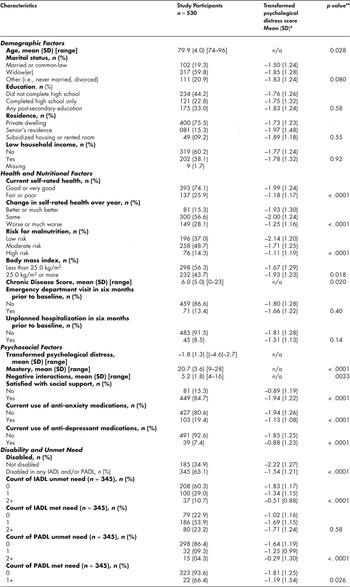
Table 2 lists the characteristics of the study participants. Disability in IADL was common: 345 women (65.1%) reported that they required physical assistance from another person in at least one IADL or PADL. Among these women, 284 (53.6%) were disabled in IADL only, 59 (11.1%) were disabled in IADL and PADL, and two (.4%) were disabled in PADL only (data not shown). The majority of disabled women had at least one of their IADL needs met [(186 + 80)/345 = 77.1%], while less than one half had at least one of their IADL needs unmet [(100 + 37)/345 = 39.7%]. In contrast, disability in PADL was relatively rare. Only 61 women reported they required physical assistance from another person in at least PADL. These PADL needs were more often unmet [(32 + 15)/61 = 77.0%)] than met [(22/61) = 36.1%]. Correlation coefficients for IADL and PADL met and unmet need among only disabled women ranged from –.43 to + .36.
Characteristics of study participants

SD = standard deviation
* Transformed psychological distress scores range from –4.64 to 2.67, where a higher score indicates greater psychological distress
** p value for the difference in psychological distress scores between variable categories
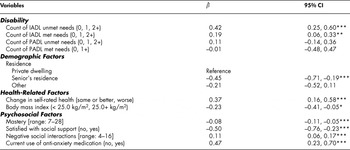
We analyzed the association of IADL and PADL met and unmet needs with psychological distress without adjusting for other variables (results not shown). IADL unmet need was associated with the greatest increase in the psychological distress score (β = .68 per one unit change in unmet IADL need; 95% CI: .49, .86), followed by PADL unmet need (β = .31 per one unit change in unmet PADL need; 95% CI: .03, .59), and IADL met need (β = .17 per one unit change in met IADL need; 95% CI: .02, .32), whereas PADL met need was not found to be statistically significantly associated with psychological distress. After adjustment for residence, change in self-rated health, BMI, and psychosocial factors (i.e., mastery, satisfaction with social support, negative social interactions, and current use of anti-anxiety medications), IADL met and unmet need remained associated with elevated distress, while PADL met need and unmet need were not (see Table 3).
Multivariable model of the association of disability and unmet need with psychological distress

CI = confidence interval
* p < .05; **p < .01; ***p < .001
Compared to women with no IADL unmet need, women with IADL unmet need had statistically significant elevated levels of psychological distress (β = .42 one unit change in unmet IADL need; 95% CI: .25, .60). Women with IADL met need also had elevated levels of psychological distress, albeit to a lesser degree (β = .19 one unit change in met IADL need; 95% CI: .06, .33). Psychosocial factors associated with elevated psychological distress included lower levels of personal mastery, dissatisfaction with social support, and negative social interactions with family or friends. Living in a private dwelling, having a BMI less than 25.0 kg/m2, worsening self-rated health over one year, and currently using anti-anxiety medication were also associated with elevated psychological distress. The adjusted R2 value for the full model was .328, indicating that 32.8 per cent of the variance in the transformed variable psychological distress was explained by the variables in the model. Residual analysis was used to confirm that the assumptions of linear regression were met, specifically linearity, normality, and homoscedasticity. There was no evidence of interaction or confounding.
Discussion
Among elderly women living in the community, we found a statistically significant association between IADL unmet need and psychological distress that remained after adjustment for disability and other factors. Both met and unmet IADL needs were associated with elevated psychological distress – in other words, simply being unable to perform an IADL independently is associated with elevated distress. This is consistent with previous studies that have found that disability is associated with depression and anxiety, two of the components of psychological distress (Bruce, Reference Bruce, Williamson, Shaffer and Parmelee2000; Kennedy, Reference Kennedy2001; Yang & George, Reference Yang and George2005; Zeiss, Lewinsohn, Rohde, & Seeley, Reference Zeiss, Lewinsohn, Rohde and Seeley1996). However, our results suggest that there are differences in the severity of psychological distress based upon the type of activity in which a woman is disabled (PADL versus IADL) and whether the need for physical assistance is met or unmet. Unmet need to perform an IADL is associated with increased psychological distress over and above the level of distress related to met IADL need.
An unexpected finding was that met IADL was also associated with elevated psychological distress, although to a lesser degree than unmet IADL need. A possible explanation may be that IADL tasks are the typical domain of women of this generation, and their self-worth may be tightly interwoven with their ability to maintain a home. Being a good housekeeper is strongly tied to the self-image of elderly women (Robinson, Reference Robinson1999). Women may be embarrassed or distressed by being unable to maintain their household in a tidy state (Adelmann, Reference Adelmann1993), or distressed at the thought of strangers coming into their home (Aronson, Reference Aronson2002), and so having one’s needs met may, in fact, be more psychologically distressing than struggling with unmet need, particularly if an individual is fiercely proud of their independence. Similarly, for many women of earlier generations, cooking is a source of enjoyment (Sidenvall, Nydahl, & Jellstrom, Reference Sidenvall, Nydahl and Jellstrom2000). Dependency in meal preparation, regardless of whether the need is met or unmet, may lead to distress because of concerns about not wanting to be a burden, not being able to retain decision-making power about meals, or not being able to maintain order and routine in daily living (Gustafsson, Andersson, Andersson, Fjellstrom, & Sidenvall, Reference Gustafsson, Andersson, Andersson, Fjellstrom and Sidenvall2003).
In contrast to our findings for IADL disability, there was no aspect of PADL disability which was found to have a statistically significantly association with elevated distress. This finding may reflect the tendency of disability to develop first in IADL because these tasks are more complicated than PADL; by the time a person becomes disabled in PADL, he or she is usually already disabled in IADL (Sonn, Reference Sonn1996). Consequently, during the slow progression of functional decline and development of disability in PADL, elderly women may have had time to adapt, either physically or psychologically, to their declining function and so may be less distressed. Alternatively, a person may be so distressed by the initial onset of disability in IADL that the development of additional PADL disability does not substantially increase an already elevated level of distress (Yang & George, Reference Yang and George2005).
We found that both mastery and social support were associated with reduced psychological distress. Mastery is the extent to which a person feels in control over the environment (Pearlin & Schooler, Reference Pearlin and Schooler1978) and has been shown to increase psychological resilience and facilitate adaptation to some of life’s most stressful events, including health problems (Kempen et al., Reference Kempen, Jelicic and Ormel1997) and functional decline (Kempen et al., Reference Kempen, van Heuvelen, van Sonderen, van den Brink, Kooijman and Ormel1999). Similarly, positive social support can act as a “stress buffer” and has been shown to reduce psychological distress (Hays et al., Reference Hays, Kasl and Jacobs1994; Krause & Jay, Reference Krause and Jay1991). In situations where home care services are not available or are not desired by an elderly person, improving a person’s sense of mastery and social support network may improve the ability to cope with unmet need. This may be achieved through day programs for seniors, which facilitate socialization with peers (Zarit, Stephens, Townsend, & Greene, Reference Zarit, Stephens, Townsend and Greene1998) and are where seniors can learn adaptive strategies or acquire adaptive devices to address their unmet needs, which may in turn improve their sense of mastery.
This research has several strengths. The MUNS cohort is population-based, which ensures good generalizability of our findings. We collected data on variables that have not been included in other studies, and this makes it possible to examine their independent effects and how they may affect the association between unmet need and psychological distress. Additionally, the database was also validated separately by two independent researchers and has virtually no missing data.
Among the limitations of this research is that we relied on self-reported disability, which may have caused some misclassification of disability. However, if a person reports being unable to perform a task, even when physically capable of doing so, the person typically will not perform the task and hence does have a need. Thus, self-report was the preferred way to assess disability and unmet need in this research.
There is the possibility of residual confounding by disability as a result of collapsing categories of met and unmet need: the more disabled a person (i.e., the greater number of needs the person has), the more likely it is that those needs will be unmet (Mor, Reference Mor, Allen and Mor1998). We collapsed the uppermost categories of counts for both IADL and PADL met need, which may have resulted in subjects being more disabled than indicated by our categorization. However, only 28 women had more than two met or unmet IADL needs, and only eight women had more than two met or unmet PADL needs; these numbers are unlikely to significantly bias our results.
Other limitations might be selection bias related to the random-digit dialing approach employed by Léger Marketing and volunteer bias. To mitigate the former, Léger Marketing made over 20 attempts to contact seniors at different times of the day and on different days. If volunteer bias was present, it would have led to fewer people with unmet need and/or psychological distress being recruited into the study, making it more difficult to identify an association between the two variables. This may limit the generalizability of the findings but would not affect the internal validity.
An additional limitation is that the scale used to measure the occurrence of negative social interactions has not been validated. Despite this limitation, we chose to use this scale because it captures a variety of types of negative interactions and the questions have face validity.
An important limitation of this research is that we cannot determine the direction of the association between unmet need and psychological distress although a bidirectional association may exist. Elderly people with disability who also have unmet need may become distressed as a result of the daily and difficult struggle to perform ADL or having to live with the consequences of not being able to perform ADL. Psychological distress may then prevent these persons from actively seeking help and/or being able to accept help to meet their needs when it is offered. Future research into unmet need should consider psychological distress as an important co-variate, as well as elucidating the direction of the association between these factors.
We lacked sufficient numbers of men with unmet need to investigate the association between unmet need and psychological distress in elderly men. The aging experience of men is different from women, and further research is needed to determine the scope of disability and unmet need among men, as well as to identify ways to address the problem.
In sum, our results show that dependence in IADL is an important challenge for community-dwelling elderly women, regardless of whether their needs are met or unmet.
As the elderly population continues to grow, the challenge to address disability and unmet need will also grow. Disability and unmet need can affect physical health, and psychological distress may further diminish physical health and quality of life for this group of citizens. It is essential to provide elderly persons with the support they need, and will accept, to adapt both physically and mentally to declining health and function. This may entail finding ways to identify struggling seniors in the community and remove barriers to accessing home care services. Furthermore, how home care services are currently provided should be examined in order to tailor these services to meet not only the client’s physical needs, but also their preferences and desires in order to allow them to retain as much control as possible over their home and life.