The bitterly cold winter of 1928–1929 sank more than one promising West End theatrical production. Beau Geste, expected to be the sensation of the season, stunned theater critics when it flopped. Among Beau Geste's casualties was the then-unknown Laurence Olivier, who had accepted a part after his brief stint in the leading role in R. C. Sherriff's Journey's End, assuming that it was a logical career decision. Everyone in the know agreed, after all, that Journey's End was a fine play but stood no chance of a successful commercial run. Sherriff's war play had received a two-night trial engagement at the Apollo Theatre in London's West End, on 9 and 10 December 1928. Its benefactor, the Incorporated Stage Society, sponsored plays deemed worthy of performance regardless of commercial potential—art for art's sake. The London critics adored it and agreed that Sherriff had created a masterpiece. But despite their best efforts, Sherriff and his still-obscure producer, James Whale, could not find a theater manager who would touch it, let alone pursue a full engagement. Sherriff prepared to return to his quiet life as a Surrey insurance surveyor.
Sherriff's play is the story of a group of British officers stationed in a dugout at Saint-Quentin just before the German offensive of March 1918. They await an imminent attack and wrestle with the strain of war, each in his own way. The young, tough-as-nails commanding officer, Captain Dennis Stanhope, who was the public school golden boy, is cracking under the weight of three grueling years of frontline service and retreats to the whisky bottle to sustain his nerves. The embittered captain is horrified when his lifelong friend, the earnest Second Lieutenant Jimmy Raleigh, fresh from school, is assigned to his dugout. Stanhope, betrothed to Raleigh's sister, fears that she will learn of his weakness, and he therefore deeply resents Raleigh and the hero worship he has carried with him from home. As the days march on, tensions mount. Stanhope lashes out at Raleigh, and the German attack finally begins. In the last, climactic scene, Raleigh is fatally wounded. Softening, Stanhope tenderly cares for him during their last moments together. Then, composing himself one more time, the commander moves out into the trench to fulfill his duty, and the dugout collapses, enshrouding Raleigh's corpse in darkness.Footnote 1
Within less than a month of its premiere, Journey's End was shattering box-office records. Against all expectations, Sherriff's play premiered to enormous commercial success. Throngs flocked to the theater over the next year and a half to experience the play heralded as a triumph of realism, and lauded as the best war play ever written. The British press applauded the play's depiction of the ethos of trench life. Many were compelled to lyrical adoration. Sydney Carroll, of the Daily Telegraph, could barely contain himself: “You will never sense the theatre,” he proclaimed.
This is not “acting” but reality. The hand of God presses itself firmly on your shoulder. You realise how truly noble, in spite of all its shortcomings, is this lump of clay called “man.” Your soul will be full of gratitude that such men existed, and that they were Englishmen—that the inherited nobility of the race survived at such a moment. These men bring the war back to us.Footnote 2
Thousands joined him in a chorus of praise. The production drew acclaim from theatrical legends and politicians alike, from Sybil Thorndike to Winston Churchill. The Prince of Wales described it as “the best play he ever saw in his life.”Footnote 3 Sherriff, Whale, and their actors soared to international fame and launched their careers on it. Unimaginable international success would follow. By November of that year, Journey's End was already translated and performed in fourteen languages and in dozens of countries, and the play that had famously cost only £60 to produce made its backers a fortune. Seemingly against all odds, Journey's End became a cultural phenomenon. How are we to explain this?
In pursuit of an answer to this puzzle, this article offers three methodological interventions in the historiography of British popular culture in the aftermath of the Great War. First, where existing scholarship has treated Journey's End as a piece of literature, I conceptualize it as a collective cultural product that circulated among a mass audience.Footnote 4 The most thorough treatments of Sherriff's play have prioritized the autobiographical influences on his work. Reading the story alongside Sherriff's war correspondence and private accounts of his own combat experience, researchers have probed the play for evidence of authorial intentions and veracity.Footnote 5 This is representative of a broader tendency to overemphasize the production of Great War narratives at the expense of attention to reception, consumption, and spectatorship. Rather than asking whether or not Journey's End was an accurate reflection of Sherriff's war experience, I set out to explain why contemporaries believed it to be. Through this reorientation, this article constitutes an attempt to take seriously Stephen Heathorn's call for greater attention to cultural reception, and for an analysis of “how average people responded to the representations of the war projected at them through commemorative, literary and popular culture.”Footnote 6
Second, I push back on historians' tendency to view Great War narratives as one-dimensional mnemonic products, and underscore the commercial nature of Sherriff's play. Since Paul Fussell published his magisterial The Great War and Modern Memory in 1975, historians and literary critics have been fascinated by the way a war deemed fundamentally indescribable was ordered into narrative form. While scholars have gradually revised Fussell's thesis that the First World War ushered in a new, modern, ironic form of imagination and thus constituted a caesura within British cultural life, most work still treats representations of the Great War as largely detached from commerce and the entertainment industry. Jay Winter, for example, has been among the most influential in overturning Fussell's cultural rupture thesis, demonstrating through his study of bereavement and mourning that the mass of people relied on traditional language and forms, not sardonic modernism, in order to make sense of their losses and transcend them.Footnote 7 For Winter, the work of commemorating the war resulted in “fictive kinship networks” of “people related by blood or experience,” or what he calls “communities in mourning,” in which social networks beyond the parameters of the state or central government helped families to learn about the war in order to grapple with mass death.Footnote 8 But the avalanche of plays, films, exhibitions, and novels that circulated during the interbellum decades complicates this portrait of “kinship bond[s] between families in wartime and those who set about helping them,” drawn together solely through benevolent acts.
Certainly, these narratives featured in commemorative rituals and “ceremonies of collective memory,” such as when the BBC chose to broadcast Journey's End as part of its Armistice Day programming in 1929.Footnote 9 But these philanthropic efforts Winter so elegantly excavates, which “marked indelibly much of interwar communal life,” sit uneasily alongside a commercial circuit of stories that purported to offer the “truth” of the war experience, lucrative products that baited audiences with the promise of “authenticity” in cinema palaces and theaters nearly nonstop from the Armistice well into the next global cataclysm.Footnote 10 Not quite crass profiteering but still hugely profitable, not quite altruism but often functioning altruistically, these commercial stories occupied an ontological space somewhere between entertainment and elegy, offering spectators not only the possibility of access to knowledge previously closed off to noncombatants, but also thrilling spectacle—for an admission fee. If Winter and those who have followed him have shown us how representations of the Great War helped individuals, families, and communities to heal in its aftermath, examining Journey's End as a fundamentally commercial story suggests that we need to consider this traffic in the “truth” about the war as a booming industry, of which healing was only one consequence. My aim here is not to refute the validity of the benevolence narrative but rather to gesture toward a more nuanced and complicated process.
Similarly, treating Sherriff's play as a commercial product and exploring its reception changes our understanding of who was involved in the process of representing the Great War during the interbellum decades. Janet S. K. Watson has called attention to the ways in which popular perceptions of the conflict changed over time. Emphasizing the differences between the texts produced during the war and the disillusioned war books of the late 1920s and 1930s, Watson's Fighting Different Wars (2004) explains how the trench narrative became the hegemonic depiction of the First World War. By the 1930s, infantry stories such as Sherriff's Journey's End, she argues, became seen “not just as the primary way of understanding the war but the only legitimate one,” delegitimizing and silencing accounts by women and noncombatants.Footnote 11 If we envision Journey's End as a commercial product catering to a mass audience, however, it becomes apparent that silencing is too simple a word to describe the role of women and noncombatants in the play's rise to hegemony. If the middle-class, masculinist trench narrative displaced other visions of the Great War by the 1930s, it did so in large part because in a democratizing Britain cultural consumers from all walks of life—male and female, combatant and noncombatant—financially endorsed it and bought into its legitimacy as an authentic vision of combat.
Third, I interrogate the role of the theatrical medium in interbellum attempts to visualize total war, investigating Journey's End as an arena for multisensory, ephemeral audience encounter. While film historians have elucidated the challenges the British film industry faced when attempting to represent industrial combat and have incorporated comparative analysis of the stage and its conventions, theater scholars have remained trapped within a literary approach. As a result, we have not yet determined why in 1928 it was the most ancient medium, the theater, not the film industry, that produced Britain's most “authentic” depiction of this quintessentially modern war. Journey's End, in its original incarnation as a play, reveals how at the end of the 1920s, the stage managed to provide audiences with the most gripping approximation of war as “the real thing.” Harnessing the multisensory, visceral, and immediate qualities of live performance, Journey's End offered spectators not only a realistic story but an immersive surrogate experience.Footnote 12
Balancing all three of these methodological interventions, I argue that Sherriff's play soared to legendary success because contemporaries never conceived of it as merely a play. The processes I analyze here blurred the play's ontological status as commercial entertainment. Explaining how Journey's End became a box-office sensation offers insight into the boundaries between reality and representation, past and present, and into the commercial quandaries of a theatrical industry struggling to fend off the technical challenges posed by the cinema. To begin, I explore how a web of overlapping narratives constructed and circulated by the young author, his savvy production team, and the buzzing British press helped to shape spectators' expectations about the play and its meaning. All rooted in the primacy of direct experience as a source of authoritative testimony and authenticity, these stories about Sherriff's play highlighted its engagement with veterans of the Great War, casting them as writers, performers, and spectators. Cumulatively, these narratives added a powerful aura of credibility to Journey's End as a form of historical reenactment. Next, I examine the spectatorial experience facilitated by the play and its theatrical space, demonstrating that the peculiar qualities of live performance enabled theatergoers to approach the play as a source of vicarious knowledge about the First World War. I then analyze how a previously underacknowledged figure, the show's producer, Maurice Browne, marketed the play to divergent consumer groups in contradictory ways, dexterously playing on the exigencies of the ailing theater industry at the end of the 1920s. Browne shrewdly translated commercial support of his production into an opportunity for theatergoers to conspicuously perform their artistic taste, intellectual independence, and ardent patriotism. Finally, I conclude by considering the implications of this play for historical approaches to interwar cultural life and the legacy of the First World War across the generations.
BRINGING THE WAR HOME TO US: SHERRIFF'S PLAY AS REENACTMENT
The widespread belief in the credibility of Journey's End was the result of an intricate process that began before audiences even entered the theater. Interlocking narratives spun by the press, a savvy production team, and Sherriff himself highlighted the play's connection with veterans of the Great War. Drawing authority from veterans as purveyors of truth about what the war was like, these stories constructed an intimate association between Sherriff's fictionalized account and the veterans' actual war service records. These narratives cast veterans as writers, performers, and spectators, blurring the boundaries between memory and story, realism and reality.
The starting point for all of this chatter was the war record of the young author, who had served as a captain with the East Surreys for eleven months on the Western Front, surviving multiple cataclysms (including Saint-Quentin, the play's setting) before being wounded in the head at Ypres.Footnote 13 Surrounding the play's premiere, hundreds of articles appeared in the press, virtually all of which referenced Sherriff's war service record.Footnote 14 This wave of stories called attention to his authority as a veteran, establishing that he possessed firsthand experience of the action presented in his play. Sherriff publicly insisted that his work was merely a reflection of his own war memories, adamantly eschewing any charges of artifice, propaganda, or moralization. “The life we led in France … was an extraordinarily dramatic one,” he told the Star, “and I thought that perhaps people who could not take part would like to know exactly what life was like—to be shown in a realistic way just how the men lived out there … It was just a picture that I tried to make realistic.”Footnote 15 Through this cluster of articles delivered to mass audiences, Sherriff's play was transformed from narrative into testimony.
Press features also highlighted Sherriff's status as a nonprofessional playwright and unassuming sportsman, enchanting readers with romantic narratives of the author's rise to fame. He was not just the man who wrote Journey's End. He was the Surrey insurance surveyor turned amateur playwright, the rowing captain who enjoyed playing threequarter-back for Rosslyn Park Rugby Club, the everyman who penned Journey's End to pass the time on cold, damp winter evenings. The play was intended for performance as a fund-raiser for his rowing club, this story went. Sherriff had sent it off to literary agent Curtis Browne on a whim and just happened to strike it rich with one of the most successful plays in living memory. All of this attention to Sherriff's amateur status functioned to reassure audiences that he was unlikely to write a highbrow piece of theater. Journey's End was untheatrical because its author was untrained in manufacturing artifice, merely an “ordinary man, who after going through a tremendous experience, was moved to write a play.”Footnote 16 Sherriff himself was keenly aware of this popular narrative, and actively encouraged its transmission. Recognizing the elements of this popular tale that reporters found most beguiling, he understood that they wanted to perpetuate “the story they had heard about a young, obscure insurance clerk … who had written the play for no reason beyond a little money to buy a boat for his rowing club.” Sherriff indulged their appetite, with satisfactory results:
It went down well. There was a romantic flavour about the little island on the Thames and the ramshackle old boathouse that caught their imagination. They asked me a lot of questions, and I embellished the story with all the picturesque detail I could devise. It was published at length and became, in a manner of speaking, the established, official story because it was copied and translated into the language of numerous foreign countries where the play was to be done. It was as near the truth as made no difference, and I read it so frequently that I began to believe it myself.Footnote 17
Taken together, these biographical tales amalgamated within the public imagination to form a celebrity persona for Sherriff as an honest veteran who could be trusted to recount his memory of the Great War without theatrical effect. Rooted in the primacy of direct experience, and made more romantic owing to Sherriff's overnight rise from everyman to celebrity, this public portrait depicted Journey's End as eyewitness testimony. Collectively cultivated and circulated, Sherriff's biography, as mass narrative, doubled as a process of authorization. The young author was as much a fictive character as any of the men figuring in his play.
It was not just that the press depicted Sherriff as an honest veteran who could be trusted to recount his memory of the Great War without theatrical effect. Even more importantly, Journey's End was performed by veterans, too. Alongside Sherriff's public biography, the press delivered a frenzy of stories about the many actors in the company who had also served in the conflict, adding a new dimension of meaning to the play and its spectatorial experience. At least five of the performers had fought, and their reputations as veterans licensed them to physically reenact their memories for paying spectators. For months, columnists reported on the uncanny similarities between the tasks these men had performed from 1914 to 1918 and the roles they acted in Sherriff's play. Melville Cooper, as the Cockney Lieutenant Trotter, had served with the Highlanders' 51st Division. And by peculiar coincidence, he was taken prisoner when raiding a German trench at Saint-Quentin, the exact type of raid and precise location depicted in Journey's End.Footnote 18 Cooper announced that he had based his performances on one of his fellow prisoners in Germany.Footnote 19 Similarly, Alexander Field, playing the comical mess orderly, not only served in the Great War but also wore onstage “the same puttees he wore in Flanders.”Footnote 20
Because they had really been there, like Sherriff, these actors became arbiters of exclusive knowledge. The interaction of fictional narrative with “true” stories reframed the play as reenactment, rather than entertainment, and transformed the men's performances from realism into the real thing. George Zucco, for example, won lavish praise as the avuncular second in command, Lieutenant Osborne, because he was rumored to be replicating his earlier experience as a junior officer serving under Colonel Glazebrook in the Leeds Rifles. Zucco had survived the bloody Somme offensive in 1916. And just as his character was killed while directing the raid of a German trench, Zucco was badly wounded while leading a raid on a German dugout in 1917. The fluke resemblance between the actor and his character was headline news and convinced many observers that his performance was completely authentic. The published response of a correspondent for the Yorkshire Post is representative:
There is no doubt at all that, with “Journey's End,” Mr. Zucco has “arrived.” Perfectly cast though the play is, his performance stands out because of its complete sincerity. He takes his audience—and I venture to say, himself—back twelve years, and as an apparently effortless piece of characterisation, it should go down in theatrical history. Perhaps that is because, during rehearsals, he was told on no account to “act.”Footnote 21
For months, critics and columnists featured profiles of the veterans in the show and their uncanny naturalism, recycling headlines like “True to the Trenches,” “Old Soldiers,” and “Real Comrades of the War,” or simply summarizing, “Many of the actors will be fighting their battles over again in ‘Journey's End.’”Footnote 22 And when discussing the actors too young to have served, commentators took special care to establish the authenticity of their performances: Colin Clive, Robert Speaight, and Geoffrey Wincott may have been too young to have taken part in the conflict, reported the Star, “but they have captured the authentic spirit from those who were actually ‘over there.’”Footnote 23 As a result, during performance, the combination of the many war records among the cast and the striking similarities between what characters and actors endured culminated in an enthralling potency. “Written, directed, and, in great part, acted by men who served,” explained one critic, “the thing has a compelling force which, to use an often abused expression, ‘brings the war home to us.’”Footnote 24
Not only did the public know that the play was written, acted, and staged by former servicemen, but it was also watched, endorsed, and celebrated by veterans of the Great War, a phenomenon closely and regularly documented in the press. From the moment of its premiere, Journey's End drew acclaim from theater critics who had served in the conflict.Footnote 25 Newspaper correspondents frequently wrote of veterans in the theater who found the performance so true to life that they were suddenly and involuntarily overwhelmed with painful recollections. At the premiere, one woman noticed the man sitting next to her “simply couldn't bear it and had to go.”Footnote 26 Another woman explained to the Sheffield Telegraph that the play was so realistic that it “had disastrous consequences for her husband,” a man who had not touched alcohol since the war but found himself so overwhelmed during the performance that he resorted to a glass of whiskey in the theater bar.Footnote 27 “To those who knew the trenches of France and Flanders,” confessed one veteran reviewer, “the realism of ‘Journey's End’ is all but unbearable.”Footnote 28
Another popular tale surrounding the play centered on the strange phenomenon of former servicemen attending the show in record numbers. In Huddersfield, one columnist recounted the stories he overheard old comrades swapping between acts. It was “obvious that the train of memory was already at full steam ahead.”Footnote 29 This was an episode repeated and recounted time and again as newspapers regaled their readers with stories about serendipitous reunions. A London man discovered as he bought his ticket that the box office attendant was an old subaltern from his battalion.Footnote 30 Elsewhere, a reporter overheard a group of former comrades sharing their astonishment at the similarities between Sherriff's characters and the men they had known in France.Footnote 31 Many regiments, including Sherriff's, opted to dine nearby and attend the play together in lieu of their traditional annual reunion dinners.Footnote 32 And Sherriff and his associates were continually fielding requests for free tickets for former servicemen, many of them wounded, who could not afford to purchase their own.Footnote 33 Wherever it went, Journey's End transformed into a space for former servicemen to reunite and to offer their overwhelming approval of Sherriff's play and its authenticity. “It makes you think of the old days,” explained Sergeant G. H. Wyatt, of the Coldstream Guards. “We all knew these fellows, didn't we? This is so real.”Footnote 34
The production team did much to encourage this unusual association between the play and men who had really fought. They invited high-ranking military officials, like Field Marshal Lord Plumer, to attend the premiere, adding an air of patriotic ceremony to a commercial entertainment.Footnote 35 They frequently gave benefit performances in aid of veterans' charities, such as the Haig Memorial Homes, both across Britain and throughout the empire.Footnote 36 In many instances, the veterans who attended these performances displayed the evidence of their war records on their bodies, with a rolled-up trouser where a leg had once been, or a white bandage in place of a missing eye. The very presence of these men, whose records were conspicuously evident to the public and the press that covered these events, lent another dimension of credibility to the performance, blurring the boundaries between reality and representation.
In the forty years since Fussell inaugurated the scholarly debate about how the catastrophic experience of the First World War became disenchanted narrative, historians have gradually grown more specific about the historicity of this process. Where Fussell gestured vaguely toward the war years as generative of ironic modernist poetry and prose, subsequent scholarship demonstrated that the rise of the sardonic, gruesome trench narrative was an interwar phenomenon, solidified by the early 1930s.Footnote 37 The popular visions of the Great War, this body of work has shown us, shifted and evolved over time.Footnote 38 From the early 1920s, but especially between 1928 and 1930, as Watson has demonstrated, the British reading public encountered a torrent of disillusioned, “realistic” accounts of combat written by men who had served in the conflict. These novels, she argues, “were much more about life after the war than the war itself,” “part of the construction of memory, not experience.”Footnote 39 The success of Edmund Blunden's Undertones of War (1928) or Erich Maria Remarque's All Quiet on the Western Front (1928) had more to do with servicemen's disappointment with the state and the public during the 1920s than with their war service. As the infantryman's story of the horrors of the Western Front became widely accepted as the most credible vision of the war, Watson argues, competing accounts were marginalized and written out of the hegemonic history of the war. The visions of women, noncombatants, and noninfantrymen were either lost to history or reshaped around the trench narrative form.
And yet, the public conversation about the authenticity of Journey's End, unfolding across the national and regional press through thousands of articles and a sea of letters to editors, suggests a different interpretation of the rise of the trench narrative. The scale of this phenomenon and the amount of attention it garnered indicates that the press was catering to a mass audience who found this conversation about authenticity appealing. Sherriff's play was a commercial product that required widespread popular support in order to succeed, and the burgeoning interwar press required a readership in order to prosper. As business enterprises, both appealed to popular appetite on behalf of the British public—a public composed of men and women, working-class and middle-class consumers, Britons who had served in the infantry and those who did not. Envisioning Journey's End and the press stories surrounding it as a commercial phenomenon reveals a more participatory process than Watson or her predecessors allow. The rise of the trench narrative was an interwar phenomenon, but one in which noninfantrymen took part. Moreover, to a far greater extent than the novels that have dominated historical scholarship on the aftermath of the First World War, the liveness of the theatrical medium made Journey's End an inherently interactive narrative arena.
We can glean some idea of public enthusiasm through press accounts of ordinary Britons attending the show. Civilian reviewers and spectators often followed the soldiers in the audience as closely as those on the stage. In 1929, for example, the production team collaborated with the Prince of Wales on a special Armistice Day performance for Victoria Cross recipients, part of a larger three-day commemorative event. Around 300 recipients from throughout the empire, chosen by lottery, were brought to London to participate. Throngs of citizens crowded outside of the theater hours before the curtain in hopes of catching a glimpse of the war heroes. “They stood three feet deep along the pavement, peeping into cars and taxis at the heroes of the evening as unashamedly as women peep at debutantes through the windows of cars waiting in the Mall before a court,” reported the Daily Telegraph.Footnote 40 Enthusiastic spectators patted the men on the back as they filed by, and women frantically tried to collect signatures and kisses from their guests of honor.Footnote 41 “Have a pint before you go over the top, old man!” cheered grateful patriots—an offer so frequently accepted that the curtain was delayed a full twenty minutes.Footnote 42
And when the performance finally began, civilian theatergoers observed the Victoria Cross recipients with fascination. “[T]here was the curious feeling of realism on both sides of the curtain,” explained the Era.Footnote 43 Each indication of approval further blurred the play's ontological status, concealing its position as a fictional product. “They followed the action of the play with absorbed attention which betokened their keen enjoyment,” declared one reporter. “They lived again, as it were, in the atmosphere of the trenches; followed its humour and watched its incidents with the understanding of practical experience.”Footnote 44 Another correspondent admitted that the sight of the Victoria Cross recipients taking in the performance brought “a lump to the throat and a catch at the heart.”Footnote 45 “It was not emotion, but memories which were astir then,” explained the Yorkshire Post. “You knew it by their laughter at little things which other audiences have doubtless missed.”Footnote 46Journey's End must be authentic and accurate, these accounts assured their readers, because even the Victoria Cross recipients watching the play believed it to be. It carried them back in time, deep into their own recollections of the front.
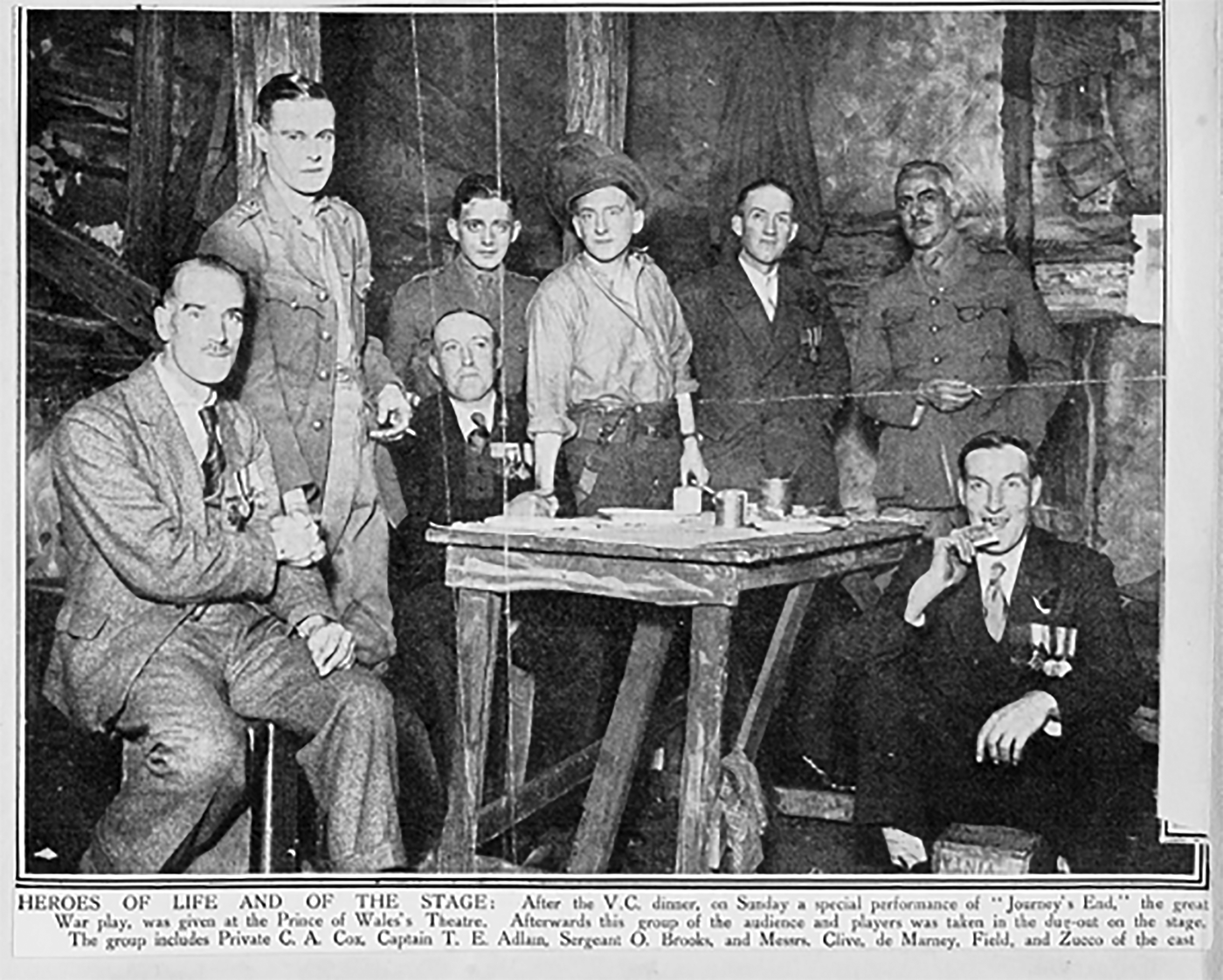
As if to prove this, many newspapers featured a series of unusual photographs over the following week. After the performance, a group of the Victoria Cross recipients joined the actors in the onstage dugout for conversation, and savvy photographers took the opportunity to capture this peculiar congress of representatives of past and present. The effect is jarring. Without the caption, it might prove challenging to tell which men are entertainers and which are actual combatants. Colin Clive (Stanhope) and Maurice Evans (Raleigh), neither of whom served in the war, appear in weathered military uniform, as though they have just descended from rotation in the trench overhead. Beside them, in immaculate civilian clothing, are three men who actually fought. Sergeant Oliver Brooks, awarded the Victoria Cross for leading a bombing party through enemy fire to regain two hundred yards of allied trenches, is seated in front of Evans, smoking and shaking hands with Alexander Field (Mason).Footnote 47 Christopher Augustus Cox, a Bedfordshire stretcher bearer who survived the Somme and Thiepval and then rescued dozens of wounded men from his own and neighboring battalions, grins as he pretends to eat one of the prop biscuits. A man who spoke very little to his eight children about what he had seen at the front, Cox attended Remembrance Day ceremonies every year for most of his life. His daughter would later remember the way her father, after the two minutes' silence, held out his hands to catch a poppy petal floating down through the air and then brought it home with him to stow away in a bundle. He had survived the war and emerged a decorated soldier, but his brother James was killed.Footnote 48
Photograph of veterans and actors in onstage dugout following performance for Victoria Cross recipients. “Heroes of Life and of the Stage,” Sphere, 16 November 1929, Scrapbook 52, Ellen Van Volkenburg–Maurice Browne Collection, University of Michigan Library (Special Collections Library). © Illustrated London News Ltd.

Perhaps most poignant of all, Lieutenant Tom Edwin Adlam, a Salisbury Victoria Cross recipient, shakes Clive's hand in what seems a quiet endorsement of the play's fidelity. At only 22 years old, as a temporary second lieutenant, Adlam led his men on a mission to capture a village at Thiepval, sustaining two serious injuries. Seated on the crate at the fake dugout table, is Adlam, then a thirty-five-year-old schoolteacher. In just ten years, he would be serving as a lieutenant in another global cataclysm.Footnote 49
SPECTATORSHIP AS VICARIOUS EXPERIENCE
In accounting for the unusual magnetism of Journey's End, it is important to understand the peculiar effect of live performance itself. After all, the London public had encountered many “realistic” Great War narratives on the page, stage, and screen before Journey's End. The years leading up to its premiere witnessed what contemporaries referred to as a “war boom,” an outpouring of literature penned by men who had served and who purported to share their experiences.Footnote 50 The year of the play's commercial premiere, 1929, marked the publication of several iconic war novels, including Robert Graves' Good-bye to All That and the English translation of Remarque's All Quiet on the Western Front. Throughout the 1920s, London had also seen a host of plays depicting the First World War, such as Allan Monkhouse's The Conquering Hero (1923), Harry Wall's Havoc (1924), and John Van Druten's adaptation of Rebecca West's The Return of the Soldier (1928). And as cinema palaces multiplied across the nation, more and more consumers encountered moving pictures of the war, including a flood of realistic battle reconstructions from the mid-1920s onward.Footnote 51 But Journey's End derived much of its power from the fact that audiences encountered it as a live performance event. None of this is quite captured in the literary approach to Sherriff's play. While it is surely missing the mark to claim that “academic literary historians … are reliably useless on a live medium like theatre,” it is nonetheless necessary to reconsider the story as a narrative intended to be not simply observed but rather fully experienced.Footnote 52 As a performance event, Journey's End thrilled audiences, and convinced them of its authenticity through a delicate blend of scenic naturalism, the multisensory immersion of live encounter, and sanitized narrative. Its success owed as much to the legacy of the Great War as to the technical conditions of possibility of the interwar entertainment industry.
As both ephemeral event and material encounter, Journey's End created for its audiences an impression of spectacular realism, beginning with its set design. From the opening curtain, the production offered a glimpse into an intricate setting that many reviewers hailed as intensely authentic. The press drew attention to the fact that the director and set designer, James Whale, was a veteran of the Great War. By strange coincidence, Whale had been taken prisoner in the same sector as the one represented in the play. Newspapers pitched the set to the public as “an exact replica of the one in which Mr. James Whale, who designed it, served on the St. Quentin front when he was a lieutenant.”Footnote 53 The dugout featured sparse furnishings: a table, a few benches, and upturned crates to serve as chairs. It was littered haphazardly with props, conveying a feeling of entrapment. Miscellaneous pieces of equipment such as hats, packs, and gas masks were pegged to the walls. Empty bottles served as candleholders on the tabletop, amid a clutter of tin mugs, newspapers, and maps. The dugout featured three exits: one to stage left, one to stage right, and one upstage center, where earthen stairs carved from the ground led out of the space to the trench above. Many reporters and writers to newspaper editors noted that even the small postcards pinned to the walls were historically accurate.Footnote 54
Sherriff, many years later, remembered a sense of awe from his first encounter with Whale's set design. “Above all it was real,” he explained. “There may have never been a dugout like this one: but any man who had lived in the trenches would say, ‘This is it: this is what it was like.’”Footnote 55 He was right. The set, and all of its realistic components—furniture, tarnished cigarette cases, coins, handkerchiefs, revolvers—convinced many theatergoers that it was an authentic approximation of the real thing. Some curious and distinguished guests were lucky enough to go “up the line” themselves, as the producer took them backstage and proudly showed off the banana slices posing as bacon and chicken, pieces of gingerbread trimmed to resemble cutlets, and a mixture of sugar and water concocted to look like whiskey.Footnote 56 So popular and celebrated was this stage design that it inspired Major Charles ffoulkes to construct a very successful life-size model dugout at the Imperial War Museum after he caught a performance of Journey's End at the Savoy.Footnote 57
In addition to the naturalistic set design, the production featured elaborate sound and lighting plots that made the spectator's experience even more thrilling. Whale and his crew engineered an innovative set of contraptions that could reproduce the whizzing shriek of crashing shells and the percussive roar of machine-gun fire with uncanny accuracy. Sherriff explained to the press that he had wanted to expose the audience to the sensations of relentless ammunition.Footnote 58 The operation required an enormous backstage crew, carefully choreographed and disciplined, to operate yacht cannons and other devices with precise timing.Footnote 59 The effect, for spectators, was visceral. “There are bangs in this play which will almost bring your heart through your waistcoat,” wrote one critic.Footnote 60 Additionally, the production featured a complicated lighting plot, which replicated the eerie glow of Very lights and explosives.Footnote 61
Set design by James Whale, November 1928. From producer's prompt book for Journey's End. Ellen Van Volkenburg–Maurice Browne Collection, University of Michigan Library (Special Collections Library). Reproduced by kind permission of the estate of David Lewis.
The performance components that made Journey's End a riveting spectacle, something to be sensed as much as imagined, were so ingrained in the play that they followed it even beyond the West End. Amateur productions went to great lengths to incorporate lavish special effects. When the Bicester Social Club performed Journey's End in February 1934, the thespians labored to recapture the texture of the original performance by covering the wood dugout stairs with sacking, in order to mimic the appearance and sound of heavy earth. Frederick Smith, the producer of this amateur performance, was himself a veteran of the Great War and felt compelled to remain faithful to the look and feel of Sherriff's original production, to maintain the play's “truth and sincerity” as a war testimony. Not possessing the resources of a major commercial theater, Smith and his company used a radiogram and record to replicate machine-gun fire, and a bass drum and thunder sheet for falling shells. Simple red and green fireworks functioned as Very lights and SOS signals. And in order to create the perfect ambiance for the theater space that would make audiences feel as though they were actually in the dugout with the actors, Smith rigged a dimmer on the stage footlights so as not to “spoil the candle light effect” for observers.Footnote 62 Even radio broadcasts of Journey's End incorporated instructions for recreating the trench atmosphere at home. When the BBC broadcast Sherriff's play on the evening of Armistice Day, 1929, the announcer instructed his audiences to sit “in a darkened room with only the faint flicker at the fire to cast shadows here and there,” in order to help them “picture the damp dug-out with its rough beds and box seats,” to capture “something of the atmosphere” of the stage version.Footnote 63 And as evidenced by the voluminous correspondence that the BBC passed on to Sherriff, many listeners found this incredibly effective. “I felt myself in that ‘dug-out’ all the time,” wrote an Edinburgh painter, adding, “you did well to leave us there without bringing us back to the studio!”Footnote 64
Journey's End also developed its potency from the unique qualities of live performance as a medium. While it might seem curious that in late 1928 and early 1929 it was the stage and not the cinema that produced Britain's most “authentic” representation of the Great War, especially considering the sheer number of war films produced throughout the decade, there are at least two major reasons for the play's potency. First, despite its potential for photographic verisimilitude, the filmic medium had no monopoly on creating an impression of realism. Journey's End arrived at a moment when the cinema industry was itself in a state of flux, at the advent of talking pictures and synchronized sound. As film historian Lawrence Napper has demonstrated, these technological innovations posed new challenges for British filmmakers hoping to produce “realism” onscreen. Critics worried that rather than resulting in a more lifelike film, “the very presence of sound” might “draw attention [to] its artificiality.”Footnote 65
Second, the stage created for audiences an immediate, immersive spectatorial experience. The Big Parade (1925) might have offered battle scenes as unparalleled visual display, but Journey's End presented figures who moved and breathed and who occupied the same physical space as the spectator. The ambiance of the theater contributed to this powerful interaction between performer and consumer. Enveloped in darkness, theatergoers could take in what was accredited as an authentic representation of life on the front, as though momentarily admitted to the trench to observe its occupants, unnoticed. Where the cinema could offer spectators the illusion of looking in, the theater provided the multisensory impression of being there. There is a reason that interwar cinema exhibitors sometimes incorporated live performance elements into film screenings, as when a Welsh screening of Maurice Elvey's Mademoiselle from Armentières (1926) included a stage trench populated with “live” Tommies.Footnote 66 The theater did not just show its audiences the war. It transported them. In this very modern moment, when it came to depicting the most technologically advanced conflict the world had ever seen, strangely enough, it was the most ancient medium that provided the best opportunities for replicating the “real thing.” After Journey's End, realizing the suitability of live performance for depicting the war, frenzied theater managers scurried to thrust their hands into a potential profit. “‘Realism to fight the talkies' seems to be the slogan of several West-end managements just now,” explained the Star, when relaying anecdotes about managers like Norman Loring, who frantically rifled through bookshops for gruesome war stories that might be adapted for the stage.Footnote 67
For theatergoers who had not witnessed the war firsthand, Journey's End promised not only entertainment, but vicarious experience. Where ffoulkes' model dugout in South Kensington allowed children to peer through faux window slats in order to “see how their fathers and elders once lived in the trenches,” Journey's End offered total war as sensory adventure.Footnote 68 Within the space of the Savoy, what had once been invisible, untouchable, and unheard became tangible. What had lived only in the mind, conveyed through one-dimensional textual novels or cinematic images, became immersive sensory encounter. All at once, spectators could hear the relentless thuds, shrieks, and hisses of shellfire. They could smell the traces of gunpowder and dust wafting from the stage into the darkened auditorium. Kinesthetically, they could feel the textures of splintered tables assembled from warped lumber, the grit of dust and dirt atop each makeshift step leading from the dugout.Footnote 69 What had once proved elusively far away in space, time, and experience suddenly came within reach. What had been lost was temporarily recovered and made available. Journey's End, as a performance event, commodified the war experience for the price of a seat.
And for a nation still reeling from mass bereavement, this was an appealing possibility. Of course, not all spectators attended Journey's End to obtain surrogate knowledge of lost fathers or sons, husbands or friends. Some sought merely a night out in the West End. Others must have been attracted to the promise of thrilling entertainment, prepared to be dazzled by explosive special effects and scenic display. But plenty of theatergoers encountered the play as a form of historical reenactment, and when combined with the immersive possibilities of live performance, a portal in the recesses of the past. For these witnesses, the play was able to “transport [an] entire audience to a dug-out in France, now long since filled in and grassed over,” and the emotional effect of the performance was overwhelming.Footnote 70 Many critics described the strange stillness and quiet that overtook the crowd as it sat unstirred for several moments following the final curtain. “The effect was eerie and unreal,” Sherriff remembered,
for there wasn't a sound from the thousand people out there in the darkness. It was as if, by some magic spell, they had been spirited away, and the theatre was empty. When at last the curtain rose upon a line of soldiers, in steel helmets and mud-spattered uniforms, with the smoke and dust of shattered dugout partly veiling them, the audience still sat in silence, and the curtain fell without a sound.Footnote 71
This space and its unusual group of onstage proxies, both live and inanimate, allowed ordinary people to bring their own private, personal stories and interweave them with the narrative being presented onstage. The press relayed multiple tales of onlookers moved to uncontrollable emotion. At one show, a spectator heard a heavy sigh during the most dramatic moment in the play, as two characters left the dugout to carry out a fatal raid on an enemy trench. The wide-eyed woman next to him was saying the rosary, “turning in her fingers a string of beads—a dead soldier's last gift.”Footnote 72 It is impossible to know what stories or questions of her own this woman carried into the Savoy, but it is evident that she found them somehow compatible with what she encountered there. Elsewhere, an actor playing Stanhope on a provincial tour found himself the target of a stranger's imaginative process. A shy man hesitantly approached him to compliment his performance, and, squeezing the actor's hand, whispered, “You see, my son was a Hibbert,” referring to the shell-shocked character, whom many critics labeled a coward.Footnote 73 The varying conditions of their own engagement with the Great War transformed these spectators into collaborative storytellers, and imbued the play with an intense poignancy. “We read into it our own thoughts and emotions,” explained the critic C. B. Purdom. “The play is, in a sense, not an individual production, but the work of an epoch, and the audiences that witness it contribute to its effect out of their own experience.”Footnote 74
But Journey's End, as a performance event, also derived part of its illusion of “realism” from a blend of euphemism and erasure that made it, historically, less realistic. If we approach it through the context of a society still grappling with mass bereavement, some of the play's most interesting representational strategies become visible. Despite its intense scenic naturalism, for example, Journey's End was a highly fictionalized and sanitized representation of life on the Western Front. It was, and remains, a story about four years of brutal carnage, dismemberment, and mass death, which contains no onstage violence. All killing occurs offstage, suggested by flashes of artificial shell bursts or the constant roar of gunfire. Unlike the barrage of war films of the 1920s, Journey's End did not attempt to stage epic battle sequences, but rather it sought to recreate the experience of hearing and feeling them through a wall. In sidestepping these representations of violence, the production team escaped the technical challenge of creating realistic displays of gore, and this simultaneously obviated for the audience the emotional challenge of confronting bloody spectacle. Moreover, when it is suggested, violence is something that happens to the British officers; it is never something that they inflict on others. This mixture of euphemism and sanitized gloss made the story palatable to audiences who had very personal stakes in the play's depiction of British servicemen. It was easier to imagine oneself and loved ones as noble victims of industrialized warfare rather than active agents of violence.
Moreover, the characters themselves read today as melodramatic stock figures: a naive young schoolboy whose ideals are shattered, a tough-as-nails commander who nobly conceals his own suffering, a sage schoolmaster who gently and humbly guides younger officers through the vicissitudes of a grueling war experience, and so on. Sherriff explained time and again how he had constructed these characters as composite portraits of men with whom he had served during his time in France, injecting them with an aura of credibility that made them even more enchanting for potential spectators.Footnote 75 The play's characters are, in fact, archetypes. But this flattening of “real” men into one-dimensional stock characters only served to make the interwar observer's process of imaginative displacement even easier. By turning the men into archetypes, Sherriff's play blurred individual idiosyncrasies, making it easier for audiences to imagine real people whom they had actually known, instead. This same process was at work, for example, in the scene just before Raleigh and Osborne depart the dugout on what proves a fatal raid for the elder officer. Moving to the top of the stairs, Sherriff's directions and the lighting plot reveal, the two actors paused in the doorway. In this moment, the lighting created a blazing sunset, and converted the duo's tableau to silhouette. The details of their individual identities were temporarily masked, making it easier to envision another person in their stead.Footnote 76
Most significantly of all, for those spectators still struggling with the gaping hole of bereavement, the play's closing scene features its only onstage death. Raleigh, the youthful and noble schoolboy officer, catches a blow from the enemy artillery barrage and is carried into the dugout, mortally wounded. In this moment, the audience witnesses the play's only tender interaction between Raleigh and Stanhope as the commander softens and attends to his lifelong friend during their final moments together. For so many who had lost loved ones, who had been unable to care for them as they drew their last breaths, this representation might help to address a haunting question: What was it like to die on the Western Front? As Colin Clive gently wiped Maurice Evans' ashen face with cool water and cradled the boy's head in his arms as he quietly expired, theatergoers might have wondered about their own loved ones' dying moments. Had they been alone? Had they suffered? No, this narrative reassured them. And to make this surrogate funereal experience even more emphatic, as Stanhope left his dead friend to rejoin the company in the trench outside, the performance concluded with the set caving in on itself, entombing Evans' body as the stage transformed to darkness.Footnote 77 As if to acknowledge the sacred nature of this transaction between audience and performers, the astute producer did not permit the actors to take their customary bows. As he later remembered, “After the play's end, the curtain rose again for a moment on twelve figures clad in uniform, standing stiffly at attention and dimly seen against a darkness amid the swirl of smoke; we knew that at least two of those twelve were already dead.”Footnote 78 The possibility of cathartic witnessing and soothing vicarious experience, for those spectators who desired it, was made readily available nightly at the Savoy Theatre.
“WE WILL REMEMBER”: MAURICE BROWNE, MASS AUDIENCES, AND THEATERGOING AS PERFORMANCE
Maurice Browne later remembered how the players resented his decision to forego a traditional curtain call. But he knew, as the man who watched the audiences watching the performance, that it was crucial to uphold the aura of ceremony until the very end of the event. “The impersonality of that picture,” he recalled, “drove home Sherriff's theme: war.”Footnote 79 This small decision is emblematic of Browne's enormous contribution to the play's success as an expert showman and savvy businessman. But existing scholarship has practically written Browne out of the history of this play. Framing Journey's End as Sherriff's story has precluded investigation of the man who actually gave it to the London public, and has obscured the fact that Journey's End was a lucrative commercial enterprise.Footnote 80 In a moment when other West End productions were sinking by the score, Journey's End was selling out months in advance and turning away thousands of hopeful theatergoers at the door.Footnote 81 In addition to the earnings from the West End production (and the London ticket agencies with whom he had negotiated a record-breaking contract), Browne was earning enormous profits from the handful of provincial touring companies, the dozens of international productions, and the generous film rights that he had negotiated by early 1929.Footnote 82 An unknown who had only recently returned to England after several difficult years in the United States, Browne blossomed from penniless actor to the toast of the West End. Understanding who the producer was and why he decided to take a chance on this play—despite warnings that he would ruin himself and his backers—sheds new light on Journey's End as a commercial entertainment, and goes a long way toward explaining its unexpected success.
Maurice Browne was an ardent pacifist who saw in Journey's End an opportunity to lay bare war's atrocities. His antiwar convictions were a product not only of the First World War but also the Second Boer War. In 1899, at eighteen years old, Browne had rushed to defend the empire and received a post as a lance corporal. But he quickly discovered that the reality of war service was nothing like Kipling or the Augustans had led him to believe. Looking back on this experience near the end of his life, Browne remembered the horrors he had encountered there: sick horses writhing in agony and frothing at the mouth before being mercifully shot and tossed into the sea, the filth and odors of mud mingling with dead vermin, and the thick blankets of lice coating every surface. The boy was horrified. “If this was war,” he later recalled, “war was an evil past his measuring.”Footnote 83 Invalided out for a bad knee, Browne returned home greatly matured and severely disillusioned. War had ceased to carry any credibility for him. He would spend the rest of his life conspiring against it.Footnote 84 And in 1928, on the advice of a family member who had seen the Incorporated Stage Society production, he encountered a script of Sherriff's play; Browne knew he had found his next project. He was attracted to the play's grim realism, which he hoped might persuade theatergoers that future violence must be avoided at any cost.Footnote 85
Still, Browne was also a well-bred, highly intellectual proponent of legitimate drama who pitched Journey's End to like-minded critics and practitioners in a moment when many perceived the English theater to be in a perpetual state of decline. At a time when other western European governments heavily subsidized national theaters, these patrons worried that the nation that had produced Shakespeare displayed little respect for the stage. In 1929, Geoffrey Whitworth explained, the theater could “be said to be non-existent in the view of Authority unless it be a sort of mild milch cow to be drained as dry as may be for the sustenance of a thirsty Chancellor of the Exchequer.”Footnote 86 Moreover, the late 1920s saw the West End flooded with American imports, suggesting that British playwrights were incapable of keeping pace with their transatlantic neighbors, unable “to produce ‘the goods,’” as the Northern Whig put it.Footnote 87 Sir Gerald du Maurier, the great English actor and manager, worried aloud in 1928 that there were merely “no good plays to be had.”Footnote 88 Worse yet, some critics feared governmental neglect could prove fatal for the theatrical industry, as new technologies were rapidly expediting the development of the talking film business. This competition from the film industry threatened to deplete the already-dwindling number of British theatergoers.
But technology was not the only problem plaguing the health of the legitimate stage. Highbrow critics also fretted over the influx of new types of theatergoers to West End spaces. As a result of the social, economic, and political changes accelerated by the First World War, the composition of London theatrical audiences underwent considerable transformation in the interwar years. This was a demographic shift along both class and gender lines. As theater historian Maggie Gale has pointed out, women attended the theater in unprecedented numbers. And as in other public domains where women's independence was increasingly visible, there was “a significant amount of gendered disturbance to the male hegemony and status quo of the various theatres of the day.”Footnote 89 The working classes also acquired greater visibility within the West End's glittering palaces. Whether this was part of long historical process or a recent development is a matter of debate, but the timing of this transformation matters much less than the reality that many well-to-do patrons who had previously enjoyed a monopoly on these spaces believed their hegemonic position to be under siege.
Predictably, many of London's well-connected patrons lamented the loss of their exclusive place in theatrical society. Some expressed their anxiety about changing audience composition by decrying public taste, and deploring its effects on the health of the London theater. By denouncing the abysmal appetites of newly licensed cultural consumers, elite critics implied their own superior taste. The new theatergoing public suffered from the habit of “always wanting to be thrilled,” some complained.Footnote 90 James Agate, an outspoken theater critic, lamented that the London theater scene had become a stream of “persistent, consistent, and consecutive failures in public taste.” The popularity of revue during the twenties seemed to offer an object lesson in this unfortunate situation. Charismatic showmen like C. B. Cochran, for instance, furnished audiences with lavish musical numbers bursting with spectacular scenery and performed by his world-famous “Young Ladies,” the bevy of scantily clad showgirls that was always his biggest attraction.Footnote 91 Casting a wary eye toward Cochran's packed houses, distressed critics complained that unpracticed theatergoers were only interested in fluff, only able to appreciate entertainment, rather than art.Footnote 92
At least part of the unexpected success of Sherriff's play resulted from the fact that Maurice Browne shrewdly recognized all of these anxieties about the state of the English stage, and marketed Journey's End accordingly. This feat is all the more impressive because he managed to cater to so many different constituencies at once, in contradictory ways. Highbrow critics who feared the decay of the national drama, for example, welcomed Browne's presentation of a somber war play penned by a genuine Englishman, which featured no dazzling musical numbers and only one setting—a drab, earthen dugout. Contemporaries who feared the feminization of the stage embraced the play that boasted an all-male cast. In their press campaign to garner public support for the production, critics recycled the production's backstory, casting Browne as the vanguard of the movement to resuscitate the English stage. He had returned from the United States penniless, Browne and his admirers explained. Fate threw him into the path of two wealthy benefactors who agreed to finance a West End production of his choosing. And as luck would have it, Journey's End fell into his lap only days later, and he bravely chose to risk all of his capital on a war play that all voices warned him would fail, as an act of devotion to the English theater he loved so dearly.Footnote 93 During his weekly radio broadcast, James Agate, anticipating the commercial premiere at the Savoy, implored his listeners to vote with their wallets and buy tickets to Journey's End for the sake of the legitimate stage. “If you don't like intelligent plays, by all means stay away,” he taunted them.
But if you are going to Mr. Browne's theatre … do for your own sakes and for the sake of the drama which you love go at once! Don't put it off and think that any time will do. Any time will do for rubbish that runs a year. But any time will not do for good intelligent plays which need oxygen of your immediate presence. I repeat—if you're not going, don't! If you are going to go, go—and don't mess about!Footnote 94
Playing on the exigencies of the ailing theater industry, Browne persuaded colleagues that his production was a beacon of hope. “[T]hings look better than they did,” remarked the critic Hannen Swaffer with uncharacteristic optimism. “Sometimes I feel my campaign for an English theatre is winning.”Footnote 95
But just as well-heeled men like Agate and Swaffer released a sigh of relief, Browne simultaneously catered to the working-class audiences that had caused them so much anxiety. Part of the play's sensational success resulted from his ability to mobilize these emerging audiences. Explicitly eschewing any charges of elitism or highbrow taste, Browne instead emphasized his belief in the ability of the common citizen to appreciate good drama. He announced his decision to produce “intelligent plays for intelligent people,” insisting that the general public had better taste than highbrow critics let on. Depicting other producers as condescending, and therefore implying his own trustworthiness, he declared that “the manager who loses money is the one who produces down to what he considers the taste of the public.” Rather, Browne argued, it was a manager's duty to offer the public opportunities to support good, intelligent plays. “My view,” he told the Observer, “is that the playgoer will take the best if it is properly presented to him.” Outlining his plan for rescuing the domestic theater, he explained that he aimed to transform it into the “focusing center for adult intelligence.”Footnote 96
Endearing himself to working-class audiences, Browne also enjoyed a reputation for providing excellent entertainment at an excellent value. Distancing himself from other West End commercial managers, he announced his innovative profit-sharing scheme. He declared that he had set up his company so that “every person will be paid a salary and a definite share of the profits,” and so “every worker in the theatre will be regarded as integral part of the organization.”Footnote 97 Browne appealed to audiences of limited means as an underdog who appreciated the lower orders. He frequently appeared in the press for giving bonuses to his entire staff. In addition to low admission prices, visitors appreciated the small amenities and services found in Browne's houses, including free theater programs and cloakrooms. “It is an ‘Everyman's Theatre’ if ever there was one,” gushed one patron. Commentators praised Browne for his selflessness and his policy “to produce interesting plays at fair prices, under comfortable audience conditions and equitable working conditions.”Footnote 98 While his competitors protested his unorthodox accommodations and the effects on their bottom line, London's mass audiences responded appreciatively.Footnote 99
Browne was so convinced of the production's mass appeal that he often risked isolating elite theatergoers in his campaign to recruit working-class spectators. In a letter to the audience, published in the Journey's End souvenir program, Browne distinguished between “the Superior Person” and the “man-in-the-street.” The Superior Person, he explained, had used a variety of tactics to attempt to control the lower echelons, including the Defense of the Realm Act, slums, and war. This elitist menace continued to extend his greedy grip on power in the theater, Browne argued, by decrying common people and their atrocious taste in drama, by characterizing mass audiences as immoral and incapable of appreciating tragedy, only legs. He presented his audiences with
a fairytale … the tale of an Englishman who for twenty years, in poverty and obscurity, worked in foreign countries, following a dream: and then crept back to his own country, defeated. It will be told how, when he got back to London, he had not enough money to pay for a seat in a ‘bus to his lodgings, and so walked, carrying his bag … the gods … led him to his “Journey's End.” And it will be told that, when he reached it, the public and the Press of his country showered him with praise and money, utterly beyond his deserving.
Browne aligned himself with those patrons who possessed little dramatic training or education, but who could nonetheless appreciate good theater “without instruction.”
Adding one more powerful tactic, Browne reminded spectators that just over a decade ago, the Superior Person had led the nation into brutal war. This class enemy, he goaded readers, “killed your son and your brother, your lover and your husband, your father and your friend.” And in 1929, to distract working-class theatergoers from this reality, the Superior Person tried to placate them with dazzling revues and mindless fluff, all the while scolding them for their poor artistic taste:
But the man-in-the-street—whose mouthpiece and champion Sherriff has greatly become—says, quietly and enduringly, and to himself, and as in the words of the ritual: “At the going down of the sun and in the morning we will remember.” We will remember.Footnote 100
And theatergoers took his bait by the millions, streaming into the venues wherever Journey's End played across Britain, in a conspicuous display of good taste. The press remarked over and over on the throngs of nontraditional spectators flocking into the theater. Purdom noted the unusual composition of the audience at a performance he attended in November 1929. “You will find there not the usual theatrical audience,” he explained, “but the people … A large proportion of them were men, but there were hundreds of men and women who, I am sure, hardly ever go to a theatre at all.”Footnote 101 With shrewd marketing acumen, Browne converted financial support of his production into an opportunity for mass audiences to perform their savvy artistic judgment, intellectual independence, and fierce patriotism.
FROM THE “LOST GENERATION” TO THE “NEXT GENERATION”: RETHINKING THE LEGACY OF THE GREAT WAR IN INTERBELLUM BRITAIN
Sherriff's play succeeded, against all expectations, owing to the unusual mixture of circumstances surrounding its debut. The exigencies of its particular historical moment transformed Journey's End from a play into a war reenactment, a thrilling performance event, a soothing source of knowledge about the Great War, and an antidote for the ailing British theater industry. This combination of anxieties and possibilities, unique to the end of the 1920s, catapulted all involved to international stardom. Maurice Browne rose from struggling artist to formidable impresario virtually overnight. Within weeks, he went from struggling to afford third-class train fare to becoming a wealthy businessman at the helm of a theatrical empire, and he used his new found largesse to endorse one of the causes he had held dear since the prewar years: promoting intercultural exchange and international friendship through the theater. By 1930, Journey's End was being staged in dozens of countries throughout the world—a phenomenon that doubled as lucrative commercial enterprise and international peace initiative. The play found an especially enthusiastic reception across Germany, where, just as in Britain, critics hailed it as an authentic testament to the war experience, and veterans flocked to benefit performances and endorsed the play's verisimilitude. At one Giessen performance in March 1930, for example, six hundred German officers and their families attended the play, including a lecture on the story's message given by playwright Karl Ritter before the show.Footnote 102 As a shared and global history, Journey's End symbolized hopes for international concord between theatergoers on both sides of the 1914–1918 conflict.
But by July 1944, Journey's End was being restaged in Germany under drastically different circumstances. Behind barbed wire and under the watchful eye of prison guards, for instance, a group of British soldiers performed Journey's End at Stalag 344, a German POW camp near Lamsdorf.Footnote 103 Similarly, in December of the same year, a group of captive Royal Air Force men gave a staged reading of Sherriff's play at Stalag Luft VII, in Bankau.Footnote 104 The inmates had managed to procure the script for the iconic British drama, strangely enough, from the German guards, who often attended the camp theatricals—usually the best or only entertainment in the region at that time. The prisoners constructed a makeshift proscenium theater in the camp kitchen, as food supplies were low and there was no other practical use for the space. Even in these circumstances, the company managed to recreate some of the scenic effects embedded in Sherriff's story from the time of its West End premiere, dipping electrical wires into buckets of salt water in order to make the lights dim and flicker. Despite these minor freedoms, the prisoners received strict instructions about censoring the play text. The word “Jerry” would be tolerated, but the word “Boche” was absolutely forbidden. Unfortunately, the editors missed one instance of the banned term, and when an actor read it out aloud onstage, the German commandant leapt up from his seat in the front row and shut down the performance.Footnote 105
These peculiar revivals of Sherriff's play were not limited to German camps. On a Tuesday evening in July of 1943, under the direction of Captain Wilfred “Fizzer” Pearson, a Lancashire cricket-bat maker in peacetime, the “Singapore Players” staged Journey's End in Tamarkan, Thailand, in a Japanese prisoner of war camp established to accommodate forced labor for the infamous “bridge on the River Kwai.” In the oppressive heat, on a makeshift stage crafted from a bamboo frame with a thatched roof, these British combatants played to a crowd of fellow soldiers.Footnote 106 For the prisoners at Tamarkan Bridge Camp, who found themselves subjected to disease, unrelenting heat, lice, and exhaustion, Journey's End struck close to home. One observer noted that for these men, “with nothing to do while they wait for the inevitable call to join the slave gangs on the Japanese rail-building and bridge-building crews,” Sherriff's story of British officers waiting to confront imminent death was especially poignant. The performing troupe was “much reduced in number due to beri-beri and cholera,” and had “performed too many eulogies since the war started.”Footnote 107 But despite these setbacks, the men played to an appreciative crowd of captives, as well as some non-English-speaking Japanese guards. Similar performances of Sherriff's play occurred spontaneously throughout Southern Europe and East Asia. The “Jailbirds” theater troupe staged Journey's End at Campo PG 75, an Italian prison camp in Bari, where Royal Field Artilleryman Frederick Wilfred Thorpe was detained.Footnote 108 In February 1943, Stuart Ludman, a Cambridge sapper with the Royal Engineers, adapted Journey's End at Changi, the Japanese prison camp where he was confined.Footnote 109
This generation of combatants who resurrected Sherriff's characters is absent from existing scholarship on the play. This is not only an effect of the scholarly emphasis on the authorship of Great War narratives rather than audiences and reception, but also a result of the chronological parameters historians tend to place on their investigations. Few studies of the social and cultural legacies of the Great War have reached beyond the early 1930s, and even fewer have extended into the Second World War.Footnote 110 Moreover, most of the work that has attempted to connect Britain's experience of the two wars has focused not on commercial narratives, but rather the mobilization of state materiel and financial resources, particularly surrounding the evolution of aerial warfare and home defense.Footnote 111 In order to understand these revivals of Journey's End during the Second World War, we must reframe the interwar as the intrawar, asking how commercial narratives of the Great War operated as vessels of intergenerational communication.
Cover of program from POW performance of Journey's End at Changi, February 1943 drawn by Des Bettany. Reproduced by kind permission of his family. To see more images, refer to www.changipowart.com.
At one level, then, the peculiar afterlives of Journey's End suggest that we need to extend our investigation of the cultural legacies of the Great War beyond 1939. But they also suggest that we need to renovate the model through which we think about experience and narrative. Watson's work has demonstrated how dramatically the flow of time shaped and reshaped private and public memories of the conflict.Footnote 112 It is striking, however, that the decade since the publication of Watson's book has produced no study that traces the opposite pattern. Historians have analyzed the processes through which the lived experience of the Great War transformed into retrospective story, but they have yet to explore the role these stories played in the anticipation and experience of another global cataclysm. What happened when participation in total war moved not only from lived experience to representation, but then back to lived experience again?
This historiographical shift redefines the target audience for the multitude of war narratives that circulated in the 1920s and 1930s. The men and women who confronted the Second World War grew up as a generation that could only conceptualize warfare via “the imaginings of others.”Footnote 113 Britons such as Tamarkan POW Wilfred Pearson (born in Lancashire, 1910) and Changi POW Stuart Ludman (born in Cambridge, 1921) were too young to serve in the First World War. But stories about it abounded in their hometowns during their childhoods. Between amateur and professional touring productions of Great War dramas, annual military tattoos featuring battle reenactments of episodes from the Western Front, radio broadcasts of First World War plays around Armistice Day, and a steady stream of filmic depictions of the conflict produced in Britain and imported from abroad, men like Ludman and Pearson came of age in an era saturated with spectacular visions of the Great War. These narratives occupied a significant space in the interbellum imaginary and physical landscapes. Of all the re-performances of the Great War, Journey's End was among the most commercially successful and widely circulated, which helps to explain its revivals among fighting men during the Second World War.
From the time of its premiere, contemporaries were deeply concerned with the effects of Journey's End on the interbellum generation for whom the conflict was merely “a chapter in history.”Footnote 114 Moreover, this was merely one installment in a much broader debate about children and commercial narratives of the Great War, fought across the entirety of the interwar era. Some commentators encouraged parents to take their children to see Sherriff's play, now authorized as a legitimate source of knowledge about history, patriotism, and modern warfare. The War Secretary Sir Laming Worthington-Evans, for instance, insisted that it would show young boys “the terrible things that their fathers came through in the Great War.”Footnote 115 Even angry critics resented this depiction of the conflict precisely because they were nervous that Sherriff's whiskey-guzzling officers and timorous subalterns would further corrupt a younger generation already prone to degeneracy.Footnote 116 Whether or not they approved of the play's message, however, all of these commentators shared a common concern with young people coming of age in the aftermath of 1918, impressionable and attentive to the tidal wave of stories about the war. Across the nation, fathers took their children to witness this play, incorporating Sherriff's story into an educational rite of passage.Footnote 117 For some of these families, Journey's End conveyed an experience when parents could not. Sydney Checkland, who would go on to fight in his own global war in 1939, remembered how the play was a very emotional experience for his father, a veteran of the Great War. Checkland recalled that “[i]t was some days thereafter before he could discuss it with us.”Footnote 118
This concern with the generational effects of commercial war stories was well founded. Children were fascinated with Sherriff's play, for instance, as evidenced by the many published letters from young boys to their local newspapers. Many children found in Journey's End a credible representation of a war they had not seen. M. C. Templeton interpreted Sherriff's story as a reminder of the “deep debt of gratitude” he owed to the men who took up arms for the nation.Footnote 119 A seventeen-year-old from Sunderland similarly described how the play “brought home very forcibly” to him the tragedy of the war in all of its “awful realism.”Footnote 120 A twenty-one-year-old from Port Talbot found that Journey's End caused him to think about what he and his friends would do if Britain ever went to war again and declared that they would all fight without hesitation.Footnote 121 Elsewhere, a twenty-four-year-old, under the pseudonym “Mutation,” wholeheartedly agreed.Footnote 122
These remarks seem eerily prescient considering that a decade later, this same generation was reviving the play as a means of surviving its own world war. In January 1944, even deep in the Egyptian deserts of El Khatatba, deployed members of the Royal Carbineers performed Journey's End for four nights, drawing two thousand spectators at each show. Using real artillery this time, the men actually produced the sound of machine-gun fire where the original production in London had merely rigged an imitation. They also buried electronically fired detonators in the desert sand for added dramatic effect. And just as Journey's End imitated one war, the next war imitated Journey's End. Carbineer L. G. McNicholas, a young South African private, played the part of Raleigh, the young subaltern who dies under the care of his dear friend, Captain Stanhope. Shortly after, when his company was deployed to Italy, McNicholas perished in the arms of Corporal Vernon Gardner, the man who had played the part of Stanhope.Footnote 123
In order to make sense of the reappearance of Journey's End in the prison camps of Germany, Italy, or East Asia, we might reorient our approach to the aftermath of the Great War in interbellum Britain, asking how, and to what extent, knowledge about the First World War constituted an imaginative frame of reference through which Britons made sense of the next war. Journey's End, in this context, becomes not only an authorial articulation of a war memory, or a commercial narrative that resonated with a national community in mourning, but also a bridge between one generation and the next.Footnote 124 Charting the strange afterlives of Sherriff's play, as well as the multitude of stories about the Great War that circulated publicly and privately during the 1920s and 1930s, we can begin to understand how the Great War endured as specter and spectacle for those who came of age in its wake.