INTRODUCTION
Involvement between marine mammals and fisheries has been described worldwide, varying in extent and impact according to factors including the species involved, fishing method, habitat, season and prey consumed (Kastelein et al., Reference Kastelein, Haan, Staal, Nieuwstraten, Verboom and Nachtigall1995; Reeves et al., Reference Reeves, Smith, Crespo and Ciara2003).
Interactions with fisheries are some of the most pressing threats to the conservation of marine mammals, especially at the stock level, and principally for coastal dolphins.
Along the Brazilian coast there are several reported cases of small cetaceans and fishery interactions, and marine tucuxi dolphins (Sotalia guianensis) are the second most vulnerable species (Siciliano, Reference Siciliano1994). Interactions with fishery activities, principally gill-net fisheries, represent the most serious conservation problem for this species throughout its range (Siciliano, Reference Siciliano1994; Siciliano et al., Reference Siciliano, Moreno, Silva and Alves2006). Marine tucuxi dolphins are coastal dolphins generally associated with shallow and protected estuarine waters, bays, mouth of rivers and turbid waters, where they feed on pelagic and demersal prey (Silva & Best, Reference Silva and Best1996; Siciliano et al., Reference Siciliano, Moreno, Silva and Alves2006). This dolphin has a presumably continuous distribution, from Florianópolis, Santa Catarina State, Brazil (27°35′s 48°34′W) (Simões-Lopes, Reference Simões-Lopes1988) to Nicarágua (15°58′N 85°42′W) (Carr & Bonde, Reference Carr and Bonde2000). The aim of this study is to present the results of marine tucuxi dolphins stranded with evidence of fishery activities made during a monitoring programme carried out from 2001 to 2007 on the north-eastern coast of Rio de Janeiro State.
MATERIALS AND METHODS
The records presented here were made during a monitoring programme of stranded marine mammals conducted along the coastline from Saquarema (22°55′12″S 42°30′37″W) to Barra do Itabapoana (21°25′10″S 41°00′36″W), on the north coast of the Rio de Janeiro State, Brazil, initiated in 2001. In this programme, we patrolled the coastline of the study area regularly by car-driving along the sand beaches (speed of 20 km h−1) at intervals of 20 days looking for stranded marine mammals. The surveys were made by three field researchers: the driver and two observers. The sampling effort was distributed equally throughout the study area (~290 km of the beach monitored). Because of the long distance of the monitoring area the field researchers had to spend all day long working, during the low and high tides.
All marine tucuxi dolphins that were accessible were necropsied and examined for interaction with gill-net fishery according to the protocol of Pugliares et al. (Reference Pugliares, Bogomolni, Touhey, Herzig, Harry and Moore2007). Those dolphins that presented evidence of gill-net fisheries interaction (e.g. attached gear, line or net marks) were classified as positive for incidental by-catch. Those specimens that did not show any obvious incidental by-catch characteristics (determined by photographs, necropsy or pathology), were classified as non by-catch strandings in this study, including those in advanced state of decomposition. Data on gill-net fisheries along the study area were collected in each fishing locality through interviews with the main fisheries along the study area.
To determine if there were seasonal trends in the by-catch or non by-catch strandings, the data were categorized into four seasons: January–March (summer), April–June (autumn), July–September (winter) and October–December (spring).
The stranded dolphins were divided into six classes according to the total body length of each specimen to investigate possible trends in the strandings (Class I = 72–93 cm; Class II = 94–115 cm; Class III = 116–137 cm; Class IV = 138–159 cm; Class V = 160–181 cm; Class VI = 182–203 cm). We classified, as mature females, those dolphins presented in Classes V and VI, and as mature, any dolphin included in Class VI, including males, females and unsexed dolphins (Di Beneditto & Ramos, Reference Di Beneditto and Ramos2004).
RESULTS AND DISCUSSION
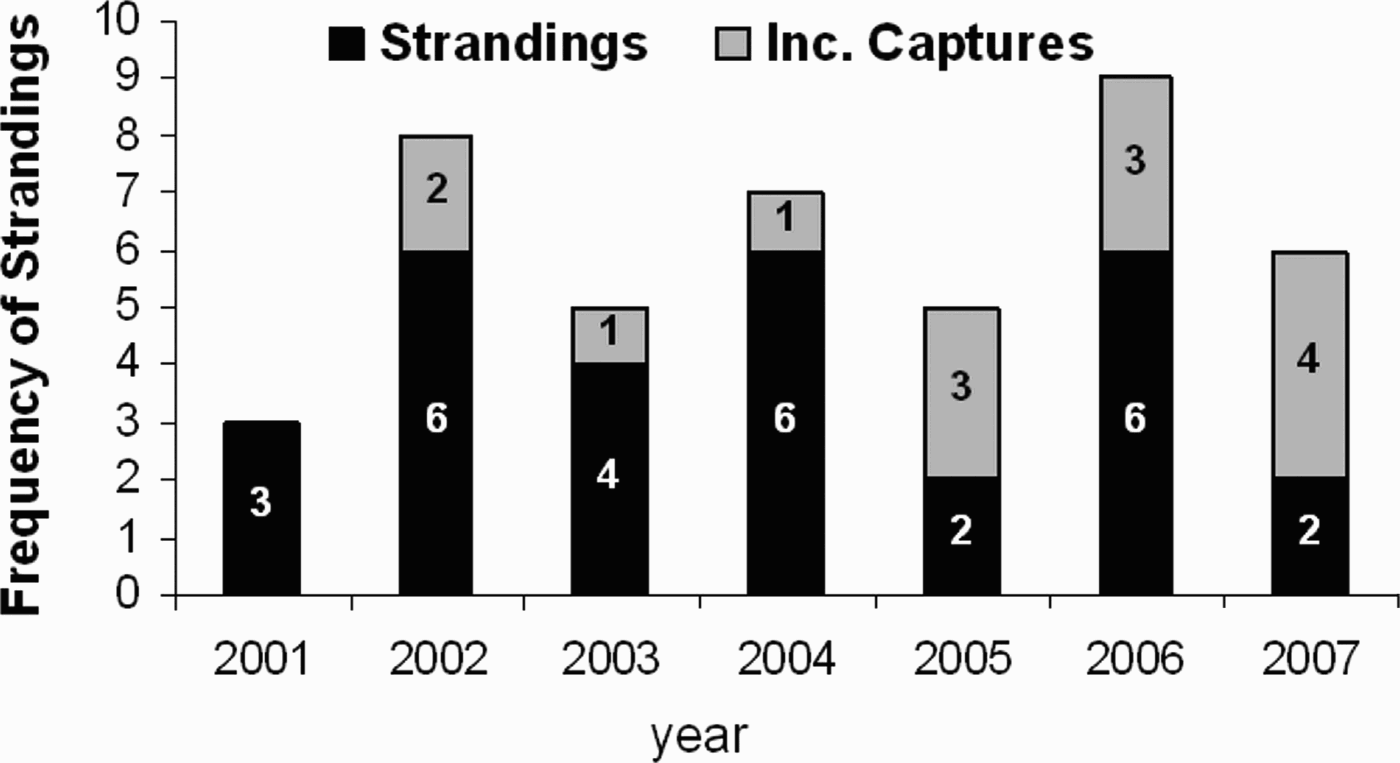
From July 2001 to August 2007 43 marine tucuxi dolphins were found in the study area, with an annual mean of 6.1 strandings (Figure 2). The highest number of strandings occurred during 2006, followed by 2002. Dolphins showing evidence of fishery interaction occurred in almost every year (annual mean = 2), except during 2001. The 43 stranded marine tucuxi dolphins were found throughout the study area, but some regions appeared to have more records than others (Figure 1).
Map showing the north-eastern coast of Rio de Janeiro State. The symbols represent the location of the occurrence of the dolphins according to the sex and related mortality (by-catch or non by-catch). BFC, Barra do Furado Canal; MR, Macaé River; SJR, São João River.

Number of marine tucuxi dolphin by-caught or non by-caught in each year, from July 2001 to August 2007 (N = 43), on the north-eastern coast of Rio de Janeiro State, Brazil. The numbers in each bar represents the number of dolphins reported in that year.

From 43 marine tucuxi dolphins stranded from 2001 to 2007, 32.5% (N = 14) showed evidence of fishery interaction while the others did not present clear evidence (or it could not be evaluated). Some of these dolphins were possibly victims of fishery by-catch; however, this was not possible to ascertain due to the advanced decomposition state of the carcasses.
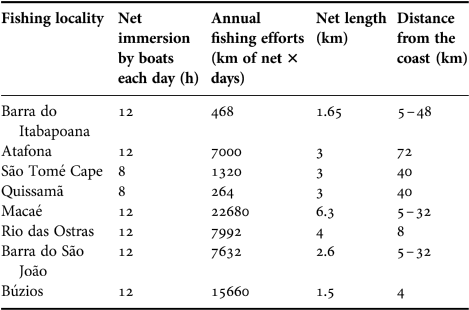
Marine tucuxi dolphins were found throughout the study area, but lack of strandings occurred in the regions near Carapebus and São Tomé Cape (Figure 1). However, most of the by-caught dolphins stranded in the northern portion of the study area, and according to Di Beneditto (Reference Di Beneditto2003), in the north coast of the Rio de Janeiro State (from Macaé to Barra de Itabapoana) marine tucuxi dolphins are the second most frequently by-caught species. This author also estimated that 100 marine tucuxi dolphins have been by-caught annually there. These results may reflect the passive gill-net fishery activities distributed in the study area (Table 1).
Characteristics of the passive gill-net fishery in each of the study areas. In the region of Arraial do Cabo gill-nets are not used. The main target fish of these fisheries are sharks, pomatomids and scianids.

In the region around Arraial do Cabo there was no presence of gill-nets and dolphins found there showed no evidence of by-catch. During previous efforts of sighting of marine mammals on land-based observations conducted in this region since 1999, few marine tucuxi were sighted. This southern portion of the study area is characterized by a relatively narrow shelf, with the coastline changing abruptly from a north–south to an east–west direction (Muehe & Valentini, Reference Muehe and Valentini1998; Campos et al., Reference Campos, Piola and Miller1999). In addition, this area is strongly influenced by intense coastal upwelling. Because of the high biological production associated with the upwelling process, oceanic predators (e.g. killer whales, Orcinus orca) are attracted to feed in this area and could predate on marine tucuxi dolphins (Siciliano et al., Reference Siciliano, Brito and Azevedo1999, Reference Siciliano, Moreno, Silva and Alves2006). Furthermore, at this zone the autumn water temperature (<18°C) could be avoided by this species of dolphin as it is thought to occur in the southern limit of its distribution (Borobia et al., Reference Borobia, Siciliano, Lodi and Hoek1991). The presence of predators and cold waters present in this southern region may act as a limiting factor for the occurrence of marine tucuxi dolphins.
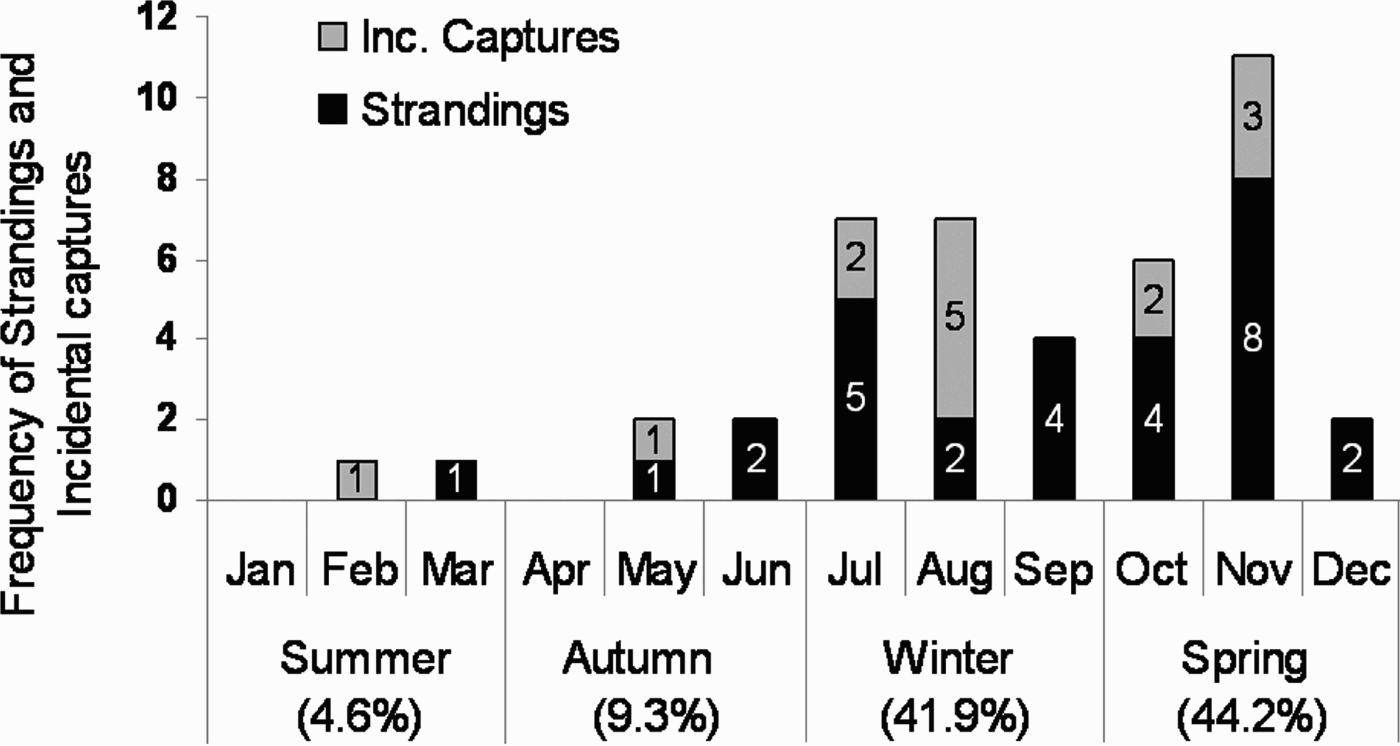
In all years, most strandings (both by-caught or non by-caught dolphins) occurred during the spring (44.4%) followed by winter (41.9%) (Figure 3). Only three strandings were recorded during the autumn and two during summer. Dolphins which showed evidence of by-catch had the highest frequency in winter (N = 8) and spring (N = 5) with a peak in August. During autumn and summer only one by-caught dolphin was reported, respectively. Similar results were found by Meirelles et al. (Reference Meirelles, Ribeiro, Silva, Soares Filho and Siciliano2006) off the Ceará coast. Despite small overall home ranges (Flores & Bazzalo, Reference Flores and Bazzalo2004), marine tucuxi dolphins show seasonal variation in its movements, possibly linked to their prey availability, however, the trend seems to vary among the study areas (Lodi, Reference Lodi2003; Garcia & Trujillo, Reference Garcia and Trujillo2004). However, Di Beneditto & Siciliano (Reference Di Beneditto and Siciliano2007) studying the diet of the stranded dolphins reported in this study, showed that marine tucuxi dolphins in this area feed on neritic prey that are distributed through the water column and are abundant all year round. It suggests that the temporal environmental variables, such as wind direction and sea currents may promote strong influences in the seasonal variables of the stranding distribution of marine tucuxi dolphins in the study area. In general, their prey species have low commercial value or are considered as by-catch species in the local fisheries (Di Beneditto et al., Reference Di Beneditto, Ramos and Lima1998).
Number of marine tucuxi dolphin by-caught or non by-caught in each season and month of the year, from July 2001 to August 2007 (N = 43), on the north-eastern coast of Rio de Janeiro State, Brazil. The numbers in each bar represent the number of dolphins reported in that month.

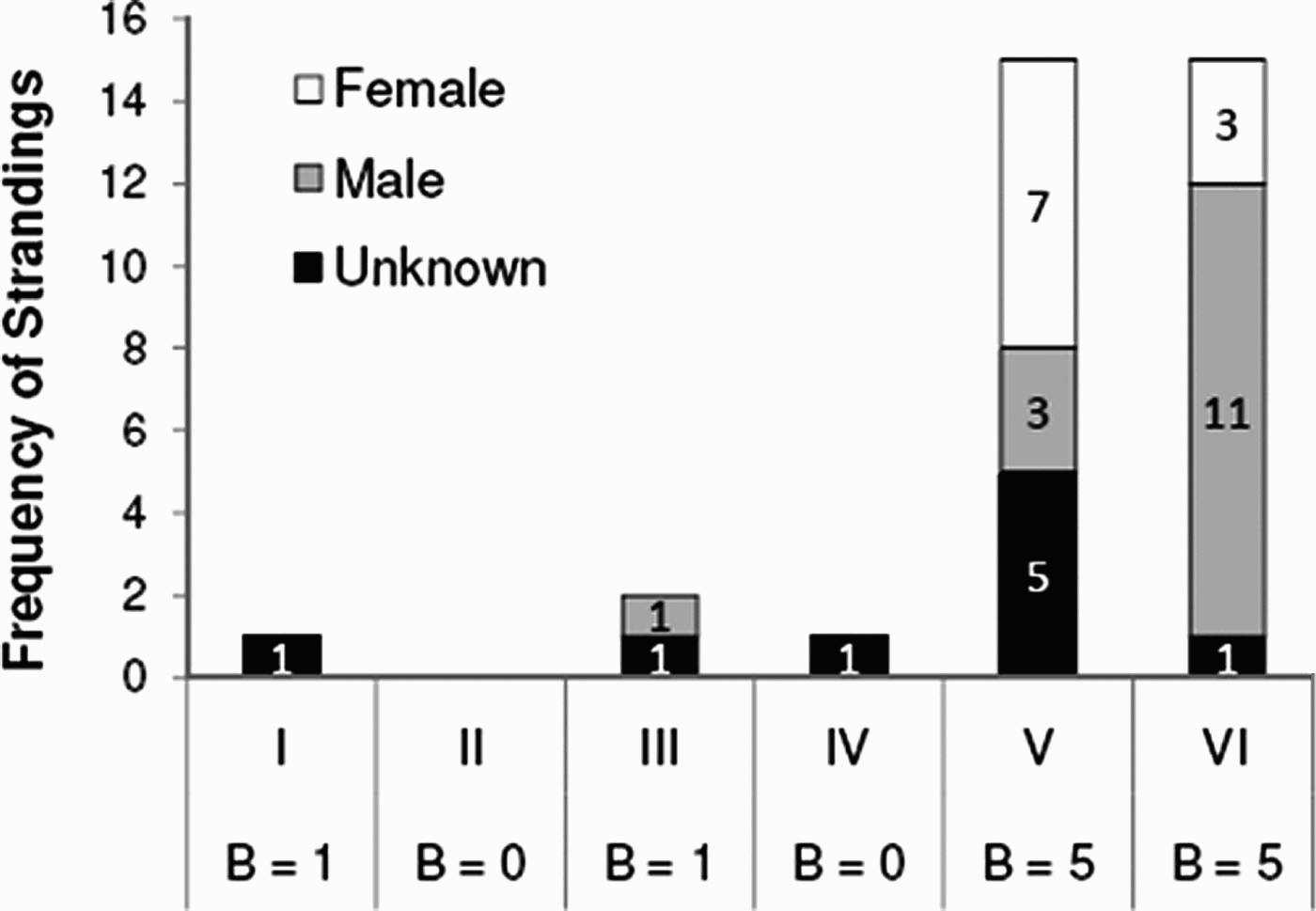
The results of the strandings referring to different classes of body length are presented in Figure 4. Most of the dolphins by-caught were included in Class V (N = 5) and Class VI (N = 5), both representing 44.1% of all dolphins measured, showing that most were sexually mature (Figure 4; Di Beneditto & Ramos, Reference Di Beneditto and Ramos2004). In Ceará State Monteiro-Neto et al. (Reference Monteiro-Neto, Alves-Junior, Ávila, Campos, Costa, Silva and Furtado-Neto2000) showed that by-catch was more frequent in marine tucuxi dolphins that were >160 cm total body length. Santos et al. (Reference Santos, Rosso and Ramos2003) and Meirelles et al. (Reference Meirelles, Ribeiro, Silva, Soares Filho and Siciliano2006) also found similar results from the south-east and north-east coast of Brazil, respectively.
The number of by-caught or non by-caught strandings for males, females, and unknown sex in each length-class stratum, from July 2001 to August 2007, on the north-eastern coast of Rio de Janeiro State. B, by-catch.

Gill-net fisheries can cause serious impacts on dolphin communities, particularly on the species living in coastal waters. Therefore, further studies have to be carried out to evaluate the population density of these dolphins in the study area to highlight the real threat that passive gill-nets present to the existence of the animals.
ACKNOWLEDGEMENTS
This is a contribution of Projeto de Monitoramento de Aves e Mamíferos Marinhos da Bacia de Campos – ENSP/FIOCRUZ & CENPES/PETROBRAS. The authors are very grateful to the team involved with GEMMLagos (Grupo de Estudos de Mamíferos Marinhos da Região dos Lagos) for their help during field work. A special thank you to Anne Marie L.S.F. de Moura for encouraging this note to be written. J.F. de Moura has a fellowship from Fundação Carlos Chagas Filho de Amparo à Pesquisa do Estado do Rio de Janeiro – FAPERJ (Process no. E-26/ 151.184/2007). We also thank the two anonymous referees for their critical comments on the manuscript.