





Background
In the contemporary medical landscape, developments in the field of medicine have led to a prolongation of life expectancy; consequently, the incidence of chronic diseases, especially cancer, has increased proportionally. It is reported that an average of 14 million people worldwide are diagnosed with cancer every year and 8.2 million people die due to cancer (Hulvat, Reference Hulvat2020; Soerjomataram and Bray, Reference Soerjomataram and Bray2021; Sung et al., Reference Sung, Ferlay, Siegel, Laversanne, Soerjomataram, Jemal and Bray2021). If this increase in the incidence of cancer continues, it is predicted that 22 million new cancer cases will occur in 2030 (Sung et al., Reference Sung, Ferlay, Siegel, Laversanne, Soerjomataram, Jemal and Bray2021).
Cancer patients experience many health problems caused by long treatment processes. For this reason, cancer patients are the patient group in need of care services the most. The need for cancer patients to receive professional care and the demand to improve their quality of life has led healthcare professionals to provide comprehensive care to cancer patients. As a result of these, palliative care has started to develop rapidly in recent years (Koesel et al., Reference Koesel, Tocchi, Burke, Yap and Harrison2019; Greer et al., Reference Greer, Applebaum, Jacobsen, Temel and Jackson2020; Henson et al., Reference Henson, Maddocks, Evans, Hicks and Higginson2020).
Cancer patients hospitalized in palliative care centres have many physical symptoms such as pain, nausea, vomiting, fatigue, sensory and emotional changes, disorientation, delirium, depression, sleep problems, regression, non-compliance with the treatment, rejection of the treatment, loneliness, and fear of the unknown. They may also experience many psychological problems (Koesel et al., Reference Koesel, Tocchi, Burke, Yap and Harrison2019; Quinn et al., Reference Quinn, Shurrab, Gitau, Kavalieratos, Isenberg, Stall, Stukel, Goldman, Horn, Cram, Detsky and Bell2020). Pain, which negatively affects patients and their relatives physically, psychosocially, and economically, is among the most common causes of complaints in palliative care patients. Pain is also one of the problems that reduces the quality of life and causes the most fear. Three out of five cancer patients experience pain at some stage of the disease and 25% of newly diagnosed patients, 33% of those receiving active cancer treatment, and 75% of advanced-level cancer patients experience intense pain (Koesel et al., Reference Koesel, Tocchi, Burke, Yap and Harrison2019; Henson et al., Reference Henson, Maddocks, Evans, Hicks and Higginson2020; Quinn et al., Reference Quinn, Shurrab, Gitau, Kavalieratos, Isenberg, Stall, Stukel, Goldman, Horn, Cram, Detsky and Bell2020).
At the same time, pain can be the main source or trigger of other symptoms. The main purpose of palliative care is to relieve pain (Koesel et al., Reference Koesel, Tocchi, Burke, Yap and Harrison2019; Quinn et al., Reference Quinn, Shurrab, Gitau, Kavalieratos, Isenberg, Stall, Stukel, Goldman, Horn, Cram, Detsky and Bell2020). Nurses play a key role in the symptom control of palliative care patients, especially in terms of pain. It has been stated that nurses should regularly evaluate the pain of palliative care patients, obtain subjective and objective data that cause pain, use pharmacological and non-pharmacological methods effectively, and know and apply high-evidence practices (Özveren and Kırca, Reference Özveren and Kırca2019).
It has been reported that cancer patients use complementary and integrated treatment methods at a rate ranging between 22.1% and 84.1%. The increase in the tendency of patients towards complementary and integrated therapies has caused non-health professionals to start providing this service. Nurses, who are the healthcare team members who spend the most time and interact with patients and their families, have important responsibilities in preventing this situation. Nurses should develop nursing practices related to complementary therapies, which is a dimension of nursing care, by counselling, protecting patients from possible harm and unwanted effects, and following studies with high levels of evidence (Chang and Chang, Reference Chang and Chang2015).
It has been reported that cancer patients treated in palliative care centres experience intense anxiety as well as pain symptoms (Koesel et al., Reference Koesel, Tocchi, Burke, Yap and Harrison2019). Cancer diagnosis and treatment can potentially cause patients to experience emotional distress and depression (Koesel et al., Reference Koesel, Tocchi, Burke, Yap and Harrison2019; Saygılı and Çelik, Reference Saygılı and Çelik2020).
Today, cancer patients and their relatives have turned to complementary integrated practices due to reasons such as prolongation of life expectancy with early cancer diagnosis, traditional methods being on the agenda, hope of healing, desperation, and thinking that medical treatment is insufficient. In addition to pharmacological methods, non-pharmacological methods are used to relieve pain and anxiety in palliative care patients (Dingley et al., Reference Dingley, Ruckdeschel, Kotula and Lekhak2021; Choi et al., Reference Choi, Karki Kunwor, Im, Choi, Hwang, Ahmed and Han2024). Music therapy, which is one of the complementary integrated therapies, is used to relieve many symptoms, especially pain, and anxiety, seen in cancer patients (Öztürk and Özbek, Reference Öztürk and Özbek2018; Dingley et al., Reference Dingley, Ruckdeschel, Kotula and Lekhak2021; Choi et al., Reference Choi, Karki Kunwor, Im, Choi, Hwang, Ahmed and Han2024).
Music creates a neuroendocrine stimulus, increases the release of dopamine and serotonin hormones, activates the limbic system, increases the release of endorphins, suppresses the activity of the sympathetic nervous system, and decreases the release of adrenaline. It has been reported that this situation contributes significantly to the reduction of pain (Huang et al., Reference Huang, Marion and Zauszniewski2010; Bradt et al., Reference Bradt, Potvin, Kesslick, Shim, Radl, Schriver, Gracely and Komarnicky-Kocher2015; Koesel et al., Reference Koesel, Tocchi, Burke, Yap and Harrison2019; Henson et al., Reference Henson, Maddocks, Evans, Hicks and Higginson2020; Düzgün and Karadakovan, Reference Düzgün and Karadakovan2021; Andrade et al., Reference Andrade, Haas, José, Faria, Santos, Ferreira, Barichello, Pires and Barbosa2022; Rennie et al., Reference Rennie, Irvine, Huang and Huang2022) and anxiety levels (Bradt et al., Reference Bradt, Potvin, Kesslick, Shim, Radl, Schriver, Gracely and Komarnicky-Kocher2015; Koesel et al., Reference Koesel, Tocchi, Burke, Yap and Harrison2019; Andrade et al., Reference Andrade, Haas, José, Faria, Santos, Ferreira, Barichello, Pires and Barbosa2022; Rennie et al., Reference Rennie, Irvine, Huang and Huang2022). It also affects the regulation of vital signs such as blood pressure, pulse, body temperature, respiratory rate, and oxygen saturation (Antoniazza et al., Reference Antoniazza, Pinto, Ferraraccio, Damini, Sollami and Marletta2018; Itao et al., Reference Itao, Komazawa and Kobayashi2018; Öztürk and Özbek, Reference Öztürk and Özbek2018; Köhler et al., Reference Köhler, Martin, Hertrampf, Gäbel, Kessler, Ditzen and Warth2020).
Despite theoretical plausibility and growing empirical evidence from international research, significant research gaps persist in Turkish and Middle Eastern palliative care settings. Specifically, no published research has systematically evaluated music’s simultaneous effects on pain, anxiety, and vital signs in Turkish palliative cancer populations. Furthermore, optimal music therapy parameters including session duration, frequency, musical selection, and delivery methods remain incompletely characterized, particularly concerning delivery methods that prevent cross-contamination in shared hospital rooms. This cluster quasi-experimental study addresses these gaps by examining single-session music therapy’s effects on multiple outcome domains in palliative cancer patients, utilizing a room-level allocation design to maintain intervention integrity and contributing to the evidence-base for non-pharmacological symptom management in resource-limited healthcare settings.
Study objectives and hypotheses
This study aimed to determine the effect of a structured, single-session music intervention on pain intensity, state anxiety levels, and vital signs in cancer patients receiving palliative care. The study tested the following three research hypotheses:
H 1 : The music intervention will significantly reduce pain intensity in the experimental group compared to the control group.
H 2 : The music intervention will significantly reduce state anxiety levels in the experimental group compared to the control group.
H 3 : The music intervention will significantly stabilize vital signs (reduce pulse rate, respiratory rate, and blood pressure, and increase oxygen saturation) in the experimental group compared to the control group.
Methods
Type of study
The study was conducted as a cluster quasi-experimental study with a pre-test and post-test control group in order to determine the effect of music on pain, anxiety, and vital signs in cancer patients treated in a palliative care centre. The quasi-experimental approach was selected due to pragmatic constraints in palliative care settings including limited patient accrual from high mortality rates, short hospitalization durations due to disease progression, and high patient attrition.
Setting and participants
Study design and setting
This study was conducted in Palliative Care Centers of XX City Hospital and YY Training and Research Hospital. Both facilities provide specialized inpatient palliative care services for cancer patients with advanced disease, accommodating 8–16 patients in semi-private rooms with 2–4 beds per room. Standard care includes pharmacological symptom management, nursing care, nutritional support, and family counselling. Data collection occurred between February 2021 and June 2022, spanning a 16-month period. The target population comprised adult cancer patients hospitalized in palliative care centres with pain and anxiety symptoms.
Inclusion Criteria: Patients were eligible for inclusion if they were aged 18 years or older, had a confirmed cancer diagnosis of any type or stage, had been hospitalized in the palliative care centre for at least 7 days, reported pain intensity of at least three out of 10 on the Visual Analog Scale (VAS) in the preceding 24 hours, could speak and understand Turkish, demonstrated ability to communicate verbally, maintained intact orientation to person, place, and time, had no diagnosed psychiatric disorders, had no severe visual or hearing impairments, and provided voluntary informed consent to participate.
Exclusion Criteria: Patients were excluded if they had undergone major surgery within the preceding month, were currently using other complementary or integrative therapies that might confound results, had cognitive impairment preventing informed consent or reliable data collection, or displayed acute hemodynamic instability requiring intensive monitoring or severe delirium affecting participation capacity.
Sample size and power analysis
A total of 218 cancer patients hospitalized in participating palliative care centres during the study period underwent eligibility screening (Figure 1). Of these, 186 patients were excluded from the study: 90 were unable to communicate due to altered mental status or severe fatigue, 83 died before completing the seven-day hospitalization requirement, and 13 declined participation citing lack of interest or discomfort with research procedures. The final sample comprised 32 participants (16 in intervention group, 16 in control group) recruited using convenience/purposive sampling. Participants were approached by the principal investigator within 48 hours of hospitalization, provided detailed study information, and given opportunity to ask questions before providing written informed consent.
CONSORT flow diagram of the study.

Sample size was determined a priori using GPower 3.1 software. Based on pilot data and published effect sizes for music interventions on pain (Cohen’s d = 0.60), with α = 0.05, power (1−β) = 0.80, two-tailed testing, and anticipated 20% attrition, minimum required sample size was calculated as 13 participants per group. To ensure adequate power accounting for potential losses, 16 participants per group (total N = 32) were enrolled. Post hoc power analysis confirmed achieved power of 0.82 (effect size = 0.006, α = 0.05) for linear mixed models (LMM) analysis, verifying sample adequacy for detecting clinically meaningful effects.
Due to shared patient rooms, group allocation was performed at room level (cluster allocation) to prevent contamination (control patients potentially overhearing intervention group music). Hospital rooms meeting eligibility criteria were sequentially added to a randomization pool. Rooms were assigned to intervention or control groups using computer-generated random number sequences prepared by an independent statistician. All patients within assigned rooms were allocated to corresponding groups. This cluster allocation approach was necessary to maintain intervention integrity within clinical constraints but is acknowledged as a potential source of selection bias.
Data collection procedures and instruments
The data of the study were collected using the Patient Description Form, VAS, State–Trait Anxiety Inventory (STAI), and Physiological Parameter Monitoring Form between February 2021 and June 2022.
Patient information form
This form was prepared by the researcher by examining the relevant literature (Huang et al., Reference Huang, Marion and Zauszniewski2010; Antoniazza et al., Reference Antoniazza, Pinto, Ferraraccio, Damini, Sollami and Marletta2018; Itao et al., Reference Itao, Komazawa and Kobayashi2018; Bro et al., Reference Bro, Jespersen, Hansen, Vuust, Abildgaard, Gram and Johansen2019; Köhler et al., Reference Köhler, Martin, Hertrampf, Gäbel, Kessler, Ditzen and Warth2020). It consists of 15 questions that include information about the socio-demographic characteristics of individuals, chronic disease, cancer type, cancer stage, length of stay in the palliative care centre, recent surgery, duration of analgesic use, dose, and frequency of analgesics used. The form was administered through face-to-face interview with medical record verification, requiring approximately 10 minutes. Content validity was established through expert review by three palliative care specialists and two nurse researchers.
Visual Analog Scale
VAS is a pain measurement method developed by Price et al. (Reference Price, McGrath, Rafii and Buckingham1983). VAS is used to make the feeling of undetectable pain numerically significant. The range of 0 (zero) and 10 cm is determined on a ruler (0 (zero) refers to ‘no pain’ and 10 refers to ‘worst possible pain’). The patient is asked to mark the place that expresses the pain on the line. The distance marked by the patient is evaluated by measuring the starting distance of zero. The scale is interpreted as: 0 = no pain; 1–3 = mild pain; 4–6 = moderate pain; 7–10 = severe pain.
State-Trait Anxiety Inventory (STAI)
The STAI was developed by Spielberger et al., in 1970 (Spielberger et al., Reference Spielberger, Gorsuch and Lushene1970).The validity and reliability study for Turkish society was conducted by Öner and Le Compte in 1985 (Öner and Le Compte, Reference Öner and Le Compte1983). High scores indicate high anxiety levels and low scores indicate low anxiety levels. There are two types of statements in the STAI. Direct expressions express negative emotions and reversed expressions express positive emotions. A low score indicates a low level of anxiety, while a high score indicates a high level of anxiety. The internal consistency reliability coefficient (Cronbach’s α) value of the scale was between 0.94 and 0.96 for ‘State Anxiety’ and between 0.83 and 0.87 for ‘Trait Anxiety’. In the present study, Cronbach’s α value was found to be 0.81 for ‘State Anxiety’ and 0.76 for ‘Trait Anxiety’.
Physiological parameter monitoring form
Physiological Parameter Monitoring Form was researcher-developed for recording vital sign measurements at each assessment time point. The form documents six parameters: body temperature (°C) measured by tympanic thermometer, pulse rate (beats per minute) assessed via radial palpation or automated monitor, respiratory rate (breaths per minute) determined through visual observation of chest movements over 60 s, systolic blood pressure (mmHg) measured by automated sphygmomanometer, diastolic blood pressure (mmHg) measured by automated sphygmomanometer, and oxygen saturation SpO2 (%) assessed through pulse oximetry with finger probe. All equipment consisted of standard hospital clinical monitoring devices calibrated and validated according to manufacturer specifications. The researcher measured all parameters following standardized protocols with participants resting quietly for 5 minutes before measurements to ensure physiological stability.
Data collection
After obtaining the necessary permissions for the research, the rooms of the patients who were hospitalized in XX City Hospital Palliative Care Center and YY Training and Research Hospital Palliative Care Center between February 2021 and June 2022 and who met the criteria for inclusion in the study were taken into the randomization pool and then the patient rooms were assigned to the intervention and control groups. The data for this study was collected between February 2021 and June 2022. Patients who slept in the same room were included in the same group in order to prevent the participants from being affected by each other. Patients who met the inclusion criteria of the study were informed about the study both verbally and in writing, and a written Informed Voluntary Consent Form was signed by the patients participating in the study. A total of 218 patients were reached during the study, 186 of whom 90 patients were not open to communication, 83 patients died before seven days of hospitalization, and 13 patients refused to participate in the study) did not meet the inclusion criteria.
Data collection took approximately 60 minutes. After face-to-face interviews, the information obtained from the patients who agreed to participate in the study was recorded by the researcher on the data collection form.
Intervention procedures
Intervention Group: A trained nurse researcher administered the music intervention to all participants in the experimental group. The musical selection comprised a Compact Disc featuring 13 instrumental tracks in the traditional Turkish Hicaz and Buselik maqams, known for their sedative properties. This compilation was specifically prepared by the Applied Music Therapy Association (UMTED). The intervention was delivered via an MP3 player (MPEG-1 Audio Layer III) using individual stereo headphones to prevent cross-contamination. The volume was maintained at a moderate level (approximately 60–70 decibels) to emphasize the main melody without startling transitions. To allow for the stabilization of medication effects, the intervention was conducted between 10:00 AM and 5:00 PM, exactly 30 minutes following the administration of the patient’s first daily analgesic dose. Sessions took place in the patients’ rooms with dimmed lighting, closed doors, and a ‘do not disturb’ sign to minimize interruptions. During the 30-minute session, external stimuli such as visitors, phone calls, and routine nursing interventions were strictly restricted to ensure intervention fidelity.
The procedure consisted of three sequential phases:
-
1. Pre-intervention Assessment (15 minutes): The researcher administered the Patient Description Form, the STAI, and the VAS for pain. Baseline vital signs (blood pressure, pulse rate, respiratory rate, body temperature, and SpO2) were measured using standard clinical equipment and recorded on the Physiological Parameter Monitoring Form.
-
2. Intervention Delivery (30 minutes): Participants were positioned in a comfortable supine or semi-Fowler position. Headphones were applied, and patients were instructed to close their eyes, breathe normally, avoid conversation, and focus on the music.
-
3. Post-intervention Assessment (Immediate): Within five minutes of music cessation, the researcher re-evaluated the VAS pain scores, the state anxiety subscale of the STAI, and all vital signs. Trait anxiety was not reassessed, as it represents a stable personality metric.
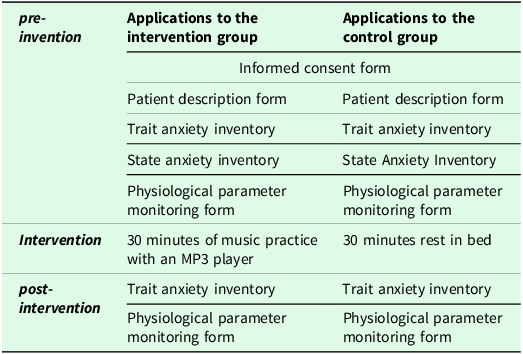
Control Group – Rest Period: Participants in the control group underwent an identical assessment protocol, substituting the music therapy with a 30-minute quiet rest period. Following the initial baseline assessments, they were instructed to rest in bed. Resting in bed was standardized as resting without any external stimuli (e.g., no television, smartphones, reading, or conversation) in a peaceful, closed-room environment. Post-rest assessments were conducted identically to those in the intervention group. Furthermore, to ensure inter-group equivalence and control for pharmacological confounding, no analgesic dose changes were made within 60 minutes before or after the session for either group. The complete procedures for both groups are summarized in Table 1.
The procedures applied to the intervention and control groups (n = 32)

Table 1. Long description
A table comparing procedures for intervention and control groups. The table has three main sections: pre-intervention, intervention, and post-intervention. It includes two columns: one for the intervention group and one for the control group. The pre-intervention section has four rows: Informed consent form, Patient description form, Trait anxiety inventory, State anxiety inventory, and Physiological parameter monitoring form. Both groups have the same forms. The intervention section has one row: 30 minutes of music practice with an MP3 player for the intervention group and 30 minutes rest in bed for the control group. The post-intervention section has two rows: Trait anxiety inventory and Physiological parameter monitoring form, both identical for both groups.
Evaluation of data
Statistical analyses were performed using SPSS version 24 software. The conformity of the variables to the normal distribution was examined using visual and analytical methods (Shapiro–Wilk Test). Descriptive analyses are given using the mean and standard deviation for normally distributed variables. The Chi-Square Test was used for categorical variables. To strictly account for the cluster allocation design (room-level assignment) and the baseline socio-demographic imbalances between groups, data were analysed using LMM instead of standard repeated measures ANOVA. In the LMM analysis, ‘time’ and ‘group’ were entered as fixed effects, while ‘patient room’ was entered as a random effect to adjust for intra-cluster correlation (clustering effects). Furthermore, education and income levels, which showed significant baseline differences, were included as covariates in the model. The group-time interaction effect was primarily evaluated to determine the intervention’s true efficacy. The statistical significance level was accepted as p < 0.05.
Results
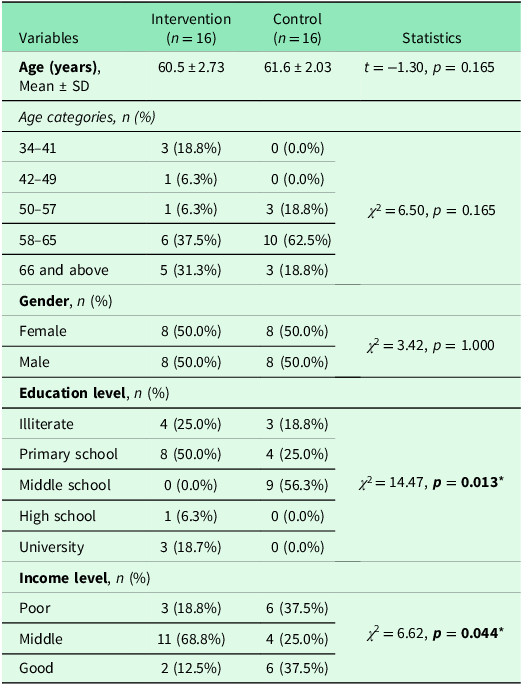
The distribution of the intervention and control groups according to their baseline sociodemographic characteristics is presented in Table 2. In terms of age categories, 37.5% of the intervention group and 62.5% of the control group were in the 58–65 age bracket. The gender distribution was 50.0% female and 50.0% male in both groups. No statistically significant difference was found between the groups in terms of age (χ 2 = 6.50, p = 0.165) and gender (χ 2 = 3.42, p = 1.000). A statistically significant difference was identified concerning education level (χ 2 = 14.47, p = 0.013) and income level (χ 2 = 6.62, p = 0.044). Consequently, education and income levels were included as covariates in the Linear Mixed Models (LMM) analyses.
Baseline sociodemographic characteristics of the participants (N = 32)

Table 2. Long description
A table comparing the sociodemographic characteristics of intervention and control groups (Table 2). The table has 11 rows and 4 columns. The columns are labeled Variables, Intervention (n = 16), Control (n = 16), and Statistics. The rows are labeled with different variables such as Age, Gender, Education level, and Income level. For Age, the mean age for the intervention group is 60.5 ± 2.73 years, and for the control group, it is 61.6 ± 2.03 years. The age categories are broken down into percentages for both groups. For Gender, both groups have 50.0% female and 50.0% male. For Education level, the intervention group has 25.0% illiterate, 50.0% primary school, 0.0% middle school, 6.3% high school, and 18.7% university. The control group has 18.8% illiterate, 25.0% primary school, 56.3% middle school, 0.0% high school, and 0.0% university. For Income level, the intervention group has 18.8% poor, 68.8% middle, and 12.5% good. The control group has 37.5% poor, 25.0% middle, and 37.5% good. The statistics section includes t-tests and chi-square tests for different variables (Table 2).
* Note: SD = Standard Deviation. p < 0.05 indicates a statistically significant difference between groups at baseline. Due to these differences, education and income levels were incorporated as covariates in the subsequent Linear Mixed Models.
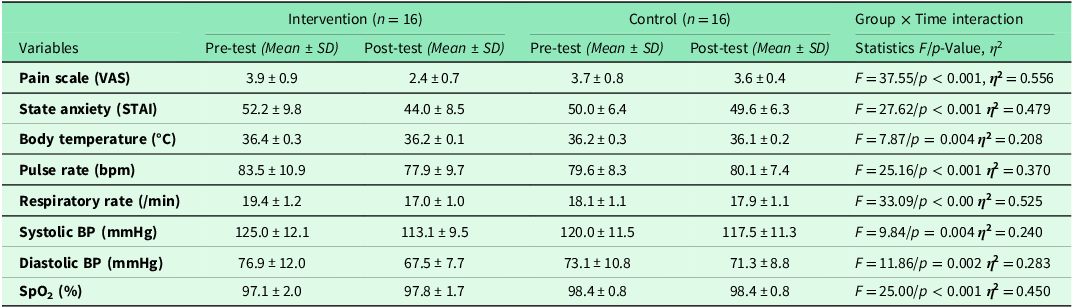
Table 3 presents the pre- and post-intervention measurements for pain, state anxiety, and physiological parameters. LMM analysis, adjusting for baseline covariates and cluster allocation, revealed a statistically significant group × time interaction for pain scores measured by the VAS (F = 37.55, p < 0.001, η 2 = 0.556). The post-intervention mean pain score was 2.4 ± 0.7 in the intervention group and 3.6 ± 0.4 in the control group.
A statistically significant group × time interaction was identified for State Anxiety Inventory (STAI) scores (F = 27.62, p < 0.001, η 2 = 0.479). The post-intervention mean state anxiety score was 44.0 ± 8.5 in the intervention group and 49.6 ± 6.3 in the control group.
Regarding the physiological parameters, statistically significant group × time interactions were observed for body temperature (F = 7.87, p = 0.004, η 2 = 0.208), pulse rate (F = 25.16, p < 0.001, η 2 = 0.370), respiratory rate (F = 33.09, p < 0.001, η 2 = 0.525), systolic blood pressure (F = 9.84, p = 0.004, η 2 = 0.240), and diastolic blood pressure (F = 11.86, p = 0.002, η 2 = 0.283). A statistically significant group × time interaction was also detected for oxygen saturation (SpO2) (F = 25.00, p < 0.001, η 2 = 0.450). The post-intervention mean SpO2 was 97.8 ± 1.7 in the intervention group and 98.4 ± 0.8 in the control group (Table 3).
Comparison of pain, state anxiety, and physiological parameters between groups pre- and post-intervention (N = 32)

Note: SD = Standard Deviation; VAS = Visual Analog Scale; STAI = State–Trait Anxiety Inventory; BP = Blood Pressure; bpm = beats per minute. P-values reflect the group × time interaction effect, adjusting for baseline socio-demographic covariates and cluster allocation via Linear Mixed Models.
Baseline Trait Anxiety Inventory scores are presented in Table 4. No statistically significant difference was found between the pre-intervention trait anxiety scores of the intervention (51.1 ± 4.2) and control (50.0 ± 3.7) groups (p = 0.430).
Comparison of Trait Anxiety Inventory Scores of the intervention and control groups (n = 32)

Table 4. Long description
The table presents a comparison of various physiological and psychological variables between intervention and control groups, each consisting of 16 participants. The table includes pre-test and post-test measurements for both groups, along with statistics for group by time interactions. The variables measured include pain scale (VAS), state anxiety (STAI), body temperature, pulse rate, respiratory rate, systolic blood pressure, diastolic blood pressure, and SpO2. Each row lists the mean and standard deviation for pre-test and post-test values for both groups, followed by the F-value, p-value, and eta squared (η²) for the group by time interaction. The table shows notable trends such as reductions in pain scale, state anxiety, pulse rate, respiratory rate, systolic blood pressure, and diastolic blood pressure in the intervention group compared to the control group. Body temperature and SpO2 levels show minimal changes. The statistics indicate significant interactions for most variables, suggesting the intervention had a measurable effect.
Discussion
Today, scientific studies support the acceptance of music as an important therapy method in the field of health. Especially in terms of pain management, anxiety levels, and regulation of vital signs, the positive effects of music are being investigated with increasing interest. By employing LMM to account for cluster allocation and baseline sociodemographic covariates, this study evaluated these effects within a rigorous statistical framework.
In our study, a statistically significant group × time interaction was identified for pain scores, indicating a notable reduction in the intervention group compared to the control group while adjusting for baseline covariates. This result supports the H1 hypothesis and aligns with literature demonstrating that music interventions, including Turkish classical music and patient-preferred selections, effectively reduce pain levels in cancer patients (Huang et al., Reference Huang, Marion and Zauszniewski2010; Bro et al., Reference Bro, Jespersen, Hansen, Vuust, Abildgaard, Gram and Johansen2019; Düzgün and Karadakovan, Reference Düzgün and Karadakovan2021).
Similarly, a statistically significant group × time interaction was observed for State Anxiety Inventory scores, demonstrating a reduction in acute anxiety within the intervention group. This supports the H2 hypothesis and is consistent with previous randomized controlled trials and systematic reviews highlighting music’s efficacy in significantly decreasing state anxiety among terminal cancer and surgical patients (Bradt et al., Reference Bradt, Potvin, Kesslick, Shim, Radl, Schriver, Gracely and Komarnicky-Kocher2015; Antoniazza et al., Reference Antoniazza, Pinto, Ferraraccio, Damini, Sollami and Marletta2018; Andrade et al., Reference Andrade, Haas, José, Faria, Santos, Ferreira, Barichello, Pires and Barbosa2022).
Regarding physiological parameters, statistically significant group × time interactions were detected for body temperature and pulse rate, indicating a physiological stabilization in the intervention group compared to the control group. This aligns with research demonstrating that sedative classical music appears to modulate autonomic responses, leading to decreased heart rate and body temperature (Antoniazza et al., Reference Antoniazza, Pinto, Ferraraccio, Damini, Sollami and Marletta2018; Itao et al., Reference Itao, Komazawa and Kobayashi2018; Köhler et al., Reference Köhler, Martin, Hertrampf, Gäbel, Kessler, Ditzen and Warth2020; Andrade et al., Reference Andrade, Haas, José, Faria, Santos, Ferreira, Barichello, Pires and Barbosa2022). The LMM analysis also revealed significant interactions for respiratory rate and blood pressure, with the intervention group demonstrating greater reductions. These modulatory effects are well-supported by meta-analyses and systematic reviews reporting similar cardiovascular and respiratory improvements following music therapy (Bradt et al., Reference Bradt, Potvin, Kesslick, Shim, Radl, Schriver, Gracely and Komarnicky-Kocher2015; Yang et al., Reference Yang, Wang, Wang, Wei, Kang, Liu and Zhang2021; Rennie et al., Reference Rennie, Irvine, Huang and Huang2022). Furthermore, a statistically significant group × time interaction indicated that SpO2 values of the intervention group were maintained at higher levels post-intervention, consistent with findings in cardiopulmonary settings (Andrade et al., Reference Andrade, Haas, José, Faria, Santos, Ferreira, Barichello, Pires and Barbosa2022). Thus, music demonstrates a potential to positively modulate vital signs in palliative care patients.
When determining the effect of music on state anxiety in cancer patients, the baseline trait anxiety levels of the patients measured by the Trait Anxiety Inventory must be similar. The fact that the patients in both groups had comparable trait anxiety levels at baseline (as confirmed in Table 4) suggests that the observed anxiolytic effects are likely attributable to the intervention rather than pre-existing personality differences. Furthermore, adjusting for baseline sociodemographic imbalances (education and income) as covariates in our LMM analysis supported the assumption that the measured effects were robust against these potential confounders.
Overall, the results show that music may contribute as a beneficial, non-pharmacological adjunct for cancer patients receiving palliative care. By acutely alleviating pain intensity and anxiety symptoms while promoting physiological stability, music therapy could be effective in helping patients achieve better mental and emotional balance. While further investigation is needed into the neurophysiological mechanisms and optimal dosages, these findings emphasize that music practices can be an effective tool to support the psychosocial well-being and quality of life of cancer patients.
Limitations of the study
This study has certain limitations that provide essential context for interpreting the findings. First, while the sample size (N = 32) provided adequate statistical power for the employed models, it reflects the inherent challenges of patient accrual in palliative care settings due to naturally high attrition and mortality rates. Second, a cluster allocation method (room-level) was strategically implemented to prevent treatment contamination between patients sharing the same hospital rooms. Third, due to the inherent nature of the music intervention, it was not possible to blind the data-collecting researcher or the patients to the group allocation. This lack of blinding may pose a potential risk of expectation bias. Finally, the study focused on evaluating the acute effects of a single 30-minute music session. The cumulative effects of multiple sessions and the long-term sustainability of symptom relief offer valuable avenues for future clinical investigation.
Conclusions
This study provides robust empirical evidence regarding the acute positive effects of music therapy on cancer patients receiving palliative care. The LMM analysis demonstrated a statistically significant group × time interaction, indicating that a single 30-minute session of maqam-based instrumental music effectively reduced pain intensity and state anxiety in the intervention group compared to the standard resting control group. Furthermore, the intervention facilitated the stabilization of physiological parameters, evidenced by significant reductions in pulse rate, respiratory rate, and blood pressure, alongside a significant increase in oxygen saturation (SpO2). These convergent findings across subjective psychological symptoms and objective physiological parameters indicate that music therapy demonstrates potential to serve as a safe, stabilizing, and non-pharmacological adjunct for acute symptom management in palliative cancer care. Ultimately, it represents a valuable complementary approach to enhance patient comfort and support holistic care in palliative oncology settings.
Recommendations
Based on the study findings and the identified limitations, the following recommendations are made for future research and clinical practice:
-
• Clinical Integration: Healthcare professionals should consider music therapy as a low-cost, safe, and complementary tool to support standard pharmacological approaches in alleviating acute pain and anxiety in palliative care settings.
-
• Future Research Designs: To definitively establish the efficacy of music therapy, future research must prioritize large-scale, individually randomized controlled trials with adequate power and blinded outcome assessments.
-
• Dose–Response and Personalization: Systematic investigations are needed to determine the optimal dose–response relationships, including variations in session duration and frequency. Additionally, studies comparing standardized clinical music (such as specific maqams) with personalized music chosen based on individual patient preferences would highly enhance clinical relevance.
-
• Longitudinal Impact: Prospective cohort studies should be conducted to assess the sustained, long-term effects of repeated music therapy sessions on the overall quality of life, functional status, and end-of-life experience of cancer patients.
Data availability statement
The datasets generated and/or analysed during the current study are not publicly available due to institutional and ethical restrictions but are available from the corresponding author on reasonable request.
Acknowledgements
We would like to thank the volunteers who participated in the study and the healthcare professionals who supported our research for their valuable contributions.
Author contributions
G.K., is responsible for conceptualization, methodology, formal analysis, investigation, resources, software, writing – original draft, writing – reviewing and editing, visualization, and project administration. P.T.K., is responsible for conceptualization, data curation, methodology, formal analysis, methodology, project administration, resources, software, supervision, validation, writing – reviewing and editing, and supervision.
Funding statement
This research received no specific grant from any funding agency, commercial or not-for-profit sectors.
Competing interests
The author(s) declare none.
Ethical standards
The authors assert that all procedures contributing to this work comply with the ethical standards of the relevant national and institutional guidelines on human experimentation (XX University Clinical Research Ethics Committee, Approval no: 2021.01/06; Approval date: January 27, 2021) and with the Helsinki Declaration of 1975, as revised in 2008. Written informed consent was obtained from all subjects/patients.



 Open access

