Introduction
Cetaceans play several important ecological roles in aquatic ecosystems, such as predation in trophic webs, resuspension of sediment and conveying nutrients both vertically and horizontally (Katona & Whitehead, Reference Katona and Whitehead1988; Roman et al., Reference Roman, Estes, Morissette, Smith, Costa, McCarthy, Nation, Nicol, Pershing and Smetacek2014). Understanding how cetaceans interact with the biotic and abiotic environment can lead to increasingly refined knowledge of these ecological roles. One of the tools to achieve this goal is to investigate their feeding habits.
There are several ways of studying cetacean feeding habits. It is possible to study them from in situ observations of feeding activities, using modern cameras attached to individuals (e.g. Calambokidis et al., Reference Calambokidis, Schorr, Steiger, Francis, Bakhtiari, Marshall, Olsen, Gendron and Robertson2007) or acoustic recording tags in free-ranging individuals (e.g. Parks et al., Reference Parks, Cusano, Stimpert, Weinrich, Friedlaender and Wiley2014). Alternatively, multiple laboratory methodologies could be applied, using samples from dead and live individuals for analyses of stable isotopes (e.g. Herman et al., Reference Herman, Burrows, Wade, Durban, Matkin, LeDuc, Barrett-Lennard and Krahn2005; Newsome et al., Reference Newsome, Clementz and Koch2010), fatty acids (e.g. Herman et al., Reference Herman, Burrows, Wade, Durban, Matkin, LeDuc, Barrett-Lennard and Krahn2005; Budge et al., Reference Budge, Springer, Iverson, Sheffield and Rosa2008), molecular identification of prey (e.g. Marshall et al., Reference Marshall, Hart, Yaskowiak, Stenson, McKinnon and Perry2010), and prey remains present in stomach contents (Barros & Clarke, Reference Barros, Clarke, Perrin, Würsig and Thewissen2009). The latter is a more traditional method, yet still considered cheaper and more accessible in comparison to the former quoted methods.
The franciscana dolphin, Pontoporia blainvillei (Gervais & d'Orbigny, 1844), also known as toninha (Committee on Taxonomy, 2018), is a small cetacean and sole member of the Pontoporiidae family (Rodriguez et al., Reference Rodriguez, Rivero and Bastida2002). It is endemic to the coastal shallow waters of the South-western Atlantic ocean, occurring from the northern coast of the state of Espírito Santo (18°25′S 30°42′W), south-east of Brazil (Siciliano, Reference Siciliano1994), to the northern Gulf of San Matias (42°35′S 64°48′W), central Argentina (Crespo et al., Reference Crespo, Harris and González1998). It is usually found in turbid waters within the 30 m isobath of the continental shelf (Pinedo et al., Reference Pinedo, Praderi, Brownell, Perrin, Brownell, Kaiya and Jiankang1989; Bordino et al., Reference Bordino, Siciliano, Bastida and Cremer2002), generally near rivers and estuary mouths (Siciliano et al., Reference Siciliano, Di Beneditto and Ramos2002). Two previously described populations dwell in estuarine habitats in the Babitonga (26°S) (Cremer et al., Reference Cremer, Pinheiro and Simões-Lopes2012) and Laranjeiras (24°S) (Santos et al., Reference Santos, Oshima and Silva2009) basins in Brazil. Interactions with fishery gillnets have been reported in several areas (see Ott et al., Reference Ott, Secchi, Moreno, Danilewicz, Crespo, Bordino, Ramos, Di Beneditto, Bertozzi, Bastida, Zanelatto, Perez and Kinas2002; Rosas et al., Reference Rosas, Monteiro Filho and Oliveira2002; Netto & Di Beneditto, Reference Netto and Di Beneditto2008), representing one of the main threats that lead to the classification as a species ‘vulnerable to extinction’ by the International Union for the Conservation of Nature Red List of Endangered Species (Zerbini et al., Reference Zerbini, Secchi, Crespo, Danilewicz and Reeves2017). The incidental capture of ~2900 franciscanas per year in the early 2000s was estimated over its entire distribution area (Secchi et al., Reference Secchi, Ott, Danilewicz, Gales, Hindell and Kirkwood2003). In the Cananéia region, south-eastern Brazil, a previous study estimated that the potential annual mortality of franciscana may be ~330 specimens (Rosas et al., Reference Rosas, Monteiro Filho and Oliveira2002). Due to the alarming numbers of incidental catches in fishing operations and an imbalance in the degree of knowledge of the species throughout its distribution, Secchi et al. (Reference Secchi, Ott, Danilewicz, Gales, Hindell and Kirkwood2003) separated their range into four ‘Franciscana Management Areas (FMAs)’, defined as: FMA I: from Espírito Santo to Rio de Janeiro, Brazil; FMA II: from São Paulo to Santa Catarina, Brazil; FMA III: from Rio Grande do Sul, Brazil, to Uruguay; and FMA IV: northern Argentina. After evaluating the main gaps in species knowledge by area based on Secchi et al. (Reference Secchi, Ott, Danilewicz, Gales, Hindell and Kirkwood2003) and the national franciscana dolphin action plan in Brazilian waters (Di Beneditto et al., Reference Di Beneditto, Rocha-Campos, Danilewicz, Secchi, Moreno, Hassel, Tavares, Ott, Siciliano, Souza and Alves2010), investigating the feeding habits of this species in the FMA II was listed as one of the priorities for further investigation.
For P. blainvillei in general, piscivorous and teuthophagous feeding habits have been described in the past few decades (e.g. Fitch & Brownell, Reference Fitch and Brownell1971; Di Beneditto & Ramos, Reference Di Beneditto and Ramos2001; Rodriguez et al., Reference Rodriguez, Rivero and Bastida2002; Bittar & Di Beneditto, Reference Bittar and Di Beneditto2009; Cremer et al., Reference Cremer, Pinheiro and Simões-Lopes2012; Paso-Viola et al., Reference Paso-Viola, Denuncio, Negri, Rodríguez, Batista and Cappozzo2014). Most of the prey consumed by franciscanas throughout most of its distribution are of low commercial value or are usually considered as bycatch for the fishery market (Di Beneditto & Ramos, Reference Di Beneditto and Ramos2001; Bittar & Di beneditto, Reference Bittar and Di Beneditto2009). On the other hand, in specific sectors of its distribution, the main prey of franciscana dolphins were listed as the main targets of fishing operations (Rodríguez et al., Reference Rodriguez, Rivero and Bastida2002; Paso-Viola et al., Reference Paso-Viola, Denuncio, Negri, Rodríguez, Batista and Cappozzo2014).
Over almost five decades, only 12 studies were published on feeding habits of franciscana dolphins. So far, 707 stomach contents were evaluated throughout the distribution range of the species. The samples were not evenly distributed among all FMAs. Within FMA II specifically, there are only two available studies based on the analyses of stomach contents of 66 individuals (Cremer et al., Reference Cremer, Pinheiro and Simões-Lopes2012, N = 8; and Henning et al., Reference Henning, Carvalho, Pires, Bassoi, Marigo, Bertozzi and Araújo2018, N = 58). Furthermore, at least 10 other unpublished studies were conducted for academic degree purposes, evaluating ~600 additional samples.
Based on the described scenario, the objective of the present study was to more comprehensively evaluate the feeding habits of franciscana dolphins in FMA II using individuals found dead between 2005 and 2015, comparing present results to previous published studies conducted in all FMAs.
Materials and methods
Study area
The study area encompassed a large part of the southern Marine Protected Area of São Paulo state (São Paulo State Decree No. 53.526, 2008), Brazil (between 24°20′S and 25°30′S; e.g. Figure 1). The main economic activity in this region is commercial fisheries that involve more than 3000 fishermen (Mendonça et al., Reference Mendonça, Pires, Calasans, Xavier and Sena2003). The main exploited fish species in 2018 were Macrodon atricauda, Micropogoninas furnieri, Mugil liza, Larimus breviceps, in addition to the shrimp Xiphopenaeus kroyeri. These resources were mainly caught with bottom-set gillnets and double-trawl. Cananéia is the second county that most contributed to fish catches in the state of São Paulo (Ávila-da-Silva et al., Reference Ávila-da-Silva, Carneiro, Mendonça, Bastos, Miranda, Ribeiro and Santos2019). Due to the presence of a large number of vessels, cetacean bycatch has been occurring frequently in the area (Rosas et al., Reference Rosas, Monteiro Filho and Oliveira2002).
Map of the study area showing the southern coastal region of São Paulo state and the northern coast of Paraná state, south-eastern Brazil. Beach surveys were conducted along a 115 km stretch of coastline and dots indicate the exact locations where incidentally captured dolphins were collected.

Sampling
Samples came from cetaceans incidentally caught by fishing gillnets or found stranded along ~115 km of coastline. Beach surveys for dead cetaceans were conducted opportunistically from 2005 to 2016, providing a total of six freshly dead franciscana dolphins for this study. Fishing operations based out of Cananéia port were monitored from 2004 to 2007, and from 2011 to 2016, supplying 139 additional specimens for this investigation. From the 145 sampled stomachs, 86 belonged to males and 59 to females; 33 were sampled in summer, 36 in autumn, 51 in winter, 20 in spring. Five individuals had no precise sampling date/season. No stomach contents were added from previous studies and thus, the data presented here are derived from stomach contents analysed solely from this study.
Stomach contents were screened using a fine mesh sieve (200 μm). The whole and degraded items were stored in alcohol (70%). The otoliths were dry preserved. Cephalopod beaks were stored in a 1:1 solution of alcohol (70%) and glycerin.
Identification of food items
The sagitta otoliths and cephalopod beaks were identified to the lowest possible taxonomic level using a stereomicroscope, a reference otolith collection of fish collected in the study area, and published catalogues (Corrêa & Vianna, Reference Corrêa and Vianna1992/93; Lemos et al., Reference Lemos, Corrêa and Abilhôa1992/93, Reference Lemos, Corrêa and Pinheiro1995a, Reference Lemos, Corrêa and Pinheiro1995b; Vaske-Junior, Reference Vaske-Júnior2006; Rossi-Wongtschowski et al., Reference Rossi-Wongtschowski, Siliprandi, Brenha, Gonsales, Santificetur and Vaz-dos-Santos2014; Siliprandi et al., Reference Siliprandi, Brenha-Nunes, Rossi-Wongtschowski, Santificetur and Conversani2016; Santificetur et al., Reference Santificetur, Conversani, Brenha-Nunes, Giaretta, Siliprandi and Rossi-Wongtschowski2017). Otoliths and beaks were then classified into two categories each: right or left otoliths and lower or upper beaks. The higher value between these two categories was used to determine the total number of individuals of each prey species per stomach to avoid counting the same organism twice.
Estimating prey size and weight
The micrometre scale on a stereomicroscope was used for measurements with precision of up to 0.1 mm for all non-digested otoliths and beaks. The total length of each otolith was considered to be the longest longitudinal distance from the anterior tip to the most posterior projection (Kimura et al., Reference Kimura, Mandapat and Oxford1979). The upper and lower rostral length was used for cephalopods, according to Clarke (Reference Clarke, Bryden and Harrison1986). Regression equations from previous studies (Supplementary Table S1) were used to determine the biomass and total length or mantle length of each identified prey. When otoliths and beaks were broken or eroded, the mean of the calculated weights and lengths for the specific prey species in all analysed stomachs was used as quoted by Marçalo et al. (Reference Marçalo, Nicolau, Giménez, Ferreira, Santos, Araújo, Silva, Vingada and Pierce2018).
Index of relative importance
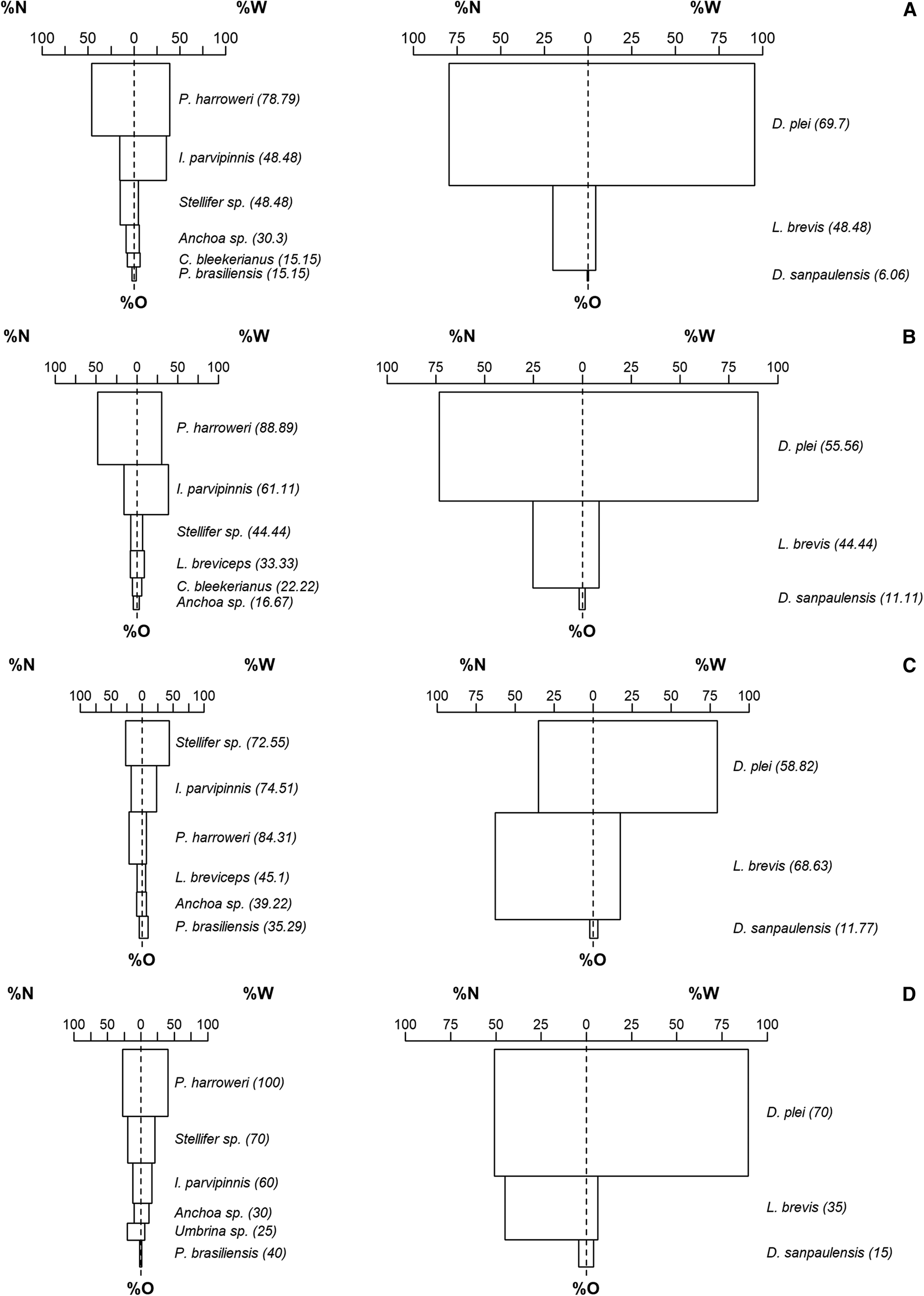
The numerical frequency (%N), the biomass (%W), the frequency of occurrence percentage (%O) and the index of relative importance (IRI) were calculated according to Pinkas et al. (Reference Pinkas, Oliphant and Iverson1971). Fish and cephalopods were analysed separately, as cephalopod beaks remain longer than fish otoliths within the cetacean stomach due to their different digestion times (Clarke, Reference Clarke, Bryden and Harrison1986). The IRI were calculated separately for each gender and season. Three species ingested by the analysed dolphins had no regression equations, so an adaptation proposed by Cremer et al. (Reference Cremer, Pinheiro and Simões-Lopes2012) was used considering IRI = %N × %O. Diagrams similar to those presented by Pinkas et al. (Reference Pinkas, Oliphant and Iverson1971) were produced using R-3.4.4 software (R Core Team, 2018) to help visualization. In the IRI Diagrams the relative importance of each prey species in the diet is depicted by a rectangle with horizontal axes representing the numerical frequency (%N) and biomass percentage (%W), and with the vertical axis representing frequency of occurrence percentage values (%O).
Amundsen diagram
Feeding strategy and the size of the feeding niche were evaluated using the Costello graphical method (Costello, Reference Costello1990) modified by Amundsen et al. (Reference Amundsen, Gabler and Staldvik1996). This graphical representation is constructed from the relation between the frequency of occurrence (O) and the specific abundance (%P; equation (1) below) of a taxonomic group of prey. The specific abundance is defined as the percentage of a taxonomic group of prey taking into account only the stomachs in which this taxon occurred.
 $$\% P_i = \left({\displaystyle{{\mathop \sum \nolimits_i S_i} \over {\mathop \sum \nolimits_{ti} S_{ti}}}} \right)\;\times \;100$$
where Si is the contribution (by biomass in this study) of prey i to the stomach contents and Sti is the total biomass of stomach contents in which prey i occurred.
Ecological indices
The feeding habits of the analysed franciscana dolphins were evaluated for each gender and season using the Simpson diversity index, which gives more importance to the most common species rather than to the rare ones, and is less sensitive to their richness (Magurran, Reference Magurran1988). To investigate the existence of possible overlap between feeding habits of males and females, Jaccard (qualitative) and Bray–Curtis (quantitative) ecological indices of similarity were employed.
Statistical analysis
Total weight and length of identified prey ingested by males and females were compared using the Wilcoxon–Mann–Whitney test (referred to as MW from here on). The difference in prey numerical abundance in stomach contents between different sexes and seasons were assessed employing a PERMANOVA (permutation multivariate analysis of variance) test. It was performed considering 9999 permutations using the Bray–Curtis distance. For any PERMANOVA significant P-values, a pairwise comparison was made between all pairs of groups to detect the origin of the difference. These non-parametric tests were used due to non-normality of the data. All statistical analyses were conducted using R-3.4.4 software (R Core Team, 2018), considering a significance level of 0.05.
Comparison to previous studies
In the current study, the authors opted to consider only the data from peer reviewed studies published in scientific journals (Supplementary Table S2). Unpublished studies comprise mostly theses required for Masters and PhD degrees and they are not easily accessible by the scientific community, written in Portuguese or Spanish, and lacking a robust scientific review before becoming available.
Results
Composition of food items
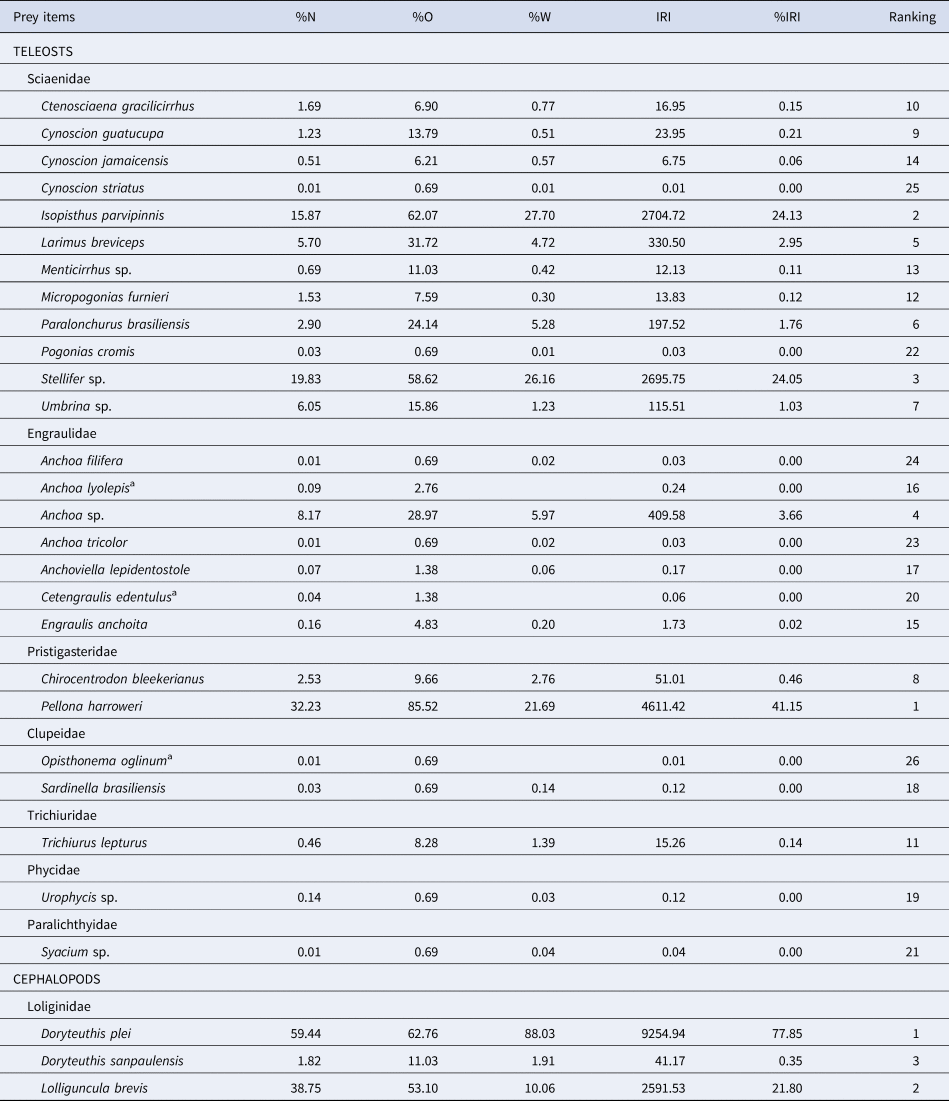
A total of 11,188 otoliths and 2343 cephalopod beaks were found in the 145 surveyed stomachs. Otoliths were present in 143 stomachs (99%) and cephalopod beaks in 111 (77%). A total of 109 stomach contents (75%) had both fish and cephalopods. None of the 145 stomachs analysed was empty. Due to the high degree of digestion, it was not possible to identify 347 otoliths. The prey total estimates comprised 7406 fishes and 1931 cephalopods in the analysed stomachs. Franciscana dolphins preyed on at least 26 different species of bony fish (Table 1), belonging to seven distinct families: Engraulidae, Sciaenidae, Pristigasteridae, Trichiuridae, Clupeidae, Paralichthyidae and Phycidae, the first two being the most represented. At least three distinct species of cephalopods were consumed (Table 1), all belonging to the family Loliginidae.
List of prey species identified after evaluating the stomach contents of franciscana dolphins (Pontoporia blainvillei) bycaught (N = 139) or stranded (N = 6) in south-eastern Brazil between 2005 and 2015

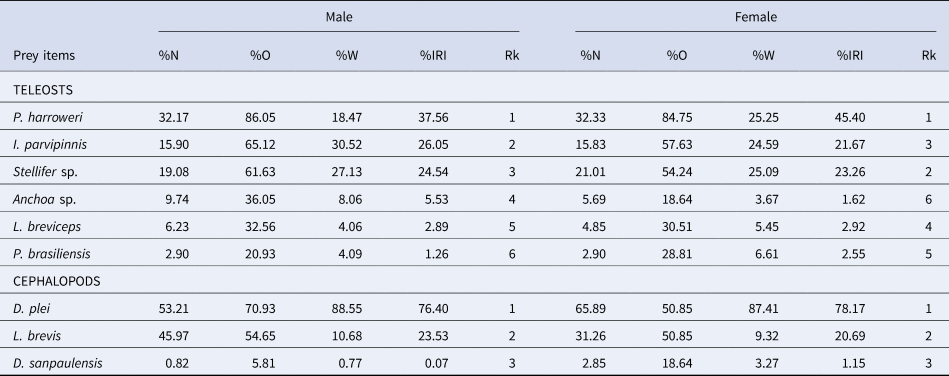
Numerical frequency (%N), frequency of occurrence percentage (%O), biomass (%W), the Index of Relative Importance (IRI), the IRI percentage and ranking are presented. Males and females were pooled together
a An adaptation of the IRI was used because of the absence of regression equations.
The studied females preyed on at least 19 taxonomic groups of bony fish from five distinct families (Engraulidae, Sciaenidae, Pristigasteridae, Trichiuridae and Clupeidae), while males preyed on 24 groups from six different families (Engraulidae, Sciaenidae, Trichiuridae, Pristigasteridae, Paralichthyidae and Phycidae). Seven taxonomic groups were ingested only by males and two only by females. Both sexes preyed on the same three species of cephalopods.
Franciscana dolphins preyed on a larger number of fish taxonomic groups in winter (21, from six families), followed by summer (19, from four families), autumn (14, from five families) and spring (13, from four families). The same three species of cephalopods were ingested all year round.
Estimates of prey size and weight
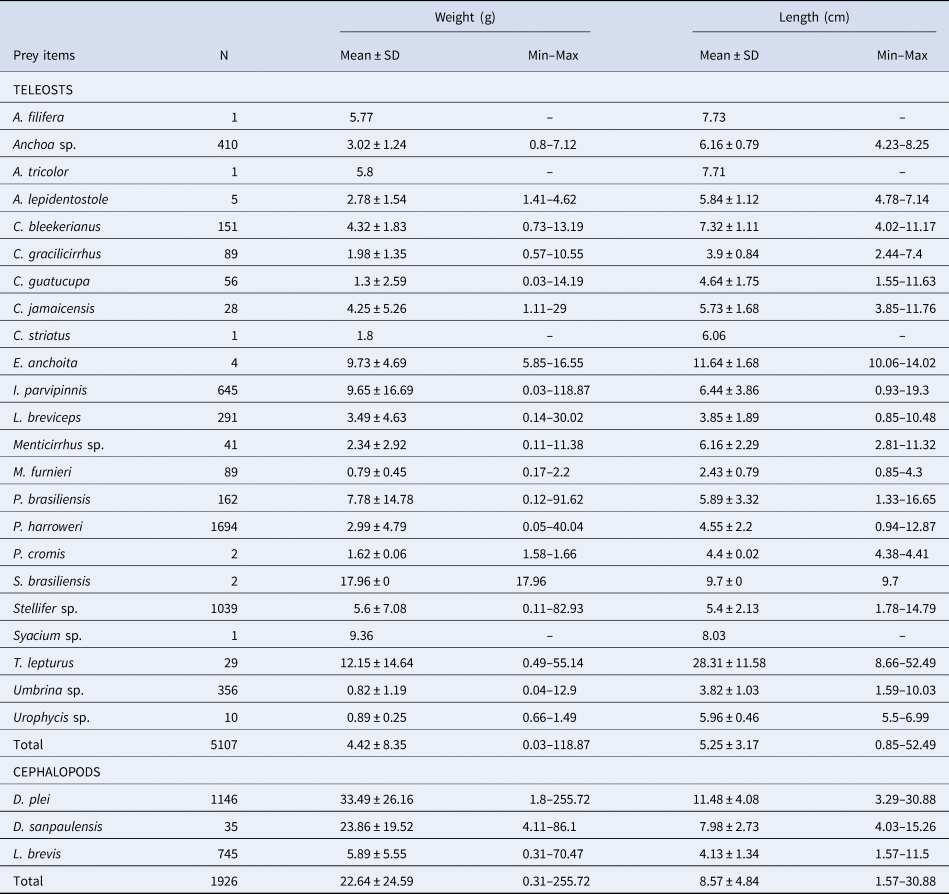
The reconstructed fish size ranged between 0.85 cm (L. breviceps) and 52.49 cm (T. lepturus), with a mean size of 5.25 cm. The reconstructed fish weight ranged from 0.03 g (I. parvipinnis) to 118.87 g (C. guatucupa), with a mean of 4.42 g (Table 2). The reconstructed size of cephalopods ranged between 1.57 cm (L. brevis) and 30.88 cm (D. plei), with a mean of 8.57 cm. The reconstructed weight of cephalopods ranged from 0.31 g (L. brevis) to 255.72 g (D. plei), with a mean of 22.64 g (Table 2).
List of identified prey items after evaluating the stomach contents of franciscana dolphins (Pontoporia blainvillei) bycaught (N = 139) or stranded (N = 6) in south-eastern Brazil between 2005 and 2015

Number of prey measured (N), Mean value and Standard Deviation (SD), minimum and maximum values (Min-Max) of estimated total weight and length for each species are presented.
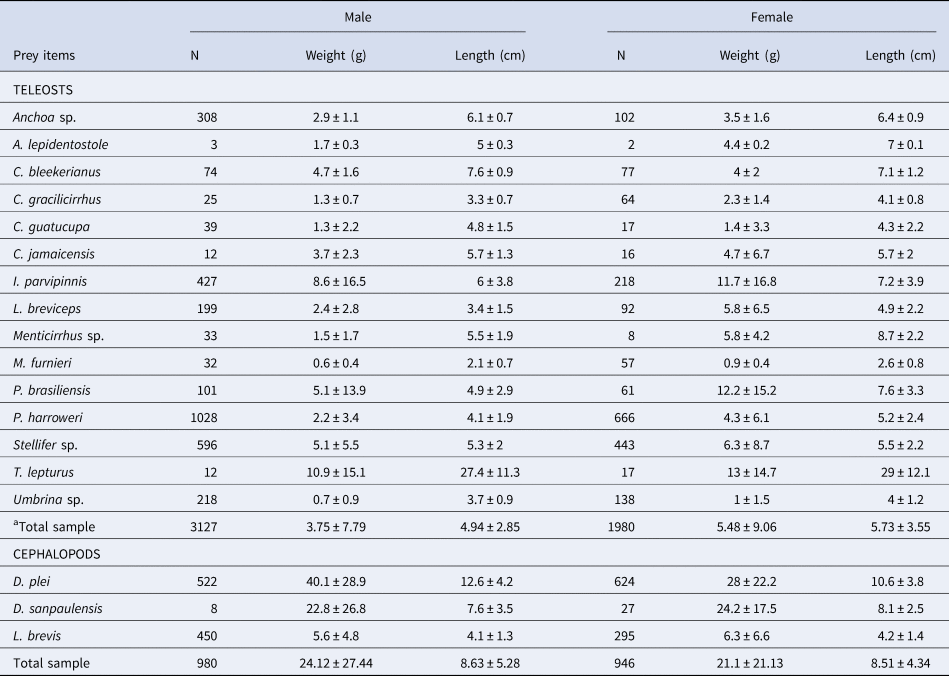
Among the 15 fish species consumed by both sexes (Table 3), 10 presented significant different sizes and weights when comparing males and females (Anchoa sp. – MW = 12,613.5 and P = 2.8 × 10⁻³; C. bleekerianus – MW = 3659.5 and P = 2.4 × 10⁻³; C. gracilicirrhus – MW = 307.5 and P = 6.5 × 10⁻⁶; I. parvipinnis – MW = 37,837.5 and P = 1 × 10⁻⁴; L. breviceps – MW = 5156.5 and P = 2.1 × 10⁻⁹; Menticirrhus sp. – MW = 38.0 and P = 1.9 × 10⁻³; M. furnieri – MW = 505.0 and P = 4.8 × 10⁻⁴; P. brasiliensis – MW = 1495.5 and P = 4.2 × 10⁻⁸; P. harroweri – MW = 238,240.5 and P = 3.1 × 10⁻²⁶; Umbrina sp. – MW = 13,027.5 and P = 3.3 × 10⁻²). In all cases except for C. bleekerianus, females consumed larger prey than males. The slender inshore squid (D. plei) was the only cephalopod species that had a significant difference in the size and weight of individuals consumed by both sexes; males captured larger individuals than females (MW = 208,267, P = 3.8 × 10⁻¹⁶).
List of prey shared by males and females of franciscana dolphins (Pontoporia blainvillei) bycaught (N = 139) or stranded (N = 6) in south-eastern Brazil between 2005 and 2015

Number of evaluated prey (N), mean value and standard deviation of total weight and length for each species are presented.
a Calculated with all species, not only with those shared by males and females.
Index of relative importance
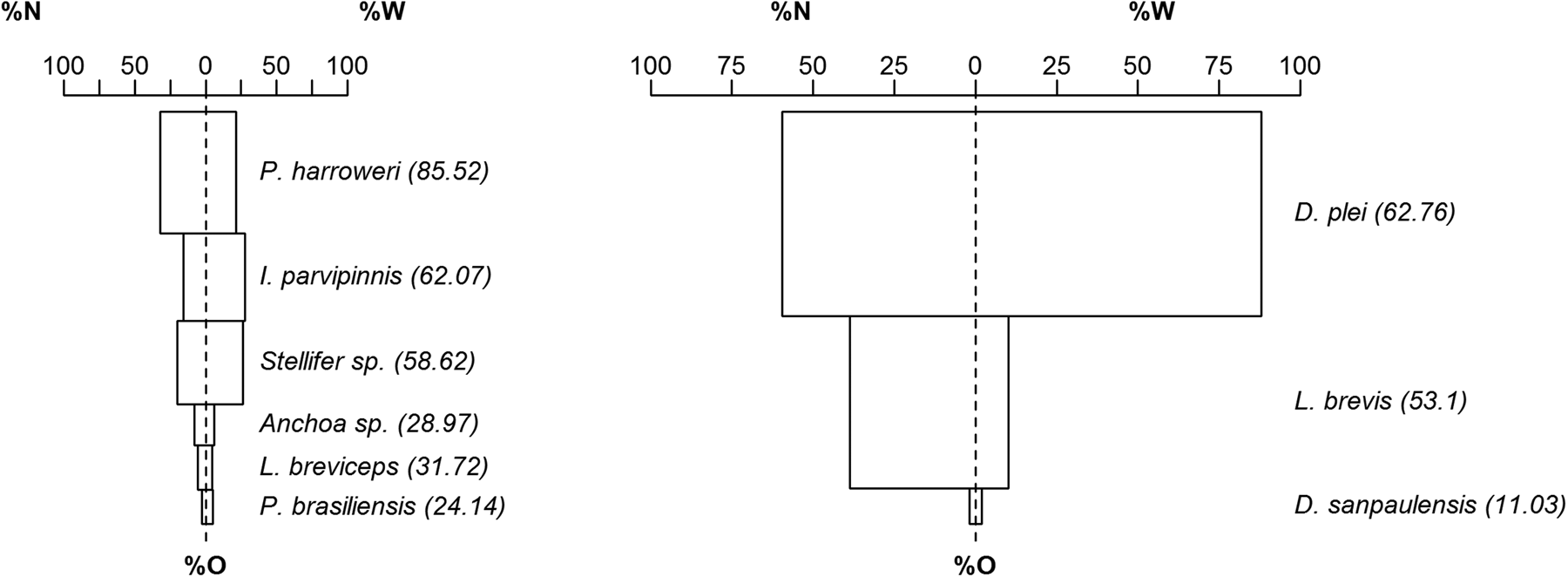
Pooling males and females, the highest values of %N and %O for fish were observed for the American coastal pellona (P. harroweri). Based on the IRI, the most important items were P. harroweri, I. parvipinnis and Stellifer sp. Together, these three items corresponded to ~90% of the IRI (Table 1), explained by their high value of %O (e.g. Figure 2). The most important cephalopod species found in all analysed stomachs was D. plei (77% of IRI). For this prey item, %N, %W and %O were above 50% (e.g. Figure 2), which explains the high IRI observed (e.g. Table 1). The six prey species with greatest importance in feeding habits were the same for both males and females, but the order of importance for both was different (e.g. Table 4).
Index of Relative Importance (IRI) diagram for the most important taxonomic groups of fish (left) and of cephalopods (right) found in the stomach contents of franciscana dolphins (Pontoporia blainvillei) bycaught (N = 139) or stranded (N = 6) in south-eastern Brazil. The horizontal axis represents the numerical frequency (%N) and biomass (%W), the vertical axis represents the frequency of occurrence percentage (%O), also indicated in parentheses.

List of the main prey species identified for males and females after evaluating the stomach contents of franciscana dolphins (Pontoporia blainvillei)

Numerical frequency (%N), frequency of occurrence percentage (%O), biomass (%W), the IRI percentage (%IRI) and the order of importance for each species of prey (Rk) are presented.
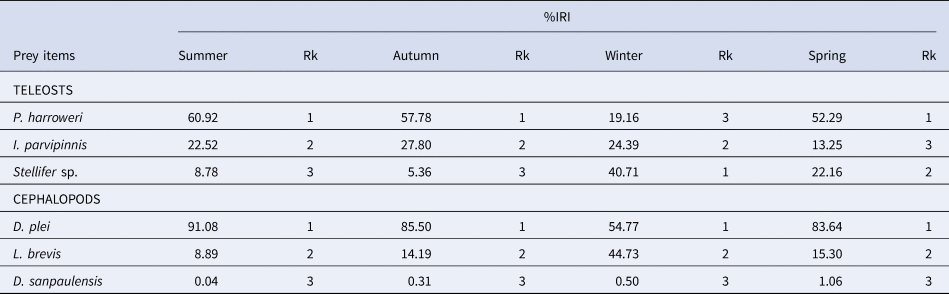
Although the most representative species among prey organisms are the same in different seasons, differences in the order of importance of fish species were observed (e.g. Table 5 and Figure 3). The order of importance of the ingested cephalopods remained the same throughout all seasons; D. plei was the most important item throughout the year. However, in winter and spring the importance of L. brevis and D. sanpaulensis was slightly higher than in the other seasons (e.g. Table 5 and Figure 3).
Index of Relative Importance (IRI) diagram for the most important taxonomic groups of fish (left) and of cephalopods (right) found in the stomach contents of franciscana dolphins (Pontoporia blainvillei) bycaught (N = 139) or stranded (N = 6) in south-eastern Brazil in summer (A), autumn (B), winter (C) and spring (D). The horizontal axis represents the numerical frequency (%N) and biomass (%W), the vertical axis represents the frequency of occurrence percentage (%O), also indicated in parentheses.

List of the main prey species identified per sampling season after evaluating the stomach contents of franciscana dolphins (Pontoporia blainvillei)

IRI percentage (%IRI) and the order of importance for each species of prey (Rk) are presented.
Amundsen diagram
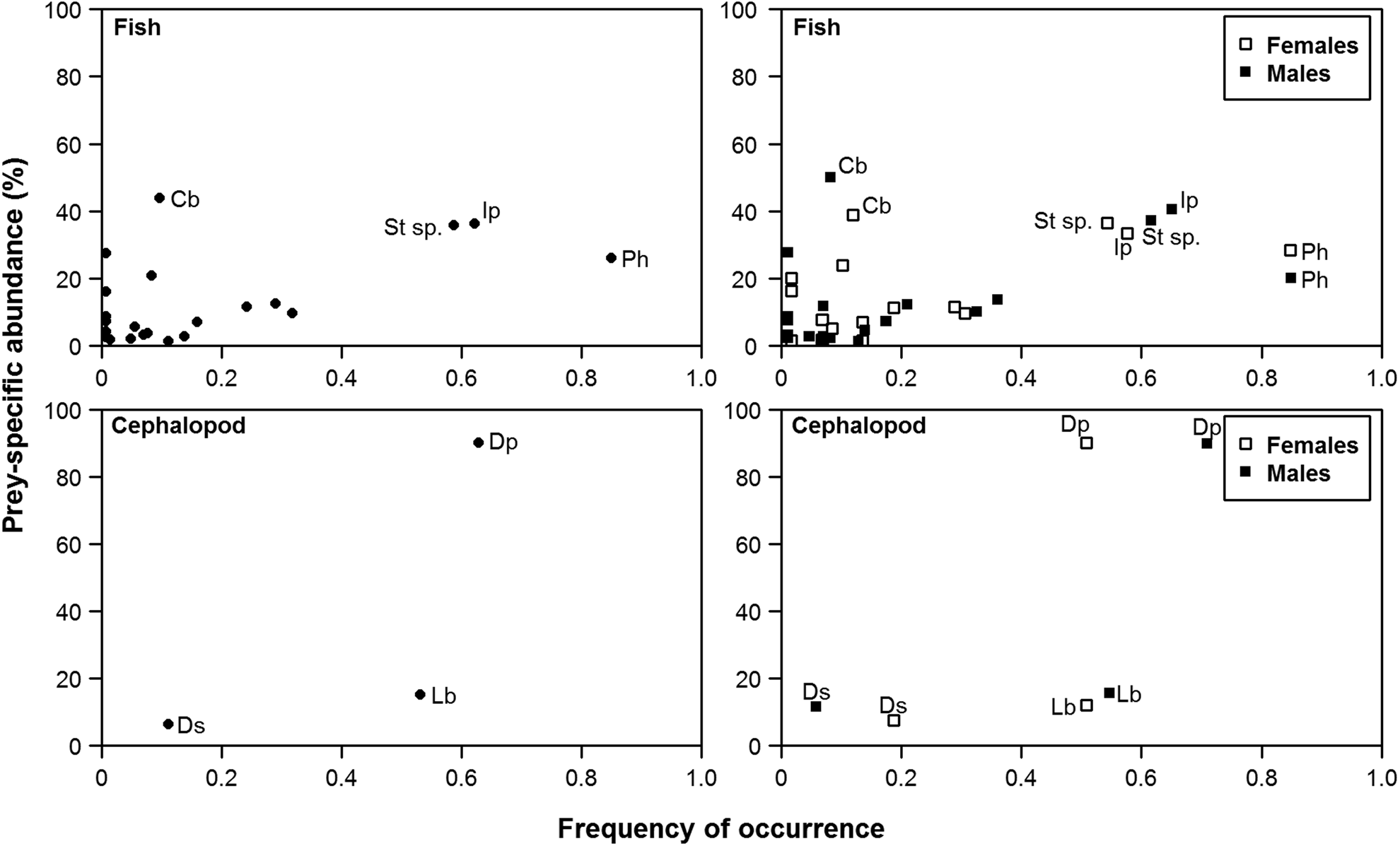
From the total identified fish species, 21 occurred rarely (O ≤ 0.3) and with a low specific abundance (%P ≤ 20). Two groups (C. bleekerianus and Syacium sp.) occurred very rarely (O ≤ 0.1), but had a greater influence on the percentage of mass when ingested (%P ≥ 27). The three most dominant groups (P. harroweri, I. parvipinnis and Stellifer sp.) occurred frequently (O ≥ 0.58) with higher specific abundance values (%P ≥ 26). All types of fish prey occurred at the bottom of the diagram, mostly in the lower left corner, characterizing a generalist feeding strategy for bony fish. For cephalopods, one species was dominant, D. plei, occurring in almost all the analysed stomachs (O = 0.63) with a high specific abundance (%P = 90), characterizing a specialized feeding habit in relation to cephalopods (e.g. Figure 4). The Amundsen diagram (e.g. Figure 4) suggests that males and females have similar dietary strategies as generalists in relation to fish and as specialists in relation to cephalopods.
Costello diagram (1990) modified by Amundsen et al. (Reference Amundsen, Gabler and Staldvik1996) plotting the frequency of occurrence against the specific abundance of fish (top) and cephalopods (bottom) found as prey items in the stomach contents of franciscana dolphins, Pontoporia blainvillei bycaught (N = 139) or stranded (N = 6) in south-eastern Brazil. Both sexes pooled together (left) and evaluated apart (right) are shown. Ph, Pellona harroweri; Ip, Isopisthus parvippinis; St. sp., Stellifer sp.; Cb, Chirocentrodon bleekerianus; Dp, Doryteuthis plei; Lb, Loligunculla brevis; Ds, Doryteuthis sanpaulensis.

Ecological indices
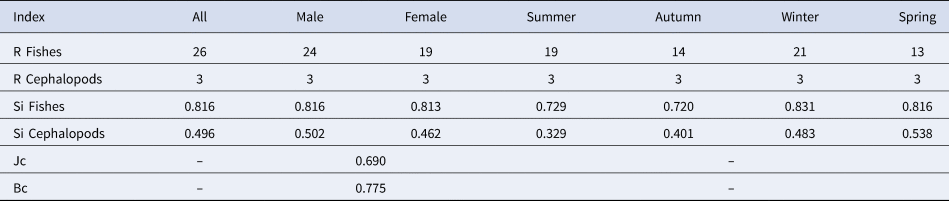
The diversity of prey species for both fish and cephalopods was similar between males and females. The similarity of feeding habits was 69% qualitatively (Jaccard index) and 77.5% quantitatively (Bray–Curtis index) in relation to the consumed prey (Table 6). Among seasons, winter and spring showed the highest diversity for both fish and cephalopods, with winter presenting the highest richness while spring showed the lowest richness for fish (Table 6).
Richness (R), Simpson diversity index (Si), Jaccard similarity index (Jc) and Bray–Curtis coefficient (Bc) for fishes and cephalopods found in the stomachs of franciscana dolphins (Pontoporia blainvillei) bycaught (N = 139) or stranded (N = 6) in south-eastern Brazil between 2005 and 2015

Information on all the individuals (All), different gender and seasons are presented.
Feeding habits between sexes and among seasons
The PERMANOVA test confirmed that there was no significant difference between the feeding habits of different sexes (F = 0.67, P = 0.76). However, a significant difference was observed (F = 1.98, P = 2 × 10⁻³) among seasons. This difference resulted from the comparisons between winter vs summer (F = 2.92, P = 2 × 10⁻³) and winter vs autumn (F = 3.46, P = 5 × 10⁻⁴).
Comparison to previous studies
In the present study, ichthyophagous and teutophagous feeding habits were clearly observed, with greater consumption of fish than cephalopods. Similar results were previously reported in 12 published studies considering all FMAs. The exception was the study from Santos & Haimovici (Reference Santos and Haimovici2001) that focused only on the consumption of cephalopods by marine mammals, including franciscana dolphins (Supplementary Table S2).
Discussion
In the present study, fish of the families Sciaenidae and Engraulidae and squids of the family Loliginidae were the most representative prey. The Sciaenidae is the most representative family of fish in all four FMAs (Supplementary Table S2). Almost all members of this fish family have a well-developed swimming bladder that resonates with the vibrations produced by certain muscles, producing a rather peculiar sound (Menezes & Figueiredo, Reference Menezes and Figueiredo1980). These sound emissions may help franciscana dolphins to locate prey in murky waters commonly present across this species range. Also, these sound emissions may increase the bycatch rate of this small cetacean, since in the search for food they may approach fishing nets in which the fish are clustered and emitting noise (Tellechea et al., Reference Tellechea, Perez, Olsson, Lima and Norbis2017).
The great majority of ingested prey by the observed dolphins is found in a large proportion of the franciscana range, but in each FMA usually 2–4 species were predominant (e.g. Di Beneditto & Ramos, Reference Di Beneditto and Ramos2001; Paso-Viola et al., Reference Paso-Viola, Denuncio, Negri, Rodríguez, Batista and Cappozzo2014; Tellechea et al., Reference Tellechea, Perez, Olsson, Lima and Norbis2017). In the present study, ~90% of the IRI values for bony fish were related to three taxonomic groups, P. harroweri (42%), I. parvipinnis (24%) and Stellifer sp. (24%) (e.g. Figure 2), the former belonging to the Pristigasteridae family and the latter two belonging to the Sciaenidae family. All three species are highly abundant in Brazilian waters (Haimovici, Reference Haimovici1998; Andrade-Tubino et al., Reference Andrade-Tubino, Ribeiro and Vianna2008). The relevance of P. harroweri was also observed in previous studies conducted in south-eastern Brazil (FMAs I and II), listed among the four main taxonomic groups of bony fish in three of five previous investigations (Di Beneditto & Ramos, Reference Di Beneditto and Ramos2001; Bittar & Di Beneditto, Reference Bittar and Di Beneditto2009; Henning et al., Reference Henning, Carvalho, Pires, Bassoi, Marigo, Bertozzi and Araújo2018). The P. harroweri southern distribution limit is around the coast of Rio Grande do Sul, about 30°S (Di Dario et al., Reference Di Dario, Williams, Nanola, Palla, Arceo, Acosta, Muallil, Aiken, Grijalba Bendeck, Brown and Munroe2017). This species distribution was reflected in the absence of P. harroweri among the main prey items in FMAs III and IV (Paso-Viola et al., Reference Paso-Viola, Denuncio, Negri, Rodríguez, Batista and Cappozzo2014; Denuncio et al., Reference Denuncio, Paso-Viola, Machovsky-Capsuka, Raubenheimer, Blasina, Machado, Polizzi, Gerpe, Cappozzo and Rodriguez2017; Franco-Trecu et al., Reference Franco-Trecu, Drago, Costa, Dimitriadis and Passadore2017; Tellechea et al., Reference Tellechea, Perez, Olsson, Lima and Norbis2017). Pellona harroweri is pelagic, contrasting with the demersal habits of I. parvipinnis and Stellifer sp.; the latter two are typically found close to unconsolidated substrates and usually found in coastal and estuarine waters in at least one stage of their life cycle (Fischer et al., Reference Fischer, Pereira and Vieira2011). None of the three main taxonomic groups of fish consumed by franciscana dolphins has great commercial value, but they are often secondary targets and one of the main byproducts in local shrimp fisheries (Mendonça & Miranda, Reference Mendonça and Miranda2008; Mendonça, Reference Mendonça2015). The majority of fish species eaten by local franciscana dolphins are discarded by the shrimp trawl fishery or used as a by-product (e.g. fishmeal, bait) (Coelho et al., Reference Coelho, Puzzi, Graça-Lopes, Rodrigues and Prieto1986; Fischer et al., Reference Fischer, Pereira and Vieira2011; Santos et al., Reference Santos, Cattani and Spach2016).
Among the cephalopods, the most important species in the analysed stomachs was D. plei followed by L. brevis. Previous studies have shown a greater importance of D. sanpaulensis and D. plei in franciscana dolphins feeding habits (Di Beneditto & Ramos, Reference Di Beneditto and Ramos2001; Bittar & Di Beneditto, Reference Bastos2009). These three species belong to the most abundant family (Loliginidae) along the south and south-east coast of Brazil (Santos & Haimovici, Reference Santos and Haimovici2001). The three squid species found in the present study have pelagic and demersal habits. Doryteuthis plei and L. brevis are usually found in warm waters. Doryteuthis plei reaches deeper waters of up to 200 m on the continental shelf, while L. brevis is found in shallower waters of up to 40 m, typically in estuaries (Roper et al., Reference Roper, Sweeny and Nauen1984). Doryteuthis sanpaulensis is also found on the continental shelf, but up to 60 m deep and in colder waters (Jereb & Roper, Reference Jereb and Roper2010). The preference for colder waters supports the frequent presence of D. sanpaulensis in the stomach contents of franciscana dolphins in FMAs III and IV (Supplementary Table S2). Cephalopod biota is influenced by the water masses and it would be expected that cold water masses from higher latitudes influence the diet of franciscanas in FMAs III and IV. Cephalopods may play an important role in the diet of P. blainvillei as it is a common item found throughout its distribution, with marked differences in specific local species observed by region. Both D. plei and D. sanpaulensis are important species for commercial and subsistence fishing in the surveyed area. However, the former appears to be the most important species of the Loliginidae family in the fishery activity of São Paulo and Santa Catarina states (FMA II) (Gasalla et al., Reference Gasalla, Postuma and Tomás2005a), while the latter appears as the main species in Rio de Janeiro (in an upwelling area) and Rio Grande do Sul states (FMAs I and III) (Gasalla et al., Reference Gasalla, Perez, Marques, Tomás, Aguiar, Oliveira, Cergole, Ávila-da-Silva and Rossi-Wongtschowski2005b). Lolliguncula brevis has no commercial relevance, and is usually by-caught in bottom trawling fisheries for shrimp and fish (Roper et al., Reference Roper, Sweeny and Nauen1984).
The consumption of both pelagic (e.g. D. plei, P. harroweri) and demersal (e.g. I. parvipinnis, Stellifer sp.) prey, indicated a feeding habit based on captures made throughout the water column, from the surface waters to the substrate. Most species ingested by franciscana dolphins are caught by fishing, whether as primary or secondary targets, or as bycatch. Fishing activities, as well as franciscana dolphins feeding activities, occur throughout the water column. The overlap of human exploitation of living marine resources and the species foraging and feeding behaviour must also be listed as the main drivers to the high rates of incidental captures of this small cetacean.
Although the IRIs indicated the predominance of three fish species (I. parvipinnis, Stellifer sp. and P. harroweri), the opposite was suggested by the Amundsen diagram presented in Figure 4, showing that there was no dominant prey species in the franciscana dolphin diet. The estimated Simpson's diversity index indicated a high diversity of fish (0.82), suggesting this small cetacean showed a generalist fish feeding habit. On the other hand, the diversity of cephalopods in the diet of franciscana dolphins was not high (0.50), based on the dominance of one or two species (D. plei and L. brevis). Doryteuthis plei appeared as the dominant species among the cephalopods, while L. brevis was frequent, but with lesser importance among the available biomass, as a result of its much smaller size and weight (Roper et al., Reference Roper, Sweeny and Nauen1984). The low variety among cephalopod prey in the diet of franciscana dolphins was possibly based on the low cephalopod richness in the surveyed area (Haimovici & Perez, Reference Haimovici and Perez1991), which would not necessarily be distinguishable from a specialist feeding strategy. The abundance of cephalopod species, as well as a detailed evaluation of the main factors that ignite the capture of squids by franciscanas, should be evaluated to better understand the feeding strategy of these dolphins in the surveyed area.
The average size of consumed fish was 5.25 cm (see Table 2), smaller than the average length (up to 11 cm) observed in other FMAs (e.g. Di Beneditto & Ramos, Reference Di Beneditto and Ramos2001; Rodriguez et al., Reference Rodriguez, Rivero and Bastida2002; Bittar & Di Beneditto, Reference Bittar and Di Beneditto2009; Cremer et al., Reference Cremer, Pinheiro and Simões-Lopes2012; Denuncio et al., Reference Denuncio, Paso-Viola, Machovsky-Capsuka, Raubenheimer, Blasina, Machado, Polizzi, Gerpe, Cappozzo and Rodriguez2017; Tellechea et al., Reference Tellechea, Perez, Olsson, Lima and Norbis2017). The observed small prey sizes are often associated with younger development stages of the prey species (Cousseau & Perrota, Reference Cousseau and Perrota2000; Fischer et al., Reference Fischer, Pereira and Vieira2011). Shallow coastal waters in close connection to estuaries and/or river discharges are used by local demersal teleosts as spawning areas (Menezes & Figueiredo, Reference Menezes and Figueiredo1980), which explains the small size of the ingested fish by the observed franciscanas. Although the majority of prey sizes were smaller than 5 cm, prey larger than 20 cm were also found. Therefore, juvenile and adult individuals may also be important for the feeding habits of franciscana dolphins, especially due to their contribution to the ingested biomass. The consumed cephalopods were generally larger than fish (mean = 8.6 cm) as observed in previous studies (Rodriguez et al., Reference Rodriguez, Rivero and Bastida2002; Paso-Viola et al., Reference Paso-Viola, Denuncio, Negri, Rodríguez, Batista and Cappozzo2014; Denuncio et al., Reference Denuncio, Paso-Viola, Machovsky-Capsuka, Raubenheimer, Blasina, Machado, Polizzi, Gerpe, Cappozzo and Rodriguez2017).
The same taxonomic groups were consumed by both male and female P. blainvillei, despite the differences in the relevance order between both diets (Table 4). Some of the observed prey were previously reported among the four most important taxonomic groups by Henning et al. (Reference Henning, Carvalho, Pires, Bassoi, Marigo, Bertozzi and Araújo2018). However, the order of importance differed when comparing this study to the previously quoted one. Males (N = 86) in the current study presented a greater richness of fish taxonomic groups than females (N = 59). However, that might be due to a larger male sample size.
Eleven of the 18 species consumed by both males and females showed a significant difference between their sizes and weights (Table 3). Of these, only two species (D. plei and C. bleekerianus) showed larger sizes and weights in the stomach contents of males. Female franciscana dolphins are generally larger than males (Crespo, Reference Crespo, Perrin, Würsig and Thewissen2009), possibly leading them to feed on larger prey. Fish diversity in the feeding habit of males and females was very similar (Simpson's diversity index of 0.82 and 0.81 respectively), even with the males showing a greater richness. Simpson's diversity index is not very sensitive to richness, and common species were in high abundance. The cephalopod diversity found in the stomachs of males and females was also very similar (0.50 and 0.46). Considering all the consumed prey, the Jaccard and Bray–Curtis similarity (0.69 and 0.78 respectively) were close to or above 70%, indicating there was a great overlap in the feeding habits of males and females of the analysed franciscana dolphins, confirmed by PERMANOVA. This similarity between prey consumed by P. blainvillei males and females may be associated with the use of similar habitats by both sexes, as previously reported by Danilewicz et al. (Reference Danilewicz, Secchi, Ott, Moreno, Bassoi and Borges-Martins2009) for FMA III and by Wells et al. (Reference Wells, Bordino and Douglas2013) for FMA IV.
Although the composition of main prey species was similar among seasons, their order of importance varied throughout the year. This finding was also reported by a previous study conducted in FMA III (Franco-Trecu et al., Reference Franco-Trecu, Drago, Costa, Dimitriadis and Passadore2017). According to the PERMANOVA test, feeding habits of analysed franciscanas were significantly different when comparing winter vs summer and winter vs autumn, but it is important to remember that differences among sample size regarding seasons may be influencing this result. Differences in diets among seasons were also reported by Henning et al. (Reference Henning, Carvalho, Pires, Bassoi, Marigo, Bertozzi and Araújo2018) in FMA II. However, in that study the significant difference was between prey ingested in winter vs spring. These differences may be related to the increase of fish body mass during the breeding season of different prey species, directly influencing the IRI. Reproduction of P. harroweri was reported in coastal waters on the northern coast of Santa Catarina (~27°S) in summer (Souza & Chaves, Reference Souza and Chaves2007), the season in which the highest IRI in the feeding habits of the analysed franciscanas was observed (e.g. Table 5 and Figure 3). Studies of Stellifer stellifer and Stellifer rastrifer on the coast of Santa Catarina and Paraná (~25°S) states, respectively, have found that the peak of the reproductive period occurs in winter and spring (Chaves & Vendel, Reference Chaves and Vendel1997; Almeida & Branco, Reference Almeida and Branco2002), seasons in which the IRI appears to be larger for the taxonomic group Stellifer sp. (e.g. Table 5 and Figure 3).
Doryteuthis plei presented lower values of %N and consequently IRI mainly in winter and spring (e.g. Table 5 and Figure 3). In these two seasons many species of the Loliginidae family undergo seasonal migrations in response to changes in water temperature, in general moving to deeper areas (Roper et al., Reference Roper, Sweeny and Nauen1984). Reinforcing this statement, aggregations of D. plei for reproductive purposes were observed in deeper waters in south-eastern Brazil in spring and winter (Rodrigues & Gasalla, Reference Rodrigues and Gasalla2008). As the franciscanas are found in coastal shallow waters, probably during this time, the area of occurrence of franciscanas and D. plei does not overlap.
There are some known biases in the analysis of stomach contents such as the different digestion status of each prey fragment, contamination by food items of the ingested prey, and being an instant rather than a long-term representation (Fitch & Brownell, Reference Fitch and Brownell1968; Clarke, Reference Clarke, Bryden and Harrison1986; Michener & Kaufman, Reference Michener, Kaufman, Michener and Lajtha2007). On the other hand, Dunshea et al. (Reference Dunshea, Barros, Berens McCabe, Gales, Hindell, Jarman and Wells2013) validated the use of this technique as an important representative of the diet of a coastal cetacean species on a population scale. Thus, the results presented here can be considered as relevant information about the diet of this small poorly known cetacean species which dwells in a restricted portion of the south-west coast of the Atlantic Ocean.
This study is one of the few aiming to describe the franciscanas' feeding habits in FMA II (Supplementary Table S2), and so far presents the largest sample size. According to the observed results, the franciscana dolphin is mostly teutophagous and ichthyophagous, not selective, probably feeding on what is most abundant in relation to species, prey size or season. It probably feeds along the water column on both pelagic and demersal resources. There may be an overlap between the resources caught by fishing as bycatch and prey ingested by local franciscanas.
Added to the present investigation, a total of 852 franciscana dolphins stomach contents were studied in almost 40 years throughout all FMAs. The results of these combined studies indicate an overlap of franciscana's restricted shallow and coastal distribution and the main fishery area from south-eastern Brazil to northern Argentina. This overlap, allied to their feeding habits, may be the main driver of franciscana dolphin high mortality rate in gillnets. Future fisheries management plans and conservation plans may consider the application of mitigation measures to reduce bycatch risk to franciscana dolphins in their distribution area.
Supplementary material
The supplementary material for this article can be found at https://doi.org/10.1017/S0025315420000120
Acknowledgements
Logistical support was provided by the Instituto Oceanográfico – Universidade de São Paulo. The authors thank Linda Waters for reviewing English. The authors thank all fishermen who helped by collecting data. Samples were collected under permits SISBIO #15572-2 and #35635. The authors are thankful for all the efforts made by both reviewers to address very important comments to improve the original manuscript, and the very kind attention of the associated editor.
Financial support
The following institutions provided financial support to this study: Cetacean Society International (1995–2018), Earthwatch Institute (2003–2007), Projeto de Conservação e Utilização Sustentável da Diversidade Biológica Brasileira (PROBIO) – Ministério do Meio Ambiente (BIRD/GEF/CNPq/ 2004–2005), and Fundação de Amparo à Pesquisa do Estado de São Paulo (FAPESP process number 2010/51323-6; 2011–2015). LBC had two fellowships from Conselho Nacional de Pesquisa e Desenvolvimento Tecnológico (CNPq Iniciação Científica process numbers: 159491/2013-4 and 146527/2014-3), XML had a fellowship (FAPESP process number 09/11545-2) and MCOS had a 30-month fellowship (CNPq Produtividade em Pesquisa process number 308331/2010-9), all related to the results presented in this study.