INTRODUCTION
There is currently great interest in discovering early cognitive markers for Alzheimer's disease (AD) that may enable the early diagnosis of individuals and facilitate the development and implementation of interventions that could halt, or at least slow, the progression of the disease. The search for cognitive markers has mainly focused on the presence of memory changes, a common early complaint of people who later develop AD (Backman et al., 2001). Nevertheless, in recent years, research has shown that language also begins to deteriorate shortly before the disease is diagnosed (Garrard et al., 2005). Some of the linguistic changes found in the early phase of AD include verbal fluency problems (Alberca et al., 1999), loss of vocabulary (Forbes-McKay et al., 2005; Garrard et al., 2005), simplification of grammatical structures (Forbes-McKay & Venneri, 2005), and difficulty with the naming of famous people (Semenza et al., 2000). It is well known that one of the early symptoms of those diagnosed with probable AD includes problems in naming people and objects (Estévez-Gonzalez et al., 2004).
In the past few decades, a variety of experimental laboratory-based tests have been used to detect linguistic changes in AD. Although there is some clinical utility in using these laboratory tests, recently some researchers have opted to analyze the linguistic changes evidenced in more open activities, including changes that may be evident in spontaneous conversation, narration, or the description of a scene (Garrard et al., 2005). The analysis of speech in terms of syntactic complexity or semantic content is of great use in differentiating healthy subjects from people with AD in the initial stage of the disease (Snowdon et al., 2000). As the disease progresses, speech is known to become less fluent and precise, while the use of empty words, redundancies, and circumlocutions increases (Hier et al., 1985).
To quantify the changes in verbal expression of people with AD, the most commonly used task has been the description of a depicted scene (Bayles & Kaszniak, 1987; Forbes-McKay & Venneri, 2005; Forbes et al., 2002). Using the Cookie Theft Picture Card of the Boston Diagnostic Aphasia Examination (Goodglass & Kaplan, 1976), Croisile et al. (1996) found that people with AD uttered more simple sentences than healthy controls. Moreover, using the same stimulus, Nicholas et al. (1985) found that people with AD produced fewer content elements and more paraphasia, repetitions, and empty phrases than controls. Hier et al. (1985) found differences between people with AD and healthy controls on numerous variables (e.g., total number of words, number of unique words, phrase length, number of subordinate clauses, etc.); however, the measure that best differentiated both groups was the number of semantic units. These authors proposed that the Boston Cookie Theft Card scene consists of eight semantic units: four agents (mother, boy, girl, and absent-minded mother) and four actions (washing dishes, falling off a chair, stealing cookies, water spilling on the floor). Hier et al. (1985) found that individuals with AD produced significantly fewer semantic units than healthy controls (4.7 vs. 7.3). Vuorinen et al. (2000) used the same procedure and found similar results. In both studies, the patient and control groups used similar total numbers of words, indicating similar fluency levels, yet the utterances of the AD group were more empty of content. In this vein, Shimada et al. (1998) found that people with AD and controls gave similar number of descriptions of the depicted scene, but those with AD provided significantly fewer relevant descriptions. Furthermore, Smith et al. (1989) found that, compared with controls, people with AD required significantly more time and more words to convey the same amount of information. The language of those with AD was less concise, being loaded with circumlocutions, redundancies, and the repetition of ideas.
These differences in the verbal production of people with AD depend on the stage of the disease. Tomoeda and Bayles (1993) conducted a longitudinal study of three people with AD. The participants were asked to describe the scene on the Cookie Theft Card once a year, each year, for 5 years, and it was found that the number of total words, information units, and the conciseness (number of information units divided by the total number of words) of productions, decreased over time, while the number of circumlocutions, frustrations, revisions of aborted phrases, and repetitions of ideas increased. The two measures most sensitive to disease progression were the number of information units and the conciseness of the speech, which decreased at a greater speed over time than the number of words uttered.
Despite this clear understanding of the progression of linguistic deterioration and the changes in verbal expression that occur once a person has been diagnosed with probable AD, little is known about the linguistic changes that might occur in the preclinical stage of the disease. Garrard et al. (2005) examined the writing of three books by the English writer Iris Murdoch, who was known to have developed AD. The books were written over the course of her adult life, and the last may have been written during the onset of AD. The analysis of Murdoch's last book, Jackson's Dilemma, showed that fewer words were used than had been used in her previous books and that fewer words per sentence were used than had been used in the author's most famous book, The Sea, The Sea. Similarly, Venneri et al. (1996) analyzed speeches by former U.S. president Ronald Reagan, who was diagnosed with probable AD in 1994. Their research shows that word finding difficulties and inappropriate phrases were apparent in 1981, 13 years before his diagnosis. Snowdon et al. (1996) studied the autobiographies of nuns written a few weeks before they had taken their religious vows, at an average age of 22 years. It was found that low idea density was associated with increased risk of developing the disease six decades later. The analysis of these subtle changes may benefit the preclinical diagnosis of AD and be of possible utility in the development of cognitive interventions to maintain linguistic functioning or in the prevention of decline in patients at risk of developing AD.
The existence of a group of people who are healthy carriers of a genetic mutation that has been identified as causing AD provides a unique opportunity to examine the appearance of symptoms in the preclinical phase of the disease, because these individuals will likely develop AD. By comparing carriers of a genetic mutation for AD who do not yet have clinical symptoms of the disease to healthy noncarrier family members, it is possible to determine whether linguistic deterioration does indeed occur before the clinical phase starts, and, if deterioration is found, to elucidate which aspects of verbal expression are the first to deteriorate.
The present study was conducted to determine the presence of linguistic changes in verbal expression during the preclinical phase of AD in healthy carriers of the E280A autosomal dominant mutation in the Presenilin-1 gene in chromosome 14, in a comparison with noncarrier family members. In this study, the task of describing the Cookie Theft Picture Card was used, as has been done in several other studies, because the task closely approximates everyday language while affording a controlled basis for detecting changes in verbal expression. Given previous research, we hypothesized that carriers of the mutation would perform worse than healthy controls on this task. Specifically, we expected the carriers to produce verbal expressions with lesser semantic information than controls, because several studies have found important differences in relation to this variable (Hier et al., 1985; Tomoeda & Bayles, 1993), even many years before symptoms of the disease became apparent (Snowdon et al., 2000). Semantic difficulties would be manifested in the production of fewer semantic units, in the identification of fewer objective situations on the picture card, and in the elaboration of fewer inferences relating to the scene depicted on the card. It was also expected that syntactic structures produced by carriers would be simpler than those produced by controls, since this effect has been observed, additionally, in other studies (Croisile et al., 1996; Forbes-McKay & Venneri, 2005). We note, however, that the production of simpler syntactic structures was found in patients in a more advanced state of the disease. Thus, we supposed that the likelihood of finding similar syntactic effects in our participant sample was not as great as the likelihood of finding semantic effects. Furthermore, we expected to find differences not just in the relative sophistication of syntactic structures used in productions, but also in other variables such as the number of phrases in an utterance, the length of the phrases, and the proportion of words of different grammatical categories. Some studies with Alzheimer's patients have reported differences in these variables (Hier et al., 1985; Tomoeda & Bayles, 1993), whereas another (Vuorinen et al., 2000) has reported that semantic information rather than the number of words changes with disease progression. In relation to this point, we note that Garrard et al. (2005) reported that Iris Murdoch, in her last book, used fewer words and clauses per sentence than she had in her two previous books, although the proportion of word types belonging to each grammatical category did not differ. In sum, we hypothesized that carriers would produce utterances bearing less semantic information but simpler structures than would healthy noncarriers.
METHODS
Participants
The sample consisted of 40 healthy Spanish speakers: 19 were carriers of E280A mutation in the Presenilin-1 gene and 21 were noncarrier family members. Individuals in these families are part of a longitudinal study that was reviewed and approved by the University of Antioquia's Ethical Research Committee in accordance with the guidelines of the Helsinki Declaration. The longitudinal study involves annual neurological examinations and comprehensive neuropsychological evaluation (The Consortium to Establish a Registry for Alzheimer's Disease (CERAD; Morris et al., 1989), as well as assessments of functional abilities, depression, and other behavioral and emotional disturbances. The team of neurologists, neuropsychologists, and psychologists evaluating these families met to determine healthy, asymptomatic individuals without demonstrated cognitive impairment who could be referred for participation in the present study. Furthermore, the team excluded individuals who (1) met Diagnostic and Statistical Manual, Fourth Edition, criteria for dementia or any mood disorder; (2) had a Mini-Mental State Examination (MMSE; Folstein et al., 1975) score less than 23; (3) scored 2 or less on either the Global Deterioration Scale or the Functional Assessment Stages; or (4) had a history of neurological or psychiatric illness. The individuals were divided into two groups based on the presence or absence of the E280A mutation in the Presenilin-1 in chromosome 14 that causes early-onset, familial AD with 100% penetrance. A total of 19 carriers and 21 noncarrier control participants belonging to the same family group were selected for the present study. Neither the carrier group nor the noncarrier controls were aware of their carrier status at the time the present study was being conducted.
The average age of the carriers was 43.2 (SD = 3.1) years, and their average years of education was 5.11 years (SD = 3.0). The carrier group was made up of 5 men and 14 women. The average age of the noncarriers was 45.3 (SD = 3.7), and their average years of education was 5.55 years (SD = 3.9). The carrier group consisted of 8 men and 13 women. The two groups were similar with respect to age [t(38) = 1.93, p = .06) and education [t(38) = 0.68, p = .50). Both groups of people lived in the same geographical area (Antioquia, Colombia) and had similar socioeconomic status. Carriers and noncarriers had similar scores on the MMSE [27.79 (SD = 2.02) and 28.81 (SD = 1.33), respectively].
Instruments
Participant description of the Cookie Theft Picture Card from the Boston Diagnostic Aphasia Examination was examined in the present study. Using methodology drawn from Hier et al. (1985), Vuorinen et al. (2000), and others, the number of semantic units described by the participants was tallied. These were units referring to agents (mother washing, absent-minded mother, boy, and girl) and actions (washing dishes, falling off a chair, stealing cookies, water spilling on the floor). The total number of objective situations and inferences made from the scene on the picture card was also scored.
The dependent variables used in this study were as follows:
- Semantic units. Two types of units were scored: agents and actions. For agents, one point was awarded for each of the four agents identified: mother washing, absent-minded mother, boy, and girl. For actions, one point was awarded for each of the four actions: washing dishes, falling off a chair, stealing cookies, and water spilling on the floor. The maximum score for this variable was eight.
- Objective situations. One point was awarded for each reference to the situations presented on the picture card.
- Inferences. One point was awarded for each possibility deduced from the context of the picture (e.g., “the boy could get hurt,” “the children take advantage of their mother's carelessness”). There was no maximum score for this variable.
- Total number of sentences. The number of sentences uttered that made sense.
- Average length of a sentence. The average number of words per sentence.
- Ratio of open-class words to closed-class words.
- The total number of simple verb forms (e.g., present, past, and future forms of the verb).
- Total number of compound verb forms (e.g., verbs used with an auxiliary verb).
Errors were also quantified (one point per error) and classified into the following categories: morphosyntactic, paraphasias, hesitations (repetition of words in the sentence, e.g., “the child is … the child is”), failed starts, interrupted phrases or ideas (e.g., “the mother was …”), and circumlocutions.
Procedure
At the start of the study, each participant was told the purpose of the evaluation and informed consent was obtained in accordance with the protocol approved by the ethics committee at the School of Medicine at the University of Antioquia (Medellín, Colombia). Then, each participant was interviewed and received a neurological evaluation to exclude the presence of dementia or other neurological or psychiatric problems. Participants were shown the Cookie Theft Picture Card and were asked to describe the depicted scene. The participants were given the instructions: “Describe everything you see on this picture card. Who is there? What are they doing?” There was no time limit for this task. To ensure that the participant completely described the scene, participants were encouraged to continue by being asked, “What else do you see in the picture? What else could you say?” When the participant responded that he or she had nothing else to say, the task was considered to have ended. Each participant's description was tape recorded and then transcribed. A senior-year psychology student administered the test and a speech therapist calculated the dependent variables from the transcription. Semantic variables were scored independently by a second rater. The coders were found to have a high level of agreement in scoring (correlations ranged from .87 to .98). Both the examiner and the coders were uninformed of the group status of the participants.
Statistical Analysis
The performance of the carrier and noncarrier groups was compared using multivariate analyses of variance (MANOVAs). The overall MANOVA F-ratio was significant [F(1,14) = 3.07, p = .007]. To adjust for multiple comparisons, a Bonferroni correction was used and the new α level was set at .0035 (.05/14).
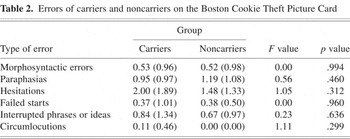
Table 1 shows the results of the univariate comparisons for each variable. The carrier group scored significantly lower than the noncarrier group on total semantic units [F(1,38) = 12.15, p = .001] and identification of objective situations [F(1,38) = 12.80, p = .001]. Carriers also used significantly more simple verbs [F(1,38) = 8.31, p = .006] and tended to use fewer compound verbs [F(1,38) = 7.11 p = .011] than noncarriers. Finally, carriers made fewer inferences [F(1,38) = 4.13, p = .045] than controls and had a lower ratio of open-class to closed-class words [F(1,38) = 8.06, p = .007], but these differences did not reach statistical significance with the Bonferroni correction. Regarding errors, there were no significant differences in any type of error between carriers and controls (see Table 2).
Performance of carriers and noncarriers on variables from the Boston Cookie Theft Picture Card

Errors of carriers and noncarriers on the Boston Cookie Theft Picture Card

DISCUSSION
The objective of this study was to determine whether healthy carriers of the E280A mutation in chromosome 14 presented changes in verbal expression evident in a description of the Cookie Theft Picture Card of the Boston Diagnostic Aphasia Examination, one of the most commonly used tests of verbal expression in people with AD (Croisile et al., 1996; Hier et al., 1985; Nicholas et al., 1985). Even though the carriers did not present clinical symptoms of AD or cognitive problems at the time of the evaluation, compared with noncarriers they evidenced subtle changes in verbal expression. Carriers scored significantly lower than noncarriers on two important semantic variables: (1) the total number of semantic units and (2) the total number of objective situations present in the picture card. Several researchers have found that the number of semantic units produced is one of the characteristics that best differentiates people with AD from healthy controls (Hier et al., 1985; Vuorinen et al., 2000). In the present study, even asymptomatic carriers of the mutation scored significantly lower than controls on semantic variables. Although such differences can easily pass undetected by the individuals and their family members, based on this finding, one can conclude that a deterioration of the conceptual system is present in the preclinical phase of AD. This finding is consistent with the results of the Nun Study (Snowdon et al., 2000), in which nuns who later developed AD were found to have produced, in their youth, written texts bearing less idea density compared with texts produced by peers who had not later developed the disease. It is difficult to ascertain whether the present sample of individuals with the E280A mutation have started to develop preclinical AD, or if the reported linguistic changes represent a cognitive trait of individuals carrying the mutation. Longitudinal studies are needed to determine exactly when these carriers begin to show further cognitive decline and to track the cognitive changes in the younger carriers who are likely to have not yet entered the preclinical phase.
There were no differences between carriers and noncarriers in the average length or total number of sentences. Although similar in total number of verbs, the texts produced by the carriers included significantly more simple verbs than did the texts produced by controls, who tended to use more compound verb forms. Likewise, there are near-significant differences in the ratio of open-class words (content words) to closed-class words (functional words). These results are consistent with those of Croisile et al. (1996) who found that patients with AD used more simple sentences than healthy controls. Our findings indicate that the carriers' language is still fluent, not differing from the language of controls in the number of total words, but that the carriers are not as concise in their expression of ideas as the noncarriers. The present study suggests that asymptomatic carriers express less semantic information than controls using the same number words, as has been shown in individuals in early stages of AD (Shimada et al., 1998; Smith et al., 1989).
Individuals in early stages of AD have been shown to produce more linguistic errors (hesitations, interrupted words, paraphasias, or circumlocutions) in spontaneous speech compared with controls (Forbes et al., 2002; Hier et al., 1985; Nicholas et al., 1985). One might hypothesize that there should be significant differences between carriers and noncarriers in the present study in some of these error categories. Consistent with this expectation, the carriers made more of these types of errors than the controls; however, the differences were not statistically significant. It is possible that the nonsignificance is the result of a lack of power or that it stems from the fact that the carriers are in the preclinical stage and have not progressed enough into the early stages of AD for the numbers of errors to significantly distinguish them from controls.
One of the main strengths of the present study is the examination of linguistic changes in a group of asymptomatic carriers of a genetic mutation that is known to cause AD. Most of the previous studies of cognitive change in the preclinical phase of AD have tested individuals who may or may not develop the disease. Individuals studied in the preclinical phase are not guaranteed to eventually develop AD; some may present an entirely different type of dementia. Other studies of the preclinical phase of AD have been retrospective studies and, thus, are hampered by the recognized limitations in the way such data can be collected (Snowdon et al., 1996). In the present study, all of the carriers will go on to develop AD and were relatively young (mean age in the mid 40s) when they were evaluated, which allows for an analysis of language independent of changes associated with aging, a potentially confounding variable in most studies of Alzheimer's disease patients.
However, the results of this study must be interpreted with caution due to the following limitations: (1) the small sample size, (2) the low education levels of the participants, (3) the young average age of both groups, and (4) the examination of individuals who will develop an early-onset form of familial Alzheimer's disease. This study should be replicated with larger populations of older individuals with various levels of schooling. Such results would determine the extent to which the results obtained in this study apply to individuals with sporadic AD, which is responsible for 95% of AD cases in the world (Edwards et al., 1991). It is also possible that some carriers may have been close to an early phase of familial AD, because the determination of being “without mild cognitive impairment” for this sample was made via clinical consensus based on the individual's CERAD neuropsychological battery performance (Morris et al., 1989), which has not yet been normed for low-educated, middle-aged Colombians.
The vast majority of studies of cognitive changes in the preclinical phase of AD have reported the presence of subtle memory changes as the key identifying characteristic of this stage (Backman et al., 2001; Estévez-Gonzalez et al., 2003; Lange et al., 2002; Small et al., 2000). However, recent studies have found that other cognitive functions, including attention (Estévez-Gonzalez et al., 2003), executive functions (Rapp & Reischies, 2005), visuospatial skills (Small et al., 1997), and language (Garrard et al., 2005), begin to deteriorate many years before the person enters the clinical stage of the disease. Some studies have found large discrepancies in a preclinical AD population in the scores of two tests: naming and visuoconstruction skills (Jacobson et al., 2002). The present study confirms the importance of linguistic changes in verbal expression as a possible early clinical marker of AD. Although the individuals in the present study were asymptomatic (without subjective memory complaints), to determine whether linguistic changes in verbal expression are present before some of the well-studied cognitive changes known to occur in the preclinical stage of AD (e.g., memory impairments), further prospective, longitudinal studies of these familial AD populations with comprehensive neuropsychological assessments are necessary. Such knowledge may facilitate early diagnosis of AD or lead to the development of interventions that maintain cognitive functioning or prevent decline in these individuals.
ACKNOWLEDGMENTS
This research was supported by the project “Study of Linguistic Processes in the Preclinical Phase of Early Family Alzheimer Disease in Antioquia 2004–2005” by CODI, Universidad de Antioquia (9889/EO1060) and grant MCT-03-BSO-00777 to the first author. Thanks to three anonymous reviewers for their comments on a previous version of this manuscript. There are no conflicts of interest affecting this manuscript.
This manuscript is new and original and has not been published elsewhere. A poster based on this work was presented at The 26th Annual National Academy of Neuropsychology Conference in San Antonio, TX, on October 27, 2006. The abstract was published as referenced in the following citation: Arango, J.C., Cuetos, F., Uribe, C., Valencia, C., & Lopera, F. (2006). Linguistic changes in the verbal expression as a preclinical marker of Alzheimer's disease onset. Archives of Clinical Neuropsychology, 21, 561–562.