INTRODUCTION
In semantic verbal fluency (SVF) tasks, individuals need to generate and retrieve as many different items from a specified category as possible within a certain amount of time. Successful retrieval requires the interplay of at least two cognitive components: A semantic component, associated with the integrity of lexico-semantic networks and an executive component, related to strategic search and retrieval processes (Shao, Janse, Visser & Meyer Reference Shao, Janse, Visser and Meyer2014, Amunts et al., Reference Amunts, Camilleri, Eickhoff, Heim and Weis2020). An impaired SVF performance is well documented in patients with dementia due to Alzheimer’s Disease (AD) or its prodromal stage amnestic Mild Cognitive Impairment (aMCI) (Auriacombe et al., Reference Auriacombe, Lechevallier, Amieva, Harston, Raoux and Dartigues2006; Gomez & White, Reference Gomez and White2006; Henry, Crawford, & Phillips, Reference Henry, Crawford and Phillips2004; Pakhomov, Eberly, & Knopman, Reference Pakhomov, Eberly and Knopman2016; Raoux et al., Reference Raoux, Amieva, Goff, Auriacombe, Carcaillon, Letenneur and Dartigues2008). However, there remains widespread disagreement as to what this impairment reflects. The two leading theoretical views either suggest loss of semantic knowledge (i.e., structural view; Rohrer, Wixted, Salmon & Butters, Reference Rohrer, Wixted, Salmon and Butters1995) or impaired executive control mechanisms (i.e., procedural view; Fernaeus & Almkvist, Reference Fernaeus and Almkvist1998). These control mechanisms include a strategic or non-strategic search through the semantic space (i.e., the semantic knowledge store, where mental representations of concepts reside (Hills, Todd and Jones Reference Hills, Todd and Jones2015; Clark et al., Reference Clark, McLaughlin, Woo, Hwang, Hurtz, Ramirez and Apostolova2016; Lerner, Ogrocki, & Thomas, Reference Lerner, Ogrocki and Thomas2009; Linz et al., Reference Linz, Tröger, Alexandersson and König2017, Reference Linz, Fors, Lindsay, Eckerström, Alexandersson and Kokkinakis2019) as well as monitoring processes to suppress previously mentioned items or items that do not belong to the category.
Evidence for the structural view stems from the latency of word production in SVF tasks. Rohrer and colleagues (Reference Rohrer, Wixted, Salmon and Butters1995) posit that verbal fluency performance depends on the number of words available in the semantic space and the time it takes to retrieve them. ‘Latency’ thus is the sum of the number of seconds from the first word to each of the subsequent words divided by the number of words produced (e.g., see Figure 1). The structural view posits that associations between a category name and its members become weaker (i.e., the semantic space disintegrates) and thus, the activation of that category name as a retrieval cue will result in the activation of fewer category members (Figure 1). With fewer available category members within the semantic space, less time is needed to find them. As a consequence, the mean latency of word production becomes shorter. Patients with aMCI or AD typically show shorter mean response latencies in combination with a reduced word count (Randolph, Braun, Goldberg, & Chase, Reference Randolph, Braun, Goldberg and Chase1993; Rohrer et al., Reference Rohrer, Wixted, Salmon and Butters1995; Tröster et al., Reference Tröster, Salmon, McCullough and Butters1989). In addition, they typically generate highly semantically related words, which mean that they stick to answers that are most commonly given by people in such a task, indicating that they are unable to fully explore their semantic space.
Influence of the structural basis of the semantic space and processing speed on the latency of word production. Structural loss results in a smaller semantic space. As a consequence, fewer words are available and less time is needed to retrieve them (i.e., the latency becomes shorter). In contrast, decreased processing speed without structural loss results in slower retrieval (i.e., longer latency, E). The first word (at 1s) is the starting point and the response latency of the second or third word is 3s or 7s, (i.e., 4–1 or 8–1).

The procedural view similarly posits that patients with aMCI or AD are unable to fully explore their semantic space (Tröger et al., Reference Tröger, Linz, König, Robert, Alexandersson, Peter and Kray2019). In contrast to the structural view; however, the procedural view suggests that patients with aMCI or AD have difficulties adapting their executive control. The majority of responses in SVF tasks are given very early in the task and considerably fewer, if any, towards the end. Two retrieval modes seem to be responsible for this pattern of word production; the majority of responses are given in an automatic retrieval mode associated with rapid word production at the beginning of the task, while then a more effortful retrieval follows towards the end. Consequently, responses given early in the task are more common (i.e., frequent) in the respective language than responses given towards the end (Linz et al., Reference Linz, Fors, Lindsay, Eckerström, Alexandersson and Kokkinakis2019). Thus, in the production of words during SVF tasks, the retrieval of ‘easy-to-access’ responses, at the beginning, can be distinguished from less common responses requiring more effort once the easy-to-access objects have been exhausted. Patients with aMCI or AD seem to have problems with adapting their search strategy towards this effortful retrieval.
So far, most studies assessed SVF tasks only once although the repeated assessment of SVF performance could help to answer the question which of the two views holds true. At the first assessment, an impairment in SVF performance can reflect both structure loss and impairment in executive control (or a combination of both). Practising a task, however, can improve the way a person solves the task and thus performance. In SVF tasks, participants may improve by adapting their executive control or by changing strategies to become more successful. Only a few studies so far have investigated changes in SVF production with repeated assessment. These studies reported that patients with aMCI do not (or only slightly) improve compared to HC (Cooper et al., Reference Cooper, Lacritz, Weiner, Rosenberg and Cullum2004; Duff et al., Reference Duff, Beglinger, Van Der Heiden, Moser, Arndt, Schultz and Paulsen2008; Duff et al., Reference Duff, Lyketsos, Beglinger, Chelune, Moser, Arndt and McCaffrey2011). However, these studies focused on a quantitative analysis of SVF performance (i.e., the number of retrieved words), but did not consider qualitative aspects (e.g., retrieval modes, word frequency, or latency of word production). Thus, they did not try to provide an explanation why (and in what way) healthy volunteers improve and patients with aMCI do not. With the current study, we will close this gap, thereby possibly helping to elucidate which of the two views holds true.
METHODS
Participants
We included n = 58 participants in this study: 29 patients with aMCI (age range = 60–81 years; n = 8 with single-domain aMCI and n = 21 with multi-domain aMCI) and 29 HC (age range = 61–81 years; all Caucasian; Table 1). We recruited patients with aMCI from the Centre for Geriatric Medicine and Gerontology at the University Medical Centre Freiburg, Germany where they received their diagnosis. HCs were recruited via newspaper advertisement and flyers circulated in Freiburg, Germany. All participants gave written informed consent prior to testing. The Ethics Committee of Freiburg University approved the study. The study conforms to the Declaration of Helsinki.
Sociodemographic characteristic of the sample (mean and standard deviations)

HC = Healthy Controls; aMCI = Patients with amnestic Mild Cognitive Impairment; f/m = female/male; MoCA = Montreal Cognitive Assessment.
Performance in a semantic verbal fluency task, repeated at three time-points (t1, t2, and t3) in a group of healthy controls (HC) or patients with amnestic Mild Cognitive Impairment (aMCI). The scores represent the mean and standard deviations

Inclusion and exclusion criteria
The study followed a standardised protocol. Participants were first screened over the phone. They had to be fluent in German with normal or corrected-to-normal vision and no history of psychiatric or neurological disorders. Further exclusion criteria were current use of psychotropic medication, current or lifetime drug abuse or addiction, brain damage, or sleep disorders. We evaluated depressive symptoms with the Geriatric Depression Scale (GDS; Sheikh & Yesavage, Reference Sheikh and Yesavage1986) and included those with GDS ≤ 6 (Sheikh & Yesavage, Reference Sheikh and Yesavage1986).
For patients with aMCI, cognitive functioning was evaluated with the neuropsychological battery from the Consortium to Establish a Registry of Alzheimer’s disease (CERAD-plus) (Morris et al., Reference Morris, Heyman, Mohs, Hughes, van Belle, Fillenbaum and Clark1989) during the diagnostic process in the memory clinic. They also received MR imaging, laboratory diagnostics, and functional assessment during the diagnostic process. To be diagnosed with aMCI, they had to show impairment in the delayed recall of a previously learned list of words (1.5 SD below age-, gender-, and education-adjusted norms). Additionally, they needed to (a) report memory complaints; (b) show no impairment in activities of daily living; and (c) no dementia according to established criteria (Petersen, Reference Petersen2004). They also needed to fulfil the criteria for a diagnosis of MCI due to AD with intermediate certainty according to revised criteria (Petersen et al., Reference Petersen, Caracciolo, Brayne, Gauthier, Jelic and Fratiglioni2014). That is, they needed to exhibit signs of neuronal injury (i.e., hippocampal volume or medial temporal atrophy by volumetric measures of visual rating). Healthy elderly volunteers were included with a MoCA score of ≥ 23 as recommended by Carson and colleagues (Reference Carson, Leach and Murphy2018).
Procedure
We collected data on 2 consecutive days. On day 1, participants completed the Montreal Cognitive Assessment (MoCA; Nasreddine et al., Reference Nasreddine, Phillips, Bédirian, Charbonneau, Whitehead, Collin and Chertkow2005), and then we administered other neuropsychological tests including a test of verbal intelligence (Lehrl, Reference Lehrl2005) as well as SVF. After a pause, we applied the SVF task a second time. On day 2, we administered the SVF task a third time and applied other cognitive tests.
Semantic verbal fluency task
We instructed participants to produce as many different four-legged animals as possible within 60s and to avoid repetitions. We collected speech recordings of all participants with a microphone on a computer and trained students from the field of computational linguistics subsequently to transcribe these recordings in PRAAT (Boersma & Weenink, Reference Boersma and Weenink2001). We obtained the following measures for statistical analyses:
Word count
We calculated the number of words produced within 60s, excluding the number of repetitions. We followed the approach suggested by Linz et al. (Reference Linz, Fors, Lindsay, Eckerström, Alexandersson and Kokkinakis2019) and included only unique, correct words to the participants’ word count. To examine the change in participants’ performance over the 60s, we segmented the transcript into six 10s time intervals. We sorted words into these time intervals based on their speech onset. Given that they performed the task 3 times, we obtained 18 data points for each participant (6 intervals*3 assessments).
Mean response latency
We computed the mean response latency (τ) according to Rohrer and colleagues (Reference Rohrer, Wixted, Salmon and Butters1995). The first uttered word (w 1 ) was used as the onset of the SVF production sequence. Then, we calculated the time that had elapsed since the onset of this word (i.e., w 1 ) until the onset of any other word in the production sequence (w i ), which would represent the subsequent response latency for these other words, according to Rohrer and colleagues. Next, we calculated the sum of all response latencies and divided it by the total number of words (n).
 $$\tau = \sum\limits_{i \,= \,2}^n {{{{w_i} - {w_1}} \over n}} .$$
Mean word frequency
Comparable to our previous study (Linz et al., Reference Linz, Tröger, Alexandersson and König2017), we calculated the mean word frequency (MWF) using the Python wordfreq package (Speer et al., Reference Speer, Chin, Lin, Jewett and Nathan2018), which combines resources such as Wikipedia, news, and book corpora as well as Twitter. We calculated the MWF, by summing up the frequencies (a) of all correctly produced words (i) divided by the word count (n).
 $$MWF = {1 \over n}\sum\limits_{i\, = \,1}^n f \left( {{a_i}} \right).$$
Statistical analysis
We performed statistical analysis with R (software version 3.4.02). As dependent variables, we used word count, mean response latency, or MWF. All analyses consisted of two within-subject factors assessment (t1, t2, and t3) and time interval (0s–10s, 10s–20s, 20s–30s, 30s–40s, 40s–50s, and 50s–60s) as well as one between-subjects factor diagnosis (aMCI and HC); resulting in an overall experimental design of 3 * 6 * 2. For the analysis of main effects and interactions, we used the analysis of variance. For the analysis of repeated assessment effects, we used two planned contrasts [t1, t2, t3 (1, −1, 0) and t1, t2, t3 (0, 1, −1)]. Statistical significance levels were set to p < 0.05 and we corrected for multiple testing with the Bonferroni–Holm procedure.
RESULTS
Word count
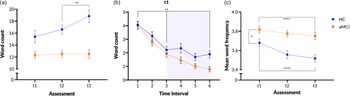
Patients with aMCI produced significantly fewer words than HC [i.e., main effect of diagnosis; F (1, 56) = 66.04, p < .001]. In addition, we found that the production of words changed significantly with repeated assessment [F (2, 952) = 3.99, p < .05] as well as across the six time intervals [F (5, 952) = 142.28, p < .001; Table 2]. A significant interaction between assessment*diagnosis indicated that the effect of repeated assessment was different for HC and patients with aMCI. Indeed, we found no significant improvement in the aMCI group, but HC significantly increased their word count when doing the task repeatedly. Planned contrasts indicated that this was due to a significant change between t2 and t3 [t (1, 320) = 4.31, p < .01; Figure 2(a)]. An exploratory analysis in the group of healthy volunteers revealed a clear distinction between two retrieval modes across the time intervals at first assessment [i.e., significant interaction between assessment*time interval, F (5, 308) = 3.2, p < .01]: healthy volunteers produced significantly more words during the first 20s of the task than during the remaining 40s [t (1,28) = 5.0, p < .001; Figure 2(b)]. At t2 and t3, this clear distinction was no longer visible. When healthy volunteers repeated the task, they increased the word count primarily during the first half of the task, while no increase was observed during the second half.
(a) Change in semantic verbal fluency performance (i.e., word count) in healthy controls (HC) and patients with amnestic Mild Cognitive Impairment (aMCI) over three assessments (t1–t3). The performance at the first assessment suggests two different retrieval modes in HC (b). Mean word frequency was higher in aMCI but changed similarly to the HC group with repeated assessment (c). Error bars represent the standard error of the mean.

Mean response latency
We found a shorter mean response latency in patients with aMCI than in HC [HC: 23.32 ± 4.88 s, aMCI: 18.99 ± 5.03 s; F (1,56) = 8.02, p < .05] and a shorter mean response latency as both groups did the task repeatedly [F (2,112) = 3.37, p < .05; Table 2]. The latter was comparable for HC and patients with aMCI since we found no significant interaction between time interval*diagnosis.
Mean word frequency
At the first assessment, the mean frequency of words was higher in patients with aMCI than in HC [F (1,56) = 3.95, p < .05; Figure 2(c); Table 2]. Both groups retrieved less frequent words towards the end of the task [F (5,952) = 76.2, p < .001]. The latter was comparable for HC and patients with aMCI since we found no significant interaction between time interval*diagnosis.
DISCUSSION
In the current study, we examined whether the well-documented impairment in SVF task performance in patients with aMCI that we also found in the current study reflects a loss of semantic knowledge (i.e., structural view) or a failure to adapt executive control (i.e., procedural view). Therefore, we had patients with aMCI and healthy volunteers perform SVF repeatedly. In line with previous research, we found that only the performance of healthy volunteers improved while that of patients with aMCI did not (Cooper, et al., Reference Cooper, Lacritz, Weiner, Rosenberg and Cullum2004; Duff et al., Reference Duff, Beglinger, Van Der Heiden, Moser, Arndt, Schultz and Paulsen2008; Duff et al., Reference Duff, Lyketsos, Beglinger, Chelune, Moser, Arndt and McCaffrey2011).
When patients with aMCI did the task for the first time, they retrieved fewer (and more frequent) words (Figure 2(a) and 2(c)) with a shorter mean response latency than healthy volunteers. A reduced word count alone can be explained by either a smaller semantic space (due to a loss of semantic knowledge) or by a slower word production. Since patients with aMCI produced fewer words in combination with a shorter mean response latency, the results of the first assessment are more in favour of a loss of semantic knowledge (or at least a less accessible semantic space). This is because successful SVF task performance requires the location, activation, and retrieval of specific members of a category. If associations between the category and its members become weaker (i.e., the semantic space disintegrates), the activation of that category name as a retrieval cue will activate fewer members. With fewer members within the semantic space, less time is needed to find them. Thus, the response latency becomes shorter. An alternative explanation for the reduced performance in patients with aMCI could be that the search process at the beginning of the task has been compromised and has thus been more effortful in patients with aMCI. If correct, they would have been expected to be slower at initiating search processes and retrieving words from memory even for easily accessible words, and hence have a mean response latency longer than healthy volunteers (see Figure 1). However, patients with aMCI had a shorter mean response latency than HC. The relative distribution of responses during the task determines the mean response latency, and therefore shorter mean response latencies indicate that patients with aMCI retrieved items predominantly at the beginning of the task and quickly exhaust their pool of accessible items. Hence, the combination of having produced fewer and more frequent (i.e., more common) words with a shorter mean response latency points to a smaller semantic space containing more commonly used words and supports the structural view – at least at the first assessment (Randolph, Braun, Goldberg, & Chase, Reference Randolph, Braun, Goldberg and Chase1993; Rohrer et al., Reference Rohrer, Wixted, Salmon and Butters1995; Tröster et al., Reference Tröster, Salmon, McCullough and Butters1989).
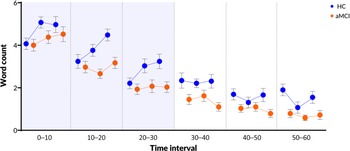
We also found evidence to support the procedural (i.e., executive) view. Comparable to other studies, we found that healthy volunteers employed two different retrieval strategies; an automatic retrieval at the beginning of the task and an effortful retrieval towards the end (Fernaeus & Almkvist, Reference Fernaeus and Almkvist1998; Linz et al., Reference Linz, Fors, Lindsay, Eckerström, Alexandersson and Kokkinakis2019; Figure 2(b)). At the beginning of the task, the automatic retrieval occurs from a pool of readily available words; that is, these are commonly used and easily accessible items. As time passes by and this initial pool of words is exhausted, word generation becomes more challenging, thus requiring more cognitive effort (i.e., more executive control). Our results suggest that healthy volunteers were able to make these additional efforts (at least at first assessment), but we did not observe this in patients with aMCI. Their performance at the first assessment did linearly decrease and did not suggest that they employed different retrieval strategies (Figure 2(a)). As already mentioned, this could indicate both structural and procedural deficits. However, they also did not engage more executive control with repeated assessment. With repeated assessment, a change in executive control seems more likely than a change in semantic knowledge (at least when the repeated assessment happens in short succession). Our group of healthy volunteers particularly improved during the first 30s of word production when doing the task repeatedly (Figure 3, highlighted in blue). Since the MWF did not significantly change during that time interval, the increase in performance was most probably not due to an increased production of less frequent words. Instead, the pool of readily available – easy-to-access – items seems to have become larger in HC. Probably, the activation of a member of the category simultaneously activated the semantic neighbourhood. Since members of a category are organised in networks, the members are represented as a system of nodes and links, as opposed to isolated pairs (Goñi et al., Reference Goñi, Arrondo, Sepulcre, Martincorena, de Mendizábal, Corominas-Murtra and Villoslada2011). Thus, a mental process (i.e., location, activation, and/or retrieval) operating on one member of the category may have changed the states of related words in the network, thereby enhancing the likelihood of these related words to be activated and retrieved when tested repeatedly. Consequently, with every repetition, more easy-to-access words became readily available. This was not the case in patients with aMCI. When doing the task repeatedly, they did neither improve in the first 30s of the task nor in the final 30s (Figure 3).
Change in semantic verbal fluency performance (i.e., word count) in HC as well as patients with aMCI over three assessments. The performance was split into six time intervals with 10s each. HC particularly increased performance during the first half of the task as highlighted in blue. Error bars represent the standard error of the mean.

Another explanation may be that healthy volunteers became more familiar with the task due to repeated practice. It could be that they remembered the responses from the previous assessment, became quicker in retrieving them with enough time to search for new items that they had not retrieved previously. This would, however, again require increased executive control since they would need to keep every response in their working memory (i.e., monitor every response) and inhibit answers already given – with increasing word count, this would become more difficult and would require more executive control. Patients with aMCI did not show this, which supports that they exhibit a problem with executive control that becomes most apparent with repeated assessment. The procedural view is also supported by data from phonemic fluency although this task was only used in patients with aMCI during the diagnostic process in the memory clinic. For phonemic verbal fluency, an individual is asked to generate as many different items starting with a certain letter (e.g., ‘F’) as possible. SVF requires a strategic search through the semantic knowledge store (i.e., the semantic space), while phonemic fluency depends more on knowledge of word spelling and phonemic relatedness. Patients with AD typically show larger impairment in SVF than in phonemic verbal fluency. Yet, for patients with aMCI, this is not necessarily the case (Brandt & Manning, Reference Brandt and Manning2009; Nutter-Upham et al., Reference Nutter-Upham, Saykin, Rabin, Roth, Wishart and Pare2008). Comparable to previous studies, patients with aMCI in our sample were better in their SVF performance than in their phonemic verbal fluency performance. This may indicate that they had more problems with executive functions than with a search through the semantic space. However, at the first assessment, the reduced word count in combination with the shorter mean response latency rather points to a loss of semantic knowledge. Therefore, our data suggests that patients with aMCI are impaired in SVF tasks due to loss of semantic knowledge in combination with a failure to adapt executive control.
LIMITATIONS
Our study may have several limitations. First, we posited that responses given earlier in the task are typically more common and that this reflects an automatic retrieval mode. However, the cultural milieu of the participants or other variables (e.g., education) may also influence the order of word generation. For the current study, we matched participants according to education and they all needed to be fluent in German (in fact, all of them had German as their first language). In addition, all of them were Caucasian and none of them had an immigrant background. Therefore, it seems unlikely that a difference in culture (or education) explains our findings.
Another possible limitation might be that we assessed phonemic fluency performance only in patients with aMCI and not in healthy controls. Therefore, a direct comparison between both groups was not possible.
Finally, our study may be limited by the fact that we included both single-domain amnestic MCI (n = 8) and multiple-domain amnestic MCI (n = 21). However, we found no significant differences between both groups regarding age, education, premorbid intelligence, or MoCA score. We also did not find any significant differences in word count, mean latency, or word frequency.
SUPPLEMENTARY MATERIAL
To view supplementary material for this article, please visit https://doi.org/10.1017/S1355617721000849.
FINANCIAL SUPPORT
This work was supported by EIT-Digital, Area 2. Innovation and Research, Segment 2.3 WEL (Digital Wellbeing), Grant number 19141.
CONFLICTS OF INTEREST
All authors declare that there are no conflicts of interest.
ETHICAL STANDARDS
The Ethics Committee of Freiburg University (Germany) approved the study.