Introduction
During the 1980s and 1990s, there were discussions suggesting that reintegrating crop and livestock enterprises was essential to a more sustainable agriculture. Several philosophical papers have been published on this conceptReference Keeney1–Reference Brummer4, as well as papers expressing the need for integrated crop/livestock researchReference Madden5–Reference Hesterman and Thorburn9.
Since World War II, there has been a general trend in North America for declining crop diversity and a concentration of research funding on a few selected crops such as corn (Zea mays L.), soybeans [Glycine max (L.) Merr.] and wheat (Triticum aestivum L.)Reference Brummer4. Many farmers are now producing only one or two cropsReference MacRae, Hills, Henning and Mehuys6, and there is mounting evidence that this approach is neither profitable for producers nor good for the environmentReference Hesterman and Thorburn9. More complementary production systems need to be developed that include both crops and livestock, and facilitate more efficient nutrient cycling systems, with the option of marketing farm-raised agricultural grain and forages through livestockReference Brummer4. An ecological rather than a factory approach to agriculture is needed for sustainable agricultural systemsReference Brown7. In the future, new technologies will have to conform to the environments where they are used, not dominate themReference Hildebrand8. There is a need for more sustainable agricultural production systems that reduce production costs by minimizing the use of purchased inputs such as fertilizers and pesticides, while decreasing adverse environmental effectsReference Keeney1, Reference Madden5. Design of well-planned cropping systems that include legumes, with crops established by no-till seeding procedures, and where part or all of the grain is marketed through farm produced livestock should facilitate development of the unique and innovative production systems needed to make farms more profitable and sustainableReference Keeney1, Reference Karn, Tanaka, Liebig, Ries, Kronberg and Hanson10, Reference Tanaka, Karn, Liebig, Kronberg and Hanson11.
Despite much discussion and debate over the value of, and the need for integrated crop/livestock research, little research has actually been conducted and published on this subject. Most ‘integrated’ research has occurred in Europe and involves only crop production, where the use of crop rotations and a less intensive management system have been successfully employed to reduce fertilizer and pesticide inputsReference Jordan, Hutcheon, Donaldson and Farmer12, Reference Ogilvy, Turley, Cook, Fisher, Holland, Prew and Spink13. In a survey of research projects described by their authors as sustainable, only 25% involved both crops and livestockReference Anderson and Lockeretz14.
Literature on interdisciplinary research that integrates crops and livestock are meager. Our review of the literature found three examples of crop/livestock systems that were truly integrated. The first was an interdisciplinary research project integrating both crop and livestock in a whole farm system initiated in southwest Virginia, USA in 1988Reference Luna, Allen, Fontenot, Daniels, Vaughan, Hagood, Taylor and Laub15. The second was in Syria where a model farm approach using three farm types was employed to investigate the benefits of closer crop/livestock integration and to determine which farm type best enhanced sheep productionReference Thomson and Bahhady16. In North Dakota, USA an integrated crop/livestock project was designed to reduce fertilizer and pesticide inputs through the use of crop rotations, polyculture and stand densityReference Tanaka, Karn, Liebig, Kronberg and Hanson11. This system was designed to produce crops, in a cropping system, that could be used for on-site winter grazing to reduce winter feed costs of dry, pregnant beef cowsReference Karn, Tanaka, Liebig, Ries, Kronberg and Hanson10. These three research programs overcame a number of obstacles and paradigms to publish their results.
The purpose of this review is to focus on some possible considerations or reasons why there have been relatively few integrated crop/livestock research programs, and even fewer publications in the past two to three decades.
Terminology
One reason for the dearth of integrated crop/livestock research can be traced to the terminology used to describe this research and the way it is perceived by many scientists. Without a better understanding of popular terminology and establishment of clear philosophical goals, it will be impossible to design and conduct relevant crop/livestock research. Some terms and concepts associated with integrating crop and livestock production that are not universally accepted by scientists in a positive way include: sustainability, alternative agriculture17, organic farmingReference Kirschenmann18, low-input sustainable agriculture (LISA), reduced-input agricultureReference Buttel, Gillespie, Janke, Caldwell and Sorrantonio19 and the perception that alternative agriculture is a return to low-tech production methods of the pastReference Hess20. Some have proposed that sustainability encompasses food security, environmental concern and economic equityReference Douglas and Douglas21. KeeneyReference Keeney1 suggested the following working definition of ‘sustainability’: ‘agricultural systems that are environmentally sound, profitable, and productive and that maintain the social fabric of the rural community’. KeeneyReference Keeney1 indicated that key components of sustainability include, soil erosion control, pest management, efficient use of on-farm and purchased inputs, maintenance of soil fertility, and utilization of biological principles in the farming operation. PrettyReference Pretty, Foo and Senta22 cautioned that sustainable agriculture should not be described in ‘a concretely defined set of technologies, practices or policies that would restrict the future options of farmers’. ‘Regenerative’ agriculture has been suggested as a more descriptive and therefore, perhaps a more acceptable term than ‘alternative’ agricultureReference Madden5. Sustainability involves greater reliance on renewable resources while protecting our environment from degradationReference Anderson and Lockeretz14.
Facility requirements
Integrated crop/livestock research that encompasses a desirable number of crop and animal treatments and replications would require a large number of hectares, considerable labor, and prodigious budgets to facilitate statistical analyses by conventional procedures and to provide meaningful information for producers. Such extensive research would require a high degree of on-site management and would result in complicated interactions that would be difficult to interpret. Most scientists are accustomed to operating on government or university research facilities in a rather controlled environment that may be more like a laboratory than the real worldReference Busch and Schwarzweller23. Scientific knowledge developed in such environments is usually thought to be superior to knowledge developed on producer's farmsReference Molnar, Duffy, Cummins and Van Santen24. However, this has led some to the observation that agricultural research results are not broadly applicable and may not be relevant for the complete range of conditions that occur, even in a given localeReference Brown7.
It has been suggested that more research needs to be carried out on farms and under farm conditions so that the results will be more applicable to producer needsReference Hildebrand8. Conducting integrated crop/livestock research on producer farms would provide the extensive land and labor resources needed to conduct integrated crop/livestock research, but this approach also presents other concerns for scientists. Producers may not have an adequate appreciation for accepted research practices and thus may not realize the necessity of closely following the research protocol. Producers may elect not to adhere strictly to experimental protocol in order to prevent or avoid economic losses or damage that could reduce productivity of crops or livestock, if experimental treatments were strictly followed. Producers may alter protocol without consulting scientists because of convenience, the perception that treatments are not working or carelessness. These changes can diminish the value of research results and compromise their interpretation without the scientist even being aware of the situation. On the positive side, the need for multiple crop/livestock treatments with multiple replications make individual farms an ideal means of fulfilling both of these needs, assuming there is adequate cooperation among producers and scientists so that non-experimental variables can be similarly controlled on cooperating farms. On-farm research not only provides much needed research information, but also provides practical cutting edge research that has direct impact to the producer. An example of farms serving as replications is in central Illinois, USA, where researchers and producers have been collaborating on different aspects of sustainable agriculture systemsReference Prow25. Farmers were selected from northern, central and southern Illinois to include cover crops in their cropping systems to improve efficiency and profit. Results indicated cover crops were promising in southern Illinois and added to the agricultural sustainability, but were not sustainable in northern Illinois.
Cropping systems used in integrated crop/livestock experiments need to be designed around the number of animals being used and their specific class and type, in order to ensure that an adequate supply of feed will be available to maintain the desired animal condition during the planned feeding period. The need to accommodate animal needs necessitates the use of experimental plots that are much larger than normally used by agronomists and soil and crop scientists. Use of larger plots may require compromises in experimental design necessitating the use of unique statistical approaches. The prevailing view that all research results must be subjected to rigorous statistical analyses may discourage some scientists from becoming involved in research that cannot be easily analyzedReference MacRae, Hills, Henning and Mehuys6. Karn et al. Reference Karn, Tanaka, Liebig, Ries, Kronberg and Hanson10 and Tanaka et al. Reference Tanaka, Karn, Liebig, Kronberg and Hanson11 illustrate how they had to compromise to conduct integrated crop/livestock research. They had to increase plot size, reduce agronomic soil and crop treatments, and use unbalanced treatment replications to provide adequate forage for the number of livestock needed to conduct the livestock research. The animal portion of the research had to be maintained longer than required in order to facilitate collection of publishable crop and soil research.
Scientific cooperation obstacles
To be truly integrated, crop/livestock research must be multidisciplinary, involving scientists of diverse training and experience with expertise to address different aspects of a research problem, and scientists must function as a team. For scientists to work as a team, individuals must set aside personal priorities for the benefit of the group. The need for a team approach also implies that individual scientists will labor in relative anonymityReference MacRae, Hills, Henning and Mehuys6. One problem with this ideal is that responsibilities, research costs, and workloads of team members will likely differ substantially, with the scientists responsible for maintaining the crops and livestock having a disproportionately larger workload and research cost than scientists who only collect and analyze data from an ongoing experiment. Scientists with the least responsibility in an integrated crop/livestock project may have the same or even a greater opportunity to publish, compared with scientists who have the most responsibilities. If the team interaction necessary for integrated crop/livestock research is to flourish, then administrators need to adequately address these inequities. One potential way to reduce some of the inequalities is to establish something similar to a principle investigator approach, which may help to provide credit to team members with the most responsibility, research cost and workloadReference Hildebrand8.
The team must formulate the problem, often the most difficult aspect of multidisciplinary researchReference Miller26. Appropriate data to be collected must be agreed upon, and there must be agreement on which individuals will be responsible for maintaining experimental plots and animals, as well as those that will collect and analyze data. Scientists must be willing to assist each other with peak workload duties as needed. Expected manuscripts and individuals responsible for authoring those manuscripts should be agreed upon before research is initiated.
Team research is also more difficult, because data collection requirements of all scientists must be considered before any actions are taken that could compromise other scientists' data collection. When scientists are working alone, many of these concerns do not exist. Cooperation in integrated crop/livestock research can also compromise an individual scientist's freedom to conduct research where the best facilities are available, where labor is easily accessible and where extraneous effects that could impact experimental outcomes can be controlled. Therefore, team research is much more difficult to conduct and interpret than an individual scientist's research, but team research provides information on the interactions of a problem rather than one component of the problem. Administrations and funding agencies must realize that to conduct integrated crop/livestock research involving multidisciplinary teams solving multiple-interaction problems requires greater funding resources and communications among scientists. Funding and communication may be the greatest deterrent to multidisciplinary teams and integrated crop/livestock research.
Academic training received by agronomists, soil and crop and animal scientists is generally quite focused for each specialty area, and scientists within these specialty areas develop their own technical jargon which can hamper communication with scientists in another discipline. Scientists usually work within a specialty area with like-minded individuals who generally understand each other's requirements, problems and needs. There is a risk in moving out of that comfort zone to unfamiliar, untested areas.
Traditionally designed experiments have a limited scope so they can be easily analyzed and readily interpreted, while the interactions in integrated crop/livestock research may be more important than crop or livestock treatments alone. Soil and crop scientists and agronomists generally use many treatments and replications with relatively small plot areas. Animal scientists, on the other hand, use relatively large numbers of animals and extensive land areas per treatment, which usually results in treatments and replications being limited. This fundamental difference alone makes design of integrated crop/livestock research difficult, because each discipline area has valid reasons for their experimental design. Tanaka et al. Reference Tanaka, Karn, Liebig, Kronberg and Hanson11 have suggested that changes in crops and soils in the northern Great Plains are slow, and their research indicates that 4 years of research data may not be adequate to understand the interactions among cropping systems and livestock on forage and grain production.
Integrated crop/livestock research is long-term in nature. Relative to time and resource requirements, the publication output initially may be low and may be orientated towards publications that accept applied research, with basic process-driven research published later. These initial applied research publications may not be looked on favorably by some administrators and scientists and may retard a scientist's academic advancement because of short-term implications. Evaluation of scientists as individuals rather than as a team, discourages an unselfish multidisciplinary team approach at the expense of enhancing the knowledge base of very complex problems associated with integrated crop/livestock production.
The pressure to publish is one of the biggest obstacles to integrated crop/livestock research. Scientists, by academic necessity must conduct research that leads to senior authored publications. In describing the institutional development cycle, AxinnReference Axinn27 observed that excessive specialization by scientists leads to severe communication problems and diminished collaboration with scientists in other disciplines. Further evidence of this trend in communication and collaboration problems is the current emphasis on journal articles rather than the scientist's participation in development and adoption of team oriented technology as a criterion for professional developmentReference Axinn27. A subtle indicator of this trend is that research has been designed to have a high probability of statistical differences, for publication purposes, rather than practical significance to solving pertinent producer problems. Hence, the clientele group for many scientists has become their own peers.
The major dilemma facing scientists, therefore, which discourages initiation of and participation in integrated crop/livestock research, is the pressure to satisfy the often short-term requirement of producing sufficient publications in contrast to the long-term commitment demanded by this type of research. Usually working within an institutional setting, scientists are under the mandate to solve real problems affecting the institution's stakeholders. Given this mandate, they struggle to design experiments that attempt to address these problems (which are usually quite complex) in the long-term, but will also hopefully render statistically significant data in the short-term for publishing. Often these two goals are not compatibleReference Hildebrand8. Most scientists feel the use of statistics is necessary to validate experimentsReference MacRae, Hills, Henning and Mehuys6. GriersonReference Grierson28 concluded that many investigations in biological sciences are not suited to statistically designed experiments, and the pressure to use statistics discourages some scientists from tackling these difficult problems, since the statistics is not intuitively obvious. Over-emphasis on the use of statistical significance to validate experiments is therefore a detriment to integrated crop/livestock research. Also, the relationship between biological data and economic data is not always clear. Nonsignficance in the former does not imply the same in the latter; therefore, exclusive reliance on statistical significance may result in economically significant results being ignoredReference Sonntag and Klein29. Biological statistical significance does not necessarily equate to economic statistical significance at a given point in time. The dynamics of integrated crop/livestock systems can be altered by changes in commodity value, weather, and technology.
Cropping system decisions
By necessity, there are practical limitations to the scope of a cropping system that is part of an integrated crop/livestock project. Crop and soil scientists must consider many questions as they design the cropping systems portion of an integrated project. Their first task is to determine the research goals of the cropping system. Possible goals may include enhancing long-term production sustainability, maximizing farm income, reducing herbicide or pesticide use, reducing chemical fertilizer use, improving soil quality, improving water-use efficiency, filling forage quality and quantity deficits at a given time during the year for a particular type and class of animal, or a combination of these goals. Crops and crop sequences play a critical role in the sustainability of cropping systemsReference Tanaka, Krupinsky, Liebig, Merrill, Ries, Hendrickson, Johnson and Hanson30. After the cropping system goals are determined, scientists must decide what tillage methods will be used to produce the crops and make efficient use of precipitation. Tillage options include conventional tillage, minimum tillage and no tillage or some practical combination of these options.
Early in the planning process, scientists must decide how many treatments (crops) and replications they can accommodate. From all of the possible crops that can be grown in a given climatic region, scientists must decide which crops are most likely to thrive and be economically feasible under an integrated production system.
Scientists must decide whether annual crops, perennial crops or a combination of annual and perennial crops would work best. It is critical to agree on the function that each crop will have in the system, whether it is for animal feed, soil enhancement or cash sale. Grasses, legumes, or oil seed crops could be used for forage production or as cash crops in an integrated system. Researchers must decide whether to use crops that are well established in a given climatic region, or to try novel crops that are new and untested in addition to native or introduced forages. After deciding which crops will be used, the specific varieties or cultivars must be determined. Established varieties may be appropriate, but it may be desirable to incorporate relatively new genetic material. Both warm- and cool-season species may be desirable to facilitate weed control, or perhaps to maintain a continuous season-long supply of high-quality forage for livestock. The intent of the crops in the cropping system will help determine which crops should be used, and whether they should be seeded as monocultures or polycultures. Integrated systems could include crop diversity in both time (rotations), and space (polyculture). Polyculture systems provide greater plant diversity and enhance soil microbial diversity and such systems are able to take advantage of erratic precipitation frequency and distribution during the growing season. Selected crops must be multifunctional, they must provide forage or grain for livestock in the system and/or be used for cash sale. But, they must also facilitate the maintenance of soil health and fertility, by fixing nitrogen, providing crop residue for erosion control and soil water conservation, or facilitating management of weed, disease, and insect problems.
If selected crops are for use in a rotation, the rotation length, the function of the crops in the rotation and the number of cycles the rotation will be maintained are critical decisions. Forage crops may either be harvested for use elsewhere or grazed on site. Forages grazed on site may either be grazed standing or swathed for use during another season of the year. Crop quality factors will be determined by time of use, crop selection, and seeding and harvest date.
One final consideration for a cropping system might be whether it is desirable to enhance or reduce wildlife production. Enhancing wildlife numbers could be either good or bad depending on the goals of producers using a cropping system.
Livestock decisions
Concurrently with cropping system decisions, scientists must determine the goals and objectives of the animal portion of an integrated crop/livestock project. Possible goals include optimizing farm income by marketing all or a portion of the grain through livestock; using animals to consume forages or low quality grains that might otherwise be wasted or of low economic value, enhancement of soil quality, and reduction of harvesting costs by maintaining animals on crop production sites where crop residues can be utilized and animal wastes retained on the soil. A secondary goal might be to use only feeds produced in the crop portion of an integrated crop/livestock system, versus including limited quantities of purchased feeds to optimize animal performance.
After goals for the animal portion of an integrated crop/livestock project are determined, scientists must decide which animal species would best facilitate reaching those goals. Depending on the goals of an integrated crop/livestock system, cattle, sheep, swine, poultry, exotic animals such as bison, deer, elk, or a combination of animal species could be used as the animal component. Ruminants can utilize low quality forages while swine and poultry are good grain scavengers. If more than one animal species are used, the scope of the project and demands on the crops portion of the project will be substantially increased. After deciding on the animal species to be used, it must be determined whether breeding animals, growing and finishing animals or some combination will be used, because the age, sex and stage of animal production, along with the time forages are used, will help determine the amount and quality of feed needed from the cropping system side of the project.
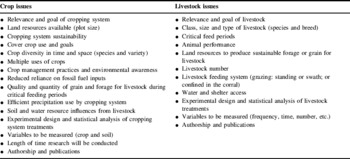
If domestic livestock species are to be used, scientists must decide which breeds have the greatest potential for the system. Breed considerations involve choosing animals that have some characteristic or characteristics that would be advantageous in the proposed integrated system versus animals that are locally adapted and/or locally preferred. Whether traditional or innovative new animal management procedures are used, cropping systems must supply adequate feed or supplement diet for the required number of animals over an extended time period. One of the most difficult decisions in an integrated crop/livestock research project involves crop plot size. Plots must be large enough to produce the amount of feed required to sustain the number of animals needed to collect valid animal data, but small enough to minimize crop production variability. Larger plots mean more work and likely an unfamiliar experimental design for crop scientists. Both crop and animal scientists will need to compromise on this critical issue. Some of the potential issues for scientists to consider prior to integrated crop/livestock research are listed in Table 1. A reasonable compromise must be reached which will provide viable data to both crop and animal scientists. Tanaka et al. Reference Tanaka, Karn, Liebig, Kronberg and Hanson11 and Karn et al. Reference Karn, Tanaka, Liebig, Ries, Kronberg and Hanson10 provide an example of the compromise needed when conducting integrated crop/livestock research.
Some potential key issues to consider when addressing integrated crop/livestock systems research, based on Tanaka et al. Reference Tanaka, Karn, Liebig, Kronberg and Hanson11 and Karn et al. Reference Karn, Tanaka, Liebig, Ries, Kronberg and Hanson10.

Summary
Over the decades, agriculture has evolved into a number of differentiated forms. Agricultural producers have become more specialized and focused, which has caused larger economic scale and resulted in the uncoupling of many crop and livestock production enterprises. In the future, diversity provides the key to overcoming many problems associated with monoculture in cropping systems, and along with combinations of livestock can help to ensure a productive and profitable agriculture. One way of increasing diversity in agricultural systems is through integration of crops and livestock. Many resulting integrated crop/livestock operations of producers may not be as large in scale as crop or livestock systems alone, but integrated crop/livestock systems will spread the risk over more enterprises, may be more efficient in their use of renewable resources through synergies that occur, and may be more profitable than crop or livestock systems alone. Integrated crop/livestock research is complex, because of all the interactions that occur, and can only be accomplished through a multidisciplinary team research program. Practical considerations when developing an integrated crop/livestock research program include:
1. Scientists need to communicate and function as a true team.
2. Project responsibilities and manuscript preparation associated with the research program need to be discussed at the onset.
3. Negotiations and compromises may be necessary on the experimental design, number of treatments and replications, land area per treatment, and animal numbers.
4. Scientists who usually work within a specialty area may need to move outside their comfort zone to solve problems.
5. Statistical analyses may be challenging and require new and unusual approaches since interactions may be more important than the main effects.
6. Crops and crop sequences are critical to cropping system sustainability and for optimum use of precipitation.
7. Cropping systems need to be developed based on the needs of the animal species, type and class that are used.
8. Animals and cropping systems need to complement each other.