Introduction
Several emerging organic pollutants (endocrine disruptors, pharmaceutical substances and personal care products) are released mostly through urban wastewater and many of them can spread through the water cycle, even reaching drinking water, due to their low removal rate (Rodil et al., Reference Rodil, Quintana, Concha-Graña, López-Mahía, Muniategui-Lorenzo and Prada-Rodríguez2012). The problem is exacerbated by the fact that many emerging pollutants are non-regulated (Richardson & Ternes Reference Richardson and Ternes2011) or newly introduced, or have only recently been regulated, as is the case with some pharmaceutical substances. Furthermore, although concentrations are generally low (ng/l) and some individual chemicals are not dangerous to human health (Schriks et al., Reference Schriks, Heringa, van der Kooi, de Voogt and van Wezel2010), there are worries about the potential and unknown risks of exposure to mixtures (Silva et al., Reference Silva, Rajapakse and Kortenkamp2002), especially in human reproduction, where the alteration could be via female or male or even both.
The detection of organic pollutants in drinking water through the study of the most sensitive developmental and reproductive parameters in zebrafish, particularly the latter, was the aim of our last work (Martínez-Sales et al., Reference Martínez-Sales, García-Ximénez and Espinós2014). In our current work, we attempt to elucidate the origin of the effects on survival, abnormality, hatching and fertility rate in zebrafish adults reared in two waters (Z and B) also tested in our previous works, from three different pathways: male origin, female origin or the water where the in vitro fertilization took place, with the aim of establishing the zebrafish as a bioindicator in water quality studies.
Materials and methods
Zebrafish maintenance
The F1 colony was reared in the laboratory following the protocol described in Westerfield (Reference Westerfield1995). Briefly, adult zebrafish were kept in 20 litre tanks at 28.5ºC, in a 3:2 ratio (females:males) (Westerfield, Reference Westerfield2007) and fed on granular food supplemented with recently defrosted hen egg yolk and shrimp meat (Simão et al. Reference Simão, Cardona-Costa, Pérez Camps and García-Ximénez2010) twice a day. The light cycle was regulated at 14 h light/10 h dark (Matthews et al. Reference Matthews, Trevarrow and Matthews2002; Brand et al. Reference Brand, Granato, Nüslein-Volhard, Nüslein-Volhard and Dahm2002). The aquariums had water recirculation systems but without active carbon filters. According to the Westerfield (Reference Westerfield2007) recommendations, one-quarter of the total aquarium water was removed weekly and replaced by clean water to avoid ammonium concentrations.
It must be stated that all environmental conditions were identical to all aquariums and the spatial distribution of the aquariums was randomized.
The experimental procedures and animal care in the present work fully comply with the standards for use of animals laid down by the Ethical Committee of the Polytechnic University of Valencia, which specifically approved this study.
Water origin
Two different waters were used in this work. Bottled spring water (Z) that was used as control in our previous works, and water B also tested in previous works from the tap water distribution network of a medium-sized city, supplied from the Túria and Xúquer rivers. Water B was selected to manifest the most harmful effects on the sensitive parameters studied in our previous works (Martínez-Sales et al., Reference Martínez-Sales, García-Ximénez and Espinós2015).
It should be noted that water B is potable and also that the chemical parameters set forth for tap water for human consumption in Royal Decree 140/2003 of 7 February, whereby the health criteria for the quality of water intended for human consumption are established, are suitable for zebrafish breeding and maintenance (Westerfield, Reference Westerfield2007). Furthermore, the drinking waters used meet the physical and chemical requirements set by this Royal Decree.
Obtaining inactivated gametes
Gametes extraction was carried out following the method describe by Westerfield (Reference Westerfield2007). Zebrafish adults (5 months post-fertilization) were carefully selected and separated from the colony after having manifested courtship behaviour at dawn. Before any extraction, specimens were sedated in a clove oil solution (100 μl oil in 1 litre of decalcified and dechlorinated water: system water) for a few minutes, then were cleaned in clear water. Eggs were extracted and deposited in a plastic spoon after gentle but firm pressure with plastic forceps on the belly previously dried. Only good eggs (yellow and translucent colour) were kept in Hanks’ buffered salt solution supplemented with 1.5% (v/v) of bovine serum albumin (BSA) and 0.1 g of NaCl/100 ml of Hanks’ medium (egg medium (F1); pH: 7.4; osmolarity: 310–320 mOsm) in a 35 mm Petri dish.
For semen extraction, males were placed belly up in a slit of a damp sponge. The genital pore was gently dried to avoid sperm activation. The sides of the fish were gently but firmly pressured with plastic forceps to collect the sperm with a microcapillary (1 × 90 mm, Narishige Scientific Instrument Laboratory), which were kept on ice until use. Sperm from two or three males was diluted in 100 μl of F1 and kept inactivated in a 35 mm Petri dish.
In vitro fertilization (IVF)
The IVF and solutions used were at room temperature. Non-activated eggs and sperm were mixed in F1 for a couple of minutes. Two groups were carried out depending on the water (Z or B) used to activate both gametes. So, 1 ml of Z or B water, depending on the experimental group, was added to the egg–sperm mixture. After 2–3 min, the time required for fertilization in zebrafish, the 35-mm Petri dish was fully filled with the corresponding water. The Petri dish was left in the incubator at 28.5ºC until the fifth day post-fertilization.
Experimental design
The following combinations were carried out:
-
• Sperm from males reared in water B were mixed with oocytes from females reared in water B, and the egg–sperm mixture (fertilization) was cultured in water B.
-
• Sperm from males reared in water B were mixed with oocytes from females reared in water B, and the egg–sperm mixture was cultured in water Z.
-
• Sperm from males reared in water B were mixed with oocytes from females reared in water Z, and the egg–sperm mixture was cultured in water B.
-
• Sperm from males reared in water B were mixed with oocytes from females reared in water Z, and the egg–sperm mixture was cultured in water Z.
-
• Sperm from males reared in water Z were mixed with oocytes from females reared in water B, and the egg–sperm mixture was cultured in water B.
-
• Sperm from males reared in water Z were mixed with oocytes from females reared in water B, and the egg–sperm mixture was cultured in water Z.
-
• Sperm from males reared in water Z were mixed with oocytes from females reared in water Z, and the egg–sperm mixture was cultured in water B.
-
• Sperm from males reared in water Z were mixed with oocytes from females reared in water Z, and the egg–sperm mixture was cultured in water Z.
All these combinations are summarized in the following diagram:

In each of these combinations we analysed the following parameters: fertility rate at the mid-blastula transition (MBT) stage, hatching rate at 72 h post fertilization (hpf) and survival and abnormalities rates at 5 days post-fertilization (dpf). Results were grouped according to the water origin, B or Z, when male effect, female effect or water effect were studied.
Statistical analysis
Results were analysed using chi-squared test (Statgraphics Plus 5.1). The Yates correction for continuity was used when a single degree of freedom was involved. Values were considered statistically different at P < 0.05.
Results
Fertility rate at MBT stage
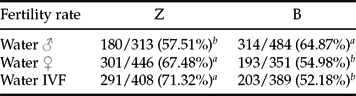
Significant differences (P < 0.05) appeared between all groups regardless of the effect analysed (see Table 1). When the male effect was analysed, water B presented better rates than water Z (64.87 vs. 57.51%). However, when the female effect and the water where the in vitro fertilization took place were analysed, the worst result was obtained in water B.
Fertility rate of zebrafish (Danio rerio) embryos, from adult males reared in water Z and in water B, adult females also reared in these two waters and the water (Z or B) where the in vitro fertilization (IVF) took place

a ,b Columns with different superscripts are statistically different (P < 0.05).
Hatching rate at 72 h post fertilization
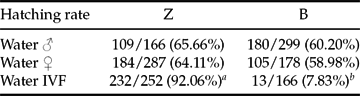
Embryo hatching rates were evaluated at 72 hpf (Martínez-Sales et al., Reference Martínez-Sales, García-Ximénez and Espinós2015). No statistically significant differences appeared when the male or female effects were assessed. However, significant differences (P < 0.05) appeared when the water effect, where the in vitro fertilization took place, was analysed (see Table 2). Water B presented the worst result (7.83%).
Hatching rate of zebrafish (Danio rerio) embryos at 72 hpf, from adult males reared in water Z and in water B, adult females also reared in these two waters and the water (Z or B) where the in vitro fertilization (IVF) took place

a ,b Columns with different superscripts are statistically different (P < 0.05).
Survival and abnormality rate at five days post fertilization
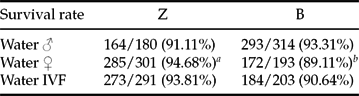
Embryo survival rates evaluated at 5 dpf were high in all groups, with no statistically significant differences (P < 0.05) between waters, except when the female effect was studied, where significant differences appeared (P = 0.0342) (see Table 3). Water B obtained the worst result (89.11%) compared with water Z (94.68%).
Survival rate of zebrafish (Danio rerio) embryos at 5dpf from adult males reared in water Z and in water B, adult females also reared in these two waters and the water (Z or B) where the in vitro fertilization (IVF) took place

a ,b Columns with different superscripts are statistically different (P < 0.05).
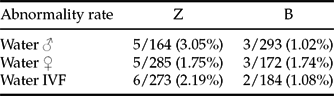
In the case of abnormalities at 5 dpf, pericardial edema, curled tails and skeletal deformities (lordosis, scoliosis, and abnormal skeletal development) were the main malformations observed. No differences were observed in the abnormality rate evaluated at 5 dpf in any group (see Table 4).
Abnormality rate of zebrafish (Danio rerio) embryos at 5dpf, from adult males reared in water Z and in water B, adult females also reared in these two waters and the water (Z or B) where the in vitro fertilization (IVF) took place

Discussion
Based upon results obtained in the current work, it can be stated that the effects of pollutants on the sensitive parameters are caused by three different non-exclusive routes: affecting oogenesis in females, spermatogenesis in males and even by a direct effect of the water during the fertilization process. As these effects operate by different pathways and have also been demonstrated in mammals and in humans, especially via sperm (Toft et al., Reference Toft, Rignell-Hydbom, Tyrkiel, Shvets, Giwercman, Lindh, Pedersen, Ludwicki, Lesovoy, Hagmar, Spanó, Manicardi, Bonefeld-Jorgensen, Thulstrup and Bonde2006; Vested et al., Reference Vested, Giwercman, Bonde and Toft2014), the value of zebrafish as a bioindicator is confirmed.
As mentioned in material and methods, in our previous work (Martínez-Sales et al., Reference Martínez-Sales, García-Ximénez and Espinós2015) water B manifested the most harmful effects on reproductive parameters, which is the reason we have focused on this water in the present work.
Regarding hatching rate, the male or female direct effects were not the origin of the decrease with respect to the results obtained in the control water. However, this effect was exclusively observed in water B when it was used in the in vitro fertilization process. Pollutants with effects on chorion seem to be the source of this decrease without an alteration of the female gametes or male gametes. Certainly, some substances found in drinking waters have decreased or even inhibited the hatching process in zebrafish, such as ibuprofen or acetaminophen (Galus et al. Reference Galus, Kirischian, Higgins, Purdy, Chow, Rangaranjan, Li, Metcalfe and Wilson2013). In our case it has not been determinate if the reduction in the hatching rate has been due to an effect on embryo or on chorion structure, or even both.
Survival rates at 5dpf were high in all cases studied. In many toxicological studies, a delay in the hatching process entails a decrease in the survival rate (Shi et al., Reference Shi, Du, Lam, Wu and Zhou2008; Zhu et al., Reference Zhu, Zhu, Duan, Qi, Li and Lang2008), related with the toxic concentration used. The lower the concentration, the lower the mortality (Powers et al., Reference Powers, Yen, Linney, Seidler and Slotkin2010). In our work, the waters employed are drinkable, so the concentration levels (ng/l or μg/l) of emerging contaminants expected are low (Khetan & Collins, Reference Khetan and Collins2007; Rodil et al., Reference Rodil, Quintana, Concha-Graña, López-Mahía, Muniategui-Lorenzo and Prada-Rodríguez2012) and thus a high survival rate is predictable.
With respect to fertility rate, there was a decrease when the in vitro fertilization took place in water B, but in this parameter there was also an effect on the quality of oocytes through the oogenesis from female adults reared in water B. However, sperm fertility from male adults reared in water B was not affected. So, despite the water effect, a female effect in this parameter also seems to be the origin of this decrease. The female effect could be explained by the possible presence in water of substances like endocrine disruptors (17α-ethinylestradiol) which could decrease the number and quality of the female gametes produced (Santos et al., Reference Santos, Paull, Van Look, Workman, Holt, Van Aerle, Kile and Tyler2007) and/or pharmaceutical substances (carbamazepine and gemfibrozil) which have been shown to reduce fecundity (total embryos produced) (Galus et al., Reference Galus, Rangarajan, Lai, Shaya, Balshine and Wilson2014). Regarding the water effect, this decrease could be explained by the presence of substances which affect the chorion structure in the micropyle, altering the sperm entry through it. Moreover, this effect can also alter the overall structure of the chorion, which could explain the decrease in the hatching rate previously described. No references to the possible substances which alter the chorion structure were found in the literature reviewed. However, it could be substances that affect directly the chorion in the same way that the bleach.
It is known that human reproduction can be affected by a wide variety of pollutants (Sharpe & Irvine, Reference Sharpe and Irvine2004; Vested et al., Reference Vested, Giwercman, Bonde and Toft2014) via male or female or even both, due to the continual occurrence of emerging or newly identified contaminants in the water resources (Bolong et al., Reference Bolong, Ismail, Salim and Matsuura2009) and the lack of preventive policy legislation (Braw-Tal, Reference Braw-Tal2010). For this reason, due to the complex detection and removal of these substances, in our current work and with the support to our previous works (Martínez-Sales et al., Reference Martínez-Sales, García-Ximénez and Espinós2014; Reference Martínez-Sales, García-Ximénez and Espinós2015), we verify the use of the zebrafish as a bioindicator of emerging contaminants in drinking water with the possibility, in this case, of discriminating the effects through three different pathways: male, female or water where the in vitro fertilization took place.
Acknowledgements
The authors would like to thank Mr Javier Rubio for his valuable technical support and Mr Neil Macowan for improving the English of this manuscript.
Funding
This research did not receive any specific grant from any funding agency in the public, commercial or not-for-profit sector.
Declaration of interest
The authors declare that there is no conflict of interest that could be perceived as prejudicing the impartiality of the research reported.