1. Introduction
Peralkaline igneous rocks exhibit a wide degree of morphological, mineralogical and compositional variation; for this reason, there have been numerous models proposed to explain their modes of genesis (e.g. Whalen et al. Reference Whalen, Currie and Chappell1987; Martin, Reference Martin2006; Markl et al. Reference Markl, Marks and Frost2010; Frost & Frost, Reference Frost and Frost2011; Vasyukova & Williams-Jones, Reference Vasyukova and Williams-Jones2020). Despite their diversity, peralkaline rocks share certain common attributes including enrichment in incompatible lithophile and high-field-strength elements and a broad spatial association with intracratonic rift settings (Sørensen, Reference Sørensen1992; Dostal, Reference Dostal2016). It is widely accepted that peralkaline magmas represent highly fractionated liquids originating either from low degrees of partial melting in the mantle or from a previously enriched crustal or mantle source (Martin, Reference Martin2006; Dostal, Reference Dostal2016; Marks & Markl, Reference Marks and Markl2017). In the latter scenario, enrichment is commonly purported to arise from focused metasomatism beneath a region of the lithosphere undergoing extension, or from an upwelling mantle plume (Martin, Reference Martin2006; Shellnutt & Zhou, Reference Shellnutt and Zhou2007). However, permissible timescales for the introduction of these volatiles remain uncertain and, for voluminous peralkaline intrusions otherwise lacking evidence of plume involvement, the extent of the enrichment imposed on the source region must be considerable.
In Labrador, there exists an atypical but systematic spatial relationship between peralkaline intrusions and anorthosite–mangerite–charnockite–granite (AMCG) -affinity rocks of the Nain Plutonic Suite (Fig. 1; Kerr, Reference Kerr2011). The Nain Plutonic Suite is one of the largest exposures of AMCG-affinity rocks worldwide (Emslie, Reference Emslie1978; Emslie et al. Reference Emslie, Hamilton and Thériault1994; Myers et al. Reference Myers, Voordouw and Tettelaar2008; Ashwal & Bybee, Reference Ashwal and Bybee2017). These igneous complexes are at the core of many enduring petrologic debates, concerned primarily with how to generate their considerable volumes of anorthosite (Bowen, Reference Bowen1917; Emslie, Reference Emslie1978; Ashwal, Reference Ashwal1993; Longhi et al. Reference Longhi, Auwera, Fram and Duchesne1999), and how to generate the ubiquitous assortment of coeval accessory lithologies including mangerite, charnockite, rapakivi granite and ferrodiorite (Emslie et al. Reference Emslie, Hamilton and Thériault1994; Scoates et al. Reference Scoates, Frost, Mitchell, Lindsley and Frost1996; Frost & Frost, Reference Frost and Frost1997, Reference Frost and Frost2008b; Vander Auwera et al. Reference Vander Auwera, Longhi and Duchesne1998; Vigneresse, Reference Vigneresse2005; Duchesne et al. Reference Duchesne, Shumlyanskyy and Mytrokhyn2017). It has become largely accepted that the ‘massif-type’ anorthosite in AMCG complexes was formed by segregation of buoyant plagioclase cumulates from a basaltic melt ponded in the lower crust (Emslie, Reference Emslie1978; Morse, Reference Morse1982; Ashwal, Reference Ashwal1993) in tectonic settings associated with either syn- to post-collisional removal of mantle lithosphere (e.g. Corrigan & Hanmer, Reference Corrigan and Hanmer1997; McLelland et al. Reference McLelland, Selleck, Hamilton and Bickford2010), or post-orogenic collapse (e.g. Vander Auwera et al. Reference Vander Auwera, Bolle, Bingen, Liégeois, Bogaerts, Duchesne, De Waele and Longhi2011). However, the source of this parental magma remains controversial. Some researchers favour a mantle origin for these melts (Mitchell et al. Reference Mitchell, Scoates, Frost and Kolker1996; Frost et al. Reference Frost, Frost, Lindsley, Chamberlain, Swapp and Scoates2010; Bybee et al. Reference Bybee, Ashwal, Shirey, Horan, Mock and Andersen2014; Ashwal & Bybee, Reference Ashwal and Bybee2017), whereas others have argued for a lower crustal source (Duchesne et al. Reference Duchesne, Liégois, Vander Auwera and Longhi1999; Longhi, Reference Longhi2005; Bédard, Reference Bédard2009; Vander Auwera et al. Reference Vander Auwera, Bolle, Bingen, Liégeois, Bogaerts, Duchesne, De Waele and Longhi2011; Duchesne et al. Reference Duchesne, Shumlyanskyy and Mytrokhyn2017). A similar debate has developed in parallel concerning the source of, and interrelation between, the accompanying granitoids and ferrodiorites (Emslie et al. Reference Emslie, Hamilton and Thériault1994; Scoates et al. Reference Scoates, Frost, Mitchell, Lindsley and Frost1996; Frost & Frost, Reference Frost and Frost1997, Reference Frost and Frost2013; McLelland et al. Reference McLelland, Bickford, Hill, Clechenko, Valley and Hamilton2004; Ashwal & Bybee, Reference Ashwal and Bybee2017; Duchesne et al. Reference Duchesne, Shumlyanskyy and Mytrokhyn2017).
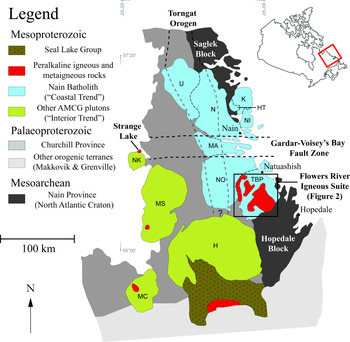
Regional map of Labrador showing the Nain Plutonic Suite’s Coastal and Interior Trend AMCG associations as well as major structural corridors in the region. Peralkaline igneous centres are shown in red. H – Harp Lake intrusion; HT – Hettasch intrusion; K – Kiglapait intrusion; MA – Makhavinekh pluton; MC – Michikamau intrusion; MS – Mistastin Batholith; N – Nain anorthosite; NI – Newark Island intrusion; NK – Napeu Kainiut quartz monzonite; NO – Notakwanon Batholith; TBP – Three Bays Pluton; U – Umiakovik Batholith. Modified from Emslie et al. (Reference Emslie, Hamilton and Thériault1994) and Kerr (Reference Kerr2011). Pluton abbreviations after Emslie et al. (Reference Emslie, Hamilton and Thériault1994). Inset area is shown in detail in Figure 2.

The Nain Plutonic Suite diverges from the established petrogenetic framework of AMCG complexes in several key regards. The Nain Plutonic Suite was not emplaced following any direct regional orogenesis (e.g. Corrigan et al. Reference Corrigan, Rivers and Dunning2000; Gower & Krogh, Reference Gower and Krogh2002), and therefore cannot have been produced in a post-collisional setting. The ages recorded by the Nain Plutonic Suite also suggest that it was an unusually long-lived magmatic system. Magmatism occurred in two distinct episodes, yielding an older suite (1460–1420 Ma) to the west and a younger suite (1362–1290 Ma) to the east (Miller et al. Reference Miller, Heaman and Birkett1997; Myers et al. Reference Myers, Voordouw and Tettelaar2008; Fig. 1), whereas emplacement windows for AMCG suites elsewhere have been estimated to span fewer than c. 10 Ma (e.g. Schärer et al. Reference Schärer, Wilmart and Duchesne1996; Scoates & Chamberlain, Reference Scoates and Chamberlain2002; McLelland et al. Reference McLelland, Bickford, Hill, Clechenko, Valley and Hamilton2004). Some authors propose a connection between Nain plutonism and prolonged convergence along the southern Laurentian margin to accommodate these differences (e.g. Myers et al. Reference Myers, Voordouw and Tettelaar2008; Hynes & Rivers, Reference Hynes and Rivers2010; McLelland et al. Reference McLelland, Selleck, Hamilton and Bickford2010), but the precise tectonic mechanism underlying magmatism in the region has not yet been fully constrained. Some degree of structural control on magmatic emplacement is evident in the confluence between the eastern Nain Plutonic Suite intrusions and the Torngat Orogen, which defines the boundary between the Archean Nain and Palaeoproterozoic Churchill Provinces (Fig. 1; Myers et al. Reference Myers, Voordouw and Tettelaar2008).
The relationship between the peralkaline rocks and their AMCG-affinity host plutons remains uncertain (e.g. Kerr, Reference Kerr2014; Ryan et al. Reference Ryan, Connelly and James2017), though many of the intrusions have been the subjects of only preliminary reconnaissance (Kerr, Reference Kerr2011). These intrusions therefore constitute a presently underutilized source of insight into the geodynamic conditions coincident with their emplacement, and potentially that of their AMCG-affinity host plutons. The c. 1240 Ma Strange Lake intrusion (Fig. 1) is the most renowned of Labrador’s peralkaline complexes (e.g. Miller et al. Reference Miller, Heaman and Birkett1997; Salvi & Williams-Jones, Reference Salvi and Williams-Jones1996; Vasyukova & Williams-Jones, Reference Vasyukova and Williams-Jones2014). Isotopic data indicate the Strange Lake intrusion was not derived directly from its host AMCG-affinity pluton (Siegel et al. Reference Siegel, Williams-Jones and Stevenson2017), but the precise relationship between these two intrusions remains incompletely understood, and the Strange Lake intrusion may post-date the earlier intrusion by as much as 200 Ma (Miller et al. Reference Miller, Heaman and Birkett1997). By contrast, chronometric data suggest peralkaline granite belonging to the Flowers River Igneous Suite (FRIS; Fig. 1) was emplaced at most 20 Ma after its AMCG-affinity host intrusions (Hill, Reference Hill1991; Myers et al. Reference Myers, Voordouw and Tettelaar2008). This relatively short delay between the two events suggests that the FRIS is more likely to have been influenced by the geodynamic conditions that persisted following the emplacement of its host intrusion. The large size and strong silica-oversaturation of the FRIS preclude low-degree partial melting as a mechanism for its formation, and there is no systematic age progression within the Nain Plutonic Suite to support the involvement of a mantle plume.
The current petrochronological framework for the Flowers River peralkaline granite suggests that it is the youngest magmatic phase within the eastern (younger) composite batholith of the Nain Plutonic Suite that was emplaced along the tectonic boundary dividing the Nain and Churchill Provinces (Hill, Reference Hill1991; Miller, Reference Miller1993; Myers et al. Reference Myers, Voordouw and Tettelaar2008). The lack of available geochronology for the host rocks to the Flowers River intrusions has impeded a complete understanding of the local magmatic history. This study presents new U–Pb zircon geochronology for the Flowers River Granite, its coeval volcanic succession and the surrounding AMCG-affinity granitoids. These results are combined with whole-rock geochemical data to construct a geodynamic model describing each successive episode of magmatism in the study area. The AMCG-affinity granitoids and ferrodiorites in the Flowers River area show moderately enriched major- and trace-element signatures relative to other AMCG-affinity rocks found elsewhere in the Nain Plutonic Suite. Episodic, comparatively enriched magmatism at a single focal centre over at least 10 Ma precludes a sub-lithospheric source, as such a source would be transient over these timescales. We therefore suggest that either the FRIS was sourced by delayed re-melting of the recently emplaced AMCG-affinity rocks, or that both suites sampled a static enriched reservoir located in the subjacent lithosphere (e.g. Goodenough et al. Reference Goodenough, Upton and Ellam2002; Upton, Reference Upton2013; Siegel et al. Reference Siegel, Williams-Jones and Stevenson2017). Massif anorthosite and associated lithologies were generated in large volumes across a wide area during emplacement of the Nain Plutonic Suite and spanned many distinct crustal regimes. Other peralkaline complexes associated with AMCG-affinity magmatism in Labrador may similarly represent the ultimate products of melts sourced from pockets of enriched lithosphere created during earlier Palaeoproterozoic tectonism.
2. Geological setting
The Flowers River Igneous Suite intrudes the southernmost region of the eastern division of the Nain Plutonic Suite, a series of AMCG-affinity intrusions distributed throughout Labrador and eastern Québec (Hill, Reference Hill1982, Reference Hill1991). The eastern subset of the Nain Plutonic Suite is a large composite batholith that occupies much of the modern coastline of Labrador, referred to here as the Nain Batholith. The Nain Batholith consists of numerous overlapping plutons emplaced during 1362–1290 Ma (Fig. 1; Myers et al. Reference Myers, Voordouw and Tettelaar2008). The surface expressions of these plutons expose variable proportions of the various AMCG association lithologies (Emslie, Reference Emslie1978), which has been speculated to reflect preservation at contrasting structural levels spanning a largely uniform initial pluton cross-section (Ryan, Reference Ryan1991; Kerr & Smith, Reference Kerr and Smith2000).
The Nain Batholith was emplaced along the Palaeoproterozoic Torngat Orogen, and is transected by the Gardar–Voisey’s Bay Fault Zone. These major structural corridors played a major role in facilitating magmatic ascent (Myers et al. Reference Myers, Voordouw and Tettelaar2008; McLelland et al. Reference McLelland, Selleck, Hamilton and Bickford2010). The Nain Batholith is bound to its west by Archean–Palaeoproterozoic gneisses of the Churchill Province, variably reworked by the Torngat Orogeny (Ryan, Reference Ryan2000). Along the coast, the Nain Batholith separates two major Archean crustal blocks: the Hopedale Block to the south and the Saglek Block to the north (Fig. 1). Collision between these two blocks at c. 2550 Ma during amalgamation of the North Atlantic Craton formed a wide suture zone, the thermal imprint of which is preserved in remnant exposures of Archean gneiss dispersed within the archipelagic eastern margins of the Nain Batholith (Connelly & Ryan, Reference Connelly and Ryan1996). The suture itself may have acted as an additional focal conduit for Mesoproterozoic plutonism, though the structure has been largely obscured by the intrusions.
The AMCG-affinity rocks that host the FRIS have been divided previously into three anorthositic plutons: the Sango Bay Pluton, Merrifield Bay Pluton and Flowers Bay Pluton (Hill, Reference Hill1988; Fig. 2). Hypersolvus, fayalite-bearing granite and monzonite occur in approximately equal proportion to the anorthositic lithologies. These granitoids are interpreted to be equivalent to the hypersthene-bearing charnockite and mangerite prevalent throughout the Nain Plutonic Suite, although emplaced at comparatively lower pressures or crystallized from magmas with high Fe/Mg (Le Maitre et al. Reference Le Maitre, Streckeisen, Zanettin, Le Bas, Bonin and Bateman2005; Frost & Frost, Reference Frost and Frost2008b). For simplicity, the three anorthositic bodies and their coeval fayalite-bearing granitoids are collectively referred to here as the ‘Three Bays Pluton’ (TBP). The TBP lies to the immediate SE of the Notakwanon Batholith, a predominantly granitic AMCG-affinity intrusion with approximately equal proportions of classic hypersthene-bearing (charnockite sensu stricto) and fayalite-bearing granitoids (Hill, Reference Hill1982; Emslie & Stirling, Reference Emslie and Stirling1993). Previous work on the Notakwanon Batholith has shown that its granitoid rocks display more pronounced Eu and Sr depletion than more northerly Nain Batholith intrusions (Emslie & Stirling, Reference Emslie and Stirling1993). There are currently no geochronological data available for the Notakwanon Batholith, but it is inferred to be slightly older than the FRIS (Myers et al. Reference Myers, Voordouw and Tettelaar2008).
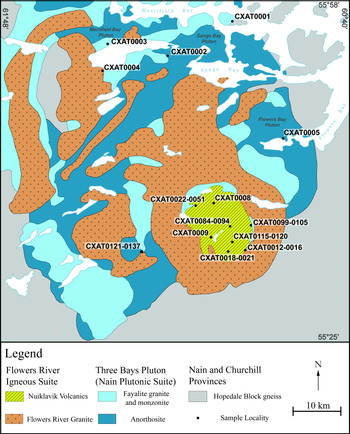
Geological map of the Three Bays Pluton and Flowers River Igneous Suite. Individual plutons are marked as named by Hill (Reference Hill1988). Modified after Hill (Reference Hill1982).

The Flowers River Igneous Suite comprises the Flowers River peralkaline granite and the coeval Nuiklavik volcanic succession. The Flowers River Granite is the largest peralkaline intrusive body in Labrador, and forms an extensive series of intrusions (> 2000 km2 mapped surface area) with arcuate to curvilinear geometry dispersed throughout the Three Bays Pluton and emplaced concentrically around the Nuiklavik caldera (Hill, Reference Hill1982; Fig. 2). Medium-grained equigranular peralkaline granite is the primary constituent of the intrusions, with sparse porphyritic and pegmatitic expressions near the roof of the pluton, and minor confinement fabrics developed locally along pluton margins (Hill, Reference Hill1982, Reference Hill1991). The coeval Nuiklavik Volcanics have attracted interest due to localized radiometric anomalies and coincident Zr–Y–Nb–REE (rare earth element) mineralization (Hill, Reference Hill1982; Miller, Reference Miller1992, Reference Miller1993). The Nuiklavik caldera is a roughly circular feature c. 10 km in diameter, located at the centre of the largest peralkaline granite intrusion, toward the southeastern extent of the study area (Fig. 1; Hill, Reference Hill1982). The volcanic succession comprises a diverse array of silicic volcanic lithofacies including crystal-rich to aphyric ash flows, ignimbrites and porphyries, as well as possible lavas and subvolcanic domes (Miller, Reference Miller1992, Reference Miller1993). The Nuiklavik Volcanics occupy a depression in the central Flowers River Granite intrusion, and windows of peralkaline granite are dispersed throughout the caldera. Volcanic rocks also lie in direct contact with inliers of fayalite granite and monzonite around the caldera edges. Pristine preservation of primary volcanic textures is common, although intense alteration frequently accompanies mineralization and may overprint these textures. Widespread, extreme Na depletion has been documented in the Nuiklavik Volcanics (Miller, Reference Miller1994), and few samples preserve mineralogical or geochemical evidence for an initially peralkaline composition. Nevertheless, trace-element compositions appear consistent with the volcanic rocks having been derived from the Flowers River magmas (Miller, Reference Miller1992).
The geochronological framework for the Flowers River area is poorly defined. Emplacement timings for the Three Bays Pluton, along with the nearby Notakwanon Batholith (Fig. 1), have previously been inferred based on ages reported for the FRIS (Emslie & Stirling, Reference Emslie and Stirling1993; Myers et al. Reference Myers, Voordouw and Tettelaar2008). The timing of Flowers River magmatism is better constrained, but the various reported ages span a considerable range. Collerson (Reference Collerson1982) first reported a Rb–Sr errorchron age of 1262 ± 7 Ma for peralkaline granites located near Flowers Bay, at the northwestern edge of the study area. Later thermal ionization mass spectrometry (ID-TIMS) U–Pb zircon dating reported two ages, 1291 ± 2 and 1289 ± 1 Ma, for a Nuiklavik porphyry (Miller, Reference Miller1994), and three zircon fractions yielded an age of 1271 ± 15 Ma for the Flowers River Granite (Hill, Reference Hill1991). Additional geochronological data would serve to clarify the relationship between the Flowers River Granite and the Nuiklavik Volcanics, as well as to determine a timing of emplacement for the Three Bays Pluton.
As noted above, the spatial association observed between peralkaline intrusions and earlier AMCG-affinity plutons in Labrador (e.g. Miller et al. Reference Miller, Heaman and Birkett1997; Kerr, Reference Kerr2011) is not a systematic component of AMCG complexes elsewhere. An exception to this is the Mount Rosa complex in Colorado, a late-stage intrusion within the Pikes Peak Batholith (Barker et al. Reference Barker, Wones, Sharp and Desborough1975; Smith et al. Reference Smith, Noblett, Wobus, Unruh, Douglass, Beane, Davis, Goldman, Kay, Gustavson, Saltoun and Stewart1999). The geodynamic conditions that fostered AMCG magmatism have also been noted to resemble those corresponding to Mesozoic peralkaline magmatism in Nigeria (Magaji et al. Reference Magaji, Martin, Ike and Ikpokonte2011; Martin et al. Reference Martin, Sokolov and Magaji2012), and the Gardar alkaline province in Greenland is inferred to sit atop an extensive AMCG complex (Bridgwater, Reference Bridgwater1967; Upton et al. Reference Upton, Emeleus, Heaman, Goodenough and Finch2003). All of these examples are similarly far removed in time from their most recent instances of regional orogenesis as the Nain Plutonic Suite. Notably, the Gardar Province is similar in age to the peralkaline intrusions in Labrador, and would have been directly adjacent to these localities around the time of their emplacement (e.g. Blaxland & Parsons, Reference Blaxland and Parsons1975; Waight et al. Reference Waight, Baker and Willigers2002; McCreath et al. Reference McCreath, Finch, Simonsen, Donaldson and Armour-Brown2012; H Salmon, unpub. Ph.D. thesis, University of London, 2013; Upton, Reference Upton2013; Borst et al. Reference Borst, Waight, Finch, Storey and Le Roux2019).
3. Sampling and analytical methods
Samples of both Three Bays Pluton and Flowers River intrusive lithologies were obtained from near the outer ring segments or at the margins of the central Flowers River intrusion (Fig. 2). A total of 37 samples were selected for whole-rock geochemical analysis, and between 400 and 1000 g of material was provided for processing. Geochemical analyses were provided by Activation Labs in Ancaster, Ontario using lithium borate fusion inductively coupled plasma optical emission spectrometry (ICP-OES) and mass spectrometry (ICP-MS) for major- and trace-element analyses, respectively. Analytical uncertainties obtained using these techniques are less than 1%. These data were supplemented with geochemical data obtained previously by the Newfoundland Department of Mines and Energy for the Nuiklavik Volcanics (Miller & Kerr, Reference Miller and Kerr2007).
Conventional petrographic mineral identification was supported by backscatter electron (BSE) imaging and energy-dispersive spectroscopy (EDS) using a JEOL 6400 scanning electron microscope (SEM) at the University of New Brunswick’s Microscopy and Microanalytical Facilities.
Laser ablation (LA-) ICP-MS was conducted at the University of New Brunswick using a Resonetics S-155-LR ArF Excimer laser system along with an Agilent Technologies 7700× quadrupole ICP-MS. Zircon analyses were performed in situ (e.g. McFarlane & Luo, Reference McFarlane and Luo2012) with on-sample fluence of 3 J cm–2 and a repetition rate of 3 Hz. Zircon specimens were ablated for 30 second intervals for the collection of U–Pb data, and for 60 second intervals for simultaneous collection of geochronological and trace-element data. Ablation crater diameter varied between 33 and 45 µm depending on the modal size of zircon grains. The primary zircon geochronological standard used was FC-1, with Plesovice and 91500 serving as secondary standards. Instrument tuning was performed prior to each analytical session using synthetic glass standard NIST-610. Standard U–Pb ages were reproducible to within 1% of the true age of the material.
4. Lithological descriptions and geochemistry
4.a. Three Bays Pluton
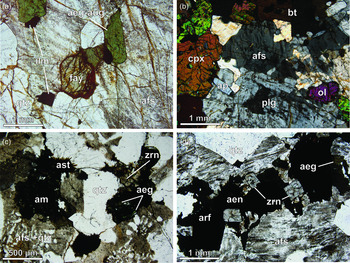
Fayalite-bearing granitoids constitute the majority of AMCG-affinity rocks exposed in the vicinity of the Nuiklavik caldera. Fayalite granite and monzonite were found primarily along the caldera margin, but highly altered examples are also exposed in windows along high-elevation ridges. Fayalite granite weathers to a dull orange-brown in outcrop, and easily disintegrates into loose K-feldspar crystals. Fresh surfaces have a paler, pink-orange hue. In thin-section, the granite contains abundant pale green augite and mesoperthite, with subordinate olivine undergoing incipient alteration to iddingsite and/or grunerite (Fig. 3a). Fayalite granite in the immediate vicinity of the caldera has deeper green, weakly to moderately pleochroic augite with greater aegirine component, and minor sodic-calcic amphibole. Monzonitic rocks are pale grey to white in outcrop, and weather to a dull white or buff colour. Fayalite monzonite is distinguished from fayalite granite by its finer perthitic exsolution, smaller pale brown augite crystals, plagioclase content and common fully pseudomorphed olivine. They show greater degrees of alteration, with decussate pale green hornblende and biotite as the dominant ferromagnesian minerals. A greater variety of lithologies were encountered along the margins of the central Flowers River pluton, distal to the caldera. These include anorthosite, leucogabbro, granite, and a microperthite- and biotite-bearing ferrodioritic rock resembling ferromonzogabbro or a melanocratic jotunite (a charnockite group designation for ferrodioritic rocks; e.g. Duchesne & Wilmart, Reference Duchesne and Wilmart1997; Vander Auwera et al. Reference Vander Auwera, Longhi and Duchesne1998; Fig. 3b). This ferrodiorite appears to be equivalent to the transitional to alkalic ferrogabbro described by Hill (Reference Hill1988), and contains abundant euhedral apatite as well as an unaltered assemblage of olivine, orthopyroxene, clinopyroxene, biotite, plagioclase, apatite and microperthitic alkali feldspar. By contrast, the anorthosite suite lithologies encountered in this study (ranging from leucogabbro to anorthosite sensu stricto) comprise plagioclase and clinopyroxene alongside a secondary mineral assemblage of prehnite, calcite, hornblende, epidote and chlorite.
Representative photomicrographs of intrusive lithologies from the Flowers River area. (a) Fayalitic olivine and (aegirine-)augite in a Three Bays Pluton fayalite granite. Plane-polarized light. (b) Representative mineralogy from a sample of moderately alkalic ferromonzogabbro (ferrodiorite). Cross-polarized light. (c) Alkali ferromagnesian minerals in a porphyritic Flowers River peralkaline granite. Note the graphic intergrowths of quartz and alkali feldspar. Plane-polarized light. (d) Alkali ferromagnesian and accessory minerals in an equigranular Flowers River peralkaline granite. Arfvedsonite and aenigmatite grow around large zircon inclusions within coarsely perthitic alkali feldspar. Plane-polarized light. Mineral abbreviations: aeg – aegirine; aeg-aug – aegirine-augite; aen – aenigmatite; afs – alkali feldspar; am – amphibole; ap – apatite; arf – arfvedsonite; bt – biotite; cpx – clinopyroxene; fay – fayalite; ilm – ilmenite; ol – olivine; plg – plagioclase; qtz – quartz; zrn – zircon.

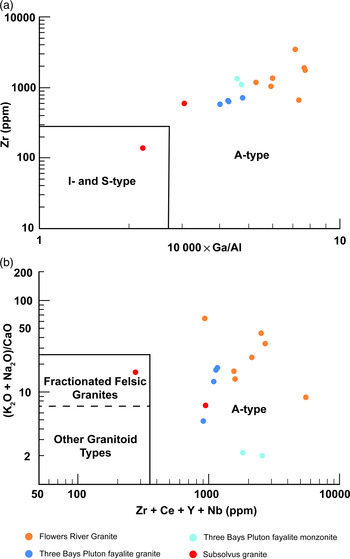
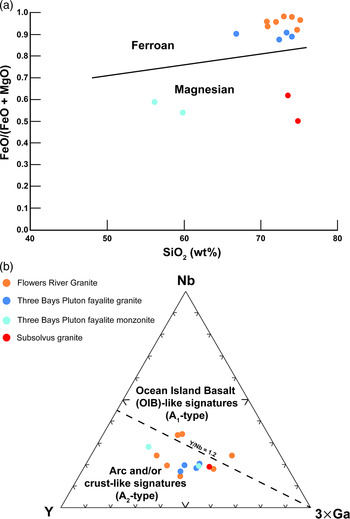
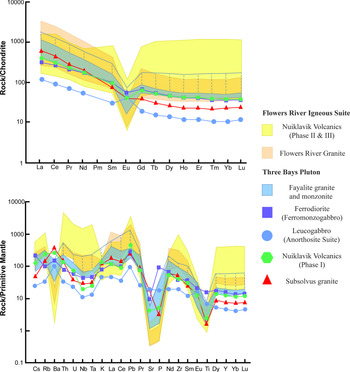
Geochemical data for Three Bays Pluton lithologies are presented in Table 1. All Three Bays granitoids plot as A-type (Fig. 4). Three Bays Pluton fayalite granite displays markedly ferroan compositions, whereas fayalite monzonite is magnesian (Fig. 5a). Three Bays Pluton granitoids unambiguously plot as type A2 granites of Eby (Reference Eby1992; Fig. 5b) and show relatively homogeneous REE and trace-element profiles (Fig. 6). These rocks show moderate to pronounced negative Eu anomalies (Eu/Eu* = 0.21–0.55), flat heavy REE (HREE) trends (Dy/Yb = 0.94–1.13), slight relative depletion in Sr, P, Ti and Ba, and variable Nb–Ta troughs. These closely resemble results of prior geochemical analyses of the Notakwanon Batholith (Emslie et al. Reference Emslie, Hamilton and Thériault1994; Fig. 1). Gabbroid members of the TBP deviate from this trend. Ferrodiorite retains a slight negative Eu anomaly (Eu/Eu* = 0.7) and depletion in Sr, but shows moderate enrichment in Ba and Ti with pronounced enrichment in P. The anorthositic rocks display a positive (or no) Eu anomaly (Eu/Eu* = 1.04–1.69), are Ba-enriched and are depleted relative to all other lithologies. Ferrodiorite and anorthositic lithologies are omitted from Figures 4 and 5 because the diagrams used are determined using the geochemical properties of granitoid rocks only.
Whole-rock major- and trace-element analyses for Three Bays Pluton lithologies

(a) Zr versus 10 000 × Al/Ga and (b) (K2O+Na2O)/CaO versus Zr + Ce + Y + Nb diagrams after Whalen et al. (Reference Whalen, Currie and Chappell1987). All samples plot in the A-type field except for one sample of subsolvus granite.

(a) FeO/(FeO+MgO) versus SiO2 plot after Frost & Frost (Reference Frost and Frost2008a). Samples of Flowers River Granite and Three Bays Pluton fayalite granite are ferroan, whereas monzonite and subsolvus granite plot in the sub-ferroan (magnesian) field. (b) Y versus Nb versus 3×Ga ternary plot after Eby (Reference Eby1992) for samples that plot as A-type in Figure 3. Most samples plot in the A2 field, but three porphyritic peralkaline granite samples have Y/Nb < 1.2 and accordingly plot in the A1 field.

Chondrite-normalized REE (top) and primitive-mantle-normalized trace-element (bottom) diagrams for the various suites of rocks exposed in the vicinity of the Flowers River Igneous Suite. Compositional ranges are provided for highly represented suites. The compositional profile of one enriched sample of fayalite monzonite (CXAT0045) is connected by dashed line to the more typical compositional range for this suite. Values plotted for the Nuiklavik Volcanics (Phase I) are an average of two samples. Normalization factors after Sun & McDonough (Reference Sun, McDonough, Saunders and Norry1989).

4.b. Flowers River Granite
The Flowers River Granite exhibits textural and mineralogical homogeneity and typically occurs as medium-grained pink to pink-white granite. It locally occurs as thin (< 1 m) pegmatitic veins intruding TBP anorthosite, especially near the outer margin of the central Flowers River pluton. Outcrops of fine-grained porphyritic granite are exposed along the southern caldera margin and in incised valleys within the caldera. Petrographic differences between granite within the caldera and nearer the limits of the central pluton are apparent in thin-section. Ferromagnesian and accessory mineral phases found near pluton margins are more coarse-grained and less altered, with Fe-oxide minerals present in considerable abundance. By contrast, the granite exposed within the caldera has developed much finer, hydrothermally altered interstitial ferromagnesian minerals and clusters of partially dissolved and/or recrystallized accessory phases (Fig. 3c). The essential mineralogical constituents in all samples are perthitic alkali feldspar, quartz, ferro-richteritic amphibole, aegirine-augite and zircon; primary aenigmatite was observed only in extracaldera granite, and feldspar in these rocks shows coarser perthitic lamellae (Fig. 3d). Ilmenite is the primary Fe–Ti oxide phase, rarely co-occurring with magnetite, and is typically observed reacting with rims of sodic-calcic amphibole to form aenigmatite. It is notable that diagnostic alkali minerals, following Le Maitre et al. (Reference Le Maitre, Streckeisen, Zanettin, Le Bas, Bonin and Bateman2005) (i.e. arfvedsonite, aegirine-augite and aenigmatite), only rarely display a conclusively magmatic appearance. Aegirine-augite, in particular, is typically present as metasomatic overgrowths on sodic-calcic amphiboles or as larger inclusion-rich crystals, although definitive magmatic specimens of both aegirine-augite and aenigmatite are present in some of the extracaldera peralkaline granite samples. The apparently secondary appearance of these phases in peralkaline granite from within the caldera may simply reflect a greater degree of interaction with late-magmatic volatiles. This is consistent with textural criteria in these samples indicating pervasive subsolidus re-equilibration, and with the behaviour of alkali phases during the late-stage petrogenesis of other peralkaline granite intrusions (e.g. Vasyukova & Williams-Jones, Reference Vasyukova and Williams-Jones2014; Yang et al. Reference Yang, Niu, Li, Hollings, Zurevinski and Xing2020).
Equigranular Flowers River Granite samples are A-type (Fig. 4), strongly ferroan (Fig. 5a), and plot in the A2 field of Eby (Reference Eby1992); however, the three porphyritic samples plot within the A1 field (Fig. 5b). Flowers River peralkaline granite (Table 2) shows geochemical profiles identical to the Three Bays granitoids, but appears more strongly differentiated (Fig. 6). Their major-element make-up includes slight elevations in FeOT, Na2O and K2O, and slightly greater depletion of CaO, MgO and TiO2 compared with fayalite granite. Trace-element profiles similarly resemble the TBP granitoids, with the Flowers River Granite showing even more pronounced depletions in Ba, Sr and P, stronger negative Eu anomalies (Eu/Eu* = 0.13–0.19) and greater absolute enrichment in all incompatible elements.
Whole-rock major- and trace-element analyses for the Flowers River peralkaline granite. ND – not determined.

4.c. Nuiklavik Volcanics
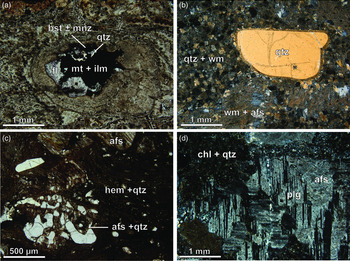
A wide variety of lithofacies have been reported in the Nuiklavik caldera. A full discussion of the caldera’s architecture is beyond the scope of this study; a more comprehensive assessment of structural and geochemical aspects of the volcanic succession can be found in CA White (unpub. PhD thesis, Memorial University of Newfoundland, 1980) and Miller (Reference Miller1993). Previous researchers have generally agreed that the Nuiklavik Volcanics are largely composed of volcaniclastic rocks; however, intensity of alteration, limited cross-sectional exposure, and the massive nature of certain samples often prohibited conclusive identification of a particular volcanic mode of emplacement for this study. The Nuiklavik rocks encountered in this study can broadly be divided into aphyric (Table 3) and porphyritic varieties (Table 4), and textural evidence is generally consistent with these rocks being volcaniclastic in nature. Phenocryst assemblages in porphyritic facies almost exclusively comprise quartz and Carlsbad twinned, microperthitic to unexsolved alkali feldspar. More rarely, larger (< 2 mm) polycrystalline lithic fragments of plagioclase and K-feldspar co-occur with smaller quartz phenocrysts in lithic tuffs. Aphyric rocks encountered over the course of this study commonly preserve discontinuous flow folia or relict fiamme, supporting earlier suggestions that welded tuffs constitute a large proportion of the Nuiklavik Volcanics (Kerr, Reference Kerr2011). Well-preserved devitrification textures, including micropoikilitic quartz and spherulites, indicate that many specimens were initially composed almost entirely of glass. Lithophysae are common in aphyric facies, and are commonly filled with a hydrothermal assemblage of quartz, Fe–Ti oxides, fluorite and sphalerite (Fig. 7a).
Whole-rock major- and trace-element analyses for aphyric facies of the Nuiklavik Volcanics.

Whole-rock major- and trace-element analyses for porphyritic facies of the Nuiklavik Volcanics. ND – not determined.

Representative photomicrographs of volcanic lithologies from the Flowers River area. (a) Large polycrystalline lithic clast of plagioclase and alkali feldspar in a chlorite-altered lithic-rich volcanic sample from the southwestern region of the caldera. Cross-polarized light. (b) Graphic-textured pyroclast set in a flow-banded, hematized crystal tuff. Plane-polarized light. (c) Filled lithophysae within a hematized aphyric volcanic sample from the northwestern region of the caldera. Coarse eu- to subhedral fluorite and oxide minerals suggest secondary growth occurred within primary void space. Accessory REE-bearing minerals (bastnäsite-(Ce) and monazite-(Ce)) occur in subordinate quantities. Cross-polarized light. (d) Porphyritic white mica-altered sample. White mica alteration in the Nuiklavik caldera is commonly accompanied by groundmass textures defined by microperthitic quartz mosaics. Cross-polarized light. Mineral abbreviations: afs – alkali feldspar; bst – bastnäsite-(Ce); chl – chlorite; fl – fluorite; hem – hematite; ilm – ilmenite; mnz – monazite; mt – magnetite; plg – plagioclase; qtz – quartz; wm – white mica.

The Nuiklavik rocks show by far the widest variability in the extent and style of alteration of any unit encountered in the study area, and this is reflected in their geochemistry (Fig. 6). This manifests primarily in their highly variable degrees of enrichment and/or depletion, as their trace-element profiles generally do not deviate considerably from those of the Flowers River and Nain suites. Incompatible element signatures in Nuiklavik rocks can show either more or less absolute enrichment compared with their intrusive counterparts. In particular, the degree of HREE enrichment varies widely, with (La/Lu)CN between 1.04 and 12.2. There is no similar compositional breadth in the depleted elements (e.g. Ba and Sr), and Eu anomalies in the Nuiklavik rocks occupy a narrow range of values (Eu/Eu* = 0.10–0.19). A systematic correlation exists between greater absolute REE concentrations and higher modal abundances of secondary bastnäsite-(Ce) and monazite-(Ce) and intensity of alteration within a sample, suggesting the enrichment is metasomatic in nature. Densely disseminated submicroscopic zircon appears to be the primary controller of these elements in samples showing the most elevated HREE concentrations.
Three distinct alteration styles are observed within the caldera, and can be defined by the dominant groundmass minerals. White mica is the most widespread style of alteration, and fine-grained micaceous masses commonly encroach on feldspar phenocrysts or pseudomorph them entirely (Fig. 7b). A second, distinct hematitic alteration imparts a red to dark brown colour on the groundmass, and red disseminated hematite particles cloud feldspar phenocrysts in affected rocks (Fig. 7c). Notably, this is the only alteration style accompanied by graphic textured pyroclasts of possible juvenile or accidental origin. Finally, a chlorite-dominant alteration was observed in two samples from the SW of the caldera (Fig. 7d), although chloritic alteration frequently occurs with bastnäsite-(Ce) and monazite-(Ce) in otherwise sericitized rocks. Alteration styles in very fine-grained, aphyric ash-flows are more difficult to assess, but EDS results indicate an assemblage comprising predominantly chlorite and quartz.
Samples affected by the chlorite-dominant alteration seen in the SW of the caldera diverge from the geochemical trends common among the other volcanic lithologies. These samples are less strongly depleted in Sr and P than other volcanics, show a marked Nb–Ta trough and are enriched in Ba (Fig. 6). They are also the only volcanic lithologies observed to contain plagioclase, which is present with K-feldspar in polycrystalline lapilli (Fig. 7d). Although accidental fragments of monzonite could serve to impart moderately elevated Sr and Ba relative to the wholesale depletion observed throughout the caldera, imparting Ba concentrations in excess of the monzonite itself is less plausible. Furthermore, only one of the two samples contains plagioclase-bearing lithic fragments, despite sharing near-identical geochemical signatures. Accordingly, these mineralogical and geochemical characteristics are deemed primary geochemical features of the samples. Along with geochronological constraints discussed in Sections 5.c and 6.b, these geochemically distinct lithologies are referred to here as Phase I of the Nuiklavik Volcanics; volcanic lithologies whose geochemistry more closely resembles that of the Flowers River Granite are grouped into Phase II and Phase III (Fig. 6; see discussion in Section 6.b).
4.d. Subsolvus granite
Two outcrops of subsolvus granite were encountered over the course of mapping. One of these exposures was along the eastern edge of the Nuiklavik caldera, and was mapped previously as belonging to the Three Bays Pluton (Hill, Reference Hill1982). The other subsolvus granite is petrologically distinct and has a metaluminous to weakly peraluminous chemistry (A/CNK = 0.93–1.07; Table 1). Their trace-element profiles are distinct among the intrusive samples collected, showing comparative depletion in incompatible elements and weaker negative Eu anomalies (Eu/Eu* = 0.45–0.70), while being undepleted in Sr and Ba (Fig. 6). The rocks are dominated by coarse-grained quartz, plagioclase and unexsolved alkali feldspar in approximately equal proportions. Minor quantities (< 10 vol.%) of biotite and chlorite occur interstitial to these phases. Gneissic xenoliths up to 0.5 m in diameter were evident in outcrop, and microxenolith domains composed of biotite + quartz ± titanite are present in thin section. These domains are rimmed by overgrowths of green augite. The extent and style of subsolidus alteration present in the subsolvus granite is consistent with its previous inclusion with the other Three Bays Pluton granitoid lithologies, and this is further supported by geochronological data (see Section 5.d).
5. U–Pb geochronology
Zircon from 17 samples were analysed in situ using SEM backscatter-electron (SEM-BSE) images to inform spot placement and avoid mixed analyses of zircon age domains. Zircon U–Pb age results are summarized in Table 5. Data were pruned by progressive exclusion based on discordance estimates for each data point, with age concordance cut-offs assessed at 1%, 2%, 3% and 5% for both normally and reversely discordant data. This subset of the data was subsequently screened for outliers using the 206Pb/238U age of individual analyses. Both a weighted mean 206Pb/238U age and concordia age were determined for all discordance intervals, where possible. All ages discussed in the text are concordia ages unless otherwise noted, and analytical uncertainties are reported at 2σ. The discordance limit used for a given sample age is reported alongside the data in Table 5, along with the number of analyses (n) and number of unique zircon grains (n z) used in the age calculation. Ages and age uncertainties are reported as calculated using the IsoPlot 3.75 for Excel package (Ludwig, Reference Ludwig2003).
Summary of U–Pb zircon ages for rocks in the Flowers River area.

a Upper intercept age.
b Value from pooled result using data from both T0009A and T0009B.
5.a. Three Bays Pluton
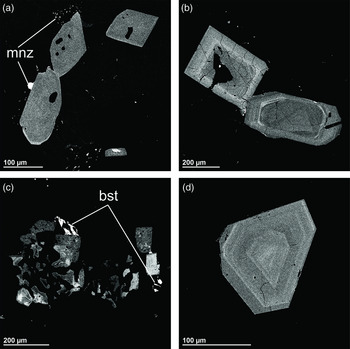
Zircon U–Pb ages were determined for three samples of fayalite granite, one sample of fayalite monzonite and one sample of ferrodiorite (ferromonzogabbro). Zircon in Three Bays Pluton granitoid samples are < 1 mm in diameter and form stubby prismatic, ovoid and blocky crystals (Fig. 8a). Backscatter images reveal either homogeneous internal structure or weak oscillatory zonation, and lack features indicative of subsequent alteration or recrystallization.
Contrast-enhanced SEM-BSE images of zircon specimens in the Flowers River area. (a) Zircon from a Three Bays augite-fayalite granite (CXAT0001) showing homogeneous internal structure. (b) Euhedral zircons from an equigranular Flowers River Granite (Sample CXAT0126) with prominent oscillatory zonation. (c) Zircon from a porphyritic Flowers River Granite (Sample CXAT0030) with irregular amoeboid geometry. Relict, concentric internal structures are weakly preserved in some parts of the crystals and may indicate partial dissolution of a primary zircon crystal. These may alternately be pseudomorphs of an earlier Zr-bearing phase. (d) Zircon from a Nuiklavik porphyry (CXAT0046) showing concentric magmatic zonation. Mineral abbreviations: bst – bastnäsite-(Ce), mnz – monazite-(Ce). Inclusions in (a) and (b) are of apatite and alkali feldspar.

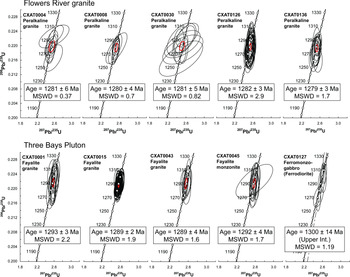
Ages obtained for Three Bays Pluton lithologies agree well with the c. 1290 Ma emplacement age originally proposed by Miller et al. (Reference Miller, Heaman and Birkett1997) for the Notakwanon Batholith. A single-sample date of 1289 ± 2 Ma for a fayalite granite is the most precise age obtained for this group (sample CXAT0015; Fig. 9). A small number of c. 1330 Ma zircon ages are present among the < 3% discordant 206Pb/238U age populations; these may represent inheritance from older pulses of magmatism. A comparable upper intercept age of 1300 ± 14 Ma is obtained for the ferromonzogabbro.
Zircon U–Pb concordia diagrams for samples of Flowers River peralkaline granite (top row) and of the various Three Bays Pluton lithologies (bottom row). All reported ages are concordia ages, except for one upper intercept age reported for a ferromonzogabbro.

5.b. Flowers River Granite
Zircon in Flowers River Granite shows considerable morphological diversity. Samples obtained from the margins of the central pluton are dominated by pristine euhedral zircon 1–3 mm in diameter (Fig. 8b) that locally comprises up to 2.5% of the modal mineralogy. These have a stubby prismatic habit and preserve well-defined, oscillatory magmatic zoning. The 206Pb/238U ages for these grains are broadly uniform around c. 1281 Ma, but a sparse population of c. 1330 Ma zircon analyses are also present. The most precise single-sample concordia ages obtained are 1282 ± 3 Ma and 1279 ± 3 Ma (Fig. 9).
Zircon morphologies in samples obtained proximal to the caldera reflect greater degrees of post-crystallization disturbance. A prevalent feature of this zircon is its amoeboid geometry (Fig. 8c), which is observed to truncate or overgrow an original magmatic zonation in BSE images. Interspersed among these are small, fractured, euhedral rhomb- and block-shaped zircons, whose internal structures are convolute and patchy. In most samples, zircon shows elevated levels of common Pb contamination, which is addressed using a 204Pb-based correction. Much of the 204Pb-corrected 206Pb/238U age distribution within this population overlaps with the c. 1281 Ma date obtained from the less-disturbed samples. A diffuse assortment of younger ages is also present within the data, spanning 540 to 1220 Ma, interpreted to reflect either ancient Pb loss or mixing between two or more discrete age domains.
5.c. Nuiklavik Volcanics
Zircon phenocrysts are abundant in most crystal-rich facies within the caldera, but are almost entirely absent from aphyric ash-flows and ignimbrites. Internal structure is rarely evident in backscatter images and, where present, appears as faint oscillatory zonation. Crystal size and morphology once again ranges from prismatic to blocky (Fig. 8d), as in intrusive lithologies, but subhedral crystal fragments thereof are also prevalent.
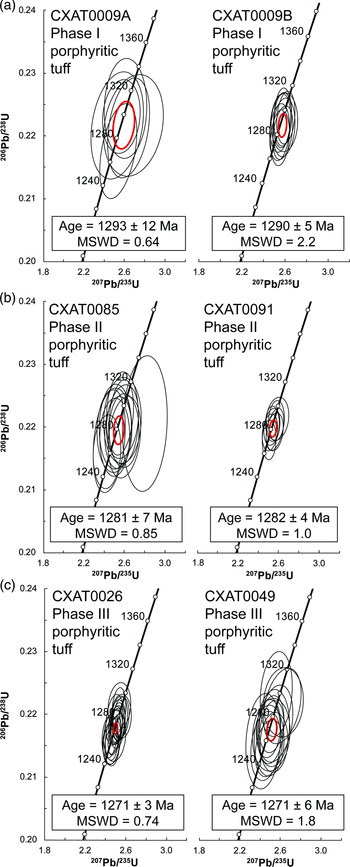
Age data for Nuiklavik volcanic rocks define three distinct groups (Fig. 10): the oldest yields a concordia age of 1290 ± 5 Ma; the intermediate population a concordia age of 1282 ± 4 Ma; and the youngest a concordia age of 1271 ± 6 Ma. Although the older two populations overlap within error, these sample sets may also be distinguished on petrologic and geochemical criteria (see Section 6.b).
Zircon U–Pb concordia diagrams with concordia ages for (a) old (Phase I), (b) intermediate (Phase II) and (c) young (Phase III) sample populations identified within the Nuiklavik Volcanics.

5.d. Subsolvus granite
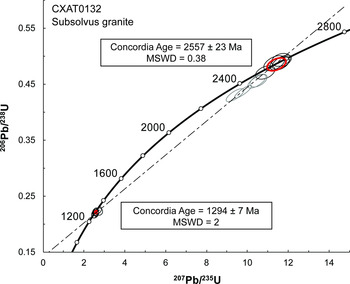
Two concordia ages are obtained from a single sample of subsolvus granite (Sample CXAT0132), and weakly discordant analyses from the older population define a discordia line between them (Fig. 11). The older of these concordia ages is 2557 ± 23 Ma, and the younger is 1293 ± 8 Ma.
Concordia plot showing U–Pb zircon ages for two concordant populations in sample T0132, a subsolvus granite from the Three Bays Pluton. The superimposed discordia line intersects both concordia ages and is defined by weakly discordant analyses within the older population.

6. Discussion
6.a. Age of the Flowers River suite
The Flowers River Granite records an emplacement age of c. 1281 Ma. This result is within error of the original 1271 ± 15 Ma age presented by Hill (Reference Hill1991). Similarly, Collerson (Reference Collerson1982) reported a comparatively young whole-rock Rb–Sr errorchron age of 1262 ± 7 Ma for peralkaline granite to the NE of the study area; however, revisions have since been proposed for the 87Rb decay constant used by Collerson (Reference Collerson1982). When adjusted for a 87Rb decay constant of (1.3972 ± 0.0045) × 10−11 a−1 (Villa et al. Reference Villa, De Bievre, Holden and Renne2015), the data yield an age of 1281 ± 3 Ma (MSWD = 1.2), which is in good accord with the U–Pb ages reported here for the Flowers River Granite. Alternatively, when adjusted for a decay constant of 1.408 × 10⁻¹¹ a−1 (Gargi, Reference Gargi2019), the data provide an age of 1271 ± 3 Ma (MSWD = 1.2), which overlaps with U–Pb ages obtained here for a subset of the Nuiklavik Volcanics (Section 6.3). No peralkaline granite samples analysed in this study provided an age in this range and, on this basis, the result using the decay constant of Villa et al. (Reference Villa, De Bievre, Holden and Renne2015) is favoured. Nevertheless, the existence of a peralkaline intrusive phase coeval with the youngest volcanic lithologies cannot be ruled out (see Section 6.3), and therefore either of these ages may be correct. Caution must also be exerted in assigning significance to Rb/Sr ages for peralkaline complexes, particularly given the locally pronounced subsolidus alteration observed in the Flowers River Granite (e.g. Borst et al. Reference Borst, Waight, Finch, Storey and Le Roux2019). In any case, the age agreement tentatively indicates that the (87Sr/86Sr)i values obtained from these data may be reliable estimates of the whole-rock isotopic signature of the Flowers River Granite. Model I Rb–Sr calculations performed in IsoPlot 3.75 (Ludwig, Reference Ludwig2003) provide a (87Sr/86Sr)i of 0.70808 ± 0.00015, compared with an originally reported value of 0.7080 ± 0.0018 (Collerson, Reference Collerson1982).
The Three Bays granitoids provide an age of c. 1290 Ma, coincident with the previously inferred age for the Notakwanon Batholith. Assuming the two are roughly coeval, the prior interpretation of the Notakwanon Batholith (and by extension, the Three Bays Pluton) as the youngest of the typical AMCG-affinity intrusions in the Nain Plutonic Suite (Myers et al. Reference Myers, Voordouw and Tettelaar2008) is correct, and this style of magmatism can be concluded to have ceased regionally following the emplacement of these two plutons. A lag of several million years separates the Flowers River Granite from this latest episode of AMCG magmatism. While not unusual in a broader regional context – Myers et al. (Reference Myers, Voordouw and Tettelaar2008) proposed five episodes of growth within the Nain Batholith – the abrupt shift to peralkaline compositions following this particular gap warrants additional scrutiny.
6.b. Archean crustal signature in the subsolvus granite
The subsolvus granite displays a geochemical signature sufficiently distinct to distinguish it from the other granitoid lithologies of the region. The younger concordia age obtained for the sample lies outside the error of the Flowers River suite. Although the age lacks the precision necessary to discount an origin unique from any of the suites discussed at length here, it most likely coincides with the emplacement of the Three Bays Pluton. Despite this, the rocks differ substantially from the Three Bays granitoids. The prevalence of gneissic xenoliths in outcrop, evident xenocrystic age inheritance, and their metaluminous to weakly peraluminous geochemistry strongly suggest that these are crustal melts produced in response to the thermal flux associated with TBP magmatism. If these are equivalent to the subsolvus granite reported by Collerson (Reference Collerson1982) to the NE of the caldera, then the elevated (87Sr/86Sr)i reported for these rocks would support an origin via crustal anatexis, with or without variable degrees of mixing with the TBP granitoid magmas.
The inherited Neoarchean age present in these rocks indicates that the crust underlying the Three Bays and Flowers River plutons was involved in the amalgamation of the Hopedale and Saglek blocks. This may help to further constrain the geometry of the Hopedale–Saglek suture zone (e.g. Wasteneys et al. Reference Wasteneys, Wardle and Krogh1996; Hinchey & Corrigan, Reference Hinchey and Corrigan2019). The coincidence of the FRIS astride a major Archean crustal suture introduces yet another lithosphere-scale structure, in addition to the Torngat Orogen and Gardar–Voisey’s Bay Fault Zone (Fig. 1), that may have permitted the magmas within the Nain Batholith to attain their shallow emplacement depths (e.g. Hill, Reference Hill1991; Myers et al. Reference Myers, Voordouw and Tettelaar2008). The previously overlooked importance of synmagmatic deformation and major structural corridors to the ascent and emplacement of massif anorthosite has recently led to the suggestion that AMCG magmatism may be the product of more conventional tectonic regimes such as continental arcs (Slagstad et al. Reference Slagstad, Roberts, Coint, Høy, Sauer, Kirkland, Marker, Røhr, Henderson, Stormoen, Skår, Sørenson and Bybee2018; Lehmann et al. Reference Lehmann, Bybee, Hayes, Owen-Smith and Belyanin2020). Although an arc setting is incompatible with the geodynamic framework of Labrador preceding the onset of Mesoproterozoic magmatism, structural conduits played a crucial role in the formation of the Nain Plutonic Suite.
6.c. Revised Nuiklavik caldera architecture
The Nuiklavik Volcanics have previously been treated as a single coherent volcanic assemblage, comagmatic with the Flowers River Granite (Hill, Reference Hill1982; Miller, Reference Miller1993). Instead, geochronological and geochemical data presented here support episodic volcanism that was linked to at least two distinct magmatic sources. The lowermost unit of the caldera is most easily discriminable, given that members of this unit are the only Nuiklavik rocks observed to contain plagioclase (albeit only in apparent lithic fragments). Relative to the other volcanic units, these rocks are comparatively undepleted in Ba and Sr, are not as enriched in incompatible elements and have 10 000×Ga/Al < 5. Zircon geochronology suggests these rocks were erupted at 1290 ± 5 Ma, coeval with emplacement of the Three Bays Pluton (Fig. 10). Combined with their similar Eu/Eu* (0.49–0.54) and FeO/(FeO+MgO) (0.87–0.90) values, these rocks are proposed to be comagmatic with a subset of the TBP granitoids. The previously reported ages of 1291 ± 2 and 1289 ± 1 Ma for the Nuiklavik Volcanics (Miller, Reference Miller1994) were likely obtained from this unit.
Georeferenced geochemical data reported by Miller & Kerr (Reference Miller and Kerr2007) for a large sampling of volcanic lithologies show that Nuiklavik rocks with Ba > 500 ppm were sampled overwhelmingly along the southwestern edge of the caldera. This coincides with the sampling location for the older rocks reported here. Accordingly, the mapping distribution of these Ba-rich samples is interpreted to represent exposures of this oldest subunit (Phase I). These rocks bear geochemical similarities to both the fayalite-bearing granitoids as well as to the subsolvus granite. It is not immediately apparent which of these magmas was parental to this episode of volcanism, or whether they are the products of some degree of magma mixing.
Two crystal-rich volcanic samples provide ages of 1281 ± 7 Ma and 1282 ± 4 Ma (Fig. 10), in good agreement with crystallization ages obtained for the Flowers River Granite (Phase II). Hematitic alteration (Fig. 7c) is characteristic of these samples, and they are the only volcanic lithofacies containing crystal fragments with granophyric texture. A third and final group (Phase III) yield concordia ages at 1271 ± 6 Ma and 1271 ± 3 Ma. These ages do not coincide with that of any intrusive phase encountered in the study area, but overlap with emplacement ages reported for the Harp Dykes, which intrude peripherally around the Three Bays Pluton and Flowers River Igneous Suite (Cadman et al. Reference Cadman, Heaman, Tarney, Wardle and Krogh1993). However, Phase III sample geochemistry is broadly indistinguishable from that of Phase II volcanism. These samples are sufficiently young relative to the Flowers River Granite to discount a single, sustained magmatic episode. Accordingly, this youngest phase of volcanism is interpreted to reflect renewed anatexis of a source parental to the Flowers River Granite resulting from sustained regional uplift (e.g. Hill, Reference Hill1991), regional heating associated with emplacement of the Harp Dykes, or both.
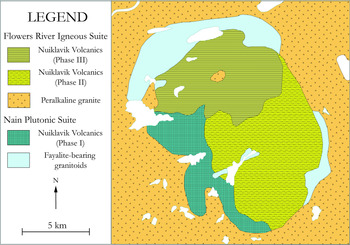
A revised caldera map (Fig. 12) reflecting the new, three-phase interpretation of volcanism has been constructed by combining the detailed volcanostratigraphic mapping of Miller (Reference Miller1993) with first-hand field observations, U–Pb data and georeferenced geochemical data from Miller & Kerr (Reference Miller and Kerr2007). Our field observations do not indicate any strict correlation between volcanostratigraphic position and the proportional abundance of porphyritic and aphyric volcanofacies. Porphyritic and aphyric samples were obtained from each of the three subunits proposed here. Mapping of these subunits is informed primarily by U–Pb results and geochemistry and, as such, is not fully compatible with the interpretations of Miller (Reference Miller1993). However, it is likely that similar lithofacies successions would arise in the geochemically similar Phase II and Phase III events, and that these would not be trivial to differentiate from a purely volcanological standpoint. Accordingly, it is suggested that the two interpretations be used in concert for future investigations.
Geological map of the Nuiklavik caldera showing estimated extents of preservation for each of the inferred phases of volcanism. All mapped contacts between separate volcanostratigraphic units are interpolated from georeferenced geochemical data, with contacts inferred from topography. Modified after Miller (Reference Miller1993).

6.d. Petrogenetic implications
The geochronology presented here supports the inclusion of the FRIS within the broader magmatic context of the Nain Batholith (Myers et al. Reference Myers, Voordouw and Tettelaar2008). Moreover, the Flowers River Granite was emplaced only several million years after the local expression of this long-lived regional AMCG magmatism. The Flowers River area is also the only locality within the Nain Batholith currently known to have experienced multiple episodes of magmatism around the same focal centre; elsewhere in the Nain Plutonic Suite, this is similarly true only to the west where other late peralkaline intrusions occur. Given this close spatial relationship and the similar age and geochemistry of the Flowers River Granite and TBP granitoids, it appears likely that certain aspects of the Flowers River Granite differentiation path were shared with or inherited from the older TBP magmas.
One sample of fayalite granite (CXAT0015) displays a weakly peralkaline chemistry (Agpaitic Index, AI = 1.01). This sample displays pronounced subsolidus alteration to its bulk mineralogy, including large inclusion-rich crystals of aegirine-augite not unlike those observed in the Flowers River Granite. The extensive alteration in this sample suggests that its peralkaline signature was produced by metasomatic addition of alkalis, and this may raise similar questions concerning the origin of the peralkaline signature of the Flowers River Granite itself. Whereas the aegirine-augite in the Flowers River Granite displays a similar morphology to that of the fayalite granite, the Flowers River Granite also contains magmatic specimens of aenigmatite and common peralkaline amphiboles optically identified to range from richterite to katophorite to arfvedsonite (Strong & Taylor, Reference Strong and Taylor1984) that do not occur in the fayalite granite. Inclusion-rich crystals of aegirine-augite are widely dispersed even among samples of peralkaline granite recording the lowest degrees of subsolidus alteration, suggesting that this aegirine-augite is perhaps a common product of reactions triggered in situ by evolution of a fluid phase. Such phenomena have become increasingly documented at other silicic peralkaline complexes (e.g. Vasyukova & Williams-Jones, Reference Vasyukova and Williams-Jones2014; Vilalva et al. Reference Vilalva, Vlach and Simonetti2016; Yang et al. Reference Yang, Niu, Li, Hollings, Zurevinski and Xing2020). Meanwhile, the weakly peralkaline fayalite granite is exposed within the central Flowers River Granite pluton, meaning that its present mineralogy may have been produced by interaction with these same fluids.
Plagioclase is perhaps the most important fractionating or refractory (e.g. Emslie et al. Reference Emslie, Hamilton and Thériault1994) mineral for producing the geochemical signatures observed in AMCG-affinity rocks. Plagioclase fractionation has similarly been explored as a driver of magma evolution towards peralkaline compositions, dubbed the ‘plagioclase effect’ in this context (Bowen, Reference Bowen1945; Frost & Frost, Reference Frost and Frost2013). Attempts to validate this connection experimentally have yielded mixed results, despite its existence being supported by numerous natural occurrences (Kovalenko et al. Reference Kovalenko, Naumov, Girnis, Dorofeeva and Yarmolyuk2006). Silicic peralkaline magmatism is now more commonly proposed to require a pre-enriched mantle source in addition to extensive fractionation and crustal contamination to produce the observed high degrees of incompatible element enrichment (e.g. Larsen & Sørensen, Reference Larsen and Sørensen1987; Kramm & Kogarko, Reference Kramm and Kogarko1994; Markl et al. Reference Markl, Marks and Frost2010). The parental transitional to alkalic basaltic melts so produced fractionate through metaluminous trachytic compositions before ultimately attaining peralkalinity (Romano et al. Reference Romano, Andújar, Scaillet, Romengo, di Carlo and Rotolo2018; Chen et al. Reference Chen, Yang and Zhang2019). By contrast, most AMCG-affinity magmas have been proposed to feasibly derive from high-pressure or polybaric fractionation of a tholeiitic, rather than transitional or alkalic, basaltic melt (e.g. Charlier et al. Reference Charlier, Duchesne, Vander Auwera, Storme, Maquil and Longhi2010; Frost & Frost, Reference Frost and Frost2013). There are few crustal alternatives for peralkaline melt generation, and these generally simply require that mantle-sourced fluids penetrate to more shallow depths (Martin, Reference Martin2006). However, a crustal origin for the granitoids of AMCG complexes is more widely supported than the mantle-derived alternative (e.g. Emslie et al. Reference Emslie, Hamilton and Thériault1994; McLelland et al. Reference McLelland, Selleck, Hamilton and Bickford2010; Ashwal & Bybee, Reference Ashwal and Bybee2017). The close spatiotemporal association and geochemical similarity between the TBP granitoids and Flowers River Granite suggests that one of the two suites marks a departure from the source typically attributed to its respective petrogenetic family.
The common inference that AMCG-affinity granitoids are the products of crustal melting is based in part on their isotopic and trace-element compositions, field relationships among the various associations within an AMCG complex, as well as a perceived paucity of compositionally intermediate material (Emslie et al. Reference Emslie, Hamilton and Thériault1994; McLelland et al. Reference McLelland, Bickford, Hill, Clechenko, Valley and Hamilton2004). Petrogenetic features argued elsewhere to necessitate a mantle source for AMCG granitoid magmas are their low fO2 and high FeO/(FeO+MgO), features most easily reconciled with direct fractionation of a mantle-derived tholeiite as noted above, or by delayed partial melting of a crystallized differentiate thereof (e.g. Frost & Frost, Reference Frost and Frost1997, Reference Frost and Frost2008 a). Creaser et al. (Reference Creaser, Price and Wormald1991) showed that only when given a source of tonalitic to granodioritic composition (with added stipulation by Frost & Frost (Reference Frost and Frost1997) that it must also be ilmenite-bearing) can anhydrous, low-fO2 and highly ferroan compositions be reproduced via crustal anatexis. Gneiss of tonalitic to granodioritic composition is notoriously abundant in Archean terranes, and it is not unreasonable to think that rocks of this composition could be voluminously represented in the underlying Hopedale Block. On these grounds, a crustal origin for the TBP granitoids cannot be fully discounted. However, the anorthosite and ferrodiorite exposed in the study area are unusually alkali-rich (Hill, Reference Hill1988; this study), and the TBP granitoids display higher agpaitic indices (AI, or molar (Na2O + K2O)/Al2O3) and incompatible element concentrations than are typical of comparable rocks elsewhere in the Nain Batholith. Accounting further for the later episode of peralkaline magmatism, it is difficult to argue that the anorthosite, ferrodiorite, TBP granitoids and Flowers River Granite each acquired their enrichment independently while being the products of multiple distinct sources. It therefore appears likely that these magmas either all experienced substantial contamination by an unidentified but extensive incompatible-element-enriched lower crustal reservoir, or that they were all sourced directly from an enriched reservoir residing in the lower crust or lithospheric mantle. Given the lack of evidence to support the existence of such a contaminant, the limited set of conditions under which crustal melting can produce ferroan liquids and the prohibitively silica-poor compositions of some of the ferrodioritic rocks (e.g. Morse, Reference Morse1991), the most probable scenario is that all of the associations in the study area share a common source located in the lithospheric mantle.
Following a liquid evolution line consisting of ferrodiorite, fayalite monzonite, fayalite granite and peralkaline granite, each successive unit displays stronger negative Eu anomalies, FeO/(FeO+MgO) approaching unity, progressive depletion of Ba, Ti, Sr and P, and enrichment in REE, Y, Zr and Nb (Fig. 6). Many of these trends are consistent with sustained fractionation of plagioclase and/or alkali feldspar, along with apatite, Fe–Ti oxides and ferromagnesian silicates. Alkali feldspar (with or without plagioclase) is present among all of the lithologies in question, whereas apatite is an abundant phase (2–5%) only in ferrodiorite and fayalite monzonite. These observations broadly align with geochemical features expected to accompany extensive fractionation along a tholeiitic trend. Furthermore, under a polybaric crystallization regime (e.g. Charlier et al. Reference Charlier, Duchesne, Vander Auwera, Storme, Maquil and Longhi2010; Bybee et al. Reference Bybee, Ashwal, Shirey, Horan, Mock and Andersen2014), a ferrodiorite of similar composition to those exposed in the study area would be capable of generating late peralkaline liquids. Accordingly, a genetic link between the TBP ferrodiorites, TBP granitoids and the Flowers River Granite appears difficult to dispute. However, a direct relationship via crystal fractionation is not supported by the geochronology presented here for the complex, since it is unlikely that a continuously evolving melt could have persisted in the middle crust for a c. 8 Ma interval without having produced material of intermediate age. Instead, the Flowers River Granite is more consistent with fractionation of a discrete anatectic melt generated from residual ferrodioritic cumulates preserved in the lower or middle crust, a scenario proposed previously for AMCG-affinity granitoids by Frost & Frost (Reference Frost and Frost1997). Whether this can be similarly extended to the older fayalite granite is not resolvable in the ages obtained here. If this were the case, it could explain the relative low abundances of intermediate compositions throughout the Nain Batholith as noted by Emslie et al. (Reference Emslie, Hamilton and Thériault1994). Another possibility is that the Flowers River Granite differentiated directly from a penecontemporaneous generation of mantle melt; however, such a liquid would require its own cycle of plagioclase fractionation (and perhaps resultant anorthosite genesis) in order to replicate the geochemical features observed in the TBP granitoids. At present, there is no evidence to support two discrete anorthosite genesis events in the study area. In light of this, we favour an anatectic origin for the FRIS; however, geochronological identification of a bimodal age distribution within the surrounding anorthosite could render the alternative scenario more plausible.
6.e. Lithotectonic sources for localized enrichment
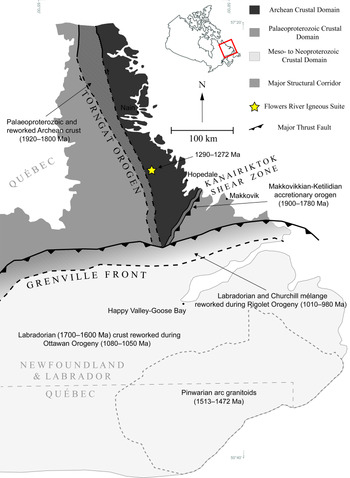
Localized enrichment of the sub-continental lithospheric mantle underlying southern tip of the Nain Batholith is consistent with the spatial distribution of major lithotectonic boundaries near the Flowers River area. The entire length of the lithosphere intruded by the Nain Batholith was directly affected by the Torngat Orogeny (1920–1800 Ma), with the consequent terrane suture playing a major role in controlling magmatic ascent and emplacement along the boundary separating the Southeastern Churchill Province and North Atlantic Craton (Myers et al. Reference Myers, Voordouw and Tettelaar2008). Only the southernmost extents of this region would have thereafter experienced peripheral effects of the Labradorian Orogeny (1710–1600 Ma; Gower et al. Reference Gower, Hall, Kilfoil, Quinlan and Wardle1997), the Makkovikian–Ketilidian Orogeny (1900–1780 Ma; Gandhi et al. Reference Gandhi, Grasty and Grieve1969) and the more distal Pinwarian Orogeny (1530–1450 Ma; Rivers & Corrigan, Reference Rivers and Corrigan2000; Fig. 13). This confluence of suprasubduction zone corridors may have localized enrichment within the orogen-proximal lithosphere underlying the southern limits of the Nain Batholith. A comparable model was put forth by Siegel et al. (Reference Siegel, Williams-Jones and Stevenson2017) for the Strange Lake intrusion, who noted its possible wider applicability to peralkaline occurrences throughout the Nain Plutonic Suite. Moreno et al. (Reference Moreno, Molina, Bea, Abu Anbar and Montero2016) proposes a similar origin for peralkaline granites in Egypt, citing slab-derived carbonatitic metasomatism of the lithospheric mantle (e.g. Poli, Reference Poli2015; Chen et al. Reference Chen, Liu, Feng, Foley, Zhou, Ducea and Hu2018) that persisted following the Pan-African Orogeny. This rationale may also be applicable to the Gardar Province, which lies between two Palaeoproterozoic orogens in Greenland’s Ketilidian and Nagssugtoqidian belts (van Gool et al. Reference van Gool, Connelly, Marker and Mengel2002; Upton, Reference Upton2013). Comparatively, however, the Gardar Province experienced flare-ups in magmatic activity over an extended period (1350–1140 Ma), and products of this magmatism spanned a far greater compositional range than has been documented in any single peralkaline occurrence in Labrador (Upton et al. Reference Upton, Emeleus, Heaman, Goodenough and Finch2003).
Map detailing the major lithotectonic elements present in Labrador and eastern Québec. The site of Flowers River magmatism is close to three major lithotectonic boundaries: the Torngat Orogen (c. 1920–1800 Ma; Myers et al. Reference Myers, Voordouw and Tettelaar2008), the Makkovikian(-Ketilidian) arc-accretion boundary (c. 1850–1720 Ma; Gandhi et al. Reference Gandhi, Grasty and Grieve1969) and the Grenville Front (c. 1080–980 Ma; Rivers & Corrigan, Reference Rivers and Corrigan2000). The Grenville Front represents reworked allochthonous or parautochthonous material of the Labradorian Orogeny (c. 1700–1600 Ma; Gower & Krogh, Reference Gower and Krogh2002), and arc granitoids of the Pinware Terrane (c. 1513–1472 Ma; Rivers & Corrigan, Reference Rivers and Corrigan2000) are located south of the Grenville Front. The Torngat Orogen was a doubly vergent, E–W transpressional event, while the Makkovikian, Labradorian and Pinwarian events involved either primarily N-vergent or doubly vergent N–S subduction or arc accretion events. Although these events are at variable distances from the southern Nain Batholith, they are of suitable orientation and magnitude to have enriched the lithosphere prior to melt extraction at c. 1364 Ma. The localization of much of the nearby Palaeoproterozoic to earliest Mesoproterozoic tectonic activity towards the south may have exposed the southernmost portions of the lithosphere to a greater degree of enrichment, ultimately producing the highly enriched magmas that gave rise to the Three Bays Pluton and Flowers River suites.

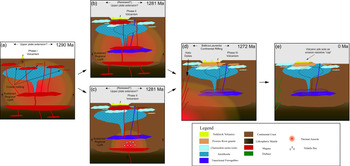
In the model proposed here, the TBP follows a typical AMCG style of emplacement (Fig. 14a; Ashwal, Reference Ashwal1993; Emslie et al. Reference Emslie, Hamilton and Thériault1994). Thereafter, the transition to peralkaline magmatism at c. 1281 Ma resulted either from renewed melting of the enriched lithospheric mantle (Fig. 14b), or from anatexis of a residual ferrodioritic reservoir in the lower crust and/or its intermediate differentiates (Fig. 14c). A third and final episode of magmatism, recorded by the Phase III Nuiklavik Volcanics at c. 1272 Ma, resulted from further uplift and thermal perturbation associated with the emplacement of the Harp Dykes, which represent a local subset of broadly asthenosphere-derived melts that were associated with the Mesoproterozoic break-up of the supercontinent Nuna and were emplaced throughout Laurentia and Baltica (Cadman et al. Reference Cadman, Tarney, Baragar and Wardle1994; Bartels et al. Reference Bartels, Nielsen, Lee and Upton2015; Fig. 14d). The erosion-resistant volcanic cap preserved the caldera and the underlying plutonic rocks, and is responsible for its elevated modern relief (Fig. 14e).
Simplified model outlining the evolution of the Flowers River area. (a) Anorthosite and mangerite-charnockite series rocks are derived from a transitional to alkalic basaltic liquid ponded in the lower crust. Heat associated with the intrusions simultaneously produces crustal partial melts. The Phase I Nuiklavik Volcanics are emplaced, deriving from one of the two melt sources or from mixing between them. (b) One of two possible origins for the Flowers River Igneous Suite. A second pulse of anorthositic diapirism occurs, while the granitoid rocks generated in this instance achieve silicic peralkaline compositions via fractionation and crustal assimilation. The eruptible fraction of these magmas (the Phase II volcanics) induces caldera collapse in the overlying volcanic centre. (c) Alternative model where mantle-sourced volatiles induce partial melting of the crystallized ferrogabbroic residue in the lower crust. As in (b), eruption of the Phase II volcanics induces caldera collapse. (d) Craton-scale tholeiitic magmatism produces the Harp Dyke swarm, the peripheral thermal effects of which induce a second partial melting event and emplacement of the Phase III volcanics. A second caldera collapse event is possible. (e) Erosion creates the modern exposures of the complex. The erosion resistance of the silicic volcanic pile acts as a ‘cap’ for the underlying granite pluton, resulting in the caldera’s high modern topographic relief.

The tectonic emplacement mechanism underlying the Nain Plutonic Suite, and by extension the TBP and FRIS, remains poorly constrained. Proposed drivers of magmatism have included upper plate extension in a far-field continental back-arc setting (e.g. Rivers & Corrigan, Reference Rivers and Corrigan2000), a mantle superswell underlying Laurentia (Hoffman, Reference Hoffman1989; Hill, Reference Hill1991) or migration of a subducted spreading centre (Gower & Krogh, Reference Gower and Krogh2002; McLelland et al. Reference McLelland, Selleck, Hamilton and Bickford2010). The latter functions best for the older plutons in the Churchill Province that young northwards (Gower & Krogh, Reference Gower and Krogh2002), but no similar spatial pattern is evident in pluton ages for the Nain Batholith. The local juxtaposition of supracrustal rocks with mid-crustal AMCG rocks has led to the conclusion that magmatism in the Flowers River area coincided with a persistent interval of seemingly permanent regional uplift (Hill, Reference Hill1991); on this basis, Hill favoured the superswell model, but ultimately argued for a lower crustal quartzofeldspathic source for the Flowers River Granite.
The protracted geodynamic activity ongoing in Laurentia throughout the Proterozoic Eon is elsewhere implicated in the genesis of numerous magmatic complexes of variable affinity, including continental arcs (e.g. Hanmer et al. Reference Hanmer, Corrigan, Pehrsson and Nadeau2000), island arcs (e.g. Sappin et al. Reference Sappin, Constantin and Clark2011), and continental rift-related mafic intrusions and lavas (Cadman et al. Reference Cadman, Tarney, Baragar and Wardle1994; Hinze et al. Reference Hinze, Allen, Braille and Mariano1997), in addition to many post-orogenic AMCG complexes (e.g. Emslie & Hegner, Reference Emslie and Hegner1993; Corrigan & Van Breemen, Reference Corrigan and van Breemen1997). Rivers & Corrigan (Reference Rivers and Corrigan2000) and Hynes & Rivers (Reference Hynes and Rivers2010) both advocate for a long-lived, Andean-type margin along southern Laurentia (modern coordinates) that remained active throughout much of the Proterozoic Eon. Pauses or polarity reversals at this distal subduction zone, and the reciprocal cessation of local upper plate extension, could explain the intermittent gaps in the Nain Plutonic Suite age record (Myers et al. Reference Myers, Voordouw and Tettelaar2008). This model of upper plate extension appears most consistent with the current petrochronological framework of the Nain Batholith. A subsequent transition to more typical tholeiitic, asthenosphere-sourced magmatism in the form of the Harp Dykes may have helped to sustain the seemingly ‘permanent’ regional uplift.
6.f. Comparison with other AMCG complexes
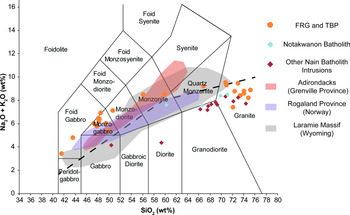
Whereas the lithological make-up of the Nain Plutonic Suite is largely in line with that of AMCG complexes worldwide, the unique emplacement setting of the Nain Plutonic Suite should be reflected in petrogenetic departures from a typical, post-collisional AMCG suite. A total alkalis versus silica plot shows that the TBP ferrodiorites are enriched relative to the ferrodiorites of other AMCG complexes, particularly those from other intrusions in the Nain Batholith (Fig. 15). The Rogaland (Norway), Laramie (central USA) and Adirondack (northeastern USA) massifs all show linearly increasing trends in alkali content relative to silica, although the overall slope of this differentiation trend varies at each locality. Comparatively, the Flowers River Granite and TBP granitoids with > 70 wt% SiO2 have lower total alkalis, defining a gently curved trend. The Flowers River magmas were able to attain peralkaline compositions despite their lower absolute alkali content, indicating that alkali feldspar could not have been solely responsible for the removal of Al from the evolving magma. If the Flowers River magmas did arise by anatexis of a material related to, but more compositionally evolved than, ferrodiorite (i.e. the fayalite monzonite), significant volumes of restitic plagioclase could feasibly produce an initial liquid sufficiently depleted in Al that would fractionate towards moderately peralkaline compositions.
Total alkalis versus silica plot for ferrodioritic and granitoid lithologies from a selection of AMCG complexes worldwide. The Flowers River Granite (FRG) and Three Bays Pluton (TBP) define a gently arcuate, moderately alkalic trend from foid gabbro to granite. Whole-rock analyses of other Nain Batholith intrusions (Umiakovik Batholith and Makhavinekh Pluton; see Fig. 1) have lower total alkali contents and may define a trend along the upper boundary from gabbro to granite, although a paucity of data from intermediate compositions leaves this to inference. The Notakwanon Batholith plots just above the more northerly Nain Batholith intrusions, although one intermediate sample shows moderate enrichment in alkalis. Compositional ranges are superimposed for geochemical data published for the Adirondack Massif (USA), Rogaland Anorthosite Province (Norway) and Laramie Anorthosite Massif (USA). Plot boundaries after Middlemost (Reference Middlemost1994). Data sources: Flowers River area: Collerson (Reference Collerson1982), Hill (Reference Hill1988) and this study; Notakwanon Batholith: Emslie & Stirling (Reference Emslie and Stirling1993); Nain Batholith: Ryan (Reference Ryan1991), Emslie & Loveridge (Reference Emslie and Loveridge1992) and Emslie & Stirling (Reference Emslie and Stirling1993); Adirondack Massif: Seifert et al. (Reference Seifert, Dymek, Whitney and Haskin2010); Rogaland Province: Vander Auwera et al. (Reference Vander Auwera, Longhi and Duchesne1998); Laramie Massif: Mitchell et al. (Reference Mitchell, Scoates, Frost and Kolker1996), Scoates et al. (Reference Scoates, Frost, Mitchell, Lindsley and Frost1996), Frost et al. (Reference Frost, Frost, Chamberlain and Edwards1999) and Anderson et al. (Reference Anderson, Frost and Frost2003).

The intimate association between AMCG magmatism and long-lived convergent margins (McLelland et al. Reference McLelland, Selleck, Hamilton and Bickford2010; Ashwal & Bybee, Reference Ashwal and Bybee2017) precludes their isolation from the metasomatic enrichment processes proposed here to account for the FRIS. Furthermore, the modest comparative enrichment of the most primitive TBP lithologies relative to post-collisional equivalents (Fig. 15) suggests that pre-enrichment of the mafic precursor alone cannot account for the transition to peralkaline magmatism in the Flowers River area. Instead, the atypical tectonic environment that fostered the Nain Plutonic Suite appears to have played a key role in the late compositional shift. It is possible that low degrees of partial melting of the ferrodioritic to mangeritic rocks in many AMCG complexes would yield liquids that fractionate toward a peralkaline chemistry. However, production of such a second generation of magma may have been inhibited by the absence of a renewed thermal anomaly, or by preceding or subsequent crustal thickening in these localities that did not occur in Labrador.
7. Summary
The Flowers River Igneous Suite was emplaced at 1281 Ma, intruding 1290 Ma AMCG-affinity rocks in the vicinity of Sango Bay. These magmatic suites represent the youngest two episodes of plutonism associated with the Mesoproterozoic assembly of the Nain Batholith. Both of these events were accompanied by a period of coeval volcanism, with a third volcanic event at c. 1272 Ma having possibly been triggered by lithospheric extension and coeval emplacement of the Harp Dyke swarm (Cadman et al. Reference Cadman, Tarney, Baragar and Wardle1994).
The Flowers River Igneous Suite is the product of protracted differentiation of a material of initially transitional to alkali basaltic composition, derived from a region of the lithospheric mantle that had previously been enriched by interaction with slab-derived volatiles. This liquid initially gave rise to moderately alkalic ferrodiorites and metaluminous mangerite-charnockite series rocks of the Three Bays Pluton, before the system ultimately attained peralkaline compositions (e.g. Romano et al. Reference Romano, Andújar, Scaillet, Romengo, di Carlo and Rotolo2018; Chen et al. Reference Chen, Yang and Zhang2019). The fertility imparted by this localized metasomatism in the lithosphere may have played a role in permitting a second episode of melting that facilitated this transition. This phenomenon was restricted to the southern limits of the Nain Batholith because it had encountered a comparatively higher volume of slab ‘traffic’, creating a persistent region of enrichment in the subcontinental lithospheric mantle (e.g. Goodenough et al. Reference Goodenough, Upton and Ellam2002; Moreno et al. Reference Moreno, Molina, Bea, Abu Anbar and Montero2016). The precise trigger for the second episode of melting is uncertain, but may be attributable to: (1) a final discrete pulse of magmatism, originating in a similar fashion to the Nain Batholith’s other constituent plutons, but from a lower initial partial melt fraction; or (2) partial melting of a source in the lower crust, cogenetic with the older Three Bays Pluton, in response to the waning stages of a thermal anomaly that had been responsible for sustaining magmatism to that point, and including a contribution from mantle-fluxed volatiles.
This spatially constrained lithotectonic control does not necessarily function as an explanation for other peralkaline bodies in Labrador, which are distributed along a roughly N–S-oriented lineament. Siegel et al. (Reference Siegel, Williams-Jones and Stevenson2017) attribute this to similar pre-enrichment of the lithospheric mantle underlying the Core Zone during the formation of the New Quebec Orogen. This suggests that these complexes were not the products of a unified regional pulse of peralkaline magmatism, and may instead reflect more localized influences. The processes which underlie AMCG complex genesis – requiring an initial, mantle-derived basaltic melt emplaced in an extensional setting – may simply be close enough in principle to those favourable to peralkaline magmatism to have facilitated the transition in Labrador under a generous range of conditions. The polycyclic tectonic history common to many Proterozoic orogens (Watson, Reference Watson1976; Kröner, Reference Kröner1991), but absent from the Nain Plutonic Suite, may have played a role in obscuring or suppressing this relationship elsewhere. Further work targeting some of the less-studied peralkaline intrusions in Labrador is needed to fully qualify their relationship to regional AMCG-affinity magmatism.
Acknowledgements
We thank A Indares, A Borst, K Goodenough, BR Frost and D Lentz for their constructive reviews and many helpful suggestions for improvements to the manuscript. This project was supported by the Grants and Contributions program of the Geological Survey of Canada GEM-2 initiative.