


Introduction
Hexahydrocannabinol (HHC) is a semi-synthetic cannabinoid produced through hydrogenation of cannabidiol (Graziano et al. Reference Graziano, Varì, Pichini, Busardo, Cassano and Di Trana.2023). First detected in Europe in 2022, it was marketed as a legal alternative to products and substances containing Δ9-tetrahydrocannabinol (THC) (EUDA 2025). Like THC, HHC binds to cannabinoid (CB) receptors, exerting psychoactive effects primarily through activity at CB1 in the central nervous system and CB2 in the peripheral nervous system (Graziano et al. Reference Graziano, Varì, Pichini, Busardo, Cassano and Di Trana.2023).
Emerging clinical evidence has linked HHC use to acute psychiatric presentations, particularly psychosis. Among Irish respondents reporting HHC use in a recent European-wide online survey of adult recreational drug users, adverse psychological effects, including anxiety, paranoia, and hallucinations, were commonly endorsed, particularly among higher-frequency users. (Mongan et al. Reference Mongan, Millar and Galvin2025). O’Mahony et al. (Reference O’Mahony, O’Malley, Kerrigan and McDonald2024), published a case series describing two individuals who developed psychotic symptoms following HHC vape use, each requiring inpatient care. A similar case series was reported in an inpatient child and adolescent mental health service. (Cevikel et al. Reference Cevikel, Ferreira, Raji, OBrien and Hallahan2026). Furthermore, HHC was the second most commonly used substance in psychosis-related admissions in one psychiatric hospital in Ireland, precipitating over a third of all cases between May 2023 and December 2024 (O’Mahony et al. Reference O’Mahony, Lanigan, Lally, O’Malley, Smyth, McDonald and Hallahan2025).
The legal availability of HHC, its perceived safety, and its use in disposable vapes have contributed to its rapid uptake, particularly among young adults. A European-wide survey of adult recreational drug users also indicated that over one-third of Irish respondents reported HHC use in the previous year (Mongan et al. Reference Mongan, Millar and Galvin2025). Although self-reported, these findings suggest widespread exposure. Despite increasing clinical concern, HHC remained unregulated until July 2025, when it was classified as a Schedule 1 controlled substance under the Misuse of Drugs Act 1977 (Ireland 2025). This legislative change followed mounting clinical concerns and advocacy from Irish psychiatrists, who described the ongoing sale of HHC as a serious public health risk (College of Psychiatrists of Ireland 2024).
The clinical profile of HHC-associated psychosis remains poorly understood. Key questions include whether HHC-related presentations differ from cannabis-related psychosis in terms of symptomatology, course, and treatment requirements. The present study aims to address this gap by characterising the demographics,clinical features, and management strategies of individuals admitted to an inpatient psychiatric unit with psychosis preceded by HHC use, and how this compares to individuals with psychosis preceded by cannabis-only, and combined HHC–cannabis use.
Methods
Study design
This study extended a previous retrospective chart review of individuals admitted with psychosis to the Adult Acute Mental Health Unit at University Hospital Galway (UHG) (O ’Mahony et al. Reference O’Mahony, Lanigan, Lally, O’Malley, Smyth, McDonald and Hallahan2025). The present analysis included all admissions with documented use of HHC or cannabis between 1 May 2023 and 31 July 2025. Data extracted from electronic medical records and clinical notes included demographic, clinical, and treatment variables. All patient data were anonymised during data extraction and were stored on secure, access-restricted hospital servers with ethical approval attained from the Galway Clinical Research Ethics Committee (C.A. 3250) prior to study commencement.
Participants
Inclusion criteria consisted of: (1) age ≥18 years; (2) an admission diagnosis of a primary psychotic disorder or substance-induced psychosis; (3) documented use of HHC and/or cannabis within 7 days before admission, based on patient self-report and/or collateral information; and (4) sufficient clinical documentation to code symptomatology and treatment variables. Exclusion criteria included recent use (≤7 days) of other psychoactive substances (e.g. cocaine, methamphetamine, ketamine, LSD, psilocybin) through history or urine drug screen, due to potential interpretation confounding. Eligible participants were identified using the hospital electronic admission database, which records each admission along with initial and discharge diagnoses. Admissions were considered substance-related if clinical notes documented HHC or cannabis use in the week preceding admission or if a urine drug screen obtained on admission indicated recent substance use. Participants were classified into three mutually exclusive groups: (1) HHC-only: HHC use without cannabis in the preceding 7 days; (2) cannabis-only: cannabis use without HHC; (3) HHC + cannabis: co-use of both substances. Routine urine toxicology was performed for THC metabolites and other substances; however, due to cross-reactivity between HHC and standard THC immunoassays, positive THC results are not specific for HHC use (Helander et al. Reference Helander, Johansson, Villén and Andersson2024; Wolf et al. Reference Wolf, Pokhai, Poklis and Williams2023). Accordingly, group assignment was based on clinical history and collateral information.
Measures
Data extraction was performed using a predefined data collection sheet by three independent reviewers. Reviewers also recorded qualitative information from the clinical record where relevant to support coding decisions. All extracted data were subsequently reviewed by the lead author alongside the accompanying qualitative comments to enhance consistency in interpretation.
Demographic variables included age at admission and sex. Family psychiatric history was coded as present if a first-degree relative had a documented history of a psychotic disorder. Legal status at admission was recorded as voluntary or involuntary (under the Mental Health Act 2001). Substance-use variables included documented use of HHC, cannabis, or another psychoactive substance (except nicotine or alcohol) within seven days prior to admission, based on patient self-report and collateral information. The psychiatry inpatient unit routinely performs a THC metabolite urine drug screen, and this was recorded. Clinical variables included onset of psychosis, categorised as acute (≤7 days), subacute (8–30 days), or insidious (>30 days) and whether the admission was their first episode of psychosis (FEP) or a recurrent presentation. Psychopathology at presentation was extracted from admission clinical history and mental state examinations, and coded for the presence or absence of affective symptoms (either depressive, hypomania, mania or mixed presentation), formal thought disorder, delusions, perceptual disturbances, aggression, self-harm, and suicidal ideation. Treatment variables included antipsychotic and benzodiazepine prescribing. For both medication classes, we recorded the total dose prescribed at three time points: on admission, the maximum daily dose reached at any point during the admission, and on discharge. Each value represented the sum of all regular and PRN/as-needed doses administered. Antipsychotic dose equivalence was based on the Second International Consensus Study of Antipsychotic Dosing (McAdam et al. Reference McAdam, Baldessarini, Murphy and Gardner2023), and benzodiazepine doses were converted to diazepam-equivalent milligrams (DE-mg) using recognised equivalence tables (Ashton Reference Ashton2011).
Indicators of acute behavioural disturbance, including use of intramuscular medication for agitation, seclusion, and physical restraint, were also recorded. Service-use variables included length of stay, calculated as the number of days from admission to discharge.
Statistical analyses
Statistical analysis was performed using the Statistical Package for Social Sciences version 29.0 for Windows (SPSS Inc., IBM, New York, USA). Descriptive analyses of key demographic and clinical data were performed for categorical and continuous variables as appropriate. Continuous variables were compared across the three groups using one-way analysis of variance (ANOVA). A repeated-measures ANOVA was used to explore dosages of antipsychotics across the inpatient admission period. Categorical variables were compared using Fisher’s exact (FE) test due to small cell counts. Associations between antipsychotic dosages and length of stay were examined using Pearson’s correlations. All tests were two-tailed with a significance level of α = 0.05. Given the exploratory nature of the analyses and the limited sample size, no correction for multiple comparisons was applied. Analyses were conducted using available data, with no imputation for missing values.
Results
Sample identification
A total of 298 psychosis-related admissions were identified through the hospital electronic inpatient database. Of these, 227 unique index admissions remained after duplicate admissions were removed. Following detailed chart review, 170 admissions were excluded due to the absence of documented HHC or cannabis use within the seven days preceding admission, while a further 11 admissions were excluded due to insufficient documentation to ascertain whether study inclusion criteria were met. Of the remaining 46 admissions, 13 were excluded due to documented use of illicit substances in addition to HHC and/or cannabis within seven days prior to admission, resulting in a final analytic sample of 33 individuals.
Demographic and clinical data
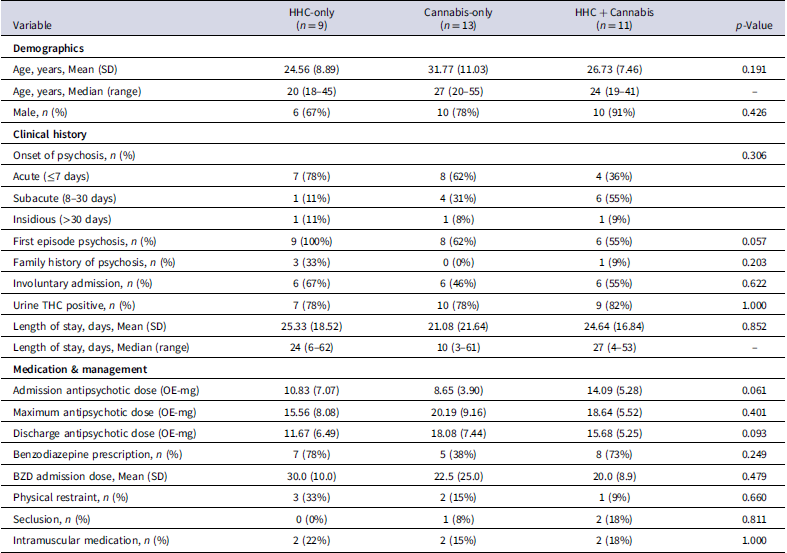
Thirty-three individuals met inclusion criteria (mean age 28.1 years, SD 9.6) (male; n = 26, 78.8%). Participants were categorised as HHC-only (n = 9), HHC + cannabis (n = 11), or cannabis-only (n = 13). Demographic and clinical data are presented in Table 1. There were no statistically significant differences in age (p = 0.19) or sex distribution (p = 0.43) between groups.
Demographic and clinical characteristics by substance use group

Table 1. Long description
A table comparing demographic and clinical characteristics by substance use group. The table has 18 rows and 6 columns. The columns are labeled Variable, HHC-only (n=9), Cannabis-only (n=13), HHC + Cannabis (n=11), and p-Value. The rows are grouped into Demographics, Clinical history, and Medication & management. Each row provides specific data points for each group and the corresponding p-value. For example, the Age row shows the mean and standard deviation for each group, and the Male row shows the number and percentage of males in each group. The table includes various clinical history details such as the onset of psychosis, first episode psychosis, family history of psychosis, involuntary admission, and urine THC positive results. It also covers medication and management aspects like antipsychotic doses, benzodiazepine prescription, physical restraint, seclusion, and intramuscular medication.
Note: Values are presented as mean (standard deviation), median (range), or n (%), as indicated. OE-mg = olanzapine equivalent milligrams. Group comparisons for continuous variables were conducted using one-way analysis of variance (ANOVA), and categorical variables were compared using Fisher’s exact test due to small cell counts.
The proportion presenting with a FEP did not differ significantly across groups (p= 0.06); however, all HHC-only cases occurred in individuals experiencing a FEP. There were no significant between-group differences in onset of psychosis (acute, subacute, or insidious) (p = 0.306), with subgroup distributions presented in Table 1. Urine toxicology for THC metabolites was comparable across groups (p = 1.00). Family history of psychosis and the rates of admission under the Mental Health Act 2001 did not differ between groups.
Symptomatology
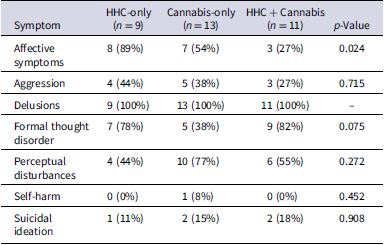
Affective symptoms were more frequent in the HHC-only group compared with the cannabis-only and HHC + cannabis groups, with the difference reaching statistical significance (p = 0.024; Table 2). Formal thought disorder was observed in 38% of the cannabis-only group, 78% of the HHC-only group, and 82% of the HHC + cannabis group. In the initial three-group comparison, this difference did not reach statistical significance (p = 0.075; Table 2); however, in a subsequent exploratory post-hoc analysis comparing the cannabis-only group with the combined HHC-exposed groups, the difference was statistically significant (p = 0.027). Other symptoms, including aggression, perceptual disturbances, self-harm, and suicidal ideation, did not differ significantly between groups (Table 2).
Symptom profile at admission by group

Table 2. Long description
A table comparing symptom profiles across different groups. The table has 7 rows and 5 columns. The columns are labeled HHC-only (n = 9), Cannabis-only (n = 13), HHC + Cannabis (n = 11), and p-Value. The rows are labeled with different symptoms: Affective symptoms, Aggression, Delusions, Formal thought disorder, Perceptual disturbances, Self-harm, and Suicidal ideation. Each cell contains the number of individuals exhibiting the symptom and the percentage in parentheses. Notable trends include a higher percentage of affective symptoms in the HHC-only group compared to the other groups, and a statistically significant p-value of 0.024. Formal thought disorder shows a higher percentage in the HHC + Cannabis group compared to the cannabis-only group, with a p-value of 0.075. Other symptoms do not show significant differences between groups.
Note: Values are n (%). p-Values were derived using Fisher’s exact test (FE). Statistical testing was not performed for delusions due to lack of variance across groups.
Management strategies
All individuals were treated with antipsychotic medication. There was a main effect of OE antipsychotic dose across the three timepoints of inpatient stay (admission, maximum, and discharge; p < 0.001) with mean OE antipsychotic dosage rising significantly from admission (Mean = 11.19 mg) to maximum (Mean = 18.13 mg; p < 0.001) and then decreasing significantly from maximum to discharge (Mean = 15.14; p = 0.002). There were no significant differences in mean antipsychotic dosages at each timepoint across groups (see Table 1). There was a significant interaction effect between OE antipsychotic dose over the three timepoints and group (p = 0.009), with post-hoc comparison tests demonstrating significantly higher OE dosage for the combined HHC + cannabis combined group at admission in contrast to cannabis only (p = 0.019) and significantly lower dosages on discharge for HHC-only in contrast to cannabis only (p = 0.031) with no other significant post-hoc contrasts (p > 0.1). Length of inpatient stay did not differ significantly across groups (p = 0.852). Median duration was 24 days (range 6–62) in the HHC-only group, 10 days (range 3–61) in the cannabis-only group, and 27 days (range 4–53) in the combined group. Maximum OE antipsychotic dose was positively correlated with length of inpatient stay (r = 0.54, p = 0.001). Benzodiazepines were prescribed less frequently in the cannabis-only group (38%) compared with the HHC-only (78%) and HHC + cannabis groups (73%), although this difference did not reach statistical significance. Use of restrictive interventions, including physical restraint, seclusion, and intramuscular medication, was infrequent and did not differ between groups (Table 1). These findings should be interpreted cautiously given the small sample size and exploratory analyses.
Discussion
This study provides, to our knowledge, the first systematic clinical comparison of HHC-associated psychosis with cannabis-associated psychosis in an acute inpatient psychiatric setting. Overall, presentations were broadly similar across groups, with no significant differences observed in demographic characteristics, behavioural disturbance, service use, overall clinical course, or management strategies. However, HHC-related presentations were associated with higher rates of affective symptoms and formal thought disorder, and all HHC-only cases occurred in individuals experiencing a FEP.
These findings build on a previous Irish case report describing psychosis induced by HHC vaping, which included prominent formal thought disorder (O’Mahony et al. Reference O’Mahony, O’Malley, Kerrigan and McDonald2024). Given the limited evidence base relating to HHC-associated psychosis, consideration of the broader literature on cannabinoid-related psychosis may help contextualise these findings. Previous studies have shown that cannabinoid-induced psychosis is associated with younger age and higher rates of affective symptoms (Arendt et al. Reference Arendt, Rosenberg, Foldager, Perto and Munk-Jorgensen2005; Di Forti et al. Reference Di Forti, Quattrone, Freeman, Tripoli, Gayer-Anderson, Quigley, Rodriguez, Jongsma, Ferraro, La Cascia, La Barbera, Tarricone, Domenico, Szöke, Arango, Tortelli, Velhorst, Bernardo, Del-Ben, Rossi Menezes and Van der Ven2019). Data from the Euro-DEN Plus network illustrate that clinically important differences may exist between presentations associated with different classes of cannabinoids (EUDA 2020). While most research examining clinical presentations to date focuses on Δ9-THC-dominant cannabis, evidence from synthetic cannabinoid receptor agonists highlights the potential for severe psychiatric presentations, including acute psychosis and behavioural dysregulation (Altintas et al. Reference Altintas, Inanc, Oruc, Arpacioglu and Gulec2016). However, direct comparisons of clinical symptomatology across different cannabinoid classes remain limited, and the relative psychotogenic potential of HHC compared with other cannabinoid receptor agonists remains uncertain.
The mechanisms underlying the higher rates of affective symptoms and formal thought disorder observed in HHC-related psychosis in this sample require further investigation. One possible explanation is that HHC may act in a manner analogous to high-potency THC, given its reported CB1 receptor agonism (Graziano et al. Reference Graziano, Varì, Pichini, Busardo, Cassano and Di Trana.2023), potentially contributing to more acute psychotic presentations. Differences in clinical profile may therefore relate to the pharmacological properties of HHC, which are not yet fully characterised.
All individuals in the HHC-only group presented with a FEP. This may reflect use of HHC among individuals with limited prior exposure to high-potency or novel cannabinoids. This is potentially facilitated by its legal availability and marketing as a lower-risk alternative to cannabis. Previous research on novel psychoactive substances has demonstrated that legal status is frequently interpreted as a proxy for safety, particularly among younger users, which may increase vulnerability to adverse psychiatric outcomes (Lally et al. Reference Lally, Higaya, Nisar, Bainbridge and Hallahan2013; Smyth Reference Smyth2023; Smyth et al. Reference Smyth, Daly, Elmusharaf, McDonald, Clarke, Craig and Cullen2020). Structurally related hemp-derived semi-synthetic cannabinoids have continued to emerge following HHC prohibition (EUDA 2024), raising the possibility that similar patterns of use and associated harms may recur.
Our urine toxicology findings have important clinical implications. Rates of positive THC metabolite screening did not differ between groups. This may reflect chemical similarity between THC and HHC, leading to overlapping metabolites and potential cross-reactivity on routine immunoassays, although co-use of THC cannot be excluded. Detection of HHC is not included in standard urine drug screening and requires specialised analytical techniques (EUDA 2023; WHO 2024). These findings highlight the limitations of routine toxicology screening in distinguishing HHC from cannabis exposure.
Management was consistent with current guidance for synthetic cannabinoid-related presentations, with use of benzodiazepines for agitation and antipsychotics for persistent psychotic symptoms (WHO 2024). Although peak antipsychotic doses varied, discharge doses were lower. No significant between-group differences were observed in length of stay or overall antipsychotic burden, indicating broadly similar clinical courses. Maximum antipsychotic dose was positively correlated with length of inpatient stay. This association is likely to reflect underlying illness severity, with more severe presentations requiring both higher antipsychotic doses and longer inpatient stays, rather than a direct treatment effect. Lower discharge doses in the HHC-only group may reflect differences in illness stage, as all individuals in this group were experiencing an FEP. Further exploration of these findings in future studies controlling for potential covariates are required.
The observed length of inpatient stay was longer than typically expected for substance-related psychosis. Median values demonstrated variability across groups, with a shorter median stay in the cannabis-only group (10 days) and longer median stays in the HHC-only (24 days) and combined (27 days) groups, which may reflect greater clinical complexity or diagnostic uncertainty, including the possibility that some cases represent substance-precipitated presentation rather than substance-induced psychosis.
The legislative response to HHC in Ireland relied on its classification as a controlled drug under the Misuse of Drugs Act 1977 (S.I. No. 404/2025) (Ireland 2025), reflecting a similar approach taken during the “head shop” era, when substance-specific bans led to substitution with newly available compounds and continued retail sale. The emergence of novel psychoactive substances at this time was associated with increased psychiatric presentations, including psychosis and acute behavioural disturbance (El-Higaya et al. Reference El-Higaya, Ahmed and Hallahan2011; Smyth et al. Reference Smyth, Daly, Elmusharaf, McDonald, Clarke, Craig and Cullen2020).
Head shops closed with the introduction of the Psychoactive Substances Act 2010, a broad prohibition on the sale of psychoactive substances (Ireland 2010). The response to HHC may reflect a return to substance-specific control strategies. Structurally related semi-synthetic cannabinoids have already been identified in European drug markets (EUDA 2025; WHO 2024), suggesting that similar patterns may recur.
This study has several limitations. The sample size was modest and analyses were exploratory, with no correction for multiple testing, increasing the risk of type I error. Findings should therefore be interpreted as hypothesis-generating.
The retrospective design relied on clinical documentation, and no structured diagnostic interviews or standardised symptom rating scales were available. This introduces the potential for information bias, variability in clinician recording practices, and observer bias. Therefore, observed differences in affective symptoms or thought disorder between groups may partly reflect these factors rather than true differences in clinical presentation.
Exposure classification was based on self-report, collateral information, and routine urine toxicology. Given the lack of routinely available confirmatory laboratory testing for HHC and known cross-reactivity between HHC and THC immunoassays (Helander et al. Reference Helander, Johansson, Villén and Andersson2024), the possibility that “HHC-only” patients also used THC cannot be excluded. Furthermore, the restriction of substance use assessment to the seven days preceding admission, does not entirely exclude the influence of earlier substance use or substances not detected on routine toxicology. These factors introduce the potential for exposure misclassification and represent a key limitation of the study, which should be considered when interpreting group differences.
The study was conducted in a single psychiatric unit, which may limit generalisability. Potential confounders, including duration and quantity of substance use and comorbid psychiatric conditions, were not fully accounted for, and longer-term outcomes were unavailable. The potential impact of variability in adherence to prescribed medication on clinical presentation was not examined.
Interpretation of group differences should consider illness stage, as all individuals in the HHC-only group were experiencing a FEP. Observed differences may therefore partly reflect illness stage rather than substance-specific effects. However, these limitations are typical of early clinical characterisations of emerging psychoactive substances and underscore the need for prospective studies incorporating targeted toxicology and standardised assessments.
Conclusion
Our findings provide clinical insight into HHC-associated psychosis and its comparison with cannabis-associated presentations. Our findings suggest the possibility of higher rates of affective symptoms and formal thought disorder in HHC-related psychosis, often occurring in first-episode contexts, while otherwise sharing features with cannabis-associated presentations. The rapid emergence and availability of semi-synthetic cannabinoids, including HHC, and their clinical effects highlight the need for further research to better characterise their impact on psychiatric presentations and inform clinical practice.
Acknowledgements
We wish to acknowledge and thank all participants for their time committed to this study.
Author contributions
All authors participated in the study design, data attainment or analysis, and critical review of the manuscript.
Funding statement
This research received no specific grant from any funding agency, commercial or not-for-profit sectors.
Competing interests
The authors declare that they have no conflict of interest. All authors have seen and approved the final version of the manuscript and believe that the manuscript represents work completed.
Ethical standards
Ethical approval was attained prior to study commencement from the Galway University Hospitals Research Ethics Committee (C.A. 3250). The authors assert that all procedures contributing to this work comply with the ethical standards of the relevant national and institutional committee on human experimentation with the Helsinki Declaration of 1975, as revised in 2008.

 Open access

