1. Introduction
The Central Asia Orogenic Belt (CAOB), also called the Central Asian Mobile Belt, Central Asian Fold Belt or Altaids, is one of the largest accretionary orogens on the Earth. It is situated between the European, Siberian, Tarim and Sino–Korean cratons (Şengör’, Natal'In & Burtman, Reference Şengör, Natal'In and Burtman1993; Jahn, Wu & Hong, Reference Jahn, Wu and Hong2000; Khain et al. Reference Khain, Bibikova, Salnikova, Kröner, Gibsher, Didenko, Degtyarev and Fedotova2003; Kovalenko et al. Reference Kovalenko, Yarmolyuk, Kovach, Kotov, Kozakov, Salnikova and Larin2004; Kröner et al. Reference Kröner, Windley, Badarch, Tomurtogoo, Hegner, Jahn, Gruschka, Khain, Demoux, Wingate, Hatcher, Carlson, McBride and Martínez Catalán2007; Windley et al. Reference Windley, Alexeiev, Xiao, Kroner and Badarch2007) (Fig. 1a), recording a long history of accretionary growth from c. 1.0 Ga to c. 250 Ma (Jahn et al. Reference Jahn, Windley, Natal'in and Dobretsov2004; Windley et al. Reference Windley, Alexeiev, Xiao, Kroner and Badarch2007; Kröner et al. Reference Kröner, Kovach, Belousova, Hegner, Armstrong, Dolgopolova, Seltmann, Alexeiev, Hoffmann and Wong2014). Most CAOB studies focus on two regions in its southernmost part: Northern Xinjiang in the west and Inner Mongolia in the east. Due to the barren environment and tough working conditions investigation of the central part of the southern CAOB (the Northern Alxa region) is limited, constraining its tectonic interpretation (Wang, Wang & Wang, Reference Wang, Wang and Wang1994; Zheng et al. Reference Zheng, Wu, Zhang, Feng, Xu, Meng and Zhang2013 a). In particular, very few Precambrian granites have yet been reported in the north of this region (Wang et al. Reference Wang, Zheng, Gehrels and Mu2001), yet Precambrian basement is important since it may be involved in the genesis of younger rocks in the region. In this study, we report a recently discovered Neoproterozoic granitic pluton from west of the Huhetaoergai area. Our study into the geochronology and geochemistry of this pluton not only constrains its age and petrogenesis, but also contributes to the understanding of tectonic affinities of the northernmost Alxa region.
(a) The Northern Alxa region in the Central Asian Orogenic Belt (modified after Jahn, Wu & Chen, Reference Jahn, Wu and Chen2000). CAOB is area in white. (b) Simplified geological map of the Northern Alxa region (modified after BGGP, 1979, 1980, 1981a , b ; BGIMAR, 1980; BGNHAR, 1976, 1980 a– d , 1982 a, b ). HZ – Huhetaoergai tectonic zone; ZZ – Zhusileng tectonic zone; GZ – Guaizihu tectonic zone. References: 1. Wang et al. (Reference Wang, Zheng, Gehrels and Mu2001); 2. Geng and Zhou (Reference Geng and Zhou2010).

2. Geological setting
In the Northern Alxa area there are three important ophiolitic belts or sutures (Fig. 1b). From north to south, they are: the Yagan Suture; the Engger Us Ophiolitic Belt; and the Qagan Qulu Ophiolitic Belt (Wang, Wang & Wang, Reference Wang, Wang and Wang1994; Wu, He & Zhang, Reference Wu, He and Zhang1998). The Engger Us Ophiolitic Belt was regarded as the suture between the North China Plate and the Tarim Plate (Wu & He, Reference Wu and He1992; Wang, Wang & Wang, Reference Wang, Wang and Wang1994; Wu, He & Zhang, Reference Wu, He and Zhang1998). The southwards subduction of the Paleo-Asian Ocean led to the formation of a back-arc basin represented by the Qugan Qulu Ophiolitic Belt (Wu, He & Zhang, Reference Wu, He and Zhang1998; Feng et al. Reference Feng, Xiao, Windley, Han, Wan, Zhang, Ao, Zhang and Lin2013; Zheng et al. Reference Zheng, Wu, Zhang, Xu, Meng and Zhang2014). The Yagan Suture was thought to be the extension of the Mingshui–Shibanjing–Xiaohuangshan Ophiolitic Belt from the Beishan area (Wu, He & Zhang, Reference Wu, He and Zhang1998), which is the main suture in the Beishan area that separated the Tarim Plate from the Kazakhstan Plate (He et al. Reference He, Li, Liu and Zhou1994; Zheng et al. Reference Zheng, Wu, Zhang, Feng, Xu, Meng and Zhang2013 b; Zuo & He, Reference Zuo and He1990). However, although rocks in the Yagan Suture Zone are highly fragmented and some ultramafic rocks are present (Wang, Wang & Wang, Reference Wang, Wang and Wang1994; Wu, He & Zhang, Reference Wu, He and Zhang1998) (Fig. 1b), no other ophiolitic components have been recognized so far. In the north of the Engger Us Ophiolitic Belt, the Yagan Suture subdivides the area into Huhetaoergai Tectonic Zone (HZ) to the north and the Zhusileng Tectonic Zone (ZZ) and the Guaizihu Tectonic Zone (GZ) to the south (Wang, Wang & Wang, Reference Wang, Wang and Wang1994; Wu, He & Zhang, Reference Wu, He and Zhang1998) (Fig. 1b). The Huhetaoergai Tectonic Zone was argued to be a palaeo-volcanic arc developed on oceanic crust preserved when the ocean closed during late Silurian – Devonian (Wang, Wang & Wang, Reference Wang, Wang and Wang1994) or Permian (Wu, He & Zhang, Reference Wu, He and Zhang1998) time. The Zhusileng Tectonic Zone and Guaizihu Tectonic Zone were regarded as early Palaeozoic passive continental margin and late Palaeozoic oceanic basin, respectively (Wang, Wang & Wang, Reference Wang, Wang and Wang1994; Wu, He & Zhang, Reference Wu, He and Zhang1998).
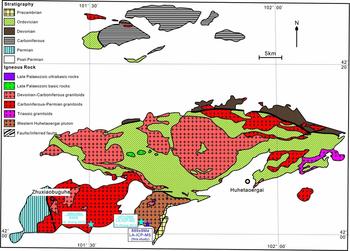
The Western Huhetaoergai granite is located in the Huhetaoergai Tectonic Zone (Fig. 2). The only Precambrian strata exposed in the Huhetaoergai Tectonic Zone are of Mesoproterozoic (Stenian–Estasian) age, into which the Western Huhetaoergai pluton intrudes. It includes sandstone, thick marble, some silicalite and slate. Its base contains purple-red sandstone with fine conglomerate (BGGP, 1980). More Precambrian strata are found in the Zhusileng Tectonic Zone (Fig. 1b). Mesoproterozoic (Stenian–Estasian) strata, only exposed south of the Wudenghan area, are composed of metasiltstone in the lower and upper parts and carbonate in the middle, in mutual fault contact (BGGP, 1981 a). In the Jindouaobao area, an early Palaeoproterozoic marine regression sedimentary sequence is widely distributed. From bottom to top, it includes magnesium carbonates, intermediate–acidic volcanic rocks and clastic rocks (BGNHAR, 1982 a). Minor late Palaeoproterozoic – early Neoproterozoic (Statherian–Calymmian) neritic carbonates and black siliceous rocks, early Neoproterozoic (Tonian) siliceous dolomites and late Neoproterozoic (Cryogenian) glacial till (c. 90 m) also occur (BGNHAR, 1982 a; Wang, Wang & Wang, Reference Wang, Wang and Wang1994).

2.a. Western Huhetaoergai granite
The Western Huhetaoergai pluton is in the Huhetaoergai Tectonic Zone and represents a batholith covering c. 80 km2. It intrudes Mesoproterozoic sandstone in the SE and Ordovician strata in the north (Fig. 2). Banded structure and weakly developed gneissic fabric are present. The banded structure comprises light and dark parallel laminations of 2–3 cm width. Generally, coarse quartz, plagioclase and feldspar comprise the light bands and fine biotite and plagioclase form the dark bands. Most minerals are aligned parallel to the bands. Elongate marble xenoliths parallel to the gneissic schistosity or laminations are also present (BGGP, 1980).
The pluton is heterogeneous with variable composition and irregular lithofacies. However, it is predominantly composed of fresh red biotite granite and grey biotite granodiorite. The granodiorite emplaced into the granite is early Carboniferous in age (W. Zhang, unpub. Ph.D. thesis, Peking University, 2013). In this study we mainly focus on the biotite granite, which is fine to medium grained. The modal mineralogy includes plagioclase (15–25%, minor alteration to sericite), perthitic feldspar (30–40%), quartz (35–45%), biotite (6–10%, some altered to chlorite) and some muscovite. Garnet is also found in one sample (AB10-45). The main accessory minerals are zircon, titanite, apatite, hematite and magnetite.
3. Geochemistry and geochronology
Samples representing the principal compositional phases of the batholith were selected for major and trace element and Nd and Sr isotopic analyses. Analytical methods are described in Appendix S1 in the online Supplementary Material, available at http://journals.cambridge.org/geo. The results are given in supplementary Tables S1 & S2, available at http://journals.cambridge.org/geo.
3.a. Major and trace elements
The SiO2 contents of the Western Huhetaoergai biotite granite ranges from 75.06 to 81.42 wt%; 9.59–12.76 wt% for Al2O3; 0.18–0.38 wt% for MgO with low Mg number (0.25–0.34; Mg2+/(Mg2++Fe2+)) (Irving & Green, Reference Irving and Green1976); 0.15–0.25 wt% for TiO2; and 0.57–0.69 wt% for CaO. All samples are peraluminous (A/NCK>1.0; for definition of notation see supplementary Table S1 notes, available at http://journals.cambridge.org/geo) (Shand, Reference Shand1943; Zen, Reference Zen1988) (Fig. 3a) and ferroan (Fe number = FeOT/(FeOT+MgO) = 0.83–0.89) (Frost et al. Reference Frost, Barnes, Collins, Arculus, Ellis and Frost2001). The total alkali content (Na2O+K2O) is 7.89 wt% on average and all samples contain more K2O than Na2O (Na2O/K2O<0.4). They have high-K calc-alkaline to shoshonitic characteristics. On the Na2O+K2O v. SiO2 diagram (Fig. 3b), the Western Huhetaoergai biotite granite plots in the sub-alkaline field. Chondrite-normalized rare Earth element (REE) patterns (Fig. 4a) (Sun & McDonough, Reference Sun, McDonough, Saunders and Norry1989) show enrichment of light REE (LREE) ((La/Yb)N = 1.9–4.3) and strongly negative Eu anomalies (δEu = 0.29–0.34). Normal mid-ocean-ridge basalt (N-MORB) -normalized trace element patterns (Fig. 4b) (Sun & McDonough, Reference Sun, McDonough, Saunders and Norry1989) show that the samples are enriched in LREE, Rb, Th, K, Nd and Sm and depleted in Ba, Nb, Ti, P and Zr.
Major characteristics of the Western Huhetaoergai granite: (a) after Shand (Reference Shand1943); (b) after Irvine & Baragar (Reference Irvine and Baragar1971).

(a) Chondrite-normalized REE patterns and (b) N-MORB-normalized trace elements patterns for the Western Huhetaoergai granite (normalized values after Sun & McDonough, Reference Sun, McDonough, Saunders and Norry1989).

3.b. Nd and Sr isotopes
Determination of ‘initial’ data is based on the geochronology. Nd model ages have been calculated with f Sm/Nd values of –0.2 to –0.6. The Western Huhetaoergai granite has high initial 87Sr/86Sr of 0.727305–0.735626 and negative ε Nd(t) of −2.6 to −1.1. Both indicate components of modern to Proterozoic age when intrusive age is plotted against ε Nd(t) (Fig. 5a). Single-stage model age (T DM1) is 2452–1707 Ma.
Isotopic data: (a) ε Nd(t) v. intrusive age; (b) ε Nd(t) v. (87Sr/86Sr)i ratios. The lower crust and upper crust fields are from Wu et al. (Reference Wu, Jahn, Wilde, Lo, Yui, Lin, Ge and Sun2003 a).

3.c. Geochronology
After geochemical analyses, a representative sample (AB10–41) was selected for dating by laser ablation inductively coupled plasma mass spectrometry (LA-ICP-MS). Analytical results are shown in supplementary Table S3, available at http://journals.cambridge.org/geo. Zircon grains are euhedral, clear to pink and transparent or euhedral to subhedral, brown and turbid to opaque. Aspect ratios (AR) range from 1:1 to 5:1. Some have inclusions and inherited cores. Most analyses represent idiomorphic grains with oscillatory zoning throughout the crystal (Fig. 6a). By integrating crystal shapes, textures and high Th/U ratios of the zircons, the majority of grains are presumed to be magmatic (Belousova et al. Reference Belousova, Griffin, O'Reilly and Fisher2002; Corfu et al. Reference Corfu, Hanchar, Hoskin and Kinny2003). One core was found and a slightly older age was obtained (1043_2_43). Analyses showing apparently older ages (1043_2_43) and those performed on grains on cracks (1043_2_46) are excluded from the age calculations. Sixteen analyses were combined to yield a concordia age of 889±8 Ma (MSWD = 0.30) (Fig. 6b), which is interpreted as the crystallization age for sample AB10–41.
(a) Cathodoluminescence (CL) images of zircons and (b) U–Pb Concordia plot. Unfilled symbols excluded from final synthesis.

4. Discussion and conclusions
4.a. Petrogenesis
The pluton was previously regarded as being of early Palaeozoic (BGGP, 1980) or late Neoproterozoic (689 Ma, TIMS zircon U–Pb; Wang, Wang & Wang, Reference Wang, Wang and Wang1994) in age. Our new LA-ICP-MS zircon U–Pb age of biotite granite (AB10–41) is 889±8 Ma, which represents the age of the Western Huhetaoergai biotite granite pluton. Few Precambrian granitoids are reported in the Northern Alxa region, so the Neoproterozoic Western Huhetaoergai granite is significant in providing information about Precambrian basement and constraining Neoproterozoic evolution.
From the mineralogical and geochemical characteristics, such as the absence of alkaline minerals, the high SiO2 and K2O contents and the peraluminous nature, the Western Huhetaoergai granite is interpreted to represent a highly fractionated potassium-rich calc-alkaline rock (e.g. Sylvester, Reference Sylvester1989). The low Fe/Mg, Ga/Al and contents of Zr, Nb, Ga, Y, Ce, Sr and CaO indicate that it is not an alkaline granite (A-type granite) but a fractionated felsic granite (Whalen, Currie & Chappell, Reference Whalen, Currie and Chappell1987). This is also supported by the striking depletions in Ba, Nb, Eu, Ti and P (Fig. 4b). According to Wu et al. (Reference Wu, Jahn, Wilde, Lo, Yui, Lin, Ge and Sun2003 b), negative Nb–Ti anomalies are related to fractionation of Ti-bearing phases (ilmenite, titanite, etc.), negative P anomalies result from apatite separation and strongly negative Eu anomalies require extensive fractionation of plagioclase and/or K-feldspar. The fractionation of K-feldspar would produce negative Eu–Ba anomalies.
The Neoproterozoic Western Huhetaoergai granite has 87Sr/86Sr values of 0.727305–0.735626, a T DM1 age of 2452–1707 Ma and slightly negative ε Nd(t) (−2.6 to −1.1). ε Nd(t) of value c. 0 shows that both a mantle (or juvenile) component and continental crust (or a sedimentary component) were involved in the genesis of the Neoproterozoic Western Huhetaoergai granite (Fig. 5b). Sr isotopic data suggest the important role of continental crust (or a sedimentary component).
Two possible processes may explain these isotopic characteristics. The first considers that the granite was generated from a high Rb/Sr source. Rb/Sr ratios of the Western Huhetaoergai granite ranges from 1.4 to 3.2 (supplementary Table S1, available at http://journals.cambridge.org/geo). To acquire high initial 87Sr/86Sr, the source would have needed much higher Rb/Sr ratios. Sr-isotope evolution of the upper continental crust is determined by its age and Rb/Sr ratios (McDermott & Hawkesworth, Reference McDermott and Hawkesworth1990). Rocks with high Rb/Sr ratios are usually considered to be from the upper continental crust; however, upper continental crust would usually produce much lower initial ε Nd than that recorded by the Western Huhetaoergai granite.
The second process considers that the granite was derived from a mantle source and assimilated/contaminated crustal rocks with very high 87Sr/86Sr. As marble xenoliths are common in the pluton, they could be responsible for the high initial 87Sr/86Sr. Previous studies show carbonate usually has high 87Sr/86Sr (0.71–0.73) (Metcalf et al. Reference Metcalf, Smith, Walker, Reed and Gonzales1995; Plank & Langmuir, Reference Plank and Langmuir1998; Faure & Mensing, Reference Faure and Mensing2010). According to Satish-Kumar et al. (Reference Satish-Kumar, Miyamoto, Hermann, Kagami, Osanai, Motoyoshi, Satish-Kumar, Motoyoshi, Osanai, Hiroi and Shiraishi2008), marble from East Antarctica has initial 87Sr/86Sr ratios between 0.7066 and 0.7582 (550 Ma) due to fluid–rock interactions. The assimilation of carbonate material may increase CaO and Sr concentrations, as well as the 87Sr/86Sr ratio (Barnes et al. Reference Barnes, Prestvik, Sundvoll and Surratt2005). The protolith of marble xenoliths in the Western Huhetaoergai pluton is probably dolomite (CaMg(CO3)2) (BGGP, 1980), but the granite has very low Sr, CaO and MgO. Consequently, it is difficult to explain its chemical characteristics by carbonate assimilation. However, minor carbonate assimilation must have occurred due to the presence of marble xenoliths. Crustal rocks with very high 87Sr/86Sr (e.g. Allègre & Othman, Reference Allègre and Othman1980) are not seen at the surface and may exist at depth. In addition, although few isotopic studies of contemporaneous granite in the CAOB are reported, the 880–864 Ma granite from Siberia's western margin has slightly lower initial ε Nd (–2.6 to –5.1), similar to the Western Huhetaoergai granite but much lower initial 87Sr/86Sr (0.7070–0.7104) (Vernikovsky et al. Reference Vernikovsky, Vernikovskaya, Wingate, Popov and Kovach2007). It is interpreted as having been generated by melting and mixing of different source components (older and younger, lower and middle crustal meta-igneous or sedimentary rocks).
4.b. Tectonic implications
4.b.1. Tectonic setting
Enrichment of LREE and negative Nb–Ta–Ti anomalies of the Western Huhetaoergai granite indicate arc-related characteristics. It is post-collisional, both with respect to being unfoliated and as defined by its trace elements (Pearce, Harris & Tindle, Reference Pearce, Harris and Tindle1984; Pearce, Reference Pearce1996), which is also consistent with its fractionated nature (e.g. Whalen, Currie & Chappell, Reference Whalen, Currie and Chappell1987). From the geochemical and geochronological data, the HZ was in a post-collisional stage at c. 890 Ma. This is difficult to correlate with the sedimentary record as the Mesoproterozoic (Stenian–Estasian) sandstone into which the Western Huhetaoergai pluton is emplaced is the only Precambrian strata exposed in the Huhetaoergai Tectonic Zone (Fig. 1b). Future basement studies would be of great benefit in addressing granite genesis in the region.
A previous study argued that the Huhetaoergai Tectonic Zone represented a palaeo-volcanic arc developed on oceanic crust, preserved when the ocean closed and interpreted as ‘juvenile’ continental crust (Wang, Wang & Wang, Reference Wang, Wang and Wang1994). The age of 689 Ma for the Western Huhetaoergai granite resulted in the interpretation that this ‘juvenile’ continental crust formed at c. 700 Ma. However, the new geochronology for the Western Huhetaoergai granite indicates that if the Huhetaoergai Tectonic Zone represents ‘juvenile’ continental crust, it should be older than c. 890 Ma. This is also supported by the presence of an additional fragment of Precambrian crystalline basement, the Mesoproterozoic strata with both marine and terrestrial components and the isotopic characteristics of the Western Huhetaoergai granite. The Huhetaoergai Tectonic Zone may therefore represent the same Neoproterozoic tectonic unit as the Zhusileng Tectonic Zone. The Western Huhetaoergai granite formed after the collision between the Huhetaoergai palaeo-volcanic arc and the Zhusileng Tectonic Zone.
4.b.2. Tectonic affinities of the northernmost Alxa region during early Neoproterozoic time
Granitoid gneiss of similar zircon U–Pb crystallization age (916±16 Ma, conventional zircon age) is recognized in the Yagan–Onch Hayrhan metamorphic core complex, Jindouaobao area, Zhusileng Tectonic Zone (Fig. 1b) by Wang et al. (Reference Wang, Zheng, Gehrels and Mu2001). The Neoproterozoic Jindouaobao granitoid gneiss has high SiO2 and K2O (SiO2 = 72–73 wt%, K2O = 4.33–4.95 wt%), peraluminous characteristics (A/CNK = 1.04–1.14) and negative Eu anomalies (δEu = 0.33–0.53), similar to the Western Huhetaoergai granite in this study. Wang et al. (Reference Wang, Zheng, Gehrels and Mu2001) argued that the Jindouaobao granitoid gneiss implied the existence of a South Mongolian/South Gobi Microcontinent, which is consistent with a U–Pb zircon crystallization age of 952±8 Ma for a gneissic granite from the South Gobi Block in south Mongolia (Hutag Uul Terrane of Badarch, Dickson Cunningham & Windley, Reference Badarch, Dickson Cunningham and Windley2002) reported by Yarmolyuk et al. (Reference Yarmolyuk, Kovalenko, Sal'nikova, Kozakov, Kotov, Kovach, Vladykin and Yakovleva2005). In this case, it may be regarded as an extension of the Xilinhot gneiss (Xiao et al. Reference Xiao, Windley, Hao and Zhai2003) located in a thrust belt near the Solonker Suture Zone, widely regarded to record the terminal evolution of the CAOB (Xiao et al. Reference Xiao, Windley, Hao and Zhai2003; Chen, Jahn & Tian, Reference Chen, Jahn and Tian2009; Li et al. Reference Li, Zhou, Brouwer, Wijbrans, Zhong and Liu2011). Our new zircon age data, together with the South Mongolian Microcontinent zircon age data (Wang et al. Reference Wang, Zheng, Gehrels and Mu2001; Shi et al. Reference Shi, Liu, Zhang, Jian, Miao, Shi and Tao2003; Yarmolyuk et al. Reference Yarmolyuk, Kovalenko, Sal'nikova, Kozakov, Kotov, Kovach, Vladykin and Yakovleva2005; Chen, Jahn & Tian, Reference Chen, Jahn and Tian2009), are plotted in a histogram (Fig. 7a and supplementary Table S4, available at http://journals.cambridge.org/geo). Note that the Xilinhot metamorphic complex shows two groups of Precambrian ages: one with ages of 1524–2900 Ma, similar to those of the North China Craton, and the other with ages of 780–900 Ma, resembling those from the South Mongolian Microcontinent (Chen, Jahn & Tian, Reference Chen, Jahn and Tian2009). As shown in Figure 7a, the zircon ages of the Western Huhetaoergai granite overlap of that of the South Mongolian Microcontinent zircon age data, indicating their close affinities at that time. Consequently, it is possible that the Western Huhetaoergai granite reflects the existence of the South Mongolian Microcontinent and may also be an extension of the Xilinhot gneiss.
(a) Histogram of zircon age data for the Western Huhetaoergai granite, compared with the South Mongolia microcontinent-related zircon age data. (b) Age histogram for Neoproterozoic igneous rocks in the Northern Alxa region, Beishan area and Tarim Craton. Data from 1. Wang et al. (Reference Wang, Zheng, Gehrels and Mu2001); 2. Yarmolyuk et al. (Reference Yarmolyuk, Kovalenko, Sal'nikova, Kozakov, Kotov, Kovach, Vladykin and Yakovleva2005); 3. Shi et al. (Reference Shi, Liu, Zhang, Jian, Miao, Shi and Tao2003); 4. Chen et al. (Reference Chen, Jahn and Tian2009); 5. Taylor et al. (Reference Taylor, Webb, Johnson and Heumann2013); 6. Liu et al. (Reference Liu, Zhao, Sun, Eizenhöfer, Han, Hou, Zhang, Wang, Liu and Xu2015); 7. Geng & Zhou (Reference Geng and Zhou2010).

Tarim Craton provides an alternative possible interpretation for the tectonic affinity of Neoproterozoic northernmost Alxa region. Wang, Wang & Wang (Reference Wang, Wang and Wang1994) indicated that both Huhetaoergai and Zhusileng tectonic zones belonged to easternmost Tarim Craton. When compared with the Neoproterozoic magmatism in the Beishan Orogenic Belt, Tarim Craton and the Alatanaobao area south of Northern Alxa region (Fig. 1), the Western Huhetaoergai granite and the Jindouaobao granitoid gneiss are more comparable with the Beishan samples in terms of their ages and rock associations (Fig. 7b). The Beishan Orogenic Belt may have been part of the Tarim Craton during early Neoproterozoic time (Liu et al. Reference Liu, Zhao, Sun, Eizenhöfer, Han, Hou, Zhang, Wang, Liu and Xu2015). However, unlike highly fractioned Western Huhetaoergai post-collisional granite, 905–871 Ma Gubaoquan orthogneisses of the Beishan Orogenic Belt are suggested to be probably arc-related I-type granitoid geochemical affinities related to subduction tectonic settings (Liu et al. Reference Liu, Zhao, Sun, Eizenhöfer, Han, Hou, Zhang, Wang, Liu and Xu2015). Referring to the similarity of the geochemistry, we favour the affinity of the northernmost Alxa region to the South Mongolian Microcontinent.
The existence of the South Mongolian Microcontinent has recently been questioned, however. From U–Pb zircon dating and microstructural analysis, Taylor et al. (Reference Taylor, Webb, Johnson and Heumann2013) pointed out that previously suspected Precambrian protoliths of Totoshan–Ulanuul (Yarmolyuk et al. Reference Yarmolyuk, Kovalenko, Sal'nikova, Kozakov, Kotov, Kovach, Vladykin and Yakovleva2005) and Tsagaan–Khairkhan blocks (Tsaagan Uul Terrane of Badarch, Dickson Cunningham & Windley, Reference Badarch, Dickson Cunningham and Windley2002), which represent a substantial portion of the South Gobi Microcontinent (e.g. Salnikova et al. Reference Salnikova, Kozakov, Kotov, Kröner, Todt, Bibikova, Nutman, Yakovleva and Kovach2001; Wang et al. Reference Wang, Zheng, Gehrels and Mu2001; Kovalenko et al. Reference Kovalenko, Yarmolyuk, Kovach, Kotov, Kozakov, Salnikova and Larin2004; Yarmolyuk et al. Reference Yarmolyuk, Kovalenko, Sal'nikova, Kozakov, Kotov, Kovach, Vladykin and Yakovleva2005, Reference Yarmolyuk, Kovach, Kovalenko, Terent'eva, Kozakov, Kotov and Eenjin2007, Reference Yarmolyuk, Kovalenko, Sal'nikova, Kovach, Kozlovsky, Kotov and Lebedev2008), formed during Devonian–Triassic times and show no evidence to support the existence of the Precambrian basement. The only Precambrian zircons found are three of Archean and one of Mesoproterozoic age (Taylor et al. Reference Taylor, Webb, Johnson and Heumann2013) (Fig. 7a), interpreted to be sourced from the Tarim and North China cratons and associated accreted terranes (such as in the Qilian, Qaidam, Yin Shan and Yan Shan regions) located along the North China margin. Although these U–Pb zircon age data from Taylor et al. (Reference Taylor, Webb, Johnson and Heumann2013) do not support the existence of exposed Precambrian rocks in the South Mongolian Microcontinent, the possibility of Precambrian rocks at deeper crustal levels cannot be ruled out entirely. Further evidence may be identified in a future study.
The Neoproterozoic age of the Western Huhetaoergai pluton may coincide with the assembly of Rodinia (Li et al. Reference Li, Bogdanova, Collins, Davidson, De Waele, Ernst, Fitzsimons, Fuck, Gladkochub and Jacobs2008; Lu et al. Reference Lu, Li, Zhang and Niu2008; Demoux et al. Reference Demoux, Kröner, Liu and Badarch2009; Shu et al. Reference Shu, Deng, Zhu, Ma and Xiao2011). From the study of magmatic zircons in gabbro, granite and paragneiss from Tarim, Shu et al. (Reference Shu, Deng, Zhu, Ma and Xiao2011) interpreted the assembly period of Rodinia to be the interval c. 1140–860 Ma (peak of 920 Ma). Synorogenic ages of 1050–844 Ma are recognized in Tarim (Lu et al. Reference Lu, Li, Zhang and Niu2008). The protoliths of orthogneisses of age c. 900–870 Ma were also discovered in the Beishan Orogenic Belt (Jiang et al. Reference Jiang, He, Zong, Zhang and Zhao2013; Yu et al. Reference Yu, Zhang, Del Real, Zhao, Hou, Gong and Li2013; Liu et al. Reference Liu, Zhao, Sun, Eizenhöfer, Han, Hou, Zhang, Wang, Liu and Xu2015). Granitoid gneiss of similar age (972–904 Ma) with similar geochemical characteristics is also reported in the Alatanaobao area, Southern Alxa region (Geng et al. Reference Geng, Wang, Shen and Wu2002; Geng & Zhou, Reference Geng and Zhou2010). The presence of rocks of age c. 1.0 Ga in the Alxa region and in the Tarim Craton demonstrates that these were joined at that time. This phase of magmatism is also documented by granite-gneiss with protolithic ages of 954±8, 956±3 and 983±6 Ma in south Mongolia (Demoux et al. Reference Demoux, Kröner, Liu and Badarch2009). In Siberia's western margin, granites of age 880–864 Ma are interpreted to relate to the formation of the Rodinia supercontinent and the Central Asian Orogenic Belt (Vernikovsky et al. Reference Vernikovsky, Vernikovskaya, Wingate, Popov and Kovach2007). Granite formation at 1.1–0.8 Ga is also recorded in south Siberia (Berzin & Dobretsov, Reference Berzin and Dobretsov1994). The genesis of the Western Huhetaoergai granite is therefore likely related to the assembly of Rodinia; at c. 890 Ma the Huhetaoergai area would have been under compression.
In summary, the Neoproterozoic Western Huhetaoergai granite is a highly fractionated potassium-rich calc-alkaline pluton with low initial ε Nd (−2.6 to −1.1) and high initial 87Sr/86Sr (0.727305 to 0.735626). The granite is probably derived from a mantle (or juvenile) source that assimilated very high 87Sr/86Sr crustal rocks during the assembly of Rodinia. The Huhetaoergai and the Zhusileng tectonic zones were together during Neoproterozoic time. During early Neoproterozoic time, the northernmost Alxa region was closely linked to the South Mongolian Microcontinent.
Acknowledgements
We gratefully acknowledge financial support from the National Natural Science Foundation of China (grant nos 41372225 and 41430210), China Scholarship Council (grant to W. Zhang, file number 2010601124) and the Swedish Research Council (grant to V. Pease). The PetroTectonics Analytical Facility is funded by the Knut and Alice Wallenberg Foundation and Department of Geological Sciences, Stockholm University.
Supplementary material
To view supplementary material for this article, please visit http://dx.doi.org/10.1017/S0016756815000631.