Introduction
Late Devonian conodonts of northwest Thailand have been described previously by several workers, including Wongwanich and Burrett (Reference Wongwanich and Burrett1984), Burrett et al. (Reference Burrett, Carey and Wongwanich1986), Savage et al. (Reference Savage, Sardsud and Buggisch2006), Königshof et al. (Reference Königshof, Savage, Lutat, Sardsud, Dopieralska, Belka and Racki2012), and Savage (Reference Savage2013). This paper concentrates on a small but important Frasnian interval 80 cm thick that extends through the Upper Palmatolepis rhenana Biozone, the Lower Palmatolepis rhenana Biozone, the Palmatolepis linguiformis Biozone, the Frasnian-Famennian global extinction event, and into the beginning of the Palmatolepis triangularis Biozone. Some of the conodonts from the upper part of this interval were illustrated and described by Savage (Reference Savage2013) and are reillustrated herein because that booklet is not readily available.
Geologic setting
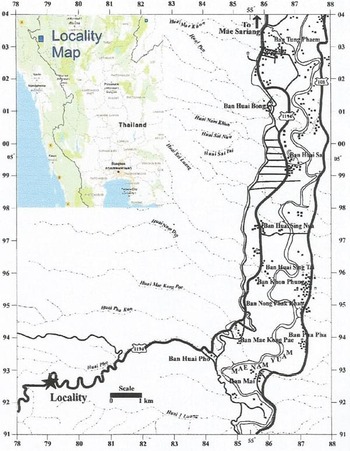
In Savage (Reference Savage2013), a near-vertical section 11 m thick near the town of Mae Sariang was described, and the conodont faunas and geochemistry were discussed. Although the cliff section is 11 m thick, a thrust fault repeats part of the section so that the Frasnian and Famennian thickness is 7.8 m. The locality is 20 km southwest of Mae Sariang at 18°01′07″N, 97°51′3″E (Fig. 1).
Location of the Mae Sariang section, 20 km southwest of Mae Sariang, northwestern Thailand, at 18°01′07″N, 97°51′30″E.

A steep, almost vertical cliff more than 20 m high is set back from the roadside and largely obscured by trees. The section was discovered by the author in 2006, in the company of A. Sardsud. At the time of our 2006 visit, the section had not been described and its importance was not appreciated, although we suspected it was largely of Devonian age.
To take preliminary samples for conodont analysis, our assistants climbed the cliff and numbered the beds with paint from D1 at the top down to D26 at the base. These numbers were used subsequently and are in reverse order of deposition. After these preliminary samples had been processed for conodonts, we returned in 2007. Following construction of a bamboo stairway up the cliff, we measured and marked the 18 Upper Devonian beds, D1 to D18, which were subdivided into 80 intervals, each about 11–15 cm thick (see Savage Reference Savage2013, fig. 2). The interval thicknesses were not arbitrary but were determined by the thickness of the larger beds. From each of these 80 intervals, conodont samples of about 2 kg were collected and processed at the University of Oregon. The samples all yielded conodonts, varying from 10s per kilogram to over 1,000 elements per kilogram. The beds contain very few megafossils although some ostracode, crinoid, and trilobite fragments have been found in thin sections (Königshof et al., Reference Königshof, Savage, Lutat, Sardsud, Dopieralska, Belka and Racki2012). In related work, G. Racki and colleagues J. Dopieralska and Z. Belka began a comparison of neodymium isotopes at the Mae Sariang section and at another section farther south at Thong Pha Phum (Dopieralska et al., Reference Dopieralska, Belka, Königshof, Racki, Savage, Lutat and Sardsud2012).
Materials and methods
Most of the materials were collected by the author between 2006 and 2010, accompanied variously by Dr. A. Sardsud of the Department of Mineral Resourses, Dr. P. Lutat of Mahrasarakham University, and in 2009 and 2010 by Drs. Sarsud and Lutat together with Dr. P. Königshof of the Senkenberg Research Institute, Germany.
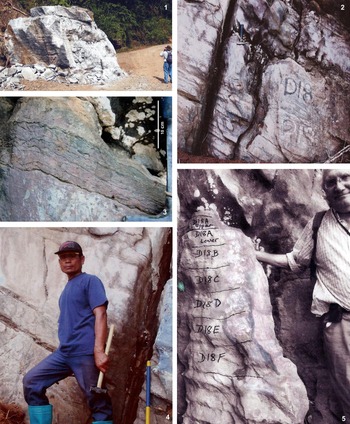
This Mae Sariang section is exposed where a stream is cutting into the cliff. During the wet season (July to October) the stream may become a waterfall, with most of the water passing through a conduit beneath the road. This erosion is a two-edged sword in that it keeps the exposure renewed but also causes large blocks to break away. A house-sized block broke from the central part of our exposure and fell down to the road in 2010 just before our field party arrived at the site (Fig. 2.1). This was a few meters east of our bamboo stairway, built three years earlier. Fortunately, the fall improved the exposure and allowed us to collect new samples from beds D17 and D18 a meter farther east from the earlier painted intervals (Fig. 2.2, 2.3, 2.5).
Photographs at the section. (1) Fallen block on the road below the section, November 2010; (2) horizons D17 (above), D18, and D19 (below), with hammer leaning against the brownish layers in upper part of D18 and D18AEx; (3) close-up of part of (2) to show the two brownish layers in upper part of D18, hammer for scale, also 10 cm scale bar; (4) field assistant standing in front of beds D18 and D19, at the left side of picture in image (2) with top of his cap level with the brownish layers that continue to his right; (5) photograph of part of D17, D18, and D19 (see Figure 2.2) with markings of where samples were taken in 2010.

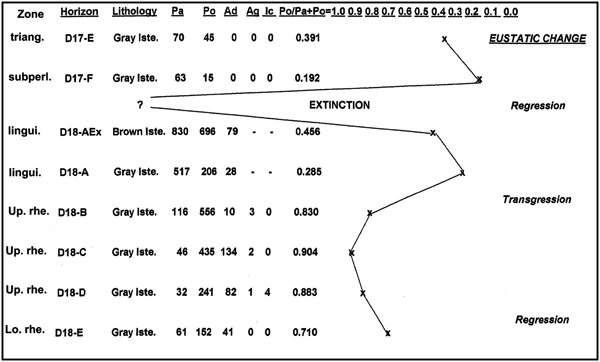
Herein the author concentrates on the part of the section that includes the Frasnian-Famennian extinction event and describes conodonts from the seven horizons D18-E up through D17-F (Fig. 3). Conodonts from most of these horizons at Mae Sariang have not been described earlier. Previously the author divided the D18-A interval into lower and upper parts (Savage, Reference Savage2013, p. 11, 13), but herein these are termed D18-A for the lower part of the linguiformis Zone and D18-AEx for the upper part of that zone.
Palmatolepis (Pa.), Polygnathus (Po.), Ancyrodella (Ad.), Ancyrognathus (Ag.), Icriodus (Ic.) P1 element numbers, resulting Po/Pa + Po plot, and eustatic change interpretation for the eight horizons D18-E (Lower rhenana Zone) up to D17-E (triangularis Zone).

Repository and institutional abbreviation
Types and figured specimens in this study are in the Condon Collection, University of Oregon. Specimen numbers are University of Oregon paleontology conodont specimens (UOPS). These conodonts will be assigned Condon Collection numbers by the curator after publication.
The conodont faunas
The conodont abundances refer to P1 elements. The counts of P1 elements herein and in Savage (Reference Savage2013) are those remaining after some were sent to G. Racki earlier for the geochemical analyses reported by Dopieralska et al. (Reference Dopieralska, Belka, Königshof, Racki, Savage, Lutat and Sardsud2012), Königshof et al. (Reference Königshof, Savage, Lutat, Sardsud, Dopieralska, Belka and Racki2012), and Savage (Reference Savage2013).
Biofacies and eustatic changes
The tectonic influences on the depositional environment are difficult to assess from the sedimentary strata. Tectonic workers have suggested the Mae Sariang area probably belongs to the Sibumasu Terrane or to the adjacent Inthanon Zone (Kamata et al., Reference Kamata, Ueno, Hara, Ichise, Charoentitirat, Charusiri and Sardsud2009; Metcalfe, Reference Metcalfe2011). In any case, it seems likely it was in a variable deeper shelf setting in the vicinity of the eastern Paleothethys Ocean.
The succession of limestone from intervals D18 upward to D1 indicates a pelagic, mostly deepwater environment with a slow accumulation of algal carbonate particles during a 16 million year period from the late Frasnian to the late Famennian. The 18 or more bedding planes presumably indicate sedimentary breaks although most conodont zones are represented, at least in part. There are probably some hiatuses that are not visible. Some discussion of the geochemistry, including the major positive δ13C isotope excursion at the Upper Kellwasser horizon, is given in Königshof et al. (Reference Königshof, Savage, Lutat, Sardsud, Dopieralska, Belka and Racki2012) and Savage (Reference Savage2013).
The systematic assessment of conodonts from horizons D18-E up to D17-F shows that over 85% of the P1 elements belong to species of Palmatolepis and Polygnathus. These genera are not equally represented in the intervals studied. Some, in the intervals D18-E to D18-B of the Lower to Upper rhenana zones, are Polygnathus-dominated, whereas interval D17-F of the Lower triangularis Zone is Palmatolepis-dominated. Between, in intervals D18-A and D18-AEx of the linguiformis Zone, Palmatolepis and Polygnathus occur more equally (Fig. 3).
The biofacies concepts proposals of Sandberg (Reference Sandberg and Barnes1976), Sandberg and Ziegler (Reference Sandberg and Ziegler1979), Ziegler and Sandberg (Reference Ziegler and Sandberg1990), and subsequent workers, use Palmatolepis-dominated and Polygnathus-dominated faunas to indicate water depths and sedimentary environments. The Polygnathus-Palmatolepis ratios in the Lower rhenana Zone and Upper rhenana Zone Mae Sariang intervals D18-E to D18-B indicate relatively regressive conditions. There is then a deepening from interval D18-B to interval D18-A. Intervals D18-A and D18-AEx are in the linguiformis Zone. It is immediately above interval D18-AEx and thus above the linguiformis Zone that the extinction event occurs (Fig. 3). This marks the Frasnian-Famennian (F-F) boundary. Many workers (see Racki, Reference Racki, Over, Morrow and Wignall2005) have suggested that a global glacially forced regression was responsible for this event, although Becker et al. (Reference Becker, Piecha, Gereke and Spellbrink2016. p. 230) favor “variable euthrophication and primary productivity pulses, not the undeniable sea-level changes.” Recently, some researchers (e.g., Sanei et al., Reference Sanei, Grasby and Beauchamp2012; Jones et al., Reference Jones, Martini and Kunio2016; Thibodean and Berquist, Reference Thibodean and Berquist2017) have suggested that a toxic level of marine mercury caused by widespread volcanism is a more likely explanation for several global extinction events. Increased toxic levels of volcanic metals could be contributors to the F-F extinction event in the Mae Sariang area, although geochemical documentation is currently limited to that shown in figure 4a-h of Savage (Reference Savage2013).
All specimens are from interval D17-F. (1, 2) Palmatolepis new species A, oral and oblique-lateral views of P1 element UOPS 602. (3, 7, 8) Palmatolepis aff. Pa. triangularis Sannemann, Reference Sannemann1955a; (3) oral view of P1 element UOPS 603; (7, 8) oral and oblique-lateral views of P1 element UOPS 605. (4–6) Palmatolepis triangularis Sannemann, Reference Sannemann1955a, oral, oblique-lateral, and aboral views of P1 element UOPS 604. (9–11, 14) Palmatolepis praetriangularis Ziegler and Sandberg, Reference Ziegler and Sandberg1988; (9–11) oral, oblique-lateral, and aboral views of P1 element UOPS 606; (14) oral view of P1 element UOPS 608. (12, 13) Palmatolepis werneri Ji and Ziegler, Reference Ji and Ziegler1993, oral and oblique-lateral views of P1 element UOPS 607. (15, 16) Polygnathus procerus Sannemann, Reference Sannemann1955b, oral and lateral views of P1 element UOPS 609. (17, 18) Palmatolepis aff. Pa. delicatula delicatula Branson and Mehl, Reference Branson and Mehl1934, oral and aboral views of P1 element UOPS 610. Note: These conodonts, from the limestone immediately above the F-F event, are relatively few (see numbers in Fig. 3) and have a coating of detritus. Scale bars = 0.5 mm.

The Palmatolepis-dominated Palmatolepis subperlobata Biozone and triangularis Zone intervals D17-F to D16-E suggest a continuing offshore, deeper-water environment. This Palmatolepis-dominant biofacies continues during most of the overlying Famennian beds in the Mae Sariang section from interval D17-F through to D1-A (Savage, Reference Savage2013), the latter interval probably in the Bi. ultimus Zone of Spalletta et al. (Reference Spalletta, Perri and Over2017).
An abrupt and distinct brownish coloration of the limestone in D18-AEx, during the second half of the linguiformis Zone, coincides with an increase in iron (Fe) and manganese (Mn) (see Savage, Reference Savage2013, fig. 4g). The brownish limestone comprises two parts (Fig. 2.3), the lower, darker part is 9 cm thick (cf. Königshof et al., Reference Königshof, Savage, Lutat, Sardsud, Dopieralska, Belka and Racki2012), and the upper, less dark part is 7 cm thick. Both contain disarticulated shell fragments and conodonts that include Palmatolepis linguiformis. A photograph taken in 2010 of a field assistant standing in the same place as Figure 2.2 is fortuitous in that the brownish bed is level with the top of his cap and can be seen to be a continuous bed (Fig. 2.4). Volcanic activity, presumably local in part, was a possible cause of the sudden brownish color change, though it should be noted that Palmatolepis linguiformis and other conodonts continue through this interval, apparently undiminished, although showing increased morphological variation, as noted for some taxa elsewhere by Ziegler and Sandberg (Reference Ziegler and Sandberg1990, p. 110). The occurrence of the bottom of the brownish layers 16 cm below the extinction event is intriguing (Fig. 2.3). If the extinction event was caused by a global temperature drop and a glacially forced regression, it is difficult to explain the relevance of this sudden color change 16 cm lower, particularly as the limestone continued to accumulate and the conodont and other faunas seemingly thrived for thousands of years. Recently, several workers have suggested that major volcanic events on the Siberian Platform contributed to Late Devonian climatic changes (Racki, Reference Racki, Over, Morrow and Wignall2005; Kiselev et al., Reference Kiselev, Yarmolyuk, Egorov, Chernyushov and Nikiphorov2006; Courtillot et al., Reference Courtillot, Kravchinsky, Quidelleur, Renne and Gladkochub2010; Bond and Grasby, Reference Bond and Grasby2017). These volcanics include the Viluy basalts and the Pripyat-Dniepner-Donets basalts, which were very extensive and probably injected large amounts of CO2 and other gases into the atmosphere and possibly added toxic amounts of metals to the oceans. Regardless of terrane reconstructions, it is unlikely Siberian Platform volcanics caused the brownish layers in the Mae Sariang deposits, although this does not preclude the possibility that local volcanics occurred during a time of widespread volcanism.
Detailed sedimentological discussion of the lower part of the brownish layer is included in Königshof et al. (Reference Königshof, Savage, Lutat, Sardsud, Dopieralska, Belka and Racki2012), although it should be noted the thickness of the lower layer is given there as 15 cm, compared with 9 cm here. As discussed by Savage (Reference Savage2013, p. 7), the positive and negative excursions of δ13C in the Mae Sariang section (see Savage, Reference Savage2013, fig. 3) generally match the regressions and transgressions suggested by Buggisch and Joachimski (Reference Buggisch and Joachimski2006).
The sequence of sampled intervals, lithology, and number of P1 elements from D17-E, above, to D18-E, below, is as follows:
- D17-E gray limestone:
triangularis Zone, few (115) conodonts recovered in this interval
- D17-F gray limestone:
subperlobata Zone, few (78) conodonts in this interval (Figure 4)
(Bedding plane: extinction event)
- D18-AEx brownish limestone:
upper part of linguiformis Zone: abundant (1,526) conodonts (Figure 5)
- D18-A gray limestone:
lower part of linguiformis Zone: abundant (723) conodonts (Figures 6, 7)
- D18-B gray limestone:
Upper rhenana Zone: abundant (672) conodonts (Figure 8)
- D18-C gray limestone:
Upper rhenana Zone: numerous (481) conodonts (Figure 9)
- D18-D gray limestone:
Lower rhenana Zone: frequent (273) conodonts (Figures 10, 11)
- D18-E gray limestone:
Lower rhenana Zone: frequent (213) conodonts (Figure 12)
All specimens are from interval D18-AEx. (1–3) Palmatolepis chaemensis new species, oral, lateral, and aboral views of P1 element UOPS 595, holotype. (4, 5) Palmatolepis khaensis Savage, Reference Savage2013, oral and aboral views of P1 element UOPS 599. (6, 7) Palmatolepis marki Savage, Reference Savage2013, oral and oblique-lateral views of P1 element UOPS 472, holotype. (8–12) Palmatolepis aff. Pa. rotunda Ziegler and Sandberg, Reference Ziegler and Sandberg1990; (8–10) oral, oblique-lateral, and aboral views of P1 element UOPS 600; (11, 12) oblique-lateral and oral views of P1 element UOPS 596. (13–15) Palmatolepis aff. Pa. subrecta Miller and Youngquist, Reference Miller and Youngquist1947, oral, aboral, and oblique-lateral views of P1 element UOPS 601. (16, 17) Icriodus alternatus alternatus Branson and Mehl, Reference Branson and Mehl1934, oral and aboral views of P1 element UOPS 611. (18, 19) Ancyrognathus asymmetricus (Ulrich and Bassler, Reference Ulrich and Bassler1926), oblique-lateral and oral views of P1 element UOPS 476. (20, 21) Polygnathus tenellus tenellus Ji and Ziegler, Reference Ji and Ziegler1993, lateral and oral views of P1 element UOPS 613. (22) Ancyrodella curvata (Branson and Mehl, Reference Branson and Mehl1934) late morphotype, oral view of P1 element UOPS 612. (23, 24) Ancyrodella ioides Ziegler, Reference Ziegler1958, lateral and oral views of P1 element UOPS 475. (25, 26) Palmatolepis linguiformis Müller, Reference Müller1956, oral and oblique-lateral views of P1 element UOPS 479. Scale bars = 0.5 mm.

All specimens are from interval D18-A. (1–6) Palmatolepis linguiformis Müller, Reference Müller1956; (1–3) oral, lateral, and aboral views of P1 element UOPS 584; (4–6) oral, oblique-lateral, and aboral views of P1 element UOPS 487. (7–9) Palmatolepis hassi Müller and Müller, Reference Müller and Müller1957, oral, oblique-lateral, and aboral views of P1 element UOPS 480. (10–12) Palmatolepis aff. Pa. kireevae Ovnatanova, Reference Ovnatanova1976, oral, oblique-lateral, and aboral views of P1 element UOPS 586. (13–15) Polygnathus burretti Savage, Reference Savage2013, oral, lateral, and aboral views of P1 element UOPS 490, holotype. (16–18) Polygnathus tenellus tenellus Ji and Ziegler, Reference Ji and Ziegler1993, oral, lateral, and aboral views of P1 element UOPS 587. (19–21) Ancyrodella ioides Ziegler, Reference Ziegler1958, oral, lateral, and aboral views of P1 element UOPS 588. (22–24) Icriodus alternatus alternatus Branson and Mehl, Reference Branson and Mehl1934, oral, aboral, and lateral views of P1 element UOPS 589. Scale bars = 0.5 mm.

All specimens are from interval D18-A. (1, 2) Ancyrodella curvata (Branson and Mehl, Reference Branson and Mehl1934) early morphotype, oral and aboral views of P1 element UOPS 590. (3–5, 9, 10) Palmatolepis amplificata Klapper, Kuz'min, and Ovnatanova, Reference Klapper, Kuz'min and Ovnatanova1996; (3–5) oral, oblique-lateral, and aboral views of P1 element UOPS 591; (9, 10) oral and aboral views of P1 element UOPS 593. (6–8) Palmatolepis cf. Pa. rotunda Ziegler and Sandberg, Reference Ziegler and Sandberg1990, oral, oblique-lateral, and aboral views of P1 element UOPS 592. (11) Palmatolepis nasuta Müller, Reference Müller1956, oral view of P1 element UOPS 484. (12–14) Polygnathus tenellus tenellus Ji and Ziegler, Reference Ji and Ziegler1993, oral, lateral, and aboral views of P1 element UOPS 489. (15–17) Palmatolepis juntianensis Han, Reference Han1987, oral, lateral, and aboral views of P1 element UOPS 594. (18, 19) Palmatolepis khaensis Savage, Reference Savage2013, oral and aboral views of P1 element UOPS 483. (20, 21) Ancyrodella hamata Ulrich and Bassler, Reference Ulrich and Bassler1926, oral and aboral views of P1 element UOPS 492. Scale bars = 0.5 mm.

All specimens are from interval D18-B. (1–3) Polygnathus tenellus surinensis new subspecies, oral, lateral, and aboral views of P1 element UOPS 577. (4–15) Polygnathus tenellus tenellus Ji and Ziegler Reference Ji and Ziegler1993; (4–6) oral, lateral, and aboral views of P1 element UOPS 578; (7–9) oral, lateral, and aboral views of P1 element UOPS 579; (10–12) oral, lateral, and aboral views of P1 element UOPS 580; (13–15) oral, lateral, and aboral views of P1 element UOPS 581. (16–21) Palmatolepis marki Savage, Reference Savage2013; (16–18) oral, lateral, and aboral views of P1 element UOPS 582; (19–21) oral, oblique-lateral, and aboral views of P1 element UOPS 583. (22–24) Ancyrodella hamata Ulrich and Bassler, Reference Ulrich and Bassler1926, oral, aboral, and lateral views of P1 element UOPS 494. Scale bars = 0.5 mm.

All specimens are from interval D18-C. (1, 2) Palmatolepis aff. Pa. rotunda Ziegler and Sandberg, Reference Ziegler and Sandberg1990, oral and aboral views of P1 element UOPS 497. (3–5) Palmatolepis aff. Pa. jamieae Ziegler & Sandberg, Reference Ziegler and Sandberg1990, oral, oblique-lateral, and aboral views of P1 element UOPS 499. (6–11, 18–20) Polygnathus tenellus tenellus Ji and Ziegler, Reference Ji and Ziegler1993; (6–8) oral, lateral, and aboral views of P1 element UOPS 568; (9–11) oral, lateral, and aboral views of P1 element UOPS 569, holotype; (18–20) oral, lateral, and aboral views of P1 element UOPS 572. (12–14) Polygnathus tenellus surinensis new subspecies, oral, lateral, and aboral views of P1 element UOPS 570. (15–17) Polygnathus aff. Po. procerus Sannemann, Reference Sannemann1955b, oral, lateral, and aboral views of UOPS P1 element 571. (21–23) Polygnathus politus Ovnatanova, Reference Ovnatanova1969, oral, lateral, and aboral views of P1 element UOPS 573. (24–26) Palmatolepis aff. Pa. hassi Müller and Müller, Reference Müller and Müller1957, oblique-lateral, oral, and aboral views of P1 element UOPS 574. (27–32) Ancyrodella hamata Ulrich and Bassler, Reference Ulrich and Bassler1926; (27–29) lateral, oral, and aboral views of P1 element UOPS 575; (30–32) lateral, oral, and aboral views of P1 element UOPS 576. Scale bars = 0.5 mm.

All specimens are from interval D18-D. (1–6) Palmatolepis thamensis new species; (1–3) oral, lateral, and aboral views of P1 element UOPS 554, holotype; (4–6) oral, lateral, and aboral views of P1 element UOPS 555, paratype. (7–9) Palmatolepis cf. Pa. kireevae Ovnatanova, Reference Ovnatanova1976, oral, lateral-oblique, and aboral views of P1 element UOPS 556. (10–12) Palmatolepis aff. Pa. boogaardi Klapper and Foster, Reference Klapper and Foster1993, oral, lateral-oblique, and aboral views of P1 element UOPS 557. (13–18) Palmatolepis new species B; (13–15) oral, lateral-oblique, and aboral views of P1 element UOPS 558; (16–18) oral, lateral-oblique, and aboral views of P1 element UOPS 559. (19–21) Palmatolepis thanisi Savage, Sardsud, and Buggisch, Reference Savage, Sardsud and Buggisch2006, oral, lateral-oblique, and aboral views of P1 element UOPS 560. Scale bars = 0.5 mm.

All specimens are from interval D18-D. (1–3) Icriodus alternatus alternatus Branson and Mehl, Reference Branson and Mehl1934, oral, lateral, and aboral views of P1 element UOPS 500. (4–6, 12–14) Polygnathus tenellus tenellus Ji and Ziegler, Reference Ji and Ziegler1993; (4–6) oral, lateral, and aboral views of P1 element UOPS 561; (12–14) oral, lateral, and aboral views of P1 element UOPS 563. (7–9, 15–17) Polygnathus politus Ovnatanova, Reference Ovnatanova1969; (7–9) oral, lateral, and aboral views of P1 element UOPS 562; (15–17) oral, lateral, and aboral views of P1 element UOPS 564. (10, 11) Ancyrognathus aff. Ag. barbus Sandberg and Ziegler, Reference Sandberg, Ziegler, Sandberg, Ziegler, Dreesen and Butler1992, oral and aboral views of P1 element UOPS 501. (18–21) Ancyrodella hamata Ulrich and Bassler, Reference Ulrich and Bassler1926; (18, 19) oral and aboral views of P1 element UOPS 565; (20, 21) oral and aboral views of P1 element UOPS 566. (22–24) Polygnathus lodinensis Pölsler, Reference Pölsler1969, oral, lateral, and aboral views of P1 element UOPS 567. Scale bars = 0.5 mm.

All specimens are from interval D18-E. (1–12) Polygnathus tenellus tenellus Ji and Ziegler, Reference Ji and Ziegler1993; (1–3) oral, lateral, and aboral views of P1 element UOPS 550; (4–6) oral, lateral, and aboral views of P1 element UOPS 551; (7–9) oral, lateral, and aboral views of P1 element UOPS 552; (10–12) oral, lateral-oblique, and aboral views of P1 element UOPS 553. (13–15) Palmatolepis jamieae Ziegler and Sandberg, Reference Ziegler and Sandberg1990, lateral-oblique, oral, and aboral views of P1 element UOPS 502. (16, 17) Palmatolepis khaensis Savage, Reference Savage2013, oral and aboral views of P1 element UOPS 505. (18–20) Ancyrodella ioides Ziegler, Reference Ziegler1958, oral, lateral, and aboral views of P1 element UOPS 503. (21–23) Ancyrodella hamata Ulrich and Bassler, Reference Ulrich and Bassler1926, oral, aboral, and lateral views of P1 element UOPS 504. (24–26) Palmatolepis aff. Pa. rotunda Ziegler and Sandberg, Reference Ziegler and Sandberg1990, lateral, aboral, and oral views of P1 element UOPS 506. Scale bars = 0.5 mm.

Systematic paleontology
The figure captions indicate from which intervals the described conodonts were collected.
Class Conodonti Branson, Reference Branson1938
Genus Ancyrodella Ulrich and Bassler, Reference Ulrich and Bassler1926
Type species
Ancyrodella nodosa Ulrich and Bassler, Reference Ulrich and Bassler1926 from the Rhinestreet Black Shale, Erie County, New York, by original designation.
Ancyrodella curvata (Branson and Mehl, Reference Branson and Mehl1934)
Figures 5.22, 7.1, 7.2
Lectotype
Ancyrognathus curvata Branson and Mehl, Reference Branson and Mehl1934 (p. 241, pl. 19, fig. 6).
Remarks
Two morphotypes have been recognized in this species. The early morphotype (Fig. 7.1, 7.2), occurring here in interval D18-A, has a less developed posterolateral lobe. The late morphotype (Fig. 5.22), common here in interval D18-AEx, differs in having a posterolateral lobe bearing a secondary carina and lobe.
Ancyrodella hamata Ulrich and Bassler, Reference Ulrich and Bassler1926
Figures 7.20, 7.21, 8.22–8.24, 9.27–9.32, 11.18–11.21, 12.21–12.23
Holotype
Ancyrodella hamata Ulrich and Bassler, Reference Ulrich and Bassler1926 (p. 48, pl. 7, fig. 7).
Remarks
Abundant in intervals D18-AEx to D18-E. The species has been identified earlier by the author as And. buckeyensis. It is now generally accepted that And. hamata is a senior synonym.
Ancyrodella ioides Ziegler, Reference Ziegler1958
Figures 5.23, 5.24, 6.19–6.21, 12.18–12.20
Holotype
Ancyrodella ioides Ziegler, Reference Ziegler1958 (p. 42, pl. 11, fig. 2a, b).
Remarks
Forty-six specimens occur in intervals D18-AEx, D18-A, and D18-E. Compared with other species of Ancyrodella, the platform is much reduced, the lateral blades curved anteriorly, and the denticles of the blade anterior are high.
Genus Ancyrognathus Branson and Mehl, Reference Branson and Mehl1934
Type species
Ancyrognathus symmetricus Branson and Mehl, Reference Branson and Mehl1934 from the Sees Creek locality, Saveton Shale, Marion County, Missouri, by original designation.
Ancyrognathus asymmetricus (Ulrich and Bassler, Reference Ulrich and Bassler1926)
Figure 5.18, 5.19
Holotype
Palmatolepis asymmetrica Ulrich and Bassler, Reference Ulrich and Bassler1926 (p. 50, pl. 7, fig. 18).
Remarks
In this species the lateral lobe is directed posterolaterally; the blade is short and particularly high anteriorly.
Ancyrognathus aff. Ag. barbus Sandberg and Ziegler Reference Sandberg, Ziegler, Sandberg, Ziegler, Dreesen and Butler1992
Figure 11.10, 11.11
Holotype
Ancyrognathus barbus Sandberg and Ziegler, Reference Sandberg, Ziegler, Sandberg, Ziegler, Dreesen and Butler1992 (p. 52, pl. 7, figs. 4, 5).
Remarks
The figured specimen differs from the holotype and other figured specimens of Sandberg and Ziegler, Reference Sandberg, Ziegler, Sandberg, Ziegler, Dreesen and Butler1992 in having a lateral carina without the marked anterior curvature and in having a much narrower platform. The holotype of Ag. barbus is from the upper Palmatolepis hassi Zone.
Genus Icriodus Branson and Mehl, Reference Branson and Mehl1938
Type species
Icriodus expansus Branson and Mehl, Reference Branson and Mehl1938 from the Mineola Limestone, Montgomery County, Missouri, by original designation.
Icriodus alternatus alternatus Branson and Mehl, Reference Branson and Mehl1934
Figures 5.16, 5.17, 6.22–6.24, 11.1–11.3
Lectotype
Icriodus alternatus Branson and Mehl, Reference Branson and Mehl1934 (p. 225, pl. 13, fig. 4), selected by Ziegler (Reference Ziegler1962, p. 51).
Remarks
The lectotype selected by Ziegler (Reference Ziegler1962) has a broken posterior cusp. Szulczewski's (Reference Szulczewski1971) discussion of the taxon noted the divergence of various authors’ interpretations. Klapper (Reference Klapper and Ziegler1975) suggested that weak middle row denticles may be more characteristic than the alternation of lateral denticles in the taxon.
Genus Palmatolepis Ulrich and Bassler, Reference Ulrich and Bassler1926
Type species
Palmatolepis perlobata Ulrich and Bassler, Reference Ulrich and Bassler1926 from the Hardin Sandstone, Maury County, Tennessee, by original designation.
Palmatolepis amplificata Klapper, Kuz'min, and Ovnatanova, Reference Klapper, Kuz'min and Ovnatanova1996
Figure 7.3–7.5, 7.9, 7.10
Holotype
Palmatolepis amplificata Klapper, Kuz'min, and Ovnatanova, Reference Klapper, Kuz'min and Ovnatanova1996 (p. 140, fig. 7.2).
Remarks
The specimens have a broader outer lobe than the holotype, but the high anterior blade, inner lobe parapet, weak lateral carina, and strong uniform denticles indicate this species.
Palmatolepis aff. Pa. boogaardi Klapper and Foster, Reference Klapper and Foster1993
Figure 10.10–10.12
Remarks
This specimen has a weaker lobe than the holotype of Klapper and Foster (Reference Klapper and Foster1993) and alternatively could be assigned to Pa. hassi Müller and Müller (Reference Müller and Müller1957), broadly interpreted.
Palmatolepis chaemensis new species
Figure 5.1–5.3
Holotype
P1 element UOPS 595, the specimen illustrated in Figure 5.1–5.3. Repository: Condon Collection, University of Oregon.
Diagnosis
Palmatolepid having a P1 element with a straight blade bearing small confluent denticles and a long narrow platform that is up-flexed posteriorly.
Description
A straight to slightly sinuous blade is composed of small confluent denticles. A long narrow platform has its greatest width at about unit midlength, with a sinuous outer margin commencing near the anterior of the blade, a short outer lobe at about midlength, situated anterior of the main node, and a slight sinus just posterior of the main node. The main node is not prominent. The inner platform margin commences just anterior of unit midlength. The platform surface is smooth, and the posterior of the platform is up-flexed. Aborally a very small basal pit is located below the main node.
Etymology
After Mae Chaem, a village northeast of the town of Mae Sariang.
Materials
Holotype plus five paratypes.
Remarks
The new species bears some resemblance to Palmatolepis minuta Branson and Mehl (Reference Branson and Mehl1934) from several zones higher, but is not close to known late linguiformis Zone taxa.
Palmatolepis aff. Pa. delicatula delicatula Branson and Mehl, Reference Branson and Mehl1934
Figure 4.17, 4.18
Remarks
In this taxon, the outer lobe is large and directed slightly anterior of the node.
Palmatolepis hassi Müller and Müller, Reference Müller and Müller1957
Figure 6.7–6.9
Holotype
Palmatolepis (Manticolepis) hassi Müller and Müller, Reference Müller and Müller1957 (p. 1103, pl. 140, fig. 4a–c).
Remarks
Pa. hassi occurs in the Mae Sariang section from the Lower rhenana Zone into the linguiformis Zone, where it is abundant (see Savage, Reference Savage2013, table 3).
Palmatolepis aff. Pa. hassi Müller and Müller, Reference Müller and Müller1957
Figure 9.24–9.26
Remarks
The figured specimens are smoother than the P1 element of Pa. hassi Müller and Müller (Reference Müller and Müller1957), have a smaller lateral lobe, and lack the inner and outer sinuses near the posterior tip of the platform. They differ from the P1 element of Pa. zhuravlevi Soboleva (Reference Soboleva2017) in having a less rounded posterior platform.
Palmatolepis jamieae Ziegler and Sandberg, Reference Ziegler and Sandberg1990
Figure 12.13–12.15
Holotype
Palmatolepis jamieae Ziegler and Sandberg, Reference Ziegler and Sandberg1990 (p. 50, pl. 6, fig. 1–3).
Remarks
This species is characterized by a flattish to slightly arched platform with maximum width just anterior of the main node, a broad outer lobe, and a straight blade that is high anteriorly and merges posteriorly into a sinuous carina. The taxon ranges from the Palmatolepis jamieae Zone to the Lower rhenana Zone.
Palmatolepis aff. Pa. jamieae Ziegler and Sandberg, Reference Ziegler and Sandberg1990
Figure 9.3–9.5
Remarks
This specimen is elongate for Pa. jamieae. D18-C is a little high for the taxon range.
Palmatolepis juntianensis Han, Reference Han1987
Figure 7.15–7.17
Holotype
Palmatolepis juntianensis Han, Reference Han1987 (p. 186, pl. 1, fig. 15).
Remarks
The figured specimen is very like the holotype of Han (Reference Han1987).
Palmatolepis khaensis Savage, Reference Savage2013
Figures 5.4, 5.5, 7.18, 7.19, 12.16, 12.17
Holotype
Palmatolepis khaensis Savage, Reference Savage2013 (p. 17, fig. 7.4–7.6).
Remarks
The specimen in Figure 5.4, 5.5 is a reillustrated paratype from Savage (Reference Savage2013).
Palmatolepis cf. Pa. kireevae Ovnatanova, Reference Ovnatanova1976
Figure 10.7–10.9
Holotype
Palmatolepis kireevae Ovnatanova, Reference Ovnatanova1976 (p. 215, pl. 9, fig. 5a, b).
Remarks
The lobe tip of this specimen is directed less anteriorly than that in the holotype.
Palmatolepis aff. Pa. kireevae Ovnatanova, Reference Ovnatanova1976
Figure 6.10–6.12
Remarks
The figured specimen resembles Pa. kireevae Ovnatanova (Reference Ovnatanova1976). Klapper et al. (Reference Klapper, Kuz'min and Ovnatanova1996, p. 145–147) described the lobe as directed slightly to the anterior. This is not so in the four specimens in D18-A. These also could be compared with Pa. aff. Pa. hassi Müller and Müller (Reference Müller and Müller1957) or Pa. aff. Pa. wildungensis Müller (Reference Müller1956).
Palmatolepis linguiformis Müller, Reference Müller1956
Figures 5.25, 5.26, 6.1–6.6
Holotype
Palmolepis linguiformis Müller, Reference Müller1956 (p. 24, pl. 7, fig. 4).
Remarks
The illustrated specimen from D18-A (Fig. 6.1–6.3) has a long platform. In the collection specimens there appears to be a gradation from those with a long platform to those with the more usual short platform, as in Figures 5.25, 5.26, 6.4–6.6.
Palmatolepis marki Savage, Reference Savage2013
Figures 5.6, 5.7, 8.16–8.21
Holotype
Palmatolepis marki Savage, Reference Savage2013 (p. 19, fig. 7.7–7.9).
Remarks
The specimen in Figure 6.10–6.12 is the reillustrated holotype from Savage (Reference Savage2013).
Palmatolepis nasuta Müller, Reference Müller1956
Figure 7.11
Holotype
Palmatolepis (Manticolepis) nasuta Müller, Reference Müller1956 (p. 23, pl. 6, fig. 31a–c).
Remarks
This specimen is one of several from interval D18-A with an extended lateral lobe. An even more extended lateral lobe is present in Pa. salibaevi Bardashev, Reference Bardashev2009.
Palmatolepis praetriangularis Ziegler and Sandberg, Reference Ziegler and Sandberg1988
Figure 4.9–4.11, 4.14
Holotype
Palmatolepis praetriangularis Ziegler and Sandberg, Reference Ziegler and Sandberg1988 (p. 298, pl. 1, fig. 1a, b).
Remarks
The illustrated specimens are very close to the holotype of Pa. praetriangularis Ziegler and Sandberg (Reference Ziegler and Sandberg1988), a species considered a synonym of Pa. ultima by Klapper (Reference Klapper2007).
Palmatolepis aff. Pa. rotunda Ziegler and Sandberg, Reference Ziegler and Sandberg1990
Figures 5.8–5.12, 9.1, 9.2, 12.24–12.26
Holotype
Palmatolepis rotunda Ziegler and Sandberg, Reference Ziegler and Sandberg1990 (p. 62, pl. 10, fig. 3).
Remarks
The specimen in Figure 5.7–5.9 has a larger lobe than the holotype of Ziegler and Sandberg (Reference Ziegler and Sandberg1990, pl. 10, fig. 3). The specimen in Figure12.24–12.26, reillustrated from Savage (Reference Savage2013), is possibly gerontic and has an even larger lobe and an anterior inner parapet.
Palmatolepis cf. Pa. rotunda Ziegler and Sandberg, Reference Ziegler and Sandberg1990
Figure 7.6–7.8
Remarks
This figured specimen could be an immature Pa. rotunda Ziegler and Sandberg (Reference Ziegler and Sandberg1990) but with a weak outer lobe.
Palmatolepis aff. Pa. subrecta Miller and Youngquist, Reference Miller and Youngquist1947
Figure 5.13–5.15
Remarks
This specimen is longer and has the lobe more anteriorly placed than in the lectotype, selected by Müller and Müller (Reference Müller and Müller1957, p. 1104).
Palmatolepis thamensis new species
Figure 10.1–10.6
Holotype
P1 element UOPS 554; the specimen illustrated in Figure 10.1–10.3. Repository: Condon Collection, University of Oregon.
Diagnosis
A palmatolepid having a P1 element with the outer lobe tip narrowly rounded and posteriorly deflected.
Description
The P1 element is subtriangular, with the inner platform margin evenly convex and the outer margin sinuous. The posterior outer margin is arched. The outer lobe tip is deflected posteriorly. The platform surface is smooth to finely nodose. The blade extends only slightly anterior of the platform. The blade and anterior carina are distinctly curved and bear strong, even denticles, extending to a prominent main node. The posterior carina reaches the posterior of the unit and comprises a variable number of fine nodes. Aborally, a minute basal pit occurs beneath the main node.
Etymology
After Na Tham village, east of the town of Mae Sariang.
Materials
Holotype and three paratypes.
Remarks
The new species has some resemblance to Pa. kireevae Ovnatanova (Reference Ovnatanova1976) but differs in the rounded and posteriorly deflected outer lobe. Pa. hassi Müller and Müller (Reference Müller and Müller1957) has a wider, more evenly rounded outer lobe and coarse nodes on the anterior of the inner lobe.
Palmatolepis thanisi Savage, Sardsud, and Buggisch, Reference Savage, Sardsud and Buggisch2006
Figure 10.19–10.21
Holotype
Palmatolepis thanisi Savage, Sardsud, and Buggisch, Reference Savage, Sardsud and Buggisch2006 (p. 182, fig. 6D–F).
Remarks
The holotype from Thong Pha Phum, Thailand (Savage et al., Reference Savage, Sardsud and Buggisch2006, fig. 6D–F), was photographed (by the author) with low-angle lighting that enhanced the small nodes of the platform margin and outer lobe tip. Paratypes from Thong Pha Phum and the Mae Sariang specimens from interval D18-D herein have a relatively smooth platform surface.
Palmatolepis triangularis Sannemann, Reference Sannemann1955a
Figure 4.4–4.6
Holotype
Palmatolepis triangularis Sannemann, Reference Sannemann1955a (p. 327, pl. 24, fig. 3).
Remarks
The taxon is within a broad definition of Pa. triangularis Sannemann, Reference Sannemann1955a but has a shorter platform of which the inner lobe meets the blade more posteriorly than in the holotype. It may be transitional from Pa. praetriangularis Ziegler and Sandberg (Reference Ziegler and Sandberg1988).
Palmatolepis aff. Pa. triangularis Sannemann, Reference Sannemann1955a
Figure 4.3, 4.7, 4.8
Remarks
The illustrated specimens differ from Pa. ultima Ziegler (Reference Ziegler1958) in having a lobe that is more rounded than in the holotype of that species and is more posteriorly directed. They differ from Ji and Ziegler's (Reference Ji and Ziegler1993) morphotype 1 of Pa. subperlobata Branson and Mehl (Reference Branson and Mehl1934) in having strong nodes on the inner platform.
Palmatolepis werneri Ji and Ziegler, Reference Ji and Ziegler1993
Figure 4.12, 4.13
Holotype
Palmatolepis werneri Ji and Ziegler, Reference Ji and Ziegler1993 (p. 73, pl. 22, fig. 8).
Remarks
This species was recorded by Savage (Reference Savage2013) from intervals D17-F to D10-A at Mae Sariang (Savage Reference Savage2013, figs. 8.19–8.21, 9.14–9.16, 11.10–11.12, tables 2, 3). The figured specimen herein closely resembles the holotype (Ji and Ziegler, Reference Ji and Ziegler1993, pl. 22, figs. 8–11).
Palmatolepis new species A
Figure 4.1, 4.2
Remarks
The illustrated specimen differs from known Lower triangularis Zone species of Palmatolepis. It is probably a new taxon but there are only two specimens, insufficient material to assess this. The figured specimen is small but probably not a juvenile because the other is almost twice as large. The latter was not photographed because of surface debris.
Palmatolepis new species B
Figure 10.13–10.18
Remarks
This is a palmatolepid having a P1 element with a subtriangular outline, a mostly smooth platform with fine nodes on a raised inner margin, a rounded to subangular outer lobe, a blade with numerous confluent denticles, a conspicuous main node, and a posterior carina of few discrete denticles. The species is without the posterior inner and outer sinuses of Pa. hassi Müller and Müller (Reference Müller and Müller1957) and the high anterior blade and pointed lobe of Pa. wildungensis Müller (Reference Müller1956). It is also without the extended and broader lateral lobe of Pa. prominens Müller (Reference Müller1956) and lacks the marked post-lobe sinuses of the holotypes of Pa. orlovi Khrustcheva and Kuz'min (Reference Khruscheva and Kuz'min1996), Pa. ultima Ziegler (Reference Ziegler1958), Pa. boogaardi Klapper and Foster (Reference Klapper and Foster1993), Pa. superlobata Branson and Mehl (Reference Branson and Mehl1934), and Pa. nasuta Müller (Reference Müller1956). The new species might be compared with Pa. praetriangularis Ziegler and Sandberg (Reference Ziegler and Sandberg1988), from which it differs mostly in lacking the fused posterior carina denticles and having a much weaker post-lobe sinus. The material comprises 12 P1 elements from the D18-D interval and one from the D18-C interval.
Genus Polygnathus Hinde, Reference Hinde1879
Type species
Polygnathus dubius Hinde, Reference Hinde1879 from the North Evans Limestone, Erie County, New York, by subsequent designation of Miller, Reference Miller1889.
Polygnathus burretti Savage, Reference Savage2013
Figure 6.13–6.15
Holotype
Polygnathus burretti Savage, Reference Savage2013 (p. 27, fig. 6.20–6.22).
Remarks
The specimen is the reillustrated holotype of Savage (Reference Savage2013).
Polygnathus lodinensis Pölsler, Reference Pölsler1969
Figure 11.22–11.24
Holotype
Polygnathus lodinensis Pölsler, Reference Pölsler1969 (p. 425, pl. 6, figs. 1–3).
Remarks
The figured specimen and five others in the D18-D collection are very like the holotype of Pölsler (Reference Pölsler1969).
Polygnathus politus Ovnatanova, Reference Ovnatanova1969
Figures 9.21–9.23, 11.7–11.9, 11.15–11.17
Holotype
Polygnathus politus Ovnatanova, Reference Ovnatanova1969 (p. 140, pl. 1, fig. 4).
Remarks
Po. politus of Ovnatanova (Reference Ovnatanova1969) is the senior synonym of Po. pacificus Savage and Funai (Reference Savage and Funai1980).
Polygnathus procerus Sannemann, Reference Sannemann1955b
Figure 4.15, 4.16
Holotype
Polygnathus procerus Sannemann, Reference Sannemann1955b (p. 150, pl. 1, fig. 11a, b).
Remarks
In oral and lateral views, the specimen in Figure 4.15, 4.16 is close to the holotype of Sannemann (Reference Sannemann1955b). Po. procerus differs from Po. tenellus Ji and Ziegler (Reference Ji and Ziegler1993) in its more down-curved and wider platform, lower carina, and lack of a short posterior blade.
Polygnathus aff. Po. procerus Sannemann Reference Sannemann1955b
Figure 9.15–9.17
Remarks
The figured specimen has a platform that is more down-curved than that in the holotype.
Polygnathus tenellus tenellus Ji and Ziegler, Reference Ji and Ziegler1993
Figures 5.20, 5.21, 6.16–6.18, 7.12–7.14, 8.4–8.15, 9.6–9.11, 9.18–9.20, 11.4–11.6, 11.12–11.14, 12.1–12.12
Holotype
Polygnathus tenellus Ji and Ziegler, Reference Ji and Ziegler1993 (p. 85, pl. 37, figs. 12, 13).
Remarks
The holotype of Ji and Ziegler (Reference Ji and Ziegler1993) has a down-curved lanceolate platform (also in their paratype, pl. 37, fig. 9). This agrees with their diagnosis but differs from the sketch in Ji and Ziegler (Reference Ji and Ziegler1993, fig. 21.9) showing an unarched narrow platform.
Polygnathus tenellus surinensis new subspecies
Figures 8.1–8.3, 9.12–9.14
Holotype
P1 element UOPS 570; the specimen illustrated in Figures 9.12–9.14. Repository: Condon Collection, University of Oregon.
Diagnosis
A polygnathid with a P1 element characterized by numerous fine nodes on platform margins and with one anterior platform margin wider and more forward than the other.
Description
The P1 element has platform margins bearing numerous fine nodes. One platform margin is wider and extends more forward than the other. The free blade is slightly shorter than the platform. The platform carina has only three or four elongate tubercules. The basal cavity is medium to large and situated close to the anterior of the platform.
Etymology
After the Mae Surin waterfall, north of the town of Mae Sariang.
Materials
Holotype plus three paratypes.
Remarks
The numerous fine nodes on the platform margins extend anteriorly to where the platform meets the blade (Fig. 9.14).
Acknowledgments
Logistic support in 2004–2010 of A. Sardsud of the Thailand Department of Mineral Resources and of P. Lutat of Mahasarakham University is gratefully acknowledged. Some of the photographs in Figure 2 were published previously by Königshof et al. (Reference Königshof, Savage, Lutat, Sardsud, Dopieralska, Belka and Racki2012). These were taken in 2010 during a field visit to the Mae Sariang section by the author and P. Königshof, after which photographs were shared. The manuscript was improved by the reviews of D.J. Over and R.T. Becker and the editorial comments of J. Jin, J. Kastigar, B. Hunda, S. Leslie, and H.-D. Sues.