Whether and why terrorist groups persist, internally dissolve, or are successfully eliminated is a fundamental question of interest to scholars of international relations. Despite the importance of this question, little scholarly work has systematically examined what leads to the successful maintenance of terrorist organizations or their failure.Footnote 1 While many studies provide insights into the dynamics of particular cases, generalizable results across groups are lacking. Consequently, the growing scholarship on terrorism lacks solid and general knowledge about what leads groups to succeed or fail. Thus, strong arguments are made about the futility of state attempts to eliminate groups with force or the obvious benefits of state sponsorship for groups, without broad and systematic supporting evidence. In this research note, I systematically assess how state sponsorship affects the fate of groups with newly collected data on sponsorship patterns.
State sponsorship is commonly thought to make groups significantly more durable.Footnote 2 State sponsors provide funding, weapons, logistics, training, and bases to groups that often have little organizational experience, no consistent revenue flow, and no territorial base. Furthermore, state support can greatly complicate the efforts of a target state (that is, target of the terrorist group) to pursue a group effectively. As many argue is the case with Iran and Hezbollah, training, funds, and equipment from a state supporter can significantly increase the group's ability to fight a target and resist counterterrorism or counterinsurgency efforts. Additionally, if a sponsor provides a relatively secure territorial base to a group, the group's ability to organize activities and maintain itself is greatly facilitated. Thus, consistent with the claims of most scholars and observers, state sponsorship at first glance seems uniformly helpful to groups. However, this view of sponsorship is in need of reevaluation.
State sponsorship can be both a blessing and a curse for groups. When groups receive safe haven from a sponsor, sponsorship can ultimately make groups more susceptible to target counterterrorism. While sponsors have incentives to provide groups with resources so that they can successfully attack the target state, they also have incentives to avoid any costs or repercussions that may result from providing support. I argue that sponsors avoid costs, physical and political, from target military operations by providing information to the target about the groups they sponsor. Sponsors have the greatest incentive to do this when the group is based within their territory because an attempt to forcefully eliminate the group necessitates military operations in the sponsor's territory. Thus, sponsorship can be a curse to groups when they rely on their patron for a safe haven.
The Jammu and Kashmir Liberation Front (JKLF) illustrates this point. The JKLF was the most prominent and successful group fighting India in Kashmir until the early 1990s. The group began to receive generous support from Pakistan in the early 1980s.Footnote 3 Pakistan also provided the JKLF with safe haven from which to organize its attacks on India. However, by 1990, the group began to suffer from its close relationship with its sponsor. In fact, the group's leadership even accused Pakistan of providing information about its whereabouts to Indian security forces.Footnote 4 The group was successfully eliminated by Indian forces in 1996. The experience of the JKLF is not sui generis—it is one of many cases in a larger unexplored pattern in state sponsorship and the fate of groups.
A terrorist group is defined as a group that uses terrorist tactics, meaning it deliberately targets civilians in pursuit of political goals.Footnote 5 The use of terrorist tactics does not preclude a group from using insurgent tactics as well. In fact, almost all groups that use insurgent tactics also use terrorist tactics, while it is not true that most groups using terrorist tactics are also insurgents. Stronger groups generally find the use of insurgent tactics attractive, while groups that are relatively small and weak tend to heavily rely on terrorist tactics.Footnote 6 The focus of this study is on groups that heavily utilize terrorist tactics. Thus, while there is overlap between the groups I analyze and the groups studied in the literature on insurgency and civil war (for example, Hezbollah in Lebanon), most of the groups analyzed here are not insurgents (for example, Baader-Meinhof in West Germany).
Using newly collected data on state sponsorship, I demonstrate how sponsorship can both help and harm groups. The results suggest that sponsorship is not always helpful to groups. First, I discuss previous literature on sponsorship and groups with foreign bases and develop theoretical expectations about the influence of state sponsorship on the fate of groups. To assess the empirical veracity of my argument, I introduce newly collected data on state sponsorship and the basing arrangements of 648 terrorist groups. Next, I analyze this new data and find support for several key hypotheses. I conclude with a discussion of the implications of my findings for the international relations literature and policymakers.
State Sponsorship and the Survival of Groups
The questions of when and how terrorist groups fail has begun to elicit increased attention from scholars and policymakers. However, there is little work that systematically delves into the factors that lead to a group's continued survival or downfall.Footnote 7 Furthermore, there are important unexplored distinctions among groups that fail in terms of how they fail.Footnote 8 Theoretically, there are at least two main modes of group failure: internal dissolution and target elimination.Footnote 9 Despite the importance of the topic, almost no existing work systematically analyzes the factors that affect group failure by either internal or external means. While some factors, such as the level of resources available to a group, should affect the risk of both types of failure similarly, state sponsorship can have different effects on the chance that a group will fail internally or be forcefully eliminated externally.
State sponsorship can alleviate the severity of a group's scramble for resources. The provision of resources is significant as terrorist groups almost always face a significant disadvantage in capabilities relative to the target state. In fact, this resource disadvantage is widely argued to be a key reason why the use of more conventional military tactics against the target state are unattractive.Footnote 10 Theoretically, resource scarcity is such a central concern that it is widely thought to drive, or at least significantly influence, the logic of much group activity.Footnote 11 Mickolus notes that “many theorists have suggested that external support by governments is necessary to ensure the survival of terrorist bands, whose limited self-generated resources would otherwise cause these organizations to wither over time.”Footnote 12 Sponsors provide essential resources such as money, training, weapons, and territory to operate from.Footnote 13 Resources are not only important for combat with the target state but are also essential for a group's internal maintenance.
Groups face a collective action problem in which their members can consider forming or joining other groups or simply leaving terrorism altogether. Accordingly, beyond espousing an ideology or goal that is attractive to potential members, groups must also provide members with enough compensation to make their outside options relatively unattractive.Footnote 14 Prominent outside options for group members are leaving the group for nonviolent politics (that is, politicization) and joining or forming an alternative group (that is, defection or splintering). If enough individual members choose to leave a group, this can lead to the group's internal demise.Footnote 15 A group with more resources is better able to compensate its members with selective benefits, which alleviates collective action problems and aids in group cohesion.Footnote 16 Thus, a group that receives sponsorship is less likely to internally dissolve. This logic leads to the following hypothesis regarding the relationship between state sponsorship and failure due to internal dissolution:
H1: All else equal, the presence of state sponsorship decreases the probability a group fails due to internal dissolution.
H1 highlights the importance of extra resources provided by a sponsor to the internal maintenance of groups. In many cases, the provision of less quantifiable resources such as training or a relatively secure territorial base are at least as important as monetary transfers or weapons. The provision of a secure territorial base is thought to be of particular importance, as possession of a relatively stable base for operations is necessary for the success of activities such as planning, recruitment, and training.Footnote 17 The finding that civil wars tend to be more severe or longer when rebel groups have a relatively secure (that is, foreign) base is evidence of this.Footnote 18 Consequently, a foreign safe haven is often viewed as the most important resource that sponsors can provide groups.Footnote 19 Muhammed Yousaf, Director of the Afghan Bureau of Pakistan's ISI from 1983–87, clearly states the idea that access to safe haven is a key resource for a group:
[Sponsorship] would mean Pakistan covertly supporting guerrillas with arms, ammunition, money, intelligence, training, and operational advice. Above all it would entail offering the border areas of the NWFP and Baluchistan as a sanctuary for the guerillas, as without a secure, cross-border base no such campaign could succeed.Footnote 20
Yousaf's view of sponsorship is representative of the view that safe haven is the most significant resource that a state can provide a group. Accordingly, provision of safe haven is indicative of how invested in the group's success the sponsor is. This view of sponsorship suggests that safe haven should decrease the group's risk of being forcefully eliminated, as a foreign base makes it harder for the target state to use force against the group.
H2a: All else equal, if a group receives safe haven from its sponsor, this decreases the probability a group fails due to forceful elimination.
While groups generally find sponsorship and a foreign base attractive there are often significant tradeoffs. In fact, there is considerable anecdotal evidence suggesting that sponsors do not naively maximize the health of their groups.Footnote 21 Sponsorship is generally a policy tool chosen by states when direct military confrontation with the target is too costly or unlikely to work (for example, Syria and Israel). Thus, sponsors typically use groups to pressure a stronger rival state over a contested issue or to weaken it through costly attacks.Footnote 22 Consequently, sponsors face a dilemma that generates competing interests relative to the groups they support. On the one hand, sponsors want to provide enough aid to the group to facilitate successful attacks. On the other hand, they also want to minimize potential military or economic costs they will incur from target reactions to group attacks. Given that sponsorship is used against another state because conventional means are too costly, sponsors are especially sensitive to bearing costs from target efforts to eliminate a group.
The potential costs from target efforts to eliminate a group are significantly higher for sponsors that provide an important base to the group.Footnote 23 When a sponsor provides a safe haven, the chance that damaging target military operations take place within the sponsor's territory are significantly higher. Schultz demonstrates that it is rational for a target state to attack the host of a hostile group and several empirical studies provide some evidence that such attacks occur.Footnote 24 A foreign safe haven represents a real security threat to the target state, which can make elimination of the haven through attacks on the group attractive (for example, recent U.S. drone attacks in Pakistan). Additionally, provision of a safe haven is a relatively transparent form of support, which can provoke target strikes directly against the sponsor's assets (for example, U.S. bombing of Libya in 1986). Regardless, military operations are likely to cause material damage and civilian casualties that are quite painful to the sponsor.
Sponsors that provide a base to the group also have incentives to provide information about the group to the target state to prevent such costs. Cooperating by providing information can help avoid a military strike or can even increase the precision of target military strikes and decrease the physical, economic, or political damage the sponsor experiences. In fact, existing evidence suggests that military strikes targeting groups are often more likely to hurt nonmembers, which strengthens sponsors' incentive to cooperate.Footnote 25 There are numerous examples of state sponsors providing information about groups to target states to avoid costs associated with target actions. The exact nature of the costs can range from physical damage from target attacks to political costs associated with collateral civilian damage. A recent example is the partial cooperation of Pakistan's ISI in the U.S. pursuit of the Taliban in western Pakistan. The successful capture of top Taliban commander Mullah Baradar was widely credited to a decision by the ISI and the Pakistani army to cooperate with the United States to a greater extent.Footnote 26 The following quote nicely illustrates the mechanism.
Increasingly, the Americans say, senior leaders in Pakistan, including the chief of its army, Gen. Ashfaq Parvez Kayani, have gradually come around to the view that they can no longer support the Taliban in Afghanistan—as they have quietly done for years—without endangering themselves. Indeed, American officials have speculated that Pakistani security officials could have picked up Mullah Baradar long ago.Footnote 27
Provision of information to the United States is especially striking given that Pakistan had intervened to help Mullah Baradar avoid being captured by the United States in November 2001. Target states are better able to forcibly eliminate a group as they gain information about its organization and the location of its key bases. Active sponsors that also provide a safe haven have more incentive and ability to provide important information and assistance to target states. Consequently, sponsors have greater capacity to meaningfully cooperate with the target in repressing the group relative to host states that are not sponsors.Footnote 28 Furthermore, given the importance of a stable territorial base to a group's military operations, the negatives of receiving the key resource of safe haven from a sponsor can outweigh the positives from being provided such an important resource.
H2b: All else equal, if a group receives safe haven from its state sponsor, this increases the probability a group fails due to target elimination.
When the sponsor does not provide safe haven, the same incentives and ability to undercut the group are absent. First, a sponsor does not have the same incentives to avoid costs from military operations if it does not provide an important base to the group. While target states might occasionally carry out retaliatory strikes against a sponsor, the threat to do so is not nearly as credible when there are no significant group operations within the sponsor's borders. Second, even if sponsors are pressured into cooperating with the target, they do not have as much incentive or ability to hurt the group when they do not provide safe haven. When the group has a significant base in sponsor territory, an active sponsor has intimate familiarity with the group's organization within its territory. However, when the sponsor simply provides other resources to the group, it has less ability to compromise the group's essential operations.Footnote 29 In sum, in the absence of a safe haven I expect the increased resources from sponsorship to have a negative effect on the probability a group is forcefully eliminated.
H3: All else equal, having a state sponsor that does not provide a base decreases the probability a group fails due to target elimination.
The argument that sponsorship can ultimately hurt groups naturally leads to the question of why groups accept sponsorship. While sponsorship is turned down in some cases, I argue that this is rare for several reasons. First, the influence of increased resources on the probability a group is able to maintain its organization can be great enough to outweigh disadvantages from becoming too close to a potentially fickle sponsor. Even relatively popular and strong groups find an influx of resources or a foreign base to be extremely hard to turn down when fighting against a government. The JKLF's decision to accept a closer relationship with Pakistan in 1986–87 illustrates how groups accept sponsorship even when it is known to carry significant risk. When Amanullah Khan, the leader of the JKLF, was presented with an offer of more help from the Pakistani ISI, he asked “how could we trust and cooperate with the ISI, which had stabbed us twice in the past?”Footnote 30 Despite initial reluctance based on prior experience, Khan and the JKLF accepted Pakistan's support as “he soon realized the ISI's potential for helping the JKLF.”Footnote 31 Thus, the influx of much-needed resources to fight India made sponsorship attractive despite the well-understood risks and costs. Similarly, despite Abdul Salam Zaeef's scathing criticism of the ISI throughout his memoir he notes in great detail how essential ISI training, weapons, and resources were to the mujahideen's efforts in Afghanistan.Footnote 32
Data: The Fate of Terrorist Groups
The existing empirical literature on terrorism contains interesting insights but is limited by the type of data analyzed. The vast majority of empirical literature on terrorism uses event data to study the frequency or mode of attacksFootnote 33 or the time-series properties of attacks.Footnote 34 Data on attacks are not well suited to the analysis of the fate of groups as there may be a lull in attacks for a year or more that does not imply a given group has failed. Thus, although it is surprising that little work investigates why some groups are able to maintain their operations while others fail, data limitations make this less surprising. I fill this gap in the literature by using data on 648 terrorist and insurgent groups that existed worldwide from 1968 to 2006. To assess the hypotheses about state sponsorship, I collected new data on state sponsorship patterns for each of the groups in the data.
Dependent Variable
Given that factors affecting the fate of groups vary temporally (for example, state sponsorship patterns), I expand the data on groups collected by Jones and Libicki to yearly data.Footnote 35 Data with the group-year as the unit of analysis are uniquely suited to answer questions about the success and failure of violent substate groups. The data record the year that each group was founded, as well as the year the group failed if it is no longer active. Of the 648 groups, 244 are still active (as of 2006) and 377 groups were eliminated or disbanded. The remaining 27 groups are coded as having achieved enough of their objectives to have been victorious.Footnote 36
Importantly, Jones and Libicki provide information on what led to the demise of the 377 groups that ceased to exist.Footnote 37 Only 127 of the 377 groups were eliminated as a direct result of military or police actions. In 250 of 377 cases, groups ended as a result of internal decisions. There are two possible ways that a group can fail for internal reasons. A group can fail because it splinters into separate factions and the original group dissolves or as a result of an internal decision to abandon the use of terrorism.Footnote 38 This coding dovetails nicely with the prior theoretical discussion of internal dissolution.
The information summarized is used to construct the dependent variable in the competing risks model. The dependent variable codes the status of each of the 648 groups in each year it remains active or in the year it fails. Thus, the dependent variable, y i,t, takes the following form:

When a group fails for either reason in a given year t, it leaves the system and thus is not in the data the following year t + 1.
Independent Variables
Independent variables that measure sponsorship patterns and the basing arrangements of groups are of primary theoretical interest. Since there is currently no reliable database on state sponsorship that covers this time period, I collect new data on whether or not each of the 648 groups experience sponsorship in a given year. To assess H1 and H3, the sponsorship—no safe haven variable measures whether each group had state supporters that did not host the group in each year it is active. Given that accusations and even claims of state support are often highly politicized, I do not record state support unless it is confirmed by a credible source. I used the START database maintained by the U.S. Department of Homeland Security, Byman, as well as numerous case and conflict-specific sources to confirm the existence of sponsorship.Footnote 39 If sponsorship was noted in the START database, I searched for confirmation from additional sources. For example, in the case of Hamas additional evidence is from Byman and Levitt, while Marcus is an additional source for the Kurdistan Worker's Party (PKK).Footnote 40 For Kashmiri groups, sources such as Schofield and Jamal were useful in coding the sponsorship patterns for multiple groups.Footnote 41
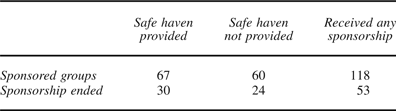
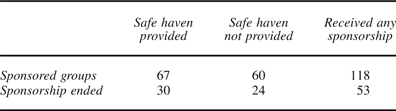
In order for a state to be coded as a sponsor in a given year, there must be evidence of official government support that is material or directly related to military operations. The kinds of support included are money, weapons, training, and intelligence. Note that this excludes less tangible things such as public statements of support and relatively weak forms of support such as allowing group members to travel within a country.Footnote 42 Thus, Iran is coded as a supporter of Hamas from 1988 to the present as there is extensive evidence that Iran's government provided considerable financial and military support.Footnote 43 In contrast, Saudi Arabia is not coded as a sponsor of Hamas, despite the fact that several intelligence reports suggest that at least 40 percent of Hamas's annual budget flows from Saudi sources.Footnote 44 The key difference is that the Iranian government explicitly provides support, while the Saudi government does not. The Saudi government has been accused of passively sponsoring terrorism because it does not take steps to halt the flow of money to Hamas from within its borders.Footnote 45 However, I do not code so-called passive support of terrorism as state sponsorship. Out of the 648 groups in the data, 118 experienced sponsorship and 60 experienced sponsorship with no safe haven at some point.Footnote 46
To assess H2a and H2b, I code the sponsorship—safe haven variable, which indicates whether the sponsor provides the group with safe haven in a given year. Safe haven is defined as a base of operations outside of the target state that meets at least one of the following conditions: (1) sustained military operations such as training or attacks are carried out from within the country, or (2) significant members of a group's leadership are permanently based there in a given year. I focus on these two conditions for three main reasons. First, bases that are essential to the maintenance of the group's membership and military operations are likely sufficient to support the continued existence of the group if it loses another base. Thus, the logic that leads to H2a should hold when the sponsor provides a base for essential group operations. Second, bases that are not directly related to a group's military operations are unlikely to be the focus of target attacks. Consequently, if there is no threat of damage from target elimination attempts, a sponsor has no incentives to provide information. Thus, the logic that leads to H2b will also possibly hold when a sponsor provides a base directly related to military planning and/or operations. Third, it is relatively easy to obtain reliable information across groups on whether a group carries out sustained military operations or has its leadership housed in a country. Although it would be interesting to obtain information on other types of organizational footprints such as fundraising offices, it is difficult to consistently find reliable information on this. Furthermore, it is also relatively difficult to identify whether the state in question explicitly supports such activities.Footnote 47
A few examples are helpful to clarify what constitutes a safe haven. Hamas is coded as having a safe haven in Syria from 1991 to 2006 given that a significant portion of the group's leadership is based in Damascus. Additionally, the Kurdistan Workers Party (PKK) is coded as having a safe haven in Syria from 1980 to 1998 since their leader, Abdullah Ocalan, was provided safe haven throughout that period.Footnote 48 In contrast, Hamas is not coded as having a safe haven in Qatar or Yemen, despite extensive evidence that the group has offices in those countries.Footnote 49 The offices are primarily related to fundraising operations and the group's leadership is not permanently based in either country. Thus, neither of these countries is considered a safe haven that Hamas could relocate to or rely on in the event it lost another base (that is, in Syria). Out of 118 groups that experienced state sponsorship, 67 relied on a sponsor for safe haven at some point.
One potential concern is that reliance on a state sponsor for a safe haven is a proxy for group strength. Thus, if I find support for H2b, it could be an artifact of the set of groups who rely on sponsors for safe haven being inherently weak. I combat this potential endogeneity issue in three ways. First, as a measure of observed strength I include the number of attacks that are attributed to each group in each year (that is, 1970–2006) in the Global Terrorism Database.Footnote 50 Number of attacks is a reasonable measure of strength, as it makes sense that stronger groups are better able to carry out more attacks.Footnote 51 Second, I code a variable that indicates the number of safe havens that a group has. The number of safe havens variable is a reasonable measure of group strength as stronger and more durable groups are likely to enjoy more safe havens. Third, the estimation of grouped duration models ensures that any additional information about the strength or health of a group that is positively correlated with how long a group has survived is systematically accounted for. Thus, given that a group that has survived for ten or fifteen years is likely stronger than a group that is one or two years old, the empirical model explicitly takes this into account.
Finally, I also assess the influence of the retraction of state sponsorship. Accordingly, I code whether or not a group has lost sponsorship. A group is coded as having lost sponsorship in a given year if it experienced sponsorship in any prior year but not in that year. I distinguish between cases in which a group is dropped by a sponsor that provides it with safe haven (that is, sponsorship ended—safe haven) and those in which the sponsor does not (that is, sponsorship dropped—no safe haven). This ensures that the effects of sponsorship—no safe haven and sponsorship—safe haven are interpreted relative to the case in which no sponsorship was ever received.Footnote 52
Patterns in state sponsorship
I also measure whether the target takes military actions within the sponsor in a given year. I utilize the militarized interstate dispute (MID) dyadic data provided by Maoz to assess whether or not there is a militarized interaction initiated by the target against the sponsor.Footnote 53 Military action is taken by the target if the MID hostility level indicates that actual military force is used, as opposed to threats or displays of force.Footnote 54 Additionally, the target must be the originator of the dispute.
Numerous scholars emphasize how the nature of groups' goals affect their relative success or failure.Footnote 55 I measure group goals with information on each group's primary goal collected by Jones and Libicki.Footnote 56 The variable regime change describes groups that primarily seek to overthrow the government of the target state. Groups with the primary goal of territorial change seek a territorial concession from the target state. The goal of policy change applies to groups who seek a change in the official policy of the target state. Groups that primarily seek social revolution want to overthrow the existing target state regime and social order. The goal of empire is ascribed to groups that seek territorial change on a transnational basis. An example of empire as a goal is al Qaeda's desire to reinstate the caliphate at the expense of numerous states. Finally, some groups primarily work to maintain the current status quo within the target state.
The political orientation of groups is measured with data collected by Jones and Libicki.Footnote 57 Groups with nationalistic orientation (for example, the FLN in Algeria) pursue nationalist goals and appeal to elements of nationality in their recruitment. Groups motivated by a religious ideology (for example, al Qaeda, Hamas) seek goals that are motivated by religious doctrine or interpretation. left-wing groups tend to have relatively radical goals such as regime change or social revolution and are motivated by left-wing political ideology such as Marxism-Leninism. On the other hand, right-wing groups are motivated by right-wing political ideology and in many cases seek maintenance of the status quo. In many cases right-wing groups such as the Contras in Nicaragua emerge to battle left-wing groups such as the Sandinistas.
The fate of terrorist groups should also be affected by key characteristics of the target state it is in conflict with. For instance, it has been widely asserted that democratic states are more constrained in dealing with terrorist threats.Footnote 58 I measure whether a target is a democracy with the target democracy variable. A state is coded as a democracy if it has a Polity IV score of at least 7. The target civil war variable accounts for whether the target is involved in a civil war or not.Footnote 59 I also control for the wealth of the target state with the per capita gross domestic product in thousands of 2000 U.S. dollars, which is a reasonable measure of state capacity.Footnote 60
Results: The Duration of Terror
I analyze the fate of terrorist groups with grouped duration models that account for temporal dependence with a cubic polynomial of duration.Footnote 61 In the competing risks model each group is assumed to have a latent probability of failure as a result of internal dissolution and a latent probability of failure as a result of successful target counterterrorism efforts each year it remains in existence. There are several potential methods to estimate a competing risks model. A simple approach is to estimate a separate logit model for each type of failure and assume that all other modes of failure are randomly censored. This approach is analogous to and will yield very similar results to the standard Cox proportional hazards approach to the estimation of competing risks. A more efficient approach is to estimate a multinomial logit model with a flexible function of time in the specification, which is the approach taken here.Footnote 62
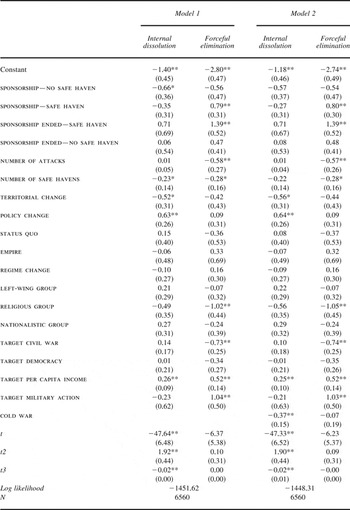
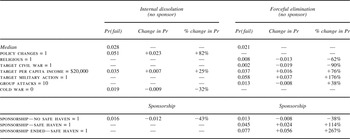
The results of two different competing risks models are presented in Table 2. The only difference between the two models is that Model 1 (that is, columns 1 and 2) does not include a cold war dummy variable, while Model 2 (that is, columns 3 and 4) does. For each of the two models, the column labeled “Internal dissolution” shows the effect each variable has on the probability of failure by internal dissolution, while the column labeled “Forceful elimination” shows the results for failure as a result of police or military action. Throughout the results section, I refer to the substantive effects of the statistically significant variables shown in Table 3. The table is based on Model 2 and shows the effect of each statistically significant variable relative to the case when all other variables are held at their median. The first row shows the predicted probability of failure as a result of internal dissolution and forceful elimination when all variables are held at their median or modal values.Footnote 63 Each subsequent row shows the substantive effect of changing a statistically significant variable on the two latent probabilities of failure. For example, the second row illustrates the effect of changing the policy change variable from 0 to 1. The first column of the second row shows the probability of internal dissolution for a group seeking a change in policy, 0.051. The second and third columns show the change in probability from the median case, +0.023, and the percentage change in probability from the median case, +82 percent.
The duration of terror

Notes: Standard errors clustered by group in parentheses.
** p < .05;
* p < .10.
Substantive efforts in competing risks models

Note: Pr = probability.
The results for internal dissolution and forceful elimination in both models illustrate important differences in how sponsorship patterns affect the two modes of failure. The existence of a sponsor that does not provide safe haven in a given year significantly decreases the probability of internal dissolution in Model 1 at the 10 percent level, which provides some support for H1. However, if one includes a variable that indicates whether it is the cold war period (that is, before 1992), the sponsorship no safe haven variable loses statistical significance, while the cold war variable is negative and significant. This suggests that the support for H1 in Model 1 is driven by sponsorship patterns during the cold war. Several states provided support to a number of groups during the cold war and also rarely provided safe haven. Most prominent among cold-war-era sponsors that rarely provide safe haven are Libya, Cuba, the U.S.S.R., China, and the United States. Almost all of these states had greatly cut back on the support they lent to groups by 1991. Furthermore, support in most cases was ideologically motivated, with Cuba, the U.S.S.R., and China generally supporting leftist groups (for example, Cuba's support for Chile's Movement of the Revolutionary Left), the U.S. support for anticommunist groups like the Contras in Nicaragua, and Libya supporting a surprisingly wide range of revolutionary groups such as the Irish Republican Army and the Pattani Liberation Organization.Footnote 64 The effect of this aid on groups' abilities to avoid internal dissolution is not significant if one estimates a “cold war effect.”Footnote 65
In contrast to the results for sponsorship without safe haven, sponsorship with a safe haven does not significantly decrease the probability of failure by internal dissolution in either model, although the sign is in the expected direction. Furthermore, I do not find support for H3 as sponsorship without safe haven does not significantly affect the probability of target elimination, although the coefficient is in the expected direction. This suggests that sponsorship with no safe haven is primarily helpful to groups in maintaining their organization and retaining their membership and is less helpful in avoiding target elimination.
The results provide considerable evidence that receiving sponsorship with safe haven is not helpful to a group's prospects. The coefficients for sponsorship—safe haven are positive and significant at the 5 percent level in both models, which provides considerable support for H2b. In contrast, H2a does not find support, which indicates that, on average, the downside for groups of relying on a sponsor for safe haven outweigh the positives of having this important resource. The results in Table 3 indicate that when a group relies upon its sponsor for safe haven the probability of target elimination is 114 percent greater than if the group does not (and has never had) sponsorship.Footnote 66 The hazard plot in Figure 1 demonstrates this relationship for a group that received sponsorship with safe haven for twelve years. This implies that having a sponsor that provides safe haven entails more risk than being without a sponsor. At first glance, this result seems to be at odds with the findings of the civil war literature that civil conflicts with transnational groups last longer.Footnote 67 However, the results in Table 2 apply to groups that receive active sponsorship and safe haven from an outside state, not any groups that enjoy a safe haven. A foreign base can be provided willingly, that is, by a sponsor, or can be provided in large part because the state is too weak to prevent it.Footnote 68 The negative and significant effect that the number of safe havens has on the probability of forceful elimination suggests that groups benefit from safe haven in states that are not sponsors.
Sponsorship and the probability of group failure: Competing risks

The significant and positive coefficients for sponsorship ended—safe haven indicates that the retraction of sponsorship from a state that provides safe haven further increases the probability of forceful elimination. In fact, if a group loses sponsorship from a state that provides safe haven it is 267 percent more likely to fail than if it had never received sponsorship and 71 percent more likely to fail relative to when it received sponsorship. Figure 1 shows this relationship for a group that loses sponsorship with safe haven after twelve years. In contrast, the insignificance of sponsorship ended—no safe haven on both modes of failure indicates that the retraction of sponsorship that does not involve safe haven does not matter.
Groups with policy change as their primary goal are significantly more susceptible to internal dissolution, while the same is not true for forceful elimination.Footnote 69 Changes in policy are generally less concrete than goals like territorial change and less ambitious than goals like empire or social revolution. Thus, it is relatively easy for group members to disagree over exactly what kinds of change are acceptable and to be satiated by a policy concession. Groups whose political orientation is religious are significantly less likely to fall victim to target state forces.Footnote 70 Thus, groups that are a part of the more recent “religious wave” of terrorismFootnote 71 have proven to be relatively difficult for states to eliminate with force. Observers such as Richardson have noted the power of religion as a motivating ideology. However, no existing work empirically demonstrates that religious groups present greater difficulty for target states.Footnote 72
Target states that take military action in sponsors are significantly more likely to eliminate a group. However, target military action against a group's sponsor does not have a significant effect on the internal cohesion of the group. The finding that target initiation of a MID against the sponsor increases the risk the group is eliminated by 176 percent suggests that target states enjoy some measure of success in putting pressure on sponsored groups.Footnote 73 Conversely, target states that are embroiled in civil wars are 90 percent less likely to forcefully eliminate a group. For example, India is embroiled in numerous conflicts with rebel groups throughout its country in addition to its conflict with Kashmiri groups. Fighting groups in the provinces of Assam, Tripura, and Nagaland in addition to groups in Jammu and Kashmir puts considerable strain on Indian security forces. Finally, groups that carry out more attacks and groups that enjoy more safe havens are significantly less likely to be eliminated. These results suggest that both the number of attacks a group carries out in a given year and the number of safe havens it enjoys are reasonable measures of group strength.
The only statistically significant variable that the two modes of failure have in common is target state per capita income. Groups are more likely to fail for internal reasons and to be forcefully eliminated by wealthier target states. This is consistent with the findings that civil wars are more likely to end in government victory as gross domestic product (GDP) per capita increases and that conditions are more ripe for the emergence of groups in poor countries.Footnote 74
Figure 1 shows further evidence of the substantive effects of the sponsorship—safe haven and the sponsorship ended—safe haven variables in the context of the hazard of group failure (that is, the probability a group fails as a function of how long it has existed). The solid gray line depicts the probability a group with no sponsor fails for internal reasons, while the three black lines depict the probability a group is forcefully eliminated under three alternative scenarios. The solid black line shows the case in which a group does not experience sponsorship for its entire life. The dotted black line depicts the case in which a group experiences sponsorship but does not rely on the sponsor for a safe haven. Finally, the dashed black line illustrates the case in which a group is dropped by a sponsor that provided safe haven for twelve years.
Figure 1 demonstrates that the shape of the hazard is strikingly different across the two modes of failure. The effect of group age is much stronger for internal dissolution. The probability a group fails for internal reasons is relatively high when a group initially emerges but falls quickly after a group survives for several years. In particular, if a group survives for eight to ten years, the probability it fails is much lower for several decades with a slight increase if the group survives for more than thirty years (which is uncommon in the data). Groups are at relatively high risk of failure for internal reasons when they are relatively “young” (that is, have existed for less than six years), while groups that have existed for around a decade become relatively immune to this risk.
The black lines in Figure 1 demonstrate that the probability a group is forcefully eliminated decreases at a considerably slower rate relative to the probability of internal dissolution as groups age. The hazard is decreasing, but the difference in probability between a new group and one that has existed for ten years is not as great as it is for the probability of internal dissolution. Thus, there is not strong evidence of an “age threshold” after which a group becomes relatively secure from forceful elimination.
Conclusion
Much ink has been spilled and hours of broadcast time have been spent to discuss the problem of states sponsoring terrorist groups. This discussion is typically framed in terms of how sponsorship improves the fortunes of a group, which in turn makes eliminating a group more difficult. The presumption has largely been that sponsorship is a major problem for target states because it makes enemy groups all that much more able to survive and continue to inflict pain. However, no study has systematically explored what factors affect whether groups fail internally or are forcefully eliminated, let alone how state sponsorship influences their fate. I argue that state sponsorship can negatively affect the fate of groups.
The preceding analysis implies that sponsorship may not be as serious of a problem for target governments as many policymakers have presumed. In fact, sponsorship does not seem to significantly help groups to avoid forceful elimination. Groups who rely on their sponsor for a safe haven are more likely to be eliminated. Moreover, groups who receive sponsorship without safe haven are not significantly more likely to avoid forceful elimination and groups that rely on their sponsor for a safe haven are not significantly less likely to fail for internal reasons. Thus, sponsorship is by no means always a good thing for groups (and a bad thing for target states). Comparison of the results to key findings in the literature on foreign bases and civil war also suggests that sponsorship is less of a problem for targets of violent groups than the problem of failed states. Salehyan shows that when rebel groups in civil conflicts have foreign bases, whether provided by a sponsor or not, the conflicts are of significantly longer duration.Footnote 75 The cases in which a group has a foreign base provided by a sponsor demonstrates that this set of cases is not so problematic. This point is further bolstered by the finding that safe haven not provided by a sponsor lowers the risk of forceful elimination. This set of findings suggests that active state sponsorship is less the problem than weak or failing states hosting groups. In sum, from a target state's perspective it is better to have an active sponsor with some degree of power over a group relative to a weak host that cannot do much about a group.
Several policy implications for target states follow from the analysis. The results of the competing risks model nicely highlight how group failure via internal dissolution and failure as a result of successful target counterterrorism actions are quite distinct processes. The hazard plots in Figure 1 imply that the forceful elimination of groups becomes increasingly relevant as groups age. Although internal dissolution occurs much more frequently, it becomes relatively unlikely after a group survives for about ten years which implies that there is an “age threshold” beyond which groups are likely to avoid internal dissolution. Additionally, target states in conflict with a group that is at least eight to ten years old should pay close attention to sponsorship patterns. The results show that groups who depend upon a sponsor for safe haven are on average more vulnerable. Thus, if a target state faces a relatively old group that receives safe haven from a sponsor the elimination of this safe haven is a reasonable strategy. For example, Turkey's successful effort to remove Abdullah Ocalan and the PKK from Syria is an example in which elimination of an important safe haven proved damaging to a relatively mature group.