From Conciliation to Impositions
Historically the parliamentary conciliation committees have been an important part of Turkey's constitutional amendment processes. Such committees have successfully brought together all the parties represented in the parliament to discuss and negotiate amendments. What distinguishes the 2017 constitutional amendments process is the detrimental absence of such committees and their contribution from all represented parties. The Nationalist Movement Party (Milliyetçi Hareket Partisi, or MHP), a conservative Turkish nationalist party, was the only participant in the conciliation process. The MHP's contribution was limited and focused only on changing the title of “president” to “the head of state” and eliminating the idea of selecting alternate MPs.
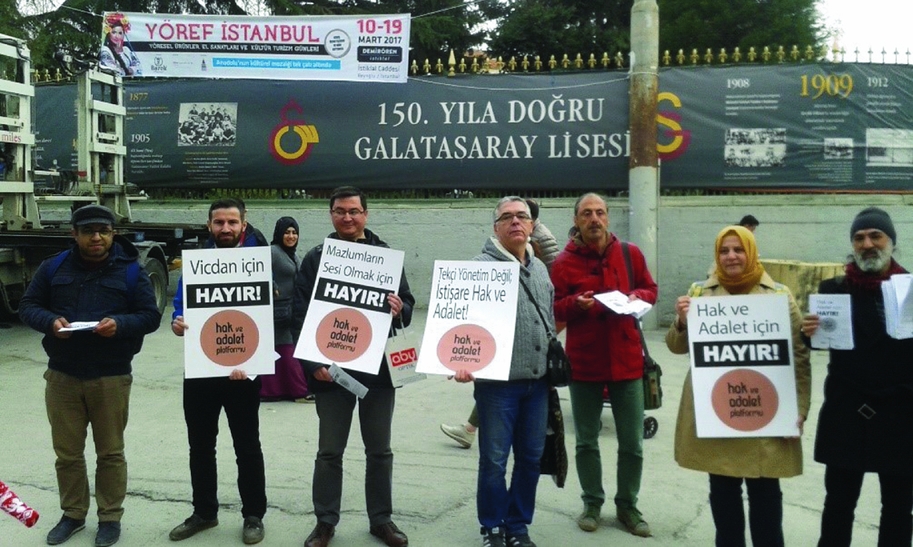
Likewise, despite limitations, public participation and public scrutiny played a pivotal role in previous constitutional amendments [Figure 1]. Especially important was the limitation on the live broadcasting of national assembly meetings, a process controlled by the Parliament (Meclis) TV and the state television. Eighteen constitutional items were accepted under the conditions of a “State of Emergency,” which was declared after the failed coup attempt in June 2016. As of the writing of this article, 20 January 2017, a total of thirty-one emergency decrees had been issued since the declaration of emergency.Footnote 1 Although decrees are meant to restore public order and contain challenges to the state, the spectrum of decrees has been puzzling as they have covered a wide range of issues from the regulation of winter tires and the appointment of university presidents to the transformation of districts to municipal districts. The scope and number of decrees raise the questions of whether and how they serve to address crucial emergency concerns.
A “NO” protest by the Law and Justice Platform in Istanbul (2017).

Any assessment of the 2017 referendum requires a review of the conditions of the media and civil society groups during the deliberation or campaign period and the ability of different groups to highlight the pros and cons of the proposed amendment package. Even a quick review indicated that the 2017 referendum took place in an environment in which many TV or radio channels were constrained and in some cases discontinued, their activities suspended under executive order in the power of law (or Emergency Decree Law, EDL). The State of Emergency restrictions on civil society groups and media created not only restrictions but also discriminatory practices in several ways. For instance, 190 media outlets (including publishing houses, newspapers and magazines, news agencies, TV stations, and radios) were closed.Footnote 2 While the Supreme Election Board (SEB) secures the fairness of elections by allowing proportional time to different parties’ views, EDL placed private channels, which constitute 85 percent of Turkey's media, beyond SEB's review thereby allowing the ruling government an unprecedented amount of media and campaign time. The Venice Commission noted the significance of this issue in the following way:
EDL no. 687 of 9 February 2017 has removed the power of the Supreme Election Council to sanction private radio and television channels which make one-sided, biased broadcasts during election and referendum campaigns. This change, which does not have any genuine link with the state of emergency as such and instead has a clear relationship with the constitutional referendum campaign, has entered into force despite the spirit, if not the letter, of Article 67 of the Turkish Constitution, which provides that “the amendments made in the electoral laws shall not be applied to the elections to be held within the year from when the amendments go into force.”Footnote 3
A review of EDLs shows that they collectively created an environment in which an open discussion of the eighteen items was constricted because 1,250 civil society associations, 125 foundations and twenty-five unions were closed down, muting or excluding a variety of views.Footnote 4 While security threats from some groups could be justified, among those civil society institutions that were closed were women's associations like the Mus Women's Roof association which had been collaborating with the Ministry of Education. Given the effective mobilization and contribution of various civil society groups (especially women's groups) to public debate, their absence or silence was noticeable during the referendum debates.
The most recent and most controversial Emergency Decree Law (EDL 696) expands on a previous one adopted in October 2016 (EDL 687) and grants civilians the right to act to protect public interest without any criminal liability. While the EDL was first perceived as a retrospective attempt to protect civilian resistance against the failed coup, its vague language also makes it prospective. The protection of the reckless action of citizens in the name of protecting public interest is seen as an amnesty for ruling party supporters’ actions, prompting reaction from the former President and the founder of the ruling AK Parti, Abdullah Gül. Dismissal of Gül's nuanced critique of the EDL by the party indicates how room for any type of opposition in Turkey has been increasingly curtailed.
Another article of the same EDL (696) requires all those on trial for terrorism-related crimes to attend court wearing the same orange uniform. This EDL has been especially scrutinized due to the ruling government's critique of similar practices in Guantanamo and the treatment of those who are on trial as criminals before a final verdict. Also important to note is that the idea of a uniform for terrorism-related crimes was also proposed after the military coup in 1980 and rejected by the Council of State in 1987. Such a practice eliminates the accused's right to use the provincial high court and court of appeal and thus raises concerns about the backsliding of Turkey's democracy.
Although a State of Emergency is not a new experience for Turkey, what distinguishes the recent one from others is the unprecedented role of the constitutional court. For the first time in Turkey's history the constitutional court declined to review the executive order concerning the power of law, placing all such orders in an unprecedented para-judicial area.Footnote 5 For the court, the state of emergency decrees were exceptional in nature and fell beyond its purview. The lack of any judicial review, along with the lack of legislative review, currently creates a “state of exception” where there is unchecked legislative power vested in the executive branch.
< tex − math/ > The recent referendum can be seen as a missed historical opportunity to adopt a civilian, consensus-based constitution in Turkey. There was consensus on the need to reform the 1982 constitution due to its illiberal nature and the fact that it was the product of the 1980 coup d’état. In fact, the AK Parti took the lead in formulating the changes to the 1982 constitution adopted after the coup by including large segments of society. What is striking is that the current adopted amendments and decrees contradict the AK Parti's long-term commitment had once achieved broad coalitions of democratizing forces. The current amendments unmade the party's accumulated accomplishments and efforts towards liberalizing the constitution; instead it exacerbated a range of restrictions that the party had once sought to dismantle. For instance, one of the successful struggles of the AK Parti was to remove political bans and prevent arbitrary political party closures. Nevertheless, the current decrees have violated some basic political rights such as the protection of parliamentarian immunity (exemplifying a risky pattern of para-constitutionalism).
Emergency decree 694 exemplifies an overall pattern. The immunity of elected parliamentarians who had impending indictments was removed in May 2016 with a temporary amendment to the constitution. Despite the careful consideration of the contingent and temporary nature of the 2016 constitutional change, EDL 694 was adapted without any scrutiny in August 2017. This new decree charges the Ankara public prosecutor to investigate any elected parliamentarian. Thus the EDL not only undermines the universal practice of immunity of all elected parliamentarians but also shows that decrees do not follow the overall spirit of the constitution. Only a few months ago it was necessary for parliament to introduce some contingent and temporary constitutional changes regarding immunities, a proposal supported by the opposition to avoid a divisive referendum. Attesting to the deterioration of conditions, many fundamental changes to Turkey's governance are now made with decrees, without any accountability or the need for parliamentary or public support.
In order to understand why such drastic constitutional amendments were endorsed by a majority in the referendum vote, even though it was a very slim majority, it is important to recognize how the amendments were securitized. While the eighteen amendments to the constitution institutionalize centralization of legislative and executive power, the referendum and the approval of the changes was framed as an anti-terrorism package and those who were critical of the amendments were delegitimized as terrorists. Although declarations of the opponents of the amendments as “terrorists” were denounced by the AK Parti, such descriptions successfully captured the essence of the proposed changes for some. Such a framing undermined the HDP's (Halkların Demokratik Partisi/Peoples’ Democracy Party) efforts to launch a comprehensive and active referendum campaign and the formation of a strong anti-amendment coalition with the fear of consolidating the AK Parti's securitization of the issues.
Withering Judiciary?
One of the important aspects of the 2017 referendum has been the reconfiguration of the board of public prosecutors and judges. Under the current system, the president appoints only four of the total of twenty-two members of the High Council of Judges and Prosecutors, the backbone of the judicial system controlling the appointment of new judges and prosecutors as well as overseeing personal decisions and promotions. The revised system (Article 14, amending Article 159) reduced the members to thirteen, granting the president power to appoint four members and the parliament to appoint the remaining seven. The Council includes the minister of justice and the minister's deputy; given that the president selects the ministers de facto, six members of the Council are directly appointed by the president. Likewise, the adopted changes have reduced the members of the Constitutional Court from seventeen to fifteen (Article 16/D, amending Article 146/1), twelve are appointed by the president and three by parliament. Overall the changes indicate that extensive power has been granted to the presidency; if the parliament is controlled by the president's party, the judiciary is, in effect, under the control of the president, thus further undermining the system of checks and balances. After the referendum, three items were enforced immediately: the non-partisan status of president was changed, the president reclaimed party membership and chairman status, and judges and prosecutors were appointed. Such changes indicate that the referendum immediately changed Turkey's regime well before the 2019 elections, the current practice is a harbinger of what's to come in two years.
In a historical decision on 11 January 2018, the Constitutional Court reversed the arrest decisions of a few who were tied to the recent failed coup, suggesting that the Court will review individual decisions taken under the state of emergency. Yet, the lower courts refused to accept these decisions. Such defiance of the lower courts against the highest court indicates Turkey's judicial system's fragmentation and thus its (in)ability to address the existing deadlock under the country's state of emergency.
From Questions about Existence to Existential Questions: Framing of the Referendum?
One of the successes of the AK Parti has been its ability to open Turkey's limited public sphere to different groups. In its early years (2002–7) the party's commitment to expand Turkey's democratic, religious, and ethnic rights formed a beneficial pact among these distinct groups. The expansion of the public sphere meant inclusion of more identities and resolution of divisive issues such as the removal of the ban on the use of Kurdish or headscarf in public positions. Yet the party's liberalizing policies and alignment with different groups has gradually eroded. Perhaps one of the most drastic changes was the party's distancing itself from Kurdish groups after a briefly successful attempt to solve the Kurdish problem.
In its current form the AK Parti lost the critical support of two crucial groups—the Kurds and liberals from different orientations—and formed a new alliance with the Turkish nationalist conservative party, MHP. In 2010, the AK Parti launched a Kurdish opening process to address the country's prolonged Kurdish question. Despite the initial success of the opening, it gradually changed to a more conservative and non-conciliatory approach. The 2013 Gezi protests, one of the largest urban protests in the country, distanced the party from the country's liberals and led to the further erosion of relations with Kurdish liberals who had pioneered the opening initiative. Thus, since 2013 the AK Parti has witnessed a significant realignment by leaving its coalition with liberals, Islamist-liberals, and Kurds to align with conservatives and nationalists. The 2017 referendum, which happened in the aftermath of the failed coup attempt by a religious network, framed the issues as a threat to the party's and the state's existence. While the party traditionally distinguished state from people, it has gradually conflated state, people, and party. The success of framing the 2017 referendum as a response to an urgent security threat emerged from a narrative that focused on an existential threat. The amendments and decrees were treated as the necessary outcome of the need to protect the state and the party from those who conspired to overtake them; such an explanation resonated with many. Despite the broad scope of the changes for the party, the 2017 referendum was a simple answer to an existential crisis—the threat to the party's existence and the necessity to ensure its survival and longevity against foreign forces. The magnitude of the threat, for many, required a favorable review of the amendment proposals. “Yes” (to the changes) was framed as a fight for Turkey's “gains” and against the existential threat while an attempt to say “No” was regarded as support lent to terrorists and as an assault on the state and its people. Given the central role of the state and nationalism and the primacy of their survival, Turkey's conservative nationalists consolidated their ideational and legislative coalition with the AK Parti.
Next?
The AK Parti was established to reform Turkey's political sphere, perceived as marginalizing its many identities, and to reconcile the authoritarian state with its alienated people. One of the most praised achievements of the AK Parti has been the institutionalization of the “unity of its people with the state” by addressing issues that had once alienated the practicing Muslim majority with prohibitions such as the headscarf ban. The party successfully addressed the grievances that were attributed to the dominance of western, ultra-secular, mainstream policies. However, the increasing use of conservative terms and symbols elevates “Sunni-religious citizens” to the position of model citizens, creating new fractures between the state and the people and among citizens. Relying on the conservative-right block, which traditionally consists of 65 percent of the electorate, the AK Parti finds it politically expedient to mobilize the conservative majority as its critical electoral base. Yet such a political approach secures electoral victories while widening the distance between various groups. This is captured in popular media as the fear of further “attacks on women with shorts” or those with a “different life style.” One can argue that AK Parti's historical failure to mobilize its base and secure a majority in the June 2015 election surprised the leadership and forced it to avoid such a future electoral “failure.” The presidential system can be seen as the ultimate electoral solution to declining support for the party and its dependence on garnering the support of the conservative majority.
Although the referendum result can be seen as a great success due to the AK Parti's ability to increase the relatively low support, 35 percent, for the idea of “presidency” to 51 percent, it also showed that 65 percent (conservative) support is not easily garnered. The continuing reference to the amendments with the old official name “President of Republic” instead of its new official name “Head of State” indicates that supporters are still not fully comfortable with and committed to the idea of a new style of presidency. The results also show that the simplistic description of Turkey's political sphere as consisting of 65 percent (conservative right) vs. 35 percent (oppositional left) cannot be taken for granted. In fact, one of the most important messages of the referendum results is that a significant potential for a new equilibrium exists.
The eighteen amendments to the constitution and reorganization of the political sphere with dominant presidential powers and limited parliamentary supervision pose the question of the possibility that some democratic accomplishments will be undone. The recent forced resignation of mayors emphasizes the reversal of the AK Parti's exaltation of elected offices over appointed ones. The party hitherto relied on elections to represent people; removal of elected mayors indicates the end of the party's adherence to electoral democracy as well as the former importance of decentralization of power and the parliamentary system's check on the executive power. Heralding the potential changes in post-2019 Turkey, the forced resignations did not create reactions but, in fact, were supported by many AK Parti members. The lack of intraparty opposition to such decisions raises questions about the AK Parti's commitment to the prevalence of elected positions over others.
While lack of democracy limits the much-needed scrutiny of the AK Parti's policies, the dominance of a hard-core Kemalist constituency and the delegate system (the power of local representative leaders) limits the capacity of the main opposition party, i.e., the Republican People's Party (Cumhuriyet Halk Partisi, or CHP) to introduce changes to its policies so as to attract the support of groups alienated by the AK Parti. While Turkey's politics necessitate reorganization, the CHP faces the challenge of being responsive to its rank and file and addressing the AK Parti's political attacks that formulate the party as the remnant of inefficient and exclusionary secularist republics.
< tex − math/ > Conclusions
As the storms of change sweep Turkey, they have unsettled established patterns of governance, causing deep political divisions in groups that once appeared intact. In Turkey's overly simplified political map, the main opposition party (CHP) is seen as an articulator of a strict state ideology that brings to the fore secularist ethnic homogeneous identities alienating those with Kurdish and Islamic identities. The AK Parti is viewed as a democratic force and protector of peoples with religious sensibilities while its regime is under continuous attack. Born in an environment defined by such a political map and related views, the AK Parti's legislative and judicial interventions (e.g., the relaxation of language limitations or removal of the headscarf ban) were seen as crucial steps towards opening up the public space to once suppressed identities. Therefore, the AK Parti's reforms in Turkey's politics seemed to amount to a sea-change given its ability to undo well-entrenched historical political positions and the overall map of oppositional identities.
The 2017 referendum and the party's reduction of all political problems to an existential threat granted it a victory to change the constitution, yet it once again limited and closed the public sphere to the plurality of views and identities. Ironically, despite its initial accomplishments the party seems to be turning the clock back and rebuilding a state that alienates its own people. Given the power grab through eighteen constitutional amendments, the 2019 presidential elections will be decisive in determining Turkey's future. One of the main challenges facing Turkey right now is to create a new mode of politics and a new form of political competition that is not based on and trapped by identity politics (secular vs. Muslim or Kurd vs. Turk). A political sphere organized around identities does not allow people to deliberate and negotiate deeply unsettling undemocratic processes and compels them instead to support certain positions and parties due to their identity claims.
Now the challenge facing the main oppositional party, the Republican People's Party (CHP), and others is to gain the support of a broad coalition of people, including those with Kurdish and Islamic sensibilities on the issues of common concerns like freedom and justice. Yet it is not easy to reframe politics and expand support while the CHP faces a range of challenges from media and its internal organization. While the mainstream media marginalizes the coverage and the role of CHP, the CHP supportive media uses a conflict-based language failing to recruit a new audience and support for the party. Although the CHP has a relatively high level of intraparty democracy, the delegate-based internal processes prevent the party leader from making policy adjustments and adopting policies to attract Kurdish and liberal groups without alienating its rank and file.Footnote 6 Thus, although the 2019 elections require a new political discourse that does not reinforce well-entrenched fault-lines (e.g., pro-Islamist vs. secular Kemalist, Kurdish vs. Turkish nationalists), the CHP's internal organization and external marginalization have undermined the party's ability to launch a broad-based coalition.
While the CHP's ideological puritanism and responsive rank and file limit the leadership, ironically the AK Parti suffers from a different problem. The lack of internal democracy makes the introduction of policies and new positions very easy for the party. Likewise, the AK Parti's rank and file readily accept the president's positions, therefore making any bottom-up change very unlikely. The AK Parti further strengthened its internal control through the firing of elected mayors upon the request of the central government. In over four years the AK Parti's supporters have moved from a pro-Kurdish peace opening position to an anti-Kurdish one. The malleable rank and file expand the power of the AK Parti while the extensive power given to the delegates deprives the CHP leadership from making tactical opportunistic decisions.
Given that the AK Parti expands its power when issues are introduced as identity-based (pro or anti-secular), it is not surprising that Turkey has recently witnessed a debate on whether müftis (jurisconsults acting within the parameters of Islamic law) can officiate a marriage. Such issues and questions are imposed from above by AK Parti leadership and serve to define Turkish politics as a battleground of feuding identities between Islamic and secular groups. While such issues consolidate a polarizing narrative, many women's groups’ nuanced language falls through the cracks. Even though granting müftis the right to lead and officiate marriages was introduced, there had been no demand for such a change. Such tactical top-down introduction of issues organizes politics along religious and anti-religious lines, thereby boosting the AK Parti's appeal and expanding support for its policies. Such politically expedient discussions include officials and public places such as müftis and mosques which have not traditionally been involved in marriage ceremonies, thereby eliminating areas that can serve to unite people.
The upcoming 2019 elections emphasize the crucial need for political reorganization and re-imagination in Turkey by recognizing the urgency of moving to a postidentity era where common concerns such as transparency and accountability, freedom, the balance of power, protection of the parliamentary system, and justice prevail. Such principle-based reorganization promises to bring to the fore the willingness of different groups to invigorate the fundamentals of a democratically inclusive system and can reshuffle identity-based political lines and define new political groups and fault-lines. The emergence of a brand new party that captured the deeply rooted opposition within the MHP and the right wing parties, the İYİ, or Good Party, under the leadership of popular female leader Meral Akşener represents an optimistic development toward creating a new political platform that transcends identity-based divisive language. Although such formations appear rather promising, a decisive shift to salvage Turkey's democratic governance and move beyond identity politics with a liberalizing democratic agenda requires the efforts and commitment of many groups.