





Impact statement
Mental health conditions are among the leading causes of disability worldwide, yet millions of people in low- and middle-income countries remain unable to access care because of a severe shortage of trained mental health professionals. This study demonstrates a practical and sustainable solution by integrating evidence-based mental health training into the education of future health workers before they enter the workforce. Through the implementation of a 10-module online Mental Health Gap Action Program Intervention Guide training program across multiple health professional disciplines and universities in Ethiopia, the study shows how countries can strengthen their mental health workforce at scale using existing educational systems. The findings have important implications for improving access to mental health services in settings where specialist resources are limited. By equipping graduating doctors, nurses, midwives and other frontline health professionals with essential mental health competencies, this approach has the potential to expand early identification, treatment and referral of people with mental health conditions, ultimately reducing the large treatment gap that exists across sub-Saharan Africa and other resource-constrained regions. Beyond Ethiopia, the study provides a scalable model for governments, universities and health systems seeking cost-effective strategies for the development of a sustainable pipeline of competent, confident and adaptable healthcare professionals who are prepared to deliver integrated mental healthcare and integrate mental health into primary health care. The lessons generated on implementation, sustainability and institutionalization can inform national education and health policies and support global efforts to achieve more equitable access to mental health care. By strengthening the capacity of future health professionals, this work contributes to long-term improvements in population health, health system performance and progress toward universal health coverage.
Introduction
Globally, mental, neurological and substance use (MNS) disorders impose a significant burden on individuals and health systems, leading to disability and diminished quality of life. In many low- and middle-income countries, access to suitable care is severely limited, leaving most people unsupported (Whiteford et al., Reference Whiteford, Ferrari and Degenhardt2016; WHO, 2024).
Recognizing this persistent treatment gap, the World Health Organization (WHO) launched the Mental Health Gap Action Programme (mhGAP) in 2008 as a global call to action. The initiative aims to help countries scale up care for priority MNS conditions, especially through their integration into primary health care (WHO, 2008). Central to this effort is the mhGAP Intervention Guide (mhGAP-IG), an evidence-based clinical tool designed to support nonspecialist health workers in the assessment, management and follow-up of priority MNS disorders in routine primary care settings (WHO, 2016a). Moreover, a standardized competency-based mhGAP-IG training package has been developed to build the competencies of nonspecialists and to support the application of the intervention guide (WHO, 2020).
While mhGAP-IG has been widely implemented through in-service training, WHO has also recently recommended its integration into pre-service education as a potentially cost-effective and sustainable complementary strategy (WHO, 2020; Iversen et al., Reference Iversen, Ogallo, Belfer, Fung, Hoven, Carswell and Skokauskas2021). Pre-service integration aims to systematically strengthen mental health education within nonspecialist health profession programs. This will ensure that future health workers acquire a minimum set of mhGAP-aligned competencies before entering service, and reduce reliance on basic remedial in-service training (Keynejad et al., Reference Keynejad, Spagnolo and Thornicroft2021).
In Ethiopia, the need for more systematic pre-service mental health training is particularly acute. The country faces a severe shortage of mental health specialists, with fewer than one psychiatrist per 100,000 people (WHO, 2024), and a large proportion of individuals with mental disorders receive no formal care (Hanlon, Reference Hanlon2017). Since approximately 2014, Ethiopia has adopted mhGAP-IG primarily through in-service training for health officers, nurses and general practitioners to strengthen primary health care services (WHO, 2016a). Although these initiatives have expanded access to care in some settings, evaluations have documented persistent challenges, including limited funding, incomplete coverage of nonspecialist providers, inconsistent implementation and difficulties sustaining post-training supervision (Keynejad et al., Reference Keynejad, Dua, Barbui and Thornicroft2018; Hanlon et al., Reference Hanlon, Alem, Lund, Hailemariam, Assefa, Giorgis and Chisholm2019).
At the same time, evidence indicates that many Ethiopian health graduates enter the workforce without sufficient practical competencies in mental health care. This is partly attributed to pre-service curricula for nonspecialist health professionals being overly theoretical and focused on advanced conditions, with limited emphasis on skills relevant to primary care practice (Fekadu and Thornicroft, Reference Fekadu and Thornicroft2014). Documented gaps include recognizing and assessing common MNS conditions, applying structured clinical decision-making for assessment and referral, and communicating effectively with patients and families in ways that reduce stigma (Girma et al., Reference Girma, Ketema, Mulatu, Kohrt, Wahid, Heim, Gronholm, Hanlon and Thornicroft2022; Chereka et al., Reference Chereka, Walle, Kassie, Shibabaw, Butta, Demsash, Hunde, Dubale, Bekana, Kitil, Emanu and Tadesse2024). Similar competency gaps have been reported across LMICs, underscoring the broader relevance of these challenges (Keynejad et al., Reference Keynejad, Dua, Barbui and Thornicroft2018).
Globally, several institutions have piloted the integration of mhGAP-IG into pre-service curricula, typically within single medical or nursing programs and through a combination of classroom teaching (Chaulagain et al., Reference Chaulagain, Pacione, Abdulmalik, Hughes, Oksana, Chumak, Mendoza, Avetisyan, Ghazaryan, Gasparyan, Chkonia, Servili, Chowdhury, Pinchuk, Belfar, Guerrero, Panteleeva and Skokauskas2020; WHO, 2020; Iversen et al., Reference Iversen, Ogallo, Belfer, Fung, Hoven, Carswell and Skokauskas2021). However, these efforts have largely remained small-scale and institution-specific, limiting their potential for broader impact, sustainability and policy uptake (Iversen et al., Reference Iversen, Ogallo, Belfer, Fung, Hoven, Carswell and Skokauskas2021). As a result, practical lessons on how to implement mhGAP-IG systematically across institutions and disciplines spanning both training and supervision remain limited.
This study developed, implemented and evaluated an mhGAP-IG-based digital training and supervision model integrated into pre-service education across four Ethiopian universities, with the aim of strengthening mental health competencies among nonspecialist health professional students.
Methodology
Study design and settings
A pre–post mixed-methods design was employed. The course was delivered at four public universities in Ethiopia, including Arbaminch, Arsi, Jimma and Wolkite Universities.
Study population
The project targeted undergraduate health professional students across four programs in Medicine, Nursing, Midwifery and Public Health.
Sample size and sampling techniques
Four public universities delivering medical and health science training were randomly selected, ensuring geographical distribution. The sample size was calculated using a paired mean difference formula for pre–post comparisons, assuming a 95% confidence level, 80% power, a moderate effect size and a 15% attrition rate. The minimum required sample size was estimated at ~100 participants per institution. Given the multi-university implementation design, 519 eligible students enrolled in the training across four public universities were included to enhance statistical power and support implementation evaluation. Ultimately, 494 students successfully completed the course and were included for knowledge evaluation, while 214 data points were complete and included for attitude evaluation (Figure 1).
Flow diagram showing selection of enrolled students.

Figure 1. Long description
The flowchart organizes data into five main vertical columns.
* Far Left: A single blue box labeled Four Universities, Total n = 494.
* Second Column: Arba Minch University n = 78. Beneath it are four sub-boxes: Medicine n = 23, P H n = 17, Nursing n = 18, and Midwifery n = 20.
* Third Column: Arsi University n = 112. Beneath it are four sub-boxes: Medicine n = 29, P H n = 42, Nursing n = 18, and Midwifery n = 23.
* Fourth Column: Jimma University n = 202. Beneath it are four sub-boxes: Medicine n = 118, P H n = 32, Nursing n = 35, and Midwifery n = 22.
* Fifth Column: Wolkite University n = 97. Beneath it are four sub-boxes: Medicine n = 46, P H n = 0, Nursing n = 35, and Midwifery n = 16.
Each university header is connected to its departmental sub-boxes by a vertical line with horizontal branches.
Eligible criteria
Students were eligible to participate if they had successfully completed selected clinical courses and associated clinical practice components that enabled them to develop foundational clinical competencies, including history taking, physical examination and interpretation of basic clinical laboratory investigations. Participants were also required to be enrolled in the academic year level and semester in which they would normally undertake the curriculum-specified psychiatry or mental health module and to have completed all prerequisite courses required for enrollment in that module. Accordingly, the target population included Year IV nursing and midwifery students, public health students and Year V medical students who had completed the required foundational clinical training. Students with incomplete baseline or post-training assessment data were excluded for analysis purposes.
Implementation approach
The project was structured around three core pillars: (1) design and development of mhGAP-based digital training modules, (2) pilot implementation and evaluation, and (3) integration of mhGAP into pre-service education curricula.
Digital module development
A 10-module online mhGAP-based training was developed and hosted on the universities’ Learning Management Systems (LMS) (Table 1). The development process followed a structured curriculum design approach which involved:
-
i. Document review and curriculum mapping: Existing curricula and key national and global documents were reviewed to identify gaps and opportunities for integration (Ababa Reference Ababa2021; Organization, 2016a, 2017).
-
ii. Stakeholder consultations: Meetings with key stakeholders informed module design and integration strategies.
-
iii. Content development and validation: A multidisciplinary team consisting of psychiatrists, instructional designers, curriculum experts and e-learning and ICT professionals participated in the course syllabus, training module and online course content development and design process.
mhGAP-IG-based online psychiatry course contents, teaching and assessment strategies

Table 1. Long description
The table consists of four columns: Modules, Module contents, Teaching strategies, and Assessment strategies.
* Module 1: Introduction to psychiatry and psychopathology. Teaching includes online, case study, and video methods. Assessment via quiz and end of chapter test.
* Module 2: Essential care, practice, and communication skills. Teaching includes online and video simulation. Assessment via quiz and end of chapter test.
* Module 3: Mood disorders including depressive, bipolar, and postpartum disorders. Teaching includes online interactive learning and clinical attachment. Assessment via quiz, end-of-course written exam, and progressive assessment.
* Module 4: Psychosis including schizophrenia spectrum. Teaching and assessment same as Module 3.
* Module 5: Epilepsy. Teaching and assessment same as Module 3.
* Module 6: Child and adolescent mental and behavioral disorders. Teaching includes online, bedside, case presentation, and video. Assessment via quiz, case presentation, portfolio, and bedside exam O S C E.
* Module 7: Disorders due to substance use. Teaching and assessment same as Module 6.
* Module 8: Psychiatric emergencies. Teaching and assessment same as Module 3.
* Module 9: Dementia and Delirium. Teaching and assessment same as Module 3.
* Module 10: Other significant mental health complaints including anxiety and minor psychiatric disorders. Teaching and assessment same as Module 3.
Pilot implementation and evaluation
The course was piloted among enrolled students. Training effectiveness was evaluated based on changes in knowledge, attitudes and skills from baseline to post-training and trainees’ reactions. Accordingly, a total of 494 students completed both pre- and post-training knowledge assessments and were included in the knowledge analysis. For the attitudes assessment, 214 students completed both assessments and were included in the analysis; exclusions were mainly due to incomplete assessments or unmatched identifying information. For the skills assessment, the required sample size was calculated assuming a medium-to-large effect size (d = 0.65), a two-sided alpha of 0.05 and 80% power, yielding 22 participants, who were randomly selected from eligible students.
The online training was delivered over a 3-week period, with a total expected learning time of 24 h. Students were expected to complete the modules and associated learning activities within the 3-week training period. Students were provided with airtime/data compensation to cover the cost of internet connectivity required to access the training platform and complete the learning activities. The training was delivered through a self-paced Learning Management System (LMS), with all assessments integrated into the platform. Participants completed baseline assessments before commencing the training modules and were required to complete all 10 modules before becoming eligible for the post-training assessment. Because the program was self-paced, the interval between the pretest and posttest varied among participants and depended on the time each student required to complete the training.
For the attitude analysis, only participants with complete paired responses to both the pre-test and post-test attitude questionnaires were included. Participants with incomplete attitude questionnaires, or those who completed the posttest without a corresponding pretest were excluded from the paired analysis. This resulted in 214 participants with complete paired attitude data available for analysis. Therefore, the final attitude sample exceeded the minimum required sample size and was considered adequately powered for the planned analyses.
Data collection tools and procedures
Knowledge: Student knowledge was measured using multiple-choice questions adapted from the WHO mhGAP-IG training guideline. These items were administered as pre- and post-training tests. Internal consistency of the knowledge test demonstrated acceptable reliability (WHO, 2017).
Attitudes: Attitudes toward mental illness were assessed using the Mental Illness Clinicians’ Attitudes Scale (MICA-2), which is a validated tool for assessing stigmatizing attitudes in medical students. MICA-2 uses a 6-point Likert scale (16 items) with a total score ranging from 16 to 96. A higher total score indicates more negative or stigmatizing attitudes, while a lower score indicates more positive attitudes. Attitudes of students were evaluated both before and after the training (Gabbidon et al., Reference Gabbidon, Clement, van Nieuwenhuizen, Kassam, Brohan, Norman and Thornicroft2013).
Rater training and calibration – Foundational skills: Clinical competency was assessed using the World Health Organization (WHO) Enhancing Assessment of Common Therapeutic Factors (ENACT) tool, a standardized instrument designed to evaluate basic helping skills and core mental health competencies. The ENACT rubric uses a four-level scoring system with explicit behavioral descriptors: Level 1 indicates unhelpful or potentially harmful behaviors; Level 2 indicates absence or partial demonstration of basic helping skills; Level 3 indicates demonstration of all required basic helping skills; and Level 4 indicates demonstration of all basic helping skills together with advanced helping competencies (Kohrt et al., Reference Kohrt, Ramaiya, Rai, Bhardwaj and Jordans2015).
Four senior psychiatrists served as competency assessors. Before data collection, all raters received orientation and training on the ENACT tool, including its competency domains, scoring criteria and standardized behavioral descriptors, to ensure a common understanding of the assessment framework and consistent application of the scoring rubric.
Competency assessments were conducted using simulated patient scenarios based on depression, mania and psychosis cases that were adapted to the Ethiopian context. Psychiatry residents served as simulated patients. Each participant completed one observed clinical encounter and was assessed by only one trained psychiatrist. The four raters independently evaluated different participants, and no participant was scored by more than one rater. Consequently, there were no overlapping ratings that would permit formal estimation of inter-rater reliability before or during the study. This study design should be considered when interpreting variability across raters.
The ENACT skill assessment was administered at two time points. The pre-test assessment was conducted 1 week before participants commenced the online training, providing a baseline measure of their skills. Participants then completed the online training, which comprised 24 h of training delivered through the online platform. The post-test ENACT assessment was conducted immediately after each participant had fully completed the training, allowing assessment of changes in observed skills following the intervention.
Qualitative data: Four focus group discussions (FGDs) were conducted, one at each participating university. Each FGD comprised 12 participants purposively selected from students who completed the online training modules, ensuring representation across academic programs and sex. The FGD guide, refined with expert input, explored perceptions of the training content, relevance, acceptability, assessment methods, challenges and strengths. All discussions were audio-recorded, translated and transcribed for analysis.
In addition, students provided feedback through a Likert-scale survey assessing satisfaction, perceived learning value and overall training experiences, alongside open-ended questions designed to capture implementation challenges and practical insights.
Evaluation of training outcomes
The primary success criterion of this pilot was improvement in participants’ mental health knowledge, attitudes and foundational clinical competencies following completion of the online competency-based training. Educational effectiveness was evaluated by comparing pre- and post-training scores on the knowledge assessment, the Mental Illness Clinicians’ Attitudes Scale (MICA-2) and the Enhancing Assessment of Common Therapeutic Factors (ENACT) tool. This pilot was designed to assess the feasibility and effectiveness of the educational intervention and was not intended to establish clinical mastery or certify readiness for independent mental health practice. As this was a pilot implementation study, feasibility outcomes included participant recruitment, enrolment, training completion and retention throughout the program. Efficacy outcomes included changes in knowledge, attitudes toward people with mental illness and clinical competency measured before and after completion of the online training.
Data analysis
Quantitative data were analyzed using descriptive statistics and paired-samples t-tests to compare pre- and post-training knowledge, attitude and skill scores. Effect sizes (Cohen’s d) were calculated to estimate the magnitude of change in the metrics. Reliability analyses (Cronbach’s alpha) were conducted to assess the internal consistency of the assessment tools.
Qualitative data from open-ended feedback were analyzed using thematic analysis. Responses were coded iteratively to identify key themes related to student learning experiences, engagement and barriers. The analysis was refined through comparison across datasets to ensure consistency and identify patterns in student feedback. Furthermore, an audio-recorded focus group discussion was transcribed verbatim. Thematic analysis was conducted using ATLAS Ti. The qualitative analysis was guided by Braun and Clarke’s thematic analysis approach (Braun and Clarke, Reference Braun and Clarke2006). Initially, the transcripts were repeatedly read for familiarization with the data. Open coding was performed for identification of specific texts and codes, which were subsequently grouped based on similarities of the idea. Emerging categories were then grouped into themes to reflect participants’ perceptions. The findings of the qualitative analysis were triangulated with the quantitative data analysis results.
Ethical considerations
An ethical clearance letter was obtained from Jimma University Institutional Review Board (IRB) with Ref. No: JUIH/IRB/415/2026. The project adhered to ethical standards by ensuring voluntary participation in all evaluation components, obtaining informed consent and anonymizing data collection. Clinical skills assessments used simulated patients, rather than real patients, to standardize the learning conditions and mitigate any risks to service users.
Results
Participant characteristics
A total of 519 eligible undergraduate healthcare students from four Ethiopian public universities enrolled in the self-paced online mental health training. Of these, 494 (95.2%) students completed all 10 training modules and both pre- and post-training knowledge assessments (Figure 2).
Flow diagram of participant recruitment, retention and analysis.

Figure 2. Long description
The flowchart begins at the top with a single box: Eligible and enrolled n = 519.
A vertical line leads to a horizontal split representing two concurrent actions: Pre-training assessment completed Knowledge and Attitude and Commenced online self-paced training.
These paths converge at a central box: Completed all 10 modules n = 494, Retention = 95.2 percent.
Below this, the flow splits into two distinct vertical columns for analysis:
Left Column - Knowledge assessment:
- Completed paired pre- and post-test n = 494.
- Included in knowledge analysis n = 494.
Right Column - Attitude assessment:
- Screened for complete paired data n = 494.
- Excluded from paired analysis n = 280. Reasons listed are: Incomplete pre- or post-test and Post-test completed without corresponding pre-test.
- Included in attitude analysis n = 214.
Study participants were selected from four programs – medicine, nursing, midwifery and public health – across four Ethiopian public universities and successfully completed the course (Table 2).
Characteristics of student participants (n = 494)

Table 2. Long description
The table is structured with six columns. The first four columns represent the Pretest (Knowledge and attitude) with a sample size n equals 494. The final two columns represent the Post-test attitude with a sample size n equals 214. The columns are labeled Variable, Category, Frequency (n), and Percentage (%).
* Sex:
- Male: Pretest frequency 288 (58%), Post-test frequency 123 (57.5%).
- Female: Pretest frequency 206 (42%), Post-test frequency 91 (42.5%).
* Institution:
- Jimma University: Pretest frequency 207 (42%), Post-test frequency 95 (44.7%).
- Arsi University: Pretest frequency 112 (23%), Post-test frequency 42 (19.6%).
- Wolkite University: Pretest frequency 97 (20%), Post-test frequency 47 (22.0%).
- Arba Minch University: Pretest frequency 78 (16%), Post-test frequency 30 (14.0%).
* Programs:
- Medicine: Pretest frequency 216 (44%), Post-test frequency 99 (46.3%).
- Nursing: Pretest frequency 106 (22%), Post-test frequency 47 (22.0%).
- Public Health Officer: Pretest frequency 91 (18%), Post-test frequency 43 (20.1%).
- Midwifery: Pretest frequency 81 (16%), Post-test frequency 25 (11.7%).
Baseline competency gaps and immediate training effects
A critical finding from the baseline evaluation revealed that ~38% (188/494) of students scored below 70% (70/100), with about 19% (94/494) scoring below 50% (50/100), indicating a lack of the required level of knowledge despite most students having already completed the mandated psychiatry courses in their curricula.
Post-training knowledge assessment showed a significant increase in students’ scores, with the pre-training mean of 72.20% (SD = 22.7) rising to 88.32% (SD = 20.3) post-training, representing an average improvement of 16.12 percentage points. The proportion of students achieving high proficiency scores (above 80%) more than doubled, increasing from 39.9% (85/214) at baseline to 82.38% (176/214) post-intervention. Additionally, the number of students scoring below 50% decreased from 18.68% (40/212) to 8.28% (18/212). These results indicate a robust positive impact on student knowledge (P < .001, Cohen’s d = 0.64).
Pre–post attitude assessment
Of the 494 participants who completed the pre-test assessment, 214 (43.3%) had complete paired pre- and post-training attitude data and were included in the attitude analysis, while 280 (56.7%) were excluded because complete paired attitude data were unavailable. A comparison of baseline characteristics between participants included and excluded from the attitude analysis showed no statistically significant differences in sex (p = 0.816), institution (p = 0.273) or academic program (p = 0.098) (Table 3).
Comparison of baseline characteristics between participants included and excluded from the attitude analysis

Table 3. Long description
The table consists of five columns: Variable, Category, Included in attitude analysis (n = 214), Excluded from attitude analysis (n = 280), and p-value.
- Sex: Male participants represent 123 (57.5 percent) of the included group and 165 (58.9 percent) of the excluded group. Female participants represent 91 (42.5 percent) of the included group and 115 (41.1 percent) of the excluded group. The p-value is 0.816.
- Institution: Jimma University has 95 (44.7 percent) included and 112 (40.0 percent) excluded. Arsi University has 42 (19.6 percent) included and 70 (25.0 percent) excluded. Wolkite University has 47 (22.0 percent) included and 50 (17.9 percent) excluded. Arba Minch University has 30 (14.0 percent) included and 48 (17.1 percent) excluded. The p-value is 0.273.
- Program: Medicine has 99 (46.3 percent) included and 117 (41.8 percent) excluded. Nursing has 47 (22.0 percent) included and 59 (21.1 percent) excluded. Public Health Officer has 43 (20.1 percent) included and 48 (17.1 percent) excluded. Midwifery has 25 (11.7 percent) included and 56 (20.0 percent) excluded. The p-value is 0.098.
All p-values are derived from Pearson’s chi-square tests.
* p-values are from Pearson’s chi-square tests comparing participants included in the attitude analysis with those excluded because complete paired attitude data were unavailable.
The pre-intervention attitude mean score was 44.38 (SD = 9.8); scores ranged from 24 to 75. Following the intervention, the post-intervention MICA-2 mean score was 41.91 (SD = 11.1); scores ranged from 16 to 68. The finding of the paired t-test demonstrated a significant improvement in attitude score following the course (Tables 2 and 4).
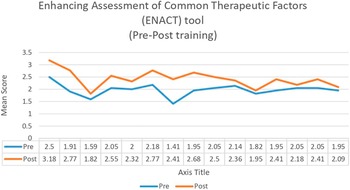
Likewise, clinical skills were evaluated by the ENACT tool at baseline and following the course. In the post-training clinical skills evaluation, students showed statistically significant gains, with the mean total ENACT score increasing from the pre-training 29.59 (SD = 3.00) to 36.40 (SD = 7.45) with a large effect size (Cohen’s d = 0.88). Participants demonstrated improvements across most of the communication and counseling skill domains following the training. Notable gains were observed in Nonverbal communication and active listening, such as Engages in other activities (e.g., answers door or mobile and completes paperwork); Negative facial expression, or other negative physical behavior/inappropriate distractions (e.g., turn off pop-ups, turn off phone notifications), where the mean score increased from 2.50 (SD = 0.74) at baseline to 3.18 (SD = 0.8) posttraining. Similarly, Verbal communication skills improved substantially from a pre-training mean of 1.91 (SD = 0.7) to 2.77 (SD = 0.9) (Tables 4 and 5).
Paired t-test result comparing the baseline and post-training mean score of the trainee

Table 4. Long description
The table consists of two main rows of data under a header row. The header row defines the columns as Pairs, Mean, S D, 95 percent C I, t-test (d f), Effect size, and asterisk P.
* Row 1: Knowledge (pre-post). Mean is 16.12. S D is 17.6. 95 percent C I is 13.85, 18.39. t-test (d f) is 13.95 (493). Effect size is 0.64. asterisk P is less than .001 asterisk.
* Row 2: Attitude (pre-post). Mean is minus 2.47. S D is 8.76. 95 percent C I is minus 3.65, minus 1.29. t-test (d f) is minus 4.12 (213). Effect size is 0.28. asterisk P is less than .001 asterisk.
Footnote: S D, standard deviation. C I, confidence interval. d f, degree of freedom. asterisk p: Significant at P less than 0.005.
SD, standard deviation; CI, confidence interval; df, degree of freedom; *p: Significant at P < 0.005.
The Distribution of Pre-post mean ENACT competancy score

Table 5. Long description
The table consists of three columns: Item, Pre-mean (S D), and Post-mean (S D). All items show an increase in mean score from pre-intervention to post-intervention.
* Non-verbal communication and active listening: Pre 2.50 (0.74), Post 3.18 (0.80).
* Verbal communication skills: Pre 1.91 (0.75), Post 2.77 (0.97).
* Explanation and promotion of confidentiality: Pre 1.59 (0.50), Post 1.82 (0.85).
* Rapport building and appropriate self-disclosure: Pre 2.05 (0.49), Post 2.55 (0.67).
* Exploration and normalization of client feelings: Pre 2.00 (0.44), Post 2.32 (0.89).
* Empathy, warmth and genuineness: Pre 2.18 (0.59), Post 2.77 (0.97).
* Assessment of harm and collaborative response planning: Pre 1.41 (0.67), Post 2.41 (0.80).
* Linking mental health to social functioning: Pre 1.95 (0.21), Post 2.68 (0.72).
* Exploration of client and social explanatory models: Pre 2.05 (0.38), Post 2.50 (0.67).
* Appropriate involvement of family or close persons: Pre 2.14 (0.35), Post 2.36 (0.79).
* Collaborative goal setting and expectations: Pre 1.82 (0.40), Post 1.95 (0.58).
* Promotion of realistic hope for change: Pre 1.95 (0.58), Post 2.41 (1.01).
* Use of coping mechanisms and prior solutions: Pre 2.05 (0.21), Post 2.18 (0.59).
* Psychoeducation using clear and local terminology: Pre 2.05 (0.38), Post 2.41 (0.67).
* Eliciting client feedback on advice and suggestions: Pre 1.95 (0.21), Post 2.09 (0.68).
Improvements were also observed in core therapeutic relationship skills, including Rapport building and appropriate self-disclosure such as Dominates session describing a personal experience, Minimizes client’s problems by describing how the helper has dealt with this, Asking unnecessary embarrassing personal questions, Discusses confidential information of other clients (2.05 [SD = 0.49] to 2.55 [SD = 0.7]) and Empathy, warmth and genuineness including Critical of client’s concerns, Dismissive of client’s concerns and Helper’s emotional response appears inappropriate, fake or acting (2.18 [SD = 0.6] to 2.77 [SD = 0.9]) (Figure 3).
Pre- and post-training clinical skills evaluation scores of students using the ENACT tool.

Figure 3. Long description
A line graph with a corresponding data table below it. The vertical Y axis is labeled Mean Score and ranges from 0 to 3.5 in increments of 0.5. The horizontal X axis is labeled Axis Title and contains 15 unnamed data points. Two lines are plotted: a blue line for Pre training and an orange line for Post training.
* The orange Post line remains consistently above the blue Pre line across all 15 points.
* Both lines show a similar fluctuating trend, with a significant dip at point 3 and point 7.
* Data values for Pre: 2.5, 1.91, 1.59, 2.05, 2, 2.18, 1.41, 1.95, 2.05, 2.14, 1.82, 1.95, 2.05, 2.05, 1.95.
* Data values for Post: 3.18, 2.77, 1.82, 2.55, 2.32, 2.77, 2.41, 2.68, 2.5, 2.36, 1.95, 2.41, 2.18, 2.41, 2.09.
* The largest gap between Pre and Post occurs at point 7, where Pre is 1.41 and Post is 2.41.
A paired-samples t-test was conducted to determine whether there was a statistically significant mean ENACT difference between pre-test competency scores (M = 29.59, SD = 3.00) and post-test competency scores (M = 36.40, SD = 7.45). The analysis revealed a statistically significant increase in competency scores, t (21) = 4.15, P < .001, mean difference = 6.81 points, with a large effect size of Cohen’s d = 0.88.
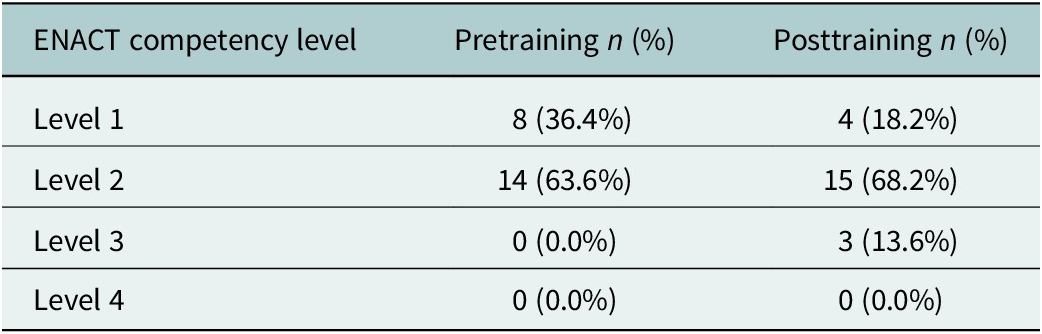
The distribution of ENACT competency levels demonstrated an overall improvement in participants’ observed competency following the training. Before training, 8 participants (36.4%) were classified at Level 1, while 14 (63.6%) were at Level 2; none of the participants achieved Level 3 or Level 4 competency. Following the training, the proportion of participants at Level 1 decreased to 4 (18.2%), whereas Level 2 increased slightly to 15 (68.2%) (Tables 5 and 6).
Distribution of participants by ENACT competency level before and after training

Table 6. Long description
The table consists of three columns: ENACT competency level, Pretraining n (%), and Posttraining n (%).
* Level 1: Decreased from 8 participants (36.4%) pretraining to 4 participants (18.2%) posttraining.
* Level 2: Increased from 14 participants (63.6%) pretraining to 15 participants (68.2%) posttraining.
* Level 3: Increased from 0 participants (0.0%) pretraining to 3 participants (13.6%) posttraining.
* Level 4: Remained at 0 participants (0.0%) for both pretraining and posttraining.
Student’s feedback survey
A total of 419 trainees completed the post-training evaluation, demonstrating high levels of acceptability and satisfaction with the course. The majority of participants agreed or strongly agreed that the learning objectives were clear (327/419, 78%), the course content was relevant (319/419, 76.1%) and the depth of content was appropriate (323/419, 77.1%). Approximately three-quarters also reported increased confidence in applying the knowledge gained (316/419, 75.4%) and rated the interactive elements (317/419, 75.6%) and quality of visual and audio materials (323/419, 77.1%) positively (Tables 6 and 7).
Descriptive statistics of feedback survey for participant reactions to the online training

Table 7. Long description
The table presents feedback from n = 494 participants. The scale ranges from 1 (strongly disagree) to 5 (strongly agree).
* Learning objectives clear: Strongly agree 47.0, Agree 31.0, Neutral 2.9, Disagree 8.1, Strongly disagree 11.0, Mean 3.95, S D 1.35.
* Course content relevant: Strongly agree 45.1, Agree 31.0, Neutral 6.2, Disagree 8.6, Strongly disagree 9.1, Mean 3.95, S D 1.29.
* Depth of content appropriate: Strongly agree 38.4, Agree 38.7, Neutral 6.7, Disagree 7.9, Strongly disagree 8.4, Mean 3.91, S D 1.23.
* Confidence in applying knowledge: Strongly agree 31.7, Agree 43.7, Neutral 10.3, Disagree 6.9, Strongly disagree 7.4, Mean 3.85, S D 1.16.
* Ease of navigating platform: Strongly agree 25.3, Agree 40.3, Neutral 15.3, Disagree 11.5, Strongly disagree 7.6, Mean 3.64, S D 1.19.
* Interactive elements engaging: Strongly agree 36.5, Agree 39.1, Neutral 9.1, Disagree 7.4, Strongly disagree 7.9, Mean 3.89, S D 1.21.
* Quality of visual/audio materials: Strongly agree 40.3, Agree 36.8, Neutral 7.6, Disagree 8.6, Strongly disagree 6.7, Mean 3.95, S D 1.19.
* Training duration appropriate: Strongly agree 24.6, Agree 42.0, Neutral 13.6, Disagree 11.7, Strongly disagree 8.1, Mean 3.63, S D 1.20.
* Overall satisfaction: Strongly agree 45.3, Agree 30.8, Neutral 9.8, Disagree 7.4, Strongly disagree 6.7, Mean 4.01, S D 1.21.
* Would recommend to peers: Strongly agree 49.9, Agree 28.9, Neutral 6.7, Disagree 7.4, Strongly disagree 7.2, Mean 4.07, S D 1.23.
Further, the overall reactions to the training were positive, with an overall mean reaction score of 3.89 (SD = 1.09 across the 10 evaluated items. The highest-rated items were overall satisfaction (M = 4.01) and likelihood of recommending the training (M = 4.07). The 10-item reaction scale demonstrated excellent internal consistency (Cronbach’s α = 0.97) (Figure 4).
Item-level distribution of student reactions to the EMPRESS online training program.

Figure 4. Long description
The chart displays the percentage of responses for ten items. The x-axis represents the percentage of responses from 0 to 100. The legend at the bottom defines three categories: Disagree (red), Neutral (light gray), and Agree (blue).
From top to bottom, the items and their approximate distributions are:
* Would recommend to peers: 20 percent Disagree, 8 percent Neutral, 72 percent Agree.
* Overall satisfaction: 19 percent Disagree, 10 percent Neutral, 71 percent Agree.
* Training duration appropriate: 25 percent Disagree, 13 percent Neutral, 62 percent Agree.
* Quality of visual/audio materials: 20 percent Disagree, 8 percent Neutral, 72 percent Agree.
* Interactive elements engaging: 20 percent Disagree, 10 percent Neutral, 70 percent Agree.
* Ease of navigating platform: 24 percent Disagree, 14 percent Neutral, 62 percent Agree.
* Confidence in applying knowledge: 19 percent Disagree, 11 percent Neutral, 70 percent Agree.
* Depth of content appropriate: 21 percent Disagree, 7 percent Neutral, 72 percent Agree.
* Course content relevant: 22 percent Disagree, 7 percent Neutral, 71 percent Agree.
* Learning objectives clear: 24 percent Disagree, 3 percent Neutral, 73 percent Agree.
Thematic findings from focus group discussions
The thematic analysis guided by the Consolidated Framework for Implementation Research (CFIR) identified seven key themes reflecting the acceptability and effectiveness of the mhGAP-IG-based online training.
Overall, participants reported that the course content was relevant and broadly aligned with their existing curricula and future professional responsibilities. Modules on psychosis, depression, epilepsy and psychiatric emergencies were frequently highlighted as useful components of the training. As one participant explained, “All of them are useful… especially psychiatry emergency, since there is no psychiatrist in every place.”
The training was reported to substantially enhance learners’ knowledge, correct misconceptions about mental illness, improve case identification and strengthen confidence in clinical decision-making and management. These perceived gains reflected a shift toward recognizing mental health care as a shared responsibility across health professions. One participant noted, “Before I enrolled in the course, I thought mental health had its own specialist; now I realized any health professional can help a patient with mental illness.”
Participants emphasized that the online format, supported by multimedia materials and structured content delivery, promoted engagement and readiness for mental health care practice, and was often considered more organized than traditional classroom teaching. While participants initially experienced challenges related to login procedures, platform navigation and internet connectivity, multimedia components – particularly interactive videos and real-life scenarios were widely appreciated for enhancing understanding and engagement. A participant reflected, “For understanding, this online is better… It’s better because there are interactive videos prepared in a real-life scenario.”
Learner engagement was facilitated by the interactive design of the course; however, participants identified limited peer-to-peer discussion and insufficient facilitator follow-up as constraints to deeper learning and sustained accountability. Several participants suggested that structured opportunities for case discussion and feedback could further strengthen learning outcomes. As one participant indicated, “Discussing case scenarios with peers could help us have a deeper understanding.”
The training was perceived as relevant across professional groups, including medicine, nursing and midwifery, supporting competencies in general clinical practice, patient support and maternal mental health care. Participants emphasized the practical value of the training for routine service delivery and recommended extending the duration of the course and incorporating additional hands-on or case-based sessions. One midwifery participant stated, “This training enables me to help pregnant mothers… to take history and manage based on it.”
Participants identified several implementation barriers and facilitators. Common barriers included time constraints related to competing academic demands and technical limitations affecting access to the platform. Key facilitators included the perceived relevance of the training content and the use of interactive learning methods. Participants recommended adopting a blended learning approach, extending the training duration, strengthening facilitator engagement and improving platform accessibility to enhance the overall effectiveness and sustainability of the program. As one participant noted, “We need enough time… it is difficult to focus when we have another exam tomorrow.”
Discussions
Implementation of a 10-module online training program based on the World Health Organization Mental Health Gap Action Programme Intervention Guide (mhGAP-IG) among undergraduate health professional students from four public universities in Ethiopia resulted in significant improvements in participants’ knowledge, attitudes and clinical skills in mental health care.
A critical finding from the baseline evaluation suggests important gaps in students’ mental health knowledge, with a substantial proportion scoring below acceptable competency levels despite prior exposure to psychiatry within their curricula. This highlights potential limitations in the depth, retention or practical orientation of conventional training approaches.
Following the intervention, there was a marked improvement in knowledge levels, with a substantial shift toward higher proficiency and a reduction in low-performing students. This pattern indicates that the mhGAP-IG-based training effectively reinforced and consolidated prior learning, translating into measurable cognitive gains. Overall, the findings suggest that structured, competency-based and contextually grounded training approaches such as mhGAP-IG can meaningfully enhance mental health knowledge among health professional students and help address persistent gaps in pre-service education.
The current finding is consistent with previous studies that evaluated the effect of mhGAP-IG training in pre-service settings in low- and middle-income countries (LMICs). Positive effects of mhGAP-IG training on mental health knowledge of primary health workers were reported by earlier studies (Organization, 2016a; Keynejad et al., Reference Keynejad, Spagnolo and Thornicroft2021; Adewuya et al., Reference Adewuya, Ola, Coker, Atilola, Olibamoyo, Oladipo and Ajomale2025). Similar to in-service training, improvements of undergraduate health science students’ knowledge about mental disorder assessment and management were documented following training in an integrated mhGAP-IG as a pre-service training (Chaulagain et al., Reference Chaulagain, Pacione, Abdulmalik, Hughes, Oksana, Chumak, Mendoza, Avetisyan, Ghazaryan, Gasparyan, Chkonia, Servili, Chowdhury, Pinchuk, Belfar, Guerrero, Panteleeva and Skokauskas2020). Similarly, the implementation of a continuing medical education course based on the mhGAP program reported positive findings of the training on mastering the represented knowledge parameters (Tkachenko, Reference Tkachenko2025).
The substantial improvement in knowledge observed may be accounted for by several factors. First, the mhGAP-IG was designed to provide real-world clinical scenarios using case-based learning (WHO, 2016a). This enhances the learners’ engagement and interaction (WHO, 2016b). Second, the integrated module allows learners to contextualize psychiatry knowledge, which helps in fostering stronger cognitive links. Third, the online training modality contributed to the improved outcomes by delivering relevant locally standardized content and enabling self-paced learning, which are attributed to improved educational outcomes (Means et al., Reference Means, Toyama, Murphy and Baki2013).
Similarly, the baseline attitude assessment showed a similar pattern, with a mean (SD) MICA-2 score of 44.38 (9.76), which is considered stigmatizing and has been associated with greater social distance and reduced willingness to adequately address the care needs of patients with mental disorders. Post-training attitude scores on the MICA-2 scale showed a modest but statistically significant decrease from a pre-training mean of 44.38 (SD = 9.8) to 41.91 (SD = 11.1) post-training (p < 0.001, Cohen’s d = 0.28). However, the mean score remaining in the 40s indicates the persistence of stigmatizing attitudes despite the observed improvements, suggesting that additional behavioral interventions are needed to reduce stigma more effectively.
Existing evidence suggests that training interventions can effectively decrease stigma toward mental illness. This recent finding suggested the positive influence of pre-service education in shaping the attitude of professionals toward people with mental illness. The findings from previous studies also supported the significant reduction of stigmatizing attitudes and improvement in willingness for care provision of mental illness following the mhGAP-IG trainings (Adewuya et al., Reference Adewuya, Ola, Coker, Atilola, Olibamoyo, Oladipo and Ajomale2025). The mhGAP-IG promotes a rights-based and person-centered care approach. This approach is preferred for reducing stigma and addressing misconceptions (WHO, 2016b). The participants’ improvement in mental health attitude may be explained by the competency content of the mhGAP-IG module. This module emphasized the importance of respectful communication, social inclusion and nonjudgmental care.
Importantly, the persistence of relatively elevated stigmatizing attitudes after training suggests that short-term didactic and skills-based exposure alone may be insufficient to meaningfully shift deeply embedded attitudinal and sociocultural determinants of stigma. This indicates that while mhGAP-IG training can initiate positive change, additional and sustained interventions are likely required to achieve more substantial attitudinal transformation. Contact-based learning and structured reflective practice, embedded within supervised clinical placements, should be considered essential complements to didactic mhGAP training if pre-service education is to deliver workforce-ready attitudes toward mental illness.
Likewise, the ENACT-based assessment of foundational clinical competencies indicated that, at baseline, participants’ ENACT scores were predominantly at Level 1 of the WHO ENACT competency framework. This level indicates that basic helping skills were generally not demonstrated consistently during the simulated clinical encounters and that some observed behaviors did not align with recommended therapeutic communication practices. Following completion of the training, most participants achieved Level 2, reflecting partial demonstration of basic helping skills and increased awareness of appropriate therapeutic behaviors, although important elements of these competencies were still applied inconsistently. These findings suggest that the training produced measurable improvements in foundational clinical competencies while highlighting the need for continued practice and supervised clinical experience to achieve proficiency at higher ENACT competency levels (Levels 3 and 4). While the training produced significant improvements in overall competency, participants demonstrated greater gains in foundational communication skills than in more complex therapeutic competencies. In particular, competencies requiring collaborative goal setting, exploration of psychosocial factors, assessment of risk and development of management plans remained comparatively lower after training.
ENACT performance was categorized into four competency levels: Level 1 = any unhelpful behavior; Level 2 = no basic skills, or some but not all basic skills; Level 3 = all basic skills; and Level 4 = all basic skills plus at least one advanced skill. Based on these predefined criteria, we considered Level 3 or above as the threshold for competent practice, because participants at Level 3 demonstrated all of the required basic skills. Level 4 represents a higher level of performance and was considered highly competent/advanced practice, as it requires demonstration of all basic skills together with at least one additional advanced skill.
Accordingly, although ENACT scores improved significantly following the training, the degree of improvement varied across individual competencies. Post-training mean scores ranged from 1.82 to 3.18 across the 15 ENACT items. The highest mean score was observed for Non-verbal communication and active listening (mean = 3.18), indicating consistent demonstration of the required basic helping skills for that competency. Most other competencies had mean scores between 2.09 and 2.77, corresponding to Level 2 of the ENACT framework, which reflects partial demonstration of basic helping skills and indicates that further practice is needed for consistent application in clinical encounters. The lowest mean scores were observed for Explanation and promotion of confidentiality (mean = 1.82) and Collaborative goal setting and expectations (mean = 1.95), suggesting that these competencies remained comparatively more difficult to acquire. These findings indicate that while the training substantially strengthened foundational helping skills, additional supervised practice may be required to achieve consistent competency across all ENACT domains.
These findings align with a growing body of evidence demonstrating that mhGAP-IG-guided training improves mental health competencies among nonspecialist providers across diverse settings. Studies conducted in countries such as Kenya (Bitta et al., Reference Bitta, Kariuki, Omar, Nasoro, Njeri, Kiambu, Ongeri and Newton2020), Malawi (Kokota et al., Reference Kokota, Lund, Ahrens, Breuer and Gilfillan2020) and Nigeria (Adewuya et al., Reference Adewuya, Ola, Coker, Atilola, Olibamoyo, Oladipo and Ajomale2025) have similarly reported improvements in clinical skills, diagnostic confidence and readiness to deliver mental health care following mhGAP-IG training. The positive effects observed in this study may be partly explained by the contextual adaptation of the mhGAP-IG to the local training context in Ethiopia, where the modules emphasized structured, evidence-based assessment and management approaches. The use of clear, algorithm-driven guidance that is practical and learner-friendly likely facilitated skill acquisition and supported the translation of knowledge into clinical practice, a conclusion further reinforced by qualitative findings highlighting the perceived relevance and applicability of the training content.
Furthermore, students’ overall reactions to the training were positive. Analysis of open-ended responses uncovered a nuanced interplay among content quality, learner engagement and platform functionality in student feedback. Participants consistently valued clear, practical and culturally relevant content, which fostered confidence and competence in mental health care. Interactive components, such as case studies and quizzes, further facilitated skill application and engagement. Nevertheless, these benefits were tempered by a number of technical and instructional design limitations, encompassing platform instability, delayed content and video loading, restricted mobile/offline access, unintuitive navigation, algorithm-related challenges, assessment scoring errors and overly dense or accelerated modules. Thus, although reactions and perceived impacts were largely positive, addressing these technical and instructional design issues remains essential to optimizing educational outcomes.
The improvements in knowledge, attitudes and clinical skills observed following the implementation of pre-service online training based on the WHO (mhGAP-IG) have important implications for health system strengthening in Ethiopia. In a context characterized by a critical shortage of mental health professionals, these findings provide strong empirical support for integrating standardized mental health competencies into pre-service education for nonspecialist health professionals as a scalable workforce development strategy. By equipping future healthcare providers with essential skills to identify, manage and appropriately refer mental health conditions, such training directly supports national efforts to integrate mental health into primary care and to maximize the use of limited specialist resources. This approach positions pre-service education as a strategic entry point for expanding the capacity and readiness of the health workforce to deliver basic mental health services.
These implications are particularly salient given the substantial burden of mental health disorders in Ethiopia, where a large proportion of the population remains untreated and access to specialized services is extremely limited. The potential effectiveness of the mhGAP-IG-based online training model highlights a feasible and cost-efficient pathway to narrowing the mental health treatment gap by strengthening workforce preparedness at scale. Moreover, the adoption of a digital training modality offers important advantages for sustainability and national scale-up in resource-constrained settings, enabling standardized, competency-based learning to reach geographically dispersed training institutions with relatively low additional cost. Institutionalizing technology-enabled mhGAP-IG training within routine pre-service curricula could therefore enhance service coverage, promote earlier detection and appropriate referral of mental health conditions and contribute to a more responsive, equitable and resilient mental health system.
Clinical and policy implications
These findings provide clear evidence that existing psychiatry curricula in undergraduate health programs are insufficient to prepare graduates for “task-sharing” roles in mental health. The baseline findings of knowledge, attitudes and skills assessments provide important though preliminary evidence for standardizing pre-service mental health education. Most student participants had already completed their formal, mandated psychiatry courses, yet 87.58% fell below the “basic proficiency” threshold (Level 3) on the ENACT clinical skills scale.
Crucially, many students scored below Level 2 at baseline, meaning they lacked mastery during patient interactions, such as failing to show empathy or ignoring significant distress. Furthermore, while the aggregate knowledge mean was 72.20%, nearly 19% of students failed to reach even a 50% score, and stigmatizing attitudes remained prevalent despite previous training. These deficiencies suggest that current pre-service training is overly theoretical and lacks the standardized, practical focus of the mhGAP framework. The lesson is clear: standardization is a systemic necessity to ensure every graduate meets a minimum competency floor before entering the workforce.
The project demonstrated that digital adoption of mhGAP is a potent vehicle for standardizing education in settings with a severe shortage of specialists. By deploying 10 modules on university Learning Management Systems (LMS), the partnership bypassed the bottleneck of limited faculty availability, training nearly 500 students in short time periods a scale that traditional in-person models could not achieve.
The project proved that integrating mhGAP into pre-service education is feasible, but it distinguished between “framework establishment” and “full institutionalization.” By aligning digital modules with the existing “didactic-clinical pathway,” the project defined a clear integration mechanism. However, the transition from a pilot to a permanent system feature remains dependent on formal curricula changes. Full institutionalization will require translating these “framework elements” into official curricula enhancements, where these mhGAP-based teachings are mandated under the curriculum of the health profession programs to ensure they outlast the project cycle.
Limitation of the study
This study has some limitations that should be considered when interpreting the findings. First, the use of voluntary participation and inclusion of students who completed both pre- and post-training assessments may have introduced selection bias, potentially limiting the generalizability of the results to all health professional students. Second, the evaluation relied on a relatively short follow-up period, which restricts conclusions about the sustainability of observed improvements in knowledge, attitudes and clinical skills over time. Third, the skills assessment component was conducted with a relatively small sample, which may have reduced statistical power and limited the precision of estimates regarding clinical competency gains. Inter-rater reliability is another limitation of this study. Although raters received standardized training and guidance on the use of the ENACT assessment, no formal pre-study inter-rater reliability assessment was conducted, and there were no overlapping ratings of the same participants by multiple raters. Consequently, formal estimation of inter-rater reliability, such as the intraclass correlation coefficient (ICC), was not possible. Future studies should incorporate formal pre-study rater calibration using standardized practice videos and include overlapping ratings during data collection to permit quantitative estimation of inter-rater reliability. Furthermore, while the training demonstrated immediate improvements in simulated or structured learning environments, the study did not assess the long-term transfer of training effects into routine clinical practice. Future research should incorporate larger samples, longer follow-up periods and workplace-based assessments to better understand the durability and real-world impact of mhGAP-based training on clinical performance and patient outcomes. Fifth, the absence of a concurrent control group limits causal inference; observed gains may partly reflect repeated testing or maturation effects, and a randomized or quasi-experimental design would strengthen future evaluations. Sixth, the post-hoc decision to exclude one rater on grounds of systematic scoring bias, though statistically defensible, was not pre-specified and may have introduced analytical bias into the clinical skills estimates. Finally, participant satisfaction data were collected through self-report surveys, which are susceptible to social desirability bias, and no formal cost-effectiveness analysis was undertaken, limiting conclusions about the resource implications of scaling this model across LMIC health systems.
Conclusions
The mhGAP-IG–based online course improved students’ mental health knowledge, strengthened foundational clinical skills and reduced stigmatizing attitudes, demonstrating its effectiveness as a feasible and scalable strategy for building mental health capacity among nonspecialist health professionals. These findings underscore the value of integrating standardized, competency-based training aligned with the WHO mhGAP-IG into routine pre-service education in Ethiopia. Scaling up the institutionalization of mhGAP-based online training across health profession curricula is therefore recommended as a practical policy and educational response to persistent workforce shortages and the growing demand for accessible, quality mental health services.
Open peer review
To view the open peer review materials for this article, please visit http://doi.org/10.1017/gmh.2026.10309.
Acknowledgments
The authors are grateful to the UK Department of Health and Social Care (DHSC), Global Health Partnerships (GHPs), partner institutions (University of Warwick, Jimma, Arsi, Arba Mich and Wolkite Universities), the study participants and Project team members.
Author contribution
The authors made the following contributions. Conceptualization: E.M., B.G.A., S.G.W. and S.P.S. Funding acquisition: E.M. and S.P.S. Study design: E.M. and S.P.S. Methodology: B.G.A. Course design: S.G.W. Course content development: E.T. and B.A. Investigation: E.M. Formal analysis: E.M. Data curation and quality assurance: B.G.A. and J.A.F. Project administration: E.A. Supervision: E.M., B.G.A., J.A.F., E.T., B.A. and S.P.S. Monitoring and evaluation: M.T. and D.M. Writing – original draft preparation: E.M. Writing – review and editing: B.G.A., S.G.W., J.A.F., E.A., J.S., D.M. and S.P.S. Final interpretation of the findings: E.M., B.G.A. and S.P.S.
Competing interests
The authors declare none.
Data availability statement
The authors confirm that the data supporting the findings of this study are available within the article.
Ethics and approvals
The Jimma University Institutional Review Board (IRB) approved this study. Informed consent was obtained from study participants.
Funding statement
The project is funded by the UK Department of Health and Social Care (DHSC) through Global Health Partnerships (GHPs) Global Health Workforce Program Phase 2 with project code GHWP 2-LG 03.






 Open access

