Many children with CHD can safely participate in all sports and recreational activities without the need for restrictions;Reference Takken, Giardini and Reybrouck 1 however, exercise training has been shown to be an underused resource in paediatric healthcare.Reference Pieles, Horn and Williams 2 In addition, several studies have found a significant and worrying mismatch between the medical opinion of the cardiologist and the perception of patients and their parents.Reference Falk, Bar-Mar and Zigel 3 – Reference Moola, McCrindle and Longmuir 5 A study conducted in the United Kingdom found that 30% of parents and their children overestimated the level of exercise they could safely participate in, with 6.7% of the overestimated exercise cases considered as potentially dangerous participation.Reference Kendall, Parsons and Sloper 4 As a result of no clear and specific advice, many cardiac patients (44%) incorrectly assumed that all exercises are safe.Reference Swan and Hills 6 Although patients who overestimate their capabilities are to be cautioned against, for fear of the exercise doing more harm than good, equally important are the many patients who overestimate the extent of their exercise restrictions, with 12% needlessly avoiding participation;Reference Kendall, Parsons and Sloper 4 however, it is also likely that uncertainty about which physical activities are appropriate will also cause anxiety, both in patients and in their parents/carers. Such anxiety may represent a significant barrier to leading a physically active lifestyle.Reference Longmuir and McCrindle 7
It is worth noting that the terms physical activity, exercise, and sport are often used synonymously in the literature. In this study, we categorised “physical activity” to include any activity that is a part of daily life that results in an increase in heart rate and energy expenditure above resting values. “Exercise” is a form of physical activity that is structured and performed with the aim of improving strength, flexibility, or aerobic endurance. We focussed our attention on the provision of “exercise” advice in this study, because of most school-based activities being classified as such an activity.
The American Heart Association has published a scientific statement on the promotion of physical activity for those with CHD, highlighting the need for the proactive promotion of an active lifestyle by health professionals.Reference Longmuir, Brothers and deFerranti 8 In addition, the “Recommendations for physical activity, recreational sport and exercise training in paediatric patients with congenital heart disease”Reference Takken, Giardini and Reybrouck 1 , emphasised that clinicians should provide patients, parents, and primary-care providers with recommendations in writing. Indeed, written instructions have been found to be more effective than verbal communication alone.Reference Swinburn, Walter and Arroll 9 Other authors have highlighted the importance of providing adolescents with individualised written advice, enabling them to participate in the management of their own health.Reference Swan and Hills 6 , Reference Caplan and Allen 10 A randomised controlled trial showed written advice to be more successful in motivating people to exercise than verbal advice alone.Reference Swinburn, Walter and Arroll 11
To the best of the authors’ knowledge, no other recent studies have examined the provision of paediatric exercise advice given by cardiac healthcare professionals in the United Kingdom. The long-term goal was to obtain information that could then be used to identify areas for improvement, as well as new activity programmes, including written advice and guidelines for use by clinicians and their support teams. Therefore, the aim of this study was to clarify the current level of advice and provision related to physical activity, which is provided nationwide to CHD patients and their families at the time of consultation.
Methods
Paediatric cardiac consultants in the United Kingdom were identified from the National Institute for Cardiovascular Outcomes Research website and were invited to complete an online questionnaire. E-mail requests were also sent to all members of the British Congenital Cardiovascular Association. A total of 85 paediatric cardiac consultants were contacted through the British Congenital Cardiovascular Association.
Paediatric consultants with expertise in cardiology and nursing staff (clinical nurse specialists, advanced nurse practitioners, and cardiac liaison nurses) working within paediatric cardiac centres were also invited to complete the online questionnaire. These were identified by the Paediatricians with Expertise in Cardiology Special Interest Group and the Congenital Cardiac Nurses Association, respectively. A total of 104 paediatric consultants and nursing staff were invited to complete the online questionnaire.
Respondents were asked to identify their professional role and confirm whether or not the centre had a rehabilitation programme, defined as a “structured programme to help patients recover and improve physical, mental, and social functioning”; this rehabilitation programme is for all patients, irrespective of whether or not they have undergone surgery. The three-page questionnaire requested details on the frequency with which physical activity is discussed with patients, the scope and format of the advice provided, and what information is considered when making recommendations. Respondents were also asked whether or not the centre routinely assessed patient’s understanding of which physical activities are appropriate for them and to identify the main factors limiting the provision of advice to patients and their families. Clinicians were also asked to determine the importance that they assign to the provision of physical activity advice. This was quantified using a Likert scale ranging from 1 (not important) to 5 (very important).
Local Research Ethics Committee approval was sought, but as the study was a survey on healthcare provision and did not require individual patient information to be revealed the National Health Service Research Ethics Committee deemed that an ethical review was not required. The project, however, followed the guidelines as outlined by the Helsinki Agreement. Respondents’ rights to anonymity and confidentiality of their responses were adhered to throughout the procedures.
Results
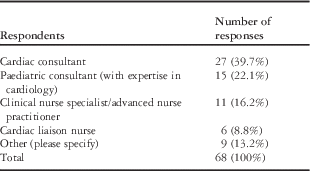
Each of the CHD specialist centres found in the United Kingdom had at least one respondent. Of the total number of questionnaires sent out to individuals, there was a response rate of 33%. Questionnaires were returned by 27 (32%) Paediatric Cardiac Consultants contacted, representing at least one completed questionnaire from each of the CHD “specialist centres” at the consultant level. A total of 41 questionnaires were returned by other healthcare professionals specialising in CHD, including paediatric cardiology registrars, paediatric consultants with expertise in cardiology, clinical nurse specialists, advanced nurse practitioners, and cardiac liaison nurses (Table 1).
Clinician’s survey respondents filtered by job role.

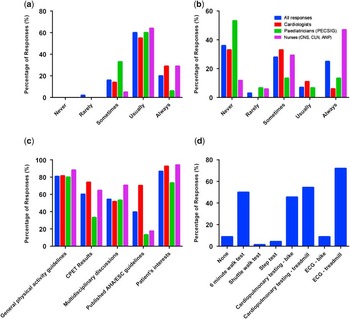
According to 39% of respondents, physical activity advice was provided at every appointment; however, only 25% of healthcare professionals considered that there were specified times, such as transition to secondary school, when advice was provided. The results (Fig 1a) suggest that exercise is discussed in the majority of consultations, with 60% of clinicians considering that exercise is usually discussed and 21% stating that it is always discussed. Furthermore, almost all healthcare professionals consider exercise and physical activity to be “very important” for their patients’ quality of life, with a mean rating of 4.62 on a Likert scale ranging from “not important” (1) to “very important” (5).
Survey responses to ( a ) How often is exercise discussed during consultations? n=68 and ( b ) How often is written exercise advice provided in consultations? n=67 ( c ) What information do you consider when providing exercise advice? n=68 ( d ) Which exercise tests are currently used? n=68. Questions A–C are filtered by role for cardiologists, members of Paediatricians with Expertise in Cardiology Special Interest Group (PECSIG), and nurses.

Although exercise is often discussed during consultations, it is uncommon for patients to be provided with written information. In our survey, 36% of clinicians stated that written advice about exercise is never provided to patients (Fig 1b).
When contemplating what exercise advice to provide to patients, the majority (87%) of clinicians consider the patient’s interests, and although general physical activity guidelines were taken into account by 81% of all clinicians, specific American Heart Association/European Society of Cardiology guidelines were taken into account by less than half (40%) of all clinicians surveyed (Fig 1c).
This figure increased to 70% when only the responses of cardiologists were considered. When cardiologists were excluded from the results, it was shown that only 19% of other healthcare professionals consider published guidelines when providing exercise advice.
In addition, the majority of healthcare professionals (60.6%) did not assess their patients’ knowledge about the level of exercise that is appropriate for them. Nurses were more likely to assess this knowledge than other clinicians (Table 2).
Is patient knowledge of appropriate levels of exercise routinely assessed?

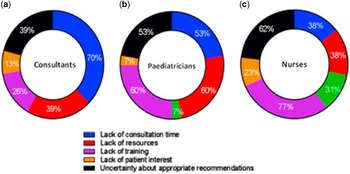
In response to the question “Which factors do you feel prevent you from providing patients with more detailed, individualised advice and recommendations about exercise?” two respondents replied that there were no limiting factors; however, three of the options given were identified by >50% of respondents. First, the lack of time during consultation (57%), followed by the lack of training in this specific area (55%), and finally uncertainty about appropriate recommendations (55%) were cited. The latter response remained high (39%) when only responses from consultants were considered. The main factor identified by cardiologists was lack of time during consultation (70%). In contrast, the main factors identified by nurses were lack of training (77%) and uncertainty about appropriate recommendations (62%). This uncertainty remained high (38%) when only responses from consultants were considered (Fig 2).
Survey responses to the question ‘Which factors do you feel prevent you from providing patients with more detailed, individualised advice, and recommendations about exercise?’ Filtered for ( a ) consultants (n=23), ( b ) paediatricians (n=15), and ( c ) nurses (n=13). Respondents could give multiple answers to the question.

Discussion
The main findings of this study show that, although exercise is discussed in the majority of consultations, the provision of written information is rare. The reasons as to why the advice given to patients was insufficient varied depending on the role of the clinician, and less than half of all the clinicians surveyed considered the published guidelines for exercise and CHD when discussing exercise with patients.
This failure to consider the published guidelines is a concern, because it is known that inactivity even from an early age has implications on basic motor development and quality of life.Reference Tong, Sparacino and Messias 12 In addition, regular physical activity is known to reduce the risk of developing chronic health conditions in later life.Reference Cavill, Biddle and Sallis 13 As 80–85% of patients born with CHD now survive to adulthoodReference Moons, Bovijn and Budts 14 , early interventions are becoming more important than ever, as the cost of the disease is going to increase in line with birth rate.
Only a quarter of respondents considered that there were specified times, such as the transition from primary to secondary school when physical activity is considered, and only 39% of respondents reported discussing physical activity at every appointment. This indicates that the timing of information provision is arbitrary, and there is often no systematic procedure for determining when physical activity advice is to be given.
Perceptions of CHD and physical activity advice differed among clinicians, particularly when asked what they considered to be the main barriers to the provision of exercise advice (Fig 1). A small proportion of paediatricians and nurses cited the risks associated with physical activity as a barrier, but this was not identified by any consultants. Conversely, consultants identified lack of time during consultations to be the main obstacle to their provision of more individualised exercise advice. Lack of training in this specific area was highlighted by over half of all respondents. On consideration of all responses, it is clear that the majority of clinicians do not have the time, resources, or specific knowledge to confidently provide exercise advice for youngsters with CHD. The variation in responses suggests that different forms of action need to be taken depending on the role of the clinician in order to truly address the issue. This would present excellent continuing professional development opportunities where consultants promote the value of physical activity to their patients, while passing on the responsibility of prescribing physical activity to cardiac nurses and physiotherapists, provided they have the necessary skills and education. This provision seems an ideal opportunity for the medical professionals to engage with other healthcare professionals – namely, registered exercise professionals.
Exercise advice should not be overlooked during the transition stages; this advice should also reflect the changing nature of sporting activities between the early-teens and mid-teens. During this period, activities become more competitive, and the players may be put under increased pressure to do well, either from themselves, peers, or coaches. This may cause over-exertion, which is potentially dangerous for a child with a heart defect. It is important to implement this extra advice from the very beginning of the transition period, starting when the patient is 12 years old, until full transfer to adult services. The need for better and more thorough information during transition was identified in a 2009 study by Moons and colleagues, where a number of patients noted that they were largely unaware of what the outpatient visit would entail until they actually arrived there, which increased their feelings of anxiety.Reference Moons, Pinxten and Dedroog 15 The American Heart Association and the European Society of Cardiology recommend physical activity for the majority of CHD patientsReference Takken, Giardini and Reybrouck 1 , Reference Longmuir, Brothers and deFerranti 8 ; however, the individual nature of CHD makes it difficult to apply these generic guidelines from consensus statements to the myriad of CHD patients. Similarly, BudtsReference Budts, Börjesson and Chessa 16 has produced a protocol for defining appropriate exercise prescription in CHD but this is limited to adolescents and young adults. This could explain the large reported percentage of uncertainty among clinicians about the appropriate recommendations (Fig 1).
As with all studies, several limitations are acknowledged. It is noted that, as with the majority of surveys, those who responded are more likely to be interested in this topic (non-response bias), and therefore there will be a degree of bias in the responses.Reference Suchman and McCandless 17 – Reference Larson and Catton 19 These findings, however, are not uncommon in other chronic disease groups – for example, cystic fibrosisReference Stevens, Oades and Armstrong 20 – where the value of exercise is recognised by clinicians and their support teams but is underutilised. The only method that could be used to truly decipher the extent of the problem would be to perform an audit. Although the questionnaire response rate of 33% is acceptableReference Baruch 21 , it could have been improved by shortening the questionnaire itself, as we know that time is a factor for clinicians, and thus the length may have discouraged some from answering.
Conclusion
In summary, this survey indicated that in the United Kingdom physical activity and exercise are discussed in the majority of consultations, but written advice is not a common practice. These practices were attributed to several reasons, such as lack of time during consultations, uncertainty about appropriate recommendations, and lack of training. Importantly, none of the cardiologists who took part in the survey felt concerned that the potential risk associated with exercise prevented them from providing more detailed advice; therefore, better education to increase the promotion and prescription of exercise is required and should form part of the clinicians and their support teams continuing professional development. This demonstrates a need for individualised, written advice for patients, through a method that is not time-consuming for clinicians and their support teams to perform. Further training and consultant awareness on published exercise guidelines would also be advantageous. Moving forward, a group effort is needed from all professionals working in this area to optimise the advice provided, and ensure that all patients are receiving individualised guidelines for physical activity. Potentially, there is a role that registered exercise professionals, with specialist paediatric training, could take to ease the burden of delivery of these types of programmes. The role of physical activity and exercise should therefore play an important part in reducing costs for the increasing financial commitment of the long-term care of CHD patients.
Acknowledgements
The authors thank the clinicians who completed this survey. They also thank Heart Research UK, who funded this research project.
Financial Support
The Research Fellow who carried out the present study was funded by the “Helping Little Hearts” grant from Heart Research UK.
Conflicts of Interest
None.