

Introduction
Elderly care arrangements attract increasing research and policy interest, with growing numbers of older people challenging the care systems in society. Most countries aim to maintain independent living in the community for as long as possible to delay costly institutional placement. In addition to formal home-based help services organised by the public sector, informal help in daily tasks provided by family members, other relatives and friends is of primary importance for many elders. Help provided by the informal sources has been found to be substantially more wide-ranging than formal help, e.g. in the United States of America (USA) (Davey et al. Reference Davey, Femia, Zarit, Shea, Sundström, Berg, Smyer and Savla2005), in Great Britain (Davey and Patsios Reference Davey and Patsios1999), in Sweden (Nordberg et al. Reference Nordberg, von Strauss, Kåreholt, Johansson and Wimo2005) and in Finland (Blomgren et al. Reference Blomgren, Martikainen, Martelin and Koskinen2008). In order to be able to predict need and cost of formal services, detailed information is needed on the current help patterns and on the determinants of receipt of help in the older population.
Empirical research has confirmed that spouses and adult children are the main sources of help for older people (Rostgaard and Fridberg Reference Rostgaard and Fridberg1998). The combination of living arrangements, existence of a spouse and existence of children is of crucial importance for receipt and amount of informal help. Least informal assistance is received by childless individuals who live alone, average amounts by those who live alone but have children, and most assistance by married people with children (Davey et al. Reference Davey, Femia, Shea, Zarit, Sundström, Berg and Smyer1999; Larsson and Silverstein Reference Larsson and Silverstein2004). In addition to living arrangements and other factors related to the potential availability of informal networks, increasing age and deteriorating functional status are consistently related to increasing receipt of care (e.g. Davey and Patsios Reference Davey and Patsios1999). Socio-economic factors may also be associated with receipt of help either directly (through the ability to purchase help, knowledge of the alternatives etc.) or indirectly through their effects on functional ability, on living arrangements and on the availability of informal support. However, evidence on their effects is still mixed (Broese van Groenou et al. Reference Broese van Groenou, Glaser, Tomassini and Jacobs2006).
Comparative studies have demonstrated clear country differences in the levels of informal and formal help: e.g. receipt of formal help is more common in Sweden than in the USA whereas informal help is more common in the USA irrespective of need of care (Davey et al. Reference Davey, Femia, Shea, Zarit, Sundström, Berg and Smyer1999, Reference Davey, Femia, Zarit, Shea, Sundström, Berg, Smyer and Savla2005). Cross-national differences in receipt and sources of help are partly influenced by population structures, e.g. age and living arrangements, and by average functional ability of older people. A general conclusion of comparative studies has been that since country differences persist after adjustment for population structures, cultural differences and/or differences in policy contexts are also related to country differences in receipt of informal and formal help (Broese van Groenou et al. Reference Broese van Groenou, Glaser, Tomassini and Jacobs2006; Davey et al. Reference Davey, Femia, Shea, Zarit, Sundström, Berg and Smyer1999). Furthermore, significant interactions have been observed between country and socio-demographic determinants such as age, living arrangements and socio-economic status, suggesting that the effects of these determinants on informal and formal help are not stable across nations. Therefore, it can be concluded that cultural and political environments are likely to influence both the distributions of the determinants and their effects on receipt of help (Broese van Groenou et al. Reference Broese van Groenou, Glaser, Tomassini and Jacobs2006; Davey et al. Reference Davey, Femia, Shea, Zarit, Sundström, Berg and Smyer1999; Shea et al. Reference Shea, Davey, Femia, Zarit, Sundström, Berg and Smyer2003). Cultural norms may affect, for example, the prevalence of living arrangements, preferences of elderly care and patterns of contact between elderly parents and their adult children (Lowenstein and Daatland Reference Lowenstein and Daatland2006; Tomassini et al. Reference Tomassini, Glaser, Wolf, Broese van Groenou and Grundy2004a). However, the effects of culture, history and politics are difficult to quantify since they are strongly interconnected. Political regime may affect availability of formal services and thus also the propensity to rely on informal help in need of care (Broese van Groenou et al. Reference Broese van Groenou, Glaser, Tomassini and Jacobs2006). Correspondingly, the prevailing policy context interacts with the cultural norms related to the willingness to help. On the other hand, policy decisions on public services are made in the prevailing cultural regime.
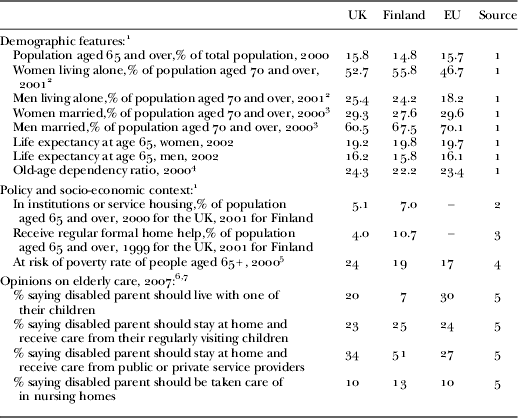
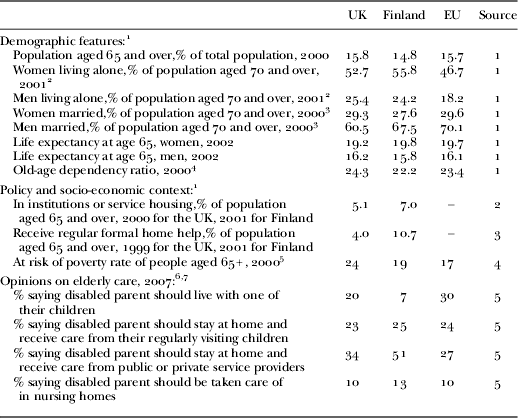
In this study, we aimed to investigate the determinants of informal help in two contexts with diverging public opinions and policies. England and Finland are two European welfare states that are characterised by roughly similar demographic contexts but that diverge in their cultural and policy features pertaining to elderly care. Some statistics of the demographic, policy, socio-economic and cultural characteristics in the two countries as well as in the European Union on average are summarised in Table 1. For data availability reasons, data for England are substituted by data for the United Kingdom (UK).Footnote 1 The demographic structure, such as the proportion of those aged 65 years and over, the proportion of older people living alone and the old-age dependency ratio, is roughly similar in the two countries. The age structure of the two countries also corresponds to the average European level, but English and Finnish older people are more likely to live alone than the Europeans on average. Life expectancy at age 65, an indicator of population health and longevity, is at the same level in England and Finland and corresponds to the average European level.
Contextual characteristics pertaining to elderly care in the United Kingdom (UK), Finland and countries of the European Union (EU) on average
Notes:
1. EU meaning the EU 25 countries: Austria, Belgium, Cyprus, Czech Republic, Denmark, Estonia, Finland, France, Germany, Greece, Hungary, Ireland, Italy, Latvia, Lithuania, Luxembourg, Malta, the Netherlands, Poland, Portugal, Slovakia, Slovenia, Spain, Sweden and the UK.
2. EU averages calculated excluding France, Sweden and Malta (data not available).
3. EU averages calculated excluding Austria, Cyprus, Estonia, France, Greece, Malta, Poland, Portugal and Spain (data not available).
4. The ratio between the total number of elderly persons of an age when they are generally economically inactive (aged 65 and over) and the number of persons of working age (from 15 to 64).
5. Income maximum 60% of median equivalised income after social transfers.
6. EU meaning the EU 27 countries: Austria, Belgium, Bulgaria, Cyprus, Czech Republic, Denmark, Estonia, Finland, France, Germany, Greece, Hungary, Ireland, Italy, Latvia, Lithuania, Luxembourg, Malta, the Netherlands, Poland, Portugal, Romania, Slovakia, Slovenia, Spain, Sweden and the UK.
7. Question: ‘Imagine an elderly father or mother who lives alone and can no longer manage to live without regular help because of her or his physical or mental health condition. In your opinion, what would be the best option for people in this situation?.’
Sources: 1. Eurostat population statistics, available at http://epp.eurostat.ec.europa.eu [Accessed 20 May 2010]. 2. UK: Organisation for Economic Cooperation and Development (2005); Finland: Nordic Social-Statistical Committee (2003). 3. UK: Comas-Herrera, Wittenberg and Pickard Reference Comas-Herrera, Wittenberg, Pickard, Comas-Herrera and Wittenberg2003; Finland: Nordic Social-Statistical Committee (2003). 4. Eurostat indicators of social inclusion, available at http://epp.eurostat.ec.europa.eu [Accessed 8 October 2010]. 5. European Commission (2007).
With similar demographic structure, England and Finland are thus facing similar challenges of an ageing population structure and growing demand for elderly care, even though the proportion of older people in Finland will rise more steeply because of the especially large baby-boom generation (Giannakouris Reference Giannakouris2008). The means to respond to the challenge diverge since welfare state structures and cultural climates towards elderly care in the two countries are very different. Great Britain belongs to the regime of Anglo-Saxon liberal market-led welfare states, based on means-tested services and minimal protection, encouraging private welfare provision (Esping-Andersen Reference Esping-Andersen1990, Reference Esping-Andersen2003). One-quarter of older people live at risk of poverty (Table 1). Organising care has traditionally been considered to be a private matter, and care responsibilities lay heavily on the families and on the market. Eligibility for state care has depended on financial circumstances, availability of other help and level of disability, and has become tighter over the years (Comas-Herrera, Wittenberg and Pickard Reference Comas-Herrera, Wittenberg and Pickard2010). However, the health-care system is publicly funded and universal. Informal care-givers provide most of the long-term elderly care. About 40 per cent of long-term care was financed by older people themselves or by their families in 2006, of which about one-quarter was user charges and three-quarters consisted of purchasing private services (Comas-Herrera, Wittenberg and Pickard Reference Comas-Herrera, Wittenberg and Pickard2010; Rostgaard and Fridberg Reference Rostgaard and Fridberg1998). The funding of long-term care is a source of considerable debate in England and a topic of concern to governments of both right and left (HM Government 2009).
In contrast, the Finnish social protection system is built on the Nordic model of a welfare state where social and health services and provision of social security are based on principles of universality and equality, delivery of services not being dependent on own income or assets. All residents are entitled to the services and benefits, and the system is financed with tax revenue with marginal or no user fees. The legal role of the family is weak: children are not responsible for providing help for their parents, and family members are not assumed to pay for the care of their elderly (Ministry of Social Affairs and Health 2003; Niemelä and Salminen Reference Niemelä and Salminen2003; Rostgaard and Fridberg Reference Rostgaard and Fridberg1998).
In both countries, a central aim of elderly care policies is to maintain independent living at home for as long as possible to prevent institutional placement. In this respect, encouraging provision of informal help has been one of the focus areas, and both countries have implemented monetary allowances to promote supply of home-based informal help (Rostgaard and Fridberg Reference Rostgaard and Fridberg1998). Also home-help services are of crucial importance for the policy targets, but their provision varies according to country. Comparative data show a clear difference in proportions of older people aged 65 and over in England and Finland receiving formal home-help services: the percentage was 11 per cent in Finland and 4 per cent in the UK around year 2000 (see Table 1). Also the proportion of older people in residential care was higher in Finland (7%) than in the UK (5%). However, making comparisons of international statistical figures is difficult because of differences in care definitions in national sources. Therefore, these comparative figures should be treated with caution.
Cultural climates and policy factors are intertwined. A special Eurobarometer survey in 2007 charted public opinions on elderly care among Europeans (European Commission 2007). A striking difference can be seen between the respondents from the UK and Finland: one-fifth of the UK respondents thought that in case of disability, elderly parents should live with one of their children, while this was the opinion of only 7 per cent of the Finns. In contrast, the majority of the Finns thought that disabled parents should live in their own homes and receive public or private support there (Table 1). Furthermore, an earlier Eurobarometer survey showed that the Finns think that the state or community should pay for the care of older people, while private funding was more pronounced in the opinions of the British (Walker Reference Walker1999).
Previous research has concluded that help from the spouse and from children are important determinants of using public formal help and may delay costly institutional placement (Blomgren et al. Reference Blomgren, Martikainen, Martelin and Koskinen2008; Nihtilä and Martikainen Reference Nihtilä and Martikainen2008). However, when studying receipt of informal care, spouses, children and other informal care-givers have usually been examined as one mixed category of all informal care-givers. Yet, spouse and children as care-givers are intrinsically different: spousal help is most often daily intra-household help whereas help from children, normally not living with their elderly parents in modern Western societies, is usually less frequent and less intensive. Also, the associations of spousal and filial help with use of public formal help services may be very different (Blomgren et al. Reference Blomgren, Martikainen, Martelin and Koskinen2008). We thus need more specific information on who among older people actually receives help from their spouse and/or children.
Aims of the study
Using highly comparable population-based data, we compare receipt of help in two European countries with roughly similar demographics but with different policies related to elderly care. We put a special emphasis on assessing the determinants of receipt of help from spouse and from children, the two most important sources of help, which previous single-nation and comparative studies on informal help have failed to study in detail. However, by studying them separately we may better understand the life circumstances and mechanisms related to the provision of informal help for older people. We also look at the interplay between public formal help and help received from these informal sources in the two countries. The specific aims of the study are to estimate the levels of receipt of help from various informal and formal sources among comparable groups of disabled elders in England and in Finland, and to estimate the associations of different factors on receipt of help from spouse and from children in the two countries and to study whether the associations are similar or different in these countries, with emphasis on the interplay between public formal help and informal help.
Data and methods
English Longitudinal Study of Ageing and Finnish Health 2000 surveys
English data come from the English Longitudinal Study of Ageing (ELSA) (Marmot et al. Reference Marmot2007). We use data from ELSA wave 1 (collected March 2002 to March 2003). The ELSA sample was based on those who lived in a responding household in the Health Survey of England (HSE) in any of the years 1998, 1999 or 2001, who had agreed to be recontacted at some time in the future and were aged 50 and over and lived in private residences at the start of ELSA fieldwork. The individual response rate of those issued to the sample was 67 per cent. When refusal to be recontacted after the HSE is taken into account in the calculations, the response rate decreased to 61 per cent. Weights are used to adjust for differential non-response probabilities. Furthermore, to take into account the original stratification of the HSE samples, weights were calibrated to match the age–sex distribution of the sample to the Census 2001 non-institutional population (Cheshire et al. Reference Cheshire, Cox, Lessof, Taylor, Banks, Breeze, Lessof and Nazroo2006; Taylor et al. Reference Taylor, Conway, Calderwood, Lessof, Marmot, Banks, Blundell, Lessof and Nazroo2003).
Finnish data come from the Health 2000 health examination survey, completed in 2000–01 in Finland and representative of the Finnish population aged 18 and over. The sample was constructed using a two-stage cluster sampling design. The data include 20 strata, of which 15 are largest cities and five represent the five university hospital regions of the country excluding the 15 largest cities. Eighty health-care districts were sampled from within these strata so that the 15 largest health-centre districts were all selected, and the remaining 65 were sampled with systematic probability proportional to size (PPS) sampling in each stratum. In the second stage, people were selected from the health-centre districts using systematic sampling (Aromaa and Koskinen Reference Aromaa, Koskinen, Aromaa and Koskinen2004; Sainio et al. Reference Sainio, Koskinen, Heliövaara, Martelin, Härkänen, Hurri, Miilunpalo and Aromaa2006). Persons aged 80 years and over were over-sampled by doubling their sampling fraction to ensure that enough observations were included in the data. The observations were weighted to reduce the bias due to non-response and to correct for the over-sampling of those aged 80 and older (Djerf et al. Reference Djerf, Laiho, Lehtonen, Härkänen, Knekt and Heistaro2008; Laiho, Djerf and Lehtonen Reference Djerf, Laiho, Lehtonen, Härkänen, Knekt and Heistaro2008). The overall participation rate in the study was 89 per cent and did not vary substantially by age (Koskinen et al. Reference Koskinen, Laiho, Rinne, Kuosmanen, Alha, Rissanen, Martelin and Heistaro2008).
Both surveys were conducted as home interviews. We confine the analyses to those older people aged 70 and over who lived in private residences and who had problems in physical functioning as described in the next chapter. With these definitions, the ELSA data include 1,369 women and 862 men, and Health 2000 data include 532 women and 241 men.
Variables
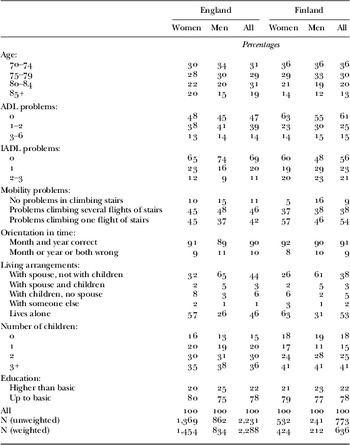
The two data sets yielded a possibility to create highly comparable measures of socio-demographic characteristics, functional ability and receipt of help. The variables are described below, and their distributions are shown in Table 2.
Sample characteristics (weighted proportions): community-dwelling disabled women and men aged 70+ in England and Finland1

Notes: ADL: activities of daily living. IADL: instrumental activities of daily living.
1. Functional limitations defined as having problems with any of the ADL or IADL functions or with climbing stairs (see Data and methods).
Gender and age
Percentages of those receiving help are shown separately for women and men. Gender and age in five-year age bands (70–74, 75–79, 80–84, 85+) are adjusted for in all multivariate models.
Measures of functional ability
Comparable questions on activities of daily living (ADL) and instrumental activities of daily living (IADL), on mobility and on cognitive functioning were used to measure functional ability. The ADL variable includes eating, getting to bed and getting up, dressing and undressing, moving about at home, showering or bathing, and using the toilet, and it was classified as having no problems, having problems in one or two functions, and having problems in three to six functions. The IADL variable includes shopping, preparing a meal and using the telephone. These were combined into having no problems, having problems in one of the functions, and having problems in two to three functions.
Mobility and cognitive functioning
Mobility problems were measured as the ability to climb one or several flights of stairs. Cognitive functioning was measured with orientation in time, i.e. the ability to remember the current month and year as part of the Mini-Mental State Examination (Folstein, Folstein and McHugh Reference Folstein, Folstein and McHugh1975). We could not use the relating question on current day since Health 2000 allowed for one day's deviation from the correct answer whereas ELSA did not. Unfortunately, no other comparable measures of cognitive functioning or measures of depressive symptoms were available in the two data sets.
Measures of availability of informal support
We constructed a detailed variable on living arrangements with the following classes: lives with spouse but not with child(ren) (with or without other persons); lives with spouse and child(ren) (with or without others); lives with child(ren), no spouse (with or without others); lives with other(s) with no spouse or child(ren); lives alone. Those living with spouse include both married and those in consensual unions. The number of children was readily available in Health 2000. In ELSA, we calculated the total number of children based on information given on household relationships and on children living outside the household.
Education
Education represents the socio-economic status. The variable is based on the highest obtained qualification and was classified into higher than basic level and up to basic level. In ELSA, those who had an at least British GCE O-level education were classified into the higher than basic category and others were classed into up to basic level. These include those with a maximum of CSE grade as well as those with foreign or no qualification. In Health 2000 data, up to basic level includes those with at most elementary school-level education, corresponding to up to nine years of schooling.
Variables on receipt of help
In ELSA, questions on receipt of help were asked from those who reported any problems in mobility, ADL or IADL functions: ‘Thinking about the activities that you have problems with, does anyone ever help you with these activities (including your partner or other people in your household)?’ In Health 2000, the following question was asked of all participants: ‘Do you receive recurrent help in your normal tasks because of limitations in your functional ability, such as help with housework tasks, bathing or showering, or shopping?’ Both surveys asked separately of receipt of help from spouse, from children or their spouses, from other relatives and friends, from public formal sources (home aid or home nurse in Health 2000, social or health service workers in ELSA), and from other sources. ELSA distinguished also privately purchased help, but this category was not among the choices in the Finnish data. Therefore, we included private help in the residual category of other sources also in ELSA.
Since receipt of help in ELSA was asked only from those reporting problems in mobility, ADL or IADL functions, we defined our study population of older people accordingly. This study thus includes those older people who had mobility problems measured by the ability to climb stairs or who had problems in any of the ADL or IADL items described above.
Statistical methods and analyses
We calculated gender-specific proportions of those receiving help from different sources and from combinations of sources. Differences in percentages were tested with Pearson's chi-square tests. Logistic regression models were run to assess the associations of different factors with getting help from spouse or from children, including in the models only those who had a spouse or children, respectively. Differences in associations between countries were assessed with interactions between country and each explanatory factor added in the full models. Analyses were performed with the Stata 9 statistical package using survey estimation commands.
Results
Receipt of help from different sources
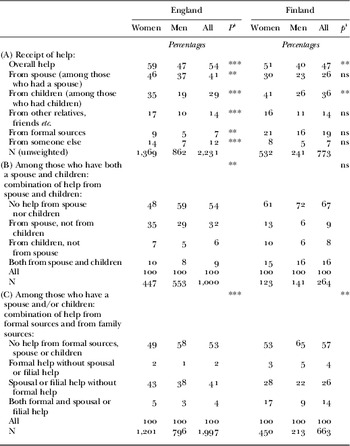
Table 3 shows the proportions of those receiving help from different sources and from combinations of sources in England and Finland. The p-values are shown for differences between women and men in each country. Overall, 54 per cent of the English and 47 per cent of the Finns aged 70 and over acknowledged receiving help in their normal tasks because of problems in their functional capacity. A larger percentage of the English than of the Finns received help from their spouses, whereas the Finns were more likely to receive help from their children. The tendency of Finns to receive help from formal sources was also observed: the proportion of Finns receiving public formal help was almost threefold compared to the English. Fewer men than women reported help in all categories in both countries. The absolute differences were fairly similar in each country but the larger English sample meant that more statistically significant gender differences were found.
Receipt of help among community-dwelling women and men aged 70+ with functional limitations in England and Finland

Significance levels:
1. Differences between women and men: ns, not significant,
* p<0.05,
** p<0.01,
*** p<0.001.
Looking at those who had both a spouse and living children, Table 3(B) shows that the majority of help recipients in England only had help from their spouse, whereas over a third of help recipients in Finland received help from both spouse and children. Furthermore, about one in seven Finns having a spouse and/or children received spousal and filial help in combination with public formal help, while this was the case only rarely in England (Table 3(C)).
Determinants of help from spouse
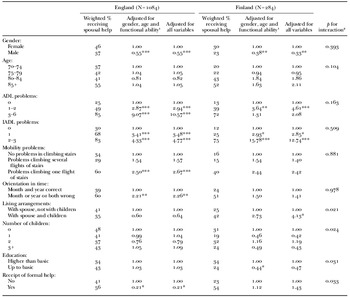
Analyses of spousal help were restricted to those who lived with a spouse. Percentages for receiving spousal help according to each determinant are shown in Table 4, as well as odds ratios first adjusted for gender, age and functional ability, and lastly for all covariates. To assess whether the effects were significantly different in the two countries, we re-ran the full model with pooled data, adding interaction terms of country and each variable separately.
Odds ratios for receiving help from spouse among those living with spouse

Notes: ADL: activities of daily living. IADL: instrumental activities of daily living.
1. Gender, age, ADL problems, IADL problems, mobility problems, orientation in time.
2. p-values for country × variable interactions in pooled model adjusted for all variables.
Significance levels: Category differs from the base category at the level of
* p<0.05,
** p<0.01,
*** p<0.001.
Fewer men than women acknowledged help from their spouses in both countries and this was not accounted for by the other factors. Age lacked a consistent association with receipt of help when functional status was adjusted for. Greater numbers of problems in ADL and IADL activities, in mobility difficulty and in incorrect orientation in time were accompanied by greater odds of receiving spousal help in England. In Finland, only IADL and ADL measures of functional capacity showed significant associations in the full model, partly due to the smaller sample size. Older people in Finland living with spouse and children were more likely to receive spousal help compared to those living with spouse only, whereas there was no significant difference between these groups in England. However, it should be noted that the group living with both spouse and children is very small, only 3 per cent of the samples in both countries, and 6–7 per cent of those sample members who had a spouse.
The number of children was not associated in any meaningful way with spousal help, and confirmatory analyses showed that the overall existence of children was not either. The interaction term between country and number of children was significant (p=0.024) but does not offer any sensible interpretation since all estimates for the subgroups were statistically insignificant and there was no obvious trend of increasing or decreasing spousal help with a growing number of children.
Education had no association with spousal help in England in either model. In Finland, there was some indication that those with low education had lower odds of receiving spousal help compared to those with higher education but the difference was not statistically significant in the full model.
Lastly, receipt of public formal help was included into the model. The interaction term of formal help and country was significant (p=0.033). Those receiving formal help had significantly lower odds of receiving spousal help in England but higher odds in Finland, even though the estimate for Finland was not statistically significant. However, even producing a statistically significant estimate, the group of those receiving formal help among those who live with their spouse in England was very small: only 2 per cent of the sample population.
Determinants of help from children
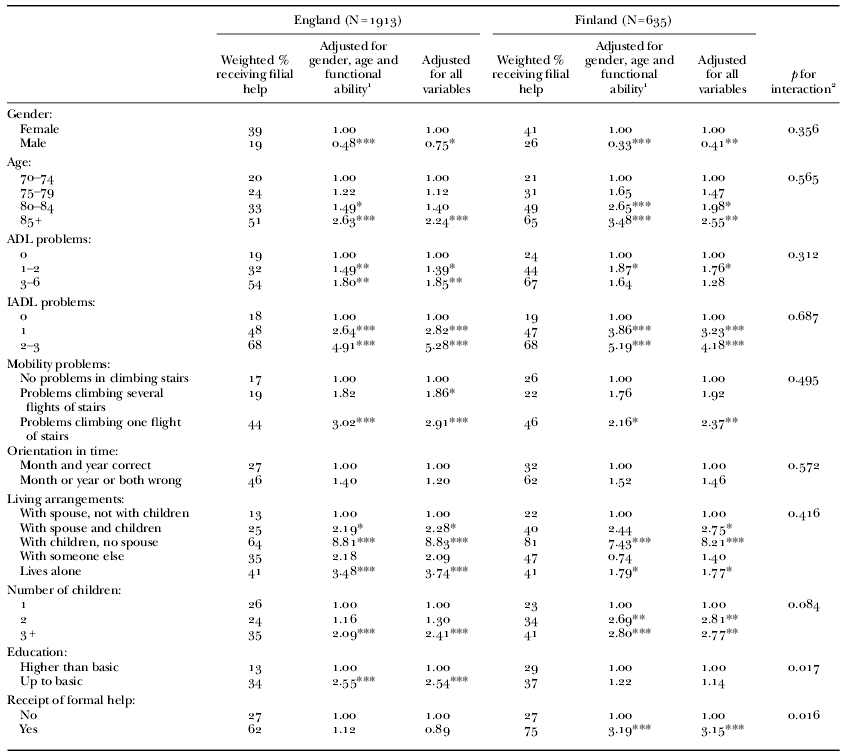
Similar models were run on help from children, including only those who had children. The odds of receiving filial help were higher for women than for men and for those with ADL, IADL and mobility limitations compared to those without (Table 5). Problems in orientation in time had no independent association in either country.
Odds ratios for receiving help from children among those who had children
Notes: ADL: activities of daily living. IADL: instrumental activities of daily living.
1. Gender, age, ADL problems, IADL problems, mobility problems, orientation in time.
2. p-values for country × variable interactions in pooled model adjusted for all variables.
Significance levels: Category differs from the base category at the level of
* p<0.05,
** p<0.01,
*** p<0.001.
The natural association between living arrangements and filial help was demonstrated in both countries: those living with their children without a spouse were most likely to receive help from children, followed by those living alone and those living with both spouse and children compared to those living with spouse only. Living alone compared to living with spouse was more strongly associated with receiving filial help in England than in Finland. Large numbers of children carried greater odds of receiving filial help, the major cut-point being between up to two and three or more children in England but between one and two or more in Finland. However, the p-value for interaction was not statistically significant.
Education played a different role in the two countries: those with lower education were more likely to receive filial help in England whereas there was no difference between the educational categories in Finland. Receipt of filial help in relation to receipt of formal help also differed in the two countries. Adjusted for other covariates, there was no association in England while in Finland those receiving formal help were more likely to receive help from their children.
Discussion
Studying cross-national differences in receipt of help
Comparative analyses with similar measures of individual characteristics and receipt of help among older people allow reaching more multifaceted conclusions on the determinants of help than single-country analyses. They also enable assessment of the potential role of cultural and policy contexts, which are likely to play a major role in help patterns (Broese van Groenou et al. Reference Broese van Groenou, Glaser, Tomassini and Jacobs2006; Davey and Patsios Reference Davey and Patsios1999; Shea et al. Reference Shea, Davey, Femia, Zarit, Sundström, Berg and Smyer2003). Discussions on the effects of different structures of formal care systems and cultural norms are important, even though the mutual roles of policy or culture cannot be explicitly specified comparing only two or a few countries.
This study aimed to estimate differences in determinants of help among community-dwelling disabled older people aged 70 and over living in England and Finland in the beginning of the 2000s. The majority of older people have at least one surviving child and/or a spouse. We concentrated our analyses on these two most important sources of help in two European welfare states representing very different political contexts pertaining to elderly care. The English system relies strongly on services generated by the markets and emphasises the family responsibilities in organising care. The Finnish system, in contrast, is based on universal allocation of public services, while not expecting strong input from the families. These differences were expected to be reflected in the proportions of older people receiving help from various sources.
We found that a larger percentage of older people aged 70+ received help from some source in their daily tasks in England compared to Finland and that there was clear variation in sources of help between the countries. The Finnish sample was somewhat younger and had fewer ADL limitations than the English sample, which may explain part of the difference in the proportions of those receiving help. The strong role of the Finnish welfare state was demonstrated in the almost threefold percentage of those getting formal public help in Finland compared to England (19 per cent versus 7 per cent, respectively). A larger proportion of the English than Finns acknowledged help from their spouses, whereas a larger share of the Finns than English acknowledged help from their children and children's spouses, calculated among those who had a spouse or who had children, respectively. There may be country differences in actual receipt of spousal help but there may also be cultural differences in perception of such help: Finns may not have considered the daily household tasks performed by their spouse to be help as often as the English did.
Receipt of filial help may have been more similarly conceptualised as actual help in both countries. The finding of more Finns than English receiving help from their children conforms to previous studies on contacts with children. Tomassini et al. (Reference Tomassini, Kalogirou, Grundy, Fokkema, Martikainen, Broese van Groenou and Karisto2004b) found that 76 per cent of Finnish women and 64 per cent of men aged 65+ had weekly face-to-face contact with their children in 2002 while the proportions were 50 and 46 per cent in Great Britain, respectively. In this respect, the stronger emphasis of family responsibilities in British care arrangements compared to Finland is not visible in our data at least when measured with help from children.
Similarities and differences in the determinants of help
As shown in previous studies (e.g. Davey and Patsios Reference Davey and Patsios1999), factors related to need of help were most strongly associated with receipt of spousal and filial help. We found that associations of gender and functional status with receipt of spousal and filial help as well as effects of age, living arrangements and number of children in the case of filial help were roughly similar in the two countries. These variables represent factors related to need of help and supply of informal help, whose effects are not likely to change substantially from one country to another.
Interestingly, women reported receiving more spousal and filial help than men in both countries. The gender difference in filial help found in this study conforms with the previous finding of women having more contact with their children and receiving more informal help from children and relatives from outside the household compared to men (Katz, Kabeto and Langa Reference Katz, Kabeto and Langa2000; Larsson and Thorslund Reference Larsson and Thorslund2002; Tomassini et al. Reference Tomassini, Kalogirou, Grundy, Fokkema, Martikainen, Broese van Groenou and Karisto2004b). In contrast, our results on spousal help differ from those received in some previous studies. According to the results of Katz et al. (Reference Katz, Kabeto and Langa2000), more married disabled men than women received help from their spouses in the USA. Likewise, Chappell (1991) found that married Canadian men were more likely than women to report help from their spouse. In theory, it is possible that in our data men get less spousal help than women at least partly because the average functional ability of the wives may be poorer than that of the husbands. Wives may therefore be less able to provide help than husbands. However, this explanation may not be relevant since husbands tend to be older than their wives (Kenrick and Keefe Reference Kenrick and Keefe1992), and thus on average have poorer functional capacity. Unfortunately, we have no comparable data on the functional capacity of the care-giving spouses.
However, we believe that another explanation may be relevant. A previous study has shown that women bear the responsibility of household labour even among older couples (Hank and Jürges Reference Hank and Jürges2007). It is possible that especially among older couples, this traditional division of household labour is taken for granted, and therefore tasks performed by the wives are seen as just their normal daily tasks whereas household tasks performed by husbands are more easily seen as help (i.e. helping the wife to perform these tasks). This may be the explanation to our finding that men reported receiving less spousal help than women – they may simply not have considered these tasks to be help. In contrast, wives may be more prone to report all household activities performed by their husbands as help (Blomgren et al. Reference Blomgren, Martikainen, Martelin and Koskinen2008). Unfortunately, it is not possible to assess the magnitude of this potential bias with our data. Only few previous studies have examined gender differences in spousal help adjusting for relevant covariates, and more research evidence is needed to establish the relationship.
Even though associations between need factors and receipt of help were roughly similar in the two countries, country differences were observed in the effects of education and receipt of formal help on receipt of both spousal and filial help. Education had no independent role in explaining receipt of help from spouse or children in Finland or in receiving spousal help in England but it did affect the chances of getting help from children in England. As those with poorer education tend to have less resources, those with lower education in England were more likely to rely on children's help whereas those with more education and more resources may have turned to privately purchased help, a conclusion echoing that of Deeming and Keen (Reference Deeming and Keen2002). In Finland, a country with extensive formal services and less emphasis on the private sector, the same pattern was not observed.
Relating to different welfare state arrangements, associations of receipt of public formal help with receipt of informal help is of primary interest. Many previous studies have tried to establish if formal services substitute for informal care, i.e. whether the input of family care-givers decreases when the supply and use of formal services increases. Some studies have indeed found evidence in favour of substitution (e.g. Van Houtven and Norton Reference Van Houtven and Norton2004). However, most results tend to support the opposite hypothesis of supplementation or complementarity: receipt of both informal and formal help correlates positively especially when need of care increases (Broese van Groenou et al. Reference Broese van Groenou, Glaser, Tomassini and Jacobs2006; Davey et al. Reference Davey, Femia, Zarit, Shea, Sundström, Berg, Smyer and Savla2005; Davey and Patsios Reference Davey and Patsios1999; Langa et al. Reference Langa, Chernew, Kabeto and Katz2001; Litwin and Attias-Donfut Reference Litwin and Attias-Donfut2009; Motel-Klingebiel, Tesch-Roemer and Von Kondratowitz Reference Motel-Klingebiel, Tesch-Roemer and Von Kondratowitz2005; Penning Reference Penning2002; Sundström, Malmberg and Johansson Reference Sundström, Malmberg and Johansson2006). However, these two processes may occur at the same time. Even though informal and formal help are likely to be complementary among those with most severe disabilities, processes of substitution may also be at work when people use formal services in lack of informal care or when informal carers cease to provide help. For example, loss of a spouse in later life increases the odds of turning to formal care services (Glaser et al. Reference Glaser, Tomassini, Racioppi and Stuchburry2006). Processes of substitution may be at work in society in general, while it has also been argued that generous welfare allocation may help to increase rather than decrease the probability of family solidarity and exchange of help between generations (Künemund and Rein Reference Künemund and Rein1999).
According to our findings, in England those living with a spouse and receiving formal help were less likely to receive spousal help but in Finland there was no significant association between formal and spousal help. In addition, the results hinted that in England those living with spouse and children were less likely to receive spousal help than those living with spouse only, while in Finland those living with spouse and children were more likely to receive spousal help. These two results taken together may indicate that many English older couples are frail and unable to help each other, a situation where other providers of help need to step up. As far as filial help is concerned, no independent association with formal help was found in England but in Finland, adjusted for several need factors, those receiving formal help had markedly higher odds of receiving filial help compared to those not receiving formal help. Even though dynamic concepts such as substitution and complementarity are inappropriate when using cross-sectional data, this positive association suggests a pattern of complementarity of help sources. It also implies that children may act as mediators, helping the elderly with gaining information on the available services and with accessing them. Evidence of this ‘bridging’ mechanism has also been found in previous studies (Blomgren et al. Reference Blomgren, Martikainen, Martelin and Koskinen2008; Geerlings et al. Reference Geerlings, Pot, Twisk and Deeg2005; Sussman Reference Sussman, Binstock and Shanas1976).
In England, where formal help is strongly means-tested and targeted to those in need, the role of children in seeking these services for their parents may be of lesser importance. Instead of gaining formal services, children of the elders in England often provide their parents with privately purchased services (Comas-Herrera, Wittenberg and Pickard Reference Comas-Herrera, Wittenberg, Pickard, Comas-Herrera and Wittenberg2003; Rostgaard and Fridberg Reference Rostgaard and Fridberg1998), which is still less common in Finland. However, the scope of privately purchased services by children is also increasing in Finland partly as a consequence of new forms of tax reductions to children purchasing home-based help for their elderly parents. Unfortunately, due to data limitations, privately paid help could not be taken into account in these analyses. Privately paid help may be treated as a mixture of formal and informal help: instead of giving the elderly their time, children may pay outside actors to perform household tasks. However, this does not alleviate the need for personal contact and emotional support from children and other informal networks (Dunér and Nordström Reference Dunér and Nordström2007). Further studies need to investigate the interplay between public, private and informal help thoroughly in different levels of disability and need.
The results of this study confirm that the care contexts may play an important role in the probabilities of children and spouse to provide care. In the face of the growing numbers and care needs of older people, the families are increasingly expected to share the burden of care arrangements with the public sector, even in traditional welfare societies. The potential availability of informal carers is also increasing: during the next 30 years, there will be an increase in the proportions of older people having a spouse and having children in European countries (Gaymu, Ekamper and Beets Reference Gaymu, Ekamper and Beets2008; Kalogirou and Murphy Reference Kalogirou and Murphy2006; Murphy, Martikainen and Pennec Reference Murphy, Martikainen and Pennec2006). However, we do not know the future care-giving potential and willingness to help of the spouses and children, and it is known that care-giving can have adverse health and financial consequences for the carer. Thus, it should not simply be assumed that spouses help each other or that children help their parents in the future. Our analyses showed that not all disabled older people with a spouse actually received spousal help (presumed to be partly because of functional difficulties of the spouses themselves) and not all parents with disabilities received help from their children.
Strengths and limitations of the study
Several limitations may have influenced the results presented above. We cannot be certain that potential cultural differences in perception of help or in reporting other information have not affected the results. The differences in the survey questions on receipt of help may have affected the reported frequencies of help receivers. The English survey ELSA asked about ever getting help whereas the Finnish Health 2000 asked to report recurrent help. Furthermore, ELSA advised to include help from other household members whereas there was no such emphasis in the Health 2000 question. This may have caused some bias towards the English reporting more overall help and more spousal help than the Finns. On the other hand, this bias may not be very strong since help with physical and cognitive functions is likely to be recurrent rather than sporadic. It is likely that when being asked about help, older people tend to include all help they normally receive, irrespective of the exact wording of the survey questions, especially when both data sets were collected as home interviews and several potential sources of help were enquired about in detail. We do not believe that the wording ‘ever getting help’ has caused older people to include sporadic help from passers-by to any great extent, for example. On the other hand, even though Health 2000 asked about ‘recurrent help’, further survey questions on the frequency of help revealed that this could also mean help that was received only once a month or less often. In this sense, the two survey questions are closer to each other than it first seems.
Furthermore, both surveys questioned separately about each source of help, and therefore Finnish respondents were also likely to report any spousal help even though intra-household help was not emphasised in the first question on overall help. We may assume that the possible bias of under-reporting spousal help in Finland should be more important among those with only minor disabilities and less important among those severely disabled with stronger help needs. However, confirmatory analyses on our data showed that the country difference in reporting spousal help remained at all levels of ADL problems. This suggests that the observed country difference cannot be reduced to the formulation of survey questions only. In sum, there is no reason to suspect that the estimates for the determinants of help would be greatly affected by the different wordings of the questions.
ELSA had a lower response rate than Health 2000 and this may affect our results as those with most severe functional restrictions tend to be over-represented among non-respondents (Sainio et al. Reference Sainio, Koskinen, Heliövaara, Martelin, Härkänen, Hurri, Miilunpalo and Aromaa2006). The losses could be particularly high among those who have no help or those who are protected by their carers from being interviewed. Thus, the differences in formal help received are likely to be under-represented but this is unlikely to change the overall contrast between the countries in complementarity of help and in reliance on spousal help.
Other limitations include the lack of care-giver characteristics in the data, affecting the care-giving potential of spouses and children. We were unable to include measures such as age and functional ability of the spouses as well as children's life situations and proximity to their parents. For example, there may be country differences in the average geographic distance between parents and children, which may affect patterns of contact and help: those who can meet their children are more likely to receive physical help whereas those whose contact is not face-to-face may still receive help with instrumental activities of daily life.
Cross-sectional data offer no possibility of follow-up, which is a disadvantage in researching the complex mechanisms of need and receipt of help interacting in time and in different contexts. Longitudinal data could better tackle the challenge of endogeneity in sources of help: decisions are made simultaneously by different actors in connection to the need of help and its changes and regarding the available options. Unfortunately, suitable comparable longitudinal data are still scarce. More research is needed on the interplay of public formal help, informal help and the rising sector of privately purchased help in different political systems. Knowledge on the balance of help between these three sectors and factors affecting their use will be needed in calculating future needs of elderly care services.
A major advantage of this study was the possibility of using highly comparable data on older people from two European countries. We were able to construct similar measures of socio-demographic factors, functional ability, social support and receipt of help. Despite the limitations of the study, our analysis presents new findings that extend the literature on informal care by providing detailed examination of the determinants of spousal and filial help in two European countries with similar demographics but different political systems pertaining to elderly care.
Conclusion
This study estimated differences in receipt and determinants of help from spouse and children among community-dwelling disabled older people aged 70 and over living in England and Finland, two welfare states with different policies on elderly care. The study confirmed that functional ability is strongly related to receipt of spousal and filial help. Higher percentages of women than men reported receiving spousal and filial help in both countries. Different policies on care arrangements were demonstrated in the different associations of formal help with informal help: Finns receiving formal help were more likely to receive filial help but no association was observed in England. Help from the formal and informal sectors are thus correlated in Finland, a country with extensive public services. In England, where formal services are targeted to those most needy, older people and their children may turn to private services instead or take over from their parent and try to manage without supplementary care. The results of this study thus imply that different welfare state systems and cultural factors may have effects on provision of informal care over and above the functional status of older people. The results suggest that in a liberal market-led state, the role of children may be to help their parents living alone and with low financial resources. In the context of a generous welfare state, children may function more as active agents bridging the gap between their parents and formal services.
We also found that failure to get spousal or filial help is not equally distributed in the older population. We further need to identify the groups with no spousal or filial help to target the public measures at the right population. Attention should be paid, for example, to elderly couples living by themselves, whose functional ability may be low and ability for mutual help weak, especially since spouse care-givers have a weaker connection with the formal care-giving sector than children or other family care-givers (Litwin and Attias-Donfut Reference Litwin and Attias-Donfut2009). The proportion of such couples will most likely rise in the future when the overall proportion of older people with spouse rises. Furthermore, more evidence is needed on the preferences of both older people and their potential carers on the care arrangements in different life circumstances and social contexts.
Acknowledgements
This study was partly funded by the Academy of Finland (grants 205631 and 203418). The study is also part of MAGGIE, an European Union-funded research programme on the major ageing and gender issues in Europe. We are grateful for the permission to use the ELSA data set, made available through the UK Data Archive. ELSA was developed by a team of researchers based at the National Centre for Social Research, University College London and the Institute for Fiscal Studies. The data were collected by the National Centre for Social Research. The funding was provided by the National Institute of Aging in the USA, and a consortium of UK government departments co-ordinated by the Office for National Statistics. The developers and funders of ELSA and the Archive do not bear any responsibility for the analyses or interpretations presented here. We also are grateful for the permission to use data from the Health 2000 survey, co-ordinated by the National Institute for Health and Welfare in Finland. We thank the anonymous referees for their valuable comments.