I. INTRODUCTION
Carbon nanotubes (CNTs), known as a class of promising one-dimensional nanomaterials, bear many fascinating properties such as mechanical strength and electrical conductivity and possess possibilities of various potential applications as electronic devices, high-strength materials, and biosensors. CNTs can also be used as scaffolds on the construction of nanostructured materials.Reference Chen, Lee and Liu1–Reference Che, Lakshmi, Fisher and Martin3 For example, CNTs can be a catalyst support, where catalytically active metal particles may decorate along the external walls or be filled in the interior.Reference Liu, Gan, Hong, Chen and Lee4–Reference Zheng, Li, Chen and Shen8 To optimize the use of nanotubes in most of applications, there is also a need to introduce different functional building blocks to CNTs, especially onto the surface of CNTs, as exampled by introducing several functional groups on their surfaces. A large number of work were focused on the chemical modifications of CNTs (e.g., by HNO3 and H2SO4–HNO3), which have been shown to improve the metal particle dispersion.Reference Chen, Zhao, Lee and Liu5–Reference Lu and Imae10 The attachment of organic molecules onto CNTs improved the solubility of CNTsReference Lu and Imae9, Reference Lu and Imae10 and moreover brought extensive applicability in the field such as the catalysis chemistry.Reference White and Mintmire11 In particular, well-defined polymers known as dendrimers (DEN) have shown promising properties to attach with the CNTs.Reference Lu and Imae9, Reference Garcia-Martinez, Scott and Crooks12
The distribution of metal on CNTs by chemical procedure is still largely based on the conventional preparation techniques such as wet dispersion of CNTs in metal precursor followed by chemical reduction with catalyst.Reference Jhn, Reddy, Shaijumon, Rajalakshmi and Ramaprabhu13, Reference Bonesi, Garaventa, Triaca and Castro Luna14 The CNT-supported metal particles can also be prepared by metal vapor depositionReference Antolini, Salgado, Giz and Gonzalez15 and chemical reduction depoition in the solution phase.Reference Ambrosio, Francia, Manzoli and Nerino16, Reference Yen, Shimizu, Lin, Bailey, Cheng and Chien17 Hence, there is an increasing interest in using advanced techniques based on microemulsion,Reference Susac, Sode, Zhu, Wong, Teo, Bizzotto, Mitchell, Parsons and Campbell18 sonochemistry,Reference Chen, Kim, Sue and Chen19, Reference Mariana, Nielson and Martin20 and microwave irradiationReference Hsieh, Chou and Chen21–Reference Li, Wu and Xu26 to prepare colloidal metallic particles and clusters, particularly those at the nanoscale. The polyol process is a proven technique for preparing colloidal metal particles.Reference Hsieh, Chou and Lin27 In this process, a polyol (most commonly ethylene glycol) solution including metal precursor salt is refluxed, and then, the polyol decomposes to release the reducing agent for metal ion reduction.
One important application of CNTs-supported metal nanoparticles is the electrocatalytic reaction in the fuel cell systems. Various catalyst supporting materials such as alumina, carbon black, mesoporous carbon, and carbon nanofibers have been investigated for the development of fuel cells.Reference Bonesi, Garaventa, Triaca and Castro Luna14, Reference Mariana, Nielson and Martin20 There has been increasing interest in multiwalled carbon nanotubes (MWCNTs) as a catalyst supportReference Jhn, Reddy, Shaijumon, Rajalakshmi and Ramaprabhu13, Reference Jeng, Chien, Hsu, Huang, Chiou and Lin28, Reference Chien and Jeng29 because of their high porosity and electrical conductivity. It is believed that well dispersion of metallic electrocatalysts on CNTs would resolve the slow kinetic problem, as CNTs have a unique one-dimensional structure.
Palladium is a metal that is known for its ability to catalyze hydrocarbons.Reference Pesant, Matta, Garin, Ledoux and Bernhardt30 It has an electronic configuration identical to platinum and forms a rather weak bond to most adsorbates. The key differences are that Pd d-bands are closer to the cores than platinum, and the lower d electron density is available for bonding. This leads to weaker interactions with π bonds, which allow unique chemistry to occur. Pd has higher oxidation potential than Pt, and the Pd oxides are more stable.Reference Lu and Wang31 Weak interatomic bonds between palladium atoms compared to platinum or nickel lead to easy formation of subsurface species, although its role is still uncertain. Moreover, palladium has a very similar lattice constant to that of platinum.Reference Lu and Wang31 With an aim to lower the cost, platinum-free alternatives are required now.
Pd-based catalysts have drawn much attention in recent years. However, the catalytic activity of Pd for the oxygen reduction reaction is lower than that of Pt and its alloys.Reference Pattabiraman32, Reference Giacomi, Balasubramanian, Khalid and McBreen33 Also, the stability of Pd is not as good as Pt in acidic, oxidative, and high-temperature environments.Reference Gullón, Iglesias, Montiel and Aldaz34–Reference Tominaka and Osaka36 The loss of Pd may involve either formation of Pd (II), Pd (IV), and Pd (VI) oxides or Pd electrodissolution. Over the last few years, much research has focused on the influence of the supports on the electrocatalytic activities of Pd for ethanol oxidation reaction. It was reported that the ethanol oxidation reaction could be activated by Pd electrocatalysts supported on MWCNTs, carbon black, and activated carbon, and the Pd catalyst supported on MWCNTs showed the best performance for ethanol oxidation in alkaline media.Reference Zheng, Li, Chen and Shen37, Reference Hu, Ding, Song and Shen38
In this article, we present a surface modification approach to deposit Pd electrocatalysts on sidewalls of CNTs. First, chemical wet oxidation in nitric acid was applied to load surface oxides on both ends and defects of nanotubes on side, creating a number of oxide groups such as carboxylic acid (−COOH), carbonyl (−CO), and carboxylate (−COO−). The modified CNTs were used to prepare CNT/Pd nanocomposite powders by four different synthesis methods. The first method includes tin sensitization on the surface of CNTs, followed by palladium metalization. In the second method, Pd metal was deposited on the surface of CNTs using the polyol process. The third method is the deposition of palladium metal by the reduction of its salt with hydrazine in the acidic solution. In the fourth method, fourth generation poly(amidoamine) (G4 PAMAM) dendrimer was used as an intermediator to load the Pd metal on the surface of the CNTs. The prepared nanocomposite powders were investigated by Fourier transform infrared (FTIR) and ultraviolet (UV) absorption spectra, thermogravimetric analysis (TGA), and transmission electron microscope (TEM) to characterize their properties.
II. EXPERIMENTAL
A. Surface modifications of MWCNT
MWCNTs were purchased from Iljin Nanotech Co., Ltd (Seoul, South Korea) and 50 mg MWCNTs were purified by heating at 60 °C in 50 ml concentrated HCl for 24 h, followed by settling for 1 h, washing with water, centrifuging for several times, and drying at 150 °C for 2 h. Acid-treated MWCNTs were obtained by heating purified MWCNTs in 50 ml concentrated HNO3/H2SO4 (3:1, v/v) for 24 h. After the dispersion was left for 24 h for settling of the acid-treated MWCNTs, it was centrifuged and the products were collected by decantation and washed for several times with water, followed by drying at 150 °C for 2 h.
B. Synthesis of Pd/CNT composite powders
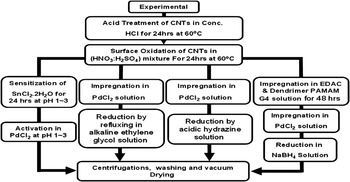
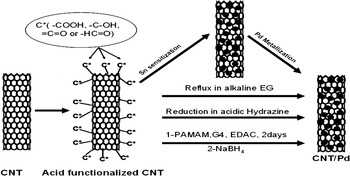
Figure 1 illustrates a schematic diagram of the steps of the fabrication process starting from MWCNTs to Pd/CNT nanocomposites: the Pd/CNT composite powders were fabricated by four different synthesis processes as illustrated in Fig. 2. The produced powders were characterized with a thermogravimetric analyzer of model TGA Q500, a FTIR analyzer of model Nicolet 6700, a Jasco V-670 series UV Spectrometer, and a TEM microscopy of model HITACHI H-7000.
A schematic diagram of four different synthesis processes of Pd/CNT nanocomposite powders.

Schematic diagrams of four different mechanisms for synthesis of Pd/CNT nanocomposite powders.

1. Synthesis of Pd/CNT composites by two-step sensitization/metalization route
The acid-treated MWCNTs were sensitized and metalized by the two-step process as follows. Ten milligrams of the acid-treated MWCNTs were added to an acidic solution of 100 mg of SnCl2 and 100 μl of concentrated HCl, the pH was adjusted at ∼1.7, and the mixture was sonicated for 15 min. The resulted mixture was stirred at 500 rpm for 24 h at room temperature. The tin-sensitized MWCNTs were washed and centrifuged for several times to exclude the excess of tin chloride.
The sensitized MWCNTs underwent Pd metalization. Ten milligrams of sensitized MWCNTs were metalized by stirring in an acidic solution containing 4 mg of PdCl2 and 40 μl of concentrated HCl and adjusting pH between 1 and 3. The produced Pd/CNT composites were washed, centrifuged, and dried at 150 °C for 2 h.
2. Synthesis of Pd/CNT composites by polyol method
A modified polyol method was applied to prepare Pd/CNT. One milligram of acid-treated MWCNTs was added to 2 ml of an ethylene glycol solution of palladium chloride containing 0.43 mg Pd metal. The pH was adjusted ∼12 by adding sodium hydroxide. The mixture was refluxed overnight. The resulted Pd/CNT composite powders were washed with ethyl alcohol followed by centrifugation and drying at 150 °C for 2 h.
3. Synthesis of Pd/CNT composites by reduction with hydrazine
Pd/CNT nanocomposite powders were prepared as follows: 10 mg of acid-treated MWCNTs were added to 100 mg of stannous chloride in 10 ml water, the pH was adjusted between 1 and 3, and the mixture was stirred by magnetic stirrer for 24 h. The reaction solution was filtered and the residues were washed for three times with water. PdCl2 (0.4 mg) were added to the produced sensitized powder in 1 ml of water, the pH was adjusted between 1 and 3, and the solution volume was adjusted to 2 ml with water. The solution was stirred with a magnetic stirrer for 24 h. Test samples were picked up from the solution every 6 h to trace the replacement reaction between the stannous ions and the palladium ions. The resulted Pd/CNT composite powders were washed with ethyl alcohol followed by centrifugation for several times and drying at 150 °C for 2 h.
4. Synthesis of Pd/CNT composites through the PAMAM dendrimer intermediator
Acid-treated MWCNTs (0.5 mg) were added to 5 ml of a G4 PAMAM dendrimer solution and 50 ml of water. 1-ethyl-3-(3-dimethylaminopropyl) carbodiimide (0.5 g) was added to the mixture and the mixture was stirred for 48 h by a magnetic stirrer, followed by adding of metal precursor (PdCl2) drop by drop with stirring for 1 h, and then adding a NaBH4 solution (NaBH4:water = 1:20) drop by drop again. The precipitated powders were collected by centrifugation, washed, and dried at 150 °C for 2 h.
III. RESULTS AND DISCUSSION
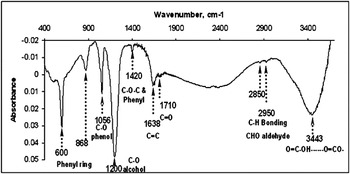
The CNTs were functionalized by acid treatment with heating at 70 °C to introduce functional groups such as carboxylic, carbonyl, and hydroxyl groups on the surface of the CNTs, and the functionalized CNTs could be easily suspended in water. The functional groups of the acid-treated CNTs were detected by FTIR, as shown in Fig. 3. The infrared chart indicates some characteristic bands. The first one is the vibration band of carboxylic group, which is detected as a weak band of C=O stretching mode at 1710 cm−1. The second and the third are C−O stretching bands of alcohol and phenol at 1200 and 1065 cm−1, respectively. In addition, there is a broad band around 3443 cm−1 to be a stretching mode of hydrogen-bonded O−H groups of carboxylic acid, alcohol, and phenol. The fourth functional group is the C=C bond, which was detected as a stretching band at 1638 cm−1, indicating the graphene backbone structure of the CNTs. The fifth type is the C−H bond in the CHO aldehyde group, which appeared as stretching bands at 2950 and 2850 cm−1.Reference Scharf, Neira, Hwang, Tiley and Banerjee39 The sixth type of bands comes from the phenyl ring and was observed at 600 and 868 cm−1. The band (1420 cm−1) of the seventh functional group is assigned to the C−O−C bond. It can be assumed from the comparison of the band intensities that hydroxyl groups are more dominant than carboxyl, aldehyde, and ether groups on acid-treated CNTs.
A FTIR chart of acid-treated MWCNTs.

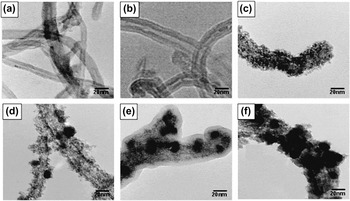
Figures 4(a) and 4(b) shows TEM micrographs of the as-received and the acid-treated MWCNTs, respectively. This process enhances the shortening of the CNTs in length as well as the functionalization of CNTs that raises the preferable dispersion of CNTs in the solution. While the as-received CNTs have the texture of agglomerated filaments, after the acid treatment, these agglomerated filaments were partly destroyed and the CNTs were shortened by the breakage of the chains. It has been reported that the acid-treated CNTs have a shorter length than the as-received one due to the effective reaction of the oxidized acids (the acidic mixture of nitric and sulfuric acids) on the graphene structure, which decaps and cuts the CNTs to short segments.Reference Daoush, Lim, Mo, Nam and Hong40
TEM Images of MWCNTs. (a) As-received MWCNT, (b) acid-treated MWCNT, (c) Sn-sensitized MWCNT (24 h), (d) Pd-activated MWCNT (1 h), (e) Pd-activated MWCNT (6 h), and (f) Pd-activated MWCNT (48 h).

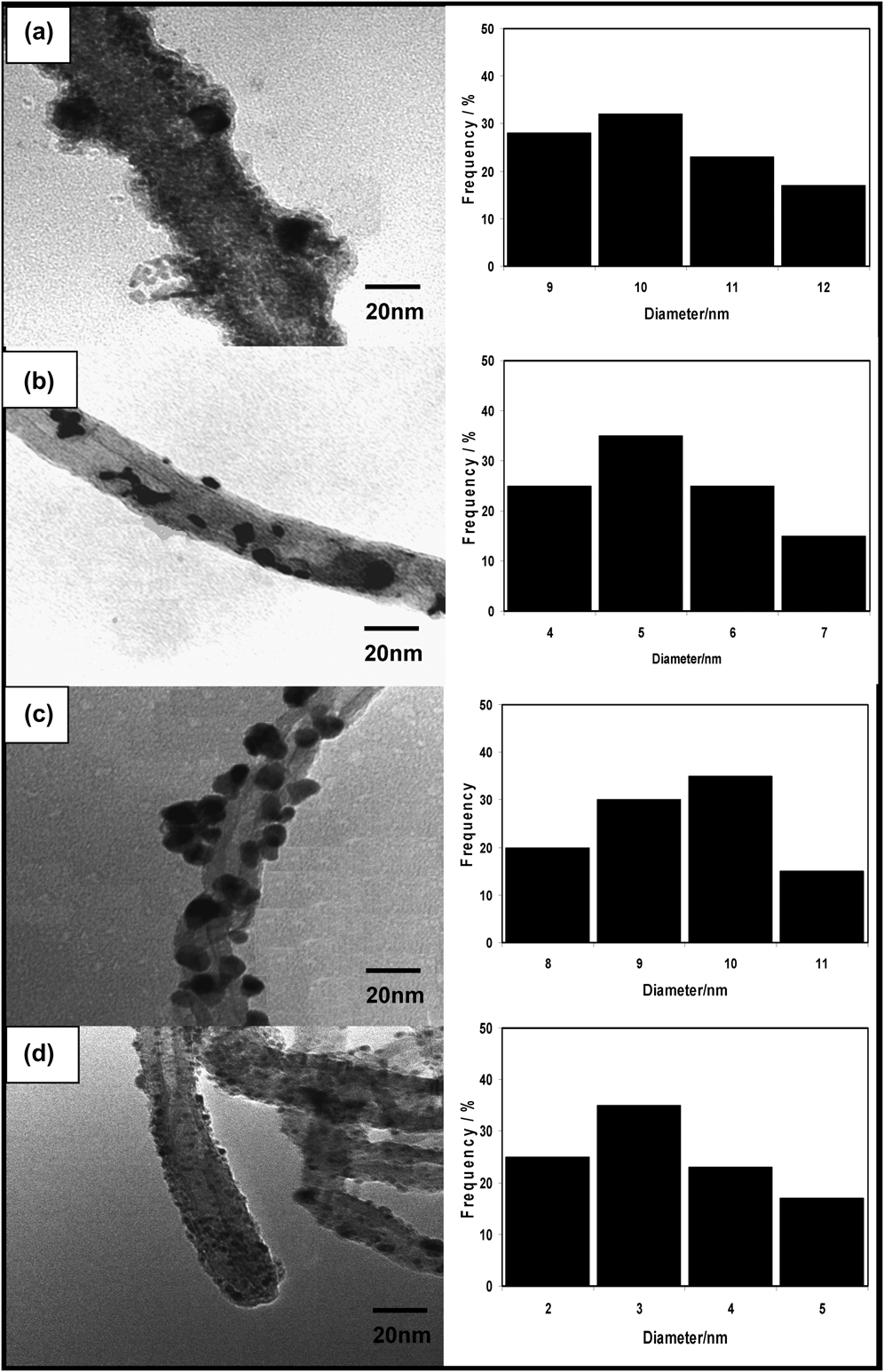
The acid-treated CNTs were deposited palladium on their surface by four different methods. The first method is the sensitization by an acidic solution of stannous chloride to deposit tin particles on the modified surface of CNTs.Reference Scharf, Neira, Hwang, Tiley and Banerjee39 The deposited tin-sensitized particles have a spherical shape with about 3–5 nm particle size and cover all the surface of the CNTs. The deposition of tin on the surface of CNTs depends on the concentration of stannous ion and the deposition time: as seen from a TEM micrograph in Fig. 4(c), the surface of CNTs was completely covered by tin particles after the deposition of 24 h. Successively, the palladium particles can replace with the tin particles and deposited on the surface of CNTs, depending on the deposition time as shown in TEM images in Fig. 4(d) after 1 h, Fig. 4(e) after 6 h, and Fig. 4(f) after 48 h. It was observed that by increasing the deposition time, the number of the palladium particles deposited on the sensitized CNTs increased. In addition, the particles of the deposited palladium ranged from 9 to 12 nm in size with a spherical particle shape and decorated the CNT, as shown in Fig. 5(a), i.e., the TEM image analysis for the deposited palladium particles on the CNT surface. The chemical reaction on the displacement of Sn by Pd ions is due to the difference in the oxidation–reduction potential of two metals (Sn4+/Sn2+ = 0.15 V and Pd2+/Pd = 0.987 V) and can be expressed by the following equations:


TEM micrographs and size distributions of Pd/CNT nanocomposite powders. (a) Prepared by Sn sensitization method, (b) prepared by polyol method, (c) prepared by hydrazine reduction, (d) prepared using G4 PAMAM dendrimers as an intermediator.

The palladium ions can replace with the adsorbed stannous ions, which dissolved in the solution as stannic ions, and the palladium metal can deposited on the CNT surface as palladium nanoparticles.
In the second method, ethylene glycol was used as a reducing agent of palladium ions in an alkaline sodium hydroxide solution under refluxing. Figure 5(b) shows a TEM image of the deposited palladium particles on the surface of CNTs. The TEM image analysis indicates that the mean particle size is 5 nm. This means that the palladium particles deposited by the polyol method using ethylene glycol as a reducing agent are finer than the particles deposited on the sensitized surface of CNTs in the first method. This result is expected because the tin particles deposited by sensitization have the size of approximately 2 nm and they become a kind of seed or nucleus for activating the deposition of the palladium metal on the sensitized surface of CNTs. It was observed that the deposited palladium particles on the MWCNTs have a 4–7 nm size and a decorated morphology.
In the third method for deposition of palladium particles, the palladium ions were reduced with hydrazine on the surface of CNTs. Hydrazine as a strong reducing agent can reduce palladium ions to palladium metal on the modified surface of CNTs. The reaction can be controlled by adjusting the solution to be acidic pH near 2 using nitric acid. The addition of hydrazine to the reaction solution should be carried out drop by drop to decrease the reaction rate and to control the deposition of the palladium on the surface of CNTs. Figure 5(c) shows a TEM image of the produced Pd/CNT nanocomposites from this method. It can be seen that the deposited palladium metal particles decorated on the surface of the CNTs. The analysis of TEM image shows the particle size distribution of the palladium metal between 8 and 11 nm with a mean particle size at 9 nm.
The last fabrication method of CNT/Pd nanocomposite is the G4 PAMAM dendrimer intermediation method. It has been reported that well-defined dendrimers with unique structures and compositions could be used to control the size and shape of metal and metal oxide nanoparticles on the surface of CNTs, and the solubility of composites.Reference Lu and Imae9, Reference Lu and Imae10 In the present study, after attached to CNTs, G4 PAMAM dendrimers were utilized to fabricate Pd nanoparticles with controlled size. A TEM image of CNT/dendrimer/Pd composites is shown in Fig. 5(d). It was found that the sizes of Pd nanoparticles deposited on CNT/dendrimer ranged between 2 and 5 nm. Obviously, all Pd nanoparticles were immobilized on the surface of CNTs, indicating strong interaction between dendrimers and Pd nanoparticles. Two types of interactions between them are known: one is the encapsulation of palladium nanoparticles in dendrimers and the other is the coordination of Pd nanoparticles outside dendrimers. The present results indicate that PAMAM dendrimers attached on CNTs play a role as a platform for the preparation of metal nanoparticles, matching with free dendrimers as a protector in medium. The platform is acting as a substrate for the nucleation of nanoparticles.
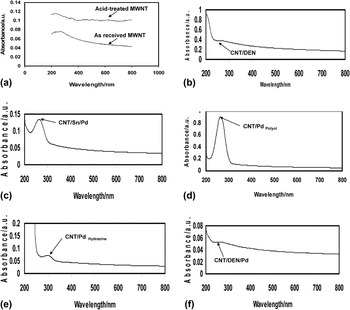
UV–visible spectrometry is also one of tools disclosing the size change of Pd particles depending on the fabrication method, as shown in Fig. 6. Because of the existence of CNTs [see Fig. 6(a)], all spectra showed a monotonic increase toward low wave length. The Pd/CNT composites synthesized by tin sensitization, polyol method, and hydrazine reduction showed strong characteristic absorption bands, as seen in Figs. 6(c)–6(e), owing to the relatively large particle sizes (5–12 nm), and the bands could be ascribed to the surface plasmon absorption of Pd nanoparticles. On the other hand, since the diameters of Pd/CNT nanoparticles synthesized using dendrimers as a platform were diminutive to be 2–5 nm (quantum dot size), the characteristic plasmon absorption appeared as a weak or nondistinctive band in the UV–visible spectrum [see Fig. 6(f)], since this band is overlapped with a band from CNT/dendrimer [see Fig. 6(b)]. These studies suggest that the dendrimer is playing an important role in the synthesis of nanoparticles on CNTs. Namely, dendrimers are immobilized on CNTs by covalent bonding, and nanoparticles are favorably fabricated on the dendrimer platform. In addition, the average diameter (3 nm) of nanoparticles is smallest in the present four methods. In the present work, CNT/dendrimer/Pd composites were produced by reducing the corresponding metal ions by NaBH4. It should be noted that all metal nanoparticles were fasten on the surface of CNTs, confirming the strong coordination between metal nanoparticles and covalent-bonded dendrimers on CNTs. As a result, the CNT/dendrimer/Pd composites were extremely stable.
UV–visible absorption spectra of MWCNTS and Pd/CNT nanocomposites dispersed in water. (a) As-received and acid-treated MWCNT, (b) CNT with dendrimer, (c) Pd/CNT nanocomposite prepared by tin sensitization, (d) Pd/CNT nanocomposite prepared by polyol method, (e) Pd/CNT nanocomposite prepared by hydrazine reduction, and (f) Pd/CNT nanocomposite prepared by using dendrimer as an intermediator.

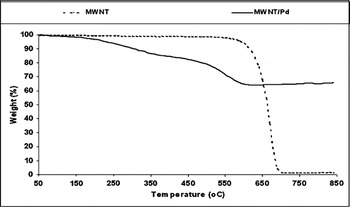
The Pd contents for the prepared samples were adjusted and evaluated by calculating the ratios between CNTs and Pd in the reactant and the products of the deposition reactions. In addition, the four deposition reactions of Pd are nonreversible reactions, and this means that all the Pd ions were converted to Pd metals deposited on the surfaces of CNTs. The produced sample powders were investigated by TGA analysis to determine the metal content. Weight percentage of the metallic content in Pd/CNT nanocomposite powders prepared by different methods was determined by TGA. As shown in Fig. 7, the purified MWCNT was almost completely burnt at the temperature range of 600–700 °C (dashed line). On the other hand, Pd/CNT nanocomposite powders weight lost up to 600 °C (solid line) due to the decomposition of CNTs and kept a constant weight of 70 wt.% above 600 °C. Therefore, from these results, the weight content of Pd nanoparticles was evaluated to be about 70% as shown in Fig. 7 for the sample powder prepared by tin sensitization followed by activation for 48 h.
TGA of purified MWCNT and Pd/CNT composite powders prepared by tin sensitization method.

IV. CONCLUSIONS
MWCNTs-supported palladium nanocomposite powders have been fabricated by acid functionalization followed by palladium deposition on its surfaces. Four different synthesis techniques were used to deposit palladium nanoparticles supported on MWCNTs. The techniques to mount the Pd nanoparticles were tin sensitization/activation, polyol method, hydrazine reduction, and using dendrimer as a platform. The results indicate that the acid-treated CNTs load several kinds of functional groups on the graphene structure such as carbonyl, carboxyl, and hydroxyl groups, and the acid treatment process is an efficient method for shortening CNTs to small segments, resulting in easy dispersion of CNTs in the solution. All Pd/CNT nanocomposite powders produced by four synthesis methods decorated the surface of CNTs. The palladium nanoparticles deposited by tin sensitization and hydrazine reduction have larger mean particle size than the nanoparticles by polyol method and dendrimer platform. In the fourth method, MWCNTs were successfully modified with NH2-terminated PAMAM dendrimers and Pd nanoparticles with narrow size distributions were directly synthesized onto dendrimers on CNTs. This method is very versatile since these metallic Pd nanoparticles were produced and anchored on the surface of CNTs. Moreover, since water-soluble dendrimers were covalently bonded on CNTs, the composite materials obtained were dispersible in water and extremely stable. The results show some light on the use of Pd/CNT composite to be a promising electrocatalyst for high performance formic acid fuel cell applications.