

Introduction
The COVID-19 pandemic highlighted the need for convenient voting procedures, and states responded by either changing rules to implement, expand, or make mail-in balloting easier (NCSL[a] 2020). Some estimates suggest “85% of the electorate [could] effectively vote by mail without an excuse” in the 2020 election (Pildes Reference Pildes2020). Several states, including Texas and Kentucky, dramatically expanded their early voting periods (Pildes Reference Pildes2020). There was pushback from the Trump Administration and from many Republicans arguing that expanding mail-in voting could lead to widespread fraud; however, despite those concerns and claims made after the election, there was no evidence of systematic voter fraud in the 2020 election (Balsamo Reference Balsamo2020).
Controversy over access to the ballot has been around since the founding of the Republic. Reforms to either restrict or expand voting across the history of the US have generally come at the state level. In recent years, many states have enacted Voter ID laws, which have the effect of restricting access to the ballot (NCSL[b] 2017). The implementation of Voter ID laws across the country generated a great deal of media attention. During this same time period, however, many states—including some states that implemented Voter ID laws, such as West Virginia and Washington—were implementing a variety of reforms to make registration and voting easier. This paper seeks to understand what factors influence whether or not a state adopted electoral reforms between 2001 and 2019.
We draw from two literatures to provide theoretical insight into why and how states innovate with electoral reforms. First, we employ the electoral reform literature to understand how within-state political dynamics affect the likelihood of adopting reforms that expand access to the ballot. Second, we use the policy diffusion literature to assess the role of policy learning on the spread of electoral reforms across states. Although individual states pursued a number of innovative electoral reforms in the 2000s, the policy diffusion literature provides leverage for understanding why so many states adopted reforms during this time period. Policies aimed at electoral reform have the potential to influence which citizens participate in our democracy. Therefore, it is critical to understand how states acting as laboratories of democracy may shape democracy itself.
Why do states innovate in a policy domain and how does state innovation affect the spread of a single policy? We use a broad approach to explain why states innovate within a single policy domain. Our novel 45-state, 19-year dataset includes the adoption of nine ballot and voting access reforms including election-day registration (EDR), same-day registration (SDR), automatic voter registration (AVR), portability, pre-registration, online registration, early voting, mail voting, and all-mail voting.Footnote 1 To answer why states adopt ballot reforms, we use regression with state fixed effects on the number of reforms adopted by states from 2001 to 2019. We find across-state learning and within-state politics can affect whether states adopt reforms to expand access to the ballot. States may be more or less likely to adopt reforms depending on the reforms of their neighbors. To address our second question, we use dyad analysis to assess the diffusion of a single reform: AVR. We find that traditional measures of diffusion do not account for the spread of AVR. Rather, states that are more innovative in electoral reform more broadly are more likely to adopt AVR and states that are more innovative are also more likely to be learned from. State innovation in electoral reforms varies across states, may be influenced by neighboring policies, and states that innovate in electoral reforms are more likely to adopt new reforms such as AVR.
Registration and Voting Reforms in the States
Election Day Registration
In the post-war era, the first major reform to make registration and voting easier was EDR, implemented first by Maine in 1973, followed over the next 2 years by Minnesota and Wisconsin (NCSL[c] 2020). EDR eliminates the closing date to place one’s name on the registered voter rolls and allows a citizen to register and cast a ballot on Election Day at the polling place. In the mid-1990s, three other states, Idaho, New Hampshire, and Wyoming, adopted EDR. In contrast to the first three states, they did so in order to avoid having to implement the National Voter Registration Act (NVRA) (Hanmer Reference Hanmer2009). Between 2005 and 2019, 15 additional states adopted EDR (NCSL[c] 2020). All of those states, except for Connecticut, also adopted SDR, in which citizens are allowed to register and vote on the same day, bringing the total to 21 states and the District of Columbia with SDR and/or EDR (NCSL[c] 2020).
1993 National Voter Registration Act, a.k.a. “Motor Voter”
In 1975, Michigan became the first state to allow citizens to register to vote when they acquire or renew a driver’s license or motor vehicle registration. Across the 1980s and the early 1990s, 29 states adopted “motor voter” procedures. Between 1984 and 1992, 10 states adopted policies providing the opportunity to register at certain public agencies (Knack Reference Knack1995). In 1993, President Clinton signed these reforms into federal law as the NVRA. NVRA mandated that all states allow residents to register to vote at motor vehicle offices, public libraries, state agencies, and military recruiting offices.Footnote 2 The idea behind “motor voter” begins with the premise that voluntary registration increases the costs associated with voting and therefore, plays a role in low turnout (Fullerton and Borch Reference Fullerton and Borch2008; Hill Reference Hill2006; Jackman Reference Jackman1987; Powell Reference Powell1986; Vonnahme Reference Vonnahme2012). Therefore, making the opportunity to register available to as many people as possible—through policies such as “motor voter”—should increase the proportion of the electorate registered to vote, and thus increase turnout.
Early Voting, No-Excuse Absentee, All-Mail Elections
While EDR and “motor voter” are aimed at easing the inconvenience of registration, other policies attempt to make the act of voting more convenient. In the late 1980s and early 1990s, eight states implemented early voting programs that allowed citizens to cast an in-person ballot up to three weeks prior to election (NCSL[d] 2020).Footnote 3 During this time, six states allowed citizens to cast no-excuse absentee ballots (Stein Reference Stein1998). Since then, states have continued to expand early voting and no-excuse absentee ballot voting options (NCSL[d] 2020; NCSL[e] 2020). In 2000, Oregon moved to all-mail elections, where a ballot is automatically mailed to every eligible voter meaning that no request or application is necessary to receive a ballot. In the last decade, Oregon was joined by Washington, Colorado, Hawaii, and Utah in its efforts to expand no-excuse absentee ballot voting options (NCSL[e] 2020). Several other states have provisions that allow for certain statewide or smaller jurisdiction elections to be conducted by mail (Cemenska et al. Reference Cemenska, Leighley, Nagler and Tokaji2009; NCSL[e] 2020),Footnote 4 and since 2000, another 11 states have provided their residents the option to vote by mail.Footnote 5
Pre-Registration
During the last three decades, 24 states implemented laws that allow individuals to register before they turn voting age, known as pre-registration (NCSL[f] 2019), which has been linked to increased voter turnout (Holbein and Hillygus Reference Holbein and Hillygus2016, Reference Holbein and Hillygus2017). Although Missouri and Hawaii had pre-registration as early as 1993, all other states that adopted pre-registration did so in the 2000s, with most doing so after 2010 (NCSL[f] 2019). While there is variation among states regarding the age individuals must be to pre-register, all of these states have adopted legislation aiming to register individuals before they turn 18. While Voter ID laws being challenged in court have received nationwide media attention, pre-registration has faced its own court litigation in places like North Carolina (NCSL[f] 2019).
Portability
Portability is an electoral reform that allows registrants who move anywhere within a state to transfer their registration and vote on Election Day. While NVRA requires states to permit voters who move within a local election jurisdiction without updating their voter registration to be allowed to vote on Election Day (McDonald Reference McDonald2008, 497), it does not necessarily require states to permit this for voters who move outside their local election jurisdiction. Several states allowed portability in the 1990s, and five have adopted the process since the turn of the century. EDR, in essence, is another policy that continues to allow statewide portable registration, with the new added benefit of allowing first-time voter registration on Election Day (Brennan Center[a] 2017; Cha and Kennedy Reference Cha and Kennedy2014; McDonald Reference McDonald2008; Skaggs and Blitzer Reference Skaggs and Blitzer2009).
Online Registration
Online voter registration is one of the most recent and widespread electoral reforms. When this policy is in place, voters fill out an online form rather than a paper application to register to vote (NCSL[g] 2020). Arizona was the first state to adopt online voter registration in 2002 and it has spread rapidly across the United States (NCSL[g] 2020; Project Vote 2017; Yu Reference Yu2019). Today, almost all US states have online voter registration (NCSL[g] 2020) which in some studies has been shown to increase turnout (Yu Reference Yu2019). Given the novelty of this reform, much less work has been done on the adoption of online registration, although Hicks, McKee, and Smith (Reference Hicks, McKee and Smith2016b) find that online voter registration has even more bipartisan support for its adoption than AVR.
Automatic Voter Registration
Used widely around the democratic world, AVR is a system in which the state takes the responsibility to add a citizen’s name to the registration rolls when that person comes of voting age. In 2015, Oregon became the first state to implement an AVR system (NCSL[h] 2020; Oregon State Legislature 2015). The policy adopted by Oregon makes two major changes to voter registration. First, it transforms the system of voluntary registration from an “opt-in” system, in which individuals had to choose to place their name on the list of registrants, to an “opt-out” system meaning that eligible citizens who interact with government agencies are automatically registered to vote unless they decline or “opt out” of the registration (Brennan Center [b] 2020). Second, AVR automatically updates information in the voter rolls once it is changed at another state agency, like the DMV. According to a Pew study, one in eight registrations nationwide contains errors or outdated information, such as an incorrect address (PEW 2012). The added benefit of automatically updating information electronically is that it saves officials time and money, thereby making the process more efficient. Following Oregon, another 19 states and the District of Columbia have adopted AVR systems (NCSL[h] 2020).
Seeking Explanations for the Adoption of Reforms
The two decades since 2000 have seen a dramatic increase in the adoption and implementation of registration and voting procedures that seek to make registration and voting more convenient for potential voters. We turn to the literature on policy diffusion—the spread of policies across governments—to provide explanations for why states choose to adopt convenient registration and voting procedures. Policies can spread through different mechanisms, one being policy learning which is when policymakers learn from other governments’ policy, adapt, and use it for their state (Shipan and Volden Reference Shipan and Volden2008, Reference Shipan and Volden2014).
We provide two contributions by applying insights from policy diffusion to the spread of electoral reforms. First, we examine why states innovate in a policy domain. Scholarship on policy diffusion has often studied the spread of a single policy or numerous policies across domains. Although this can provide important insights into how policy spreads, it may prevent us from forming broader theories as to how policy ideas within a domain spread across states. Therefore, rather than examine a single electoral reform, we ask why states adopt reforms within a policy domain. Second, we analyze policies within a policy domain that is not typically the subject of policy diffusion studies. Scholarship has focused on the diffusion of smoking legislation (Shipan and Volden Reference Shipan and Volden2006, Reference Shipan and Volden2008, Reference Shipan and Volden2014), lottery policies (Berry and Berry Reference Berry and Berry1990), welfare policies (Karch Reference Karch2007), as well as others. By examining the spread of electoral policies, we may expand the types of policies studied by diffusion scholars.
While to our knowledge studies have not focused exclusively on the diffusion of electoral reforms, many have examined the adoption of electoral policies with most focusing on the adoption of restrictive Voter ID laws (Bentele and O’Brien Reference Bentele and O’Brien2013; Biggers and Hanmer Reference Biggers and Hanmer2017; Hale and McNeal Reference Hale and McNeal2010; Hicks et al. Reference Hicks, McKee, Sellers and Smith2015; Hicks, McKee, and Smith Reference Hicks, McKee and Smith2016a; Rocha and Matsubayashi Reference Rocha and Matsubayashi2014), and a few examining the adoption of reforms facilitating access (Bali and Silver Reference Bali and Silver2006; Biggers and Hanmer Reference Biggers and Hanmer2015; Hicks, McKee, and Smith Reference Hicks, McKee and Smith2016b).Footnote 6 Of these works, four included variables to measure the percentage of neighbors having the policy in question in place (Bentele and O’Brien Reference Bentele and O’Brien2013; Biggers and Hanmer Reference Biggers and Hanmer2015, Reference Biggers and Hanmer2017; Rocha and Matsubayashi Reference Rocha and Matsubayashi2014). None of these studies found the percentage of neighbors had a significant or substantive effect on adoption of reforms.
Although other scholarship has assessed the geographic spread of a single electoral reform, our work examines how multiple electoral reforms may spread across states. This provides an opportunity to explore the role of policy characteristics on the spread and adoption of electoral reforms. Electoral reforms may spread differently than other policies commonly studied by diffusion scholars. These reforms directly affect people’s ability to participate in the democratic process and therefore, people may be more likely to be invested in whether these reforms are passed. Voting reforms may also be less complex than other types of policies which could lead many to have more formed attitudes. Therefore, these policies may be more salient than other types of policies and more likely to diffuse across US states (Nicholson-Crotty Reference Nicholson-Crotty2009).
Policy learning is an important mechanism in the spread of policies across governments (Gilardi Reference Fabrizio2010; Shipan and Volden Reference Shipan and Volden2008, Reference Shipan and Volden2014; Volden Reference Volden2016). States may be more likely to adopt electoral reforms when they learn about the reforms tried in other states, particularly if those reforms are successful (Volden Reference Volden2006). States may face pressure by citizens to adopt voting reforms as nearby states make registering and voting easier (Pacheco Reference Pacheco2012). Therefore, we expect that states whose neighbors have adopted electoral reforms will be more likely to adopt reforms.
Policy Learning Hypothesis: States with neighbors who have adopted electoral reforms will be more likely to adopt electoral reforms.
The Policy Learning hypothesis may be conditioned by the electoral reform itself. Examining state innovation within a policy domain allows us to assess the role of each policy on the likelihood of state innovation. States may learn from other states, but could that learning look different based on the electoral reform? Generally, we expect that across-state learning facilitates the adoption of policy, especially when the policy is successful (Volden Reference Volden2006). However, this may not always be the case. For example, states may learn from other states’ policy failures and abandon policies (Volden Reference Volden2016). Examining why states adopt reforms within a policy domain may provide insight into state innovation more generally.
Electoral policies also have the potential to directly influence which candidates are elected. Elected officials, then, may have a particular interest in electoral reforms that could provide an advantage in their or their party’s re-election efforts. Electoral considerations affect the spread of policies across states (Karch Reference Karch2007). Re-election interests coupled with the salience of the policy may result in particularly partisan and contentious politics surrounding the adoption of electoral policies (Bali and Silver Reference Bali and Silver2006; Bentele and O’Brien Reference Bentele and O’Brien2013; Biggers and Hanmer Reference Biggers and Hanmer2015, Reference Biggers and Hanmer2017; Hale and McNeal Reference Hale and McNeal2010; Hicks et al. Reference Hicks, McKee, Sellers and Smith2015; Hicks, Mckee, and Smith Reference Hicks, McKee and Smith2016a, Reference Hicks, McKee and Smith2016b; Rocha and Matsubayashi Reference Rocha and Matsubayashi2014).
This may, however, be conditioned by the electoral competition in the state. Scholarship has found that partisan support for restrictive Voter ID policies among Republican legislators was greater in competitive states than in non-competitive states (Bentele and O’Brien Reference Bentele and O’Brien2013; Hicks et al. Reference Hicks, McKee, Sellers and Smith2015; Hicks, Mckee, and Smith Reference Hicks, McKee and Smith2016a, Reference Hicks, McKee and Smith2016b;). Hicks, McKee, and Smith (Reference Hicks, McKee and Smith2016b) found that the effect of electoral margin on Democratic legislator support for online registration was conditioned by whether or not the Democrats were in the minority. Therefore, it is likely that legislators in electorally competitive states may be less likely to support policies that provide greater access to the ballot if they believe there is a partisan advantage to doing so. Therefore, we expect within-state party control in highly competitive states to predict a state’s likelihood of adopting voting reforms.
Party Competition Hypothesis: States with Republican-controlled legislatures and Republican governors in electorally competitive states will be less likely to adopt reforms that make registration and voting easier.
Why do states innovate in electoral reforms? We expect that states may be more or less likely to innovate in electoral reforms due to both inter-state and intra-state pressures. Using the policy diffusion literature, we expect that states will be more likely to innovate when their neighbors innovate. However, this may depend on the electoral reform itself. We also expect that party control, conditioned by electoral competition, may influence whether states adopt electoral reforms.
Data and Methods for the Adoption of Electoral Reforms
To assess why states adopt voting reforms, we created a novel dataset containing state-level variables for 45 states from 2001 to 2019.Footnote 7 The dependent variable is a composite measure of the number of expansive electoral reforms a state has in a given year. This includes nine potential reforms including EDR, SDR, portability, AVR, pre-registration, early voting, vote by mail, online registration, and all-mail voting. States received a one for each reform adopted.Footnote 8 The variable ranges from 0 to 8 with a mean of 1.96 and standard deviation of 1.59. Because states can adopt anywhere between 0 and 9 reforms, we utilize a regression with state-fixed effects.Footnote 9 One way to model policy diffusion of components of policies is through ordinary least squares regression (Boehmke Reference Boehmke2009). OLS regression, rather than a count model, is more appropriate because our data violate assumptions of negative binomial and Poisson models. Adopting electoral reforms may make it more likely for states to adopt other reforms thereby violating the assumption that the events are independent.Footnote 10 Due to the panel nature of the data, a regression with state-fixed effects is the most appropriate way to estimate the number of reforms a state has in a given year.Footnote 11
We are able to expand our understanding of how learning can affect the spread of policies by analyzing multiple policies in a single domain. We include a measure of the fraction of neighbors with each of the electoral reforms to see the independent effect of each policy on the adoption of electoral reforms more broadly. We include the fraction of neighbors with EDR, SDR, AVR, portability, vote by mail, online registration, and with all-mail voting. The proportion of neighbors with a policy is often used to measure diffusion (Berry and Berry Reference Berry and Berry1990; Karch and Cravens Reference Karch and Cravens2014; Shipan and Volden Reference Shipan and Volden2006) and, more specifically, learning (Shipan and Volden Reference Shipan and Volden2008). States may also be influenced by neighboring policies that can restrict registration or voting. Therefore, we include a measure of the fraction of neighbors with strict and non-strict Voter ID policies.
We expect both within-state and across-state political and policy dynamics to affect the likelihood of states adopting registration reforms (Berry and Berry Reference Berry and Berry1990). We include the party control of the legislature and executive branch. We expect that states controlled by Republicans will be less likely to adopt vote-expanding reforms in electorally competitive states (Biggers and Hanmer Reference Biggers and Hanmer2015; Hicks, McKee, and Smith Reference Hicks, McKee and Smith2016b). In order to test the Party Competition hypothesis we also include Holbrook and Van Dunk’s (Reference Holbrook and Dunk1993) measure of electoral competition. The measure is based on district-level competition and ranges from 0 (indicating no competition at all) to 100 (indicating a perfectly competitive electoral environment) (Holbrook and Van Dunk, Reference Holbrook and Dunk1993).Footnote 12
For the adoption of electoral reforms, characteristics of the state electorate and the propensity towards innovation may be particularly important. States that have adopted a Voter ID policy may be less likely to adopt electoral reforms. States may be more likely to adopt electoral reforms if they have a larger voting-eligible population (VEP), a more educated population, or more resources to implement the reforms. At the same time, states with a larger proportion of minority residents may face pressure to make registration and voting more difficult (Bentele and O’Brien Reference Bentele and O’Brien2013; Biggers and Hanmer Reference Biggers and Hanmer2017; Hale and McNeal Reference Hale and McNeal2010; Hicks et al. Reference Hicks, McKee, Sellers and Smith2015; Hicks, Mckee, and Smith Reference Hicks, McKee and Smith2016a, Reference Hicks, McKee and Smith2016b).Footnote 13 Therefore, we include a measure of whether the state has a Voter ID policy, government administration spending as a proportion of total state expenditures, percent of residents with a Bachelor’s degree or higher, the VEP as a proportion of the total population, the percent of Black residents, and the percent of Hispanic residents.Footnote 14 Following Boehmke (Reference Boehmke2009), we also include the log of the number of reforms not adopted by a state.Footnote 15 Our measures of government administration, education level, and minority population are lagged by 1 year.
Results
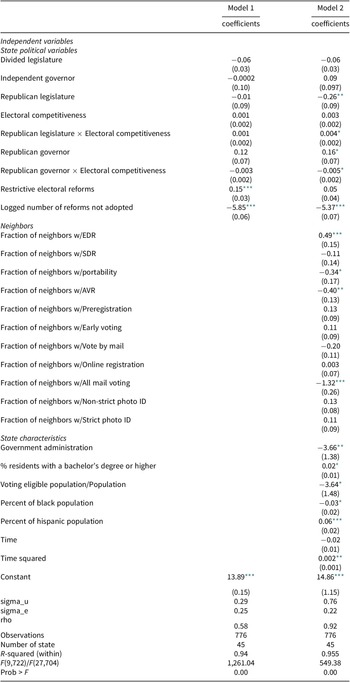
The results of our model can be found in Table 1. Model 2, the full model, demonstrates the importance of examining why states adopt policies within a domain. States may be learning from their neighbors when adopting electoral reforms, but different policies within the domain have different effects on state innovation. The model shows some support for our Policy Learning hypothesis. The only electoral reform that had a positive effect on state innovation was EDR. States with a greater proportion of neighbors with EDR are associated with the adoption of 0.49 more electoral reforms than states with fewer neighbors with EDR.
Regression with state fixed effects on adoption of voting reforms

Note. Standard errors in parentheses. OLS model with state fixed effects.
Abbreviations: AVR, automatic voter registration; EDR, election-day registration; SDR, same-day registration.
*** p < 0.001;
** p < 0.01;
* p < 0.05.
Model 2, however, suggests that some states may be learning to not adopt certain policies from their neighbors. States with a greater proportion of neighbors with portability policies are associated with adopting 0.34 fewer reforms than states with fewer neighbors that have portability policies. Similarly, states with a greater proportion of neighbors with AVR and all mail voting are associated with adopting 0.40 and 1.32 fewer reforms, respectively. Overall, when a state is surrounded by more neighbors that have portability, AVR, and all mail voting, the state adopts fewer electoral reforms. This suggests that innovating in the electoral reform domain is affected by neighboring states and that reforms within a policy domain may have different effects on state innovation. Innovation within a policy domain, then, may be dependent upon the spread of specific reforms and the characteristics of those reforms. Indeed, some reforms may actually reduce state innovation.
It may be that states are more concerned about adopting risky policies. Risky policies might be ones that most depart from current practice, which can result in implementation struggles and potential policy failure (Cohen and Moffitt Reference Cohen and Moffitt2009). Policies may be riskier when opponents can mobilize significant political and constituent backlash. Portability may be less favorable to election administrators who have less control over the voter rolls and may make states hesitant to adopt and implement similar policies. AVR and all-mail voting may be risky because they can result in the harshest political consequences. In the case of AVR and all-mail voting, opponents have utilized salient and non-complex criticisms against these reforms, especially fraud and security concerns (Norwood Reference Norwood2018; Vasilogambros Reference Vasilogambros2019). This has led to significant elite-driven constituent backlash and political polarization (Taddonio Reference Taddonio2020). Given the politicization of these reforms that have the potential to significantly increase ballot access, states may be more hesitant to pursue reforms when their neighbors are adopting the most progressive ballot access reforms.
Party control of the executive branch affects the adoption of electoral reforms in electorally competitive states, but in interesting ways. This provides some support for our Party Competition hypothesis. We expected Republican-controlled legislatures and executive branches in electorally competitive states to be less likely to adopt reforms making it easier to vote. States that have both competitive elections and a Republican governor are associated with adopting 0.005 fewer reforms. However, when electoral competitiveness is 0, having a Republican governor is associated with adopting 0.16 more electoral reforms than a Democratic governor. This demonstrates that the electoral competitiveness in the state is important for the effect of party on adopting electoral reforms. The effect, however, is small. At an electoral competitiveness rate of 35 and 55, the marginal effects of adopting electoral reforms with a Republican Governor are 1.961 and 1.958, respectively. For Democratic or Independent governors, the marginal effects of adopting electoral reforms at the same levels of electoral competitiveness are 1.957 and 2.046. In states with high levels of electoral competition, the party of the governor may matter for adopting electoral reforms.
The interaction between electoral competitiveness and Republican-controlled legislatures is positive; however, it is quite small. At an electoral competitiveness rate of 35 and 55, the marginal effects of adopting electoral reforms with a Republican legislature are 1.901 and 1.987, respectively. It seems that the conditional effect of electoral competition may be different for legislatures as Republican-controlled legislatures are slightly more likely to adopt reforms in states with greater electoral competition. These results provide limited support for the Party Competition hypothesis. As electoral competitiveness increases, states with Republican governors adopt fewer electoral reforms and states with Democratic or Independent governors adopt more electoral reforms. However, the effect of electoral competition and party control of the legislature is in the opposite direction. Both of these effect sizes are quite small.
Certain state demographic characteristics may be important for the adoption of electoral reforms. The percent of Black residents in the state has a small negative effect on the adoption of electoral reforms; however, states with larger Hispanic populations adopt more electoral reforms. This finding is partly consistent with Biggers and Hanmer’s (Reference Biggers and Hanmer2015) analysis that found the size of the Hispanic population was positively related to the adoption of early and no-excuse absentee voting while the size of the Black population had no significant effect.
The results suggest that learning may affect state innovation in the domain of electoral policy. Our study is unique in that we are able to examine why and under what conditions states will innovate in a policy domain. By focusing on a group of electoral reforms, our analysis investigates innovation more broadly, rather than state experimentation with a single policy or variations of a single policy. However, while an important step in diffusion research (Kreitzer and Boehmke Reference Kreitzer and Boehmke2016), we may miss important nuances of the spread of electoral reforms by examining the policy domain rather than a single policy.Footnote 16 To further investigate the role of policy learning and within-state political dynamics on the likelihood of adopting electoral reforms, we conduct dyad analysis to predict the spread of AVR.
Automatic Voter Registration
Assessing the adoption of electoral reforms more broadly provides an opportunity to examine the role of within and across-state innovativeness on the adoption of a single policy. AVR is an appropriate policy to examine because it is one of the newest and most innovative electoral reforms. AVR is similar to other registration reforms in that it attempts to expand registration with the added benefit of shifting the responsibility of registration from the potential voter to the government agency. Furthermore, AVR may provide insights into the diffusion of future electoral reforms because of its fairly recent development and diffusion, thereby being better representative of the current political context than registration reforms that diffused decades ago. From the analysis above, AVR does have across-state effects on policy adoption. Therefore, AVR may help us better understand how a single electoral reform spreads across states.
The study of policy diffusion began with efforts to understand state innovativeness generally (Walker Reference Walker1969). There has been more recent attention to state innovation as a more general trait (Boehmke and Skinner Reference Boehmke and Skinner2012) and what causes a state to innovate in the first place (Parinandi Reference Parinandi2020). However, studies on state innovation tend to examine many policies across multiple domains. Examining the adoption of innovations within a policy domain and the adoption of a single policy provides leverage for how the propensity to innovate within a policy domain could affect the spread of a single policy.
States may be more likely to adopt a new policy when they already have the propensity to innovate. Having already adopted reforms in a policy domain may reduce the risk of adopting a new policy. Additionally, prior innovations in a policy domain may raise the salience of an issue, thereby increasing the likelihood of adopting a new policy (Nicholson-Crotty Reference Nicholson-Crotty2009). Especially if initial reforms were successful, lessons learned from a previous reform may help states innovate further. In essence, states may learn from themselves (Smith Reference Smith2022).
Within State Innovation Hypothesis: States that are more innovative in electoral reforms will be more likely to adopt AVR.
States may also be more likely to learn from a state that is considered an innovator within a policy domain. Similarities across states and characteristics of leading states can affect whether states adopt new policies or abandon policies (Volden Reference Volden2006, Reference Volden2016). When other states are leading innovators in a policy domain, they may be more likely to be a source of policy lessons for other states because they may be seen as more reliable. Therefore, we expect states to learn from more innovative states.
Acro-State Innovation Hypothesis: States are more likely to learn from another state and adopt AVR when that state is more innovative in a policy domain.
Party support for reforms may affect their spread. Hasen (Reference Hasen2012) writes about the increase in partisan ‘voting wars’ surrounding electoral reform during the last two decades. However, Mann et al. (Reference Mann, Gronke and Adona2020) recognize that more Democratically controlled states have passed the reform and that there are partisan gaps in public support for AVR, with Democrats supporting AVR more than Republicans. Nevertheless, despite the claims about bipartisan support, we expect states with Republican-controlled legislatures to be less likely to adopt AVR.
Party Politics Hypothesis: States with unified Republican governments are less likely to adopt AVR.
Electoral competition, or lack thereof, may be an important consideration in adopting AVR. In states with low levels of electoral competition, politicians, no matter the party, may be more likely to adopt AVR. If a state is largely controlled by one party without much electoral competition, adopting AVR may register voters who are likely to vote with the dominant party. This may reduce concern among politicians that adopting AVR could affect electoral outcomes. However, it may be riskier for politicians to pursue a policy that creates an opt-out registration system in electorally competitive states because it may change the partisan makeup of voters. Therefore, we expect states with low levels of electoral competition to be more likely to adopt AVR.
AVR Electoral Competition Hypothesis: States with less electoral competition will be more likely to adopt AVR.
History of AVR
Twenty states and D.C. have adopted AVR, and nine adopted the reform prior to the 2018 elections (NCSL[h] 2020). In our analysis, we include 18 states as having adopted AVR because our dataset extends until 2019 and New York and Virginia did so in 2020 (New York State Senate 2020; Virginia State Legislature 2020). Across these states, there are differences in terms of the process through which the policy was enacted.
Most states that have adopted AVR have done so through legislation. In 2015, Oregon—a state that had already experimented with and implemented a wide variety of reforms—became the first state to adopt AVR in 2015 along partisan lines (Oregon State Legislature 2015). Republican legislators in Oregon expressed concerns that the new legislation would lead to ID theft and raised worries about the privacy of citizens (Mapes Reference Mapes2015). Democrats countered that ID theft would not be a concern because people would still have to present proof of citizenship at the time of interaction with the DMV; in terms of privacy, there would be protections in place for police officers and domestic violence victims (Mapes Reference Mapes2015). These arguments are common in states that adopted AVR along partisan lines with Democrats supporting the reform and Republicans opposing it.
West Virginia was the first state to adopt AVR with broad bipartisan support—they were able to do so because the law was a combination of stricter voter identification laws and automatic registration (Marra Reference Marra2016). Vermont, Illinois, Washington, and Massachusetts also adopted AVR with bipartisan support (Illinois General Assembly 2017; Massachusetts Legislature 2018; Vermont General Assembly 2016; Washington State Legislature 2018). Other states that adopted AVR through legislation include Rhode Island, Maryland, New Jersey, and Maine (NCSL[h] 2020).Footnote 17
Legislative procedure is not the only way that AVR has been adopted. In Georgia, Colorado, and New Mexico, AVR was implemented through administrative procedures at the Department of Motor Vehicles (AJC 2016; Brennan Center [c] 2020; NCSL[h] 2020). In both Colorado and New Mexico, these administrative procedures were subsequently followed up by legislation which further cemented the AVR system (Hernandez Reference Hernandez2019; Office of the Governor New Mexico 2019). Colorado and New Mexico also have a strong tradition of electoral reform innovation, albeit with Colorado leading the charge compared to New Mexico. Connecticut also adopted AVR through administrative procedure, although it was through an agreement between the Secretary of State and the Department of Motor Vehicles (Secretary of the State of Connecticut 2016).
AVR has also been approved by referendum. In November 2016, Alaska voters approved Ballot Measure 1, which automatically registers eligible individuals to vote when they apply for a Permanent Fund Dividend—a program specific to Alaska—unless they opt out. The ballot measure was approved by 63.7% of the voters and was the first case where the public had the option to directly vote on AVR through a referendum (Alaska Department of Revenue 2018). Michigan and Nevada have also adopted AVR through referendums (NCSL[h] 2020).
AVR has spread to almost half of the states. In 2019, AVR was brought to the forefront when it was adopted by House Democrats as part of a broad electoral reform package in the US Congress, H.R. 1, the “For the People Act,” which included campaign finance reform and provisions tackling gerrymandering (Kolinovsky Reference Kolinovsky2019). However, due to the partisan nature of these reforms the bill was not heard on the Senate floor and was largely seen as symbolic in nature. At the state level, red and blue states alike are adopting AVR, although some along partisan lines and others with bipartisan support. Many of the states that paved the way to wider spread of AVR, namely Oregon and California, are electoral reform innovators themselves. This leads to several questions: Why did AVR, a sweeping reform, spread across the states? What was the role of policy learning, state innovation, and partisan politics in the adoption of AVR? We take up these questions below.
AVR Data and Methods
We use a logistic regression with state dyads as the unit of analysis to examine the spread of AVR. Prominent diffusion studies have used dyad analysis to assess policy diffusion because it conceptualizes state-to-state relationships (Nicholson-Crotty and Carley Reference Nicholson-Crotty and Carley2018; Volden Reference Volden2006, Reference Volden2016). In dyad analysis, each state has the potential to learn from each of the other 49 states meaning that each state could adopt the same policy as each of the other states. We can think of the adopting state (State A) as having an opportunity to learn from another state (State B) after State B has adopted the policy. The unit of analysis, then, is the StateA-StateB dyad. Each dyad is coded as a one if learning occurs meaning State A adopts the policy after State B has adopted the policy.
The first state to adopt AVR was Oregon in 2015. Therefore, our dataset extends from 2016 (the first-year learning could occur) to 2019. Following Nicholson-Crotty and Carley (Reference Nicholson-Crotty and Carley2018), we exclude all state dyads after the adopting state adopted the policy and initial adopters as they did not have an opportunity to learn from other states (Oregon and California).Footnote 18 From 2016 to 2019, we have a total of 6,540 state dyads. Of those dyads, 2.75% learned from each other so that State A adopted AVR after State B had adopted the policy.
To test the Within and Across State Innovation hypotheses, we include a measure of state innovativeness for both State A and State B in the electoral reform policy domain. This includes the number of electoral reforms (excluding AVR) that State A has adopted and the number of electoral reforms (excluding AVR) State B has adopted.
We include similar independent variables in the logistic regression as we did in our fixed effects model on state innovation. We include a measure of whether states are neighbors and the fraction of neighbors with AVR to assess learning. These are common measures in diffusion studies (Shipan and Volden Reference Shipan and Volden2008; Volden Reference Volden2016) and our prior analysis suggests that having neighbors with AVR may make it less likely for states to adopt AVR. We also include whether any neighbor has a Voter ID policy as well as whether the state itself has a Voter ID policy. The Party Politics hypothesis expects that states with unified Republican governments will be less likely to adopt AVR. We include the political similarity between State A and State B in terms of whether they both have unified Republican or unified Democratic governments (Volden Reference Volden2006, Reference Volden2016).
We also include the absolute difference between investment in government administration and electoral competitiveness between State A and State B. We include state demographic data that is specific to State A including party control and the minority population. These State A specific characteristics may affect whether State A learns from State B. Finally, we include data specific to State B including party control of state B and electoral competitiveness in State B. These characteristics of State B may condition learning and affect whether State A learns from State B.
Results
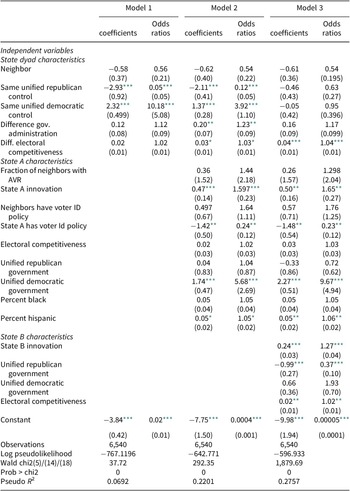
The results of the logistic regression on the spread of AVR are in Table 2, which presents the coefficients and odds ratios. The analysis suggests that the spread of AVR is affected by state innovation in an entire policy domain more so than innovation with AVR itself. Model 3, the final model, supports both the Within and Across State Innovation hypothesis. States are more likely to adopt AVR when they are more innovative in electoral reforms. The odds ratios of Model 3 suggest that states with more electoral reforms are about 65% more likely to adopt AVR. However, it is not just the propensity of State A to innovate that can affect the spread of a single policy. The propensity of State B to innovate in the domain of electoral reforms also makes it 27% more likely that State A will learn from State B. Innovation within an entire policy domain may be influencing the adoption of specific policies.
Logistic regression on state dyads for adoption of AVR

Note. Standard errors in parentheses. Forty-four state clusters; standard errors clustered on State A.
Abbreviation: AVR, automatic voter registration.
*** p < 0.001;
** p < 0.01;
* p < 0.05.
The model demonstrates mixed support for the Party Politics hypothesis. The similarity of party control between states is not statistically significant in predicting adoption of AVR in Model 3. However, when State A is under unified Democratic control it is about 9.6 times more likely to adopt AVR than a state under divided government. Party control also affects whether State B is learned from. When State B is under unified Republican control, it is about 63% less likely to be learned from by State A. Party control of the state likely provides a cue to other states whether the policy is a red or a blue policy. This supports the argument that the adoption of AVR is likely a partisan one. Although some states, such as West Virginia, adopted AVR under bipartisan support, AVR’s diffusion story may be marked by partisan struggle.
The results do not support our Electoral Competition hypothesis. The competitiveness within states does not have a statistically significant effect on adopting AVR. However, the difference in electoral competition between State A and State B may be an important factor in adopting AVR. As the difference in electoral competition between State A and State B grows, State A is about 4% more likely to adopt AVR. This is a small but statistically significant effect.
The results do not support that states are learning from their neighbors when deciding whether to adopt AVR. This traditional measure of diffusion is not as important in the spread of AVR as the general propensity to innovate by State A and State B. The spread of single reforms, then, may also rely on learning from innovation within a policy domain more generally. The characteristics of State A and State B can affect the adoption of policies. It seems the broader propensity to reform by both State A and State B is a more important cue in adopting AVR. It may be less risky for State A to adopt a sweeping reform, such as AVR, when they have already adopted a number of electoral reforms. State A may have more confidence that AVR will work or they may become more familiarized with reforms in a policy domain as they continue to innovate within that domain. Innovation by State B is also an important cue for State A. State A is more likely to adopt AVR when State B is an innovator in electoral reforms. This suggests that states considered to be leaders may need to be leaders in an entire policy domain, not just in the innovation of a single policy.
Conclusion
This paper presents a novel analysis of the adoption and spread of electoral reforms across the US states. From examining the adoption of multiple electoral reform policies, our results suggest that states learn from the policies of their neighbors when innovating in electoral reforms. Our analysis of a single electoral reform, AVR, suggests that state innovation in electoral reforms is important for the spread of AVR across states. We find states that are more innovative are more likely to adopt AVR and states that are more innovative are more likely to be learned from by other states.
We make two broad contributions to the understanding of state innovation and electoral reforms. First, we extend both the diffusion and electoral reform literature into new territory by contributing further to our understanding of how and why electoral reforms may spread across the US. Second, rather than focus on a single reform, we examine why and under what conditions states innovate in the policy domain of electoral reforms. This provides leverage to examine how individual reforms may have different effects on state innovation.
This paper raises new avenues for future research. First, conducting dyad analysis on other, less sweeping electoral reforms may provide further insight into why states adopt electoral reforms. Research could examine whether we see similar effects on the spread of other less sweeping registration and voting reforms. Second, future research should continue to study the spread of voting and registration-restricting reforms. This paper focuses on reforms that expand ballot access. However, as is well-documented, states have also been adopting reforms that restrict access to the ballot. More research should be conducted exploring whether or not, to what extent, and how states learn from other states about policies to restrict access. Third, policy entrepreneurs may play a role in the spread of electoral policies. Although outside the scope of this paper, future research could use qualitative methods to examine whether and how policy entrepreneurs contributed to the spread of these policies.
Supplementary Materials
To view supplementary material for this article, please visit http://doi.org/10.1017/spq.2022.22.
Data Availability Statement
Replication materials are available on SPPQ Dataverse at https://doi.org/10.15139/S3/7TDTGW (Smith, Hill, and Ancheva Reference Smith, Hill and Ancheva2022).
Funding Statement
The authors received no financial support for the research, authorship, and/or publication of this article.
Conflict of Interest
The authors declared no potential conflicts of interest with respect to the research, authorship, and/or publication of this article.
Author Biographies
Kelly B. Smith is an assistant professor of political science at Stetson University. Her research focuses on public policy and state politics.
David Hill is an associate dean of the College of Arts and Sciences and professor of political science at Stetson University.
Slavina Ancheva graduated Summa Cum Laude from Stetson University with a B.A. in political science and a B.S. in economics. She currently works at the European Parliament in Brussels, Belgium, as a policy adviser focusing on digital and tech legislation.