At the end of the Cold War, democracy's prospects around the world seemed promising, with some scholars even suggesting that alternatives to liberal democracy were no longer relevant (Fukuyama Reference Fukuyama1989). However, democracy has fallen into a precarious position around the world, as authoritarian alternatives enjoy high levels of mass approval, even in consolidated democracies (Foa and Mounk Reference Foa and Mounk2016; Foa and Mounk Reference Foa and Mounk2017). Why do citizens of democracies oppose systems that empower them?
While scholars have highlighted a variety of structural and agent-based factors that may contribute to these sentiments, we argue that the divide between urban and rural populations represents a key but often overlooked factor in explaining public opposition to democracy. In particular, we show that since democratic leaders face limited budgets, they often must choose whether to direct their resources to urban or rural areas. Office-seeking incentives typically lead them to favor the most electorally pivotal segment of the population, but as they adopt biased policies, the other sector becomes resentful. Support for democracy then shrinks among members of the negatively impacted group as they realize that an alternative (non-electoral) system of government may provide them with increased goods and services.Footnote 1
In making this argument, this article offers three main contributions. First, we provide a novel perspective on how distributional conflict can trigger the dissolution of mass support for democracy. While other work focuses on such factors as economic conditions and ethnic competition (Boix Reference Boix2011; Collier and Hoeffler Reference Collier and Hoeffler2005; Londregan and Poole Reference Londregan and Poole1990), we highlight geographic distributional conflict as a critical component of this phenomenon. Further, existing scholarship that maintains a distributional focus tends to emphasize class or ethnic conflict as the most salient divides (Acemoglu and Robinson Reference Acemoglu and Robinson2006; Levitsky and Way Reference Levitsky and Way2010; Tilly Reference Tilly2007; Ulfelder Reference Ulfelder2010). We show, however, that the urban–rural cleavage is highly salient in predicting attitudes toward democracy, thereby offering a more nuanced view of modernization theory, which associates greater urbanization with democratization (Lipset Reference Lipset1959). In our model, increased urbanization in a rural-biased democracy leads to more discontented citizens, greater unrest, and a higher likelihood of popular support for extra-constitutional interventions into electoral politics.
Secondly, our article helps make sense of otherwise puzzling mass attitudes. We build on recent accounts, reviewed subsequently, that highlight the importance of perceptions of geographic bias in preference formation. However, we show that it is not just impressions of sectoral bias, but actual bias—in this case, in government agricultural pricing policies—that drives preference formation for non-democratic forms of rule. Further, we move beyond anecdotal accounts to provide systematic empirical evidence that supports our model's predictions, demonstrating that our story drives observed variation across countries and over time.
Thirdly, our argument carries normative implications. Discontent with democracy can lead to alterations in both formal and informal institutions and structures that lessen citizens' capacities to hold their governments accountable. To the extent that political rights are valued intrinsically, understanding when and why they are violated can inform institutional design and other efforts to promote democracy.
The article proceeds as follows. We first develop our argument, situating it in relevant debates regarding the erosion of democratic support and distributional politics. We then formalize our theory, deriving testable implications from a game-theoretic model. Next, we present illustrative examples to illustrate how our argument affects support for democracy in real-world scenarios. After demonstrating the plausibility of our claims, we test them systematically over time and across countries in Latin America. We find strong support for our hypotheses that urban citizens exhibit greater dissatisfaction with democracy, as well as tolerance for military intervention in politics, in countries that concentrate benefits to rural producers. Conversely, urban support for democracy is heightened—and support for coups dissipated—in countries where urban citizens enjoy disproportionate material transfers. We conclude with directions for future research and a discussion of the broader implications of our findings.
Distributional Conflict and Popular Opposition to Democracy
Why would citizens of a democracy prefer a system of government in which they do not vote? Previous scholars have identified a variety of factors that contribute to these sentiments, including poor economic conditions (Boix Reference Boix2011; Collier and Hoeffler Reference Collier and Hoeffler2005; Londregan and Poole Reference Londregan and Poole1990),Footnote 2 younger democracies, presidential systems (Maeda Reference Maeda2010), low state capacity, weak institutions (Linz and Stepan Reference Linz and Stepan1996), little political competition (Wright Reference Wright2008), and polarization (Svolik Reference Svolik2018).Footnote 3 While we do not dispute the claims that these factors contribute to discontent with democracy, we argue that widespread discontent also hinges in large part on the presence of distributional conflict. Although some scholars have examined how class conflict (Acemoglu and Robinson Reference Acemoglu and Robinson2006; Tilly Reference Tilly2007) and ethnic conflict can weaken democratic regimes, particularly because of fears of exclusion by groups in power (Levitsky and Way Reference Levitsky and Way2010; Ulfelder Reference Ulfelder2010), the nature of particular cleavages that do so remains underexplored. Indeed, a recent summary of the literature on this subject (Lust and Waldner Reference Lust and Waldner2015, 7) states that “coalitions or cleavage structures that drive backsliding … require more study.” While many anecdotal reports suggest that such cleavages matter, few systematic studies show that the association holds more generally.
We concentrate our analysis on an under-studied cleavage, particularly in terms of its relationship to the erosion of popular support for democratic institutions: the rural–urban divide.Footnote 4 Of course, we do not claim that the urban–rural division constitutes the sole source of friction in electoral politics, nor that it always supersedes other cleavages. Indeed, there exist a variety of potential divides in any given society, including economic class, religious beliefs, and ethnic identities. However, while such divides may affect the political calculus of redistributive politics in particular instances, they do not always exist across countries and periods. On the other hand, a division of citizens into “city dwellers” and “country folks” typically pertains.
Furthermore, democracies tend to exhibit systematic rural bias. From price supports to tariffs (Barari, Kim, and Wong Reference Barari, Kim and Wong2019), democracies usually protect rural producers at the expense of urban consumers, though the nature and extent of rural bias varies substantially across democracies (a point we return to later). We argue that this bias can yield disproportionate discontent toward democracy among urban citizens.Footnote 5 Such dissatisfaction stems, in part, from the zero-sum nature of policymaking for urban and rural citizens. This is important since “there is reason to believe that the extent to which underlying issues are seen as zero-sum games … can affect the likelihood the elites engage in backsliding” (Lust and Waldner Reference Lust and Waldner2015, 7).
Consider, for example, the issue of food subsidies, on which we focus. Such agriculture policy is used as a tool to appease rural voters “in virtually all democracies” (Persson and Tabellini Reference Persson and Tabellini2002, 159) due to the tool's targeted nature and the homogeneity of the beneficiaries' interests, which makes them “an attractive source of cheap support” (Snyder and Samuels Reference Snyder and Samuels2001, 152).Footnote 6 While urban citizens likely favor government interventions to keep food cheap—particularly in the developing world, where food purchases constitute a critical component of overall expenditures—rural agents often engage in the production of agricultural goods, including food crops. By suppressing food prices, government agencies can improve urban consumers' real purchasing power but often do so at a cost to agricultural production's profitability (Ballard-Rosa Reference Ballard-Rosa2016; Bates Reference Bates1981; Thomson Reference Thomson2019; Wallace Reference Wallace2013). However, many democratic governments prop up the price of food crops grown by their rural farmers in order to protect their earnings, though this may drive up the market costs for such goods and thereby damage urban consumers' well-being.
With limitless resources, governments could subsidize both groups by supporting the sale price of farm goods to marketing agents and then selling these overpriced goods at a loss in the city. Yet, such agricultural intervention often generates costly budget overruns. Thus, to the extent that governments possess finite resources, their agricultural policies tend to favor one group at the expense of the other.Footnote 7 This focus therefore allows us to identify geographically separable preferences over policy that are generally beneficial to one electoral bloc and costly to another. This is key to generating discontent with democracy under our theory, as our theory requires one group to be disadvantaged relative to another group.Footnote 8
To analyze these dynamics, we follow standard work on interest-group politics in democratic systems that emphasizes the role of electorally critical groups in obtaining preferential policies, as the backing of such groups is crucial in affecting election outcomes (Dixit and Londregan Reference Dixit and Londregan1996; Persson and Tabellini Reference Persson and Tabellini2002). Yet, as in many theoretical accounts of democratic political competition that emphasize favoritism toward pivotal voting blocs, the question arises as to why the perennial “losers” continue to support such a system. Our answer is: they do not. In countries where a particular bloc is pivotal in winning votes, excluded groups that lack electoral centrality often view their distributional gains from democratic politics as suboptimal. In our model, these groups do not continue to support democratic forms of government—and may even prefer rule by the military instead.
A Model of Urban–Rural Conflict and Democratic Breakdown
We introduce a formal model as a heuristic device to consider the strategic dynamics between elected politicians and citizens of different types, conducted in the shadow of possible military intervention in politics. The model allows us to generate testable empirical hypotheses, which guide the statistical analyses that follow, while making our assumptions transparent. We consider a state with three sets of players: citizens, political parties, and the military.
Citizens
Citizens are divided between “rural” (R, who comprise a fraction α of the total population) and “urban” (U, comprising the remaining [1 − α] of the population) types, such that every citizen is of typej ∈ {R, U}. Citizens participate in economic activity in the region in which they live, with rural agents involved in agricultural production of “food” (f), while urban citizens engage in the production of other goods (x). Under the assumption that individuals require some baseline level of food to eat (θ as this baseline threshold), we employ the common Stone–Geary utility function to capture citizen consumption utility as:
 $$w_{ij}( {\,f, \;x} ) = ( f-\theta ) ^\gamma ( x) ^{1-\gamma }.$$
Citizens seek to maximize this consumption utility, subject to a budget constraint defined by their market income, y j. Without loss of generality, we normalize the price of good x to unity. Given the importance of agricultural pricing policies in many political contexts (Ballard-Rosa Reference Ballard-Rosa2016; Bates Reference Bates1981; Pierskalla Reference Pierskalla2011; Thomson Reference Thomson2019; Wallace Reference Wallace2013), we focus on the government's policy choice that affects the domestic market price of food. This price is p = π + ϕ, where π captures the world price for agricultural products and  $\phi \in [ \underline{\phi } , \;\bar{\phi }] $ represents the government's intervention in food prices (where
 $\underline{\phi } < 0 < \bar{\phi }$). The government can either increase the price of agricultural goods by setting ϕ > 0 or decrease the cost of food by setting ϕ < 0. As detailed subsequently, the theoretically central property of this policy is that it induces geographically identified preferences, that is, we focus on government policies that strictly benefit one group at a cost to another group.Footnote 9 Finally, citizens generate an inelastic supply of the type of good in their production activity, with each rural agent growing
 $\bar{f}$ units of food and urban citizen producing w units of x. Given a price of 1 for x, this implies that urban citizens' market income is y U = w; for rural agents, market income is
 $y_R = ( \pi + \phi ) \bar{f}$.
Consideration of w ij( ⋅ ) reveals a discontinuity in consumption utility that occurs if f i < θ, that is, citizen utility is undefined for cases when consumption falls below what we term the “hunger threshold” θ. In such cases, citizens respond to a lack of food by engaging in protest or revolt, which captures the historically recurrent instance of riots triggered by shortages in food availability. Formally, we declare that citizens always engage in revolt (choose ρ i = 1) whenever f i < θ and refrain from protest otherwise (choose ρ i = 0). To ease computation, we define citizen consumption utility as equal to 0 whenever f i < θ but also impose a utility penalty of ω from the protest activity.Footnote 10
Citizens cast their vote for the political party they favor based, in part, on whichever party platform maximizes their consumption utility. Since electoral contests are not decided purely by material considerations, we also introduce citizen preferences over the identity of the government. While we remain agnostic as to what constitutes these individual-level preferences for one government over another, we note that this could arise from partisan identification with one party. Formally, a voter i of type j receives additional utility of σ ij when the incumbent party is in office. These partisan preferences are separable from the effects on voters from changes to their material welfare (w ij).Footnote 11 Beyond this individual-specific preference for (or against) the incumbent party, there also exist societal “valence” preferences for each party shared by all voters (ε). As is common in the literature on probabilistic voting models (Dixit and Londregan Reference Dixit and Londregan1996; Persson and Tabellini Reference Persson and Tabellini2002), an individual voter's particular views on each party are unknown to the parties, but the distribution of such preferences in society is known. More precisely, σ ij ~ U[ − (1/2ψ j), (1/2ψ j)] and ε ~ U[ − (1/2η), (1/2η)]. Those voters with σ ij > 0 represent voters with a natural inclination toward the incumbent party, whereas those with σ ij < 0 instead lean toward the opposition. Given these additional components, the full utility for an individual citizen is given by:
 $$u_{ij}( f, \;x) = w_{ij}( f, \;x) + 1{ G = I} ( \sigma _{ij} + \epsilon ) , \;$$
where 1{G = I} is an indicator function that equals 1 while the incumbent party I is in office and 0 if the challenger C assumes power.
Finally, given our conceptual interest in the determinants of citizens’ perceptions of the legitimacy of democratic institutions, we expect that such calculations are likely to be impacted by a citizen's beliefs about their material well-being under democracy, as compared to that under an alternative arrangement. As such, given indirect citizen utility over food-price policy v i(ϕ), we define the perceived material legitimacy of democracy as:
 $$\Lambda _i( {\hat{\phi }} ) = {\rm {\opf E}}\left[{v_i( {\hat{\phi }} ) \left]{-{\rm {\opf E}}} \right[v_i( {\phi_M} ) } ] .$$
When Λi > 0, citizens believe that democracy increases their material well-being; when Λi < 0, citizens expect their quality of life to improve following the termination of electoral politics. This requires that we define the expected policy outcome in equilibrium arising from electoral politics (we denote the policy that wins the election as  $\hat{\phi }$), as compared to the policy that the military is expected to select (ϕ M) following a successful coup, which is detailed in our later discussion of equilibria.
Parties
In the functional democracy we consider at the outset of the game, two political parties, p ∈ {I, C}, compete for office. We refer to the two parties as the “Incumbent” (I) and “Challenger” (C), though no difference between the two exists, and so the discussion can be equivalently framed as between any two office-motivated parties. We follow standard workhorse models of democratic competition in modeling these parties as Downsian actors, so that they do not inherently prefer some policy, but seek only to win elections, attaching value Ω to holding office.Footnote 12 Political parties each choose a policy platform ϕ p, with  $\hat{\phi }$ denoting the platform that successfully wins the election. This policy must be affordable given existing government resources β.Footnote 13
Military
Given our interest in understanding democratic breakdown and the military's prevalent role in democratic collapse (Houle Reference Houle2009), we extend this standard probabilistic voting framework by introducing the military (M) as an additional agent in the political sphere. The military likely enters politics for a variety of reasons, which may be affected by such factors as professional norms on non-interference, integration in economic production and profitability, and the heterogeneity of ethnic groups within society and the military. We simplify the military's motivations by assuming that it seeks to opportunistically take control of the government to capture access to the government's resources, β, and remain agnostic as to how it would use the resources (for example, for personal enrichment, greater military expenditures, ethnic patronage, or otherwise).
Once in office, the military minimizes the likelihood of public unrest, as this may generate additional instability that could lead to its downfall. Thus,  $f_i^\ast \ge \theta {\mkern 1mu} \forall {\mkern 1mu} i$, so that the military ensures that food consumption meets the hunger threshold for all groups, forestalling the possibility of revolt. We abstract away from military governments' potential use of repression in the face of unrest. Given our focus on unrest generated by specific pricing policies, the military should find it more straightforward to remove the material sources of dissatisfaction than persist with such policies and resort to costly repression.Footnote 14 Given a cost for food policy of C(ϕ), we define the military's utility from holding office as:
 $$u_M( \phi ) = \beta -C( \phi ) .$$
Even if the military chooses to intervene in politics, such coups may not succeed and often generate large costs from infighting within the military, mobilizing troops to occupy the capital, and so on. We represent these costs by the parameter κ and specify that the military is successful in overthrowing electoral democracy with probability μ. Again, while a host of factors might affect coup success, military intervention has often occurred during periods of mass unrest. We leverage this historical intuition to suggest that the probability of a successful coup increases with the fraction of the citizenry engaged in revolt. More formally, we define this probability as:
 $$\mu ( \rho ) = \left\{{\matrix{ 0 & {{\rm if}\rho_i = 0\forall i} \cr \mu & {{\rm if}\rho_i = 1, \;\rho_{{\sim} i} = 0} \cr 1 & {{\rm if}\rho_i = 1\forall i} \cr } } \right.$$
Thus, the likely success of a military coup increases with the degree to which citizens are engaged in mass unrest. As detailed more precisely later in our case study of Thailand, this captures the idea that military coups often occur during periods of widespread public protest against the outcome of party politics.
Solution
We solve for subgame-perfect Nash equilibria via backwards induction. Full proofs appear in the Online Appendix, and we discuss two equilibria that arise in our game here. While our basic electoral setup follows directly from standard probabilistic voting models, our introduction of the military as a strategic actor complicates the considerations of office-seeking political parties. Critically, politicians now face a potential trade-off when selecting their electoral platforms, especially if the electorally dominant strategy would encourage a coup.
To begin, it should be noted that a rural voter's ideal policy is to set  $\phi _R^\ast{ = } \bar{\phi }$, the highest feasible price support. This increases the price of food substantially—as shown in the Online Appendix, this price increase is always preferred by rural agents, as this increases their market income and thus improves their consumption utility.Footnote 15 However, urban consumption strictly decreases as the price of food rises,Footnote 16 so urban citizens always prefer
 $\phi _U^\ast{ = } \underline{\phi } $, which is the largest feasible price-decreasing subsidy.
In such a setting, any attempt to win more voters of one bloc can only come by losing voters from the other bloc, which closely matches accounts that emphasize the dangers to democracy that may arise from “zero-sum” politics. With full knowledge of the societal distribution of voter preferences, parties only increase ϕ when doing so increases votes. In the Online Appendix, we detail the precise probability-of-victory function for parties as a function of their food-price policy (V p(ϕ p)). By taking the first-order conditions on this probability-of-victory function,Footnote 17 the vote-maximizing food-price platform is given by:
 $$\phi ^\ast{ = } \displaystyle{{( {w-\pi \theta } ) \alpha ( {1-\gamma } ) \psi _R-w( {1-\alpha } ) \psi _U} \over {\theta \alpha ( {1-\gamma } ) \psi _R}}$$
This optimal subsidy increases as the share of the population that lives in rural areas increases. With more rural votes to be won, all else equal, the greater the incentives to pander to rural voters.Footnote 18 In addition, the more easily rural voters can mobilize over food pricing for a given population distribution, the higher the food-price support selected.Footnote 19 This suggests that as the rural vote becomes more electorally crucial (whether because of larger population sizes or because of greater capacity to mobilize voters over pricing policy), it becomes more likely that politicians choose to provide benefits targeting agricultural producers, even at the expense of urban consumers (Ballard-Rosa Reference Ballard-Rosa2020; Bates Reference Bates1981; Thomson Reference Thomson2019).
For ease of explication, we assume in the following that rural citizens enjoy electoral dominance,Footnote 20 which fits with descriptions of democratic politics in many developing countries, where a preponderance of the population lives in rural areas, as well as accounts of the central role of rural voting blocs for electoral success (Harding Reference Harding2012; Hendrix and Haggard Reference Hendrix and Haggard2015; Pierskalla Reference Pierskalla2011; Varshney Reference Varshney1993). However, our results are symmetric if urban voters are electorally dominant; we thus suppress this discussion for the sake of brevity.
Equilibrium 1: “Contentious Democracy”
Via standard probabilistic voting logic, one equilibrium involves both parties opting for policy that maximizes the probability of winning the election, such that  $\phi _I^\ast{ = } \phi _C^\ast{ = } \phi ^\ast{ = } \hat{\phi }$. If urban consumption still falls above the hunger threshold at this higher price, this represents the unique equilibrium of the game, as urban actors never protest and therefore the military never intervenes.Footnote 21 We focus on the more theoretically interesting segment of the parameter space such that
 $f_U^\ast ( \phi ^\ast ) < \theta $, which implies that at post-intervention food prices, urban agents are pushed below the hunger threshold. As this generates urban unrest, the military considers staging a coup as long as κ ≤ μ(β − C(ϕ M)).
Even with perfect information, military coups can occur on the equilibrium path. When both parties propose ϕ p = ϕ*, each wins office with probability of 50 per cent, but loses office due to a successful coup with probability μ. A political party's expected utility from adhering to electorally optimal policy, even when doing so would instigate a coup, is thus u p(ϕ p = ϕ*|K = 1) = (1 − μ)/2*Ω. While a party might desire to deviate to a lower price support (that is, propose ϕ p < ϕ*) in order to prevent unrest and forestall a coup, there exists no unilateral deviation that achieves this goal. Any deviation to a lower price support results in the party losing the election with probability 1; given that the opposing party's platform is realized following the election, this results in unrest and a subsequent coup. When political parties lack the ability to coordinate their platforms—such as in particularly competitive electoral environments—military coups are therefore possible even when democratic governments recognize that their platforms may instigate them.
Equilibrium 2: “Shadow of the Military”
Suppose that rather than proposing ϕ p = ϕ*, both parties propose  $\phi _p = \tilde{\phi }$, where
 $f_U^\ast ( \tilde{\phi }) = \theta $. The term
 $\tilde{\phi }$ represents the highest price support for food production that prevents urban citizens from falling below the “hunger threshold,” thereby forestalling unrest and removing a threat of military intervention. In this case, the expected utility for a party of proposing this compromise policy is
 $u_p( \tilde{\phi }) = ( {\rm \Omega /}2) $. In contrast, deviating to electorally optimal policy not only results in winning the election with certainty, but also induces protests by the neglected group of citizens that may incentivize military intervention; in expectation, the payoff for this deviation is u p(ϕ*|K = 1) = (1 − μ)Ω. Rearranging, this compromise policy constitutes an electoral equilibrium whenever (Ω/2) ≥ (1 − μ)Ω ⇔ μ ≥ (1/2). While the 50 per cent threshold of success is somewhat arbitrary, the broader point holds that as the political effectiveness of a military coup rises, introducing the military as a strategic actor shows that parties can deviate from pure voter-driven policy outcomes as long as both can coordinate on a compromise (and the threat of a military coup is sufficiently high). We term this equilibrium the “shadow of the military,” as parties accommodate non-electoral considerations to ensure domestic security is not threatened.Footnote 22
Comparative Statics
We introduce comparative statics on perceptions of democratic legitimacy as a function of relative material well-being. As noted earlier, we define material legitimacy,  $\Lambda _i( \hat{\phi }) $, as the difference in expected consumption utility as a result of elections, as opposed to military rule. As proven in the Online Appendix, given costs that can arise from the implementation of either farm-support pricing policies (choosing ϕ M > 0) or consumer subsidy programs (choosing ϕ M < 0), the military's optimal policy is generally to remove price supports for agricultural products
 $( \phi _M^\ast{ = } 0) $.Footnote 23
Given this behavior, under Equilibrium 1, we find that the legitimacy of the democratic system for urban citizens is given by:
 $$\Lambda _U( {\hat{\phi } = \phi^\ast } ) = {\rm {\opf E}}\left[{v_U( {\phi^\ast } ) \left]{-{\rm {\opf E}}} \right[v_U( 0 ) } ] $$
Recalling that  $f_U^\ast ( \phi ^\ast ) < \theta $ and therefore ρ U = 1, after substitution, this reduces to ΛU = −v U(0) − ω < 0. As this term is strictly negative, this implies that a singular focus by electoral agents on rural needs undermines the material legitimacy of democracy for urban citizens.Footnote 24
Under Equilibrium 2, the legitimacy of the democratic system for urban citizens is given by:
 $$\Lambda _U( {\hat{\phi } = \tilde{\phi }} ) = {\rm {\opf E}}\left[{v_U( {\tilde{\phi }} ) \left]{-{\rm {\opf E}}} \right[v_U( 0 ) } ] $$
Recalling that  $f_U^\ast ( \tilde{\phi }) = \theta $, after substitution, this reduces to ΛU = −v U(0) < 0. As this is strictly negative, we again find that the material legitimacy of democracy is undermined even under a compromise policy that prevents unrest.Footnote 25 This finding suggests our two main testable hypotheses regarding attitudes toward democracy, which we make explicit in Propositions 1 and 2Footnote 26:
Proposition 1: Urban (rural) citizens in democracies characterized by rural-biased (urban-biased) agricultural policies demonstrate reduced support for democracy as a legitimate form of rule.
Proposition 2: Urban (rural) citizens in democracies characterized by rural-biased (urban-biased) agricultural policies demonstrate increased support for military intervention in politics.
Illustrative Example
Our model indicates that urban–rural distributional conflict can reduce support for democracy, especially when budgets are tight, as governments provide the majority sector with targeted benefits. Citizens of the neglected minority sector can thus become disillusioned with their material well-being under electoral politics, potentially even increasing support for military intervention. We illustrate how the model plays out in a real-world case of rising urban discontent under a rural-biased democracy using the example of Thailand.
In this case, the Thai Rak Thai (TRT) party won the 2001 election due to strong support in rural areas in northern and central Thailand (Baker and Phongpaichit Reference Baker and Phongpaichit2014) and received comparatively little support from the urban middle class in southern Thailand (Phongpaichit and Baker Reference Phongpaichit and Baker2004). The ruling TRT party's election platform emphasized policies geared toward rural voters because the population is comprised of mostly rural citizens, including plans for a village fund, a Medicare program, a farmers' debt moratorium, and a bank for the poor. The TRT consulted with rural activists and non-governmental organizations on their election program, and the TRT's election posters described the three policy pillars of agrarian debt relief, village funds, and cheap healthcare (Baker and Phongpaichit Reference Baker and Phongpaichit2014). TRT campaign propaganda noted the party leader, Thaksin's, origins in village life, tying his life experience to his support for rural empowerment.
After becoming prime minister, Thaksin immediately began to exhibit severe rural bias in his economic policies, granting semi-subsistence peasants greater access to capital and markets (Baker and Phongpaichit Reference Baker and Phongpaichit2014, 265). By the fall, most of the country's 75,000 rural villages had received funds, more than five million loans had been approved, and debt relief was available to more than two million agrarian debtors (Phongpaichit and Baker Reference Phongpaichit and Baker2008, 66). Other policies targeting the rural sector included micro-credit finance programs like One Tambon One Product, which allowed local producers to receive grants, loans, and export assistance (Moore and Donaldson Reference Moore and Donaldson2015, 11), as well as the People's Bank Program, the Village Development Fund, and the Bank for Small and Medium Sized Enterprises. Thaksin promoted his policies by saying that the government aimed to reduce the economic gap between rural and urban areas (Phongpaichit and Baker Reference Phongpaichit and Baker2008, 9).
Thaksin also deployed a similar strategy of targeting rural voters in his 2005 reelection campaign, in contrast to the Democrat Party, which primarily touted the continuation of its unpopular economic policies, without offering clear benefits to rural voters (Ockey Reference Ockey2003).Footnote 27 Thaksin's strategy boosted the TRT to another election victory and suggested the possibility that future electoral contests would be similarly dominated by a seemingly hegemonic TRT (Phatharathananunth Reference Phatharathananunth2008, 106). As a result of this agrarian bias, the urban middle class feared subjugation at the hands of the rural masses (Phatharathananunth Reference Phatharathananunth2008, 78) and accused Thaksin of redistributing public funds toward expensive rural programs (The Economist 2006). Massive anti-government demonstrations began in September 2005, as thousands of mostly urban citizens in Bangkok protested Thaksin and the TRT. In response, counter-protesters from rural areas poured into Bangkok to express support for the government (Prasirtsuk Reference Prasirtsuk2007).
By the middle of 2006, some urban opposition groups were openly clamoring for the king to take over from Thaksin in a coup d'etat (Glassman Reference Glassman2010). On September 19, 2006, the military staged a coup while Thaksin was in New York, which received strong support from the urban population (Prasirtsuk Reference Prasirtsuk2007). In public statements, the junta blamed Thaksin for creating a divide between the urban middle class and the rural poor, and asserted that this rift necessitated military intervention (Phongpaichit and Baker Reference Phongpaichit and Baker2008). The Assembly drafted a new constitution limiting the role of parliament and the executive, while boosting the power of the military and bureaucracy. With regards to policy, the military regime showed little support for rural development programs like One Tambon One Product (Moore and Donaldson Reference Moore and Donaldson2015, 13).
Empirical Analysis
Having demonstrated historical support for our main claims that rural-biased agricultural policies significantly affected urban citizens' perceptions of democracy and increased their support for military intervention in politics, we now examine whether our theoretical predictions receive support more systematically. While there exist a number of cross-national surveys that query respondents over their views on democracy, our theoretical emphasis on urban–rural divides imposes several challenges. First, many surveys do not include geographic information that would allow us to distinguish the views of citizens that live in urban as opposed to rural regions of the country. In addition, given the theoretical importance of military intervention in politics, we also require questions that tap into respondents' views over the appropriateness of a coup, but these are rarely asked. Finally, in order to substantiate our emphasis on the importance of rural- versus urban-biased policies, we require a comparable indicator of relative government attention to urban and rural policy preferences.
Latin America serves as an ideal setting in which information is available about all of these theoretically relevant pieces. Given the historical frequency of coups in the region, this serves as a location where popular views on the proper political role of the military are likely to be of heightened salience. Further, there are many instances in which biased agricultural policies led to unrest among urban citizens. For example, in Argentina, Perón and the Peronist movement favored urban interests over rural producers and exporters, creating discontent (O'Donnell Reference O'Donnell1978) and contributing to the eventual coup (O'Donnell Reference O'Donnell1975). Similar dynamics were present in 1973 in Chile.Footnote 28 While other factors were at play as well,Footnote 29 urban–rural conflict was often present in this setting.
Data and Estimation
To measure our first key independent variable, we use data from the Agrimonitor section of the Inter-American Development Bank (IADB) on government intervention in agricultural markets, which provides a close parallel to our theoretical emphasis on food-price politics.Footnote 30 Agrimonitor has compiled data on government support for agricultural producers and domestic consumers of food products for seventeen countries in Latin America, beginning as early as 2004 for a subset of countries and continuing up to 2014.Footnote 31 We construct a measure of (relative) rural bias in agricultural policy based on average “total transfers to agricultural producers from taxpayers” (TPT, measured in constant USD), as well as average “total transfers to consumers from taxpayers” (TCT, also in USD), subtracting consumer benefits from producer benefits. Country-years that score 0 on this measure represent governments that provide equal per capita benefits to agricultural producers and consumers; we call these regimes “unbiased.” This measure takes positive values for years in which the value of transfers to producers outweighs that to consumers, which we refer to as “rural bias.” Conversely, years in which consumers are significantly favored over producers result in negative values, which we label “urban bias.”
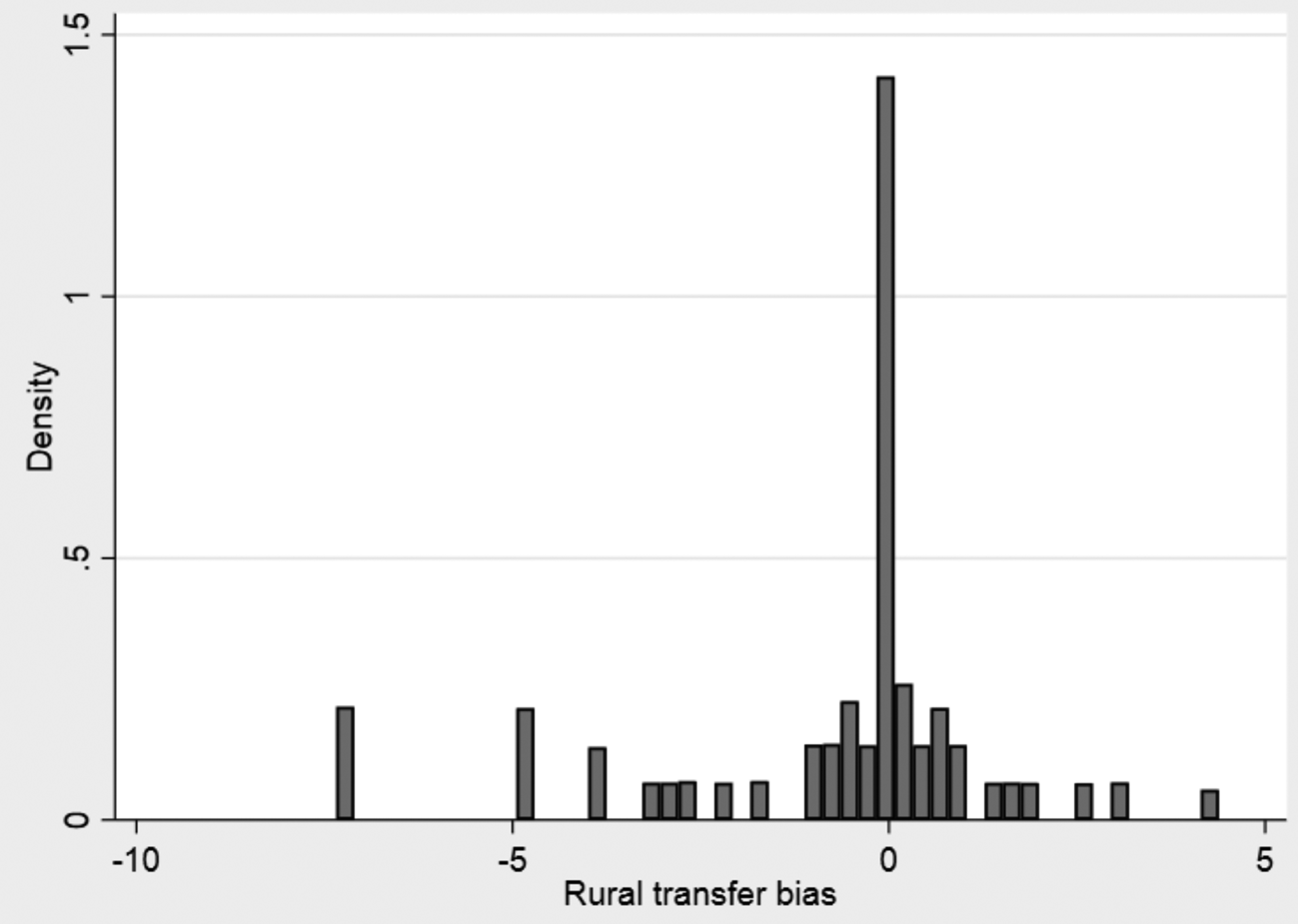
As reported in Figure 1, a plurality of countries are characterized by a relatively even distribution of transfers to producers and consumers; the median value of the distribution is at 0. However, there is substantial variation in terms of relative bias toward consumers or producers in the data, ranging from cases of “extra” per capita transfers to urban consumers of approximately USD730 to “extra” rural transfers of about USD440. We exploit this variation across countries to test our primary hypothesis that urban citizens are significantly less sanguine about democracy in regimes where rural producers are favored; conversely, they may be more supportive of democracy in systems where they receive more transfers.
Rural transfer bias.
Note: Distribution from taxpayers of transfers to agricultural producers less transfers to consumers (in 100s USD), 16 Latin American countries.

Our other key independent variables are a measure of whether a respondent lived in an urban area, along with its interaction with our measure of rural transfer bias, which are used to assess our theoretical expectation that the effects of geographic location on democratic legitimacy are conditioned by greater government support for one geographic group over another.Footnote 32 In some specifications, we add demographic control variables that might be linked to support for democratic legitimacy and perceptions of military rule. These include measures for whether a respondent identified as Male, the respondent's Age at the time of the survey, the number of Years of Schooling they reported, and a dummy for whether the respondent identified their ethnicity as White.Footnote 33
We also introduce several country-level covariates that may be associated with levels of urbanization, while also affecting support for democracy, including measures of economic development (Gross domestic product [GDP] per capita), growth (GDP growth), and Democracy, from the Polity IV project. Similarly, we add a measure of the Agricultural value added (% GDP) to ensure that our results are not an artifact of more heavily agricultural economies in general. Given concerns that countries with larger populations, more population density, or larger urban populations could be more fractious in general (Alesina and Spolaore Reference Alesina and Spolaore2005), we also introduce controls for these demographic factors.Footnote 34
Given the importance to our model of limited government fiscal ability (as with unlimited budgets, governments could subsidize all social groups without limit), we additionally introduce several measures to account for government spending capacity. First, we introduce a measure of Tax revenue to capture governments' ability to raise revenue via taxation. For many countries, additional financial resources may be provided by the sale of natural resources on international markets, so we control for a country's average Oil rents. Finally, recent research suggests that the fiscal feasibility of agricultural subsidies may be conditioned by a country's trade status (Ballard-Rosa Reference Ballard-Rosa2016; Ballard-Rosa Reference Ballard-Rosa2020), and so we control for the amount of Trade in which a country engages.Footnote 35
We use two types of dependent variables. First, we report results from analyses of whether respondents Preferred democracy over all other forms of government. This is an indicator variable that takes the value of 1 if a respondent preferred democracy.Footnote 36 Our second type of dependent variable measures respondents' Support for coups, which is described subsequently. Summary statistics for all variables are provided in Table A-1 in the Online Appendix.
Given the binary nature of these variables, we follow standard practice in estimating our results using a probit model. Standard errors are clustered at the country level to deal with potential autocorrelation across units. To account for time-invariant country characteristics, we include country fixed effects in all reported specifications, and to address global secular trends in support for democracy, we include year fixed effects.Footnote 37
Regression Results
Preference for Democracy
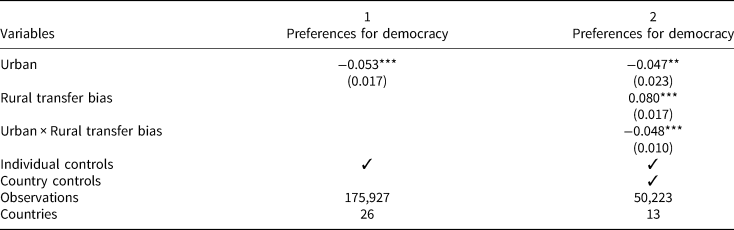
As reported in Column 1 of Table 1, when we include only our set of basic demographic characteristics, we find that citizens living in urban areas are significantly less likely to prefer democracy as a form of government.Footnote 38 Yet, once we introduce our measure of Rural transfer bias in Column 2, along with its interaction with Urban, we find that the consequences of rural bias for democratic legitimacy differ greatly depending on whether citizens are likely to benefit from this favoritism.Footnote 39 Among respondents in non-urban areas, the effect of rural bias is to significantly increase support for democratic rule; conversely, urban citizens in rural-biased systems exhibit significantly lower preferences for democracy. Interestingly, these results also suggest that urbanization itself need not intrinsically reduce support for democracy. If anything, in more urban-biased systems, urban citizens appear somewhat more favorable toward democracy than their rural compatriots.Footnote 40
Preferences for democracy and rural bias

Notes: Robust standard errors clustered by country in parentheses. The table reports results of probit regressions of preference for democracy on demographic and country-level covariates. Country and year fixed effects are suppressed for presentation. Individual-level controls include gender, age, education, and race; country-level controls include levels of democracy, GDP per capita, GDP growth, total population, population density, urban population (percentage of total), tax revenue, trade, oil rents, and agriculture value added (all as a percentage of GDP). *** p < 0.01; ** p < 0.05; * p < 0.1.
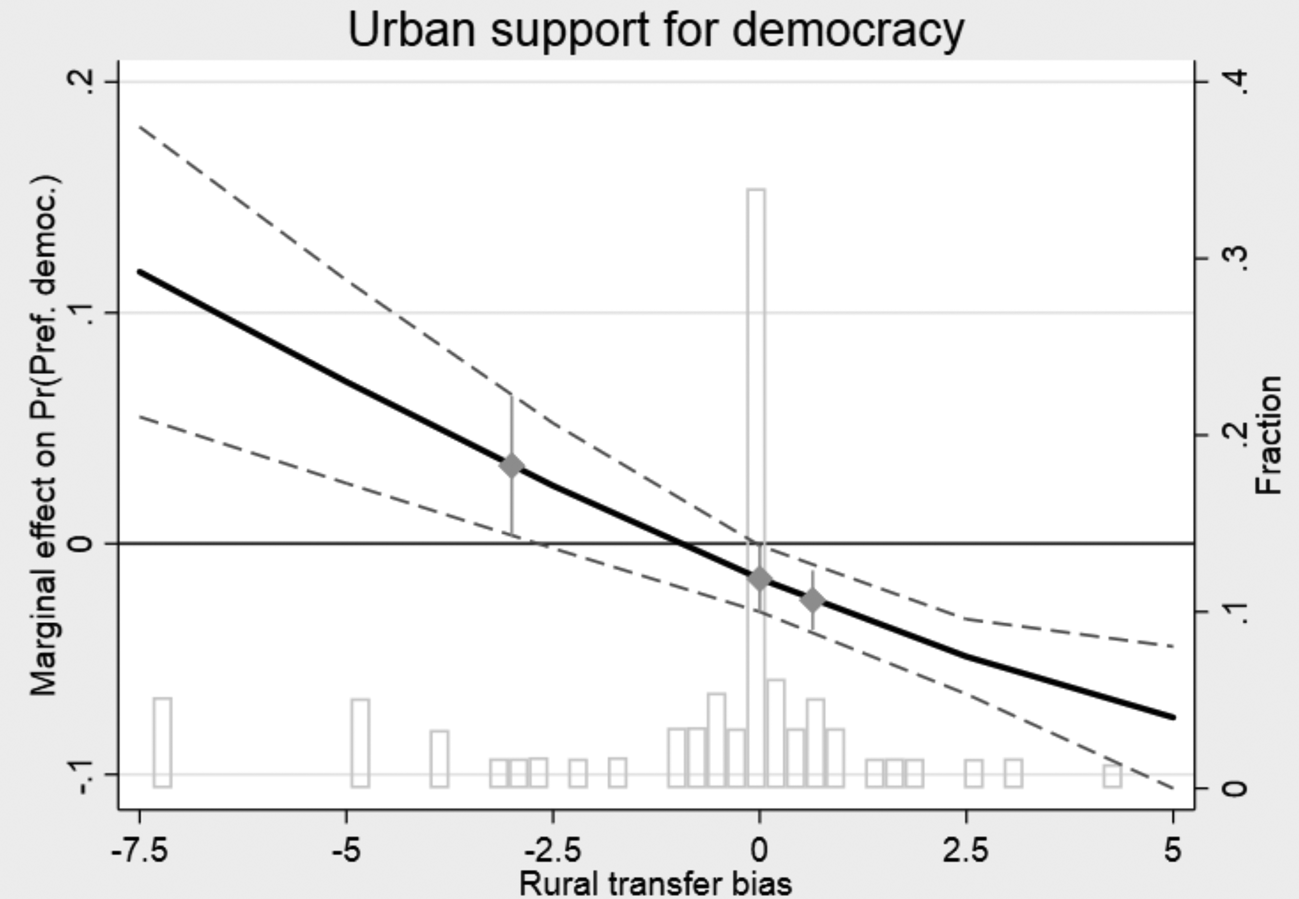
To capture the conditional effect of urban dwelling on preferences for democracy, we report in Figure 2 the marginal effect of living in an urban location, holding all covariates at their sample means. There is a clear downward trend in the effect of urban identity over the range of transfer bias. Whereas in urban-biased cases, urban citizens report a significant increase in their preference for democracy, in rural-biased countries, urban citizens report significantly lower preferences for democracy, an effect that is statistically significant at conventional levels.
Marginal effect of urban dwelling on democratic support.
Notes: This figure reports the marginal effect (and 95 per cent confidence intervals) of living in an urban area on preference for democratic rule, conditional on rural transfer bias. Dark-gray diamonds correspond to marginal effects estimated at the median value of each tercile of the distribution. Light-gray bars indicate the empirical distribution of the transfer bias measure.

While we follow common practice in reporting marginal effects in Figure 2 across the entire distributional range of the transfer bias measure, recent work on linear multiplicative interaction terms suggests reporting estimates at meaningful points of the distribution to avoid extrapolating linear terms to sparsely populated segments of the parameter space (Hainmueller, Mummolo, and Xu Reference Hainmueller, Mummolo and Xu2019). We therefore also provide estimated marginal effects of urbanization at the median of each tercile of the distribution. These terciles correspond closely to our conceptualization of relative bias toward consumers or producers, so we characterize each as representing “urban-biased,” “unbiased,” and “rural-biased” cases.Footnote 41 The dark gray diamonds in Figure 2 correspond to each of these medians. Whereas urban citizens in the urban-biased tercile are approximately 3.3 percentage points more likely to say they prefer democracy (p < 0.05), urban citizens in the rural-biased tercile are approximately 2.4 percentage points less likely to favor democracy (p < 0.000). In terms of substantive magnitude, with 26 per cent of respondents saying they do not favor democracy overall, the six-percentage-point decrease from urban- to rural-biased systems represents an important drop in such support. Interestingly, even in the middle tercile—corresponding to relatively unbiased cases—we continue to find evidence for some dissatisfaction among urban citizens, who are approximately 1.5 percentage points less likely to favor democracy (p < 0.05). This suggests that additional factors beyond rural-biased agricultural policy may drive urban disapproval of democratic government; we return to this point in more detail later.
Support for Military Intervention
We now examine whether urban citizens in rural-biased regimes show greater support for a military coup. Given the historical prevalence of coups in Latin America, our question is particularly important in this context. We construct our dependent variable for these tests using LAPOP data, as this survey asks respondents about their support for military intervention in several different forms over the course of the panel. We focus on the three most prevalent outcomes. Several waves of LAPOP ask respondents the following question: “In your opinion, would a military coup be justified under the following conditions?” Respondents are then asked whether they believe a military intervention in politics would be appropriate in cases where unemployment is high, when crime is high, and when corruption is high.
There exists significant variation in individual responses to each of these three questions. While support for a coup to deal with crime is most strongly correlated with one to deal with corruption (at approximately 0.70), support for a coup to address unemployment is correlated with the crime measure at about 0.44 and with the corruption measure at about 0.45.Footnote 42 Given the significant variability in the responses to each question, we construct binary outcomes representing respondent support for a coup under each of these three conditions and report results from regression of these binary measures of Coup support separately for each outcome after including our full battery of individual- and country-level covariates.
Since individuals exhibit clear variation in their responses to these different questions, each of the three motivations for a coup may represent different mechanisms by which citizen support for electoral politics may be undermined. We have argued that the effects of agricultural policy bias on citizen's support for military intervention manifest themselves through their consequences on the material legitimacy of democracy. The closest outcome to our theoretical emphasis comes from support for a coup to address poor economic performance; here, support for military intervention to address high levels of unemployment is most relevant. In addition, if consistent electoral bias leads to perceptions of corruption by segments of the public, support for coups to address corruption may similarly be influenced by the degree of transfer bias. However, we remain more agnostic about the theoretical relevance of our primary mechanism for driving support for a coup to address crime. Unless transfer biases also lead to a heightened experience of crime, which seems unlikely, this third mechanism is least relevant to our theoretical framework.
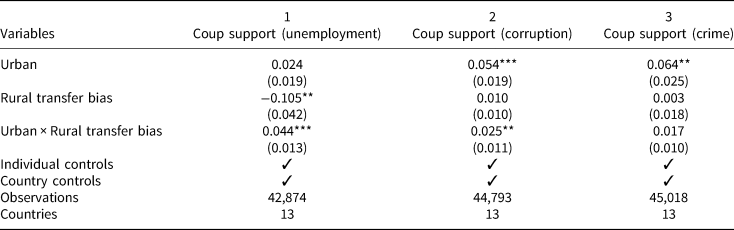
In Column 1 of Table 2, we report results taking support for a coup to address unemployment as our outcome. In support of our theoretical predictions, we find that urban citizens express greater support for military intervention in politics to deal with poor economic performance; however, this effect only arises in countries characterized by rural biases toward agricultural producers. We also find that rural citizens are significantly less likely to support military intervention to address unemployment as the transfer bias toward agricultural interests increases.
Support for coups and rural bias

Notes: Robust standard errors clustered by country in parentheses. The table reports the results of probit regressions of support for a military coup (for varying reasons) on demographic and country-level covariates. Country and year fixed effects are suppressed for presentation. Individual-level controls include gender, age, education, and race; country-level controls include levels of democracy, GDP per capita, GDP growth, total population, population density, urban population (percentage of total), tax revenue, trade, oil rents, and agriculture value added (all as a percentage of GDP). *** p < 0.01; ** p < 0.05; * p < 0.1.
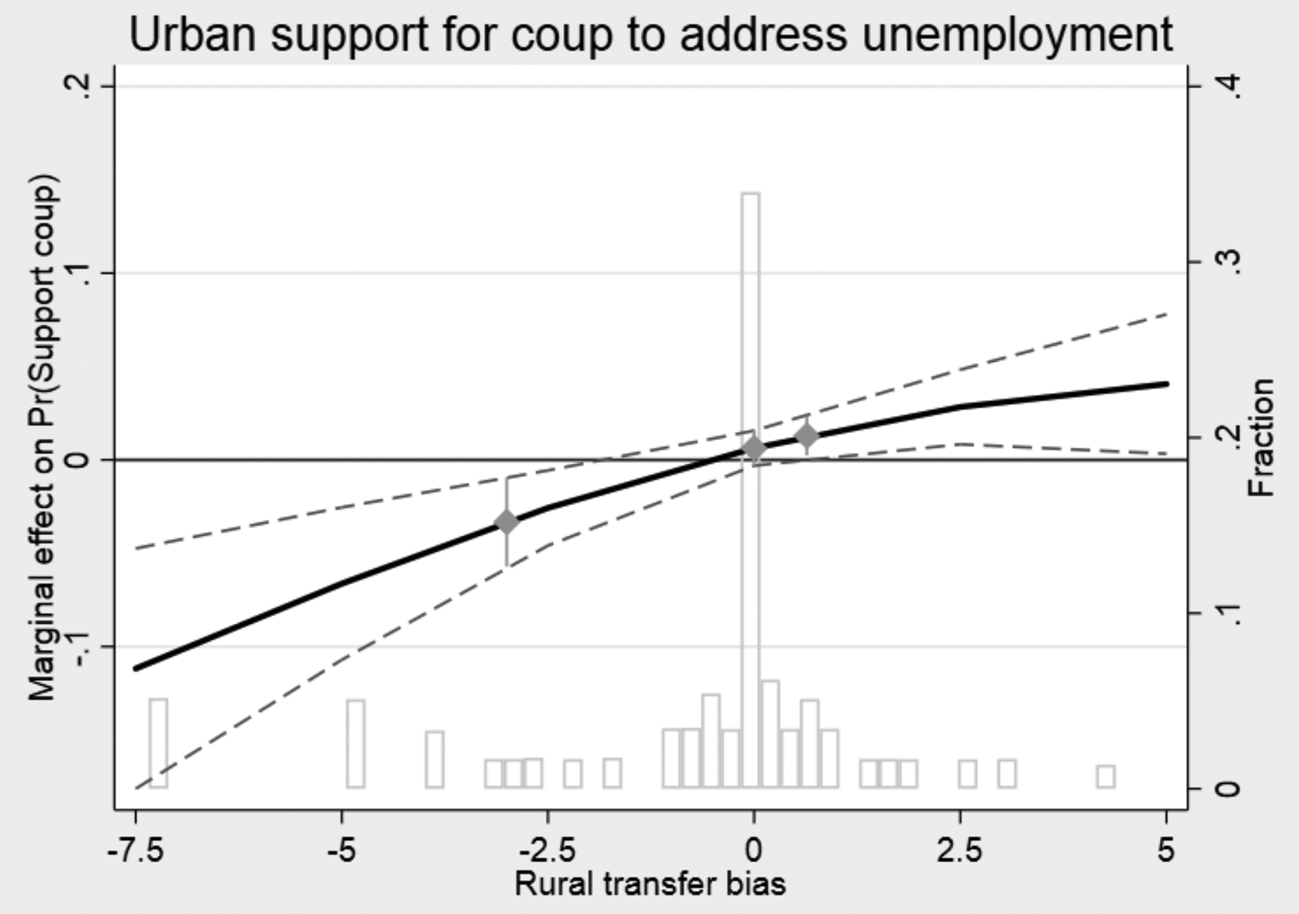
We plot the conditional marginal effect of urban dwelling on support for a coup to address unemployment in Figure 3. The figure reveals that urban citizens in unbiased systems demonstrate no systematic difference in their support for a coup, as compared to a statistically significant increase in support for a coup among urban dwellers in rural-biased countries of approximately 1.3 percentage points. Conversely, urban citizens in urban-biased systems are approximately 3.3 percentage points less likely to favor a military intervention to address unemployment. Against an average level of support for such coups of 20 per cent, this 4.6-percentage-point swing is of sizable substantive magnitude. This provides additional support for our theoretical expectations that consistent electoral bias against particular groups is likely to lead not only to an overall reduction in their support for democratic rule, but also an increase in their likelihood of supporting a military intervention in politics when economic conditions deteriorate.
Marginal effect of urban dwelling on coup (unemployment) support.
Notes: The figure reports the marginal effect of living in an urban area on support for a coup (when unemployment is high), conditional on whether a country is characterized by rural bias. Dark-gray diamonds correspond to marginal effects estimated at the median value of each tercile of the distribution. Light-gray bars indicate the empirical distribution of the transfer bias measure.

In Column 2 of Table 2, we consider factors that affect public support for coups to address high levels of corruption. As with coups to address unemployment, we find that urban citizens in more rural-biased systems are more likely to indicate support for a coup (for a plot of marginal effects, see Figure A-1 in the Online Appendix). Finally, turning to Column 3, we do not find evidence that the positive effect of urbanization on support for coups to limit crime is conditioned by rural transfer bias. We cannot reject the null hypothesis that these estimated effects are equal to one another, as captured by the insignificant interaction term and the marginal effects plotted in Figure A-2 in the Online Appendix. This suggests that citizens' support for military intervention is conditioned by rural transfer bias in cases of poor economic performance and corruption. On the other hand, urban support for a coup to address crime appears largely unrelated to rural transfer bias.
Robustness
We subject these primary results to a host of additional robustness tests; for the sake of space, we present the results in the Online Appendix. While the results of our robustness checks support our theoretical propositions, we note that our analysis remains observational; thus, the potential for omitted variable bias, reverse causality, and other model misspecifications remains. We show a strong correlation between our key independent variables and our dependent variable; however, we cannot demonstrate causality with this design.
First, we confirm that individuals who were victimized by crime and who perceive their neighborhoods as insecure are more likely to support military coups under conditions of high crime (Pérez Reference Pérez2009; Visconti Reference Visconti2019), as shown in Table A-2 in the Online Appendix; however, the inclusion of measures of exposure to crime does not affect the significance of our primary factors of interest. Next, we verify that the addition of trust in the military, concern about the state of the economy, political ideology, and authoritarianism does not alter the substantive interpretation of our primary effects, as reported in Tables A-3, A-4, and A-9 in the Online Appendix; similarly, models that account for voter turnout or support for challenger parties likewise replicate our core findings (see Table A-10 in the Online Appendix). Moreover, our results are robust to the use of a multilevel model that includes nested country and year random effects, as shown in Table A-6 in the Online Appendix, as well as the use of bootstrapped standard errors (see Tables A-7 and A-8 in the Online Appendix).
We also explore an alternative measure of sectoral bias, drawing on Agrimonitor data to capture the total transfers to producers from consumers (TPC) (see Figure A-3 in the Online Appendix). Although our primary theoretical concern is with government transfers to different groups of citizens, as explored earlier, this alternate measurement may also be relevant if citizens internalize the extent to which agricultural producers benefit from material transfers from consumers. Further, we consider an alternative measure of democracy using data from the Varieties of Democracy (V-Dem) dataset. We demonstrate in Tables A-5 and A-11 in the Online Appendix that our main findings remain robustly significant using these alternate codings.
Finally, while we have shown robust support for our expectation that urban preference for democracy and opposition to military intervention decline significantly in rural-biased systems, it is difficult to prove that such dissatisfaction is a direct result of urban perceptions of bias toward agricultural producers. Although we provide qualitative evidence in support of this mechanism, to further substantiate our interpretation of these primary empirical findings, we perform several placebo exercises. In our placebo tests, we investigate whether the effect of urbanization on support for democracy or coups is conditioned by alternative economic factors that are not consonant with our theoretical emphasis on urban/rural biases in agricultural support.
In our first exercise, we consider whether urban preference for democracy is affected by a different sort of government expenditure: Military spending. While it is possible that such expenditures could take on a geographic component in certain countries, we do not have any generalized expectation that they should do so. If we were to find that urban distaste for democracy was also higher in countries with more military expenditures, this might point to more general dissatisfaction among city dwellers for government expenditures toward any group. In a similar vein, while some work suggests that particular types of education expenditures might provide greater benefits to urban or rural citizens (Stasavage Reference Stasavage2005), it is unclear that total education expenditure should have a similar geographic bias. We do not expect, therefore, that the effect of urban dwelling on support for democracy should be conditioned by government Expenditure on education.
Beyond general government spending, it is also possible that the effect we document of rising urban dissatisfaction as a function of rural transfer bias could be the by-product of some economic consequence of these policies. For instance, perhaps urban citizens are less able to turn to subsistence farming when times are bad and therefore fault governments for any perceived economic failure. To test this alternative explanation, we include a measure of the Unemployment level, as well as its interaction with urban dwelling. As reported in Columns 1 through 3 of Table A-12 in the Online Appendix, in none of these cases do we find that the relationship between urbanization and preference for democracy is conditional on these placebo measures, as indicated by the lack of statistical significance on the interaction term for all three factors. These null results help to buttress our interpretation of our main finding that urban dissatisfaction with electoral politics is strongly conditioned by policies with a clear urban–rural dimension.
Conclusion
We have shown that distributional conflict between urban and rural populations can lead citizens in the neglected sector not only to disfavor democratic government, but even to express support for military coups. If a leader favors agricultural development over urban food consumption to win over pivotal rural voters, urban citizens may revolt and potentially trigger military intervention in politics.Footnote 43 We formalized this argument, derived explicit propositions, and tested our claims, both qualitatively and quantitatively, finding strong support for the theory.
This study offers a novel theory of the erosion of democratic support that emphasizes the salience of urban–rural distributional conflict, going beyond previous accounts that focus on economic conditions or ethnic competition. In doing so, we contribute to several large academic literatures. In addition to those mentioned previously, we also provide nuance to modernization theory; in contrast to previous scholars,Footnote 44 we find that urbanization is not necessarily linked to increased popular demand for democracy, but can instead exacerbate declining support for democracy (Harding Reference Harding2012). Moreover, we contribute to an emerging literature that connects perceptions of sectoral bias to crises of democratic legitimacy, not only in non-consolidated democracies, but also in nations like the United States (McQuarrie Reference McQuarrie2017).
We expect that our theory is highly generalizable. Indeed, our illustrative examples show that it holds across Latin America and in at least one prominent case outside the region. The theory should hold most readily when one segment of the population is overrepresented in the political system, which often occurs when the size of this population is greater than an alternative one, but can also happen as an artifact of the political system. It also pertains most to situations where agricultural policy is prevalent given the importance of the cost of food. This is often correlated with economic development because agricultural policy is typically less important for high-income countries.
Further, while our theoretical account focuses on cases in which democratic breakdown occurs through a coup, the argument that support for democracy falls among geographic populations when other voters are disproportionately represented in politics should apply to any regime in which this occurs. The specific prediction regarding democratic breakdown also pertains to the more common cases of incumbent takeovers (Kendall-Taylor and Frantz Reference Kendall-Taylor and Frantz2016), though the model would need to be slightly adapted, in particular, support for democracy would decrease among groups that benefit from the current leadership (Svolik Reference Svolik2018). Finally, cases in which breakdown leads to a coup are most likely in societies with an interventionist military.
Moreover, our theory and findings have policy implications regarding the prevention of erosion of democratic support. Constitutional or legal limits on redistribution may be necessary to guard against severely biased distributive policies that are both electorally successful and threatening to democratic stability. Furthermore, abetting food scarcity through economic development may deter the food riots that sometimes trigger military intervention in politics.
Supplementary Material
Online appendices are available at: https://doi.org/10.1017/S0007123422000291
Data Availability Statement
Replication data for this article can be found in Harvard Dataverse at: https://doi.org/10.7910/DVN/UVDDBD
Financial Support
None.
Competing Interests
None.