Introduction
Auditory verbal hallucinations (AVH) are a core symptom of psychotic disorders including schizophrenia. However, the presence of these hallucinations extends beyond psychotic disorders as AVH also occur in the general population with a median prevalence of 13.2% (van Os et al. Reference van Os, Kenis and Rutten2010; Beavan et al. Reference Beavan, Read and Cartwright2011). This observation has contributed to the proposition of a continuum model that describes the severity and prevalence of psychotic experiences in the population. This continuum ranges from the extended phenotype in the general population to full-blown psychotic symptoms in the clinical phenotype. To facilitate early detection, intervention and potentially prevention of psychosis, it is essential to determine how flexibly individuals can move along the psychosis spectrum and which risk factors mediate transition to psychosis. Studies investigating transition to psychosis mainly focused on individuals at risk for psychosis who present with mild psychotic symptoms including perceptual aberrations, ideas of reference and paranoid ideation without psychotic-level conviction (Fusar-Poli et al. Reference Fusar-Poli, Borgwardt, Bechdolf, Addington, Riecher-Rössler, Schultze-Lutter, Keshavan, Wood, Ruhrmann, Seidman, Valmaggia, Cannon, Velthorst, De Haan, Cornblatt, Bonoldi, Birchwood, McGlashan, Carpenter, McGorry, Klosterkötter, McGuire and Yung2013). Transition risks in these individuals range between 18% at 6 months and about 40% after 3 years (Fusar-Poli et al. Reference Fusar-Poli, Bonoldi, Yung, Borgwardt, Kempton, Valmaggia, Barale, Caverzasi and McGuire2012). Importantly, this group presents with high co-morbidity including anxiety, depression, and negative symptoms, suggesting that subclinical psychotic symptoms represent a nonspecific indicator of psychopathology (Yung et al. Reference Yung, Nelson, Stanford, Simmons, Cosgrave, Killackey, Phillips, Bechdolf, Buckby and McGorry2008). As these individuals are typically brought to clinical attention because of experienced distress and disability (Fusar-Poli et al. Reference Fusar-Poli, Borgwardt, Bechdolf, Addington, Riecher-Rössler, Schultze-Lutter, Keshavan, Wood, Ruhrmann, Seidman, Valmaggia, Cannon, Velthorst, De Haan, Cornblatt, Bonoldi, Birchwood, McGlashan, Carpenter, McGorry, Klosterkötter, McGuire and Yung2013), transition rates for psychosis and associated psychopathology may be substantially lower in individuals that experience subclinical psychotic symptoms in the absence of distress. Indeed, subclinical psychotic experiences are transient in most adolescents and adults in the general population (Hanssen et al. Reference Hanssen, Bak, Bijl, Vollebergh and van Os2005; van Os et al. Reference van Os, Linscott, Myin-Germeys, Delespaul and Krabbendam2009). An intuitive explanation for the transitory nature of these experiences in the general population is their mild nature. Specifically, development of psychosis or other psychopathology might be more prevalent in individuals experiencing symptoms akin to those seen in patients, such as AVH, in the absence of distress. The only longitudinal study to date to investigate AVH in the general population found that AVH had disappeared over a period of 5 years in 76% of 7- to 8-year-old children (Bartels-Velthuis et al. Reference Bartels-Velthuis, van de Willige, Jenner, van Os and Wiersma2011). However, it is yet to be determined whether AVH are also transitory in adults past the peak incidence age (15–35 years) for psychosis (Kessler et al. Reference Kessler, Amminger, Aguilar-Gaxiola, Alonso, Lee and Ustun2007) and whether these individuals are still at a high risk of developing a psychotic disorder or other psychopathology. To investigate these hypotheses, we conducted a 5-year follow-up study in a group of non-psychotic individuals who experienced frequent AVH when they were first interviewed in 2007/2008 and the matched control group (Sommer et al. Reference Sommer, Daalman, Rietkerk, Diederen, Bakker, Wijkstra and Boks2010a ). At time of inclusion, people with AVH (n = 103) did not fulfil criteria for Axis I or II psychopathology (with the exception of depressive or anxiety disorder in full remission), but most had a schizotypal tendency reflected in the presence of AVH, magical beliefs and a tendency toward formal thought disorder (Sommer et al. Reference Sommer, Derwort, Daalman, de Weijer, Liddle and Boks2010b ). This cohort has been rigorously assessed in previous studies to shed light on the pathophysiology of AVH in the absence of confounding factors such as psychotropic drugs, additional symptomatology, a history of hospital admissions and a need for care (for an overview see Diederen et al. Reference Diederen, Van Lutterveld and Sommer2012; Daalman & Diederen, Reference Daalman and Diederen2013). Incidence of psychosis and a need for mental healthcare in the following 5 years was assessed in both individuals with AVH and the previously included control group. Observing increased psychopathology in these individuals with AVH might argue for the use of early intervention measures in individuals with AVH. In addition, the outcome of this study will further our understanding of AVH occurring in relative isolation and provide crucial information on the long term health of this specific cohort of non-psychotic individuals.
Method
Participants
We aimed to include all 103 adults with AVH (age 41 ± 13, 71% females) and 60 matched control subjects (age 48 ± 13, 70% females) that participated in the initial study (Sommer et al. Reference Sommer, Daalman, Rietkerk, Diederen, Bakker, Wijkstra and Boks2010a ). For the initial study, participants were recruited with the help of a Dutch website: ‘explore your mind’ (www.verkenuwgeest.nl). At baseline, included participants did not meet criteria for a DSM-IV Axis I or Axis II diagnosis, as assessed by a psychiatrist with the Comprehensive Assessment of Symptoms and History (CASH) interview (Andreasen et al. Reference Andreasen, Flaum and Arndt1992) and the Structured Clinical Interview for Personality Disorder (SCID-II; First et al. Reference First, Spitzer, Gibbon and Williams1995a , Reference First, Spitzer, Gibbon, Williams, Davies, Borus, Howes, Kane, Pope and Rounsaville b ). Depressive or anxiety disorders in full remission were not an exclusion criterion in the original study. Exclusion criteria in the original study consisted of current alcohol abuse (more than 20 units per week) and current drug abuse (using cannabis more than once a month and/or the use of other illicit substances). We screened for alcohol and drug abuse with the help of anamnesis and urine samples. In the initial study we only included participants who experienced AVH at least once per month and who had experienced AVH for at least a year. At baseline, the participants experienced AVH for 29 (±17) years. See Sommer et al. (Reference Sommer, Daalman, Rietkerk, Diederen, Bakker, Wijkstra and Boks2010a ) for an extended description of the initial recruitment and selection procedure. The study was approved by the Humans Ethics Committee of the University Medical Center Utrecht. After complete description of the study to the subjects, informed consent was obtained.
Clinical interviews
Follow-up interviews were conducted via telephone to ensure sufficient respondents. To screen for psychopathology 5 years after the initial inclusion we used the CASH interview (Andreasen et al. Reference Andreasen, Flaum and Arndt1992). When uncertain about complaints, symptoms or diagnosis, the participant was invited to the hospital and interviewed face-to-face by a psychiatrist (AVH, n = 5), or (if the participant refused to visit the hospital) a psychiatrist performed a second interview by phone (AVH, n = 4). If the participant had visited other clinics over the last 5 years, we used diagnoses given by the treating physician who was contacted (with the participant's consent) for the verification of diagnoses. Need for mental healthcare was defined as (1) the presence of a psychiatric disorder (including psychosis) causing distress and dysfunction as identified using the CASH and/or (2) treatment provided by a (mental) healthcare specialist (e.g. general practitioner, psychologist, social worker, psychiatrist) for psychological complaints (e.g. coping with divorce, mourning, burn-out, lack of self-esteem) in the 5 years after initial inclusion.
We conducted the Psychotic Symptoms Rating Scales (PSYRATS) Auditory Hallucinations Rating Scale (AHRS; Haddock et al. Reference Haddock, McCarron, Tarrier and Faragher1999) to determine whether voices had persisted and whether there were any changes in AVH phenomenology. We operationalized the variable ‘emotional valence of content’ as the sum of three items from the AHRS: ‘amount of negative content of voices’, ‘degree of negative content’ and ‘amount of distress’; i.e. an ordinal variable expressing overall burden of voices with negative content. The variable ‘total distress’ was operationalized as the sum of two items from the AHRS: ‘intensity of distress’, and ‘disruption to life caused by voices’. The rationale for this clustering was twofold. First, we observed high correlations between scores on the baseline items combined in the factors ‘emotional value of content’ and ‘total distress’ (Daalman et al. Reference Daalman, Boks, Diederen, de Weijer, Blom, Kahn and Sommer2011). Second, we have consistently used this clustering to facilitate comparisons across studies in this cohort of non-psychotic individuals with AVH (Diederen et al. Reference Diederen, De Weijer, Daalman, Blom, Neggers, Kahn and Sommer2010; Daalman et al. Reference Daalman, Boks, Diederen, de Weijer, Blom, Kahn and Sommer2011, Reference Daalman, Diederen, Derks, van Lutterveld, Kahn and Sommer2012). As a result, the following items were used in this study: frequency, duration, location, loudness, beliefs regarding the origin of voices, controllability, emotional valence of content and total distress.
Statistics
To determine whether adults with AVH included in the follow-up were comparable at baseline to the non-included subsample, we performed non-parametric Mann–Whitney tests on the following baseline variables: age, years of education, Schizotypal Personality Questionnaire (SPQ; Raine, Reference Raine1991) score, Global Assessment of Functioning (GAF; Jones et al. Reference Jones, Thornicroft, Coffey and Dunn1995) score, AVH characteristics (PSYRATS AHRS; Haddock et al. Reference Haddock, McCarron, Tarrier and Faragher1999) and an estimate for verbal IQ obtained with the National Adult Reading Test (NART; Nelson & Willison, Reference Nelson and Willison1991). In addition, prevalence of a psychotic disorder in first- or second-degree family members measured using the Family Interview for Genetic Studies (FIGS; NIMH Genetics Initiative, Reference NIMH1992), and depression in the past diagnosed with the CASH were compared between the groups using χ2 tests. We subsequently identified potential differences in age and sex between the included adults with AVH and the controls with a t test (age) and χ2 test (sex).
To establish whether the incidence of psychopathology was increased in the adults with AVH, we compared transition to psychosis and a general need for mental healthcare between these adults and the control group using χ2 tests. Next, we identified which factors were predictive of psychopathology in the adults with AVH using logistic regression analyses with (1) psychotic disorder (yes/no) and (2) need for mental healthcare (yes/no) as the dependent variables. Predictors for these analyses consisted of the following baseline measures: GAF score, SPQ score, age, years of education, and prevalence of psychosis in first- or second-degree family members (FIGS), prevalence of childhood trauma [Childhood Trauma Questionnaire – Short form (CTQ-SF; Bernstein et al. Reference Bernstein, Stein, Newcomb, Walker, Pogge, Ahluvalia, Stokes, Handelsman, Medrano, Desmond and Zule2003)], depression in remission at baseline and AVH characteristics (PSYRATS AHRS). Missing values of the AVH items were replaced using an expectation maximization procedure. The percentage of missing items ranged between 1.23% and 3.70% for the different items.
Finally, we performed non-parametric Wilcoxon tests to determine if AVH characteristics measured with the PSYRATS AHRS at follow-up differed from scores on this questionnaire during the initial visit. Only individuals that heard voices on both occasions were included in this analysis.
Results
Follow-up inclusions
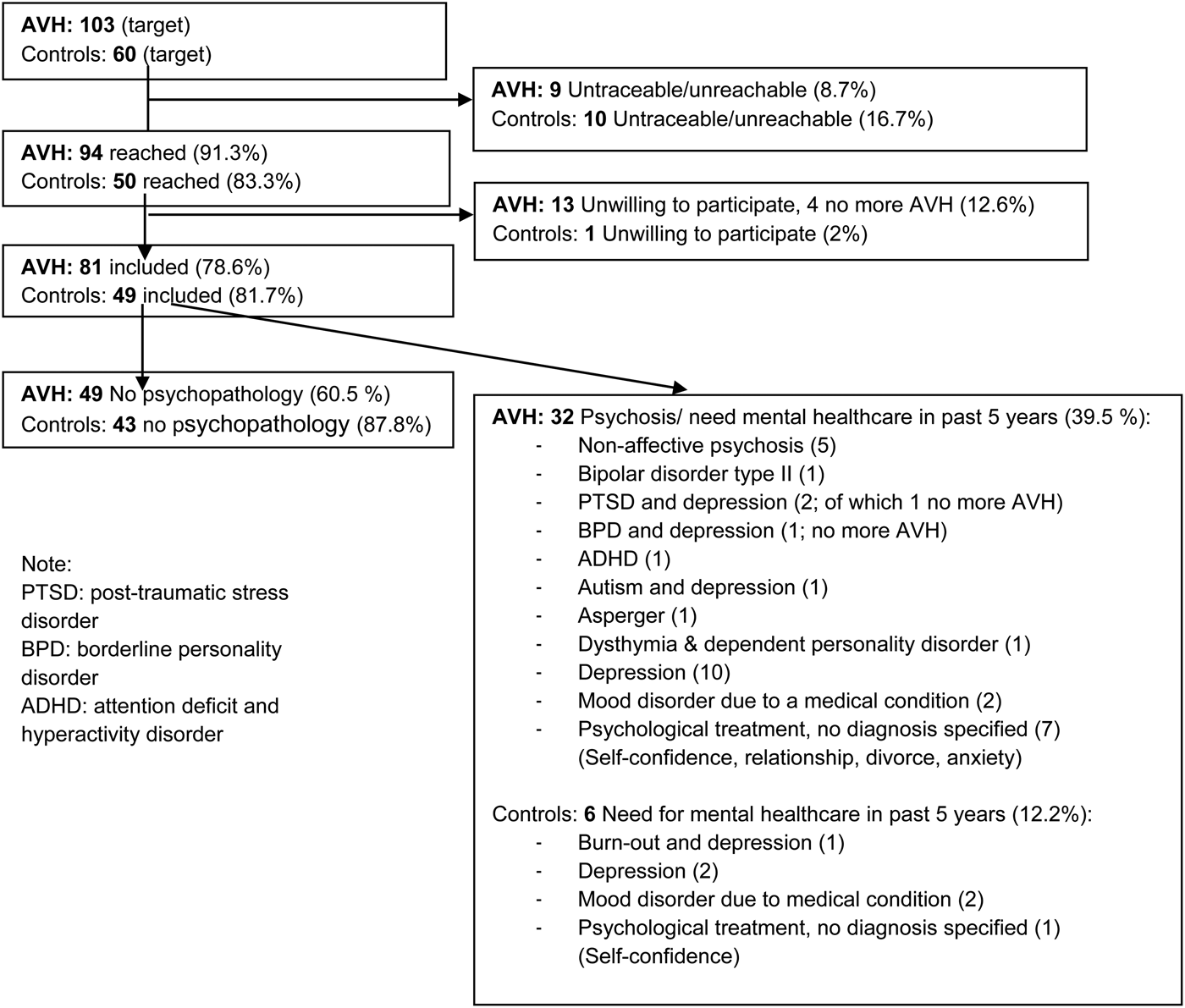
Of the 103 adults with AVH and 60 controls that participated in the initial study, we included 81 (79%) adults with AVH and 49 (82%) controls at follow-up. Nine adults with AVH and ten control participants could not be reached due to changes in telephone number and address. Thirteen adults with AVH and one control participant did not want to participate in the follow-up study as they could not spare the time (AVH, n = 3), expected an increase in distress of AVH due to participation (AVH, n = 1), expressed a lack of motivation (AVH, n= 1) or were terminally ill (control, n = 1). The remaining eight adults with AVH did not provide reasons for not participating. The 13 adults with AVH who did not participate were, however, willing to indicate whether AVH had persisted. AVH had persisted in nine of these 13 adults. Sixteen adults with AVH (20%, Fig. 1) and six controls (12%) were not past the peak incidence age (15–35) for psychosis during follow-up.
Age distribution of individuals with auditory verbal hallucinations (AVH) at the time of follow-up. The majority of individuals with AVH were past the peak incidence age for psychosis (15–35 years; on the right of the dashed vertical line).

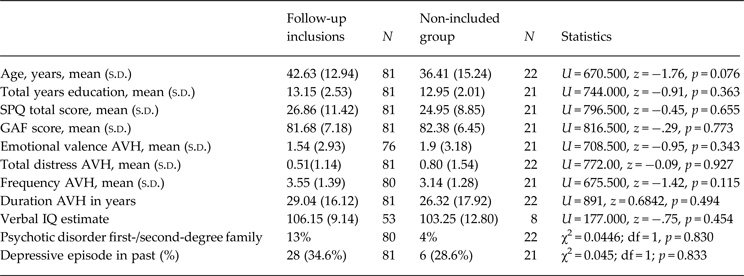
The adults with AVH included at follow-up (AVH, n = 81) did not differ significantly from the non-included group (AVH, n = 22) with respect to age, total years of education, SPQ score, GAF score, emotional valence of AVH, distress by AVH, frequency of AVH, duration of AVH in years and verbal IQ estimate, as measured on their initial visit, whether they had experienced a depressive episode in the past or the prevalence of a first- or second-degree family member with a psychotic disorder (Table 1). As in our initial report (Sommer et al. Reference Sommer, Daalman, Rietkerk, Diederen, Bakker, Wijkstra and Boks2010a ), the control participants were significantly older than the adults with AVH at the time of follow-up (t 99.63 = 2.86, p = 0.005). Sex did not differ significantly between the included adults with AVH and controls at follow-up. The mean time between the first and second inclusion was 59.5 months (s.d. = 6.5) in the adults with AVH and 76.6 months (s.d. = 18.4) in the control group. Although the time between the initial visit and the follow-up was significantly increased in the control group (t 54,9 = 6.31, p < 0.001), this rendered no confound as both groups were asked to report problems arising in the 5 years after the initial inclusion.
Baseline characteristics and comparison of follow-up inclusions and non-included group

AVH, Auditory verbal hallucinations; GAF, Global Assessment of Functioning; SPQ, Schizotypal Personality Questionnaire.
Psychotic disorders
Psychiatric interviews and/or contact with participants’ healthcare providers revealed that five (6.2%) adults with AVH (age 48 ± 13.4) had been diagnosed with a psychotic disorder (Fig. 2). Specific diagnoses consisted of schizophrenia (n = 3) and psychosis not otherwise specified (n = 2). Four of these individuals were past the peak incidence age for psychosis (15–35 years; Kessler et al. Reference Kessler, Amminger, Aguilar-Gaxiola, Alonso, Lee and Ustun2007). Three (60%) of these individuals received a diagnosis of depression in remission at baseline. None of the control participants had been diagnosed with a psychotic disorder. The incidence of a psychotic disorder differed on trend-level between the groups (χ2 = 3.15, df = 1, p = 0.076). Age did not significantly impact the incidence of a psychotic disorder (χ2 = 24.45, df = 45, p = 0.994). When we excluded individuals that were diagnosed with depression in remission at baseline, the incidence of a psychotic disorder was no longer more prevalent in the AVH group (χ2 = 1.61, df = 1, p = 0.204).
Flowchart of included participants.

Risk factors for psychosis
Visual inspection revealed that the five individuals that developed psychosis after 5 years had experienced AVH frequently at baseline, with a predominantly negative emotional valence (n = 4) and that the majority of these individuals experienced distress in relation to the voices at baseline (n = 3). In addition, most of these individuals presented with higher than average SPQ scores at baseline (n = 3), and lower than average GAF scores (n = 4) compared to the participants who had not transitioned to psychosis (Fig. 3). We did not carry out the planned logistic regression as this analysis requires a minimum of 10 observations per independent variable.
Auditory verbal hallucination (AVH) frequency (a), emotional valence (b), total distress (c), Global Assessment of Functioning score (d), total Schizotypal Personality Questionnaire score (e), total years of education (f), and total number ‘types of childhood trauma’ (g), in adults with AVH that did (x-axis = 1) or did not (x-axis = 0) meet criteria for a psychotic disorder. Larger circles indicate more participants with the same score. No psychotic disorder (n = 86), psychotic disorder (n = 5).

Need for mental healthcare and diagnosis of depression
Thirty-two adults with AVH (39.5%) had developed a need for mental healthcare over the past 5 years (including the five individuals with psychosis described above). Clinical diagnoses included schizophrenia (3), psychosis not otherwise specified (2), bipolar disorder (1), post-traumatic stress disorder (2), personality disorders (2), attention deficit hyperactivity disorder (ADHD; 1), autism (1), Asperger's syndrome (1) and depression (10) and mood disorder due to a medical condition (2). Although we screened for psychotic disorders and affective disorders including depression using the CASH interview (Andreasen et al. Reference Andreasen, Flaum and Arndt1992) during the initial visit, we did not specifically screen for ADHD, Asperger's syndrome and autism. It is therefore possible that these symptoms were already present at baseline. However, at baseline none of these individuals had obtained diagnosis or therapy for these syndromes. In addition, a number of individuals (n = 7) had sought psychological treatment for anxiety, self-confidence issues and relational problems (Fig. 2).
In the control group, five individuals (12.2%) had developed a need for mental healthcare. Clinical diagnoses included depression (n = 3) and mood disorders due to a medical condition (n = 2). In addition, one control participant had sought psychological treatment to cope with a close family member being diagnosed with Asperger's syndrome. The incidence of a need for mental healthcare was significantly higher in the adults with AVH in comparison to the control group (χ2 = 12.86, df = 1, p < 0.001). Age did not significantly impact the incidence of a need for mental healthcare (χ2 = 55.02, df = 45, p = 0.146). Individuals who received a diagnosis depression in remission at baseline might have presented with an increased need for care compared to other participants. However, after the exclusion of individuals with depression in remission at baseline, individuals with AVH still presented with an increased need for care after 5 years (χ2 = 4.524, df = 1, p < 0.033).
Risk factors for need for mental healthcare
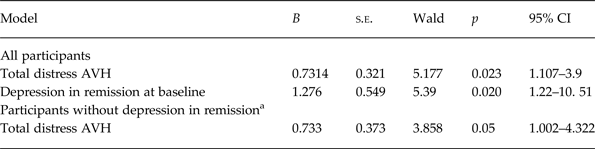
The binary logistic regression analysis revealed that the variables ‘total distress of AVH’ and ‘depression in remission’ at baseline were the sole significant predictors of a need for mental healthcare (Table 2). Importantly, after exclusion of the individuals with depression in remission at baseline, total distress of AVH was still a significant predictor of need for care 5 years later. GAF score, SPQ score, age, years of education and psychosis prevalence in first- or second-degree family, prevalence of childhood trauma, AVH emotional valence, AVH frequency, AVH control and AVH age of onset did not predict a need for mental healthcare.
Logistic regression model: predicting the presence of a need for mental healthcare

CI, Confidence interval; AVH, auditory verbal hallucinations.
a Without depression in remission at baseline.
Persistence of AVH
Ten (10/81) participants no longer experienced AVH and one participant was indecisive about the presence of voices. Therefore, voice characteristics of 70 individuals were compared between baseline and follow-up. Without corrections for multiple testing, borderline significant differences were found with respect to a decrease in frequency of AVH (Z = −1.914, p = 0.056), experiencing more control over AVH (Z = −2.099, p = 0.036) and a decrease in experienced distress (Z = −1.944, p = 0.052) after 5 years. However, after Bonferroni correction none of these changes were significant (required p value after correction = 0.006). These results were similar after exclusion of individuals with depression in remission at baseline.
Changes in attitude toward AVH
Eleven participants changed their attitude toward the voices. One participant previously believed the AVH originated from spiritual guides, but changed her belief after experiencing a depressive episode in which she received no help from the voices. Two participants indicated that they no longer view the AVH as voices but rather as an intuition (n = 1) or emotion (n = 1). Two participants realized after the first study visit that not everyone experiences AVH. One of these participants sought treatment and received the diagnosis schizophrenia, whereas the other participant indicated that she feels lucky to experience the AVH. In addition, although two participants stated increased interest and attention toward the AVH, three other participants mentioned they now ignore the AVH. One of the three participants felt too weak to handle this experience. Finally, one participant now embraces the AVH, whereas they used to trouble her.
Examples of AVH experiences
At the initial study visit, Mr S. indicated that he could not understand what the voices were saying. It seemed as if he was among a group of pre-school children and all of them were speaking at once. Nowadays he hears adult voices and frequently understands what they are saying. The AVH are never unpleasant. The voices advise him and give him information. Furthermore, Mr S. indicates that the AVH enable him to help other people, for instance by interpreting other people's dreams or paranormal observations.
Ms. K. hears two voices which she believes belong to guides. She can contact them at all times and she can also make them disappear. She hears the voices less frequently than 5 years ago as she feels she needs their advice less frequently nowadays. The AVH help her to establish and maintain her self-esteem.
When Ms. J. hears voices they are often accompanied by visual hallucinations. Specifically, she sees deceased people who are in need of advice. She experiences the AVH as positive, she has full control over the voices and lets them know if their timing is inconvenient. The voices can be unpleasant, however, if they shout at her or curse. Whenever, this happens she tells the voices to back off or she ignores them. She has not experienced any changes in the phenomenology of the AVH.
Discussion
We aimed to determine whether AVH in healthy adults past the peak incidence age for psychosis (15–35 years; Kessler et al. Reference Kessler, Amminger, Aguilar-Gaxiola, Alonso, Lee and Ustun2007) are associated with increased risk for psychopathology. Consequently, we examined the incidence of transition to psychosis and a need for mental healthcare after 5 years in a group of non-psychotic adults (age 42.6 ± 12.9) who presented with frequent AVH when first interviewed (Sommer et al. Reference Sommer, Daalman, Rietkerk, Diederen, Bakker, Wijkstra and Boks2010a ). Importantly, these individuals experienced AVH in the absence of confounding factors such as psychotropic drugs, additional symptomatology, a history of hospital admissions and a need for care. Thus, investigation of this cohort allowed us to investigate the specific relationship between AVH in relative isolation and a need for mental healthcare. Five adults with AVH (6%) fulfilled the criteria for a psychotic disorder 5 years after the initial inclusion, whereas none of the control participants experienced psychosis. Although the limited number of individuals developing psychosis hampered statistical identification of risk factors for transition to psychosis, qualitative inspection points to increased frequency of AVH, negative emotional content of AVH and distress, as well as an increased tendency for schizotypy and decreased global functioning in individuals developing psychosis. Development of psychopathology was not limited to psychosis as 39.5% of adults with AVH developed a need for mental healthcare, including individuals with a psychotic disorder. Need for mental healthcare was significantly lower in the control group (12.2%). This result held after the exclusion of participants with depression in remission at baseline. The only significant risk factors for a need for mental healthcare in the adults with AVH were distress due to AVH at baseline and depression in remission at baseline. As individuals with depression in remission at baseline may be considered more vulnerable to psychopathology, we repeated the analyses without these individuals. We found that total distress was still a significant predictor for need for care. Most adults with AVH (88%) still experienced AVH with similar phenomenology after 5 years, suggesting that AVH after the peak risk for psychotic disorders constitute a stable symptom.
Although conversion to psychosis (6.2%) was relatively low in our sample, as expected in adults with a mean age of 43, it was trend-level higher than the control group and higher than the general incidence rates for psychosis (31.7/1 00 000 person-years; Kirkbride et al. Reference Kirkbride, Errazuriz, Croudace, Morgan, Jackson, Boydell, Murray and Jones2012). However, transition to psychosis in our group was substantially reduced compared to conversion rates in individuals at risk for developing psychosis (18% at 6 months – 40% after 3 years; Fusar-Poli et al. Reference Fusar-Poli, Bonoldi, Yung, Borgwardt, Kempton, Valmaggia, Barale, Caverzasi and McGuire2012). Importantly, individuals with an at risk mental state differ from our sample as they typically present with mild psychotic symptoms including perceptual aberrations, ideas of reference and paranoid ideation rather than full-blown psychotic symptoms such as AVH (Fusar-Poli et al. Reference Fusar-Poli, Bonoldi, Yung, Borgwardt, Kempton, Valmaggia, Barale, Caverzasi and McGuire2012, Reference Fusar-Poli, Borgwardt, Bechdolf, Addington, Riecher-Rössler, Schultze-Lutter, Keshavan, Wood, Ruhrmann, Seidman, Valmaggia, Cannon, Velthorst, De Haan, Cornblatt, Bonoldi, Birchwood, McGlashan, Carpenter, McGorry, Klosterkötter, McGuire and Yung2013). In addition, these individuals are typically within the peak incidence age for psychosis (15–35 years) and are help-seeking (Kessler et al. Reference Kessler, Amminger, Aguilar-Gaxiola, Alonso, Lee and Ustun2007; Fusar-Poli et al. Reference Fusar-Poli, Borgwardt, Bechdolf, Addington, Riecher-Rössler, Schultze-Lutter, Keshavan, Wood, Ruhrmann, Seidman, Valmaggia, Cannon, Velthorst, De Haan, Cornblatt, Bonoldi, Birchwood, McGlashan, Carpenter, McGorry, Klosterkötter, McGuire and Yung2013), which presumably increases risk for psychosis compared to our sample. Indeed, a recent study reported a (2-year) conversion rate of 8% in adults (18–65 years) with subclinical psychotic symptoms in the general population, which is comparable to our findings (Hanssen et al. Reference Hanssen, Bak, Bijl, Vollebergh and van Os2005). A main difference between this and our study is, however, that our sample experienced full-blown AVH in the absence of a need for care. Thus, interestingly, increased symptom expression in adults in the absence of distress is not necessarily predictive of psychosis.
Apart from the risk for psychosis, the relatively large proportion of adults with AVH that developed a need for mental healthcare over a 5 year period (39%), in comparison to the control group (12%), suggests a more general liability for psychiatric diseases in these individuals. This may indicate that adults with AVH are vulnerable to mental health problems in general, which is in accordance with a model of high co-morbidity and vulnerability on several pathological domains (psychotic symptoms, negative symptoms, affective complaints and cognitive aberrations; van Os et al. Reference van Os, Kenis and Rutten2010). In line with our finding, many individuals at risk for psychosis develop co-morbid diagnoses; in particular anxiety, depression and substance use disorders as well as a lower quality of life (Verdoux et al. Reference Verdoux, van Os, Maurice-Tison, Gay, Salamon and Bourgeois1999; Yung et al. Reference Yung, Nelson, Stanford, Simmons, Cosgrave, Killackey, Phillips, Bechdolf, Buckby and McGorry2008). Thus, mild psychotic symptoms are predictive of a wide range of conditions and co-morbidity rather than being limited to psychosis. In our sample, distress due to voices was the only significant predictor for need for mental healthcare. In accordance with this, one of the criteria for an attenuated psychosis syndrome (APS) states that the psychotic experiences should be accompanied by a certain amount of distress, underlining the significance of this associated distress. However, one of the reasons that APS is not yet a formal DSM-5 diagnosis pertains to the heterogeneity of this group (Fusar-Poli & Yung, Reference Fusar-Poli and Yung2012; Gaudiano & Zimmerman, Reference Gaudiano and Zimmerman2013; Phillips, Reference Phillips2013). In our study, the individuals that developed a need for mental healthcare also constituted a rather mixed group, requiring need for mental healthcare for various reasons. Furthermore, the fact that the majority of our sample did not develop a need for mental healthcare is in line with the continuum hypothesis which states that experiencing symptoms of psychosis such as delusions and hallucinations is not inevitably associated with the presence of disorder (van Os et al. Reference van Os, Kenis and Rutten2010). However, the increased need for mental healthcare in relation to relatively isolated AVH might nevertheless argue for the use of early intervention measures in individuals with AVH. The identification of risk factors for development of psychosis may benefit from the inclusion of biological variables in future studies. Individuals that develop psychopathology might for instance present with certain biomarkers that have been associated with AVH such as decreased language lateralization, cortical thickness or aberrant connectivity (Diederen et al. Reference Diederen, De Weijer, Daalman, Blom, Neggers, Kahn and Sommer2010, Reference Diederen, Neggers, de Weijer, van Lutterveld, Daalman, Eickhoff, Clos, Kahn and Sommer2013; de Weijer et al. Reference de Weijer, Neggers, Diederen, Mandl, Kahn, Pol, Hilleke and Sommer2013; van Lutterveld et al. Reference van Lutterveld, van den Heuvel, Diederen, de Weijer, Begemann, Brouwer, Daalman, Blom, Kahn and Sommer2014). We did not include biological variables in the current study as we only had MRI scans for a minority of these individuals (de Weijer et al. Reference de Weijer, Neggers, Diederen, Mandl, Kahn, Pol, Hilleke and Sommer2013).
The observation that childhood trauma did not significantly predict need for care in the individuals with AVH might appear counterintuitive as previous studies have related childhood trauma to the presence of AVH and a need for care, including psychosis (Browne & Finkelhor, Reference Browne and Finkelhor1986; Malinosky-Rummell & Hansen, Reference Malinosky-Rummell and Hansen1993; Read et al. Reference Read, van Os, Morrison and Ross2005; Allardyce et al. Reference Allardyce, Gaebel, Zielasek and van Os2007; Larkin & Read, Reference Larkin and Read2008). Our observation is, however, in line with a previous study in this cohort that reported similar incidences in the prevalence of traumatic experiences in psychotic and non-psychotic individuals with AVH (Daalman et al. Reference Daalman, Diederen, Derks, van Lutterveld, Kahn and Sommer2012). These results suggest that childhood trauma renders a person more vulnerable to experience AVH, independent of a need for care. Differences in need for care between psychotic and non-psychotic individuals could be related to the age at which trauma was experienced. Specifically, traumatic experiences might have age-specific effects during childhood on beliefs about voices (Offen et al. Reference Offen, Waller and Thomas2003) and brain development (Andersen et al. Reference Andersen, Tomada, Vincow, Valente, Polcari and Teicher2014). In addition, it has been suggested that whether individuals are more likely to develop psychiatric symptoms depends not only on the abuse itself but also on specific circumstances such as the relationship with the perpetrator, support from others or punishment for the abuse (McCarthy-Jones, Reference McCarthy-Jones2011).
Finally, the high number of individuals in whom AVH persisted in the absence of any significant changes in voice characteristics suggests that AVH at adult age can be a stable phenomenon. This is in strong contrast with previous studies that found (subclinical) psychotic experiences to be largely transitory in children and young adults (Hanssen et al. Reference Hanssen, Bak, Bijl, Vollebergh and van Os2005; van Os et al. Reference van Os, Linscott, Myin-Germeys, Delespaul and Krabbendam2009; Bartels-Velthuis et al. Reference Bartels-Velthuis, van de Willige, Jenner, van Os and Wiersma2011). Thus, if AVH persist after early adulthood this symptom will likely persist throughout the lifespan even in the absence of psychosis.
Limitations
We were only able to include a limited number of individuals which hampered statistical power to identify risk factors for the transition to psychopathology. It is, however, important to note that even with this relatively small sample we observed a significant increase in the need for mental healthcare and identified total distress as a significant predictor for the need for mental healthcare. In addition, the individuals with AVH were highly selected as only individuals willing to participate in the initial and follow-up study were included. Although follow-up inclusions and the non-included group did not differ on most baseline measures, we cannot rule out missing individuals that presented with additional clinical symptoms. Especially, there was a trend for non-included participants to be younger than the included participants which may have increased the risk for psychosis. It is thus possible that transition to psychosis is underestimated in the current study. Another limitation of this study is that follow-up assessment of psychopathology was conducted by telephone while the baseline assessment was conducted face-to-face. When conducting interviews by telephone one may miss subtle non-verbal cues. In contrast, the relative anonymity associated with the telephone interview may render subjects to be more willing to honestly report symptoms (Crippa et al. Reference Crippa, de Lima Osório, Del-Ben, Da Silva Freitas and Loureiro2008). Importantly, a recent study showed excellent agreement between telephone and face-to-face assessment for Axis I and Axis II disorders (Rohde et al. Reference Rohde, Lewinsohn and Seeley1997). Within the context of psychotic disorders, one study assessed telephone diagnosis v. face-to-face diagnosis using the SCID interview in a sample of 76 outpatients from which 50% had a history of a lifetime psychotic disorder (Hajebi et al. Reference Hajebi, Motevalian, Amin-Esmaeili, Hefazi, Radgoodarzi, Rahimi-Movaghar and Sharifi2012). Telephone and face-to-face diagnosis were in agreement for diagnosing life-time psychotic disorder, however, psychotic disorder in the past 12 months was higher when the interview was conducted by telephone than face-to-face (43.1% v. 26.4%), perhaps because of the aforementioned relative anonymity associated with telephone interviews. In short, there is some evidence that phone interviewing and face-to-face assessment are in (partial) agreement. To minimize this potential disagreement, we inquired after ongoing treatment and diagnoses made elsewhere, which served as a check for missed diagnoses during the interview. It should further be noted that several measures exist to assess the characteristics of auditory hallucinations. For example, a modified version of the Schedules for Clinical Assessment in Neuropsychiatry (SCAN) interview (Wing et al. Reference Wing, Babor, Brugha, Burke, Cooper and Giel1990; Nayani & David, Reference Nayani and David1996) and the Mental Health Research Institute Unusual Perceptions Schedule (MUPS; Carter et al. Reference Carter, Mackinnon, Howard, Zeegers and Copolov1995) have been used to assess auditory hallucinations (Copolov et al. Reference Copolov, Trauer and Mackinnon2004). The SCAN and MUPS are both semi-structured interviews, providing more opportunity to assess characteristics of hallucinations compared to the closed, standardized format of the PSYRATS. We chose the PSYRATS in the current study as it is an often used measure in hallucination research, making it more easy to compare the present results to other studies in the field. Moreover, one may argue that the specific clustering of PSYRATS items in this study might have affected the results. We used this clustering as we observed high correlations between baseline items combined in the factors ‘emotional value of content’ and ‘total distress’ (Daalman et al. Reference Daalman, Boks, Diederen, de Weijer, Blom, Kahn and Sommer2011). In addition, our clustering was similar to the clustering used in previous studies in this cohort (Diederen et al. Reference Diederen, De Weijer, Daalman, Blom, Neggers, Kahn and Sommer2010; Daalman et al. Reference Daalman, Boks, Diederen, de Weijer, Blom, Kahn and Sommer2011, Reference Daalman, Diederen, Derks, van Lutterveld, Kahn and Sommer2012). In addition, although the use of factors established in studies with a substantial number of participants is usually preferable, it is unclear whether factor structures reported in schizophrenia spectrum patients are generalizable to non-psychotic individuals with AVH. It has to be noted though that repetition of our analyses using both the three and four factor models reported in a recent study yielded comparable results (Woodward et al. Reference Woodward, Jung, Hwang, Yin, Taylor, Menon, Peters, Kuipers, Waters and Lecomte2014). Specifically, the first factor Distress that included negative content, distress and control in the three factor model and negative content and distress in the four factor model, was the sole significant predictor of a need for care (p = 0.0257, p = 0.0492 for the three and four factor model respectively). Thus, using a slightly different categorization of items strengthened our observation that distress is a significant predictor for the development of need for care in non-psychotic individuals with AVH. Finally, it is possible that individuals were misdiagnosed at baseline, especially those with depression in remission. However, our results did not change after the exclusion of those individuals with a diagnosis depression in remission at baseline.
In conclusion, instead of lying on a psychosis continuum, individuals that experience stable AVH in relative isolation may be best viewed as situated on a need for care continuum
Acknowledgements
We thank Anouk Nijkamp for contributing to the data collection. This work was supported by the Nederlandse Wetenschappelijke Organisatie (Dutch Scientific Research Organisation) (grant nos. 916.56.172, 017.106.301); the Nederlandse Wetenschappelijke Organisatie had no further role in study design; in the collection analysis and interpretation of data; in the writing of the report; and in the decision to submit the paper for publication.
Declaration of Interest
None