Spanish estudiantina ensembles achieved immense popularity in the last two decades of the nineteenth century and were integral to the international projection of Spanish popular musical styles and associated dances. These groups of serenading musicians, formed around a core of plucked string instruments, had historical precedents in Spanish student groups dating back to medieval times, and in the rondallas that were associated with outdoor music. However, in the latter part of the nineteenth century these traditions were recast in the changing urban contexts of the Iberian Peninsula, and from 1878 the estudiantina gained an international dimension in the wake of the Parisian triumph of the ‘Estudiantina Española’. The groups that followed their example and toured internationally consolidated the estudiantina’s migration from the street to the stage, and in the process expanded the repertories associated with these ensembles.
The (Re-) emergence of the Estudiantina in Nineteenth-century Spain and the Romantic Image of the Spanish Student
The concept of the estudiantina, or student group (from which the term is derived), has a long association with music-making in Spain. These groups date back to at least the thirteenth century, coinciding with the foundation of universities in the Spanish peninsula.Footnote 1 Well established by the sixteenth century, such bands of student groups make their appearance as picaresque characters in the literature of the seventeenth and eighteenth centuries. Music-making was often associated with poor university students or sopistas (literally soup eaters), who played for their subsistence and to defray the costs of traveling to and from their home towns, seeking alms from the public or from hospices.
From the middle of the nineteenth century the estudiantinas and their modes of music-making in Spain seem to have been part of a conscious recreation of historical traditions that had disappeared by the early nineteenth century. These changes were prefigured by a series of edicts that came into effect during the regency of María Cristina (1833–40): these included enshrining the right to hold Carnival festivities, the confiscation of church properties and closing of hospices; the restructure of the university sector and the establishment of the Complutense University in Madrid; and the banning of traditional student uniform, which was deemed to be antiquated (and consisted of bicorne or tricorne, cape and cassock).Footnote 2 By the mid nineteenth century there are references to estudiantina groups, dressing up in variants of student garb from earlier centuries, making their presence felt as part of campus life, serenading their professors and performing at university celebrations. They would also take part in urban street serenades, most notably as part of the Carnival festivities.Footnote 3
Some of the urban estudiantinas were not actually made up of students, instead being groups of professional or itinerant street musicians, who donned antiquated student dress during Carnival and in the performance of outdoor music.Footnote 4 Outside of the specific context of the estudiantina other ensembles of plucked instruments, such as the rondalla típica or rondalla aragonesa,Footnote 5 were often used in popular or rustic settings to accompany folk music and dance styles such as the jota, fandango and seguidilla. In the late nineteenth and early twentieth centuries such ensembles were even occasionally involved with the accompaniment of flamenco artists and genres, in particular in song forms (or palos) like the malagueña.Footnote 6
The plucked musical instruments featured at the heart of the estudiantina ensembles were the Spanish steel-string bandurria and laúd, which were played with plectra. The bandurria and laúd are similar in range and sound to the mandolin and the mandola, although they consist of 12 strings (six unison pairs) tuned in fourths and have a flat-backed construction. These melodic instruments were supported in the bass register and through chordal accompaniment by the guitar, performed finger-style and plucked or strummed. In the nineteenth century the estudiantina ensembles were often augmented melodically with the addition of violins or flutes, and rhythmically via percussion instruments such as the pandereta [tambourine] and on occasion castanets. Some of the items performed by estudiantinas may have included a singer or massed singing by the instrumentalists.
From what is known of the repertory of the estudiantinas in the 1860s and 1870s it seems they performed dance styles such as the seguidilla and the jota (which could include choral accompaniment), marches and popular urban song styles such as the habanera. Much of this repertory overlapped with the musical local colour used to project Spanishness in the zarzuelas (the Spanish equivalent of the opéra comique) of the time, and from the 1870s the género chico (one-act mostly comic) zarzuelas. Francisco Asenjo Barbieri, one of the leading zarzuela composers (who often employed the pseudonym ‘Maestro Bandurria’ and played the instrument),Footnote 7 integrated the estudiantina’s sonority and performance contexts into his theatrical works. He did this to great effect, both in stage ensembles and by using plucked instruments within the orchestral fabric of his works, most notably in the choral ‘Jota de los estudiantes’ (Jota of the Students) from El Barberillo de Lavapiés (The Barber of Lavapiés) (1874).
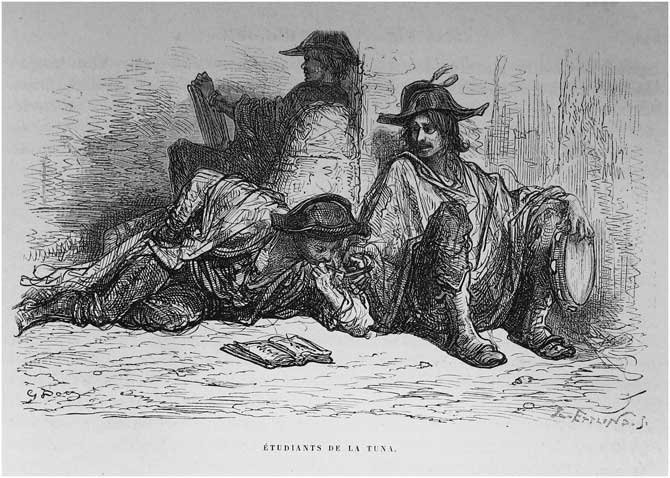
In their accounts of the estudiantinas, Romantic European authors searched for characteristics that accorded with longstanding literary stereotypes of the Spanish student, and in the process often perpetuated these. Charles Davillier, one of the most widely read travel writers on Spain from the second half of the nineteenth century, began his description of the students by outlining their famed qualities and their poverty, which was further accentuated by the accompanying image of his illustrator Gustave Doré (Fig. 1):
The ancient romances are full of descriptions of the characteristics of the students …. The exploits of the students have been made the subjects of popular ballads, where they are held up to praise or to ridicule. They have also been, times without number, caricatured in the local prints, and set down as the authors of all the practical jokes, pleasantries, and scandals which could be traced to no certain source. The misery of their lives was proverbial. One of them says, ‘Since I became a student, since I have worn the cloak, I have eaten nothing but soups made out of old boots’.Footnote 8
Davillier, like several French travel writers engaging with Spain, commented on several points of resemblance between the estudiantinas of the 1860s and medieval troubadours:
[P]oor and nomadic like [ancient knights-errant], poets and musicians like the [trobadores of the Middle Ages], singing under balconies, and holding out their hats to beg for a cuarto or a peseta in exchange for their jotas or their seguidilla. It is thus that they are represented in popular song.Footnote 9
‘Étudiants de la tuna’, Ch. D’Avillier and Gustave Doré (ill.), Spain, trans. J. Thomson (London: Bickers & Son, 1881): 431
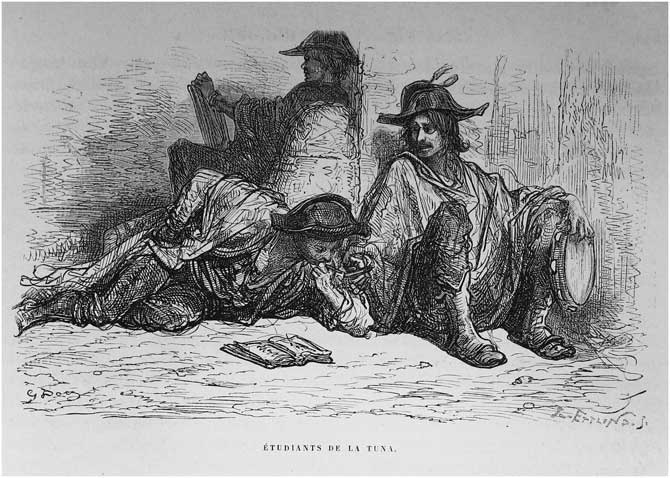
However, Davillier was careful to warn tourists against any expectation of encountering such legendary students:
They are now as rare as the fossils of antediluvian animals, and the last specimen of this race has passed away to join the manola, the fraile, and other remains of ancient picturesque Spain. The modern students are more orderly and less turbulent than their early prototypes; yet they are still noted for their love of practical joking and trickery.Footnote 10
Davillier’s observations on Spanish students were reflected by English-speaking correspondents, who by the late 1870s had noted the preponderance of estudiantina groups as part of the Carnival atmosphere in Madrid:
The strange manners of the Spanish students of the past century have formed the subject of many a Spanish romance …. But today the manners of the Spanish student have lost all their originality, and nothing distinguishes him from other young men, save during the carnival, when he dons a particular costume, and goes about serenading the people like his juvenile countrymen of former times …. The carnival at Madrid rarely takes place without the assistance of two or three estudiantinas, who parade about with their guitars, mandoline, fifes, and violins, and honour the leading inhabitants with a serenade.Footnote 11
The regular presence of Madrid’s estudiantinas as part of the city’s Carnival celebrations began gaining official approbation by the mid-1870s. No longer restricted to their university festivities, there are even accounts of Carnival serenades in the vicinity of Madrid’s Palacio Real [Royal Palace]. The new King Alfonso XII (who succeeded the Republican government of 1868–1874 following the abdication of his mother Queen Isabel II) encouraged their activities by allocating 12,000 reales for the groups performing in the public square facing the Palacio Real during the Carnival of 1877. This royal endorsement provided the impetus for the Parisian escapade of the following year, which launched the estudiantina as an international phenomenon.
Creating a Sensation in Paris on the Eve of the 1878 Universal Exposition
The international dissemination of the estudiantina can be traced back to March 1878, when a large group of students based in Madrid decided to form a society to travel to Paris. Consisting of 64 students from various faculties of the University of Madrid (almost half of them medical students) and from the Conservatorium, the group planned their visit to coincide with the French capital’s Carnival festivities and preparations for the 1878 Exposition Universelle, which would commence in May of that year.Footnote 12 They took their cue from the activities undertaken by estudiantinas in previous Madrid Carnivals. Despite their being from well-to-do bourgeois families, it seems the Spanish monarchy and government had reservations about the estudiantina’s Parisian foray, given the propensity for pranks among such student groups.Footnote 13 Well aware that their activities in Paris would reflect upon Spain, the students (under the leadership of Ildefonso de Zabaleta and Joaquín de Castañeda) drafted a strict set of rules that would govern their code of conduct, and named themselves the Estudiantina Española.Footnote 14
Rather than put together their own ad hoc student dress from bygone eras, this group commissioned Lorenzo Paris, the principal costumier of the Teatro Real (Madrid’s royal opera house), to design and fabricate a costume that reflected elements of Renaissance student dress, which was described by one Parisian correspondent as follows:
[B]lack dress of velvet, in the fashion of the time of Philip II., [which] was highly admired. A harlequin’s cocked hat [bicorne] with an ivory spoon for a cocade; a black velvet doublet with a sash of the same stuff, and steel buttons; velvet inexpressibles, black silk stockings, patent leather shoes with rosettes of black ribbon and steel buckles, and a black cloth cloak arranged so as to allow the arm to pass through and play on the guitar.Footnote 15
The luxurious nature of the costume and its attention to detail went well beyond what had been the dress of estudiantinas in Spain. It included a number of anachronistic elements, such as a Renaissance ruffled collar alongside an eighteenth-century bicorne hat.Footnote 16 This costume was, in essence, a nineteenth-century theatrical representation of the Spanish students past, which would form the basic template for the uniform of future estudiantina groups.Footnote 17 In their desire to represent Spain, the students ‘ornamented [their guitars and tambourines] with ribbons of the national colours, yellow and red; their castanets are tied with the same’.Footnote 18 But what most excited the curiosity of the Parisian onlookers was the spoon:
It appears that it is a memorial of the good old times – a remnant of the old habits of poverty-stricken students who begged their meals at the convent doors, and in order to be ever ready for the repast, wore their spoons in their hats. The spoon to-day is nothing more than a symbol.Footnote 19
After arriving in Paris on 2 March 1878, the Estudiantina Española (or Estudiantina Espagnole, as it was sometimes referred to in the French press), directed themselves to Spanish Embassy, performing along the boulevards and suspending traffic on the Quai d’Orsay. This form of street music dominated their activities over the next few days, and included serenades outside the residences of some of the leading Spanish and French dignitaries: the palaces of the French President Patrice Maurice de MacMahon and the ex-Queen of Spain, Isabel II, and the homes of the famous opera singer (and mistress of Alfonso XII) Elena Sanz and the renowned author Victor Hugo. They were supplemented by serenades outside the offices of the principal newspapers, starting with Le Figaro on 3 March, which attracted more than 10,000 spectators and set the pattern whereby the daily activities of the Estudiantina Española would receive extensive coverage in the press. On 6 March Le Gaulois claimed on its front page that:
The spectacle that they provide brings to life on our boulevards the costumes and the customs of another country and another century, this ambulant anachronism pleases the Parisians for its novelty and foreignness, and the Parisians can’t help but applaud them.Footnote 20
The exuberance of these street musicians and the spontaneity of their appearances during the first week of March added to their attraction:
They go about through the city at their own sweet will, stopping here and there, like the pifferari, and playing. Sometimes one of them dances, and then there is a rush to see this strange improvised performance.Footnote 21
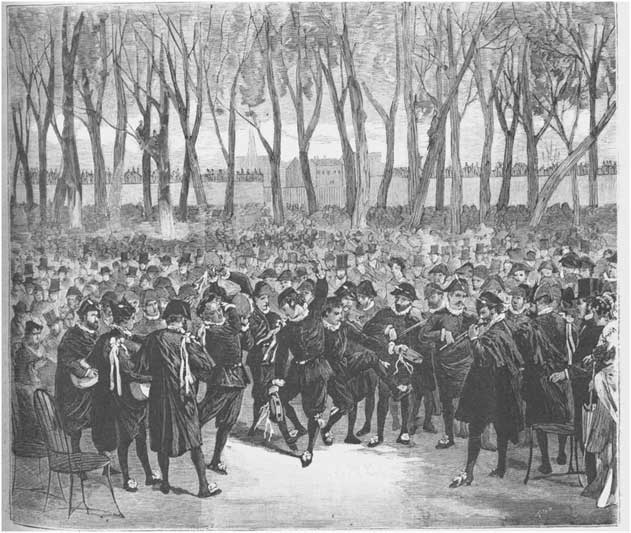
But what drew the largest crowds of Parisians were the impromptu performances at some of the principal sites of the French capital, which included parts of Montmartre, the Place de l’Opéra and the Jardin des Tuileries, where the Estudiantina attracted an estimated crowd of 50,000 people on 6 March (Fig. 2).Footnote 22
M.J. Gaudran, Estudiantina Española in the Jardin des Tuileries, in Ilustración española y americana 28, no. 10 (1878): cover
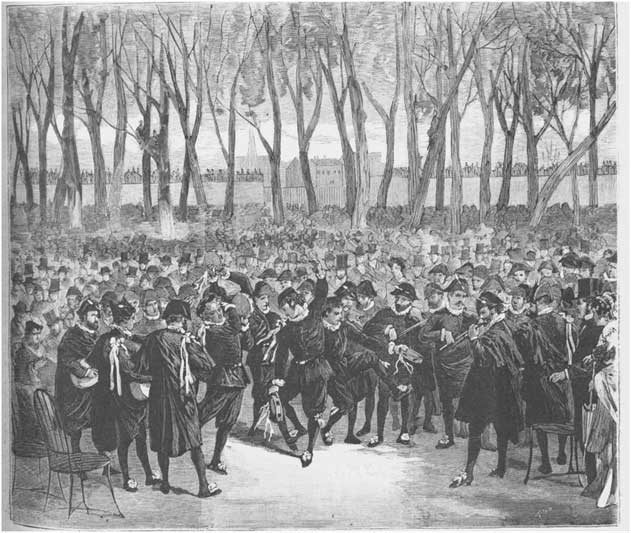
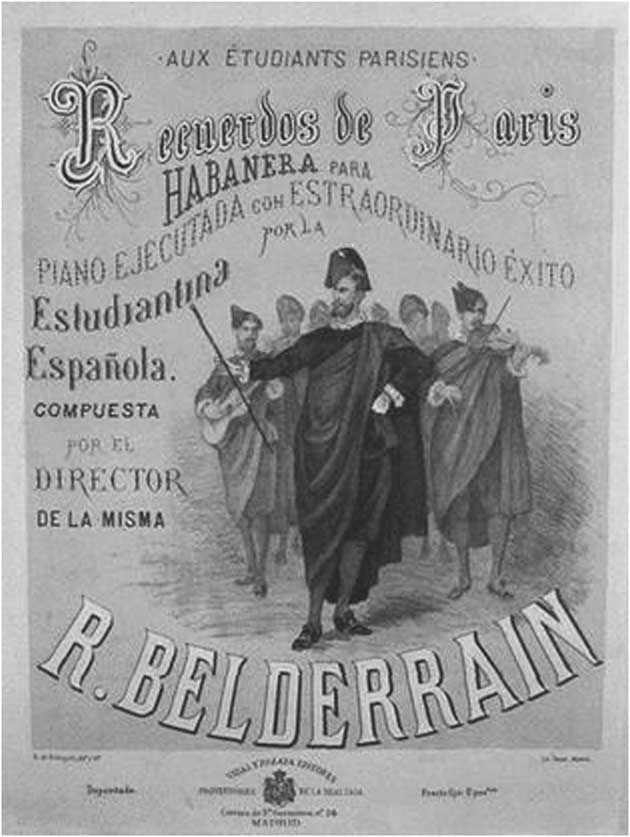
While several of the students acted as standard bearers, more than ‘[f]ifty of their number perform very beautiful music on the violin, the flute, the guitar, and two other instruments exclusively Spanish’,Footnote 23 and a number of the pandereta [tambourine] players danced to the strains of a jota or zortzico. Like their counterparts in Spain, the repertory of the Estudiantina Española consisted primarily of arrangements of Spanish airs, including instrumental versions of boleros, jotas zortzicos, polos and malagueñas, as well jotas and seguidillas at times accompanied by song. They also incorporated urban popular styles such as waltzes and habaneras (which had gained popularity in Second Empire Paris),Footnote 24 as well as marches and pasodobles. Some of these Spanish airs were taken from zarzuela arrangements or composed popular scores, as was the case with Eduardo Lucena’s ‘Olé! Jota’, which gained notoriety following its performances by the Estudiantina Española.Footnote 25 A habanera was also composed by the musical director of the Estudiantina Española, Ruperto Beldurraín (a composition prize winner at the Madrid Conservatorium) in honour of the French students and performed repeatedly in Paris (Fig. 3).Footnote 26
Ruperto Belderrain, Recuerdos de Paris (Madrid, 1878)
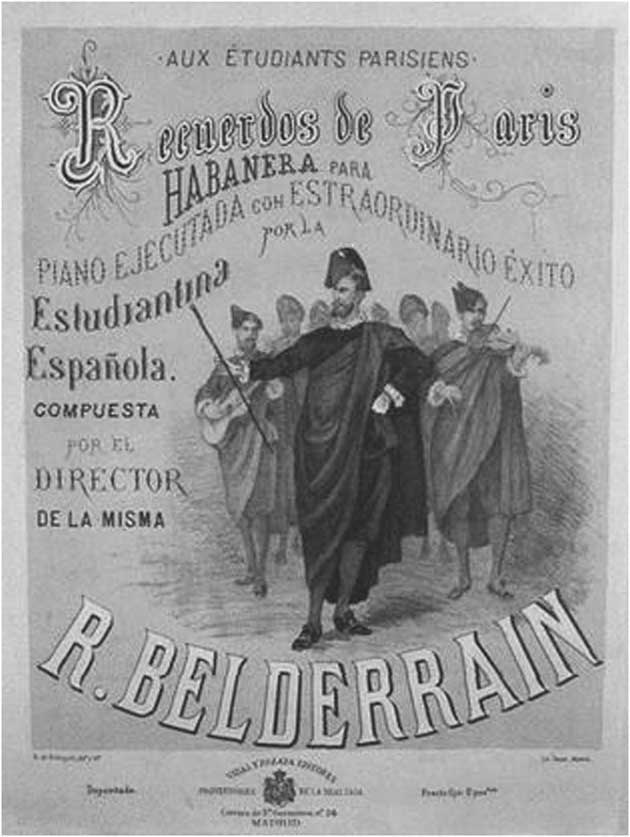
Several papers noted that the Spanish students had done much to revive the spirit of Carnival in the French capital, and that exuberant crowds of this size had not been seen on the streets of Paris since the fall of the Second Empire.Footnote 27 The Spanish journalist Fernando González thought the French public’s fascination with the students resulted from a confluence of factors:
The novelty of the venture, the circumstances of the moment, the nature of the Carnival festivities, the novelistic character of the enterprise, the courtesy of the race, better known here for its physical than for its intellectual or moral qualities, and above all the beauty of their costumes and our national airs, [all of which] satisfactorily explain the ovations and applause that have been garnered from far and wide by our young compatriots.Footnote 28
After the ravages of the Franco-Prussian war the Spanish students represented a less threatening invasion, one that was welcomed by the extensive Hispanic colony in Paris (which included a large aristocratic circle in exile) and was seen by the press as fomenting the bonds of Latinité and Franco-Spanish fraternity.Footnote 29 To this end university students from Paris took it upon themselves to accompany the Estudiantina Española and to host several events, including a banquet in their honour at the Richelieu restaurant on 7 March.Footnote 30
The success of the Estudiantina Española in Paris meant that the students were obliged to stay beyond the Carnival celebrations.Footnote 31 In the second week of their Parisian stay, there seems to be a shift in the activities of the students who, although still performing outdoors on occasion, spent more of their time being fêted by – and serenading – leading French citizens and nobility, including the Prince of Wales (the future King Edward VII) on 9 March. While there is no evidence of the Estudiantina Española seeking funds from the public in their outdoor performances, they were given sizeable donations by aristocrats and patrons of the salons they appeared at to defray the costs of their extended sojourn.Footnote 32 On 8 March a fancy dress ball was held in their honour at the Grand Hotel, sponsored by the famous entertainment impresario of Spanish origin Josep Oller.Footnote 33 The ball was attended by more than 600 people, including leading figures from the Hispanic colony and the ‘artistic demi monde’,Footnote 34 and in its aftermath the estudiantina bicorne increasingly became a fashion accessory for many Parisian women. In fact the students, and the Romantic associations of the Spanish serenade, seem to have particularly caught the attention of the female public.
French women … admire what is for them as romantic as it is new …. They have seen in each of these students a new Count Almaviva singing at the foot of Rosina’s grilled window the beautiful serenade from the Barber; and feminine fantasy is stimulated by the frivolity of these newspapers that have converted our current students into graduates of Salamanca, and our zarzuela arias into serenades.Footnote 35
The long association in the French consciousness of the figure of Figaro with the Spanish serenade of a bygone era was further reinforced by the fact that the logo of Le Figaro, France’s most widely selling newspaper of the time, presented the Spanish barber sporting an antiquated costume and guitar – with obvious similarities to the fabricated costume of the Estudiantina Española (Fig. 4).
Logo of Le Figaro, 1826

The Figaro association may have also facilitated the migration of the Estudiantina Española from the streets and salons of Paris to its stages. Two concerts were given in their honour at the Théâtre-Italien on Sunday 10 March and Thursday 14 March, on the eve of their departure from Paris.Footnote 36 Elena Sanz, a leading soprano of the Théâtre-Italien, joined the Estudiantina on 10 March ‘singing jotas and habaneras from her homeland’.Footnote 37 But it was during their farewell performance that the students were co-opted by the theatre to become part of the staging and the local colour of a performance of the Rossini’s Barber of Seville.
After the farewell banquet offered them by the students of Paris, which closed their daylight doings, they went to the Italian Opera, to which they had been specially invited, and the opera being Rossini’s immortal ‘Barbiere’, the party joined in with voices and guitars in the scene of the music lesson, to the immense delight of the audience, and gave various dances and Spanish airs in the course of the evening.Footnote 38
The success of the Estudiantina Española and the widespread international reports of their conquest of Paris set the stage for estudiantina ensembles becoming fixtures of the cosmopolitan music halls and popular stages over the following quarter of a century.
The Professional estudiantina on the International Stage
The Estudiantina Española spawned a multitude of imitators that would form part of the international popular music stage till the early twentieth century, starting with the groups that performed at the Paris Exposition of that year. Most of these ensembles, comprising professional entertainers,Footnote 39 ranged in size from 10–20 players (although at times as small as a trio), and predominantly employed bandurrias, laúdes and guitars.Footnote 40 This was a highly successful commercial formula that built on the terrain established by the ubiquitous touring American minstrel groups.Footnote 41 The most famous of these ensembles was the Estudiantina Figaro, founded by Dionisio Granados in Madrid in 1878.Footnote 42 Granados cannily drew on the aura associated with the character of Figaro, which had come to the fore during the Parisian tour of the Estudiantina Española.
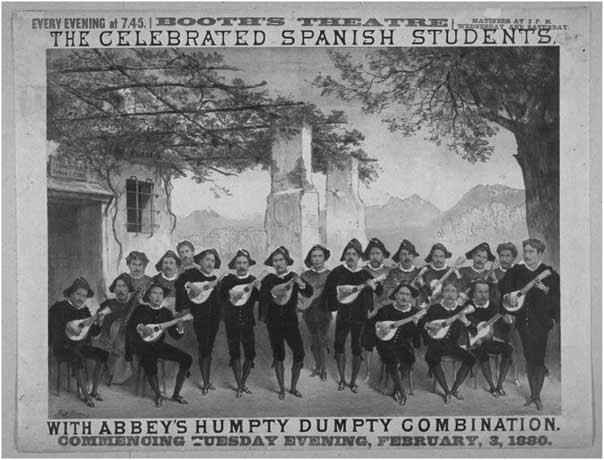
The Estudiantina Figaro, with its extensive touring across several continents, was the most important ensemble in fomenting the international vogue for the Spanish students (see Fig. 5). By 1881 they claimed to have given more than 1,300 concerts across Europe (from Imperial Russia to England, playing repeatedly before heads of state) and North America, with members of the troupe going on to an extensive tour of Latin America (1880–86).Footnote 43 In its various incarnations, the Estudiantina Figaro continued through to 1904 and spawned imitators in many of the countries it visited. In the USA groups of fake Spaniards, mostly Italians performing on mandolins and guitars, impersonated the dress, performance contexts and repertories of the estudiantinas and toured their acts widely.Footnote 44
The music performed by professional estudiantinas varied according to the abilities of the ensembles and their directors, and the contexts in which they performed. While the initial repertory of the Estudiantina Española had focused on folk-inspired Spanish airs (often mediated by their presentation in the contexts of the zarzuela), the commercial estudiantinas starting with the Estudiantina Figaro also adapted European orchestral music, often overtures and marches. The Estudiantina Figaro, with over 150 diverse items in their core repertory, also accompanied operatic arias with guest singers. However, their programmes continued to highlight adaptations of Spanish airs and regional dances (from the waltz-like jota to the flamenco-inspired malagueña), as well as incorporating urban songs and dances from the zarzuela and the revistas [stage reviews, a form of género chico or one-act zarzuela]. Through works like Ruperto Chapí and Joaquín Valverde’s hugely successful stage review La gran via (1886), Spain was at the forefront of a new popular urban style, and works such as these figured in the estudiantinas’ repertory. Below is a typical programme of the Estudiantina Figaro from the mid-1880s, on this occasion from an 1885 New Year’s concert performed in an outdoor setting before 3,500 people in Santiago, Chile.Footnote 45
PART 1
Dionisio Granados, Rumania (March)
Emile Waldteufel, A tí (Waltzes)
Friedrich von Flotow, Overture to Martha
PART 2
Luigi Arditi, L’Ingénue (Gavotte)
Gioacchino Rossini, overture from William Tell
Un Beso (Mazurka)
PART 3
Dionisio Granados, Fantasies on Spanish Airs
Giuseppe Verdi, Miserere from Il Trovatore
Eduardo López Juarranz, Puerto Real (Pasodoble)
The repertory of the Estudiantina Figaro included new compositions and arrangements by their musical director Dionisio Granados, whose works for the ensemble were also published in piano arrangements throughout Europe; he had great success in Vienna with his suite of waltzes El Turia.Footnote 46 A number of European composers also wrote piano and orchestral works inspired by the sonority of the estudiantinas, the most popular of which was Emile Waldteufel’s Estudiantina (1883),Footnote 47 which became one of the most performed waltzes of the 1880s and formed part of the repertory of many estudiantinas.
While the directors of the estudiantinas were literate musicians who made many of the arrangements for their ensembles, this was not necessarily the case for the entire ensemble. However, they were known for their brilliance of execution and spontaneity, and most played from memory. As noted by a correspondent of London’s Era: ‘At the signal of the conductor the chords were struck and the rapid passages executed with the precision of clockwork, or rather with still greater exactness, for sometimes clocks do not keep time.’Footnote 48
‘The Celebrated Spanish Students’, 1880 advertisement for Booth’s Theatre (New York), where the Estudiantina Figaro performed for four months between the acts of the pantomime Humpty Dumpty
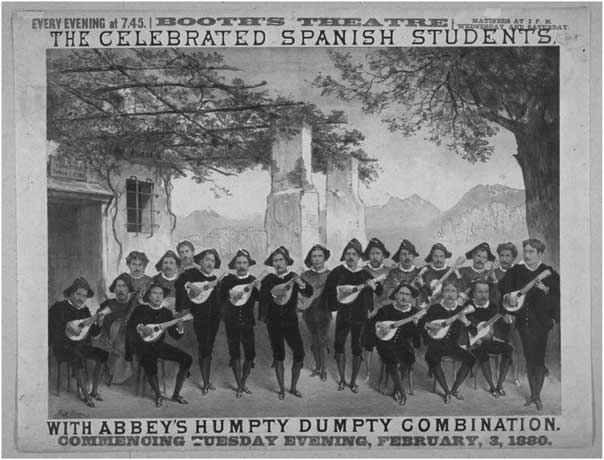
The performance contexts of the professional estudiantinas included theatres, outdoor public venues and expositions, garden parties and salons. They became fixtures of the music hall and the café chantant to World War I, often accompanying the new wave of Spanish and exotic dancers that swept these circuits from the late 1880s, and taking the form of on-stage ‘street’ serenaders. The Estudiantina Figaro’s stay in London in the summer of 1879 provides a snapshot of their performance contexts. They appeared in a range of venues, from the rose show at the Crystal Palace to a season at the Alhambra Theatre, performing twice between acts of the regular programme. Gone is the outdoor exuberance associated with the Estudiantina Española in Paris the previous year, with the Era describing them as being positioned in three rows, sitting ‘with one leg crossed over the other and display[ing] extreme Spanish gravity. But the grave and reverend Senors are vivacious enough in the manipulation of their instruments.’Footnote 49 While there was some consternation at the fact that these musicians were not actually Spanish students, and that there was not enough Spanish repertory, audiences were won over by their instrumental verve and dexterity.Footnote 50 There are also references to some performances of the Estudiantina Figaro at salons and garden parties.Footnote 51
The costumed Spanish estudiantina’s presence on the international stage had waned by the early twentieth century, although its traditions continued to thrive among amateur university groups in Spain and parts of Latin America.Footnote 52 However the multi-faceted legacy of the estudiantinas on fin-de-siècle popular music and music-making has yet to be fully researched. An early repercussion of the Estudiantina Española and its successors was the impetus it provided for the creation of different types of plucked string ensembles, and the subsequent mass production of relatively cheap fretted instruments, starting with the Italian mandolin orchestras that formed in 1878.Footnote 53 By the end of the 1880s, the term estudiantina also denoted localized mixed and plucked-based ensembles, playing folk and popular repertories (and this was one of the competitive categories at the 1889 Paris Exposition),Footnote 54 and from the 1890s, the term estudiantina was employed to describe the bourgeois amateur social music phenomenon of the plucked string orchestras in continental Europe. The late nineteenth century also witnessed the creation of a number of Mediterranean syncretic popular urban musical forms in which this new plucked sonority was an important component, from the Neapolitan song to elements of the Ottoman smyrneiko.Footnote 55 The transculturation of estudiantinas in many parts of Latin America (often through the impetus of the extended tours of the Estudiantina Figaro through the Americas in the 1880s) resulted in local folk and urban popular variants of the ensemble, and possible influences in the shaping of the sonority of styles such as the Brazilian choro and the Argentine tango.Footnote 56 Yet none of this would have been possible without the interest generated by the performances of the Estudiantina Española in Paris on the eve of the Exposition Universelle of 1878, and the engagement of the international press with this phenomenon.