

INTRODUCTION: TYPES OF MEANING
Few people start learning an L2 for the exotic sounds or for the elegant sentence structure that they detect in it. Meaning is what we are all after. We would all like to understand and to be able to convey thoughts and feelings and observations in another language the way we do in our native language. Ever since Aristotle, linguists have considered language to be the pairing of form (sound or written strings) and meaning. In this article, I examine the road to meaning, that is, how we get to understand and convey meaning in an L2, and where the pitfalls to that may lie. I begin by distinguishing among several types of meanings: lexical, grammatical, semantic, and pragmatic. Next, I situate them in the language architecture.
For many people, when they think of learning a foreign language, semantics describes predominantly what meanings are encoded in the foreign words. For example, the English cat is gatto in Italian; both words denote a small furry animal. Semantics, however, involves much more than word meaning. Lexical meanings are stored in our mental lexicon, while sentential semantics is compositional, that is, it is calculated by combining the meanings of all the words in a sentence and taking their order into account. Take, for example, the English sentence Cats were exterminated in a cataclysm. Depending on the context, it may mean that a number of cats were exterminated in a specific tragic event in the past, but it can also mean (untruthfully) that all cats were affected by a cataclysm and are now extinct, like dinosaurs. Of these two meaning of cats, only the first is available for the equivalent Italian sentence Gatti sono stati sterminati da un cataclisma, while the second is not (Longobardi, Reference Longobardi2001, among others). Although cats and gatti have the same word meaning in both languages, when used in speech, they give rise to two sentence meanings in English, but only one sentence meaning in Italian. This difference is captured and explained by the rules for calculating sentence meaning in the two languages, which is the research focus of (phrasal) semantics.
Grammatical meaning also comes into consideration in calculating sentential meaning. Consider the two sentences Jane eats sushi and Jane ate sushi. They contain two identical lexical items (Jane, sushi), and the third, the verbal form, encodes a grammatical difference in tense and aspect. We understand that a present habitual (but not an ongoing) event is meant by the first utterance, while a past habitual event or a past completed event is a possible reading of the second. Grammatical meanings are mostly encoded in inflectional morphology (-ed for past simple, -s for third-person singular present simple, etc.).
A fourth type of meaning, known as pragmatic meaning, depends on context consideration and knowledge of the world. It is the object of investigation of linguistic pragmatics. Scalar implicatures are a good example of the dissociation between semantic (or logical) and pragmatic meaning. Consider the following example of a well-known pragmatic inference. When we hear the sentence Some professors are smart, we actually understand that the speaker wants to say Not all professors are smart. Notice that the meaning not all is not encoded by the speaker's utterance, nor is it part of what the speaker has said. Rather, that interpretation is an assumption inferentially derived by the hearer on the basis of what the speaker has said. Logically speaking, some means some and possibly all. For pragmatic felicity, however, some means some but not all. The rationale goes like this: If the speaker wanted to say that some and possibly all professors are smart, she would have uttered all professors are smart, being maximally informative. Since she did not, she must really mean not all professors are smart. Understatements of this sort in human speech are regulated by Gricean maxims and, more specifically, the maxim of quantity: Make your contribution as informative as is required; do not make your contribution more informative than is required (Grice, Reference Grice1989). Lexical items that induce such calculations are arranged on a scale: <some, most, all>, <start, finish>, and so on, where uttering the lower-placed item implies that the higher placed item is not true.
When learning an L2, speakers are faced with four different acquisition tasks regarding meaning: First, they have to learn the lexical items of the target language, that is, map the linguistic form and lexical meaning one by one. This is certainly a laborious task. Second, learning the functional morphology is qualitatively different: Abstracting away from irregular morphology, once a speaker learns that -ed in English encodes a past habit or a past completed event, she can apply this knowledge to all English regular verbs. Third and fourth are sentential and pragmatic meanings, which are calculated using universal mechanisms of human language. Once the lexical and grammatical meanings are learned, sentential and pragmatic meanings come for free and do not constitute a barrier for acquisition. I will explain these statements based on current assumptions of the language architecture in the next section.
LANGUAGE ARCHITECTURE AND TYPES OF MEANINGS
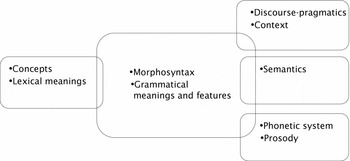
It is important to review current proposals for the language architecture in order to clarify our assumptions on types of meanings, modularity, and learning tasks in L2 acquisition. I assume a widely accepted model of the grammar following Reinhart (Reference Reinhart2006), illustrated in Figure 1 and explained below.
Modular design of the language faculty, following Reinhart (Reference Reinhart2006).

What is to be learned and what comes for free, keeping in mind the language architecture in Figure 1 above? In producing a sentence, all the requisite lexical items are drawn from the mental lexicon into the computational system (the morphosyntax box). The latter can be imagined as a working space where operations such as select, merge, and agree combine lexical items into phrases, and then into bigger phrases until a sentence tree is complete. The operation select is responsible for a category selecting a particular complement, for instance, the verb read selects a nominal object a book. Merge adds a new lexical item to a partially composed structure, while agree ensures the checking of features such that two categories on the tree are in agreement, for example, the subject and verb form in the sentence He knows. Syntactic operations continue until all of the lexical items in the lexical array are exhausted and all grammatical features are checked. Both visible and invisible operations (movements) take place here. A movement operation is postulated when an element is merged and interpreted in one part of the structure but is pronounced in another: For example, in the question What did you read?, the complement what is merged after the verb and interpreted as asking about the object of reading, but we pronounce it sentence-initially.
Universal principles and language-specific parameters reside in this computational system. The latter are reflected in the features of the grammatical morphemes also residing in the morphosyntax box. The complete syntactic object (the tree) is then passed on by means of a spell-out procedure to the phonetic system for pronunciation and to the semantic system for interpretation. Context, for example, the discourse-pragmatics of the message or the dialogue, also impacts semantic processes and interacts with the computational system. A reverse mechanism of building a syntactic tree in the syntactic module and sending it for interpretation to the semantic module is proposed for comprehension.
The key ideas here are compositionality (building up structure from building blocks: lexical and grammatical morphemes) and a matching procedure between syntactic structure and interpretation. Next, I elaborate on this matching procedure, or interface, between syntax and semantics. Fairly uncontroversially, syntactic structure needs to be correlated with semantic structure for a form-meaning mapping; however, this correlation is not always trivial (Jackendoff, Reference Jackendoff2002). The syntactic processor works with objects like syntactic trees, their constituents, and relations: noun phrases, verb phrases, grammatical features, and so forth. The semantic processor operates with events and states, agents and patients, individuals and propositions. For example, in the sentence The teacher ate the apple, the teacher is a noun phrase in subject position in the syntax, but an agent in the semantics. The operations at the interface are limited precisely to those structures that need to be correlated, and they do not see other structures and operations (like case-marking) that would have no relevance to the other module.
When two languages come into play, this computation gets even more complicated. That is why it is crucial to identify how languages differ and how we learn meanings in an L1 and L2. Within a formalist framework such as minimalism (Chomsky, Reference Chomsky1995) or Jackendoff's (Reference Jackendoff2002) parallel architecture, Universal Grammar (UG) makes available universal principles common to all languages and a finite number of grammatical meanings and word order options. Children learning their native language fix these parametric options based on the input they are exposed to.
The central question for L2 researchers then is: How much of semantic or conceptual structure is part of Universal Grammar, and how much of it may be parameterized? Jackendoff (Reference Jackendoff2002) argued that the basic architecture and contents of conceptual structure are universal and innate, while languages differ in their syntactic strategies for expressing phrasal semantics. Different linguistic forms assemble and map different natural groupings of meanings. There are numerous instances of mismatches at the syntax-semantics interface. For example, while the English past progressive tense signifies an ongoing event in the past, Spanish imperfect can have both an ongoing and a habitual interpretation. The English simple past tense, on the other hand, has a onetime finished event interpretation and a habitual interpretation, while the Spanish preterit has only the former. Thus, the same semantic primitive meanings (ongoing, habitual, and onetime finished event), which have to be expressed in every language and are therefore part of universal conceptual structure, are distributed over different pieces of functional morphology. What hosts most of the language variation in meaning, then, is the syntax-semantics interface.
Context-dependent meanings are calculated at the interface between syntax and discourse/pragmatics. For example, topic and focus (roughly, old and new information) are universal categories and all languages have to reflect them in one way or another. But some languages use intonation, other languages use clitic doubling or movement of certain phrases, and many others can use a mix of both strategies to mark topic and focus. Thus, the grammatical meanings of old and new information can be calculated at two different interfaces: at the syntax-phonetics/phonology interface and the syntax-discourse interface, or both.
To recapitulate our assumptions, linguistic meaning has its own combinatorial structure and is not simply read off the syntax. The operations at the form-meaning interfaces are nontrivial computations. Linguistic computations at all levels of structure are universal. When learning an L2, however, a speaker may be confronted with different mappings between units of meaning and units of morphosyntactic structure. Syntax and phonetics/phonology, syntax and discourse, and semantics and pragmatics also interface in a nontrivial, but universal, way.
TWO LEARNING SITUATIONS AT THE SYNTAX-SEMANTICS INTERFACE
Recent studies on the L2 acquisition of interpretive properties have looked mainly at two types of learning tasks. In one type, the properties to be learned demonstrate quite complex syntax, in the sense that sentences involve less frequent constructions (e.g., French double genitivesFootnote 1 in Dekydtspotter, Sprouse, & Anderson, Reference Dekydtspotter, Sprouse and Anderson1997; French discontinuous wh-phrasesFootnote 2 in Dekydtspotter & Sprouse, Reference Dekydtspotter and Sprouse2001; French quantifiers at a distanceFootnote 3 in Dekydtspotter, Sprouse, & Thyre, Reference Dekydtspotter, Sprouse and Thyre1999/2000; Dutch and German scramblingFootnote 4 in Unsworth, Reference Unsworth2005; Hopp, Reference Hopp2007). The native speakers in these experiments very often show far lower acceptance rates than we are used to seeing in the L2 literature. In many cases, alternative ways of articulating the same message exist, making the tested constructions dispreferred. (This in itself may explain the fact that learners sometimes have higher rates of acceptance than native speakers.) In most cases, the properties under scrutiny present the poverty of the stimulus situations to the learner, in the sense that no positive evidence exists for them in the linguistic input. However, at the syntax-semantics interface, these same properties do not present much difficulty, as there are no mismatches. This learning situation can be dubbed complex syntax–simple semantics. If learners have acquired the relevant functional lexicon item and have constructed the right sentence representation, the presence or absence of semantic interpretation follows in a straightforward way without any more stipulations. In most cases, learners demonstrate that a contrast exists in their grammar between the allowed and the disallowed interpretations.
In another type of learning situation, the syntactic structure presents less difficulty to the learners. Quite often, these studies deal with properties related to truth-conditional meanings of common morphological forms, like the preterit and imperfect tenses in Spanish-English interlanguage (Montrul & Slabakova, Reference Montrul, Slabakova, Perez-Leroux and Liceras2002), progressive tenses in Japanese-English interlanguage (Gabriele, Reference Gabriele2005), and bare verb meaning in Bulgarian-English interlanguage (Slabakova, Reference Slabakova2003). Not surprisingly, native speakers in these experiments show the regular range of accuracy found in studies of L2 acquisition (80–90%). The learning challenges lie, however, at the syntax-semantics interface. Learners have to figure out what morphological forms are mapped onto what meanings in the target language, since there is no one-to-one correspondence at the syntax-semantics interface. Somewhat simplistically, I dub this learning situation simple syntax–complex semantics. Results at all levels of proficiency from beginner to near-native point to the conclusion that knowledge of this type of semantic mismatch emerges gradually but surely. Next, I discuss some studies representative of the two learning situations.
As an example of the complex syntax-simple semantics learning situation, I examine tense-dependent interpretations of discontinuous quantifiers, as studied by Dekydtspotter and Sprouse (Reference Dekydtspotter and Sprouse2001). The semantic knowledge to be acquired involves the speech-time versus past time construal of adjectival restrictions of quantifiers. Consider the French sentence in (1).
(1) Qui de célèbre fumait au bistro dans les année 60?
Who of famous smoked in the bar in the 60s?
“Which famous person smoked in bars in the 60s?”
A possible answer to this question may involve a present and a past celebrity. On the other hand, it is impossible to answer the discontinuous interrogative constituent as in (2) with a present celebrity. Only someone who was a celebrity in the past is the appropriate answer.
(2) Qui fumait de célèbre au bistro dans les année 60?
Who smoked of famous in the bar in the 60s?
“Which famous person smoked in bars in the 60s?”
Without going into analysis of details, the two interpretations depend on where the adjectival phrase de célèbre is interpreted in the structure: below or above the tense operator. What kind of knowledge must an L2 learner have in order to be aware of both interpretations in the case of continuous wh-constituents but only one interpretation in the case of discontinuous ones? First, knowledge of overt wh-movement is required. It relies on properties of wh-words encoded in the functional lexicon, but such knowledge can be transferred from the native language in English-French interlanguage, since both English and French exhibit wh-movement. Second, knowledge that discontinuous interrogatives are allowed in French is necessary. This property is not taught in French classrooms (Dekydtspotter & Sprouse, Reference Dekydtspotter and Sprouse2001) but was given to the participants in the experiment in the form of the test sentences (assuming they believe that the researchers did not trick them into judging ungrammatical sentences). Third, the (not taught) language-specific knowledge that French allows the wh-word qui (who) to have an adjectival restriction at all is necessary, while English who famous and who of famous are not legitimate strings. Most importantly, however, what Dekydtspotter and Sprouse labeled the universal deductive procedure is indispensable for reaching the interpretive knowledge. The authors made a convincing case for the interpretations not being learnable on the basis of input alone and not transferable from English.
The task of the participants was to read a paragraph-length context in English matched with a test sentence in French. After the test sentence, the participants had to answer whether that was the correct answer to the question. The results show that past-time readings were preferred for continuous and discontinuous interrogatives by natives and learners alike. In this respect, learners followed the native pattern. It is knowledge of the missing interpretation, namely, the speech-time reading (in example 2, someone who is a celebrity at present) with discontinuous constituents that is crucial in answering the research question of this study. Both intermediate and advanced learners demonstrated a statistically significant difference in their acceptance of the available and the unavailable interpretations. In other words, they reliably treated the two constructions differently. Learners were capable of successfully combining the properties related to the French functional lexicon—the availability of wh-movement and discontinuous interrogatives—with the universal meaning-calculating algorithm. Even not very proficient L2 learners, in this case learners with as little as three semesters of exposure to French, manifested knowledge depending on this universal algorithm. It is no small achievement on the part of the learners that even with dispreferred strings or interpretations and under severe poverty of the stimulus, they manage to exhibit the contrasts we expect based on the respective syntactic structures and the universal meaning computation procedure.
To illustrate the simple syntax-complex semantics learning situation, we take a look at an aspectual mismatch. The linguistic properties whose acquisition Slabakova (Reference Slabakova2003) investigated have to do with grammatical aspect. English differs from German, Romance, and Slavic with respect to the semantics of the present tense. The hachure sign # signifies that this interpretation is not available.
(3)


Furthermore, the English bare infinitive denotes not only the processual part of an event but includes the completion of that event.
(4)
In trying to explain the facts illustrated in (4), many researchers have noticed that English verbal morphology is impoverished (Bennett & Partee, Reference Bennett and Partee1972). The experimental study adopts Giorgi and Pianesi's (Reference Giorgi and Pianesi1997) proposal. English verbs, they argued, are “naked” forms that can express several verbal values, such as the bare infinitive, the first and second person singular, and the first, second, and third person plural. Giorgi and Pianesi proposed that verbs are categorically disambiguated in English by being marked in the lexicon with the aspectual feature [+perf], standing for perfective. Thus, children acquiring English can distinguish verbal forms from nominals, whose feature bundle will exclude the feature [+perf]. In Romance, Slavic, and other Germanic languages, on the other hand, all verbal forms have to be inflected for person, number, and tense. Thus, nouns and verbs cannot have the same forms, unlike English, in which zero-derivation abounds. The Bulgarian verb, for example, is associated with typical verbal features as [+V, person, number], and it is recognizable and learnable as a verb because of these features. Bulgarian verbs are therefore not associated with a [+perf] feature. Consequently, Bulgarian equivalents to bare infinitives do not entail completion of the event, as (5) illustrates.
(5)
Thus, Bulgarian and English exhibit a contrast in the present viewpoint aspect. It follows that the Bulgarian equivalent to the bare verb does not have to check the feature [+perf] because the verbal root does not carry this feature from the lexicon. In the acquisition of English by Bulgarian native speakers, then, the learning task is to notice the trigger of this property: The fact that English inflectional morphology is highly impoverished, lacking many person-number-tense verb endings. The property itself, if Giorgi and Pianesi (Reference Giorgi and Pianesi1997) were correct, is the [+perf] feature that is attached to English eventive verbs in the lexicon. Knowledge of this property will entail knowledge of four different interpretive facts: (a) bare verb forms denote a completed event; (b) present tense has only habitual interpretation; (c) the progressive affix is needed for ongoing interpretation of eventive verbs; (d) states in the progressive denote temporary states. This is a syntax-semantics mismatch that relates a minimal difference between languages—the presence or absence of a feature in the lexicon—to various and superficially not connected interpretive properties. All of the properties are not attested in the native language of the learners. Even more importantly, of the four semantic properties just enumerated, the second, third, and fourth are introduced, discussed, and drilled in language classrooms. The first one, however, is not explicitly taught.
The learners in this study were typical classroom instructed learners of low, high intermediate, and advanced proficiency. All participants took a production task to ascertain knowledge of inflectional morphology and a truth value judgment task with a story in their native language and a test sentence in English; they had to indicate whether the test sentence was a good description of the story.
Results on the acquisition of all four semantic properties pattern the same way. On the three instructed properties (habitual interpretation of the present, progressive needed for ongoing interpretation, and states in the progressive denote temporary states), the advanced learners were highly accurate. Intermediate learners were more accurate on the habitual present than on ongoing progressive. Recall that the simple present in Bulgarian has both a habitual and an ongoing interpretation, so the progressive tense is a new form-meaning mapping for them. Advanced learners had no problem with the meaning of the progressive tense. Thus initial first language (L1) transfer and subsequent morphological acquisition were clearly attested in the data.
On the crucial knowledge that an English bare verb denotes a complete event, and consequently is incompatible with an incomplete event story, advanced learners were even more accurate than native speakers. They rejected the unavailable meaning 87% of the time. Even more importantly, all learner groups were quite accurate in attributing a complete interpretation to the bare verb, a property that cannot transfer from the L1, as example (5) indicates. Individual accuracy showed that more than half of individual learners had acquired successfully every aspect of the taught properties. Importantly, 44% to 72% of individuals in different proficiency groups were successful on the mappings of the untaught property.
After establishing that it is possible to acquire semantic properties in the L2 that are not manifested in the native language, let us now turn to the impact of the instruction variable. Slabakova (Reference Slabakova2003) reported that extensive scrutiny of the instruction materials and discussions with the instructors ascertained that the present simple and progressive tense meanings are explicitly taught and drilled from the beginning of classroom instruction. On the other hand, the closed denotation of bare verb forms is not taught, and the Bulgarian teachers are not consciously aware of it. Is it the case that instruction is a significant variable and learners were more accurate on the taught than on untaught properties? The short answer is no. All groups performed equally well on all conditions. The theoretical implication of this finding is that all semantic effects of learning the trigger (English verbs are morphologically impoverished) and the related property ([+perf] feature attached to verbs in the lexicon) appear to be engaged at the same time. Even untaught syntax-semantics mismatches are learnable to a nativelike level.
Finally, in this section I summarize some research on what has been argued to be a true semantic parameter: the article choice parameter. The learning situation can still be described as involving a simple syntax-complex semantics; however, understanding how the discourse affects article choice is crucial for correct usage, too. As is well known, speakers of a language without articles (e.g., Japanese, Chinese, Korean, and Russian) have a hard time using articles correctly in English. A number of experimental studies (e.g., Huebner, Reference Huebner1983; Robertson, Reference Robertson2000, among many others) have identified two types of errors these learners make: They either omit articles altogether or use them in inappropriate contexts. A series of recent studies, reported on in Ionin (Reference Ionin2003); Ionin, Ko, and Wexler (Reference Ionin, Ko and Wexler2004); and Ionin, Zubizarreta, and Maldonado (Reference Ionin, Zubizarreta and Maldonado2008) provide a principled, parameter-based explanation of learner article interpretation and use. Definiteness and specificity are semantic features; both are part of the conceptual arsenal of language. They are also discourse-related since they rely on the knowledge of the speaker and the hearer in a communication situation. By using a definite nominal phrase, a speaker refers to a uniquely identified individual in the mind of the speaker and the hearer. Definiteness is morphologically encoded by the; indefiniteness by a(n) for singular count nouns and by zero article for plural nouns. Uniqueness can be established by either prior mention or shared knowledge. Specificity, on the other hand, also reflects the property of uniqueness (an object or person being singled-out in the situation), but only in the mind of the speaker, not of the hearer. A specific nominal phrase has to be noteworthy in some discourse-related way. Specificity is not marked morphologically in standard English; that is, nominal phrases can be specific or not, as the examples in (6) illustrate for indefinites.
- (6)
a. Jill wants to marry a Canadian. She is going to present him to her family at Christmas. (indefinite specific)
b. Jill wants to marry a Canadian, but she has not met one yet. (indefinite nonspecific)
When speakers of a language without articles have to acquire articles in English, their learning task is to map the semantic feature definiteness onto its morphological expression the, and the lack of it to a(n) or zero article. Note that in article-less languages definiteness is established through context and other linguistic means such as demonstrative pronouns but does not have dedicated morphology. Thus, it is not the semantic feature definiteness that is new to the learners, just its morphological expression is. The two semantic features, specificity and definiteness, are somewhat close in meaning, having to do with establishing uniqueness of an object in the discourse. It is not inconceivable, then, for learners to use both features in semantically bootstrapping themselves into the morphology. However, Ionin (Reference Ionin2003) and Ionin et al. (Reference Ionin, Ko and Wexler2004) went one step further and propose the article choice parameter as in (7), a principled explanation of how languages choose which feature their articles reflect.
(7) A language that has two articles distinguishes them as follows:
• The definiteness setting: Articles are distinguished on the basis of definiteness (exemplified in English).
• The specificity setting: Articles are distinguished on the basis of specificity (exemplified in Samoan).
Cross-linguistic evidence for this semantic parameter comes mainly from Samoan, a language that purportedly uses the article le with specific nominal phrases and the article se with nonspecific ones, regardless of definiteness. Based on the article choice parameter, Ionin et al. (Reference Ionin, Ko and Wexler2004) predicted that learners of English from article-less languages will fluctuate between the different settings of the UG-supplied semantic parameter until the input leads them to the target value (definiteness). Their native language will not aid them in this choice since it distinguishes both features, but none of them morphologically. Importantly, they will overuse a in nonspecific contexts and the in specific contexts. These predictions are subsumed under the fluctuation hypothesis.
Ionin et al. (Reference Ionin, Ko and Wexler2004) tested beginning, intermediate, and advanced learners of English with Russian or Korean as their native languages. They employed a forced-choice elicitation task and a production task. Results indicate that when the target article is the, learners incorrectly use a with 8% of the specific NPs but with 33% of the nonspecific NPs. Similarly, when the target article is indefinite, learners incorrectly chose the 36% of the time with specific NPs but only 7% with nonspecific NPs. Thus learners' behavior is not random; their choice of article is significantly affected by the specificity of the nominal phrase. In the process of acquiring the morphological expressions of definiteness, they may sometimes map nonspecific definite NPs onto a, and specific indefinite NPs onto the. In other words, they fluctuate between the definiteness and the specificity value of the article choice parameter. The predictions of the fluctuation hypothesis are supported indeed.
However, individual results reveal a more complex picture. Of the 25 intermediate and advanced Russian-native learners, only 5 had acquired the definiteness, target-like English pattern. Two participants demonstrated the opposite (specificity) setting of the parameter and 8 fluctuated between definiteness and specificity. Furthermore, there were 3 learners who only heeded specificity with either indefinite or definite NPs but not both. Finally, 7 learners showed a truly miscellaneous pattern, unpredicted by the fluctuation hypothesis. In addition, Ionin et al. (Reference Ionin, Ko and Wexler2004) production results revealed that learners overused the with specific indefinites, but did not overuse a with nonspecific definites. In conclusion, the article choice parameter and the related fluctuation prediction is a principled explanation of learners' ostensibly erratic, but actually predictable article choice. It is an eminently testable hypothesis. Moreover, as more English L2 groups are being tested from different languages without articles, some interesting variation is being uncovered. For example, the presence of classifiers in Chinese (which are only used with indefinite NPs) may be aiding the learners in acquiring English articles, while the presence of demonstrative pronouns (which are specificity and deixis markers) is not aiding Polish (Tryzna, Reference Tryzna, García Mayo and Hawkins2009) and Russian learners in a similar way. However, the main conclusion remains that, even though the learners cannot transfer any morphology knowledge from their native languages, the universal semantics helps them to bootstrap themselves into language-specific morphological expressions of definiteness.
In this section, three studies illustrative of two types of learning situations were reviewed. These are representative of a range of recent studies on the L2 acquisition of the syntax-semantics interface (for an extensive review, see Slabakova, Reference Slabakova2006, Reference Slabakova2008). In the next section, I turn to acquisition at the syntax-discourse interface.
THE SYNTAX-DISCOURSE INTERFACE
The syntax-discourse interface may be qualitatively different from the syntax-semantics interface. There is a growing body of research suggesting that external interface properties, those that are at the interface of linguistic modules and other cognitive systems such as syntax-discourse, are especially difficult to acquire and cause developmental delays for L1-L2 learners. On the other hand, internal interface properties, those that are at the interface of different linguistic modules such as syntax and semantics are acquired more fluidly and faster (Tsimpli & Sorace Reference Tsimpli, Sorace, Bamman, Magnitskaia and Zaller2006, White Reference White, Ritchie and Bhatia2009). The most well-researched property at the syntax-discourse interface is the null subject parameter, since it involves both syntactic and pragmatic constraints (Belletti, Bennati, & Sorace, Reference Belletti, Bennati and Sorace2007; Rothman, Reference Rothman2009, among many others) I will compare here two studies that investigate another property: clitic doubling. Clitic doubling in Bulgarian (a syntactic property) is sensitive to which argument is topic (old information, based on the current discourse), Topics are clitic-doubled whether they are fronted as in (8A) or in situ as in (8B).
(8)
In Spanish, a very similar construction is known as clitic-left dislocation (CLLD)Footnote 5: A fronted topic is doubled by a clitic, but only when that fronted object is specific:
(9) El libro, lo lei
the book, it-cl read-1sg
“The book, I read.”
(10) *Un libro, lo lei
a book, it-cl read-1sg
“A book, I read.”
Valenzuela (Reference Valenzuela, Slabakova, Montrul and Prevost2006) studied knowledge of this semantic-pragmatic constraint in the interlanguage grammar of near-native speakers of Spanish with English as their native language. She employed an oral grammaticality judgment (GJ) task, an oral sentence selection task, and a written sentence completion task, all targeting knowledge of the same property. Oral presentation of the experimental stimuli is crucial in such studies, as the intonation should include a pause between the fronted object and the rest of the sentence, but not a very long pause (Valenzuela, Reference Valenzuela, Slabakova, Montrul and Prevost2006). Results of all three tasks indicate that near-native speakers are not distinguishing between specific and nonspecific topic constructions to the same degree as the monolingual controls. However, the differences are really a matter of degree, as all the choices of the near-natives are in the right direction. It is also notable that about 30% of individual learners demonstrate the target contrast in their L2 grammars.
Ivanov (Reference Ivanov2009) also studied knowledge of clitic doubling as a marker of topicality, but he compared it to knowledge of the fact that the clitic is ungrammatical when it doubles focused constituents. He employed a GJ task and a context-sentence evaluation task: a situation described in English and a short dialogue in Bulgarian where the participants had to evaluate four different word order and clitic combinations (fronted object versus object in situ, presence versus absence of a clitic) on a scale from 1 (totally unacceptable) to 5 (perfectly acceptable). Test items were presented both written and aurally. Fourteen intermediate and 10 advanced learners of Bulgarian as well as 15 native Bulgarian controls participated in the experiment.
Recall that knowledge of clitic doubling in these learners' interlanguage cannot come from English since English lacks clitics. The discourse requirements are not taught in Bulgarian classrooms but they are extremely frequent in everyday informal Bulgarian. Intermediate learners as a group were not sensitive to the discourse properties of clitic doubling, although on the whole they were aware of their syntactic properties. All advanced learners exhibited knowledge of syntactic as well as the discourse requirements of clitic doubling, and 9 out of 24 learners (37.5%) were statistically indistinguishable from native speakers in recognizing the pragmatic constraints. The results of this study demonstrate that complex properties at the syntax-pragmatics interface are not impossible to acquire.
While the jury is still out on L2 acquisition at the syntax-discourse interface, some studies indicate that there is extended optionality and variability in the acquisition of different types of interface properties while other studies point to complete and successful acquisition. It is essential in the future to expand the range of properties and languages that we investigate at this interface so that we get a better picture of the underlying reasons for the variability.
THE SEMANTICS-PRAGMATICS INTERFACE
Finally, I review some recent work on the acquisition of properties on the interface between semantics and pragmatics. Work on L2 acquisition of such properties is in its very early stages, but there is already a considerable body of findings on the child knowledge of such properties. To remind the reader, a scalar implicature is the additional (not all) meaning calculated over and above the literal meaning in sentences such as Some professors are smart. Since their computation mechanism is universal, the learning task in L2 acquisition involves transferring this purportedly universal mechanism from the L1. Therefore, we expect L2 learners to be accurate in scalar implicature derivation once they know the scalar lexical items, but that processing resources may have an impact on accuracy and speed.
Slabakova (in press) tested knowledge of scalar implicatures by 23 English native speakers, 30 Korean native speakers, and 30 advanced and 20 intermediate Korean learners of English. The two native speaker groups were intended to ascertain that the scalar implicature calculation mechanism is indeed universal. In Experiment 1, subjects read eight universally true sentences (All elephants have trunks), eight sentences infelicitous with some (Some elephants have trunks), eight sentences felicitous with some (Some books have color pictures), 8 sentences false with all (All books have color pictures), and eight absurd fillers (All/some garages sing). If the participants agreed with the sentences such as Some elephants have trunks, the answer was coded as logical; if they rejected the sentences as not fully informative since all elephants have trunks, the answer was coded as pragmatic.
The results confirmed that English and Korean adult native speakers give about 60% logical answers and 40% pragmatic answers. In addition, individual results revealed that these participants fell roughly into two groups: people who consistently gave logical answers and people who consistently chose pragmatically felicitous answers. Importantly, Korean learners of English attributed more pragmatic interpretations to scalar implicatures without context (around 60%) than they did in their native Korean, and significantly more than English native speakers. When asked to judge sentences with some in context, they offered pragmatic judgments around 90% of the times (Experiment 2). These findings suggest that L2 learners observe Gricean maxims even at an intermediate level of attainment, and probably right after they learn the scalar lexical terms. Much more research on properties at the semantics-pragmatics interface is necessary before we come to any solid conclusions. However, it is safe to say at this point that the first findings point to no real difficulty at this interface.
CONCLUSION
The acquisition of meaning is arguably the most important task of the L2 learner. Linguists distinguish between lexical, grammatical, semantic, and discourse-pragmatic meanings, situated in different modules of the language architecture. By definition, lexical and grammatical meanings capture language variation. Mapping of forms to lexical and grammatical meanings constitutes the main task, and the hardest part, of language acquisition. The remaining two meanings, sentential and discourse-pragmatic, are calculated using universal computation mechanisms. It was illustrated that universal semantic meanings (e.g., specificity) affect the morphological mapping of closely related meanings (e.g., definiteness, Ionin et al., Reference Ionin, Ko and Wexler2004). It was argued that once the inflectional morphology is learned, learners are aware of all its semantic consequences (Dekydtspotter & Sprouse, Reference Dekydtspotter and Sprouse2001), no matter whether the properties are taught or untaught (Slabakova, Reference Slabakova2003). Even at the syntax-discourse interface, acquisition of properties unavailable from the L1 is possible (Ivanov, Reference Ivanov2009; Valenzuela, Reference Valenzuela, Slabakova, Montrul and Prevost2006). At the semantics-pragmatics interface, L2 learners transfer universal properties like Gricean maxims (Slabakova, in press). It follows that in order to acquire meaning in an L2, the learner has to go through the inflectional morphology, and hence, morphology is the bottleneck of acquisition (Slabakova, Reference Slabakova2008). Phrasal and linguistic pragmatic meaning comes for free!
In the future, it will be profitable to dig deeper into meaning-form mismatches across languages and factor in the effect of the different surface realizations of the same meaning. For example, as discussed earlier, all languages mark topic and focus, also known as theme and rheme, old and new information. If the L1 marks topic and focus with lexical means only, is it harder to learn a language that marks them through intonation, or through word order changes and regular morphology like clitics? A specific case of a L1-L2 form-meaning mismatch is the case when a language (e.g., English) marks a meaning, say, past time, through a regular morpheme such as -ed, while another language (e.g., Vietnamese, Thai) indexes time through various adverbials and discourse. The prediction is that it will be much harder to acquire a qualitatively different way of denoting a grammatical meaning as compared to just mapping it to another piece of morphology. Going even deeper into form-meaning mappings, we should point out that one form-one meaning mappings are extremely rare in practice. In this article, I have mentioned the past tense morpheme in English as a carrier of the past time meaning. However, as Lardiere (Reference Lardiere2007) convincingly argued, there is no such thing as a plus or minus past feature reflected in past tense marking. The latter can also mark eventive perfect aspect (Paul walked the dog), counterfactuality (If I bought this, I'd be sorry), politeness or distance (I was wondering . . .), or even lack of tense in sequence of tense situations (in Roger said that he disagreed with her analysis, the disagreement may still be going on). Which of those many meanings of the -ed morphology are learned first, and which are learned through more extensive exposure? Answers to these and other intriguing research questions will bring more detail into the bigger picture, permit new generalizations, and enhance our understanding of how we acquire meaning in an L2 language.