1 Introduction
During the past several decades, a number of language studies have focused on the advantages of using computers and on-line networks for primary or secondary language education (Davis & Lyman-Hager, Reference Davis and Lyman-Hager1997; Thorne, Black & Sykes, Reference Thorne, Black and Sykes2009). An important advantage of computer mediated language education could be its presentation of words via multiple modalities, including printed text, graphics, dynamic video, and sound, to improve pronunciation (Davis & Lyman-Hager, Reference Davis and Lyman-Hager1997). In addition to those benefits, on-line games used in language education have additional beneficial factors such as social virtualities, massively multiplayer on-line (MMO) game interactions, and synthetic immersive environments (Thorne et al., Reference Thorne, Black and Sykes2009).
A second language (L2) is acquired through both implicit and explicit learning (Paradis, Reference Paradis2004). Implicit learning usually means acquiring complex information incidentally, without realizing what has been learned. Both attentional and working memory mechanisms seem to be associated with implicit learning. Explicit learning means that one can declare when information has been acquired.
Functional brain changes concomitant with learning a second language can be measured by resting-state functional magnetic resonance imaging (rs-fMRI). The resting-state brain imaging approach is useful in investigating the brain’s functional organization, measuring changes in the brain from normal to abnormal conditions, and (when compared to a baseline assessment) measuring changes after an intervention. The functional connectivity (FC) of rs-fMRI is an in vivo tool for the assessment of neural circuitry in the human brain that shows the connectivity between brain areas that share functional properties (Biswal, Kylen & Hyde, Reference Biswal, Kylen and Hyde1997). In particular, rs-fMRI can depict when two brain regions show temporal correlation, even when those regions are spatially remote, which suggests that those two regions share functional properties and form a neural network for a specific function.
Our aim in this study was to investigate the effects of playing an on-line English language education game on learners’ English ability and on their brain’s FC using the rs-fMRI technique. We proposed the following three research questions:
-
1. Would an individual’s English ability be improved by playing the on-line English language education game?
-
2. Would playing the game spark a change in the FC of the brain regions associated with language acquisition?
-
3. Would there be any association between improvement in English language proficiency and pragmatic skills and any changes in the regional brain FC?
2 Literature review
2.1 The use of computers and on-line games in second language education
Memory and cognition are subserved by two separate processing streams: verbal information (printed words) and non-verbal information (pictures or objects) (Paivio, Reference Paivio1971). Because computers can apply the two systems concurrently, several practitioners have applied computer technology to second language education and suggested that those systems have great potential to enhance learning (Fotos, Reference Fotos1996; Levy, Reference Levy1997; Muyskens, Reference Muyskens1997). The advantages of computer-assisted language learning have become more pronounced as computer technology (web, blog, social network, etc.) has developed. Those advantages include experiential learning, motivation, enhanced student achievement, authentic materials for study, greater interaction, individualization, independence from a single source of information, and global understanding (Zhytska Reference Zhytska2012). A recent meta-analysis of studies on the effectiveness of computer technology-supported language learning found that computer-assisted learning outperformed non-computer-assisted learning in L2 education (Grgurović, Chapelle & Shelley, Reference Grgurović, Chapelle and Shelley2013).
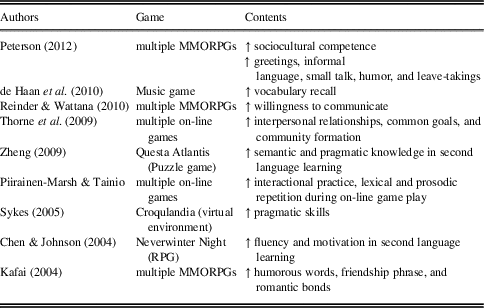
In addition to the benefits of computer use in L2 education, three advanced factors (social virtualities, MMO game interactions, and synthetic immersive environments) associated with on-line game use in language education have been suggested (Thorne et al., Reference Thorne, Black and Sykes2009) (Table 1). When playing “Second Life” (http://secondlife.com), a 3-D virtual-world MMO that is entirely built and owned by its residents, L2 learners effectively experience task-based learning activities in social virtualities with high levels of motivation and task completion in language education. Kafai, Sandoval, Enyedy, Nixon and Herrera (Reference Kafai, Sandoval, Enyedy, Nixon and Herrera2004) suggested that goal-directed collaboration in MMO games might enhance the social activities of the players with humorous words, friendship, and romance-based phrases. Sykes (Reference Sykes2005) reported that playing “Croquelandia” (http://gamerlearner.com/2007/12/07/), an open-source platform game, to build a foreign-language-specific synthetic immersive environment was effective for learning Spanish pragmatics.
On-line game and language education

Note: MMORPG: Massive Multiplayer Online Role-playing Game
Results from other studies on the effectiveness of game play in improving language education (Reinders & Wattana, Reference Reinders and Wattana2010; Peterson, Reference Peterson2012) showed improvement in English communication skills, especially non-verbal pragmatic skills (Table 1). Reinders and Wattana (Reference Reinders and Wattana2010) reported that playing MMO role-playing games increased the quantity and quality of L2 interactions in a game, as well as the players’ willingness to use the target language in a non-threatening environment outside the game. Zheng, Young, Wagner and Brewer (Reference Zheng, Young, Wagner and Brewer2009) reported that the educational game “Quest Atlantis” improved semantic and pragmatic knowledge in English native and non-native speakers. Chen and Johnson (Reference Chen and Johnson2004) showed that the commercial role-playing game “Neverwinter Night” improved fluency and the motivation to practise Spanish language skills in adolescent students. In a recent study about digital game-based learning, Reinders and Wattana (Reference Reinders and Wattan2015) suggested that game play lowered students’ affective barriers to learning and increased their willingness to communicate.
In a meta-analysis of game and L2 learning experience, Peterson (Reference Peterson2012) summarized the reasons for the effectiveness of game play in improving language ability: (1) game players can use the target language in an immersive environment; (2) during game play, game players use language with game characters or other players in virtual situations and in meaningful ways (socially appropriate language); (3) game players are exposed to cultural and linguistic knowledge that can’t easily be presented in textbooks or classrooms; and (4) game players receive feedback and rewards in response to repeating, revising, and reformulating game events. In addition, Sykes (Reference Sykes2005) suggested that one of the valuable benefits of computer-assisted education for L2 pragmatic learning is its flexibility and built-in complexity. That is, an on-line modality or game situation encourages the use of an integrated set of complex features to exercise complex L2 pragmatics in a realistic amount of time.
2.2 The neuroscience of L2 learning
Ellis (Reference Ellis2002) suggested that L2 learners initially use hippocampal explicit memories after the first registration of linguistic forms, and then they depend on neocortical implicit learning, which is associated with the final convergence of native-like language performance. Similarly, (Paradis, Reference Paradis2004) suggested that the dual-system neurocognitive model (implicit linguistic competence and explicit knowledge) of second language acquisition is domain specific. Implicit linguistic competence relies on specific neural systems, including Broca’s area and Wernicke’s area, parts of the left basal ganglia, and the right cerebellum (Paradis, Reference Paradis2004). Broca’s area and Wernicke’s area are known to play central roles in human language function (Price, Reference Price2012). Broca’s area is linked to language production, and Wernicke’s area is involved in a language comprehension network (Heilman & Scholes, Reference Heilman and Scholes1976). On the other hand, explicit knowledge, as represented by declarative memory, is subserved by the hippocampal system, including the parahippocampal gyri and the medial temporal lobe (Paradis Reference Paradis2004).
2.3 Language areas and rs-fMRI
fMRI is a specific brain imaging technique that measures brain activity by detecting associated changes in blood flow (DeYoe, Bandettini, Neitz, Miller & Winans, Reference DeYoe, Bandettini, Neitz, Miller and Winans1994) using the blood oxygenation level-dependent (BOLD) signal. Researchers use rs-fMRI to investigate intrinsic brain activity when a subject is at rest rather than performing a specific challenge or being exposed to task stimulations. Because brain activity exists even in the absence of a specific task or stimulation, any brain region can show spontaneous fluctuations in blood flow as measured by the BOLD signal.
In an fMRI study to determine the spatial relationships between native and second languages within Broca’s area, the areas that responded to L2 presentation were spatially separated from the areas that responded to native language (Kim, Relkin, Lee & Hirsch, Reference Kim, Relkin, Lee and Hirsch1997). Moreover, the activation sites for the two different languages tended to be spatially distinct in Broca’s area when the L2 was learned later in life, but not when it was acquired in early childhood (Kim et al., Reference Kim, Relkin, Lee and Hirsch1997).
Several studies have demonstrated that the FC determined by rs-fMRI is a reliable way to access language-related brain networks (Kollndorfer, Fischmeister, Kasprian, Prayer & Schopf, Reference Kollndorfer, Fischmeister, Kasprian, Prayer and Schopf2013; Zhu, Fan, Zou, Wang, Gao & Niu, Reference Zhu, Fan, Zou, Wang, Gao and Niu2014). In one such study( Kelly ,Uddin, Shehzad, Margulies, Castellanos, Milham & Petrides, Reference Kelly, Uddin, Shehzad, Margulies, Castellanos, Milham and Petrides2010) provided evidence that the ventrolateral frontal regions, including the anterior precentral regions of the premotor cortex and Broca’s area (pars opercularis and pars triangularis), are functionally linked during language production (Kelly et al, Reference Kelly, Uddin, Shehzad, Margulies, Castellanos, Milham and Petrides2010).In a subsequent rs-fMRI study, Zhu et al., (Reference Zhu, Fan, Zou, Wang, Gao and Niu2014) reported that the functional network of Broca’s area was predominantly left lateralized (hemisphere dominance of the language network).
3 Methods
3.1 Participants
In response to advertisements posted in Chung Ang University Hospital and at NC Soft Inc., we screened fifteen children as potential participants. Of those fifteen children, twelve were within the age range of nine to ten years old and met the following inclusion criteria: (1) native Korean language speakers; (2) no plan to engage in English language classes except for their in-school English education (50 minutes per session, two sessions per week) and the HoDoo English education program for twelve weeks (50 minutes per day, five days per week); and (3) IQ assessed with Wechsler Intelligence Scale for Children-Fourth Edition Korean version (K-WISC-IV) (Baron Reference Baron2005) ≥80. Exclusion criteria included: (1) psychiatric disorders, as assessed with Korean Kiddie Schedule for Affective Disorders and Schizophrenia-Present and Lifetime version (K-SADS-PL) (Kim et al., 2004); (2) history of head trauma with loss of consciousness or chronic medical illness; and (3) contra-indication for MRI scanning such as claustrophobia or the presence of metal implants. One child with an IQ≤80 and one child with attention-deficit hyperactivity disorder were excluded. A third child was excluded for having lived in the United States for one year. The research protocol was approved by the Chung Ang University Hospital Institutional Review Board. The children provided written informed assent, and the parents provided written informed consent.
3.2 English education on-line game program
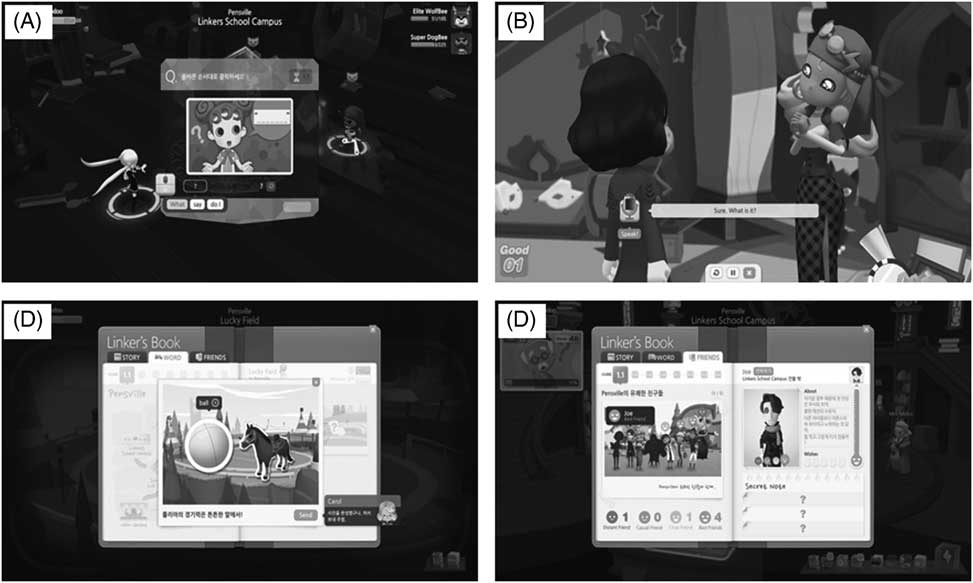
Considering the advantages of computers and on-line games, the HoDoo English game (NCSOFT©, Kyung-ki, Korea) was developed to teach English to native Korean speakers. The realistic, 3D, virtual English-speaking environment includes authentic English-speaking characters in daily life situations, diverse interactions with multiple characters and monsters, and an immersive environment with multiple attractions and 120 distinctive backgrounds. Each learner selects a main character that completes various tasks throughout the game, which includes 480 episodes and situations. For 50 minutes a day, children can use English to complete missions and meet virtual characters in the game. While playing the game, children speak through microphones, and the automated voice recognition system responds with appropriate facial expressions, vocal tones, and gestures. The key pedagogical content of the game includes: (1) Chunk-based learning – children learn English through four types of activities: listen & repeat, read aloud, tracing, and fill in the blanks; (2) Conversational learning – stories facilitate participation in realistic conversations; and (3) Testing – children are tested at the completion of each session (Figure 1).
Scenes from the HoDoo English game (NCSOFT©, Kyung-ki, Korea) Note: (A) Chunk-based learning: in which children speak English through four types of activities: listen & repeat, read aloud, tracing, and fill in the blanks; (B) conversational learning: stories facilitate participation in realistic conversations; (C) and (D) testing: in which children take after completing each session

3.3 Assessments
To assess English ability before and after playing the on-line English education game, a native British English speaker (A. Bruckshaw) assessed the twelve children in terms of English language proficiency and pragmatic skills. This native speaker was a business English instructor in Korea for five years. Following the American Council on the Teaching of Foreign Language proficiency guidelines of 2012 (Swender, Conrad & Vicars, Reference Swender, Conrad and Vicars2012), Bruckshaw assessed proficiency levels using a 32 item scale: nine short answers in response to simple questions; sixteen description scores in response to object and picture presentations; and eight free conversation scores in virtual situations. Pragmatic skills were assessed using a 45 item scale: eighteen verbal skill scores (for example, “uses politeness markers,” “changes topics appropriately,” and “expresses feelings/needs/problems”) and 27 non-verbal skill scores. Non-verbal skills included: (1) maintains appropriate eye contact (e.g. initiates/maintains eye contact during interaction); (2) indicates agreement or disagreement (e.g. shakes head or nods); (3) uses appropriate facial expressions (e.g. expression matches emotion conveyed); (4) uses appropriate social distancing (e.g. distance from strangers); (5) uses appropriate physical posturing (e.g. turns toward speaker); (6) uses appropriate greetings, pre-closing, closings (e.g. smiles, waves goodbye); (7) uses natural gestures (e.g. points to referent); (8) answers/acknowledges (e.g. turns when called); 9) takes turns (e.g., in activities, games, interactions).
3.4 Processing
After the enrollment screening and the English ability assessment, the twelve participating children underwent an fMRI scan. For the next twelve weeks, the children played the on-line English education game for 50 minutes per day, five days per week (because private educational institutes in Korea generally run their classes for 50 minutes per day, five days per week).
At the end of twelve weeks of game play, we repeated the English ability assessment and fMRI scan. The game platform automatically recorded images of the users’ facial expressions and behaviors during game play, as well as their playing time, scores, and game stage.
3.5 Brain imaging processing and analysis
We used a 3.0 T Philips Achieva scanner for all rs-fMRI scans and acquired images axially with an echo-planar imaging sequence. The parameters included: TR/TE=3000/40 ms, 40 slices, 64X64 matrix, 90° flip angle, 230-mm FOV, and 3-mm section thickness without a gap. In each scan, the scan time was 720 s, and we obtained 230 volumes. TR is the basic temporal resolution parameter that indicates how often a particular brain slice is excited and allowed to lose its magnetization. The 3-mm section thickness indicates the dimensions of a voxel (a three-dimensional rectangular cuboid), and the voxel size determines the spatial resolution.
In fMRI studies, the BOLD signal of activation is relatively weak, so other sources of noise in the data need to be cautiously controlled (Faro & Mohamed Reference Faro and Mohamed2010) using a series of technical processing stages before the start of the actual statistical analysis. We used the Data Processing Assistant for Resting-State fMRI (DPARSFA-http://www.restfmri.net), which is a plug-in software tool that works with Statistical Parametric Mapping (SPM8, http://www.fil.ion.ucl.ac.uk/spm/software/spm8/), and the Resting-State fMRI Data Analysis toolkit (REST, http://resting-fmri.sourceforge.net). We corrected all images for slice acquisition time differences; realigned, normalized, and spatially smoothed them with a 4-mm FWHM kernel; and de-trended and temporally band-pass filtered them to 0.01–0.08 Hz. We used an independent, component-based noise correction method to regress out sources of noise, such as white matter, cerebrospinal fluid signals, and head motion-related covariates.
We then applied an FC analysis to assess functional brain activity using the REST software. The protocol consisted of extracting the average BOLD time course from a seed region and then computing Pearson’s correlation coefficients between that average time course and the BOLD time course of every other voxel. We converted the correlation coefficients to normally distributed z-scores using Fisher’s z-transform. On the first-level analysis, within-group FC maps with two seeds, the left inferior frontal gyrus (Broca’s area) and the left posterior section of the superior temporal gyrus (Wernicke’s area), were assessed using a one sample t-test analysis in the SPM8 software. On the second-level analysis of the changes after twelve weeks of game play, we analyzed group FC maps with the left inferior frontal gyrus (Broca’s area) and the left posterior section of the superior temporal gyrus (Wernicke’s area) using a paired t-test. We set the resulting maps to a threshold using a p<0.05 family-wise error correction for multiple comparisons with an extent of more than 40 contiguous voxels and performed a cluster analysis (derived from an uncorrected p<0.001 and 40 extended voxels).
3.6 Statistics
The changes in proficiency levels and pragmatic skills from baseline to after the twelve week intervention were assessed with ANCOVA (Keppel Reference Keppel1991), controlling for age and total IQ. We analyzed correlations between changes in the proficiency and pragmatic skill scores and the scores of the four subscales of the K-WISC-IV using Spearman correlations. The correlations between the changes in the proficiency and pragmatic skill scores and the average peak values in clusters were calculated by paired t-tests using Spearman correlation coefficients. To correct for multiple comparisons, the statistical significance of the changes in proficiency and pragmatic levels was a priori set at p≤0.025 (0.05/2). Statistical significance in the correlation between non-verbal pragmatic scores and the scores of the four subscales of the K-WISC-IV was a priori set at p≤0.01 (0.05/5).
4 Results
4.1 Demographics
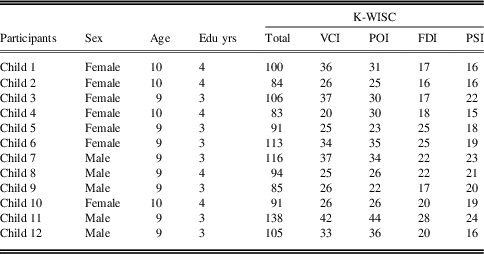
Twelve children participated in the study, seven females and five males. The mean age of the children was 9.3±0.49, and the mean number of years of education was 3.4±0.5 (Table 2). The mean IQ was 100.5±16.2. Four of the children were very shy speaking English with native American English speakers because they had never met native American English speakers before.
Demographic characteristics

Note: Edu yrs: education years; K-WISC: Wechsler Intelligence Scale for Children Fourth Edition; VCI: Verbal Comprehension Index; POI: perceptual organization index; FDI: freedom from distractibility index; PSI: processing index
4.2 Changes in English ability
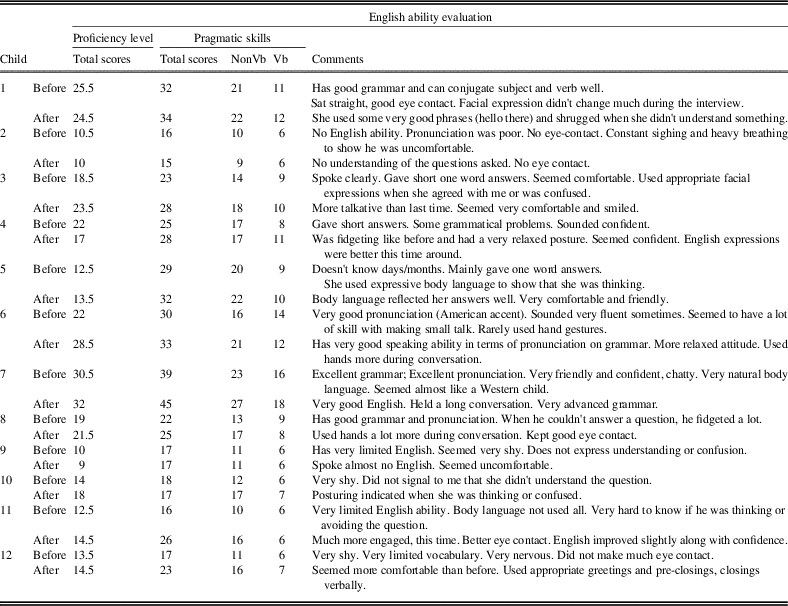
Two of the four shy children no longer exhibited shyness when speaking English with native American English speakers at the end of the twelve weeks (Table 3). There was no significant change in their proficiency level before and after the English learning on-line game (F(1,11)=1.87, MSF=3.64, p=0.20). However, their total pragmatic skill scores improved (F(1,11)=7.54, MSF=19.04, p=0.02). In a post hoc test of pragmatic skill scores, the non-verbal pragmatic skill scores improved (F(1,11)=8.74, MSF=22.12, p=0.01), and the verbal pragmatic skill scores stayed the same (F(1,11)=0.06, MSF=1.01, p=0.81). The changes in the non-verbal pragmatic scores before and after game play were positively correlated with total IQ (r=0.67, p<0.01). In a post hoc test, the changes in the non-verbal pragmatic scores before and after game play were positively correlated with the child’s freedom from distractibility (r=0.70, p=0.01) and with their processing speed, as determined by the K-WISC-IV (r=0.60, p=0.03).
English language skills before and after twelve weeks’ game play

Note: NonVb: non-verbal; Vb: verbal
4.3 Brain FC
4.3.1 Brain regions showing FC within Broca’s area
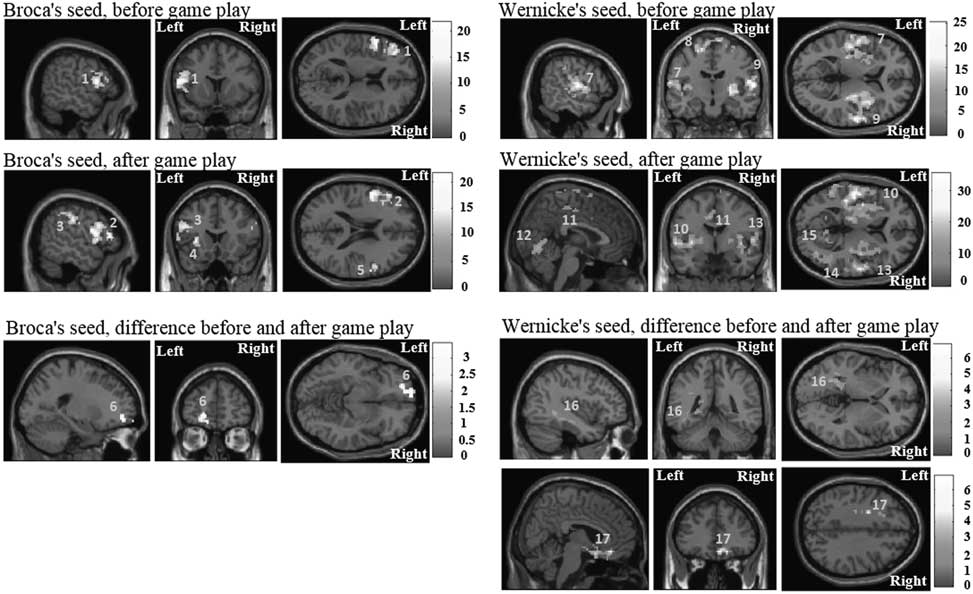
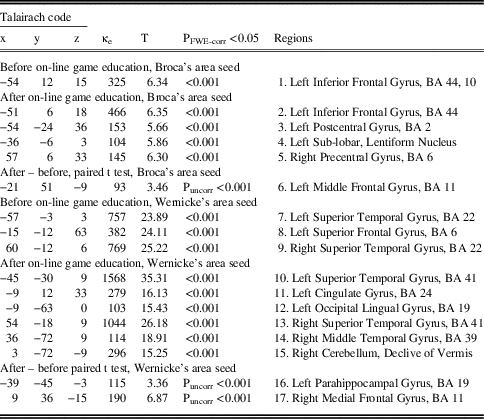
Before playing the on-line English education game, Broca’s area was positively correlated with the left inferior frontal gyrus (Brodmann areas (BAs) 44 & 10; p Fwe<0.05<0.001). After playing the on-line English education game, Broca’s area was positively correlated with the left inferior frontal gyrus (BA 44), the left postcentral gyrus (BA 2), the left sub-lobar, and the right precentral gyrus (BA 6) (p Fwe<0.05<0.001). These results mean that Broca’s area was simultaneously activated with the left inferior frontal gyrus before game play, and with the left inferior frontal gyrus, the left postcentrul gyrus, the left sub-lobar, and the right precentral gyrus after game play. In other words, Broca’s area seemed to share functional properties with the left inferior frontal gyrus before game play, and with the left inferior frontal gyrus, the left postcentral gyrus, the left sub-lobar, and the right precentral gyrus after game play.
After twelve weeks of on-line English education game play, the FC between the Broca’s area seed and the left middle frontal gyrus (BA 11) increased (p uncorrected<0.001; Figure 2; Table 4). This result means that twelve weeks of on-line English education game play intensified the neural networking between Broca’s area and the left middle frontal gyrus.
FC from seed region to other brain areas Note: See Table 4 for the explanation of yellow and red regions in picture (1–17).

FC from seed regions to other brain areas

Note: BA: Broadmann area
4.3.2 Brain regions showing FC within Wernicke’s area
Before playing the on-line English education game, Wernicke’s area was positively correlated with the left superior temporal gyrus (BA 22), the left superior frontal gyrus (BA 6), and the right superior temporal gyrus (BA 22; p Fwe<0.05<0.001). After playing the on-line English education game for twelve weeks, we found a positive correlation between Wernicke’s area and the left superior temporal gyrus (BA 41), the left cingulate gyrus (BA 24), the left lingual gyrus (BA 19), the right superior temporal gyrus (BA 41), the right middle temporal gyrus (BA 39), and the right cerebellum (p Fwe<0.05<0.001). These results mean that before game play, Wernicke’s area was simultaneously activated with the left superior temporal gyrus, the left superior frontal gyrus, and the right superior temporal gyrus. After twelve weeks of game play, Wernicke’s area was simultaneously activated with the left superior temporal gyrus, the left cingulate gyrus, the left lingual gyrus, the right superior temporal gyrus, the right middle temporal gyrus, and the right cerebellum. In other words, Wernicke’s area seemed to share functional properties with the left superior temporal gyrus, the left superior frontal gyrus, and the right superior temporal gyrus before game play began, and with the left superior temporal gyrus, the left cingulate gyrus, the left lingual gyrus, the right superior gyrus, the right middle temporal gyrus, and right cerebellum following twelve weeks of game play.
In response to twelve weeks of on-line English education game play, the connectivity between Wernicke’s area and the left parahippocampal gyrus (BA 19) and the right medial frontal gyrus (BA 11) increased (p uncorrected<0.001; Figure 2; Table 4). This result means that twelve weeks of on-line English education game play intensified the neural networking between Wernicke’s area and the left parahippocampal gyrus and the right medial frontal gyrus.
4.4 Correlation between the changes in pragmatic scores and the peak values in clusters
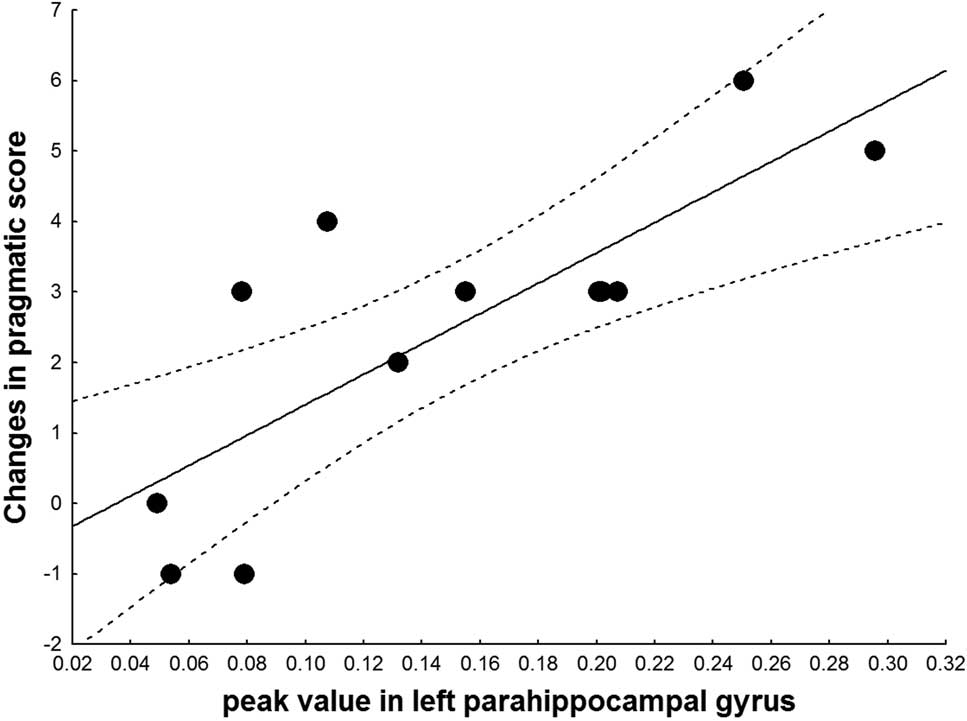
The changes in pragmatic scores were positively correlated with the average peak values in the left parahippocampal gyrus (r=0.68, p=0.01). The changes in the non-verbal pragmatic scores were positively correlated with the average peak brain activity in the left parahippocampal gyrus at a trend level (r=0.51, p=0.08; Figure 3). We found no significant correlations between the non-verbal pragmatic scores and the average peak brain activity in other areas. In addition, we found no significant correlations between the proficiency scores, verbal pragmatic scores, and average peak brain activity in all brain areas.
Correlations between pragmatic scores and peak values within left parahippocampal gyrus The changes in pragmatic scores were positively correlated with the averaged peak values in left parahippocampal gyrus at a trend level (r=0.68, p=0.01).

5 Discussion
To the best of our knowledge, this is the first study to assess both improvements in the subjects’ English ability and their intelligence components, and changes in the activity in the language areas of the brain following on-line language education game play. On-line English education game play effectively improved the children’s English communication skills, especially in terms of their non-verbal pragmatic skills. After playing the game, the children showed an increased positive connectivity between Broca’s area and the left frontal cortex, as well as between Wernicke’s area and the left parahippocampal gyrus and the right medial frontal gyrus. In addition, the increased connectivity between Wernicke’s area and the left parahippocampal gyrus was positively correlated with improvements in non-verbal pragmatic scores.
5.1 The effectiveness of on-line game play in improving English ability
Consistent with other studies on the effectiveness of game play in improving language education (Reinders & Wattana, Reference Reinders and Wattana2010; Peterson, Reference Peterson2012), this study showed improvements in the children’s ability to communicate in English, especially in their non-verbal pragmatic skills (Table 4).
In this study, changes in the subjects’ non-verbal pragmatic scores before and after game play were positively correlated with their freedom from distractibility and their processing speed indices on the K-WISC-IV. With the digit span, letter-number sequencing, and arithmetic subsets, the freedom from distractibility index reflects working memory (Baron, Reference Baron2005). The processing speed index consists of the coding, symbol search, and cancellation subsets (Baron, Reference Baron2005). Working memory and processing speed capacity are correlated with language recognition in terms of reading and listening spans (Protopapas, Archonti & Skaloumbakas, Reference Protopapas, Archonti and Skaloumbakas2007; Besser, Koelewijn, Zekveld, Kramer & Festen, Reference Besser, Koelewijn, Zekveld, Kramer and Festen2013). The on-line game format might improve English language abilities by enhancing working memory and processing speed.
5.2 FC between Broca’s area and the left hemisphere
After the English education provided by the on-line game play, connectivity increased between Broca’s area and the left hemisphere regions, including the inferior frontal gyrus, the postcentral gyrus, and the left lentiform nucleus. Moreover, after the on-line English education game play, connectivity increased between Broca’s area and the left middle frontal gyrus. This finding is consistent with a previous rs-fMRI study showing left hemisphere dominance in the language network (Liu, Stufflebeam, Sepulcre, Hedden & Buckner, Reference Liu, Stufflebeam, Sepulcre, Hedden and Buckner2009; Tomasi & Volkow, Reference Tomasi and Volkow2012). This lateralization could be associated with the optimization of neural processing in speech production, which might not be efficient if both hemispheres were used simultaneously (Tomasi & Volkow, Reference Tomasi and Volkow2012). The increased connectivity between Broca’s area and the right precentral gyrus could be an effect of game play. In excessive on-line game players, the precentral gyrus often shows increased activity in response to on-line game cues (Feng, Chen, J. Sun J, Zhou, Y. Sun , Ding, Zhang, Zhuang, Xu & Du, Reference Feng, Chen, Sun, Zhou, Sun, Ding, Zhang, Zhuang, Xu and Du2013; Yuan, Cheng, T. Dong, Bi, Xing, Yu, Zhao, M. Dong, von Deneen, Liu, Qin & Tian, Reference Yuan, Cheng, Dong, Bi, Xing, Yu, Zhao, Dong, von Deneen, Liu, Qin and Tian2013). Therefore, we cautiously suggest that on-line English education game play might increase activity in the speech production areas of the brain.
5.3 FC between Wernicke’s area and the left frontal cortex
Compared to the leftward symmetric connection of Broca’s area, Wernicke’s area is connected to both hemispheres: the left superior temporal gyrus, the left cingulate gyrus, the left lingual gyrus, the right superior temporal gyrus, the right middle temporal gyrus, and the right cerebellum. In addition, non-verbal pragmatic scores are positively correlated with the activation of the parahippocampal gyrus. The regions that connect Wernicke’s area to the left hemisphere regions, including the cingulate gyrus and the lingual gyrus, could play an important role in semantic word processing (Mesulam, Reference Mesulam1998). In a group independent-component-analysis of 336 children and adolescents between the ages of five and eighteen, semantic language skill was associated with the mid-superior temporal gyrus, the parahippocampal gyrus, the inferior frontal gyrus, the angular gyrus, and the medial parietal lobe (Karunanayaka, Schmithorst, Vannest, Szaflarski, Plante & Holland, Reference Karunanayaka, Schmithorst, Vannest, Szaflarski, Plante and Holland2010). In addition, the parahippocampal and the inferior and middle temporal gyri were activated in response to semantic and visual/audio verb stimulation (Karunanayaka et al., Reference Karunanayaka, Schmithorst, Vannest, Szaflarski, Plante and Holland2010). Those areas of the brain were also associated with learning an L2 (Paradis, Reference Paradis2004; Ellis, Reference Ellis2005). A rightward asymmetry has been frequently reported in Wernicke’s area (Tomasi & Volkow, Reference Tomasi and Volkow2012; Zhu et al., Reference Zhu, Fan, Zou, Wang, Gao and Niu2014). The right hemisphere is thought to be associated with processing figurative language, language prosody, and implicit linguistic learning, in contrast to literal interpretation (Tompkins & Mateer, Reference Tompkins and Mateer1985; Proverbio, Crotti, Zani & Adorni, Reference Proverbio, Crotti, Zani and Adorni2009). The right superior temporal gyrus within the language network is thought to be associated with idiomatic expressions (Arzouan, Goldstein & Faust, Reference Arzouan, Goldstein and Faust2007; Zempleni, Haverkort, Renken & L, Reference Zempleni, Haverkort, Renken and L2007). In an fMRI study, the right superior frontal gyrus and the right middle frontal gyrus also activated in response to metaphorical language stimulation (Lauro, Tettamanti, Cappa & Papagno, Reference Lauro, Tettamanti, Cappa and Papagno2008). We cautiously suggest that on-line English education game play might improve the comprehension of semantic expressions by enhancing figurative language processing.
5.4 Summary and implications
English education provided by on-line game play effectively improved English communication skill, especially non-verbal pragmatic skills. After on-line English education game play, the children showed an increased positive connectivity between Broca’s area and the left frontal cortex. This left lateralization seems to be associated with strengthening neural processing within the speech production areas. The children also showed an increased positive connectivity between Wernicke’s area and the left parahippocampal and right medial frontal gyri after playing the on-line English education game. Additionally, an increase in connectivity between Wernicke’s area and the left parahippocampal gyrus was positively correlated with improvements in non-verbal pragmatic scores. The left parahippocampal gyrus within the language network might play an important role in semantic word processing. The right superior temporal gyrus within the language network is thought to be associated with processing figurative language and idiomatic expressions. Taken together, we cautiously suggest that playing an on-line English education game might strengthen neural processing in speech production areas and improve the comprehension of semantic expressions by enhancing figurative language processing. The on-line English education game play seemed to enhance L2 learning by training verbal (printed words) and non-verbal (pictures or objects) information systems concurrently using visual, auditory, tactile, and kinesthetic sensory modalities.
5.5 Limitations
The current study has several limitations. First, the small number of subjects makes it hard to generalize the results. In addition, with a small number of subjects, this study was not detailed enough to probe the correlations between game training components (chunk-based learning, task-based learning, and situated learning) and improved components in language ability.
Second, because this study did not have control subjects, the educational effects of the on-line game could not be compared to the educational effects of an off-line program. Future studies should compare the effectiveness of the on-line English education game with that of a standard English education program. Third, the duration of the on-line English education game play might be unable to account for the long-term effects of the game experience.
5.6 Conclusion
On-line English education game play improved L2 ability, particularly in terms of non-verbal pragmatic skills, in native Korean speaking children. In addition, brain FC from Broca’s area to the left hemisphere as well as from Wernicke’s area to both hemispheres was enhanced by the on-line game play. This means that playing the on-line English education game seems to improve communication skills and semantic expression by enhancing figurative language processing.
These results highlight the effectiveness of on-line game play in the improvement of English ability. The game stimulates different sensory systems by activating the associated brain regions, which play a key role in figurative expressions and general language function. These findings are very impressive because they show that people with social cognition and/or non-verbal communication difficulties, such as those with autism spectrum disorder, depression, attention-deficit hyperactivity disorder, and/or intellectual disabilities, could improve their English ability through on-line educational game play.
Acknowledgements
Source of funding: This work was supported by a grant from the Korea Creative Content Agency (R2014040055). NC Soft, Inc. and Kidaptive Asia, Inc. technically supported this work.