INTRODUCTION
Halophila stipulacea (Forsskål) Ascherson (Hydrocharitaceae) is a tropical seagrass distributed along the coasts of the western Indian Ocean and the Red Sea (den Hartog, Reference Hartog, McRoy and Helferich1977; Larkum & den Hartog, Reference Larkum, Hartog and Larkum1989; Short et al., Reference Short, Coles, Pergent-Martini, Short and Coles2001). Although plant fragments belonging to this species were found in the eastern Mediterranean in 1894 (Fritsch, Reference Fritsch1895), the first record of living plants in well established meadows came thirty years later from Rhodes (Forti, Reference Forti1927; Issel, Reference Issel1928). Such early occurrences with respect to the opening of the Suez Canal in 1869, coupled with the wider and abundant distribution of the species in the Aegean Sea during the 1950s, induced Pérès & Picard (Reference Pérès and Picard1958) to affirm that H. stipulacea was a ‘paleomediterranean’ element that had survived the late Miocene crisis (Taviani, Reference Taviani2002) as a relict in the eastern Mediterranean Sea. In his seminal review of lessepsian migration (penetration of Red Sea species into the Mediterranean Sea through the Suez Canal), Por (Reference Por1971) argued to the contrary that Halophila stipulacea had been one of the first invaders into the Mediterranean Sea because it was ‘pre-adapted’ to cross the salinity barriers through the Canal. Apparently, the species remained restricted to the eastern Mediterranean for several decades (Lipkin, Reference Lipkin1975a, Reference Lipkinb; Van Der Velte & den Hartog, 1992; Kashta & Pizzuto, Reference Kashta and Pizzuto1995), but then showed a progressive colonization towards the western areas through Malta (Lanfranco, Reference Lanfranco1970) and the Ionian coast of Sicily (Biliotti & Abdelaad, Reference Biliotti and Abdelahad1990; Alongi et al., Reference Alongi, Cormaci and Pizzuto1992). In the western basin, it was first observed in 1995 at the island of Vulcano in the Aeolian Archipelago, southern Tyrrhenian Sea (Acunto et al., Reference Acunto, Maltagliati, Rindi, Rossi, Cinelli and Lardicci1997; Procaccini et al., Reference Procaccini, Acunto, Famà and Maltagliati1999). For more than ten years the species was not reported north of this latter location. This paper reports on the occurrence of Halophila stipulacea within the harbour of Palinuro (Salerno), a Tyrrhenian Sea locality about 180 km north of Vulcano Island, and gives some information on the settlement characteristics, plant density and morphological features. The record is discussed in the frame of the changing Mediterranean Sea biogeography (Bianchi, Reference Bianchi2007).
MATERIALS AND METHODS
Study site
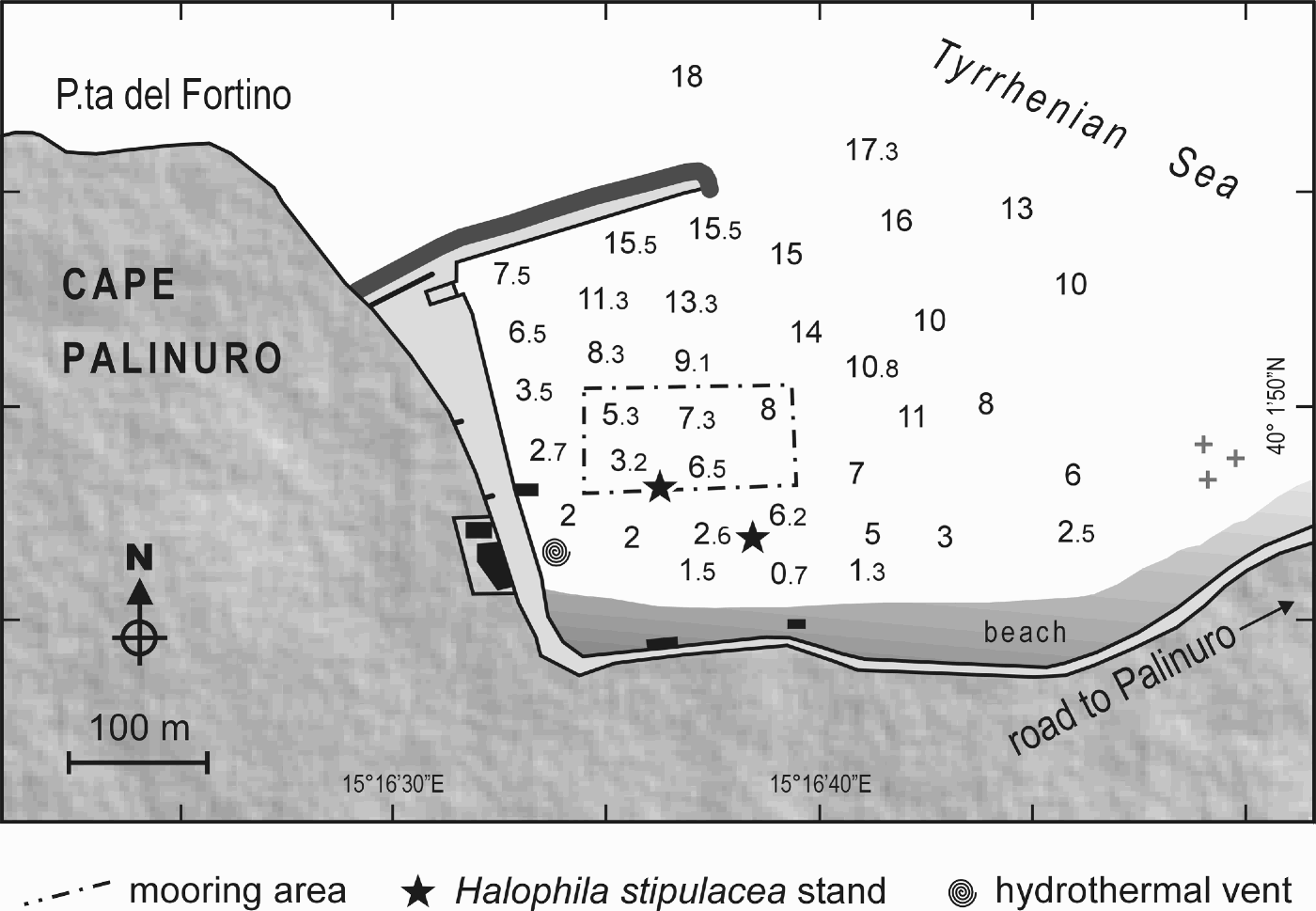
The settlement of the species, with a small patch (>1 m2), was first observed within the harbour of Palinuro (40°01.680′N 15°16.736′E) in September 2006. The harbour of Palinuro is a sheltered inlet protected by an artificial dock (Figure 1). The bottom is sandy and interspersed with a bed of the Mediterranean endemic seagrass Posidonia oceanica, from 1 m to around 10 m in depth. Due to the presence of numerous moorings, chains, anchors and lines of pleasure and fishing boats, the P. oceanica bed is quite degraded and regressed, showing a large amount of dead matte. Sampling of shoots for morphology, and estimates of shoot density were conducted by SCUBA diving in mid-June 2007. Quantitative samples were taken over a surface of 10 × 10 cm (4 replicates) in different patches of H. stipulacea at 2 m depth. In each quantitative sample, the number of shoots was counted to estimate shoot density, and ten plants were randomly selected and measured (number of leaves, leaf length and width) to evaluate shoot morphology.
Map of the harbour of Palinuro (Salerno, Campania coast), with indication of Halophila stipulacea occurrence. Soundings in metres. The position of the hydrothermal vent is taken from Alvisi et al. (Reference Alvisi, Barbieri and Colantoni1994).

A qualitative sample was also taken at 2 m depth in a patch where larger shoots of Halophila stipulacea were observed to vertically overgrow living Posidonia oceanica shoots. Twenty of such shoots were measured to characterize their morphology and evaluate their differences with shoots of quantitative samples collected far from the edge of the P. oceanica bed Piazzi et al., Reference Piazzi, Balestri and Cinelli2005; Van Tussenbroek et al., Reference Van Tussenbroek, Wong and Marquez-Guzman2008.
All collected shoots were washed from the sediments and fixed in 4% formalin. For each sample the presence of male flowers was noted and the flowering percentage (no. of flowering shoots/total no. of shoots × 100) was calculated (Pergent & Pergent-Martini, Reference Pergent and Pergent-Martini1988). Leaf morphological variables collected on shoots in the middle of the patch and at the edge of the P. oceanica meadow were compared with a t-test.
RESULTS
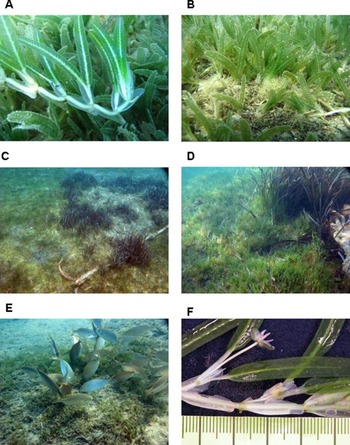
Species identification features: Halophila stipulacea is the only non-indigenous seagrass species to date to be reported from both the eastern and western Mediterranean Sea (Lipkin et al., Reference Lipkin, Beer, Zakai, Green and Short2003; Procaccini et al., Reference Procaccini, Buia, Gambi, Perez, Pergent, Pegent-Martini, Romero, Green and Short2003). Specimens collected in the Palinuro Harbour were checked for identification using the key provided by Kuo & den Hartog (Reference Kuo, Hartog, Short and Coles2001). The morphological features of our specimens match well with the H. stipulacea description and diagnostic characters of this key. In particular, typical of this species are the linear, oblong and membranous blades (up to 60 mm long), with 10–40 branched cross veins and serrulate margins (Figure 2A). Also very clear is the most distinctive character of H. stipulacea, represented by a pair of large, persistent, transparent scales, elliptic in shape and covering the short petiole, as illustrated in Figure 2A & F. Male flowers with tepals 3–4 mm long, and anthers 2–3.5 mm long (Figure 2F). Our specimens were also compared with herbarium specimens available at the Botany Department of the University of Catania (www.dipbot.unict.it/frame/vegetazionemarina.htm) collected along the coast of Sicily (identified by Professor G. Giaccone), as well as with the iconography available in various publications. Several shoots, also bearing male flowers as in Figure 2F, are deposited at the herbarium of the Stazione Zoologica (Laboratorio di ecologia del benthos) for reference.
(A) Close up picture of some shoots of Halophila stipulacea in the harbour of Palinuro (Tyrrhenian Sea) (Photograph: F. Barbieri); note the main diagnostic character for identification of the species: a pair of large, persistent, transparent scales, elliptic in shape and covering the short petiole; (B) shoots of Halophila stipulacea in the harbour of Palinuro (Tyrrhenian Sea) settled on a dead matte of Posidonia oceanica (Photograph: F. Barbieri); (C) a patch of Halophila stipulacea settled on the dead matte of Posidonia oceanica and interspersed with Posidonia shoots (Photograph: M.C. Gambi); (D) Halophila shoots merged with Posidonia oceanica shoots in Palinuro Harbour (Photograph: M.C. Gambi); (E) a school of the herbivore fish Sarpa salpa foraging within a patch of Halophila stipulacea in the harbour of Palinuro (Photograph: M.C. Gambi); (F) a mature male flower of Halophila stipulacea collected in the harbour of Palinuro (Photograph: B. Iacono).

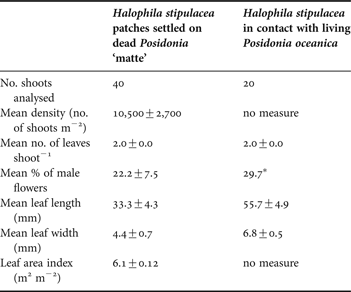
In June 2007 Halophila stipulacea was distributed within the harbour of Palinuro in a limited area, a narrow belt from 0.5 to 5 m depth in front of the small beach that lines the southern side of the harbour (Figure 1). In this area (approximately 25 m wide and 50 m long) various patches were present and all were found on dead Posidonia oceanica matte (Figure 2B,C). The majority of the patches were <1 m2, while two patches were bigger, one ~9 m wide × 7 m long and the other 2 m × 1.5 m, both located at 2 m depth. As a whole, considering all patches, we have estimated a bottom coverage by the plant of ~16 m2. In several patches H. stipulaceae was in contact with living P. oceanica shoots (Figure 2C,D). Halophila stipulacea shoots in contact with living P. oceanica had generally a vertical (ortothropous) growth over the P. oceanica leaves, and showed significant higher dimensions (both for length and width) than shoots settled in the middle of the patch (see Table 1; t-test, P < 0.01).
Shoots density and plant features of the Halophila stipulacea settlement in the harbour of Palinuro (June 2007).

*, single value.
In a small patch at 5 m depth, a school of Sarpa salpa was observed to forage within the patch itself (Figure 2E). However, no signs of direct grazing on Halophila leaves were detected, so it is likely that the fish school grazed upon the leaf epiphytes or upon small macroalgae interspersed with H. stipulaceae shoots.
Only male flowers were observed, mainly concentrated in the terminal portion of the horizontal stolons. Most flowers were at an early stage of development, with relatively few mature ones (Figure 2F).
DISCUSSION
The limited and fragmented extension of Halophila stipulacea patches recorded in the harbour of Palinuro suggests a recent colonization event of this plant in the area, probably due to the anchoring of pleasure boats coming from the Aeolian Archipelago, Sicily. It is a known fact that anchors can be an effective way of dissemination of alien marine macrophytes (Boudouresque & Verlaque, Reference Boudouresque, Verlaque and Briand2002). A similar dispersion vector has been speculated by Lipkin (Reference Lipkin1975a) as regards to the initial introduction of this species in the eastern Mediterranean, through multiple occasions either as fragments in fishing gears or attached to the hull of ships passing the Suez Canal. In this respect, it is also worth reporting that a similar mechanism of introduction has been hypothesized for a H. stipulacea settlement reported in the tropical West Atlantic (Grenada, West Indies) by Ruiz & Ballantine (Reference Ruiz and Ballantine2004). These authors stated that, ‘as there is little commercial shipping between Grenada and the Mediterranean, the most likely vector was a tourist pleasure yacht, and that the species has the potential to survive such trans-oceanic transfer’. A similar hypothesis was also formulated along the Campania coast at Punta Licosa, not far from Palinuro, for the introduction of a small patch of the alien macroalga Caulerpa taxifolia (Russo et al., Reference Russo, Balzano and Carrada2003).
Tourist traffic of pleasure boats is quite intense between Palinuro—one of the most attractive tourist areas along the Campania shoreline—and the northern coast of Sicily (Aeolian Archipelago), or the southern Tyrrhenian coast of Calabria, where H. stipulacea and C. taxifolia are well established, respectively.
Halophila stipulacea patches were only observed within the dead matte of Posidonia suggesting that this species needs a certain degree of organic matter and fine fraction in the sediment to settle. In addition, the dead matte is a low competition habitat where generally other fast growing plants, such as Cymodocea nodosa, Nanozostera noltii (=Zostera noltii = Zostera nana) and Caulerpa spp. settle preferentially (Montefalcone et al., Reference Montefalcone, Morri, Peirano, Albertelli and Bianchi2007). Mean shoot density in Palinuro (2 m depth) was lower than that observed in the meadow at Vulcano Island, where density ranged between 13,000 and 15,000 shoots m–2 at 5 to 25 m depth (Procaccini et al., Reference Procaccini, Acunto, Famà and Maltagliati1999), or in the Giardini Naxos (eastern Sicily), where density at 4 m surpassed 19,000 shoots m–2 (Cancemi et al., Reference Cancemi, Terlizzi, Scipione and Mazzella1994). This fact may further support the hypothesis of a recent colonization. Finding male flowers only is usual in the Mediterranean and is consistent with observation in other locations (Cancemi et al., Reference Cancemi, Terlizzi, Scipione and Mazzella1994; Procaccini et al., Reference Procaccini, Acunto, Famà and Maltagliati1999). This suggests the hypothesis of the introduction of male specimens only, or the difficulty of female flowers to develop under the Mediterranean environmental conditions. Therefore, the main propagation of the species is by fragmentation and vegetative stolonization. Shoot features (no. of leaves, leaf length and width) were also lower than those recorded at Vulcano, except for the shoots collected at the edge with living P. oceanica. Although settlement of H. stipulacea was still spatially limited, the availability of large areas of dead matte within the Palinuro Harbour suggest that the plant has potential favourable conditions for further colonization and expansion in the area.
BIOGEOGRAPHIC CONSIDERATIONS
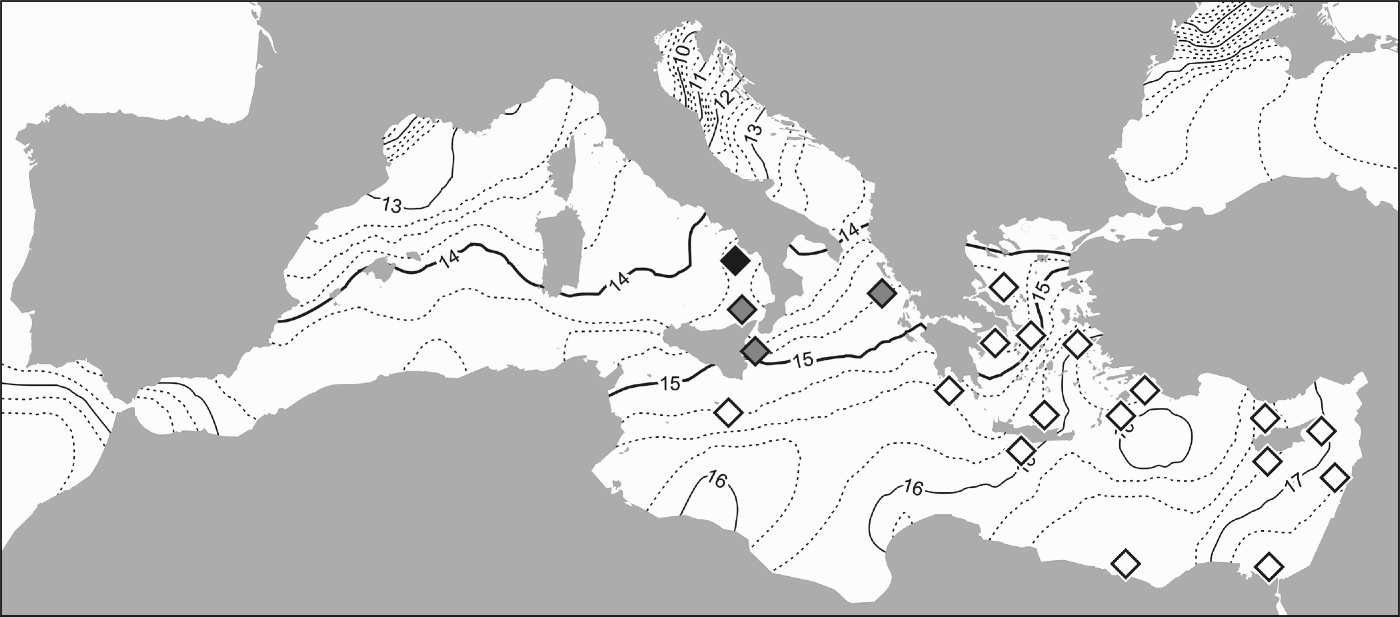
For nearly a century after its ingress into the Mediterranean Sea, Halophila stipulacea remained confined to the eastern basin, conforming to a typical pattern for lessepsian migrants: Por (Reference Por1990) defined the geographical limits to the expansion of Red Sea species in the Mediterranean as the ‘Andispara line’ to the north (Andispara being an island in the Aegean) and recent findings also along the coast of Albania (Xhulaj & Kashta, Reference Xhulaj, Kashta and Pergent-Martini2007), and the Strait of Sicily to the west. These boundaries match what Bianchi (Reference Bianchi2007) called the ‘15°C divide’ (i.e. the climatological surface isotherm for February), seen as a physiological barrier for the establishment of species with tropical affinities and origins in the Mediterranean Sea. In the latter two decades, however, H. stipulacea crossed the 15°C divide and started to go west (Figure 3). While its settling at Vulcano Island was to date an isolated patch merely facing the western basin, as the Aeolian area is still connected biogeographically to the Ionian Sea (Bianchi, Reference Bianchi2004), the present record at Palinuro provides proof of its expansion in the north-western Mediterranean. Both Vulcano and Palinuro settlements are intriguingly close to shallow-water hydrothermal vents (Dando et al., Reference Dando, Stüben and Varnavas1999), and De Biasi & Aliani (Reference De Biasi and Aliani2003) provided suggestive evidence that these vents may act as stepping stones for lessepsian migrants. The vent within Palinuro Harbour, located in close vicinity to the patches of Halophila stipulacea (Figure 1), maintains water temperature at 21.5°C in its immediate surroundings (Alvisi et al., Reference Alvisi, Barbieri and Colantoni1994), and this may set more favourable conditions for the settlement of this seagrass.
The Mediterranean Sea with surface isotherms of February (climatological means: Bianchi, Reference Bianchi2007). The 14°C and the 15°C ‘divides’ (see text) are highlighted by a thicker tract. Diamonds illustrate records of Halophila stipulacea: white and grey symbols show the records before 1980 and those of the 1990s, respectively (see text for references), the black symbol corresponds to the present finding at Palinuro (Salerno, Campania coast).

Due to the increased occurrence of warm-water species in recent years, it has been said that the Mediterranean Sea is undergoing a process of ‘tropicalization’ (Bianchi & Morri, Reference Bianchi and Morri2003). Tropical species have been entering the Mediterranean either through the Suez Canal or the Gibraltar Strait for decades, but they used to remain in the eastern or western basin, respectively, thus conforming to—and in a sense even reinforcing—the traditional physiographic and biogeographic subdivision of the Mediterranean Sea (Bianchi et al., Reference Bianchi, Boero, Fraschetti, Morri and Argano2002). However, just like H. stipulacea did, many lessepsian species have recently crossed the Strait of Sicily from east to west (see Pipitone et al., Reference Pipitone, D'Anna, Coppola, Di Stefano and Badalamenti2004 for a recent example). On the other side, Atlantic species have travelled the opposite way, passing from west to east: Atlantic and Red Sea migrant syngnathid fish now thrive together in Turkish waters (Gokoglu et al., Reference Gokoglu, Bodur and Kaya2004). The case of the Atlantic crab Percnon gibbesi perfectly mirrors that of Halophila stipulacea: it has crossed the Strait of Sicily (Bellantoni & Corazza, Reference Bellantoni and Corazza2003) and travelled eastward along the coasts of Calabria (Faccia & Bianchi, Reference Faccia and Bianchi2007) to eventually reach the Levant Sea (Yokes & Galil, Reference Yokes and Galil2006). To the north, P. gibbesi has apparently stopped at the Pontine Islands (Russo & Villani, 2004), which is in the same biogeographic sector as Palinuro (Bianchi & Morri, Reference Bianchi and Morri2000) and close to the ‘14°C divide’, the claimed northern boundary for Mediterranean warm-water species (Bianchi, Reference Bianchi2007) (Figure 3). However, we should consider that the examples given above refer to animals which are mobile and have large scale dispersive stages (larvae), and therefore higher potential for expansion in respect to macrophytes.
The traditional major biogeographic boundary between western and eastern Mediterranean is thus apparently fading in favour of a south–north boundary: recent re-appraisals of faunal distributions within the Mediterranean found such south–north subdivision for corals (Morri et al., Reference Morri, Vafidis, Peirano, Chintiroglou and Bianchi2000), sponges (Pansini & Longo, Reference Pansini and Longo2003) and pycnogonids (Chimenz-Gusso & Lattanzi, Reference Chimenz-Gusso and Lattanzi2003). Bianchi (Reference Bianchi2007) suggested that the alleged biotic differences between western and eastern Mediterranean are due more to differences in temperature regime than to the physical barrier of the Strait of Sicily, as it was traditionally assumed: this has profound implications, as the sea warming trend observed in the Mediterranean (Bianchi, Reference Bianchi1997; Bianchi & Morri, Reference Bianchi and Morri2004) can move isotherms but cannot change the morphology of the straits.
The northward expansion of Halophila stipulacea, Percnon gibbesi and many other, including native species in both the eastern and western basins (Grubelić et al., Reference Grubelić, Antolić, Despalatović, Grbec and Paklar2004; Sara et al., Reference Sara, Bianchi and Morri2005) occurred in exactly the same time frame of a major climatic event that upset the hydrological patterns of the whole Mediterranean in the 1980s and 1990s (Malanotte-Rizzoli et al., Reference Malanotte-Rizzoli, Manca, Ribera d'Alcala, Theocharis, Brenner, Budillon and Ozsoy1999), with dramatic effects on the marine ecosystems (Briand, Reference Briand2000). Along the coast of Campania, the region where the ‘14°C divide’ is passing and Palinuro is located, various phenomena and events related to seawater thermal anomalies have been recently documented (Gambi, Reference Gambi2006; Gambi et al., Reference Gambi, Cigliano and Iacono2006; Cigliano & Gambi, Reference Cigliano and Gambi2007), including the increased occurrence and frequency of several native or introduced warm-water species (Dappiano et al., Reference Dappiano, Iacono and Gambi2002; Dappiano & Gambi, Reference Dappiano and Gambi2004). Whatever the specific mechanism of dissemination (we postulated boat traffic), the present finding of H. stipulacea at Palinuro perfectly fits the frame of a scenario hypothesized by Bianchi (Reference Bianchi2007) for the changing marine biogeography of the Mediterranean of tomorrow: the traditionally acknowledged subdivision between a species-richer western basin and a species-poorer eastern basin, viewed as a legacy of the Quaternary colonization waves from the Atlantic filtered out toward the east by the sill of the Sicily Strait (Bianchi et al., Reference Bianchi, Boero, Fraschetti, Morri and Argano2002), is being replaced by a newly established subdivision between a southern (sub)tropical and a northern warm-temperate Mediterranean Sea.
ACKNOWLEDGEMENTS
Professor Giuseppe Giaccone kindly provided the iconography of the herbarium specimens of Halophila stipulacea at the Botany Department of the University of Catania for reference. Carla Morri (Genoa) provided literature references and critical advice. Serena Coraggioso (Palinuro) helped with the map of Figure 1. Thanks are also due to Francesca Ferraris and Alessio Rovere (Genoa) for cartographic support. The study of the penetration of lessepsian migrants in the western Mediterranean Sea falls within the scope of the on-going project ‘The impacts of biological invasions and climate change on the biodiversity of the Mediterranean Sea’ (Italy–Israel Cooperation—R & D Proposal for 2007).