
Introduction
The devastation caused by the appearance of the so-called Black Death, or second great plague pandemic, in England during 1348–1349 is hard to underestimate. Between one-third and half of the population died in less than two years, and reoccurring outbreaks throughout the fourteenth century, while less devastating, took a significant further toll on the population (Horrox Reference Horrox1994: 3–4). To date, the archaeological evidence for this disaster, in England at least, is relatively slight. It is well documented that, in London, two emergency cemeteries were opened specifically to manage the overwhelming numbers of plague dead. Archaeological excavations at East Smithfield have confirmed the presence of one of these cemeteries, illuminating how the urban authorities coped with the growing emergency, particularly through the use of mass graves (Grainger et al. Reference Grainger, Hawkins, Cowal and Mikulski2008).
That the Black Death had an equally devastating effect on more dispersed, rural communities is well documented; for example, in Hatcher's (Reference Hatcher2008) eloquent narrative of the suffering experienced by the villagers of Walsham, Suffolk, which was drawn from extensive manorial court records. Nonetheless, in many traditional accounts of the Black Death, there is an assumption that rural communities, with their far smaller populations, may have been better placed to cope with the dead, and did not need to resort to mass burial (Gottfried Reference Gottfried2010: xiv). This assumption is corroborated by the apparent lack of archaeological evidence for non-normative burial practices in rural cemeteries. Recent excavations within the precinct of Thornton Abbey in North Lincolnshire, however, question this position, and demonstrate that isolated rural communities met similar, if not greater, challenges in the face of such catastrophic mortality.
Thornton Abbey was founded as an Augustinian priory in 1139 and prospered during the later Middle Ages, in the thirteenth to fifteenth centuries, due to its involvement in the burgeoning wool trade. Shortly before its closure on 12 December 1539 during the Dissolution of the Monasteries, the abbey is reported as having an annual revenue of “£591 0s 2¾d”, making it one of the richer monastic houses in England (Page Reference Page1906: 165–66). The roughly rectangular monastic precinct, defined by moats, banks and walls on three sides and a stream on the fourth, covers an area of approximately 30ha, and represents one of the most complete monastic precincts in the UK (Coppack Reference Coppack, Tyszka, Miller and Bryant1991: 37). Since 2011, the University of Sheffield has undertaken a comprehensive archaeological characterisation of the entire monastic precinct, including geophysical and topographical surveys, as well as targeted excavations.
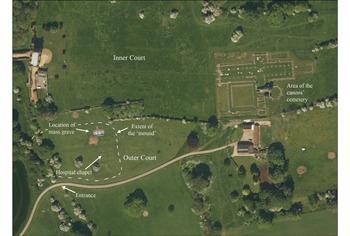
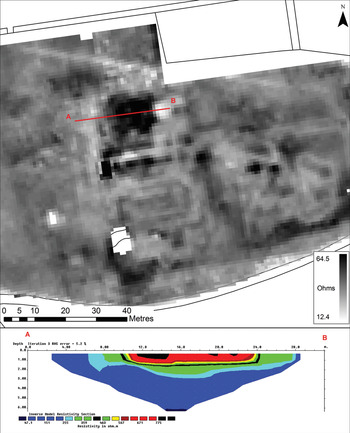
During 2013, the focus of the excavation shifted to an area referred to as a ‘hillock’ or ‘mound’, situated to the south of the inner precinct wall, close to a secondary medieval entrance into the outer precinct (Figure 1). Rather than being an artificial mound, this feature is now known to be a natural promontory of glacial sand and gravels extending from higher ground to the west, which was truncated by the construction of the monastery's boundary moat. Today, as in the medieval period, this area remains the precinct's highest point, rising 2–3m above the flat monastic enclosure. It was thought by the excavation team that the mound, with its distinct earthworks, might be the location for possible post-Dissolution, rather than medieval, activity. To test this, a resistance survey was conducted in 2012. This revealed a sub-rectangular, high-resistance feature measuring approximately 15 × 10m in the north-eastern corner of the mound (Figure 2). This feature was directly aligned with a breach in the inner precinct wall, and the earthworks beyond that were thought to be the remains of a mansion built in 1607 (Roberts Reference Roberts1984). It therefore seemed probable that some subsidiary post-medieval structure or garden feature was located on the promontory. Thus, a trench was opened to explore this area.
Location of the mass grave within the monastic precinct (courtesy of the University of Sheffield).

Resistivity surveys of the mass grave (courtesy of the University of Sheffield).

The mass grave
Rather than the expected structural remains, the excavation immediately revealed articulated human skeletal remains. Although cut features were initially difficult to see, as the mound consisted almost entirely of sand, the arrangement of the skeletons indicates that they were buried in a single event, rather than as individual interments. This burial was the cause of the high-resistance geophysical anomaly: while a cut feature would normally create lower resistance, the high reading may have been caused by the sandy matrix of the mound, combined with the digging and immediate backfilling of the grave, and the great density of bodies. This resulted in a looser fill, which allowed water to drain more freely, thus creating a high resistance geophysical anomaly in comparison to the undisturbed surroundings. A Tigre Resistivity Profiler revealed it to be a shallow feature, only 0.4–0.6m deep, with a slightly irregular flat base and shallow, sloping sides (Figure 2), whose shape correlated with the distribution of burials. This led to the interpretation of the feature as a mass grave.
Over the course of two summer field seasons in 2013–2014, the feature was fully excavated. Given the sandy soil conditions, the poor bone preservation, the numbers of interred individuals and the time required to excavate them, the whole grave could not be exposed at once. Instead, skeletons were individually located, excavated, recorded using geo-rectified photography and then lifted to minimise deterioration of the bones. Consequently, it was only possible to reconstruct a full plan of the burial in post-excavation (Figure 3).
Plan of the mass grave and later burials cutting it (courtesy of the University of Sheffield).

Deposition and treatment of the dead
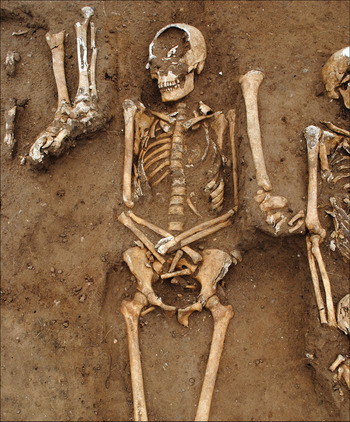
Throughout the grave, the dead were prepared and deposited with great care. In almost all cases, apart from for the very young, it was apparent that the bodies had been bound in shrouds, as suggested by transverse compression of the shoulders (for an overview of the evidence for the wrapping of bodies, see Nilsson Stutz & Larsson Reference Nilsson Stutz and Larsson2016). The bodies were all placed into the grave in a single layer and in eight overlapping rows, often with the lower legs and feet of the adults from one row being placed in the space between the heads of the next row (Figure 4). None were intercutting, although some individuals were clearly touching when fleshed; occasional differences in level between the rows of bodies might suggest that the grave was filled over the course of several days or weeks, with each phase being partially backfilled, rather than the burial event occurring in a single instance, although still as a one-time event (Duday Reference Duday, Raoult and Drancourt2008: 50). Throughout the grave, younger children were interspersed with larger individuals, with a particular clustering around the northern corners of the grave. No personal artefacts or other dress accessories were found, other than a single late medieval double oval-loop belt buckle, probably an accidental inclusion as it was not in direct association with any individual.
Detailed view showing how the rows of burial overlap, with the lower legs and feet of an individual from one row in the space between the heads of individuals in the next row (courtesy of the University of Sheffield).

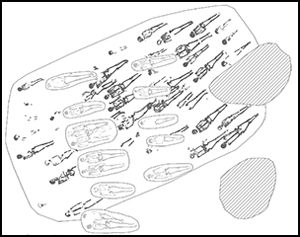
After the grave had been backfilled, it was cut by occasional, much later, interments dating to the late fourteenth or fifteenth centuries, while later quarrying disturbed and partly removed portions of the grave's centre and easternmost edge. This subsequent disturbance, along with the fragmentary condition of many of the skeletons, masked the true extent and layout of the grave. When the original layout of the bodies is digitally reconstructed from the positions of the skeletons, however, the true, simultaneous, nature of the burial becomes clear (Figure 5).
Schematic reconstruction of the grave (courtesy of the University of Sheffield).

The population, dating and possible cause of death
At least 48 individuals were recovered, although given the later disturbance, this probably represents an underestimate of the original number of individuals who were buried here. The biological age-at-death of the 48 individuals was estimated from dental and skeletal growth and development in the sub-adults (Moorrees et al. Reference Moorrees, Fanning and Hunt1963; Anderson et al. Reference Anderson, Thompson and Popovich1976; Scheuer et al. Reference Scheuer, Musgrave and Evans1980; Scheuer & Black Reference Scheuer and Black2000), and by degenerative changes of the skeleton and dentition in the adults (Miles Reference Miles1962; Lovejoy et al. Reference Lovejoy, Meidl, Pryszbeck and Mensford1985; Brooks & Suchey Reference Brooks and Suchey1990). The age categories observed were: young child (1–5 years), older child (6–11 years), adolescent (12–17 years), young adult (18–24 years), prime adult (~25–34 years), mature adult (~35–44 years) and older adult (~45+ years). The grave yielded a high proportion of sub-adults (56.2 per cent; 27/48) aged between one and 17 years at the time of death. No infants below 12 months of age were recovered, although this may partly be explained by the harsh soil conditions that resulted in very poor bone preservation, particularly for the younger individuals (see Figure 6 for mortality profile; Figure 7).
Mortality profile of the mass grave (courtesy of the University of Sheffield).

Poor preservation of infant burials (courtesy of the University of Sheffield).

Adult sex estimation was based on morphological characteristics of the skull and pelvis (Buikstra & Ubelaker Reference Buikstra and Ubelaker1994). Among the 17 individuals for whom sex could be estimated, there was a greater representation of males compared to females (males = 11; females = 6). The presence of both men and women, however, indicates that, despite the location of the grave within the monastery's outer precinct, those buried must have been members of the local secular community rather than the monastic population, although this does not exclude that some members of the priory were among them. Given the number of dead who were buried in a single episode, it seems probable that the grave was a response to a single catastrophic event.
Radiocarbon assays of two skeletons from the centre of the grave provide dates of cal AD 1295–1400 at 95.4 per cent probability (SUERC-49228, using OxCal v4.3; Bronk Ramsey Reference Bronk Ramsey2009) and cal AD 1295–1404 at 95.4 per cent probability (SUERC-49229, using OxCal v4.3; Bronk Ramsey Reference Bronk Ramsey2009) respectively, while ceramics and two silver pennies of Edward III (r. 1327–1377) found within the grave fill provide a terminus post quem of the mid fourteenth century. Although there are potentially many factors that might account for this mass fatality, the most probable cause is the Black Death, which arrived in this part of northern Lincolnshire during the spring and early summer of 1349 (Horrox Reference Horrox1994: 10). In that year, the chronicle at the Cistercian Abbey of Louth Park (40km south of Thornton Abbey) recorded that “obierunt multi Monachi de Parco Lude. Inter quos obiit Dompnus Walterus de Luda, Abbas [many of the monks of Louth Park died. Among them died Walter of Louth, abbot]” (Venables Reference Venables1891: 38). The situation was as serious, if not worse, at Meaux Abbey, located just 18km from Thornton. Here, just ten of the original community of 50 monks and lay brothers survived the Black Death and, perhaps more significantly given the Thornton evidence, “major pars tenentium nostrorum in diversis locis obissent [the majority of our tenants in different places died]” (Bond Reference Bond1868: 37).
The initial outbreak of the plague in 1349 seems to be the most probable cause of mass death in the fourteenth century, although it should be noted that there were a number of subsequent, and no less deadly, reoccurrences throughout the second half of the century (Bolton Reference Bolton, Ormrod and Lindley1996). An outbreak in 1361–1362 was particularly virulent in eastern England, and is recorded by several chroniclers of the time to have disproportionally affected children (Horrox Reference Horrox1994: 85). Indeed, the Louth Park Chronicle noted: “fuit mortalitas hominum, sed maxime juvenum et puerorum, unde pestilentia puerorum communtier nuncupatur [there was a mortality of men, but chiefly adolescents and boys, as a result it is commonly called the pestilence of boys]” (Venables Reference Venables1891: 40). Given the broad range of the radiocarbon dates, the mass grave from Thornton could easily have been the result of any of the fourteenth-century outbreaks of plague.
Identification of Yersinia pestis
As there is a distinct possibility that the mass grave at Thornton Abbey resulted from catastrophic mortality related to the Black Death, molar teeth from 16 individuals that had sufficiently well-preserved samples surviving were sent to the McMaster Ancient DNA centre in Ontario, Canada, to investigate the potential for surviving molecular evidence of the Y. pestis pathogen. It was anticipated that there would little chance of DNA surviving, due to the generally poor skeletal preservation.
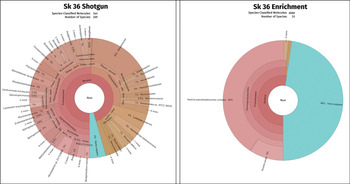
Ancient DNA was extracted using a customised protocol for ancient samples (Dabney et al. Reference Dabney, Knapp, Glocke, Gansauge, Weihmann, Nickel, Valdiosera, García, Pääbo and Arsuaga2013), with each extract screened for the presence of a plague-specific gene (Wagner et al. Reference Wagner2014; see the online supplementary material (OSM) for laboratory protocols and in-depth results). Of 16 individuals sampled, one (Sk36) tested consistently positive for Y. pestis across all technical replicates. To confirm the presence of plague in this individual further, the extracted DNA was converted into the format required for next-generation sequencing, a process known as DNA library preparation (Meyer & Kircher Reference Meyer and Kircher2010). Sequenced molecules were entered into multiple taxonomic classification programs to identify the presence of Y. pestis via an ensemble (or shotgun) approach (McIntyre et al. Reference McIntyre2017). Only one molecule in the Sk36 sample was identified as having a sequence similar to Y. pestis; 11 molecules were identified at the species-complex level for Y. pseudotuberculosis (causing TB-like symptoms, possibly the species from which other pathogenic Yersinia are thought to have evolved).
Given these low-abundance estimates, a whole genome capture approach was attempted in order to increase the proportion of available Y. pestis molecules for analysis. This process removes contaminants and uninformative sequences, and has previously contributed to the successful retrieval of ancient pathogens, including plague, cholera and smallpox (Bos et al. Reference Bos2011; Devault et al. Reference Devault2014; Duggan et al. Reference Duggan2016). Whole genome enrichment for Y. pestis dramatically improved recovery rates, transforming the Y. pseudotuberculosis complex from nearly indistinguishable from sequencing noise to the second-most abundant taxon (Figure 8). Sensitivity at the species level also improved, with Y. pestis becoming the third-most abundant taxon. The abundance of Homo sapiens also rose, in both Sk36 and the negative control. This may be due to sequence similarity between the ‘bait’ molecules used to select target regions of DNA and the human genome. Furthermore, marker gene analysis predicted Y. pestis to be the only identifiable species based on successful alignment to 17 marker genes.
Species profile comparison for Sk36 between shotgun (left) and Yersinia pestis enrichment (right) (courtesy of McMaster Ancient DNA Center).

The concordance of multiple lines of evidence, including PCR screening, shotgun classification and whole-genome enrichment conclusively demonstrates the presence of plague in this sample. More genome sequence data, however, are required to identify the precise strain of plague present at Thornton Abbey. Currently, we speculate that it relates closely to the East Smithfield strain from the 1348–1349 outbreak. Further analysis will reveal how the Thornton Abbey plague was connected to other outbreaks in England and Europe, and will aid in reconstructing the historical spread of this disease.
The setting of the burial
Later medieval Black Death cemeteries are surprisingly rare in England. The best known are the two historically documented burial grounds established at East and West Smithfield, London. The East Smithfield cemetery has been partially excavated and, in addition to ordinary single interments neatly laid out in rows, is recognised for a series of long mass-burial trenches, in which the dead were placed side by side (Grainger et al. Reference Grainger, Hawkins, Cowal and Mikulski2008). Furthermore, recent aDNA analysis of up to 200 samples from East Smithfield has revealed traces of Y. pestis in several individuals (Bos et al. Reference Bos2011; Schuenemann et al. Reference Schuenemann2011). Limited excavations in 2014 on the site of the West Smithfield cemetery have also yielded the remains of Black Death victims and evidence for the Y. pestis bacterium, although these individuals were all interred in single grave cuts (Pfizenmaier Reference Pfizenmaier2016). The only other late medieval mass burials in England comparable in form, if not size, to Thornton Abbey were excavated at Hereford Cathedral in 1993. Three rectangular pits containing between 200 and 300 individuals were found (Stone & Appleton-Fox Reference Stone and Appleton-Fox1996: 46–48). Associated radiocarbon assays date them to AD 1335±54. Y. pestis-specific aDNA has been recovered from tooth pulp from several individuals (Haensch et al. Reference Haensch2010), although the stratigraphic report and full osteological analysis has yet to be published (see Kacki Reference Kacki2016).
The mass grave at Thornton Abbey is set apart from other fourteenth-century examples by its rural location and monastic association. It might reasonably be expected that the concentrated populations of urban centres would be particularly prone to infectious disease, which could potentially result in very large numbers of dead needing a swift burial; this may also have been the case in rural communities. Studies have demonstrated that in many cases, mortality rates could proportionally be as high in rural contexts (e.g. Benedictow Reference Benedictow1987), although the lower overall numbers of dead would generally have made it easier to continue using normal burial practices (Kacki et al. Reference Kacki, Rahalison, Rajerison, Ferroglio and Bianucci2011; Bianucci & Kacki Reference Bianucci, Kacki, Harbeck, von Heyking and Schwarzberg2012). As for the grave's location within the monastic precinct at Thornton, it is clearly separate from the burial ground around the church (see Figure 1), and its apparently secular rather than religious population requires further explanation. The medieval parish church at Thornton Curtis was the centre for local worship and burial from the eleventh century onwards. There must be a particular reason why the mass grave was dug at the abbey, possibly at the point at which the parish church could no longer accommodate the great number of plague victims.
Although the parish church might be the prime focus for non-monastic interment, another institution acted as a focus for burial during the Middle Ages: the hospital. Medieval hospitals were religious institutions that provided a variety of services to the needy, including assisting pilgrims, providing alms to the poor and helping the sick and dying. These centres were usually run along monastic principles and were often attached to an established religious house (Gilchrist Reference Gilchrist1995: 8–14). Many, if not most, had associated graveyards, and excavations have revealed numerous multiple or mass burials. The most extensively excavated example in England is St Mary Spital in London, which yielded 175 large burial pits, over 100 of which contained 15 or more burials; the largest held 43 individuals (Connell et al. Reference Connell, Jones, Redfern and Walker2012: 217).
All the St Mary Spital pits were smaller than the mass grave at Thornton, and were largely of an earlier date (mid twelfth century and c. 1250–1400). It is, however, clear that medieval hospitals were accustomed to handling the burial of large numbers of individuals, and the presence of a religious community would have made it possible to manage such numbers effectively. This pattern is also seen across continental Europe, where the excavations of several medieval hospital sites have revealed mass graves. Perhaps the best known is the Heiligen-Geist-Hospital in Lübeck, Germany, where 21 multiple burials were excavated (Prechel Reference Prechel1996; Lügert et al. Reference Lügert, Heinrich and Päffgen2002). Most contained fewer than ten individuals, although three contained between 10 and 25; two other mass graves contained 121 and 169 individuals, respectively (Lügert et al. Reference Lügert, Heinrich and Päffgen2002: 160). Multiple burials have also been found at medieval hospital sites in France. At the Hôtel-Dieu-le-Comte in Troyes, for example, 104 individuals were found buried in ten rectangular pits (Réveillas Reference Réveillas2010: 129–42). Parallels can also be drawn with the Hospice Sainte-Catherine site in Verdun, where two pits containing 23 and 26 individuals respectively, were found, although these date to the late seventeenth to early eighteenth centuries (Réveillas Reference Réveillas2010: 188–94). Finally, an unspecified number of individuals were found in a mass grave at the Hôpital du Saint-Esprit site in Besançon (Vaxelaire Reference Vaxelaire2002), although the date of this example is uncertain.
Hospitals were not the only locations in Europe at which mass burials have been identified. The rural cemetery at Saint-Laurent-de-la-Cabrerisse in south-western France, for example, contained three fourteenth-century graves, each containing between two and five individuals that tested positive for Y. pestis (Kacki et al. Reference Kacki, Rahalison, Rajerison, Ferroglio and Bianucci2011). Contemporaneous mass graves containing individuals testing positive for Y. pestis have also been found at sites apparently unconnected to hospitals in Barcelona, Spain, in Ellwangen and Manching-Pichl, Germany, and in Bondy, France (Wiechmann et al. Reference Wiechmann, Harbeck and Grupe2010; Tran et al. Reference Tran, Forestier, Drancourt, Raoult and Aboudharam2011; Spyrou et al. Reference Spyrou2016).
Nonetheless, given the potential association between mass burials and hospitals, it is worth re-evaluating the evidence from Thornton Abbey, especially as secular burial would not ordinarily be expected in this area of the priory precinct. Crucially, there is a single reference to a hospital at Thornton. In 1322, an indulgence was granted for the repair of the chapel of the hospital of St James, located outside the walls of the monastery (Page Reference Page1906: 235). The location of this hospital has never been confirmed, but in light of the presence of the mass grave, our focus has shifted to the earthworks of what appeared to be a large building to the south of the grave, measuring approximately 21 × 11m, and aligned on an east–west axis. Between 2014 and 2016, two trenches were excavated at either end of the building, which, although heavily robbed, was revealed to be a substantial stone-built, single-cell chapel, with a brick-built extension at its western end, probably the residential section of the hospital complex (for a discussion of comparable sites, see Huggon Reference Huggon, Gerrard and Gutiérrez2018). Hence, it now seems probable that the hospital of St James was indeed at this location, and that, during the fourteenth century, it became the focus for the treatment and then burial of the large numbers of local people afflicted with the Black Death.
Conclusion
As they are relatively scarce, any medieval mass burials discovered in Britain must be considered as nationally important. To a society that valued ‘a good death’ above all else (cf. Beaty Reference Beaty1970), the universal expectation would have been for the dead to be interred individually and with full church rites. Indeed, despite the presence of three large mass graves at the East Smithfield Black Death cemetery in London, most individuals were given separate burials; this practice appears to have been the norm, when possible. A mass grave therefore represents a catastrophic failure of the established system of dealing with the dead, presumably due to the overwhelming numbers needing to be interred and the scarcity of the living to perform these tasks. The hospital run by the canons of Thornton Abbey was the last and only functioning institution where local inhabitants could bring the dead and dying to receive a proper burial and hope for salvation in the afterlife. Even in such difficult circumstances, and despite the unusual communal nature of the burial, great care was taken with the deceased, who were, in most cases, shrouded and laid neatly in the mass grave, with the due reverence befitting a ‘proper’ medieval Christian burial.
Thornton Abbey's mass grave is particularly important due to its rural location and its complete excavation. All other contagion-related mass graves found in England are in urban contexts and would have been formed from a very diverse and widespread population. They would almost certainly have included many individuals from outside of the immediate area, perhaps even from abroad. This is much less likely to be the case at Thornton: the 48 men, women and children interred here must represent a significant proportion of the local parochial population. Although this reflects an acute historical tragedy, it also provides hitherto unseen details about the response of a small rural community to the devastation caused by the arrival of the Black Death in the fourteenth century. The Thornton Abbey mass grave is a discovery that is thus far unique in England, and adds significantly to an understanding of the most deadly pandemic of the last millennium to have affected Europe.
Acknowledgements
The authors would like to acknowledge the support of Tim Allen, Keith Miller and Jim Williams (Historic England), Kevin Booth (English Heritage), and Alison Williams and Mike Hemblade (North Lincolnshire Historic Environment Record). We are also grateful to Glyn Coppack and Caroline Atkins for their advice; to Rachel Askew for her many insightful comments on the text; to the Yarborough Estate for granting permission to excavate; and to the tenant farmer, John Farrow, for his encouragement. Finally, we are particularly indebted to the anonymous referees and their exhaustive comments on all aspects of the text, which undoubtedly made this a stronger paper. Any errors or misconceptions remain our own.
Supplementary material
To view supplementary material for this article, please visit https://doi.org/10.15184/aqy.2019.213