1. Instrumental Research and the Concerns about Epistemic Decline
What epistemic consequences ensue when scientific research is taken over by corporate interests? In this paper, I will examine one important recent example of such a takeover. Among other things, I will describe the role of a certain kind of local model that figures importantly in connecting research efforts with product development, and whose occurrences are sometimes aptly called ‘design rules’. It is often feared that these and all other results of application-driven research are inevitably pragmatic, provisional, or otherwise inferior to the knowledge achieved by curiosity-driven academic science. The ambiguity of this paper's title alludes to these worries: It is reasonable to assume that in industrial research, design rules. Might the demands of successful product design even threaten to overrule the traditional epistemic values of academic science?
Quite a few players in public debates about science evidently fear so, and have expressed their concern that the gradual privatization of research will eventually prove detrimental for the epistemic merits of science as a whole. One of them is John Ziman, prized theoretical physicist, long-time chairman of the United Kingdom's Council for Science and Society, and founding director of the Science Policy Support Group. He summarizes the matter as follows:
[T]he practices and norms of instrumental research are almost the opposite of those of academic science. Being normally funded by contracts rather than by patronage, instrumental science is so captive of material interests and commercial agendas that it is partisan rather than objective in its judgments. Its findings are exploited as intellectual property, and are thus proprietary rather than public. Because it serves specific power groups and technical elites, it tends to produce ‘local’ rather than universal knowledge. Being addressed primarily to foreseen problems and needs it is prosaic rather than imaginative, and is tested pragmatically by practical success rather than being subjected to communal critical scrutiny. (Ziman Reference Ziman2002, 399)Footnote 1
By “instrumental research” Ziman means “the production of knowledge with clearly foreseen or potential uses” (397). I take it that this is intended to describe epistemic practices that differ from traditional, epistemically oriented academic science in terms of their primary research goals. Research that is subordinated to a concrete purpose of application and utilization of the knowledge sought qualifies as instrumental. I shall therefore assume that industrial research constitutes a typical case of what Ziman has in mind when he speaks of instrumental science.
Philosophers tend to regard the worries at issue as belonging to the realm of science policy, pointing as they do to the question of who does have and who should have control over the agenda of scientific research. Accordingly, the developments behind these concerns have so far primarily been approached from a social science perspective rather than from the point of view of the philosophy of science.Footnote 2 I maintain, however, that these matters should be a concern for philosophers of science, because they are really epistemological issues.
It might not be obvious that they are, for they are not concerned with the question of what knowledge is; neither are they involved in the refutation of skepticism. There is, however, a further project of epistemology, which has been called its ameliorative dimension, which consists in the endeavor to promote and secure our cognitive success by finding the methods and means most suitable to our epistemic ends (Kitcher Reference Kitcher1992). There is also increasing recognition of the fact that our advanced epistemic aims inevitably require a collective effort, and that therefore the social arrangements of our epistemic practices are an important part of the means to achieve them.Footnote 3 Peer reviewed publication and granting of funds, norms of good scientific conduct, and the meritocratic social structure of the scientific community all belong to the methodology we employ in order to make the greatest progress toward our epistemic ends. The large scale changes observed by sociologists and critics like Ziman affect the social arrangements under which a great and ever growing part of scientific research is undertaken. To ask whether these changes threaten the success of our collective epistemic effort is therefore an important new task for the epistemologist (and her more specific variety, the philosopher of science).
Let me emphasize three selected aspects that show how the problems addressed by Ziman importantly include epistemological issues. They are all related to the challenge that instrumental research creates knowledge of inferior quality (as compared to the quality of results produced by curiosity-driven academic science).
The first aspect I would like to stress is Ziman's declaration that the knowledge provided by instrumental research is only local. In claiming this, Ziman makes an assertion about limited scope. This is potentially a serious charge against the epistemic merits of the research in question, if understood in the following way. I take it to be uncontroversial that science is expected to produce explanatory knowledge, and some philosophers have argued that this must go together with the integration of individual phenomena into unified schemes (Friedman Reference Friedman1974; Kitcher Reference Kitcher1981). If they have a point, and if “local” means insular, i.e., if the models tend to stand alone, without integration into an overarching theoretical framework, then instrumental research fails to produce one kind of knowledge expected from scientific endeavors.
The second important aspect is Ziman's assertion that instrumental research is prosaic: It is not concerned with the generation of new and interesting questions, but restricted to a limited set of foreseen problems that stand in the way of a given intended application. If the aim of inquiry is significant truth, this prosaic turn might simply reflect a shifting standard of significance. As Kitcher (Reference Kitcher2001, Chapter 6) has argued, significance in science as we know it is generated by both our practical concerns and our epistemic interests. If instrumental research would turn out to derive its notion of significance from only one of these two sources, this would amount to at least epistemic impoverishment, if not epistemic failure.
Finally, it is alleged that science in its instrumentalized manifestation exercises less care in the confirmation of its results: They are accepted if and only if they work for the desired application—or so Ziman seems to suggest when he asserts that the results of instrumental research are only pragmatically tested. In order to allow for a specific application, a new scientific claim will typically need to hold only for a narrow range of conditions, defined by the context of application. If experimental examination is therefore confined to this narrow context, then pragmatic testing in this sense can go so far as to infringe upon methodological standards of severe scientific testing, such as diversity and variety of evidence. It can also lead to epistemic limitations if the researchers’ limited concern for one specific context of application should lead them to disregard the question of how well the claim agrees with other established scientific beliefs (although to include this worry under the rubric of pragmatic testing admittedly implies a liberal sense of “testing”). In contrast, academic science might be expected to involve a wide range of assays of a new scientific claim, such as thorough checks for coherence with established scientific beliefs or testing in a broad range of experimental contexts. This is what we might expect to result from the system of mutual criticism in academic science—the “communal critical scrutiny” to which Ziman alludes. If this is a realistic picture of the situation, then we have here another sense in which instrumental research is epistemically inferior to traditional academic science.
This third concern also incorporates the worries about proprietary knowledge, that I will therefore treat as subordinate to the concern about merely pragmatic confirmation. The reason for this is that, as far as the quality of the knowledge produced is concerned, the main problem with proprietary knowledge arises in so far as it is withheld from the criticism of the scientific community. That there are in fact serious problems here is evident despite the fact that patents, the best-known form of proprietary knowledge, always involve the publication of the results protected. While it is true that intellectual property rights thus offer a more open alternative to secrecy as a means of knowledge appropriation, in many cases serious problems remain. Let me briefly indicate three problems that show that the epistemological concerns about proprietary knowledge cannot be removed by a quick reference to the public character of patents. First, the desire to protect intellectual property forces researchers to keep findings secret until a patent application is filed, and thus almost inevitably delays the publication of results and can considerably slow down scientific communication.Footnote 4 Second, obstacles to free research can arise when important research tools are protected by intellectual property rights. This is the case with biomaterials, which used to be freely exchanged among researchers until patent protection brought an end to this practice (Kenney Reference Kenney1986, Chapter 6). Finally and perhaps most important, there are circumstances where secrecy still is a more effective means to protect research results than intellectual property rights. For example, once a company patents a new drug, several of its competitors may engage in so called ‘me-too research’, i.e., they will tinker with the molecule until they find a substance with similar effects but not covered by the patent. It is therefore wise to let them know as late as possible and reap first mover advantages to establish a strong market position before the me-too substances flood the market. Similarly, when you have made an invention whose illegitimate use by competitors is in principle hard to prove (e.g., a new manufacturing process rather than a new design), patents will offer little protection. The conclusion is the same: Better keep it, so to speak, ‘in the house’. Each of these problems might result in the situation that individual lines of research are pursued within the seclusion of a single laboratory rather than in the marketplace of critical opinion.
There are additional problems implied in Ziman's statement. As regards the proprietary character of science, there is the important question regarding who should be allowed to profit financially from scientific research (Nelkin Reference Nelkin1984). (This question has loomed large in the discussion of intellectual property ever since U.S. legislation introduced the Bayh-Dole act, which in effect allowed private entities to profit from publicly financed research.)
There are also the vital and complex issues of fraud and bias in the context of instrumental science. Both are most alarming in cases where researchers are balancing producer risk against consumer risk, to borrow two terms from C. West Churchman (Reference Churchman1948; cf. Shrader-Frechette Reference Shrader-Frechette1994, Chapter 6, who prefers to speak of “developer risk” and “public risk”). Take, for example, the case of research on the health effects of second hand smoke and let the null hypothesis be that second hand smoke has no detrimental effects. Then the risk of committing a ‘false positive’ (which occurs when the research ends up rejecting a null hypothesis that is in fact true) is mainly borne by the tobacco industry and therefore called the ‘producer risk’, while the risk of committing a ‘false negative’ (accepting a null hypothesis that is in fact false) is the ‘consumer risk’, for obvious reasons.Footnote 5 It is often easy to reduce the risk of one type of error in exchange for an increase of the other by altering problem selection, experimental design, data analysis or even one's practices of disseminating and publishing results. Bias results when researchers are not impartial between producer and consumer risks. This is a serious concern for research ethics (Resnik Reference Resnik2000).
There are, however, many cases of industrial research that are concerned with the design of a prospective product rather than with its efficacy or its side effects. Often, such research concerns uncertainties that will have to be settled by the time the design can be finalized. Any error on the part of the researchers will typically result in the product's failure to function as planned. In such cases, there is no obvious distinction between producer risk and consumer risk, and the danger of bias is therefore a lot smaller than in the aforementioned type of situation.Footnote 6 The case study I am presenting in this paper is of this latter type, and I will therefore leave the problem of bias aside. This is not to belittle its importance, but rather to keep the scope of this paper within reason. Instead, I will concentrate primarily on the three challenges to the epistemic merits of instrumental science that, using Ziman's terminology, can be epitomized in the claim that science in the service of instrumental purposes produces knowledge that is local, prosaic and only pragmatically confirmed.
So far, we have seen how the charge challenges the epistemic merit of instrumental research in several aspects. At this point, it is important to examine how it is founded. Critics of the privatization of science often present it in a matter-of-fact manner, as if its contentions were obvious. However, a simple and powerful prima facie consideration can be reconstructed that underlies the charge of epistemic inferiority. Furthermore, its implications are extensive enough to give the philosopher of science pause.
The prima facie consideration begins with the observation that in epistemically oriented research, the choice of research questions is often strongly influenced by the accessibility of theoretically well understood idealizations, by the availability of controllable mathematical representations, and by the viability of clear and manageable experimental designs. In contrast, the choice of research questions in instrumental research will in most cases be determined by the requirements set by the intended application. Therefore researchers will routinely be confronted with a discomforting unavailability of any of these advantageous starting points of research. The result may be called an overtaxing of science. The reaction on the researchers’ part may reasonably be expected to be the development of provisional epistemic practices. These may simplify the situation by directing the focus solely to those particular questions that are absolutely essential for tackling the practical problem at hand and by being satisfied with answers that prove to work sufficiently well for the solution of the given problem. Such strategies should indeed deliver knowledge that is local and prosaic and involve a pragmatic stance toward confirmation.Footnote 7
To see how far this line of reasoning and the related charges capture the features of instrumental research as it is really happening, let us now turn to a characteristic episode of industrial research from the 1990s.
2. Giant Magnetoresistance Research as an Example of Instrumental Research
In the following four sections of the paper, one line of research in condensed matter physics that created much attention in the 1990s will be examined with respect to the epistemological charges described above. My case rests to a great extent on the published research literature. In addition, I have conducted interviews with Reinder Coehoorn and Theo Rijks, two physicists from the Philips Research Laboratories who were both heavily involved in the research under consideration.
The matter at issue is research on a novel physical effect called “Giant Magnetoresistance” (GMR). To be precise, the effect was novel in 1988, when it was simultaneously and independently discovered in two rather typical academic research institutions (namely by Albert Fert and co-workers at the Université Paris-Sud and by Peter Grünberg's group at the Research Centre Jülich, Germany). The effect can be observed with certain layered systems of thin ferromagnetic films separated by non-ferromagnetic conducting spacer layers. Basically, the effect is that the electric resistance of such systems is subject to great (“giant”) variations, dependent on the relative orientation to each other of the magnetization directions in the different ferromagnetic layers.Footnote 8
Shortly after its discovery, industrial research quickly joined the effort to investigate the GMR effect. Outstanding contributions were made by researchers from the IBM laboratories in Almaden, California, and from the Philips Research Laboratories in Eindhoven, Netherlands, and by several other companies that also invested in GMR research. Obviously, their investments were motivated by the technological potential of the GMR effect. This in turn has to do with the possibility of affecting the magnetization direction in one or more of the ferromagnetic layers in a GMR system by means of a magnetic field applied from outside. As a result of this possibility, GMR systems are in principle suited to act as sensors for magnetic fields.
Right from the start, it was hoped that a prospective GMR sensor would combine the qualities of miniaturization potential and great sensitivity better than any magnetic sensor technology known so far. This made GMR attractive for many applications, but maybe most of all for read heads for magnetic media. In magnetic data storage media, the binary code is realized by different magnetization directions of tiny regions of the medium. The information must accordingly be read off by a small and highly sensitive magnetic sensor. As early as 1997, IBM presented a GMR hard disk drive ready for production. The implementation of GMR technology led to a sizeable increase in data density.Footnote 9 In addition, there are other uses of GMR technology, such as sensors for mechanical parameters in vehicles or machines, or medical sensors for biomagnetic fields.
GMR research is a clear example of instrumental research on two levels. On the institutional level, the greater part of decisive research efforts were executed within industry owned research institutions. On the level of research objectives, the set of obvious application possibilities and the gigantic market potential leave no doubt that the research in this area was under pressure to deliver applicable results. On the other hand, GMR research is clearly different from mere technology development, because the physics of the effect was far from clearly established when the quest for applicable GMR sensors began. Researchers in search of applicable GMR systems could not draw from an established inventory of models for the effect; instead, the theoretical tools to deal with the effect had to be developed in conjunction with the design of applicable systems.
This is not to say that the mechanism behind the effect was unknown. To the contrary, a rough qualitative explanation of the effect was available right from the beginning and is still believed to be basically correct. It is based on the two-current model of the electronic transport properties of ferromagnets that was proposed by Nevill Mott in 1964. For a better understanding of the effect, I will outline the model for the case of a GMR sandwich composed of two ferromagnetic layers and one non-ferromagnetic metallic interlayer. The model explains the effect with reference to spin-dependent scattering of transport electrons. Scattering events are what causes electric resistance, and in ferromagnetic media, the scattering probability of each transport electron depends on the orientation of its spin relative to the local magnetization of the medium. For the type of materials most commonly used within GMR sensors, scattering events (especially near the layer boundaries) are much more probable for electrons that are spin-polarized in the direction opposite to the local magnetization (called “minority spin electrons”) as compared to those polarized in accordance with local magnetization (“majority spin”).Footnote 10
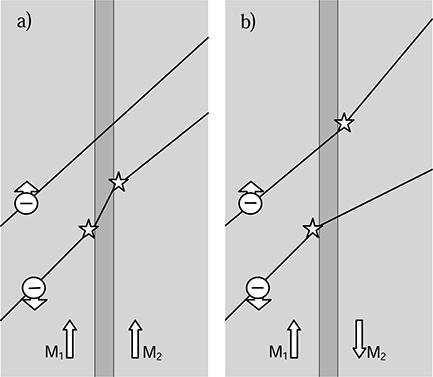
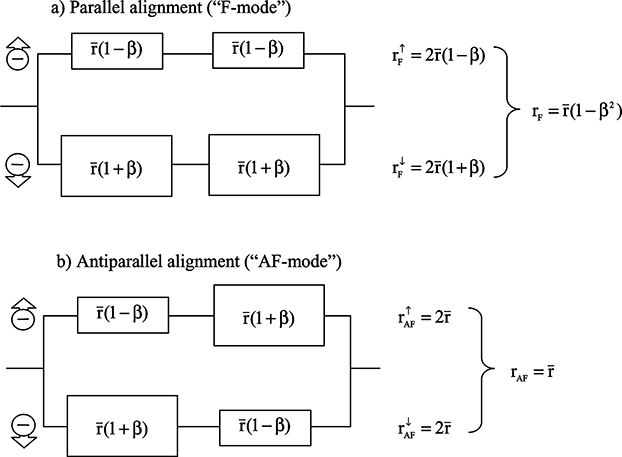
The two-current model assumes the electric current in the system to be composed of one spin-up current and one spin-down current. The two currents do not interfere with each other and can thus be treated as if arranged in a parallel connection. The electrons of each current are assumed to move freely through the system and pass through both layers on their way (Figure 1). Therefore, they can be added like two parallel currents and the difference in total resistance for different arrangements of magnetization directions can be explained as in Figure 2. (The left and right resistors on each line in Figure 2 represent the resistance by each current on its way through the left and right layers of Figure 1, respectively.) In the case of antiparallel alignment (AF-mode) of the magnetization directions in the two layers, both currents are subject to the same medium resistance. In the case of parallel alignment (F-mode), one current (the one spin-polarized in the same direction) experiences a decreased resistance, the other an increased one. Since the currents form a parallel connection, the result of the unequal distribution of resistance among the two currents in F-mode is a lower total resistance than in AF-mode, where resistance is, so to say, equally distributed. This difference accounts for the GMR effect. (The size of the resistance change
 $\Delta R/ R$
, called “magnetoresistance ratio” or “MR ratio,” was 100% in the original paper reporting the effect. It is considerably lower for room temperature, but meanwhile also room temperature MR ratios above 100% have been achieved in the laboratory (Parkin Reference Parkin, Maekawa and Shinjo2002).
Schematic representation of the two current model, following Grünberg Reference Grünberg2001, 36. Two spin-polarized currents of transport electrons (symbolized by a minus-sign in a circle, with an arrow indicating the respective spin-polarization) are whirring through a GMR sandwich. Stars stand for the most probable scattering events. Arrows M 1 and M 2 indicate the local magnetization directions within the ferromagnetic layers. In the case of antiparallel alignment (b), both currents have the same resistance, in the parallel case (a), the spin down current encounters an increased resistance, the spin up current a decreased one.

The different resistances for the spin up and spin down currents in case (a) result in a lower total resistance than the equal resistances in case (b).

Despite the explanatory force of this basic model, the knowledge of the early 1990s left many questions about the effect open—among them some important matters concerning the design of applicable GMR sensors. The theoretical models alone did not enable the researchers to make sufficiently precise predictions about the concrete thin film structures that could be manufactured. Neither the MR ratio nor other important properties of any of a multitude of possible thin film structures could be predicted. Prominent among these properties are the temperature dependence of the effect and the exact field dependence of the signal, that should be well reproducible. To understand the desiderata of GMR research, we should take a look at how GMR systems were intended to be applied.
3. How to Design a Spin Valve
At this point I will outline the prevailing conception of a sensor for magnetic fields based on a GMR system. The magnetization in one of the ferromagnetic layers (the ‘pinned layer’) has to be fixed in direction. This is accomplished by means of an effect called exchange biasing: If prepared adequately (by growing the layers in a magnetic field), the magnetization of one of the ferromagnetic layers is pinned by the exchange interaction across the interface to an adjoining antiferromagnetic layer (the “pinning layer”). The other ferromagnetic layer (the “free layer”) is not pinned and ideally its magnetization adapts to fields outside the structure. In virtue of the GMR effect, the electrical resistance of the system varies with the relative orientation to each other of the magnetization directions of the free and the pinned layers, and therefore, the resistance can be taken as indicative of the outside magnetic field to which the free layer is adapting. This kind of structure was first described by a group from the IBM Research Division, who dubbed it “spin valve” (Dieny et al. Reference Dieny, Speriosu, Metin, Parkin, Gurney, Baumgart and Wilhoit1991a, Reference Dieny, Speriosu, Parkin, Gurney, Wilhoit and Mauri1991b).
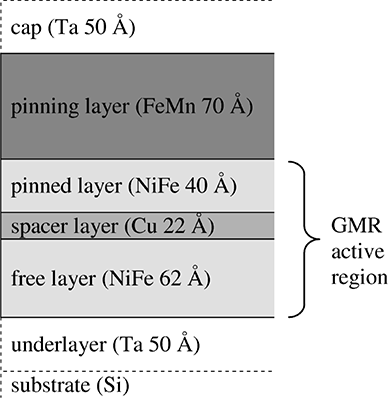
Figure 3 shows an example of a typical spin-valve structure. The materials used in this example are, however, not imperative. The ferromagnetic layers can be of iron, nickel, cobalt or one of their alloys. For the non-ferromagnetic conducting spacer layer, chromium, copper, silver and gold have been used. (Here the restricting factor is that the lattice structures of ferromagnetic and interlayer materials must match; non-matching structures give rough interfaces that destroy the effect.)
Layout of one of the spin-valve structures studied in Dieny et al. Reference Dieny, Speriosu, Metin, Parkin, Gurney, Baumgart and Wilhoit1991a.

Each individual spin-valve structure must be grown layer by layer within an elaborate vacuum deposition system (by means of sputtering deposition). Note that the GMR active region in the example is only 124 Å thick—which is little more that the one hundred thousandth part of a millimeter.
From the application perspective, there are several desired properties that a spin-valve structure should ideally possess. It should operate around room temperature and the output signal should be thermally stable. It should be corrosion-resistant. It should, of course, display a strong GMR effect. It is also important that the change of the magnetization direction in the free layer takes place in the right field interval, namely around zero field. (This does not, however, complete the list of desired properties of a spin valve. See Coehoorn Reference Coehoorn and Buschow2003, 26, who itemizes 18 different requirements.) Optimizing all these properties is the focus of a large part of the GMR research of the 1990s. One problem is that a spin valve's characteristics, including its MR ratio and the field dependence of the signal, vary strongly with the materials employed, the dimensions of the system, and, importantly, the layer thicknesses of the GMR active layers as well as the pinning layer.
One approach to the design problem at hand is to produce a huge number of multilayer systems and test them for their properties. One example of this procedure from the early years of GMR research is a study by Stuart Parkin from IBM that examined cobalt sandwiches separated by transition metal spacer layers, concentrating on the strength of the interlayer exchange coupling and its dependence on spacer layer thickness and material. To investigate this very specific aspect, Parkin tested more than 20 different transition metals (each with varying layer thicknesses) for their properties as spacer layer material (Parkin Reference Parkin1991).
However, this extremely patient, pedestrian, route was not the universal approach in industrial research on GMR. “You want to narrow it down if possible. Doing experiments is always in all aspects very cumbersome,” as Theo Rijks remarked to me. In the early 1990s Rijks was doing his PhD research with the GMR researchers at the Philips Research Laboratories. In order to save time and avoid a lot of troublesome experimental work, Rijks and many other GMR researchers in private and public institutions worldwide chose a more theoretical approach: they worked on improving the models of the effect. Reinder Coehoorn, who was Rijks’ supervisor and is still one of Philips’ major GMR researchers, has pointed out to me that an additional hoped for advantage of the theoretical approach was that it might ultimately make it possible “to condense all these many results which had to be obtained within a single framework.”
The starting point was in most cases a model proposed as early as 1989, by Bob Camley from the University of Colorado and Jozef Barnas from the Technical University Poznan, Poland (Camley and Barnas Reference Camley and Barnas1989; cf. Coehoorn Reference Coehoorn and Buschow2003, 86–89). The Camley-Barnas model (CB model) is a semiclassical model in that it essentially treats transport electrons as point particles but also integrates some quantum mechanical tools such as Fermi-Dirac statistics. It has free parameters for the diverse scattering probabilities within the layers, at the layer interfaces, and at the outer boundaries of the system. The CB model offered many avenues for improvement. Not only did the parameters have to be determined for each kind of structure, but also the model allows the insertion of new parameters and other extensions (Coehoorn Reference Coehoorn and Buschow2003, 89–106).
The modeling efforts did not result in precise predictions of, for example, structures with the highest MR ratio. The reason for this is that precise measures are dependent on the perfection of the materials, and real world layered structures are not composed of perfect crystals. Instead, the models proved extremely helpful in understanding trends. (For example, the model can explain why a layer should be 60 Å rather than 600 Å thick in order to achieve a high MR ratio, but not necessarily why 62 Å are better than 61 Å.)
To give an example of the products that industrial research supplies to the company, let us look at a case of modeling effort directed at the aim of optimizing the field dependence of the signal. In a read head, the spin-valve structure will take the form of a narrow stripe. Wiep Folkerts, Jacques Kools, and others at Philips Research worked on the task of determining how the magnetization in the free layer is influenced under these conditions.Footnote 11 The magnetic poles at the ends of the pinned layer give rise to magnetostatic coupling, biasing the magnetization in the free layer in the opposite direction of the pinned layer, while at the same time ferromagnetic interlayer coupling between both layers biases it in the other direction, parallel to the one of the pinned layer. For the optimal sensor signal around zero field, the magnetization of the free layer should not be biased toward either orientation of the relevant axis. Folkerts and Kools (Reference Folkerts and Kools1998) used a combination of analytic descriptions of the relevant interactions and finite element calculations to find out how the parameters in a spin-valve stripe can be chosen such that the influences of both interactions cancel each other out in the center of the stripe. They found that for an unshielded stripe this happens when the product of the pinned layer's thickness and its magnetization approximately equals the product of the height of the element and the strength of the ferromagnetic interlayer coupling (which is known by measurement). This and some other rules that they propose for the optimal design of applicable GMR stripes they call “design rules.” They also report an extensive series of experiments they performed in order to confirm their design rules.
4. Design Rules: Local, but Not Provisional
Design rules are typical outcomes of research processes in instrumental research. Let us define a design rule as a conditional proposition
 $A\rightarrow B$
, where B is a proposition that describes one or more properties of a certain kind of system that are interesting for its application, and A describes a set of characteristics of the same system that can be controlled during its production. In this general sense, it is powerful design rules that researchers in instrumental research should strive to come up with if they want to promote the technological enterprise that their research is part of.
Design rules are undoubtedly very specific kinds of models and limited in their scope in that they apply only to a very narrow range of technical artifacts. Therefore, the importance of design rules might be taken to support the concerns about the local character of instrumental research. To give a plastic example of the specificity in question, the design rules by Folkerts and Kools, as they stand, apply only to the so-called ‘yoke-type’ read heads that the Philips engineers worked on (primarily in order to employ them in magnetic tape systems), and not to the so-called ‘shielded heads’ used by IBM and others for computer hard disks (though they can easily be adapted to the case of shielded heads by adding an extra term for the influence of the sense current on the field).
However, the epistemic deficiency suspected to come with local models at the beginning of this paper cannot be found in this example. The specificity of the model does not deprive it of its potential to explain. The design rule avails itself of more general knowledge about two kinds of magnetic interactions and employs this knowledge to show how a specific kind of spin-valve system can be arranged in such a way that the magnetization of the free layer is not biased in either direction in the absence of an external electric field. Moreover, it does include an explanation why a spin-valve designed in accordance with the design rule has this property, namely, because magnetostatic coupling and ferromagnetic interlayer coupling cancel each other out.
The reason is that the design rule, though local in scope, is not insular. It was not created by simply extrapolating the general trends from a plethora of experiments and condensing them into a handy rule of thumb, but instead it combines some reasonable assumptions about which interactions play a role in biasing the free layer of a narrow unshielded spin-valve strip with the general background knowledge about these interactions.
It might be suspected that this example is a fortuitous case, where the integration of the design rules into the web of theories and models about magnetic interactions is due to the scientific curiosity of the individual researchers and the specific circumstances of their research that happened to allow them to pursue their epistemic interests. However, I hold that this is not the case. A quick reflection on the general situation of the spin-valve designer will reveal the reasons for this assessment. GMR systems can be built of a myriad of combinations of diverse metallic materials, pure or alloyed. Layer thickness and other geometrical dimensions of the systems can be varied in many ways. All these choices affect the technically relevant properties of the system. Furthermore, the interdependencies of the relevant features are typically not linear or otherwise easy to extrapolate from a few measurements.Footnote 12 Under these circumstances, it is an economically sound decision to begin by searching for helpful models instead of embarking on a tour of purely experimental exploration into this vast space of possibilities. The most promising strategy to find the most interesting places in this space is to be guided by models. These models serve their function as useful guides only because they integrate some apt theoretical ideas about the phenomena underlying the effect. Integration is thus not a contingent feature of magnetoelectronics research that persists despite application pressure. In contrast to the prima facie consideration supporting epistemic pessimism from Section 1, where it was suspected that the complexity of real life demands would lead to an overtaxing of science and to provisional research strategies, it is precisely the complexity of the desired applicable system, the spin-valve, that makes theoretical integration crucial.
As far as the standards of confirmation are concerned, it is true that design rules are tested with spin valve structures to see if they work. This must not be confused with merely pragmatic testing. As we have seen, the rules were arrived at by a time-honored combination of approaches in the physical sciences, namely by a combination of computational work starting from some general assumptions on the one hand and thorough experimental corroboration on the other (which is always an extremely important part of the process of establishing design rules). Furthermore, hypotheses and models in application-oriented GMR research are generally subjected to communal critical scrutiny. Ideas of other scientists are routinely tested, corroborated, modified or rejected in the GMR literature—no matter whether the author is employed by a university or a company.Footnote 13 Nor should it come as a surprise that this is so. In industrial research, far-reaching decisions may be based on the scientific beliefs about a phenomenon that have accumulated within the research division; it is thus an economic as well as a cognitive concern that these beliefs are instances of reliable knowledge.
It might be objected that the communal scrutiny incited by this motive is not the same one that we cherish in academic science, because it is only concerned with beliefs that are of immediate importance to the industrial researchers’ own work. It has long been realized, however, that this is simply the scientific condition: A scientist will have motivation to invest in the work and check somebody else's results (a kind of work that will not usually earn her much academic credit) only if these results are of immediate importance for the problem that she is working on (Hull Reference Hull1988, 341–348). Of course, this situation has its shortcomings and some important flaws and even cases of fraud are known to have gone unnoticed for some time (Broad and Wade Reference Broad and Wade1982, Chapter 4). However, the general trust in the system of communal assessment reflects the confidence that a faulty result will either be detected eventually, or fall into oblivion. In any case, there is no apparent difference here between the practices of industrial researchers on GMR (as they are documented in their publications) and those common to academic science.
What might come as a surprise is that results of privately funded research are published so widely and openly as in the example of GMR research. The publication of knowledge is of course a precondition for its communal critical assessment. However, the findings of, for example, IBM or Philips researchers are outcomes of a considerable private investment. How can it be profitable for companies to make them available to the general (scientific) public? Obviously, one answer to this question is that a company can gain proprietary control over the knowledge produced in its own house via patents. Once the patent is established, the respective results can (and must to a certain extent) be published. Furthermore, there are important benefits of in-house research that are independent of the appropriation of the resulting knowledge, for example the benefits of in-house competency regarding current scientific developments (including the often crucial tacit knowledge involved in the material respects of research) and the more immediate and quicker access to new knowledge that may enable the company to reap first-mover advantages in new and developing markets (Rosenberg Reference Rosenberg1990). In short, there are ways to profit from in-house research other than secrecy. Furthermore, secrecy is a particularly risky way to secure the fruit of one's research efforts (compared to relying on intellectual property rights), especially in an environment of high employee mobility: Once the secret leaks out, you have lost the stake.Footnote 14 Openness, in contrast, offers many advantages over secrecy. It enhances the company's prestige; it guarantees the research department's visibility and attractiveness to potential employees; and maybe most important, it allows the industrial researchers to remain plugged in to the network of scientific communication. (In the case of GMR research, it might be of additional relevance that Coehoorn describes the situation as one in which many findings were ‘in the air’—sooner or later someone from the large community would probably have come up with them, so that secrecy about them would not have made much sense anyway.)
I conclude that the results of industrial research that can be found in the area of GMR research are neither local nor confined to pragmatic testing of results in a sense that would limit their epistemic merits as compared to those of academic science. There remains the question whether the research at issue is prosaic in Ziman's sense, that is, confined to a pre-determined set of practical problems and not concerned with the generation of new, interesting issues.
5. Spin-off from Spin Research
With respect to this question, I will examine another episode from GMR research. The thin film structures have been examined in various geometrical arrangements, the most important of which and the one responsible for its technological success so far is the CIP (“current in plane”) geometry, where the sense current flows parallel to the layers of a thin film sandwich. However, another geometry that has been intensively studied was the CPP (“current perpendicular to plane”) geometry with the sense current flowing vertically across the stacked layers. There are enormous technical problems with CPP systems for the simple reason that the lateral dimensions of the thin film systems are normally some orders of magnitude larger than its thickness, so that the electric resistance across the film is so low that it is practically immeasurable with customary techniques. This problem accounts for the fact that there were for a long time no technical applications of CPP devices and that only very recent technologies like the non-volatile magnetic random access memory, MRAM, are now starting to make use of GMR structures in CPP arrangement (Parkin Reference Parkin, Maekawa and Shinjo2002, Section 5.3.4; cf. Åkerman Reference Åkerman2005). Enormous efforts have been expended in order to overcome these problems—also by researchers in industry-owned laboratories. (See Gijs and Bauer Reference Gijs and Bauer1997 for a survey of the research efforts on CPP.) One of the very first successes was a method by Martin Gijs and others from Philips, who lithographically cut a nanocolumn from an extended multilayer film in order to have a system with a measurable resistance across the layers (Gijs et al. Reference Gijs, Lenczowski and Giesbers1993).
This of course evokes the question why an industrial institution would invest any efforts at all in a line of research with such immense technical problems—especially when a technically more promising alternative kind of system, the CIP geometry, is available and also awaiting further research. As Coehoorn explained to me, the goals of the CPP line of research at Philips were somewhat open in the very beginning. However, while it soon became apparent that there were many obstacles to technical implementation, it was clear that the CPP geometry's main advantage was that it was extremely helpful in understanding and analyzing aspects of the GMR effect.
The reason for this is that the symmetry of the CPP arrangement makes the combination of theory and experiment a great deal more fruitful. While in CIP experiments the researcher can never be sure which parts of the system are probed by the sense current and to what extent, the current density in CPP experiments must of necessity be the same in all layers. This factor facilitated the analysis of CPP experiments and permitted far-reaching conclusions about spin-dependent scattering rates in the different parts of multilayers. The results of CPP experimentation and their analysis have even made it possible to model the scattering of transport electrons at rough interfaces (Bauer et al. Reference Bauer, Kees, Schep and Kelly2002). So this line of research has in fact contributed to an increased understanding of spin dependent transport.
CPP experiments have also facilitated a reliable separate determination of the different resistivities for majority spin and minority spin electrons. A comparison with theoretically calculated values showed that the difference in resistivity between majority and minority spin in 3D transition metal alloys that was concluded from experiments was, though considerable, much less dramatic than what was expected from theory. It was concluded that this is due to spin-mixing caused by spin-orbit interaction (SOI), which was originally assumed to be of minor importance for the materials at question. SOI is a relativistic effect that can change the spin-direction of an electron. Ultimately the relevance of SOI means that spin-up and spin-down transport electrons can not be considered as two completely separate parallel currents and therefore that the two-current model is problematic for ferromagnets with strongly spin-dependent conductivities (Banhart et al. Reference Banhart, Ebert and Vernes1997; Coehoorn Reference Coehoorn and Buschow2003, Section 3.2). Note that this insight into an unexpected relevance of SOI and a limitation of the two-current model has become possible only through GMR research. Prior to the experimental study of systems displaying GMR, there simply was no experimental access to the separate conductivities of majority spin and minority spin transport electrons.
These episodes show two things. First, industrial research on GMR was not focused on a pre-determined, limited set of problems, defined by the requirements of applicable read heads. The example of the CPP experiments shows that the researchers did embark on a new line of research (complete with new theoretical and experimental problems)—partly in order to improve the general understanding of the effect. Second, the research opened up new experimental techniques that almost automatically raised new questions. (“Why is the difference in resistivity between majority and minority spin currents less than we expected?”) The endeavor to answer such questions, which was taken up by academic scientists as well as industrial researchers, then lead to new, unexpected insights. In short, 1990s industrial research on GMR was neither prosaic nor sterile; it deliberately headed for new problems and raised new questions, inciting more research as it went along.
A fact that might still require comment is that the discovery of the GMR effect itself took place in academic institutions. This may inspire the question: Could GMR research retain its epistemic merits without a functioning environment of academic science? Speculative as this question may be, I believe that we have reason to suspect that the correct answer is ‘No’. Consider just the industrial laboratories’ constant demand for highly qualified specialists. Not only does the academic system provide the necessary education to young scientists, but also it is an important means by which research laboratories assess the qualifications of potential employees. The academic system can only serve this purpose if academic science is in itself a prospering enterprise (Dasgupta and David Reference Dasgupta and David1994, Section 7). This fact alone seems to me to suggest that industrial research does depend on an environment of academic science, and it justifies the focus on the less speculative question of how well it performs within this environment.
6. Conclusion
The preceding sections have shown that industrial research on the GMR effect does not suffer from the epistemic deficiencies predicted by Ziman for instrumental research. Of course, I do not want to extend this claim to all instances of application-oriented knowledge production. When an engineer calculates tensions and compressions within a bridge truss by inserting the parameters of her design into well-established models, she too produces knowledge with clearly foreseen uses. This work may be relatively unimaginative and yield results that only apply to one very specific type of structure, but this will not alarm anyone or excite apprehensions of epistemic decline. What I claim is that there are some important branches of applied science that are theoretically innovative and integrative, methodologically thorough and fruitful in the generation of new scientific issues. I would like to follow the terminology of Martin Carrier (Reference Carrier and Gillies2004, Section 3), who emphasizes that among those activities that usually fall under the label “applied science,” there is a subset in which the research character predominates; this subset consists of innovative activities that not only piece together established elements of knowledge, but also generate genuinely novel knowledge. Carrier singles out this subset and calls it “application dominated research.” We have seen that industrial research on the GMR effect can serve as a good example of application-dominated research in this sense.
More prominent examples from the recent history of science can provide more evidence. Shortly after the Second World War, Bell Laboratories formed a semiconductor research group with the aim of inventing and designing a solid-state amplifier. Not only did the group's research bring pioneering experimental techniques, but also the first failed experiments instigated a modification of the theory of semiconduction (undertaken by Bell Labs’ own John Bardeen, in his theory of surface states; Braun Reference Braun, Hoddeson, Braun, Teichmann and Weart1992, 466–472). It ultimately led to the invention of the point-contact transistor in 1948 and a Nobel Prize in physics for Bell researchers Bardeen, Walter Brattain, and William Shockley in 1956. Other famous examples of application-dominated research include Siemens’ development of electron microscopy, Bell Laboratories’ maser research, and IBM's achievements in the area of high temperature superconduction. The case study presented in this paper shows that epistemic merits can also prosper in less sensational cases of industrial research. Recent research has drawn attention to the fact that even the recent history of research in pharmaceutical industry, so often scathed for its prosaic methods of high throughput screening, can in fact provide examples of imaginative and innovative science. The so-called ‘method of rational drug design’ integrates the epistemic aim of understanding fundamental physiological mechanisms and the practical aim of developing new pharmaceuticals (Adam Reference Adam2005).
Evidence drawn from case studies is bound to remain open to doubt. Therefore, the difficult question that remains is whether the existence of application-dominated research plays such a great role that it can serve as a mitigation of Ziman's and others’ worries, or whether it is rather a rare exception and we must beware of being fooled into believing that we live in the Land of Cockaigne just because we have been served one excellent meal. On the one hand, anyone can flip open any of the physics journals cited in this paper and browse through the authors’ institutional affiliations. You will note that the contributions from industrial institutions to high-level physical research are considerable. It must be admitted that examples like the IBM Research Division or the Philips Research Laboratories are exceptional at least in the sense that the concentration of research resources that each of them represents is unusually high. However, this does not mean that the epistemic virtues displayed by GMR research constitute a freak incident from a friendly niche within the otherwise humdrum and sterile environment of industrial research. To the contrary, I hold that there is an inherent trend of the quest for design rules to stimulate innovative knowledge production that includes improvements in the theoretical understanding of the phenomena under consideration—in the terms just introduced: to lead to application-dominated research.
The reason for my confidence in this trend is neatly exemplified by the GMR example. The more complex the desired technical system is—that is, the more parameters there are that can actively be affected in the design and production of the system—the less hopeful it becomes that a process of trial-and-error will find a superior design. Our prescientific ancestors had no choice but to follow the pedestrian route of blind trial-and-error on their way to reliable design rules for archways and ship hulls, but today the fruitful combination of theory and experiment offers more promising avenues to success. To use and develop guiding theoretical ideas is therefore an investment that is intended to pay off in the form of a road map to the vast space of design possibilities.Footnote 15
Furthermore, there need not be any necessity to withhold the fruit of said investment from the critical scrutiny of the scientific community. Quite to the contrary, industrial researchers will profit when another scientist invests her resources to check the results that their design rules will build upon. However, additional restrictions obtain with regard to this issue, as I have indicated in Section 1. The open communication in industrial GMR research is partly due to the possibility of intellectual property protection by means of patents. In other cases, however, where researchers can not find a more effective way to safeguard the financial profits that are expected to flow from the knowledge they produce than to keep it secret, commercial interests are indeed a threat to openness. Generally and positively speaking, a precondition of openness is that those means of appropriation of research results that do not require secrecy (i.e., roughly speaking, appropriation by means of intellectual property rights plus the benefits of in-house competency and first-mover advantages) must together add enough value to the business that they alone make in-house research sufficiently profitable.Footnote 16 I have already indicated that there seem to be entire branches of knowledge-based industry where this condition does not prevail (especially if the legal instruments of intellectual property protection are not effective for one reason or another). Sadly, one must also add one further necessary condition of openness: that there are no agents involved who manipulate publication practices in order to reduce producer risk at the cost of an increased consumer risk.
These limitations notwithstanding, the clear conclusion of this inquiry is that industrial research must not be subjected to wholesale epistemological condemnation. If the desired technical system possesses a certain complexity and if circumstances allow the necessary openness, then the thorough epistemic practices of the sciences are also the most reasonable way to reliable design rules. The example of GMR research shows that some industrial researchers do indeed choose this way.
Of course, this is not to set at naught all worries about the growing privatization of science. The political concerns about bias and about the distribution of ownership of intellectual property remain unabated. The drive of the criticism of Ziman and others presumably derives a great part of its impetus from the acuteness of these issues. However, on the epistemological side, one must concede that industrial research does not always put science in a context of social arrangements where its epistemic merits necessarily suffer. This study has suggested some conditions under which they can still thrive—complex demands for design rules and circumstances that allow (minimal) openness.