1 Introduction
Humans can often effortlessly decide about the similarity or relatedness of two wordsFootnote 1 . This can be explained, in part, by the experience that humans have in using and encountering related words in similar contexts. For instance, as human beings, we know rain and umbrella are highly related, while there is a little, if any, connection between rain and textbook. While this is trivial for humans, it is often not as simple to translate this judgment process for machines without the careful formulation of background and contextual knowledge surrounding each word and its relationships. Formally speaking, semantic relatedness (SR) is defined as a form of semantic or functional associations between two words rather than just lexical relations such as synonymy and hyponymy (Budan & Graeme, Reference Budan and Graeme2006). The objective of SR methods is to closely model such associations.
SR is widely used in many practical applications, particularly in natural language processing (NLP) including semantic information retrieval, keyword extraction and document summarization, where it is used to quantify the relations between words or between words and documents (Leong & Mihalcea, Reference Leong and Mihalcea2011). Information retrieval techniques have particular interest in SR measures as their incorporation in the retrieval process allows for the identification of meaningfully related but lexically dissimilar content (Budanitsky & Hirst, Reference Budanitsky and Hirst2006). Other more specialized domains such as biomedical informatics and geoinformatics have also benefited from SR techniques to identify relationships between bioentities (Pedersen et al., Reference Pedersen, Pakhomov, Patwardhan and Chute2007) and geographic concepts (Hecht et al., Reference Hecht, Carton, Quaderi, Schöning, Raubal, Gergle and Downey2012), respectively.
The development and formalization of SR methods is a formidable task that requires solutions for various challenges. In this paper, we are primarily concerned with two main challenges in this area: (1) challenges related to the underlying knowledge resources that can provide insight into SR of words, and (2) challenges related to the formalization of the relatedness measures. In order to understand the scope of these two challenges and to identify the current state of the art, we extensively review work in the area of SR, specifically attempting to cover the main models and techniques that have been proposed to address each of the two challenges.
To this end, we propose a taxonomic framework for comparing some of the more widely known work in this domain with specific focus on the above two aspects. The framework is presented by considering the basic features of SR methods including: (i) the knowledge resources that an SR method adopts; (ii) the computational methods that an SR method is based on; and (iii) the evaluation method that is used to assess the suitability of an SR method, including the used data sets and evaluation metrics. The framework dimensions and its sub-dimensions are used as a basis for comparing the strengths and weaknesses of the wider known work in the domain; consequently, providing a guideline for researchers and practitioners to choose appropriate features when constructing or selecting SR methods according to their needs.
The rest of this paper is organized as follows: Section 2 clearly outlines the criteria used for selecting the methods studied in this paper and describes each method in detail. Section 3 presents the proposed framework, and its dimensions and sub-dimensions. Section 4 compares the selected methods and discusses the strengths and weakness of each method in the context of the proposed framework. Section 5 provides a meta-analysis of the findings in this paper and identifies areas for future research. Section 6 concludes the paper.
2 Semantic relatedness methods
Our research objective is to develop a framework that allows us to compare some of the well-known methods in the SR literature. We adopted an iterative approach towards the design of this framework. We initially base our work on the three main dimensions that have already been highlighted in the literature (Agirre et al., Reference Agirre, Alfonseca, Hall, Kravalova, Paşca and Soroa2009; Chen et al., Reference Chen, Ding, Bowes and Brown2009), namely knowledge resources, computational methods and evaluation approaches. We then identify several important work in the literature that would be considered seminal or novel work in the domain of SR. Our criteria for selecting these methods are as follows:
-
∙ Selecting methods with a substantial impact on the literature: Our objective has been to select and review methods that have had a notable impact on the research community. For this purpose, one of the criteria for choosing a study has been its citation count obtained through Google Scholar. We postulate that the higher the citation count for a publication, the better the proposed method has been received and recognized by the community.
-
∙ Selecting methods with original proposals: Our goal has been to include work that was the first to propose an idea with regards to using a knowledge resource or a computation method. The selection included studies that were original work in proposing the idea and not adoptions of earlier ideas. To decide on originality of two similar pieces of work, the work published earlier and cited by other work in an earlier chronological order was chosen as the original one.
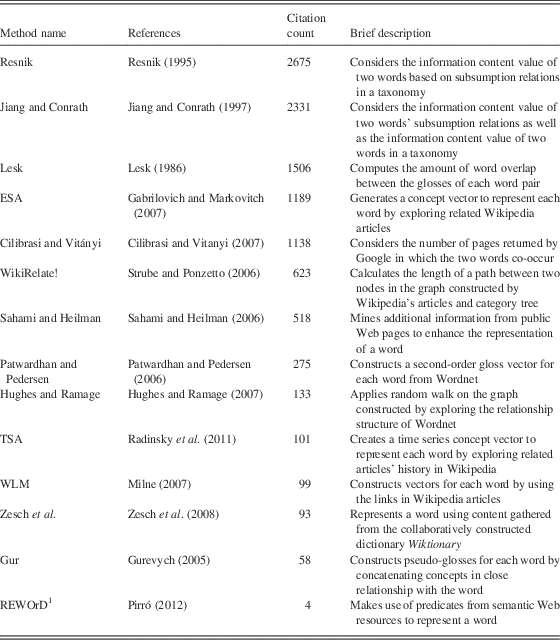
For example, we chose Explicit Semantic Analysis (ESA) (Gabrilovich & Markovitch, Reference Gabrilovich and Markovitch2007) since it is the pioneering work in exploring Wikipedia’s articles and concepts as the underlying knowledge resource. Another example is the work by Sahami and Heilman (Reference Sahami and Heilman2006) who was one of the first to propose the use of Web search engine results for developing a similarity kernel function. Table 1 shows a summary of the selected methods ordered by their citation counts along with their references, and a brief introduction of each method. In order to avoid papers with high citation count due to self-citations or semi-self-citations, the citations of the selected papers were manually reviewed.
Summary of selected methods

ESA=Explicit Semantic Analysis; TSA=Temporal Semantic Analysis.
1 This paper has few citations, but it is the only method which uses predicates in semantic resources at the time of writing this paper.
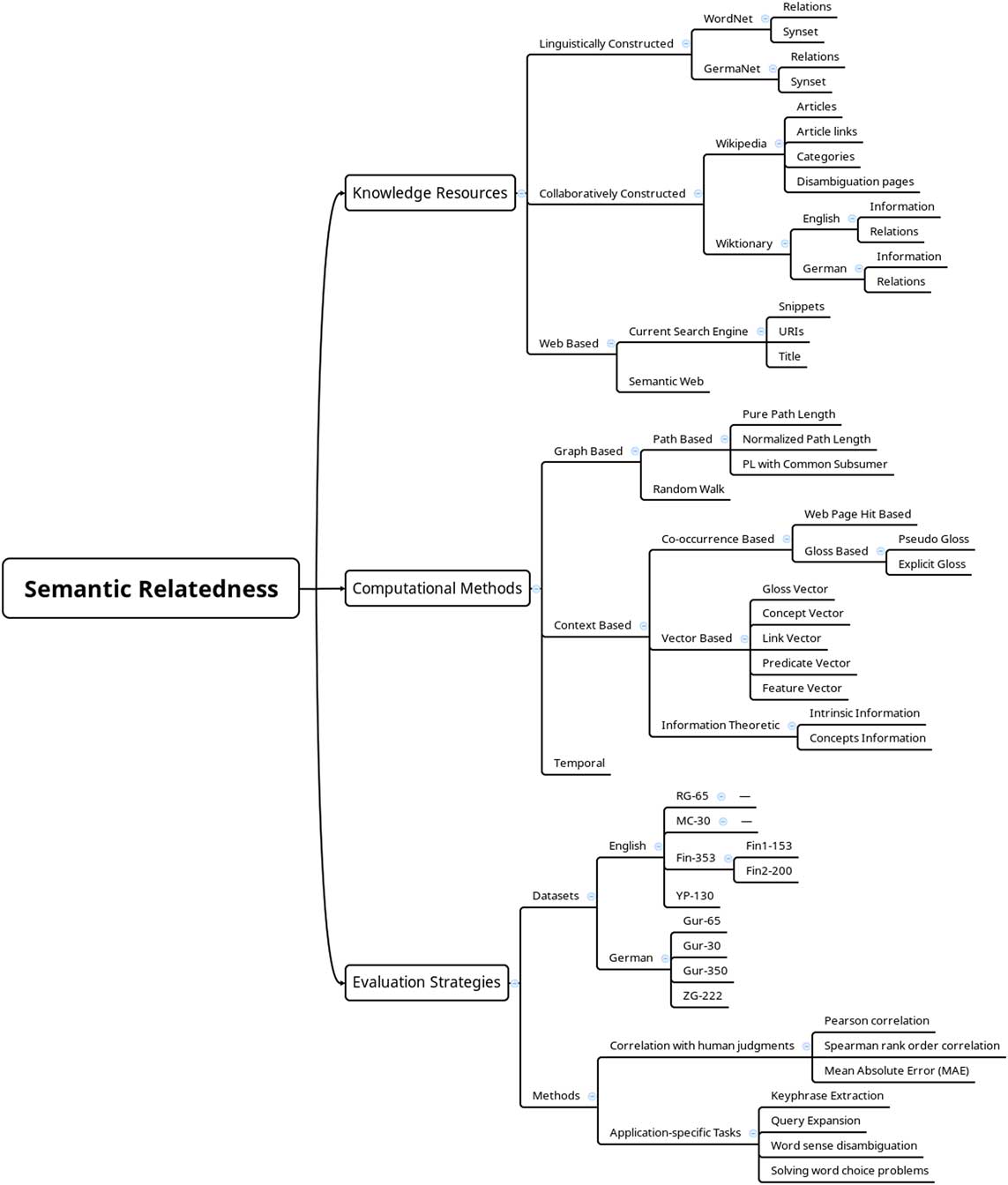
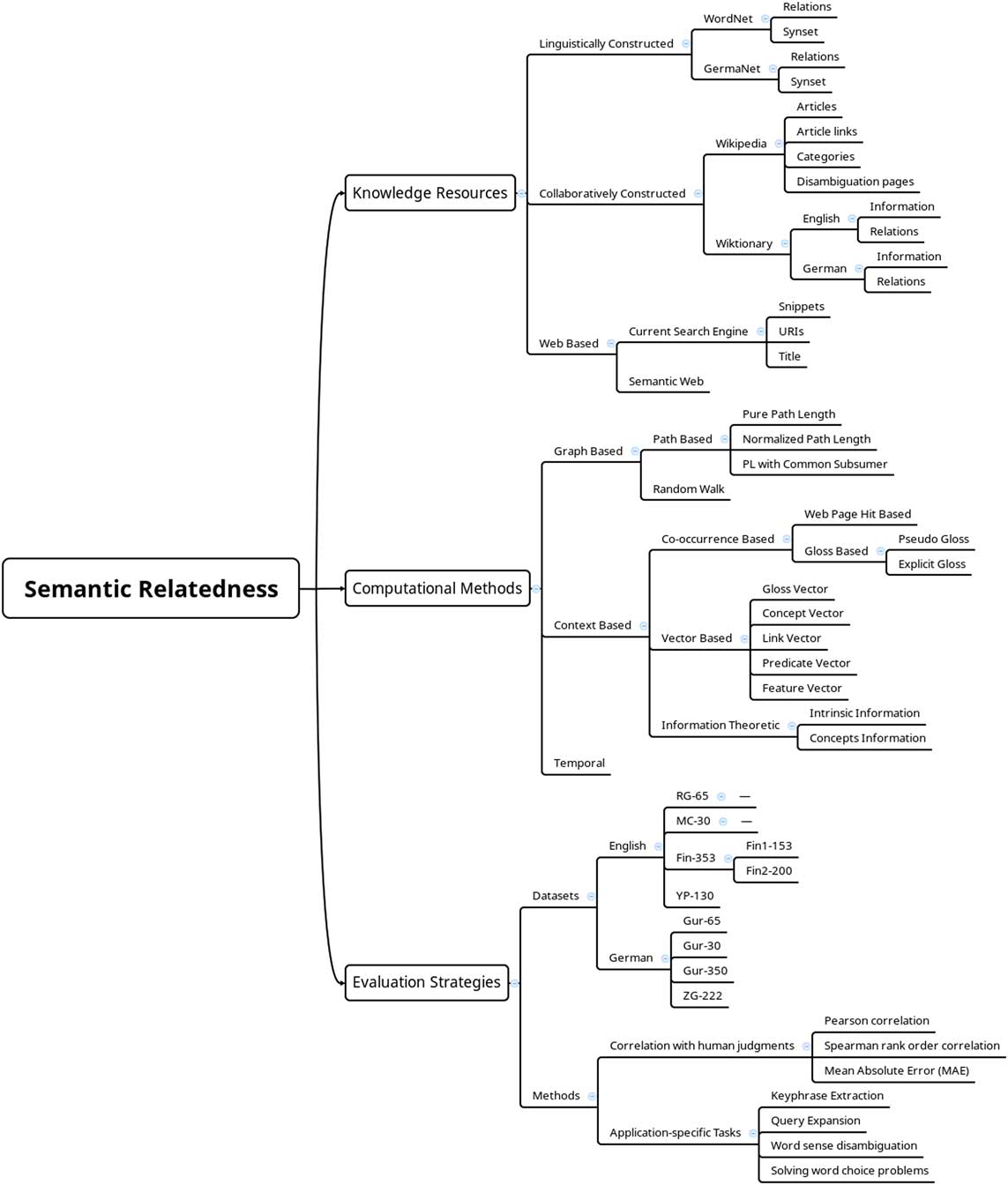
Once the methods were selected based on the above criteria, the approaches introduced in each of these 14 methods were studied with respect to the three main dimensions of our taxonomy. For instance, the fact that Resnik (Reference Resnik1995) uses WordNet as the knowledge resource, whereas ESA (Gabrilovich & Markovitch, Reference Gabrilovich and Markovitch2007) employs Wikipedia. Based on the extracted information from each of the 14 methods, we generalized the findings to build a hierarchical representation of the types of work done in the literature, as shown in Figure 1. Therefore, the development of the taxonomy has been based on evidence derived from the relevant literature and serves as a platform for comparing some of the well-known SR methods. As will be discussed in the remainder of the paper and shown in Tables 4, 5 and 7, the taxonomy shows the diversity of the types of knowledge resources, computational methods and evaluation approaches that have been presented in the literature for measuring SR.
The proposed framework dimensions
As shown in Table 1, the 14 selected methods utilize a wide range of knowledge resources that have been proposed for SR calculation such as Wikipedia, Web search engines, ontologies and Wiktionary, to name a few. Furthermore, they cover the state of the art computational methods that are based on word co-occurrences, vector space representation, random walk, path between words or temporal relation between words. In the remaining part of this section, we give an overview of each selected method.
Resnik (Reference Resnik1995) hypothesizes that SR between two words is a measure of the amount of information they share. For this purpose, and in order to identify shared information, the method proposed in Resnik (Reference Resnik1995) identifies the lowest common subsumer of the two words within an IS-A hierarchy. The information content value of the subsumer is regarded as an indicator of SR.
Jiang and Conrath (Reference Jiang and Conrath1997) employ the information content value of words as well as the information content value of the two words’ lowest common subsumer in a lexical taxonomy structure to compute SR. The information content value of two words’ lowest common subsumer describes the amount of information these two words share, whereas the information content value of a word indicates how informative that specific word is. Here, SR is defined based on the information content of the lowest common subsumer in the context of the information content of each individual word.
Lesk (Reference Lesk1986) structures his work on the short pieces of text (glosses) defining each word in WordNet. Specifically, SR is computed by counting the number of word overlaps in the glosses of the two words, where higher overlap means higher relatedness between two words.
ESA, proposed by Gabrilovich and Markovitch (Reference Gabrilovich and Markovitch2007), uses Wikipedia as its underlying knowledge resource. The motivation behind ESA is that Wikipedia contains numerous articles, each one focusing on a single concept; hence, Wikipedia can be viewed as a collection of concepts, each with an article explicitly defined by humans. In their approach, a semantic interpreter is built to map a word into a vector of Wikipedia concepts coupled with weights, where the weights are term frequency-inverse document frequence (TF–IDF) values of the input word in the underlying articles. In this context, SR is measured based on the cosine similarity of the two words’ vectors.
Cilibrasi and Vitányi (Reference Cilibrasi and Vitanyi2007) have proposed a method that relies on the information retrieved from a Web search engine. The motivation behind their work is that similar words when used as search queries will result in similar Web page results. Therefore, the count of the number of shared Web pages returned by a Web search engine for three different search queries, namely w 1, w 2, w 1 and w 2, is used to formalize the normalized Google distance (NGD). SR is defined as the inverse of NGD.
WikiRelate! (Strube & Ponzetto, Reference Strube and Ponzetto2006) takes advantage of Wikipedia articles and category tree to compute SR. In their work, the authors apply to Wikipedia the measures that were originally designed for WordNet. Articles are retrieved from Wikipedia by querying word pairs. Wikipedia’s disambiguation pages obtained for each word are used for disambiguation of the words. The categories related to the retrieved articles are used to compute SR by for instance, considering the length of the shortest path or the length of the path that maximizes information content.
Sahami and Heilman (Reference Sahami and Heilman2006) have introduced a new approach for computing SR aimed at overcoming the poor performance of traditional document similarity methods when applied on short text snippets (Sahami & Heilman, Reference Sahami and Heilman2006). Their method, similar to the work in Cilibrasi and Vitanyi (Reference Cilibrasi and Vitanyi2007), benefit from Web search results. In particular, they leverage Web search results for enhancing short snippets. Top ranked words, based on the TF–IDF measure from the search results, are used to build a vector for each input word. The vector is then used to compute the degree of SR between the two words.
Patwardhan and Pedersen (Reference Patwardhan and Pedersen2006) used the co-occurrence information as well as the definitions of words in WordNet to build gloss vectors corresponding to each word. The gloss vector is created in two steps: (1) the first-order vector consisting of co-occurrences between the target word and other words among all the glosses in WordNet is formed; (2) additionally word co-occurrence information are calculated by concatenating the glosses of words that are related to each other within WordNet. Cosine similarity is applied to the gloss vectors to measure the relatedness between two words.
Hughes and Ramage (Reference Hughes and Ramage2007) present an application of Markov chain theory to measure SR based on a graph extracted from WordNet. The graph is constructed such that the nodes are entries in WordNet and the edges are relational links between words. The authors adopted three types of nodes including Synset nodes, TokenPOS nodes and Token nodes, whereas the relationship types are hypernym/hyponym, instance/instance of, antonym, entails/entailed by, adjective satellite and causes/caused by. SR is calculated by assuming a particle that starts from a specific word, and then roams through the constructed graph. The particle tends to explore the neighborhood related to the target word, hence resulting in a stationary distribution. SR is the similarity between two stationary distributions obtained for the two words.
Temporal Semantic Analysis (TSA) method considers temporal information of resources. It was proposed by Radinsky et al. (Reference Radinsky, Agichtein, Gabrilovich and Markovitch2011) who hypothesized that by studying the similarity of word usage patterns over time, a great deal of relatedness information can be discovered to enhance the SR results. In their method, each word is represented as a weighted vector of concept time series derived from a historical archive such as NY Times archive. Then SR of a pair of words is computed by finding the similarity between two times series representing two words.
WLM: In order to reduce the computation expenses of the ESA approach, Milne (Reference Milne2007) developed a more efficient method by incorporating links found within Wikipedia articles corresponding to the words being compared. The method assumes that the more links two articles share, the more related they are. Thus, a word is represented as vector of links. The links are weighted based on a simple but intuitive idea: articles that receive many incoming links can be considered general articles providing less specific information. Semantic similarity of two words is then the cosine similarity between the weighted vectors representing two words.
Zesch et al. (Reference Zesch, Müller and Gurevych2008) have systematically studied the applicability of Wiktionary as a lexical resource for computing SR. They explored the features of Wiktionary including its relation types, languages, size, instance structure and instance incompleteness in order to propose two SR measures namely a path-based approach and a vector-based approach, explained in detail later in the paper.
Gur: The work by Gurevych (Reference Gurevych2005) relies on the structure of GermaNet, a conceptual network of relations between German words. Since GermaNet does not include word glosses for word definitions, Gurevych generated artificial conceptual glosses (pseudo-glosses) to describe each word. The pseudo-glosses are constructed by concatenating words that are in close relation to the target words through relations such as synonymy, hypernymy and meronymy, to name a few. SR between two words is then defined as the amount of word overlap between their pseudo-glosses.
REWOrD exploits SPARQL queries to access RDF data from DBPedia and evaluates the relatedness of two words based on the informativeness of the path between the two words (Pirró, Reference Pirró2012). The first step in applying REWOrD is to find DBpedia triples that are relevant to each of the words. The authors then introduce the notion of informativeness, which is calculated based on predicate frequency and inverse triple frequency. This is then used to build a vector for each word. The cosine similarity between the vectors for the two words is regarded as their degree of relatedness.
3 Dimensions of the framework
As discussed in the previous section, there are several SR approaches and systems in the literature that differ from each other in the way they approach and define relatedness or the resources they use. In this section, we describe various aspects of SR techniques based on the proposed classification framework, which consists of three main dimensions and several sub-dimensions. The framework dimensions (Figure 1) are as follows:
-
1. Knowledge resources, including:
-
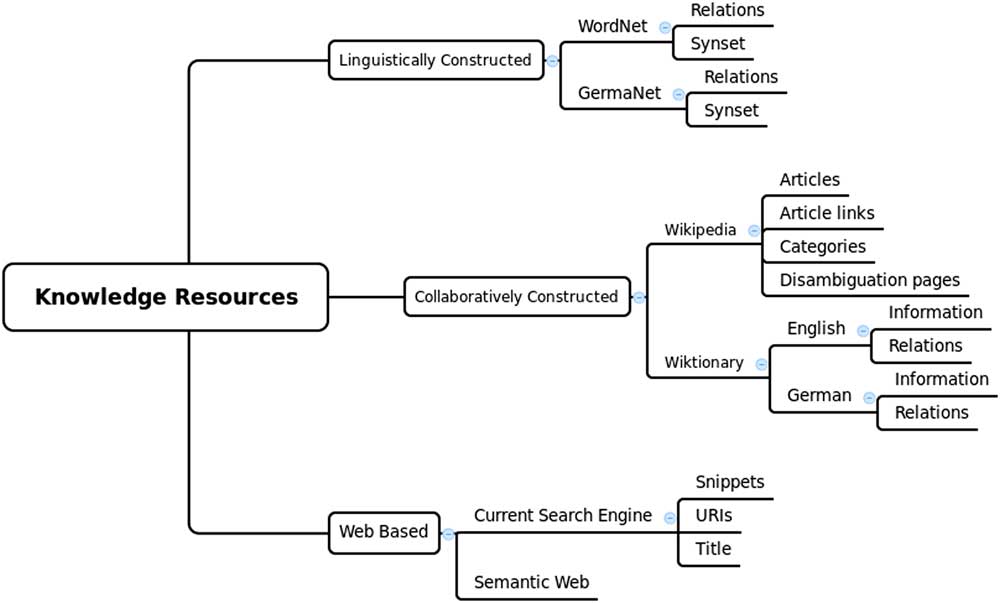
a. Linguistically constructed resources (Relations, Synsets in WordNet and GermaNet).
-
b. Collaboratively constructed resources (Articles, Article links, Categories, Disambiguation pages in Wikipedia, Information and Relations in English and German Wiktionary).
-
c. Web-based resources (Web Search Engines such as Google, Yahoo, Bing and the Semantic Web, i.e. the Linked Open Data cloud).
-
-
2. Computational methods, including:
-
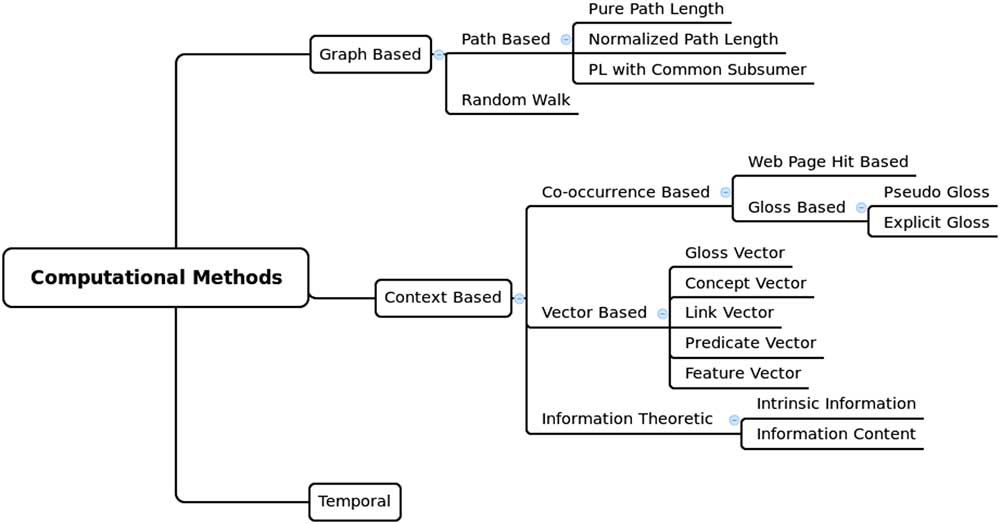
a. Graph-based methods (Path-based such as Pure Path Length, Graph Length, Common Subsumer and Random Walk).
-
b. Context-based methods (Co-occurrence-based such as Web Page Hit; Implicit Gloss or Explicit Gloss-based; Vector-based including Gloss Vector, Concept Vector, Links Vector, Predicates Vector and Feature Vector; Information Content-based such as Concepts Information and Intrinsic Information).
-
c. Temporal methods.
-
-
3. Evaluation strategies, including:
-
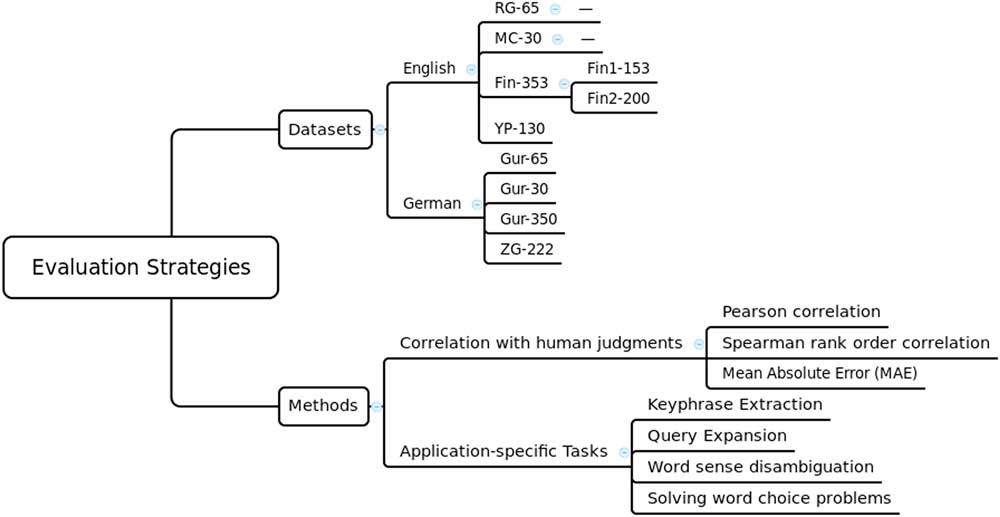
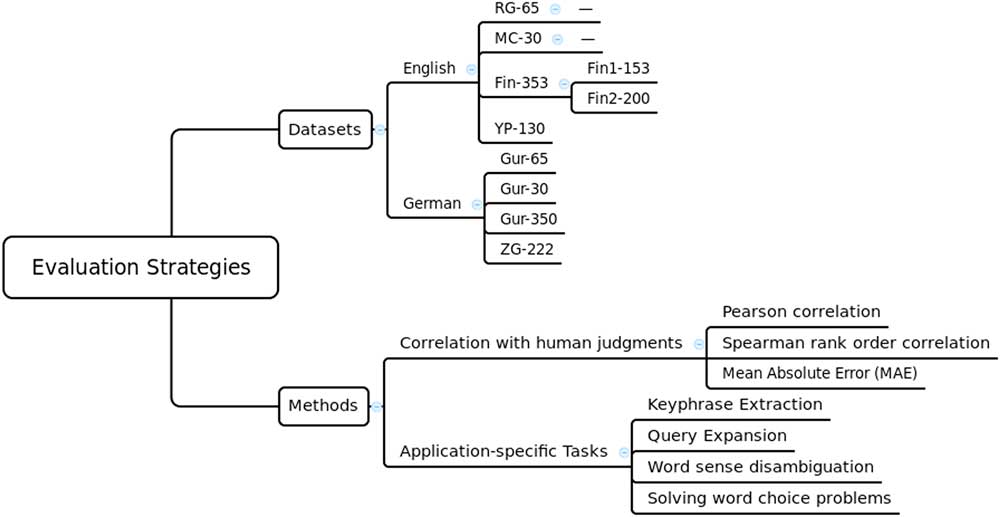
a. Data sets (English Data sets such as RG-65, MC-30, Fin-353 (Fin1-153,Fin2-200) and YP-130. German Data set like Gur-65, Gur-30, Gur-350 and ZG-222).
-
b. Methods (Correlation with human judgments through Pearson’s Correlation or Spearman’s Rank Order Correlation. Application specific such as Keyphrase Extraction, Semantic Information Retrieval, Word Sense Disambiguation and Solving word choice problems).
-
The following subsections describe the framework more deeply covering the three top-level dimensions (Resources, Methods and Evaluation Strategies) and each of their sub-dimensions.
3.1 Knowledge resources
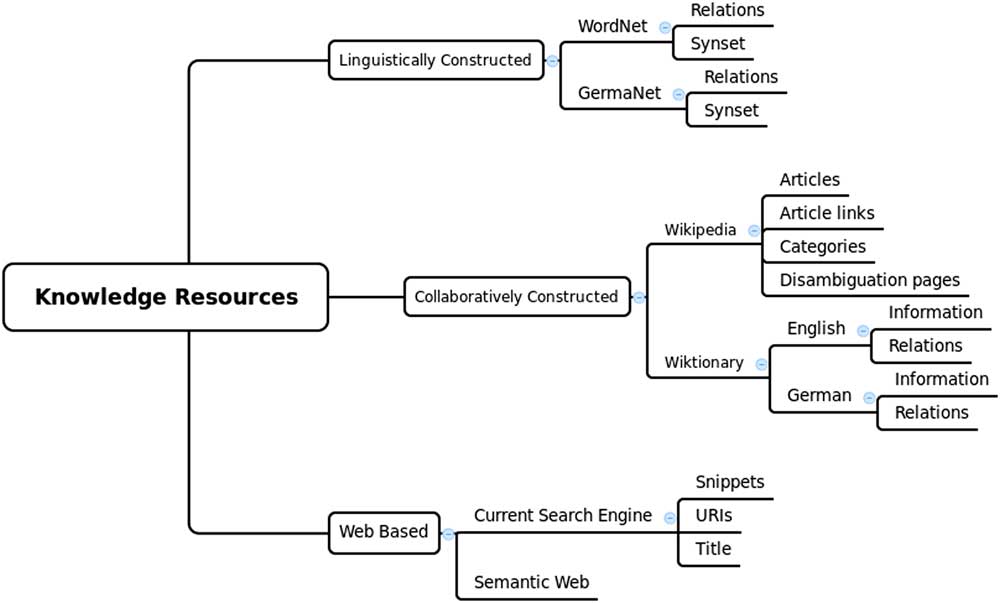
In the context of SR techniques, the term knowledge resource refers to the type and source of information that is used for determining the degree of relatedness between two words. We cover three main types of knowledge resources, namely (i) linguistically constructed resources such as Wordnet, (ii) collaboratively constructed resources such as Wikipedia and (iii) Web-based resources including Web search engine results. The taxonomy of the covered knowledge resources is shown in Figure 2.
Knowledge resources taxonomy
3.1.1 Linguistically constructed knowledge resources
The knowledge resources of this type consist of data sets that have been systematically developed by expert linguists. These knowledge resources are considered the most reliable as they have been curated through a well-reviewed and controlled process. Two of the most widely used resources include WordNet and GermaNet.
WordNet is a large lexical database for the English language. It consists of information that describes English words and expresses various meanings that a word can have in different contexts. Relations and synsets are two of the main constituents of WordNet where relations express information such as hypernymy, antonymy and hyponymy, and synsets represent groups of synonymous words. Additionally, members of each synset are often further described using a short piece of textual descriptor called the gloss. Various researchers have already benefited from Wordnet for computing the degree of SR between two words. These works have exploited both WordNet’s relations and its glosses.
Relations in WordNet provide the means to organize words in hierarchical structures. For instance, based on the hyponymy and hypernymy relations, words can be placed in a hierarchy where relations between general and specific terms are explicitly described. This hierarchical structure expressed through WordNet relations has been the source for various SR measures through which the lowest common subsumer of two words has been used as an indication of the relation between them. Resnik (Reference Resnik1995), Jiang and Conrath (Reference Jiang and Conrath1997) and Li et al. (Reference Li, Bandar and McLean2003) have considered the information content of the subsumer of two words to define the degree of their relatedness. This is based on a simple yet effective observation that subsumers in lower levels of the hierarchy provide more information as they refer to more specific concepts thus revealing greater information content and hence indicating strong relatedness between two words.
Besides relying on the hyponymy and hypernymy relations, other relationship types have also been used to create a word graph where the nodes are WordNet synsets and the corresponding edges are relations. Once the graph is constructed, various graph manipulation techniques have been used to derive relatedness of the nodes in the graph. Rada et al. (Reference Rada, Mili, Bicknell and Blettner1989) benefited from this graph representation and represented relatedness as a measure of the shortest path between two nodes. Leacock and Chodorow (Reference Leacock and Chodorow1998) further improved this calculation by taking into account the depth of the graph along with the path length. In contrast and instead of focusing on path length, Hughes and Ramage (Reference Hughes and Ramage2007) applied a random walk process on the graph to extract a statistic distribution that denotes the probability of reaching other nodes by starting from a given node. SR is then computed by measuring the similarity between two static distributions obtained by starting from each of the two nodes.
While relations in WordNet allow for identifying structural relatedness between words, glosses allow for the identification of content-based relations between words. A gloss is a short piece of text that describes the meaning of each synset in Wordnet. For example, the gloss of the synset ‘relatedness’ is ‘a particular manner of connectedness’. Various notable work have already been developed that measure SR between two words based on the information content overlap of their corresponding glosses. A simple yet effective approach is to count the word overlap between two glosses, and consider the words more related if their word count overlap is higher. While Lesk (Reference Lesk1986) introduced this method in 1986, some other methods have expanded upon it by introducing the concept of pseudo-glosses. The idea behind pseudo-glosses is that some glosses in Wordnet are too short and hence not effective for calculating relatedness. Therefore, methods are proposed to expand glosses to overcome this problem. Banerjee and Pedersen (Reference Banerjee and Pedersen2002) developed pseudo-glosses for a given word by concatenating the glosses of other related words (e.g. the synset, hypernym, hyponym, holonym, meronym, troponym and attribute of words in pairs) to its gloss. Mihalcea and Moldovan (Reference Mihalcea and Moldovan1999) expanded the glosses by considering the glosses of other words in the WordNet relation hierarchy. Another approach, which deviates from the idea of word overlaps from the glosses, is based on the development of a feature representation for each word where the feature set is created using bags of words within the glosses of the words in WordNet. For instance, Patwardhan and Pedersen (Reference Patwardhan and Pedersen2006) represented a word by its second-order gloss vector. In their work, first-order context vectors are created by measuring the co-occurrences between words based on their glosses. Then, the second-order vector for word w is formed by adding the first-order context vectors of words that exist in the gloss of w. For example, the gloss of word fork is ‘cutlery used to serve and eat food’, after removing stopwords, the first context vectors of words ‘cutlery’, ‘serve’, ‘eat’ and ‘food’ can be created by counting the co-occurrences between these words based on their glosses. Then the second-order vector for fork is created by adding the first-order context vectors of these four words.
GermaNet is a German counterpart of WordNet. Many of the approaches applied to WordNet can also be employed for GermaNet. However, the main distinguishing feature of GermaNet is that it does not include glosses; therefore, the original gloss-based methods which calculate relatedness based on glosses are not directly applicable. In order to exploit gloss-based methods, glosses need to be generated from scratch. Gurevych (Reference Gurevych2005) has proposed one such method where pseudo-glosses are generated by concatenating words that are in close relations to the target word in the relationship hierarchy. The generated pseudo-glosses are then used as a representation of the gloss for the words in GermaNet.
3.1.2 Collaboratively constructed knowledge resources
The second class of knowledge resources that are widely exploited in the literature are the information sources that have been collaboratively developed through crowdsourcing on the Web. While these knowledge resources are not necessarily developed by domain expert authorities, they contain reliable information due to extensive peer review and content moderation. Wikipedia and Wiktionary are among the most actively maintained information sources that have received attention from the SR community.
3.1.3 Wikipedia
The information collected in Wikipedia is represented through the so-called articles, which are focused on and dedicated to the description of a specific topic. The content of each article is gathered and edited collaboratively and is often strictly moderated by community volunteers. Besides articles, Wikipedia provides hyperlinks between articles, categories and disambiguation pages. Various researchers have already benefited from the textual content of Wikipedia articles, the hyperlink graph structure as well as categories and disambiguation pages to develop SR measures.
One of the widely used SR methods that exploits Wikipedia article content is ESA (Gabrilovich & Markovitch, Reference Gabrilovich and Markovitch2007). In this method, each Wikipedia article is assumed to be describing a single word or concepts, which is represented as a weighted mixture of the set of terms that appear in the content of the Wikipedia article. The weights are TF–IDF values of the terms. In ESA, the main idea behind the use of Wikipedia articles is to develop a weighted bag of words representation that can be used for similarity measurement.
Article links, which are inward hyperlinks connecting two Wikipedia articles can be used to establish relationship between two concepts (words) represented by the two Wikipedia articles. Witten and Milne (Reference Witten and Milne2008) and Milne (Reference Milne2007) have already benefited from article links when proposing the WLM method. They exploit Wikipedia article links by representing each word as a weighted vector of links computed based on the number of links on the word’s Wikipedia article and the probability of the link’s occurrence. Different from WLM, WikiWalk (Yeh et al., Reference Yeh, Ramage, Manning, Agirre and Soroa2009) exploits Wikipedia article link structure to construct a graph in which Wikipedia articles are the vertices and the edges are the links between the articles. This graph structure, which closely mimics the Wikipedia content structure, is employed for performing a variation of the PageRank algorithm to find word similarities.
The Wikipedia Category system is a hierarchical structure where each category can have subcategories through Hyponymy or Meronymy relations. Each article is coupled with one or more categories. From the category perspective, each category contains one or more articles. Given the meaningful classification that Wikipedia categories provide, WikiRelate (Strube & Ponzetto, Reference Strube and Ponzetto2006) defines SR between two words based on the mapping between the Wikipedia articles representing the words and their related categories. The basic idea behind this approach is that SR of two words is dependent on the relatedness of their categories, therefore, using the word-category mapping, the distance between the categories of two words are taken as a measure of the words’ SR. Other than WikiRelate, WikiWalk (Yeh et al., Reference Yeh, Ramage, Manning, Agirre and Soroa2009) also employs Wikipedia category links to augment the graph structure that it builds based on the article links in order to take category similarities into account.
Within Wikipedia, disambiguation pages provide context for words that can have multiple meanings. Disambiguation pages contain links to the most pertinent article per sense of the word along with a brief description. For example, querying java returns a Wikipedia disambiguation page which contains links to other pages consisting of Java Sea, north of the island of Java, Java Trench, a subduction zone trench west of the island of Java, among others. In addition to using Wikipedia categories, WikiRelate also benefits from the disambiguation pages by resolving all redirects in the disambiguation pages and selecting the sense (the redirect link) that results in the highest SR between the two words.
3.1.4 Wiktionary
Wiktionary is a multilingual, Web-based, freely available dictionary,
thesaurus and phrasebook (Zesch et al., Reference Zesch, Müller and Gurevych2008) designed as a lexical companion
to Wikipedia. Wiktionary shares many commonalities with Wordnet as they both
include words, lexical relations between words and short pieces of text
describing the words (glosses). Given the fact that Wiktionary consists of a
large number of words, a high-dimensional concept vector can be constructed
based on its constituent words. For example, Zesch et al.
(Reference Zesch, Müller and Gurevych2008) use both English and
German versions of Wiktionary to compute SR. In their approach, they
construct a concept vector
 $$\underline{v} \left( w \right)\,{\equals}\,\left( {v_{{1,\,\ldots\,,}} v_{n} } \right)$$
where the value of v
i
is the TF–IDF of word w in Wiktionary entry
d
i
. Once each word is represented as a concept vector, SR between two
words is calculated based on the cosine similarity of their concept
vectors.
Similar to Wordnet, Wiktionary consist of lexical–semantic relations that are explicitly encoded in the structure of each Wiktionary entry. The English Wiktionary consists of relations such as compounds, abbreviations and acronyms, among others (Zesch, Reference Zesch2010). Some researchers have developed SR measures that focus on these relations. As mentioned earlier, the work by Zesch et al. (Reference Zesch, Müller and Gurevych2008) adopts two methods based on Wiktionary content: the first method takes Wiktionary words into account as outlined above and the second method relies on the relations between the words in Wiktionary. In the latter approach, a graph is built whose nodes are the Wiktionary words and the edges are the lexical–semantic relations between these words. SR is then measured by calculating the shortest path between each two node. Likewise, Krizhanovsky and Lin (Reference Krizhanovsky and Lin2009) have applied a path-based method on a graph constructed based on Russian Wiktionary. In order to address the small vocabulary size of the Russian Wiktionary, the authors have used translations between the Russian and English Wiktionary. On this basis, the shortest path between two words is found and the distance is used to indicate similarity. It is also worth mentioning that Wiktionary has glosses for some of its entries. Therefore, the concept of glosses or more specifically pseudo-glosses can also be exploited for identifying SR based on Wiktionary. For example, Meyer and Gurevych (Reference Meyer and Gurevych2012) explored the glosses in Wiktionary to perform disambiguation based on word overlaps in glosses. They calculated similarity between words with the right sense to create sense-disambiguated word vectors, which resulted in a higher accuracy compared to methods based on WordNet and Wikipedia.
3.1.5 Web-based resources
It has been estimated that there are over 45 billion Web pages on the World Wide Web that have been created with no central coordinationFootnote 2 . Most of these Web pages carry implicit user-understandable semantics. Many researchers have relied on this implicit semantics to measure SR between words. In the Web-based knowledge resource category, two main information sources have been used, namely Web search engines and semantic Web resources.
3.1.6 Web search engines
Given the size of the Web and the role of search engines in content retrieval, there have been extensive research that have looked at how the results of search engines can be taken as an indication for SR. For a given search query, search engines often return useful information such as result snippets, Web page URIs, user-specified metadata and descriptive page titles. The information content value of the outputs of search engines have been considered as possible indicators of relatedness.
Web search engine snippets are short pieces of text for each result returned by search engine that contain a set of terms that describe the retrieved page. Some authors have benefited from snippets to measure SR. For instance, Spanakis et al. (Reference Spanakis, Siolas and Stafylopatis2009) have proposed a hybrid Web-based measure for computing SR between words by automatically extracting lexico-syntactic patterns from snippets based on the idea that similar words should have similar usage patterns. Similarly, Bollegala et al. (Reference Bollegala, Matsuo and Ishizuka2007) have developed a SR method that relies on search snippets, and considers both word counts and lexical-syntactic patterns when comparing the results of three queries w 1, w 2 and (w 1 and w 2). Sahami and Heilman (Reference Sahami and Heilman2006) collect snippets of the top ranked pages for a query and represent each query through an TF–IDF term vector of the collection of snippets. SR of two words is then computed based on the similarity of their query term vectors. Furthermore, Chen et al. (Reference Chen, Lin and Wei2006) have proposed a double-checking model to analyze snippets returned by a Web search engine, where the double-checking model is formed by a forward process which counts the total occurrences of w 2 in the top N snippets of query w 1 and a backward process which counts the total occurrences of w 1 in the top N snippets of query w 2. Duan and Zeng (Reference Duan and Zeng2012) count the occurrences of each word and also the co-occurrence of the two words within the returned snippets and compute SR based on the obtained count frequencies.
There have been other works based on Web search engine results that do not necessarily rely on snippets only, but also consider the content of the retrieved Web pages. The main reason for this is the short length of snippets that could impact the accuracy of the SR measures. For example, Sahami and Heilman (Reference Sahami and Heilman2006), who initially considered snippets as their knowledge resource, have enhanced snippets by adding the top-k words with the highest TF–IDF value from each of the returned document to the vector representing each word. Duan and Zeng (Reference Duan and Zeng2012) have also considered the retrieved documents by analyzing the number of documents where the two words occur independently and also those where the words co-occur. There are several works that operate based on a very similar approach on the retrieved documents, which can be found in (Bollegala et al., Reference Bollegala, Matsuo and Ishizuka2007; Cilibrasi & Vitanyi, Reference Cilibrasi and Vitanyi2007; Spanakis et al., Reference Spanakis, Siolas and Stafylopatis2009).
3.1.7 Semantic Web
More recent knowledge resources are provided by the Semantic Web community in the form of ontologies and the Linked Open Data. These resources are based primarily on the RDF model, built of triples in the form of <subject, predicate, object>. A triple explicitly defines a relationship between a subject and an object through a meaningful relationship, known as a predicate. As introduced earlier, REWOrD (Pirró, Reference Pirró2012) is one of the earlier works that exploit the concept of Linked Open Data, especially the DBpedia knowledge base, to compute SR. In REWOrD approach, the correspondence between words and DBpedia’s semantic concepts are first found. The retrieved DBpedia concepts are then used to construct a vector for each word. Vector similarity is used as the measure of SR between two words. Gracia and Mena (Reference Gracia and Mena2008) have calculated SR between two concepts within a Semantic Web ontology by finding and comparing the similarity of their ontological contexts. An ontological context for a concept is defined as a collection of highly related concepts within the ontology that can support unambiguous definition of the given concept. For instance, the ontological context of a concept can include its hypernyms and synonyms. Karanastasi and Christodoulakis (Reference Karanastasi and Christodoulakis2007) have introduced OntoNL SR measure that depends on semantic relations defined by the Web Ontology Language. In this model, the authors compute SR by integrating three aspects: the number of common properties and inverse of properties that the two concepts share, the path distances of two concepts’ common subsumer and the count of the common nouns and synonyms from the concepts’ descriptions in the ontology. Finally, Zhou et al. (Reference Zhou, Wang, Chao, Zhang and Yu2012) have proposed the Linked Open Data Description Overlap (LODDO) method that measures SR between words as long as the words have corresponding concepts (entities) on the Linked Open Data. For any given pair of concepts, LODDO would retrieve the description of the concepts from the Linked Open Data cloud and use text overlap methods to compute the relatedness of the two concepts based on their derived descriptions.
One of the research areas that has important synergies with the SR domain is ontology matching, also known as ontology alignment. Ontology matching is concerned with the identification of similar concepts within two different ontologies. As described by Euzenat and Shvaiko (Reference Euzenat and Shvaiko2013), and Otero-Cerdeira et al. (Reference Otero-Cerdeira, Rodríguez-Martínez and Gómez-Rodríguez2015), ontology matching methods can be performed at element and/or structure levels. Within the element-level mapping approaches that have the closest resemblance to SR measurement techniques, there are typically two types of approaches, namely point-to-point and interlingua approaches (Gruninger & Kopena, Reference Gruninger and Kopena2005). In the point-to-point approach, elements of the two ontologies are directly mapped to each other, while in the interlingua approach, elements of each ontology are separately mapped to an intermediary standalone ontology. The idea of interlingua-based mapping can be helpful for measuring cross-language SR. It should be noted that while many mapping techniques employ SR measurement to determine the relevance or similarity of two concepts across the two ontologies, ontology mapping techniques often do not solely rely on SR and incorporate other additional information such as ontology structure and depth information to perform the mapping process.
3.2 Computational methods
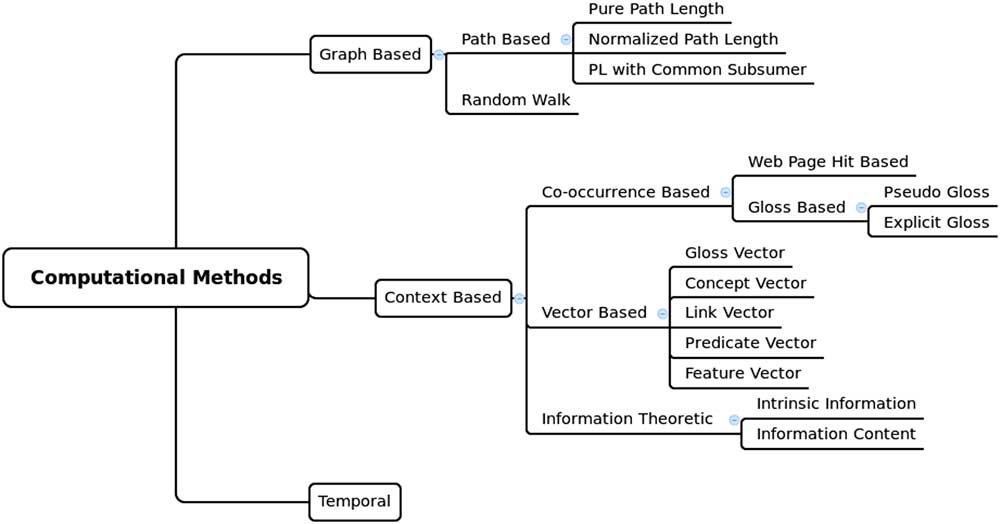
In addition to the knowledge resources used for computing SR values, the method that is applied to the adopted knowledge resource plays a significant role in the quality of a relatedness measure. Methods developed for SR computation are introduced in this section. The taxonomy of such methods is shown in Figure 3. We review three major categories of methods, namely graph-based, context-based and temporal.
Computational methods taxonomy
3.2.1 Graph-based methods
The basic idea of graph-based methods is to view the information derived from a knowledge resource as a graph whose nodes are terms or concepts, whereas edges are relations, specific to the selected knowledge resource, between pairs of terms or concepts. By adopting a graph-based representation model, many different graph analysis techniques can be applied to compute SR between two words. The two main approaches that have been studied in the literature include path-based methods that consider the path length between two nodes in the graph, and random walk methods that take advantage of the probabilistic likelihood of reaching a destination node from a source node in the graph.
3.2.2 Path-based methods
The path connecting two nodes in a graph-based representation of a knowledge resource can reveal important information about the degree of relatedness between two words. Path-based approaches often rely on the length of the shortest path between two nodes in the graph to measure their SR. It is intuitively assumed that the shorter the path is, the higher SR between the two words would be.
Pure path length methods only consider the length of the shortest path between two nodes, which is computed by simply counting the number of edges on the path from one node to the other. For instance, Rada et al. (Reference Rada, Mili, Bicknell and Blettner1989) compute SR by using the path length l between two nodes where the degree of similarity of two nodes is defined as the length of longest path in the graph subtracted by l. Jarmasz and Szpakowicz (Reference Jarmasz and Szpakowicz2012a, Reference Jarmasz and Szpakowicz2012b) adopt Rada et al.’s method and apply it to Roget’s thesaurus by counting the number of edges between the two words in the Roget’s taxonomy. In WikiRelate, Strube and Ponzetto (Reference Strube and Ponzetto2006) select the shortest path between two words (corresponding to Wikipedia articles) based on the graph constructed from Wikipedia where the nodes are the Wikipedia articles and the edges are the links between the articles. Furthermore, some researchers have used additional corpus statistics in combination with path length to compute SR. For example, Jiang and Conrath (Reference Jiang and Conrath1997) calculated the sum of all the weights on the shortest path to measure similarity, where the weights on the edges are generated from the corpus statistics.
Normalized path length approaches consider additional graph statistics such
as the depth of the graph to normalize the length of the shortest path
between two nodes. For instance, Leacock and Chodorow (Reference Leacock and Chodorow1998) normalize the shortest path length by
considering the depth as length of the longest path in the
graph, and define the semantic similarity measure as
 $sim_{{LC98}} (w,w_{2} ) \,{\equals}\, {\minus}{\rm log}{{l(w_{1} ,w_{2} ) {\plus} 1} \over {2 \cdot {\rm depth}}}$
.
Both pure path length-based and normalized path length-based methods do not
consider the information content value of a node. Some researchers have
argued that the shared information content value of two words within a graph
can be understood through their common subsumer. The consideration of the
common subsumer in such approaches ensures that those words which are
located higher in the taxonomy (i.e. are more abstract), receive a lower
relatedness score compared to those words that are lower in the taxonomy but
have comparable path length. For instance, assuming a taxonomic structure,
the work by Wu and Palmer (Reference Wu and Palmer1994) is
a path length approach, which considers the lowest common subsumer of two
words lcs(w, w
2) along with the shortest path length between the two words in
order to measure SR as follows:
 $sim_{{WuP94}} \,{\equals}\, {{2 \cdot {\rm depth}(lcs)} \over {l(w,lcs) {\plus} l(w_{2} ,lcs) {\plus} 2 \cdot {\rm depth}(lcs)}}$
.
3.2.3 Random walk methods
Some researchers have based their SR calculation on the likelihood of
reaching a node from another node based on a random Markov chain traversal
of the graph. In such models, the edges of the graph form a transition
matrix between the vertices where each column contains a normalized outgoing
probability distribution for a particular node, and the value in each cell
represents the conditional probability of moving from one node to the other.
Based on this initial transition matrix and with repeated conditional
transitions, a stationary distribution will be obtained for each vertex of
the graph. SR is computed by computing the similarity between the stationary
distributions obtained for two words. For example, by extracting information
from WordNet, Hughes and Ramage (Reference Hughes and Ramage2007) construct a graph where the nodes are
Synsets, TokenPOS and
Tokens, whereas the edges are the WordNet’s
relationships between these nodes. The authors define the probability of
reaching word w
i
in the tth iteration
 $$( {w_{i}^{{(t)}} } )$$
as the sum of all paths in the graph leading to this word
from the previous iteration:
 $w_{i}^{{(t)}} {\equals} \mathop \sum\nolimits_{w_{j}\in v} w_{j}^{{(t{\minus}1)}} P(w_{i} \!\mid\!w_{j} )$
. Yeh et al. (Reference Yeh, Ramage, Manning, Agirre and Soroa2009) have applied random walks on Wikipedia link
structure. These authors treated the Wikipedia articles as vertices and
links between articles as edges of a graph. Based on this graph structure,
the initial edge weights were determined based on the ESA method
(Gabrilovich & Markovitch, Reference Gabrilovich and Markovitch2007), after which the Markov chain theory was applied to obtain
stationary distributions for each word. SR was then obtained by computing
the similarity between any two stationary distributions.
3.2.4 Context-based methods
The latent relation hypothesis postulates that words that are observed in similar contexts or frequently share similar contexts can be considered related (Turney & Pantel, Reference Turney and Pantel2010). Context-based methods primarily operate based on this hypothesis and attempt to measure SR of words through the degree of similarity of the contexts the words appear in. Different researchers have come up with various forms of word context including Web pages where a word appears in, the Wikipedia articles where a word occurs and the WordNet glosses where the word is observed, just to name a few. We identify and elaborate on three forms of context-based SR methods, namely co-occurrence-based, vector-based and information content-based methods.
3.2.5 Co-occurrence-based methods
Two word contexts that have been commonly used in the literature for this purpose include (i) Web pages where the words occur, and (ii) WordNet glosses where the words are observed.
In order to exploit the Web page content where the words occur, the work
proposed in Bollegala et al. (Reference Bollegala, Matsuo and Ishizuka2007), Spanakis et al. (Reference Spanakis, Siolas and Stafylopatis2009), Duan and Zeng (Reference Duan and Zeng2012) employ a Web search engine to
retrieve the specific Web pages where the words occur independently and also
simultaneously. The degree of overlap between the retrieved Web pages for
each query is used to determine relatedness. Assuming N is
the number of documents indexed by the search engine and
H(q) is the number of search results
for query q, well-known set similarity measures such as
Jaccard
 $\left( {{{H(w_{1} {\cap}{w_{2}} )} \over {H(w_{1} ) {\plus} H(w_{2} ) {\minus} H(w_{1} {\cap}w_{2} )}}} \right)$
, overlap
 $$\left( {{{H(w_{1} {\cap}{w_{2}} )} \over {{\rm min}(H(w_{1} ),H(w_{2} ))}}} \right)$$
, Dice
 $\left( {{{2H(w_{1} {\cap} {w_{2}} )} \over {H(w_{1} ) {\plus} H(w_{2} )}}} \right)$
and point-wise mutual information
 $\left( {{\rm log}_{2} ({{{{H(w_{1} {\cap}{w_{2}} )} \over N}} \over {{{H(w_{1} )} \over N} \cdot {{H(w_{2} )} \over N}}})} \right)$
are used to measure SR of two words w
1 and w
2.
A seminal work in this area is the Google distance proposed by Cilibrasi and Vitányi (Reference Cilibrasi and Vitanyi2007). The authors have proposed the NGD to determine the distance between a pair of words where the degree of relatedness is determined based on Google’s search results. If two words produce the exact same search result set when used as a query in the Google search engine, their NGD would be 0 and if they do not share overlaps, their NGD would be infinite. Gracia and Mena (Reference Gracia and Mena2008) later transformed NGD to compute the relatedness between words regardless of whether Google search engine is used or not.
As mentioned earlier, context has also been modeled through WordNet glosses where each word’s gloss or any gloss where the word is observed are considered to be the context for the word. Many of the existing work such as Lesk (Reference Lesk1986), Gurevych (Reference Gurevych2005), Zesch et al. (Reference Zesch, Müller and Gurevych2008) are based on such context definition and assume that each word has either a WordNet entry with a corresponding gloss or a gloss can be synthetically generated for the word.
When context is modeled as through explicit glosses, they are extracted
directly from WordNet. For example, Lesk (Reference Lesk1986) built his method by counting the number of word overlaps
between two glosses:
 $$\mid\!\!{\rm gloss}(w_{1} ) \,{\cap}\, {\rm gloss}(w_{2} ) \!\!\mid,$$
where gloss(w
i
) is the set of words in the gloss of word w
i
. Banerjee and Pedersen (Reference Banerjee and Pedersen2002)
extended the gloss of each word by taking into account the glosses of
related words to overcome the problem that some glosses in WordNet are short
in length. Moreover, Mihalcea and Moldovan (Reference Mihalcea and Moldovan1999) constructed the gloss of a word by combining
all the glosses found in its synsets, and then counted the number of word
overlaps to determine relatedness.
Considering explicit glosses and their extensions as word context is not always possible, for example, the case of GermanNet; therefore, in some cases pseudo-glosses are employed as context. For instance, Gurevych (Reference Gurevych2005) constructed pseudo-glosses by concatenating words which are in close relation (e.g. Synonymy, Meronymy) with the target word.
3.2.6 Vector-based methods
The idea behind vector-based models is to construct a vector representation model for each word that can be used to calculate SR through vector similarity measures. Word vectors have been traditionally represented using information extracted from different knowledge resources such as WordNet glosses, Wikipedia links and Web search result snippets, just to name a few. Based on the type of elements used in the word vector representation, we divide vector-based methods into gloss vector, concept vector, link vector, predicate vector and feature vector categories.
Within the gloss vector category, Patwardhan and Pedersen (Reference Patwardhan and Pedersen2006) construct word vectors using WordNet glosses. The authors initially create the first-order co-occurrence vectors in WordNet, where the co-occurrences are between the target word and other words in the target word’s gloss. This is followed by computing second-order co-occurrences, which is inspired by the second-order word sense discrimination approach proposed by Schütze (Reference Schütze1998). The authors suggest that the use of the Cosine similarity measure on any two such vectors would result in a reliable SR value for those two words. Other researchers have later proposed some variants of the gloss vector representation such as the work by Wan and Angryk (Reference Wan and Angryk2007) and Pedersen (Reference Pedersen2012).
While gloss vector methods focus on information from WordNet, concept vector methods employ content from Wikipedia to build vector representation of words. One of the better known concept vector method, introduced by Gabrilovich and Markovitch (Reference Gabrilovich and Markovitch2007), is based on the assumption that each Wikipedia article has a topical focus, that is, the content of each Wikipedia article is focused on a specific topic. Accordingly, a word is represented as a vector whose elements are the TF–IDF values of the words that appear in the corresponding Wikipedia article. The limitation of this approach is that it only provides SR values between words that have corresponding Wikipedia articles. Zesch et al. (Reference Zesch, Müller and Gurevych2008) also created a high-dimensional concept vector for each word based on the concept space in Wiktionary.
Unlike gloss and concept vector models, link vector methods
represent a word through its links to other words. For this purpose, the
link vector model needs to be built on knowledge resources that provide some
form of word interlinking, for example, through hyperlinks. Milne (Reference Milne2007) has proposed one of the widely
used link vector models where each word is represented by the links it has
to other Wikipedia articles. However, given the fact that not all the links
in an article have the same significance, the author defines a weighting
scheme for the links. The basis of the weighting scheme is that a page would
be considered rather general (less specific) if too many pages link to it.
Therefore, Milne defines the weight of a link in a specific Wikipedia
article as
 ${\rm log}\left( {{N \over {\,\mid\,T\,\mid\,}}} \right)$
, where T is the number of articles that
link to the target article and N the total number of
Wikipedia articles. A word is then expressed as a weighted vector of links
that appear in its corresponding Wikipedia article. Other authors such as Bu
et al. (Reference Bu, Hao and Zhu2011)
and Turdakov and Velikhov (Reference Turdakov and Velikhov2008),
among others, have also used and promoted the link vector
representation.
In the predicate vector representation, the focus is on deriving a vector for each word based on the content of RDF graphs. For instance, in the REWOrD system, Pirró (Reference Pirró2012) created a predicate vector for each word, in which the elements of the vector were other words that were connected to the target word through at least one explicit predicate. The author further suggested that the predicate vector could contain other words that were observed along the path of the words that were compared for SR. Predicate frequency, inverse triple frequency and path informativeness were used to weight each element of the vector.
Finally, feature vector models focus on identifying key discriminative characteristics that can uniquely represent a word. The major difference between feature vector models and the previous three vector representations is that the elements of the feature vector do not rely directly on some form of co-occurrence information but rather they rely on specific metrics to represent a word. For instance, Spanakis et al. (Reference Spanakis, Siolas and Stafylopatis2009) proposed to model each word as a feature vector that includes features such as page count metrics, and lexico-syntactic patterns extracted from Google results (e.g. using titles, snippets and URLs). Along the same lines, Bollegala et al. (Reference Bollegala, Matsuo and Ishizuka2007) constructed a feature vector based on the lexico-syntactic patterns that they extracted from the results of a Web search, for example, a word pair based on the frequency of each pattern. For instance, they determined that words that were related to each other in a given sentence using phrases such as: also known as, is a, part of, is an example of, have a high likelihood of being suitable features for computing SR.
3.2.7 Information theoretic methods
Information theoretic approaches compute relatedness between words by considering how much common information the two words share. The intuition is that the more similar information the two words convey, the more similar they would be. Information theoretic approaches can be divided into two subcategories depending on how information content sharing is measured.
Intrinsic information theoretic methods rely on a taxonomic knowledge resource for measuring SR. To determine the degree of common information shared by two words, intrinsic methods consider features such as position and frequency of the word in the taxonomic structure. For instance, Resnik (Reference Resnik1995) proposed one of the seminal intrinsic methods where similarity of two words is determined by considering the information content value of two words’ subsumer. In his work, Resnik defines information content as the negative log likelihood of the probability of encountering an instance of a given concept. In simple terms, the more general the common subsumer of the words is in the taxonomy hierarchy, the less similar the words would be. Later, Seco et al. (Reference Seco, Veale and Hayes2004) base their work on the primary premise of Resnik’s work by assuming that infrequent words are more informative than frequent ones. Based on this assumption, information content value of a word is determined within the context of WordNet by counting the number of hyponyms that a word has, where the words that have more hyponyms have a lower information content value. Furthermore, the authors assume that words that are leaf nodes in the WordNet hierarchy can be assumed to exert maximal information content.
In the other class of information theoretic approaches, known as information content methods, the information value of the words is considered for computing SR. Among the better known works in this class, Jiang and Conrath (Reference Jiang and Conrath1997) and Li et al. (Reference Li, Bandar and McLean2003) have extended the approach developed by Resnik (Reference Resnik1995) by additionally making use of the information content of a word. In Jiang and Conrath’s (Reference Jiang and Conrath1997) work, two measurements were used, namely, node-based information content calculation and edge counting. In the node-based approach, the information content of a concept in a taxonomy is defined as the probability that an instance of that concept is encountered in that taxonomy. In the edge counting schema, distance is calculated between two nodes representing instances of the concepts being compared. The shorter the distance is, the more similar the two concepts are. Jiang and Conrath found that the edge counting scheme is highly dependent on the quality of the taxonomy and its structure while the node-based approach is less sensitive to the details of the hierarchy of the taxonomy. The authors further proposed an edge-based approach where the distance function between two concepts is defined as the sum of two concepts’ information content subtracted from the information content of the concepts’ lowest super-ordinate. Furthermore, Li et al. (Reference Li, Bandar and McLean2003) works with a tree-structured taxonomy and intuitively assumes that: (1) similarity between two concepts is related to their commonality, where commonality is measured by the number of nodes in the taxonomy that related to both concepts; (2) similarity between two concepts is also dependent on the differences between them where the difference between two concepts is measured by the number of nodes that exclusively related to each concept but not the other; and (3) the maximum similarity between two concepts is when they are identical. Lin defines the information content of a concept based on the probability that randomly selected nodes in that taxonomy belong to that concept. Accordingly, SR is measured based on the information content of similarity and differences between two concepts.
3.2.8 Temporal methods
Some researchers have recently focused on the temporal correlation between words to determine their SR. While there are not many approaches that consider temporality, the idea behind such approaches is that words that have similar behavioral patterns over time, for example, occurrence, can be considered similar. Temporal methods require knowledge resources that incorporate and offer some form of temporality in their information. For instance, Radinsky et al. (Reference Radinsky, Agichtein, Gabrilovich and Markovitch2011) propose the TSA method where they represent each word as a weighted vector of word time series produced from a historical archive such as the history of Wikipedia articles, which shows the temporal evolution of each article. Based on the time series for each word, the SR of two words is measured through time series cross-correlation and dynamic time warping. In a different line of work, Milikic et al. (Reference Milikic, Jovanovic and Stankovic2011) have been one of the earlier researchers who have used a non-traditional knowledge resource for temporally modeling SR. These authors measured co-occurrence of words on Twitter to calculate SR of those words; then, standard deviation of the SR of words within different time periods is employed to estimate the changes of SR between words over time. Finally, Zhao et al. (Reference Zhao, Hoi, Liu, Bhowmick, Lyu and Ma2006) hypothesized that temporal factors have a strong impact on the accuracy of similarity measures especially in the context of search queries. Therefore, the authors present a framework that considers temporal characteristics of historical search click-through data to enhance the measurement of similarity between queries. In their work, the similarity between search queries is determined based on the similarity of their historical click-through pages over several different time periods.
3.3 Evaluation
In order to evaluate their SR work, researchers have used different data sets and methods for comparative analysis. In this section, we focus on classifying the data sets and methods that exist in the literature for evaluating SR methods.
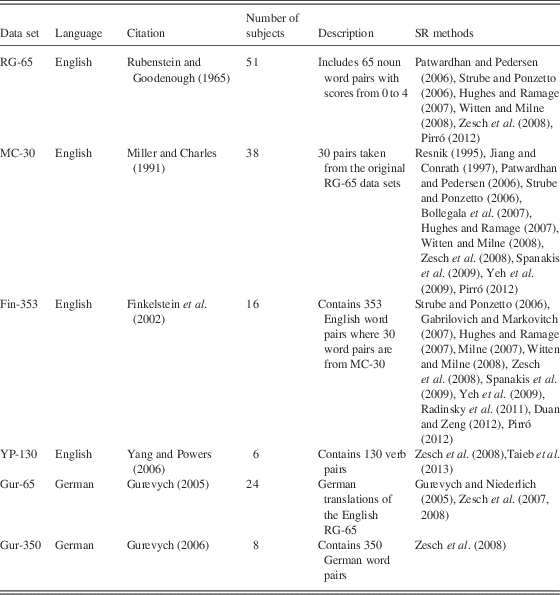
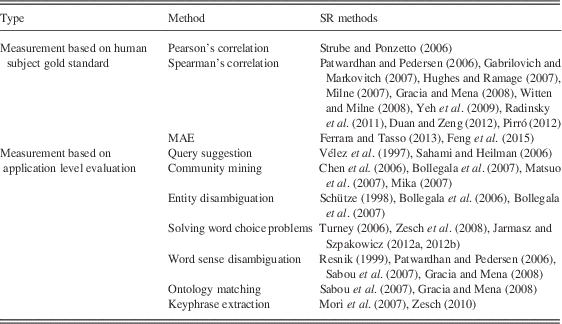
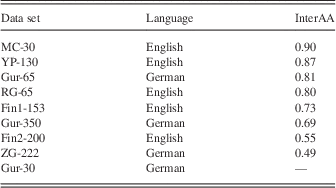
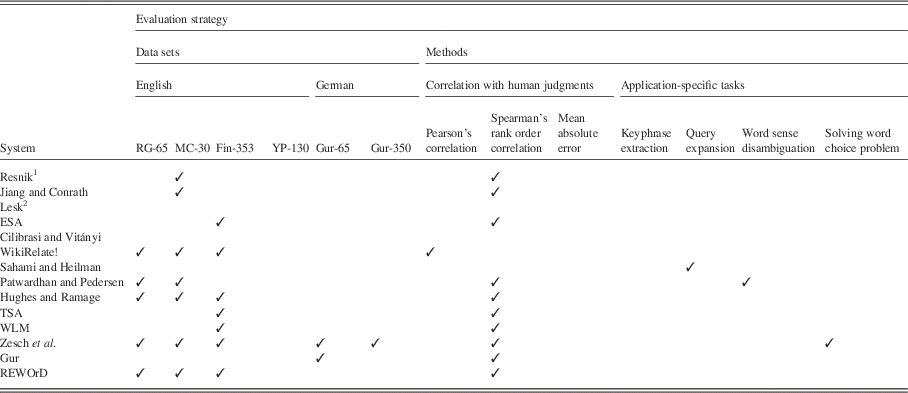
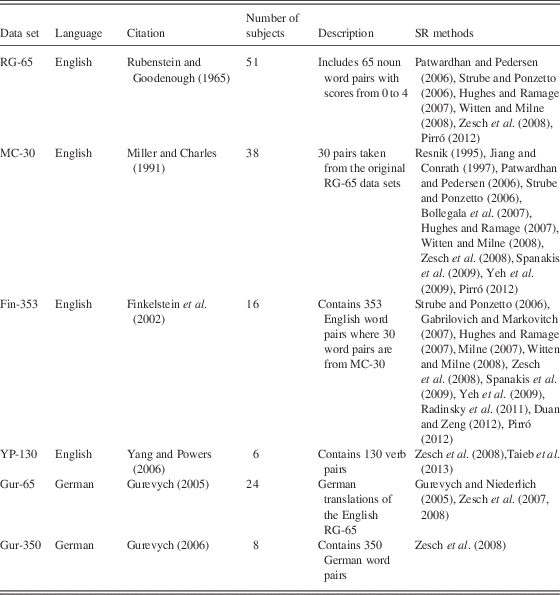
The data sets that have been used in the evaluations are mostly curated for the English and German languages. These data sets are often constructed by collecting subjective opinion of humans with regards to the SR of words. Table 2 provides an overview of some of the common data sets and their brief description. From the perspective of the evaluation methods, these methods can be divided into two main categories, namely determining correlation with human judgments and application-specific evaluations. Table 3 provides a summary of the evaluation methods that have been used in the literature. The taxonomy of the data sets and methods used for evaluating SR methods is shown in Figure 4.
The details of the evaluation strategies
Summary of the data sets reported in the literature
SR=semantic relatedness.
Summary of methods used for evaluation of semantic relatedness (SR) methods
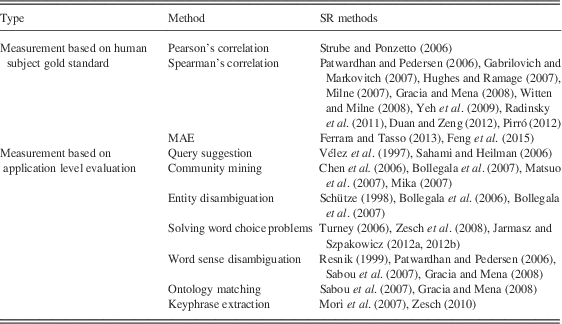
MAE, mean absolute error.
3.3.1 Data sets
The main purpose of developing SR data sets is to curate a set of word pairs with known degrees of SR so they can be used as a gold standard benchmark for evaluating various SR methods. The data sets are most often developed by soliciting human judgments with regards to the SR of a set of word pairs. The data sets that have been used and cited in the literature are primarily in the English and German languages.
As shown in Table 2, the most popular English language data sets are the RG-65, MC-30, Fin-353 and YP-130 data sets:
-
∙ The Rubenstein and Goodenough (Reference Rubenstein and Goodenough1965) data set (RG-65) includes 65 noun pairs. The similarity of each pair is scored on a scale of 0–4 where a higher number indicates higher similarity. In order to collect human judgments, 51 subjects participated in the data collection process and the similarity value of each word pair is equal to the average of the values assigned by the subjects. The RG-65 data set has been used by many researchers as a gold standard to evaluate their SR methods, for example, Strube and Ponzetto (Reference Strube and Ponzetto2006) and Gabrilovich and Markovitch (Reference Gabrilovich and Markovitch2007) selected RG-65 as a gold standard to analyze their work.
-
∙ The Miller and Charles (Reference Miller and Charles1991) data set (MC-30) is a subset of 30 pairs taken from the original RG-65 data set with an additional replicated experiment by another 38 subjects. Given the replicated study and a relatively manageable size of word pairs, the MC-30 data set has been one of popular data sets for comparative analytics in many works such as Witten and Milne (Reference Witten and Milne2008) and Spanakis et al. (Reference Spanakis, Siolas and Stafylopatis2009).
-
∙ The Finkelstein et al. (Reference Finkelstein, Gabrilovich, Matias, Rivlin, Solan, Wolfman and Ruppin2002) data set (Fin-353) contains 353 English word pairs among which 30 word pairs are directly taken from the MC-30 data set. The data set is further divided into two subsets where the scores in first set, Fin-153 (containing 153 word pairs), are obtained from 13 subjects, and in the second set, Fin-200 (containing 200 word pairs), from 16 subjects. Therefore, in some works, the first set has been used for training purposes, and the second set is then used for evaluation. The use of Fin-353 has also been quite popular in the literature including the work by Pirró (Reference Pirró2012) and Agirre et al. (Reference Agirre, Alfonseca, Hall, Kravalova, Paşca and Soroa2009), among others.
-
∙ The Yang and Powers (Reference Yang and Powers2006) data set (YP-130) contains 130 verb pairs particularly made for evaluating the ability of a SR method to determine the relatedness of verbs. Zesch et al. (Reference Zesch, Müller and Gurevych2008) are one of the few researchers that employed the YP-130 data set in order to evaluate the ability of their proposed SR on verb pairs in addition to more typical noun pairs.
Researchers have also developed data sets in German among which Gur-65, Gur-30, Gur-350 and ZG-222 are the most popular:
-
∙ The Gurevych (Reference Gurevych2005) data set (Gur-65) is the German translation of the English RG-65 data set. Gurevych (Reference Gurevych2005) and Zesch et al. (Reference Zesch, Müller and Gurevych2008) have used the Gur-65 data set to evaluate their methods.
-
∙ The Gurevych (Reference Gurevych2005) data set (Gur-30) is a subset of the Gur-65 data set that corresponds to the English MC-30 derived from RG-65.
-
∙ The Gurevych (Reference Gurevych2006) data set (Gur-350) contains 350 word pairs which includes nouns, verbs and adjectives curated by eight human subjects. Although used only in few works, such as Zesch et al. (Reference Zesch, Müller and Gurevych2008), it is a valuable data set that includes a wide variety of word types that cannot be seen in other data sets.
-
∙ The Zesch and Gurevych (Reference Zesch and Gurevych2006) data set (ZG-222) consists of word pairs from specific domains. It contains 222 domain specific word pairs that were evaluated by 21 subjects. This data set also consists of nouns, verbs and adjectives.
3.3.2 Methods
The typical methods for evaluating SR techniques can be broadly classified into two classes: (1) computing the degree of correlation with human judgments, and (2) measuring performance in application-specific tasks.
3.3.3 Correlation with human judgments
One of the main techniques for evaluating SR methods has been to compare their outcomes with a gold standard data set such as those introduced earlier. Researchers have either compared the absolute predicted relatedness value with the relatedness value of the gold standard, or compared the word pair rankings produced by the relatedness method with the rankings in the gold standard. The latter approach has received more reception as it is less sensitive to the actual relatedness score values and allows for a more pragmatic comparison of the relatedness measures in practice. Such an approach hypothesizes that in order to be considered an accurate SR method, the produced rankings from the word pair orderings need to be accurate regardless of the actual numerical value assigned to word pairs. However, in the former evaluation method, the absolute SR values are considered to be important with the justification that the rankings in the gold standard data sets do not necessarily accurately represent the desired word pair ordering. This is supported by the fact that in some cases, the gold standard word orderings are sensitive to very small difference between the word pair similarities and therefore, the correct order is questionable.
In order to evaluate the absolute value of the predicted SR measure, researchers have predominantly used the mean absolute error which measures how closely the predicted value resembles the expected value (Polčicová & Návrat, Reference Polčicová and Návrat2002; Bicici, Reference Bicici2015). For the purpose of measuring rank correlations, Spearman’s rank correlation has been used (Gabrilovich & Markovitch, Reference Gabrilovich and Markovitch2007; Hughes & Ramage, Reference Hughes and Ramage2007). Spearman’s correlation compares if the ranking of the results from a specific SR method correlate with the ranking provided by human judgments in the gold standard. Pearson’s product–moment correlation has also been used by some researchers such as Strube and Ponzetto (Reference Strube and Ponzetto2006)
3.3.4 Application-specific tasks
As an alternative to the direct evaluation of SR methods through a gold standard, application-specific tasks are often used to measure the impact of the proposed SR methods on improving the performance of a particular task. The underlying hypothesis of application-specific evaluations is that the more accurate a SR measure is, the more it improves the performance of the task at hand. Different authors have used various application-specific tasks for evaluating their work. For instance, Sahami and Heilman (Reference Sahami and Heilman2006) evaluated their work in the context of search query suggestion; Bollegala et al. (Reference Bollegala, Matsuo and Ishizuka2007) considered the community mining domain to test their SR method; Zesch et al. (Reference Zesch, Müller and Gurevych2008), Patwardhan and Pedersen (Reference Patwardhan and Pedersen2006) and Gracia and Mena (Reference Gracia and Mena2008) considered entity and word sense disambiguation as their target evaluation application area; Gracia and Mena (Reference Gracia and Mena2008) deployed their method in the context of the ontology matching task.
The advantage of application-specific tasks-based evaluation is that not only it shows whether the SR measure is able to cause any notable improvement but also shows how well the SR measure is suitable for domain specific tasks. For instance, one could show, through experimentation, that although a given SR method does not perform well under all conditions, it is effective for a specific task or application area. Table 3 shows how different work in the literature have implemented and reported their evaluation strategy and results.
4 Comparison of the different methods in framework
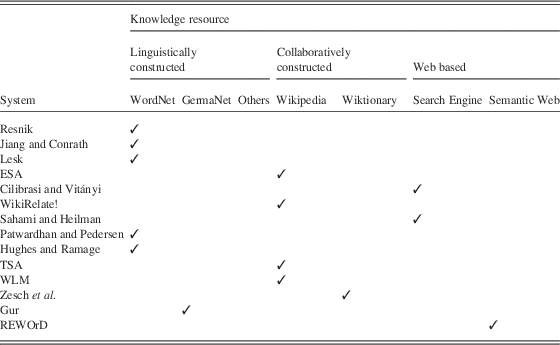
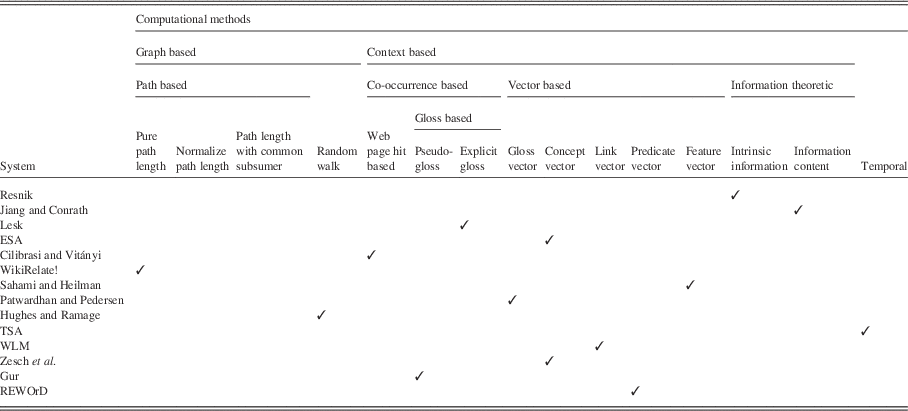
In this section, we map the selected methods into the proposed framework. To this end, we have created three mapping tables based on the three top-level dimensions in the framework: Knowledge Resources (Table 4), Methods (Table 5) and Evaluation Strategies (Table 7). In these tables, the columns show the dimensions and sub-dimensions of our framework and the rows are the methods studied here, and each cell presents the value of the dimension for the selected method.
Summary of used knowledge resource
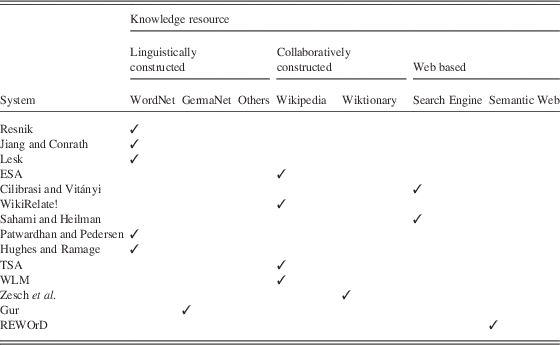
ESA=Explicit Semantic Analysis; TSA=Temporal Semantic Analysis.
Summary of the discussed methods
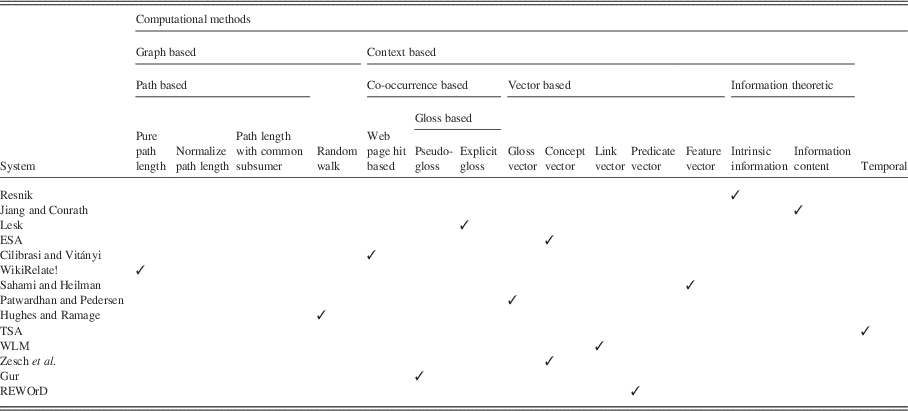
ESA=Explicit Semantic Analysis; TSA=Temporal Semantic Analysis.
In order to help researchers or system builders develop their SR methods by selecting different features according to their requirements, we summarize the differences, advantages and weaknesses of each dimension in the framework.
4.1 Selection of knowledge resources
The knowledge resource selected as the underlying foundation for computing SR defines primarily how the relationship between the words is viewed. Linguistically constructed knowledge resources accurately model the relations between words and provide reliable definitions of words given they are most often constructed by expert linguists. However, accurate construction of such knowledge resources is expensive and time consuming and as new words are continuously being added to the language, it is becoming increasingly hard to maintain such resources. Still, majority of the SR methods covered in this paper, use linguistically constructed knowledge resources due to their accuracy and reliability.
Collaboratively constructed knowledge resources, such as Wikipedia, are created through crowdsourcing. In Wikipedia, articles provide tremendous amount of information about contexts where certain words appear, the co-occurrence patterns, link structure of content relationships, word sense variants, and even word and concept categories, which have all been gathered through crowdsourcing. The collaborative nature of such knowledge resources enables efficient and continuous update of information; therefore, new additions to the language are more likely to be covered. According to a report from Zesch and Gurevych (Reference Zesch and Gurevych2010), the growth of Wikipedia has a positive effect on coverage without affecting the suitability and accuracy of results. Another unique characteristic of collaboratively constructed knowledge resources is that the involvement of many authors leads to the incorporation of many different distinct styles of writing and word selection, which while may not be ideal for the coherency of the text itself, is an ideal source of information about people’s tendency toward word usage and word relatedness.
While both linguistically and collaboratively developed knowledge resources provide descriptive information about words, other sources of textual content such as those provided through the Web in general, for example, Weblogs, news outlets and social networks, can be used as an informal source of word semantics. Our recent work showed that the semantics of words might shift depending on the context where they are used or where they appear (Feng et al., Reference Feng, Fani, Bagheri and Jovanovic2015). For instance, there seems to be an observable difference in the most common senses of words when used on Twitter compared to when the words are used on Wikipedia. For this reason, Web content, retrievable through Web search engines, can provide a valuable source of information about word semantics based on their occurrence contexts. However, while this type of resource provides a very high coverage, the accuracy of the information is dependent on the quality of the search engine and the degree of ambiguity of the terms that being queried. Table 4 summarizes the use of various knowledge resource types by the selected methods.
4.2 Selection of computation method
The selection of the most suitable method for computing SR depends on many different factors such as the type of knowledge resource that is adopted, the amount of computing and storage resources available for the computation, and the desired accuracy of the approach, just to name a few. For instance, one would only be able to adopt a path-based method if the underlying knowledge resource can be modeled through a graph representation. Furthermore, depending on the type of the path-based method, the explicit type of edges in the graph need to also be well defined, for example, in the case of those methods that rely on the common subsumer of two nodes, the type of edges connecting two nodes is the subsumption relation.
Unlike path-based methods, random walk-based methods do not require explicit semantics of the relations to be defined in a knowledge resources; they only need the edges to be of the same type and have a quantifiable weight, which could for instance be the co-occurrence number of two words. Therefore, compared to path-based methods, methods that adopt a random walk approach have fewer requirements on the underlying knowledge resource and can be used in conjunction with a wider range of knowledge resources.
Context-based methods can be applied on any knowledge resource that includes minimal description of words; therefore, they are much more flexible and can be used with various types of knowledge resources. For instance, co-occurrence-based methods calculate word overlaps in textual information, which can be easily extracted from any source. However, the limitation of such approaches is that information about the various senses of a word is not directly considered and therefore there is a possibility that the usage pattern of ambiguous terms can negatively impact the accuracy of the SR scores. One of the pitfalls of the context-based approaches is the role of semantically insignificant words that appear in many different contexts. Such words co-occur with many words and therefore in many cases increase the probability of SR between two words that are otherwise not related.
Similar to context-based approaches, vector-based methods do not have specific requirements from the underlying knowledge resource. In such approaches, each word is represented as a vector of features. The most common vector representation is the bag of words model derived from different knowledge resources. When designing vector-based models two important considerations need to be taken into account: (i) the bag of words representation for words is extremely sparse and often overlooks word interdependencies. More recent approaches for the vector representation in NLP such as Word2Vec (Mikolov et al., Reference Mikolov, Sutskever, Chen, Corrado and Dean2013a, Reference Mikolov, Yih and Zweig2013b) and deep semantic embedding (Wu et al., Reference Wu, Min and Bai2014) can be used to improve this. (ii) the model is highly sensitive to the weights of words in the vector (Turney & Pantel, Reference Turney and Pantel2010); therefore, the decision as to which weighting scheme to be used in the vector would have a high impact on the results. The weighting schemes that require global corpus information would need more computation and update as the corpus evolves. Therefore, while quite straightforward to implement, vector-based models are quite sensitive to features used in the vector representation and the weights applied to the features.
Information theoretic methods are one of the most restricted models as they are highly coupled with the underlying knowledge resources, which need to have a structured form. The structure of the knowledge resources is used to determine the degree of information that a pair of words share. Therefore, only knowledge resources such as WordNet can be used in information theoretic methods, thereby, restricting the applicability of such approaches in practice.
4.3 Selection of evaluation technique
In terms of evaluating the developed SR measures, our review shows that most authors have adopted a gold standard-based approach and compared their results with the gold standard according to the derived ranking of the word pairs using Spearman’s rank correlation. As shown in Table 6, there are different gold standard data sets. One of the important factors in deciding which gold standard data set to adopt is the inter-rater agreement of the participants from whom the similarity values were collected. Table 6 reports the inter-rater agreement of the participants for the gold standard data sets where available. As argued by Graham et al. (Reference Graham, Milanowski and Miller2012), an inter-rater agreement of over 75% would be considered reliable; therefore, gold standard data sets with such agreement or higher can be effectively used in experiments.
Inter-rater agreement values of each data sets
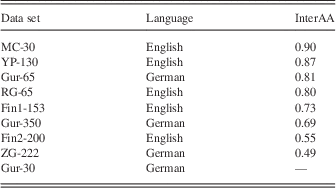
InterAA=Inter-rater agreement.
One of the reasons that application-specific tasks have not been widely used in the literature is that the accuracy of the SR method is not directly observable and is only evaluated indirectly through the performance of the higher level task. Therefore, it is possible that a good performing SR method is affected by the parameters inside the application framework. In order to properly use application-specific tasks for evaluation of SR measure, a controlled experiment needs to be organized where all parameters of the application-specific task are kept constant and the SR method would be the only variable parameter. The performance of the task would then be measured and directly compared before and after the SR method is applied to the task to measure its impact.
In summary and according to Table 7, for the purpose of evaluation, most authors have chosen to work with RC-65, MC-30 and Fin-353 data sets as their gold standards, in combination with Spearman’s rank correlation method.
Summary of the use of evaluation strategies
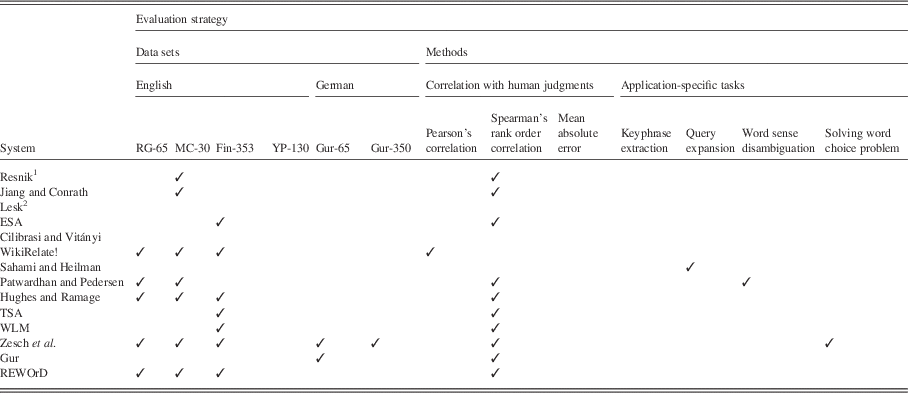
ESA=Explicit Semantic Analysis; TSA=Temporal Semantic Analysis.
1 Authors did not specify which correlation method was used.
2 The paper did not include an evaluation strategy.
5 Meta-analysis
From the comparative analysis of the different SR methods that have been reviewed in the previous sections, two distinct approaches for calculating semantic similarity emerge: (1) approaches based on latent relation hypothesis, and (2) approaches based on content structure.
In the approaches that adopt the latent relation hypothesis, the main premise is that relatedness is derived from and measured based on the words’ context. For this reason, knowledge resources are primarily employed to build context for every given word. In these approaches regardless of the content of the knowledge resource, the primary objective is to identify a representative context for a word such that similarity and relatedness between words could be determined based on the similarity of their contexts. Context is predominantly defined as the words or terms that surround the word of interest or that are used to define it. Therefore, many different types of textual corpora such as Wikipedia articles, Web pages, search snippets, WordNet glosses, among others have been used to build context for words. The hypothesis is that if two words or terms are observed frequently enough together, then they are most likely related to each other from a semantic perspective, as well. The advantage of such an approach is that it is able to determine SR of words, terms or phrases that do not have explicit semantics or presence in formal dictionaries, for example, brb, icymi, among others. It has been shown by Feng et al. (Reference Feng, Fani, Bagheri and Jovanovic2015) that the latent relation hypothesis is a suitable model for handling the SR of terms in contexts where unfamiliar terms are abundant such as Twitter.
While the approaches that focus on building context for words based on textual corpora have the flexibility to handle a wide range of words and terms, they can be sensitive to the role and impact of noise. The authors of ESA (Gabrilovich & Markovitch, Reference Gabrilovich and Markovitch2007) have pointed out that they have crawled information from the Open Directory Project and used it for training purposes, which could have led to ‘non-negligible amount of noise’. In general and when considering methods that employ knowledge resources that are derived from open information sources, the impact of noise needs to be measured and controlled. This is an issue that the research community is yet to explore. Within the context of topic and event detection from social network content, some authors have already proposed information theoretic and time series-based methods for identifying noise from textual corporal (Weng & Lee, Reference Weng and Lee2011). Such models can be applied to the knowledge resources used in the context of SR to avoid the impact of noise on the measurements.
Another important consideration when dealing with large corpora to build context is the domain specificity of the content and its impact on the dominant senses of the words. For instance, depending on the domain to which the corpora belongs, the set of words that co-occur with ambiguous terms such as apple, and java would be different. For these two examples, if the domain of the corpora being used is technology, then the inclination of the terms that co-occur with these two words would lean toward the Computer Science sense of the words. However, if the corpora being used is on food, then the other sense will dominate. The SR derived based on one corpus would therefore not be transferrable to the other. For this reason, it is imperative to systematically understand the role of the underlying corpora and their domain on the SR measure that is built. To the extent of our knowledge, there is yet to be work on the transferability of SR method across corpora. For instance, would the SR models learnt from Wikipedia content be applicable for similarity measurement on online News content from CNN Politics?
It is also important to point out the role of temporality when context is being constructed for words. Most of the work (except a few such as Radinsky et al., Reference Radinsky, Agichtein, Gabrilovich and Markovitch2011) in the literature assume that the knowledge resource that is being used as the basis for SR measurement is stable and constant. Therefore, the context that is constructed on this basis does not consider the possibility of the evolution of the word contexts over time. For instance, corpora gathered prior to 1976 will not have any reference to an entity called Apple Inc. However, such references will show up after this date. Therefore, the context of the word apple changes significantly over time and needs to be taken into consideration. The same applies to many words that have either been created after a certain date or their meaning or interpretation has changed or continues to change in reaction to real-world events. Even more so now than before, with the real-time nature of the content on the Web, the speed at which words contexts evolve is much faster; therefore, there is need for not only methods that consider temporal contexts but also methods that are able to automatically determine the length of the time windows between which the semantics of the words shift through time. The time window determination would be important as the time window for each word might be different depending on how their semantics change over time. Some words would essentially carry the same semantics over a long period of time while others might have much faster semantic shifts.
In the second category of work, knowledge resources are used to extract structure that can be used for determining SR. For instance, links between Web pages, Wikipedia category hierarchy and WordNet hypernym links have been used to build graphs from the knowledge resources to be used for measuring SR. Most existing online content forms provide some method of direct or indirect linking mechanism between content items; therefore, the extraction of structure from such corpora is possible. The added benefit of adopting structure extraction approaches from knowledge resources is that it opens up the possibility of applying a wealth of techniques that can analyze structured content, for example, tree traversal and path finding techniques, graph analysis techniques and network mining, just to name a few. As was discussed in the paper, various authors have used a variety of different knowledge resources for building the structure that they need for computing a semantic similarity measure. Hence, the SR value will be dependent on the knowledge resource that is used to extract the structure. For instance, the SR methods of WikiRelate! That use the Wikipedia category tree structure would only be suitable for measuring the SR between two words that are observed in Wikipedia and not beyond that. To address this limitation, one of the areas that warrants further exploration is the integration of various structures that can be obtained from different knowledge resources. For instance, it would be interesting to investigate whether it is possible to integrate structures extracted from WordNet, for example, hypernym relation graph, with the graph extracted from Wikipedia category hierarchy so that a more comprehensive representation is built. Such an integration would allow the SR methods to not only have a higher coverage but also be more accurate as information from multiple facets are integrated.
In addition, and along similar lines, there may be cases where structure information or context-based information alone would not be sufficient for accurately modeling SR of words. There have been very few reported works that have explored the possibility of systematically integrating structural and context-based information. For instance, within the domain of user interest modeling on microblogging platforms such as Twitter, researchers have already explored the possibility of integrating structural information and context-based information, for example, users’ social network structure combined with their posted content, for identifying user interests, which have shown to be quite effective (Zarrinkalam et al., Reference Zarrinkalam, Fani, Bagheri and Kahani2016). Similar work on the systematic integration of context and structure could lead to more robust SR measurement techniques.
A final observation that can be made from reviewing the literature is the role of the communication medium on determining the SR of words. As reported in Feng et al. (Reference Feng, Fani, Bagheri and Jovanovic2015), the semantics of words can substantially shift depending on the communication medium where they are used. For instance, the words movie and popcorn were determined to be highly related to each other on Twitter but rated very low within the WS-353 gold standard. Therefore, it seems that SR is not only context dependent but may also be dependent on the medium where the communication takes place. An important area where further exploration can happen is to understand how medium impacts the semantics of words and whether it would be possible to align the semantic spaces of words across different communication medium.
6 Concluding remarks
In this paper, we report on a comprehensive study of SR methods, which considers different knowledge resources, methods and evaluations. First, we selected a representative set of SR approaches reported in the literature. Then, we created a framework to classify these approaches according to the following three dimension: knowledge resource(s) used, the computational method applied for computing relatedness and the adopted evaluation method. By mapping the selected systems into the framework, we systematically analyzed the advantages and disadvantages of each identified knowledge resources, relatedness computational method, as well as evaluation methods. Therefore, researchers who would want to further improve or deploy certain SR systems or methods can highly benefit from the insight provided by this study. In addition, we have provided a critical discussion on the limitations of existing methods and offer suggestions on potential valuable research directions that can be taken in future research in this domain.
Acknowledgments
The first two authors acknowledge funding from the Natural Sciences and Engineering Research Council of Canada.