Following the advances in peri-operative care and life-saving technologies over the last few decades, children with heart disease are now surviving to adolescence and adulthood.Reference Khairy, Ionescu-Ittu, Mackie, Abrahamowicz, Pilote and Marelli 1 Extensive research has documented neurodevelopmental and psychosocial challenges among children and adolescents with CHD, prompting a scientific statement from the American Heart Association recommending periodic developmental surveillance, screening, evaluation, and re-evaluation.Reference Marino, Lipkin and Newburger 2 Recent studies suggest that children with arrhythmias, particularly those requiring cardiac rhythm devices, may also be at heightened risk for anxiety and other psychosocial problems.Reference Czosek, Bonney and Cassedy 3 , Reference Sears, Amant and Zeigler 4 Neurodevelopmental and psychosocial challenges can have a strong negative impact on social relationships, educational attainment, and quality of life.Reference Marino, Lipkin and Newburger 2 , Reference Czosek, Bonney and Cassedy 3
Psychologists are becoming increasingly integrated into paediatric cardiology clinics to optimise the psychosocial functioning of children with heart disease and their families.Reference Brosig, Butcher and Butler 5 , Reference Brosig, Yang, Hoffmann, Dasgupta and Mussatto 6 Psychology consultation and intervention in this setting typically relies on direct referral from a medical provider,Reference Brosig, Yang, Hoffmann, Dasgupta and Mussatto 6 which may be subject to variability in the degree to which providers enquire about developmental and psychosocial problems and the extent to which families feel comfortable discussing these concerns with their provider. A systematic psychosocial screening process within a paediatric cardiology clinic could result in increased identification of concerns and more efficient use of limited psychology resources.Reference Brosig, Yang, Hoffmann, Dasgupta and Mussatto 6 Although psychosocial screening has been implemented and evaluated in primary-care settings,Reference Borowsky, Mozayeny and Ireland 7 , Reference Gardner, Lucas, Kolko and Campo 8 few studies have examined the clinical utility of a brief psychosocial screening questionnaire administered as part of routine care in a paediatric medical specialty settingReference Guilfoyle, Wagner, Smith and Modi 9 , Reference Maddux, Bass, Geraghty-Sirridge, Carpenter and Christenson 10 such as cardiology. This study aimed to fill this gap in the literature by examining the clinical utility of the Pediatric Symptom Checklist 17 for identifying psychosocial concerns and improving access to behavioural healthcare services within a paediatric cardiology clinic.
Materials and methods
Participants and procedures
Participants were the parents of 561 children between the ages of 4 and 17 presenting for follow-up of their CHD, acquired heart disease, and/or arrhythmia over a 12-month period at an outpatient cardiology clinic within a paediatric hospital. Parents were asked by the clinic medical assistants to complete a psychosocial screening questionnaire as part of their child’s routine care before their meeting with the cardiologist. This screening process was implemented after the addition of a dedicated psychologist to the cardiac centre. Completed questionnaires were reviewed by the psychologist, who contacted families by phone if they reported interest in discussing their questions or concerns with the cardiac behavioural healthcare specialist or if the cardiologist or nurse specifically requested that the family be contacted. The psychologist made one to two phone call attempts and left messages for those families who could not be reached. A psychology consultation was scheduled following the phone conversation when appropriate.
Questionnaires completed within the first 12 months following implementation of the screening process (February 2011 to January 2012) were included in analyses. In cases where multiple questionnaires were completed for the same child over subsequent visits, the first questionnaire administration was included in the analyses and subsequent administrations were excluded. Although questionnaires were provided to parents of children presenting to outpatient cardiology for a variety of concerns, including risk factors for cardiac issues with no current heart disease, analyses were limited to those 561 patients with diagnosed CHD, acquired heart disease, and/or arrhythmia. Child sociodemographic information such as age, gender, race/ethnicity, and private versus public health insurance was obtained from the electronic medical record. Information about the parent who completed the questionnaire was not available. This study was reviewed and approved by the Nemours Institutional Review Board with waiver of the requirement for documentation of informed consent.
Measures
The original Pediatric Symptom Checklist is a 35-item, parent-report questionnaire intended for use in healthcare settings to improve the recognition and treatment of psychosocial problems in children and adolescents.Reference Jellinek, Murphy, Robinson, Feins, Lamb and Fenton 11 The Pediatric Symptom Checklist has been suggested for use in paediatric cardiology based on research support in other patient populations.Reference Marino, Lipkin and Newburger 2 An abbreviated, 17-item version of the Pediatric Symptom Checklist consisting of three subscales – internalising, externalising, and attention – in addition to a total score has been developed as a brief screening toolReference Gardner, Lucas, Kolko and Campo 8 and was utilised in the present study. Items are rated as “Never (0)”, “Sometimes (1)”, or “Often (2)” and are summed for the calculation of subscale and total scores. The internalising subscale screens for symptoms of anxiety and depression – for example, feels sad or unhappy, feels hopeless, worries a lot, etc – with a score of 5 or higher indicating significant concern. The attention subscale screens for difficulties with attention and concentration – for example, fidgety and unable to sit still, has trouble concentrating, distracted easily, etc – with a score of 7 or higher indicating significant concern. The externalising subscale screens for difficulties with conduct – for example, refuses to share, fights with other children, does not listen to rules, etc – with a score of 7 or higher indicating significant concern. A total score of 15 or higher indicates significant overall concern regarding psychosocial functioning. In a normative paediatric primary-care sample (n=2028), 12% of the children scored above the clinical cut-off for internalising problems, 7% for attention problems, 10% for externalising problems, and 11% for total psychosocial problems.Reference Borowsky, Mozayeny and Ireland 7 Overall, 22% of the children in the normative sample scored above the clinical cut-off for one or more Pediatric Symptom Checklist 17 scales.
Both the original Pediatric Symptom Checklist and the 17-item version have been widely used for research and clinical purposes and have demonstrated sound psychometric properties. In a study involving 18,045 Pediatric Symptom Checklist 17 administrations within a primary-care setting, this questionnaire demonstrated good overall internal consistency (α=0.89) and the subscales demonstrated acceptable-to-good internal consistency (α=0.79–0.83).Reference Gardner, Lucas, Kolko and Campo 8 The Pediatric Symptom Checklist 17 was also found to have good sensitivity and specificity when subscales were compared with similar, well-validated measures including the Screen for Childhood Anxiety-Related Disorders (internalising) and the Iowa Connors (attention and externalising).Reference Gardner, Murphy and Childs 12 The Pediatric Symptom Checklist 17 is available in English and Spanish, both of which were utilised for the present study.
Moreover, two additional questions were added to the end of the Pediatric Symptom Checklist 17 to assess for known neurodevelopmental and adjustment difficulties in this patient population, as these domains were not fully captured by the existing questionnaire: (1) “Do you have any concerns about your child’s learning or development (language, motor, social skills)?” and (2) “Do you have any questions about how your child’s cardiac diagnosis could impact adjustment, school performance, or family functioning?”. A third question was added to assess parent interest in speaking with the psychologist or “behavioural health specialist”: (3) “Would you like to discuss your questions or any concerns noted above with our cardiac behavioural health specialist?”. Parents were informed that the behavioural healthcare specialist would contact them by phone if they indicated “yes” to this question.
Statistical analyses
Data were analysed using Statistical Package for the Social Sciences software, version 22.0. Subscale and total scores were calculated for each participant. For each Pediatric Symptom Checklist 17 scale, children were classified as scoring above or below cut-offs indicative of risk for clinically elevated symptoms.Reference Gardner, Murphy and Childs 12 Proportions of children scoring above each cut-off were compared with corresponding proportions from a normative paediatric primary-care sample using a z-score statistic.Reference Borowsky, Mozayeny and Ireland 7
The sample was split by (1) single ventricle versus two-ventricle physiology, cardiac physiology and by (2) history of cardiac surgery versus no cardiac surgery, surgical history. Pearson’s correlations and independent samples t-tests were conducted to evaluate the relationships between the Pediatric Symptom Checklist 17 scores and cardiac physiology, surgical history, and sociodemographic characteristics. Chi-square tests of independence were performed to evaluate the relationships of parental endorsement of concerns related to learning or adjustment to cardiac physiology, surgical history, and sociodemographic characteristics.
Results
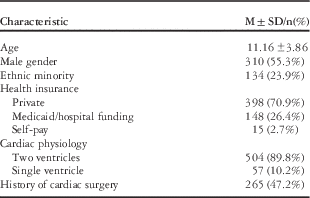
The Pediatric Symptom Checklist 17 was completed by parents of 561 children with CHD, acquired heart disease, and/or arrhythmia with no apparent difficulty or barriers. The screening process required minimal time and effort on the part of the clinic staff and families. Child sociodemographic and clinical characteristics are displayed in Table 1.
Child sociodemographic and clinical characteristics.

Pediatric Symptom Checklist 17
A total of 112 children (20%) scored above the clinical cut-off for one or more Pediatric Symptom Checklist 17 scales. Percentages of children scoring above externalising (10.5%), attention (8.7%), and overall psychosocial concern (9.3%) cut-offs did not differ significantly from a normative primary-care sample (p’s>0.05).Reference Borowsky, Mozayeny and Ireland 7 The percentage of children scoring above the internalising cut-off (7.8%) was significantly lower than that reported for the normative sample (12%; z=2.96, p<0.01).Reference Borowsky, Mozayeny and Ireland 7
There were no significant differences in the Pediatric Symptom Checklist 17 scores based on cardiac physiology (p’s>0.2) or surgical history (p’s>0.05). Increasing child age was positively associated with internaliszing symptoms (r=0.18, p<0.001) and negatively associated with externalising symptoms (r=−0.16, p<0.001), whereas attention symptoms and total psychosocial problems were not related to age. Compared with females, male children scored higher on attention symptoms (2.9±2.6 versus 2.1±2.4, t(559)=3.44, p=0.001), externalising symptoms (2.6±2.9 versus 2.0±2.5, t(556)=2.77, p=0.006), and total psychosocial problems (7.2±5.9 versus 5.9±5.2, t(559)=2.79, p=0.005). Compared with those with private insurance, children with public insurance scored higher on attention symptoms (3.2±2.6 versus 2.3±2.4, t(544)=3.9, p<0.001), externalising symptoms (3.2±3.2 versus 2.0±2.4, t(213)=4.2, p<0.001), and total psychosocial problems (8.4±6.1 versus 5.9±5.3, t(234)=4.2, p<0.001). Pediatric Symptom Checklist 17 scores did not differ between children of ethnic minority background and non-ethnic minority background.
Concerns about learning/development and adjustment to cardiac diagnosis
Among all, 17% of the parents endorsed concerns about their child’s learning and development and 20% endorsed questions about how the child’s cardiac diagnosis could impact adjustment, school performance, or family functioning. There were no differences in rates of concern based on cardiac physiology (p’s>0.1); however, parents of children with a history of cardiac surgery were more likely to have concerns about their child’s learning and development compared with those whose children did not have cardiac surgery, 22 versus 13%, χ2 (1, n=557)=7.73, p=0.005.
As compared with parents of children with private insurance, parents of children with public insurance were more likely to endorse concerns about learning and development, 27 versus 13%, χ2 (1, n=542)=13.70, p<0.001, and to have questions about how the child’s cardiac diagnosis could impact adjustment, school performance, or family functioning, 32 versus 16%, χ2 (1, n=537)=17.15, p<0.001. Parents of ethnic minority children were also more likely than parents of Caucasian children to endorse concerns about learning and development, 23 versus 15%, χ2 (1, n=551)=5.17, p=0.02, and questions about how the child’s cardiac diagnosis could impact adjustment, school performance, or family functioning, 30 versus 17%, χ2 (1, n=545)=10.38, p=0.001. Parents of younger children (ages 4–11) were more likely than parents of older children (ages 12–18) to express concerns about their child’s development and learning, 21 versus 12%, χ2 (1, n=557)=7.15, p=0.007.
Interest in behavioural healthcare services
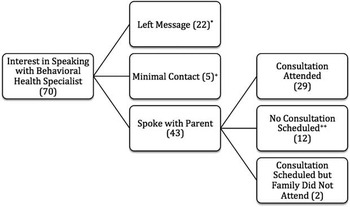
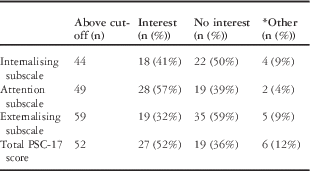
Of 112 parents reporting clinically elevated concerns on one or more of the Pediatric Symptom Checklist 17 scales, only 41 (37%) indicated interest in speaking to a behavioural healthcare specialist. Table 2 displays the rates of interest by elevation on each Pediatric Symptom Checklist 17 scale. In addition, 29 parents who did not report elevated concerns on any of the Pediatric Symptom Checklist 17 scales indicated interest in speaking with the behavioural healthcare specialist, and were, therefore, also contacted by phone. Only 29 families ultimately attended a psychology consultation as a result of the psychosocial screening process. See Figure 1 for additional details.
Utilisation of behavioural healthcare services. *Left message and parent did not return phone call. +The psychologist was able to reach the parent once and the parent indicated interest but could not complete the phone consultation at that time and did not call back. ++Reasons for not scheduling a consultation included the family requesting a provider closer home, the child was already receiving a higher level of behavioural healthcare than what could be provided in the outpatient cardiology setting, concerns that were not psychosocial or neurodevelopmental in nature, or no significant concerns reported.

Interest in speaking with a behavioural healthcare specialist among parents reporting elevated psychosocial concerns.

* Parent did not answer or indicated that the child was already being treated by a behavioural healthcare specialist
Discussion
Given extensive research documenting neurodevelopmental and psychosocial challenges among children with CHDReference Marino, Lipkin and Newburger 2 and preliminary studies indicating poorer psychosocial functioning and quality of life among children with arrhythmias and cardiac rhythm devices,Reference Czosek, Bonney and Cassedy 3 , Reference Sears, Amant and Zeigler 4 psychologists are becoming increasingly integrated into paediatric cardiology clinics. The question of how best to identify children and families who could benefit from psychology support is crucial, given limited psychology resources.Reference Marino, Lipkin and Newburger 2 , Reference Hearps, McCarthy and Muscara 13 , Reference Pulgaron, Wile, Schneider, Young and Delamater 14 Systematic psychosocial screening processes have been implemented in primary-care settings;Reference Borowsky, Mozayeny and Ireland 7 , Reference Gardner, Lucas, Kolko and Campo 8 however, few studies have examined the use of a psychosocial screening questionnaire administered as part of routine care in a paediatric medical specialty settingReference Guilfoyle, Wagner, Smith and Modi 9 , Reference Maddux, Bass, Geraghty-Sirridge, Carpenter and Christenson 10 such as cardiology.
This study provides preliminary evidence for the feasibility of a systematic psychosocial screening process in a paediatric cardiology clinic. The screening questionnaire was completed by the parents of 561 children before meeting with the cardiologist and required minimal time and effort on the part of clinic staff and families; however, results indicate limited clinical utility of the selected screening tool. Rates of clinically elevated scores on the Paediatric Symptom Checklist 17 did not exceed that observed in the general population, and parents of children with single-ventricle cardiac physiology and those with a history of heart surgery did not endorse higher rates of concern compared with parents of children with much less complex medical histories – that is, mild CHD with no intervention. These results indicate that the Pediatric Symptom Checklist 17 may not be sensitive to the specific difficulties experienced by this patient population. Indeed, studies on children with CHD suggest a characteristic pattern of combined impairments in attention, executive function, behaviour, social cognition, language skills, and motor skills that are high in prevalence but low in severityReference Wernovsky 15 and may be missed by screening tools designed for the general population. Interestingly, two additional questions added to the screening questionnaire to assess concerns regarding development and emotional adjustment to the cardiac diagnosis were endorsed at a rate that was approximately double that of any of the Pediatric Symptom Checklist 17 clinical scales and were more often endorsed by parents of children who had undergone a heart surgery compared with those who did not. It may be that a psychosocial screening questionnaire specifically designed or modified for this patient population that includes a greater focus on characteristic developmental challenges – that is, impairments in executive function, behavioural dysregulation, and poor social cognition – and emotional adjustment to the cardiac diagnosis would yield improved clinical utility.
It is of concern that parents of children with public insurance endorsed more psychosocial problems than parents of children with private insurance. Furthermore, parents of children with public insurance as well as those of ethnic minority backgrounds were more likely to express concerns about learning and development and questions about adjustment to the cardiac diagnosis. Numerous studies have documented disparities in child and family psychosocial functioning based on sociodemographic characteristics, both in the general paediatric population as well as among patients with heart disease.Reference Cassedy, Drotar and Ittenbach 16 , Reference Lawoko and Soares 17 The results of this study are consistent with studies indicating that sociodemographic characteristics may predict psychosocial outcomes to a greater extent than medical or surgical variables.Reference Lawoko and Soares 17 , Reference Logan, Woodford, Struemph, Chopko and Sood 18 Psychosocial screening questionnaires developed or modified for this patient population would likely benefit from inclusion of sociodemographic information known to place a child and family at heightened risk for psychosocial problems.Reference Hearps, McCarthy and Muscara 13
The low percentage of parents indicating interest in speaking by phone with a behavioural healthcare specialist immediately after endorsing clinically elevated concerns, or who returned the psychologist’s phone call after indicating interest in a phone discussion, is also of concern. Although reasons for declining psychology follow-up or not returning the phone call were not directly assessed, research has identified perceptions of mental health problems – for example, thinking that problems are not serious, deciding to handle the problems on their own, etc – and mental healthcare services – for example, stigma, thinking that the treatment would not help, believing that the child would not want to attend, etc – as frequent barriers to mental healthcare.Reference Owens, Hoagwood and Horwitz 19 These barriers may be particularly prominent when psychosocial problems are identified through widespread screening processes, as most families were likely not actively seeking help for psychosocial problems before completing the screening questionnaire. Structural barriers are also common, including perceived cost, convenience, and wait time for mental healthcare services.Reference Owens, Hoagwood and Horwitz 19 When the psychologist was able to reach the family by phone, the family scheduled and attended a psychology consultation in two-thirds of the cases, suggesting that personal contact with the psychologist may increase a family’s comfort with and understanding of psychology consultation and intervention services within a medical setting, thereby reducing barriers to care. Although it is not possible for a psychologist to meet all the families served by a paediatric cardiology clinic, there may be benefit to psychology integration in specific clinics that serve high-risk patient populations, such as those with single-ventricle CHD or cardiac rhythm devices.Reference Brosig, Yang, Hoffmann, Dasgupta and Mussatto 6 The model of psychology integration within cardiac neurodevelopmental follow-up programmes may be particularly effective, as families often meet the psychologist while the child is an infant, sometimes even before hospital discharge, and continue to follow-up with a psychologist within the context of the programme throughout childhood and adolescence.Reference Brosig, Butcher and Butler 5 These early and frequent contacts with one or more psychologists could result in a better understanding of the role of psychology within a medical setting and reduced stigma associated with seeking help for paediatric behavioural health concerns.Reference Anderson, Loughlin, Goldberg and Laffel 20 , Reference Guilfoyle, Follansbee-Junger and Modi 21 The extent to which cardiologists or other medical providers discuss psychosocial concerns and the role of psychology during the clinic visit may also impact the family’s comfort with and understanding of psychology consultation and intervention services. These and other strategies for reducing barriers to behavioural healthcare for paediatric cardiology patients should be examined through future studies.
The limited nature of our data is a limitation of this study. As the psychosocial screening process was implemented as part of routine clinical care, characteristics of the parent completing the questionnaire and reasons for declining phone contact with the psychologist were not assessed. Future studies examining psychosocial screening processes could directly assess the barriers to behavioural healthcare, including perceived stigma, as well as characteristics of the parent or family that may be associated with increased barriers. Parents’ perceptions regarding the acceptability of the screening process were also not directly assessed, although few parents refused to complete the questionnaire, left items blank, or provided negative feedback about the process, indicating preliminary acceptability and feasibility. Parents who indicated psychosocial concerns in the clinically elevated range but declined speaking to a behavioural healthcare specialist were not contacted by phone. It is possible that a different process – for example, contacting all parents who reported clinically elevated concerns without first asking if they would like to be contacted – would have resulted in different outcomes. Although the intention was for all parents of children between the ages of 4 and 17 presenting for a follow-up appointment to be screened with the Pediatric Symptom Checklist 17, it is possible that a small percentage of families were not provided with the questionnaire due to busy clinic flow. Families were sociodemographically diverse and representative of the clinic catchment area, and any questionnaires not administered did not likely impact the generalisability of results.
In conclusion, although this study demonstrated that a psychosocial screening process can be implemented in an outpatient cardiology setting with minimal time and effort required from clinic staff and families, future research is needed to identify a screening questionnaire that is sufficiently sensitive to the unique developmental and psychosocial challenges experienced by this patient population. Future research is also needed to determine how to address barriers to behavioural healthcare among children with psychosocial difficulties and their families within a paediatric cardiology setting.
Acknowledgements
The authors thank Jeanne Mulhern, RN, Linda Morris, RN, Pamela Lafferty, Shaneea Brown, and Crystal Moody for their assistance in implementing the psychosocial screening process described in this paper.
Financial Support
Dr Sood’s work on this project was supported by an Institutional Development Award from the National Institute of General Medical Sciences of the National Institutes of Health under grant number U54-GM104941 (PI: Binder-Macleod).
Conflicts of Interest
None.
Ethical Standards
The authors assert that all the procedures contributing to this work comply with the ethical standards of national guidelines on human experimentation and with the Helsinki Declaration of 1975, as revised in 2008, and have been approved by the Nemours Institutional Review Board.