INTRODUCTION
Seed dispersal – the transportation of seeds away from parent plants – is one of the most important ecological processes on Earth. Primates are often important and effective seed dispersers (reviewed by Chapman & Russo Reference CHAPMAN, RUSSO, Campbell, Fuentes, MacKinnon, Stumpf and Bearder2007), especially on Madagascar due to a marked paucity of other vertebrate frugivores (Dewar Reference DEWAR, Martin and Klein1984, Wright Reference WRIGHT, Patterson and Goodman1997). Preliminary data, and a suite of behavioural, physiological and ecological characteristics potentially conducive to effective dispersal, strongly suggest that the black-and-white ruffed lemur (Varecia variegata Gray) could be an effective seed disperser and may play a critical role in dispersing larger seeds (Dew & Wright Reference DEW and WRIGHT1998).
Varecia is the most frugivorous lemur genus, with a highly diverse diet (Vasey Reference VASEY, Goodman and Benstead2003), thereby potentially dispersing a wide array of species. As the largest Madagascar frugivore (Dew & Wright Reference DEW and WRIGHT1998), Varecia variegata has an extremely large gape (Tattersall Reference TATTERSALL1982), enabling ingestion of large seeds smaller-bodied frugivores cannot swallow (Wheelwright Reference WHEELWRIGHT1985): it may then be a critical disperser of large-seeded species. Relatively large home ranges and long daily path lengths, which may be positively correlated with dispersal distance (Bowman et al. Reference BOWMAN, JAEGER and FAHRIG2002), suggest ruffed lemurs can carry seeds over long distances. Seeds are passed intact through their gut and faecal clumps are loosely held together (Dew & Wright Reference DEW and WRIGHT1998). Finally, gut passage times of Varecia spp. are rapid compared with other lemurs (Edwards & Ullrey Reference EDWARDS and ULLREY1999), possibly resulting in more defecations per day and fewer seeds per dung pile (Wehncke et al. Reference WEHNCKE, HUBBELL, FOSTER and DALLING2003). These characteristics may reduce the likelihood of density-dependent seed mortality by depositing seeds in low densities, or enable colonization of new sites by dispersing seeds far from the parent tree (Connell Reference CONNELL, den Boer and Gradwell1971, Howe & Smallwood Reference HOWE and SMALLWOOD1982, Janzen Reference JANZEN1970, Schupp Reference SCHUPP1993).
Despite such strong indications of the important role this species plays in dispersing seeds, no studies have investigated dispersal patterns generated by it. We hypothesized that Varecia variegata is an effective seed disperser in the Manombo forest. To test this hypothesis, we quantified how many seeds and species were dispersed, how far seeds were dispersed from their parent plants, and the effect gut passage had on seed germination, and also described the characteristics of their droppings. To test a second hypothesis that Varecia variegata is an important disperser of large seeds, the size of dispersed seeds was quantified.
STUDY SITE
The 15 000-ha coastal lowland forest of Manombo is situated in the Fianarantsoa province of south-east Madagascar. The forest is highly disturbed due to slash-and-burn agriculture, logging and frequent cyclone damage (Ratsimbazafy Reference RATSIMBAZAFY2002). Manombo receives high rainfall throughout the year; annual average temperature is 23°C (Ratsimbazafy Reference RATSIMBAZAFY2002). This 3-mo study was conducted between September and December 2009, encompassing the moist-cool (September–October), hot-dry (November) and the beginning of the hot-rainy (December–February) seasons. Fruit production at Manombo peaks between September–November and is at its lowest between February and April (Ratsimbazafy Reference RATSIMBAZAFY2002).
METHODS
Study species
Varecia variegata is patchily distributed throughout Madagascar's eastern rain forests (Vasey Reference VASEY, Goodman and Benstead2003). The Manombo population belongs to one of three subspecies, Varecia variegata editorium (Hill) (simply referred to here as Varecia variegata). All subspecies are critically endangered by habitat loss and hunting. Data were collected on one habituated group of three (adult male, adult female, juvenile) and one semi-habituated group of four (adult male, adult female, two juveniles).
Diet, feeding and ranging
Continuous focal animal observation (Altmann Reference ALTMANN1974) was conducted on all age/sex classes. Each focal animal was followed over three consecutive days at a time (observation periods 9.6 ± 2.4 h (mean ± SD), range = 2.4 − 12.1 h) to track seeds from ingestion to defecation (Stevenson Reference STEVENSON2000). Activity was observed throughout the day, from when the lemurs awoke (around 06h00) until approximately 17h00. Sleeping sites were searched for seeds deposited overnight wherever possible. All activity was documented (feeding/moving/resting/other). Consumed plant parts were identified (fruit/leaves/nectar/flowers/other) and fruit ripeness (ripe/unripe/becoming ripe) and treatment (whole fruit swallowed/flesh only consumed/bite of the fruit taken) were noted. Ripeness was estimated by observing the colour, softness and scent of fruits on the tree and ground. Seed treatment (spat or dropped/chewed/swallowed) was also recorded.
Feeding trees were marked and their GPS locations recorded. Botanical samples were taken for later identification with the aid of a Malagasy botanist and field guidebook (Schatz Reference SCHATZ2001). Upon defecation, GPS locations of deposition sites were recorded and faecal samples were collected for later analysis. Home ranges were calculated using GIS software (Hawth's Analysis Tools v.3.27 extension in ESRI ArcGIS™ v.9.2) and daily path lengths with Garmin Mapsource software (v.6.15.6). Observation periods of less than 8 h were excluded from daily path length analyses.
Faecal sample analysis
Faecal samples were washed and passed through a sieve. Seeds were identified, using a seed reference library compiled from feeding-tree fruit samples, counted and examined for damage.
Food plants were categorized as: ‘dispersed’ (ripe fruit consumed and intact seeds identified in faeces); ‘possibly dispersed’ (only unripe fruits consumed/whole ripe fruits consumed but seeds not found in faeces – often the case if a tree was fed on only once); ‘not dispersed’ (fruit was not consumed/seeds consistently masticated and consumed).
A random subset of up to 30 defecated seeds (dictated by availability) for each dispersed species was taken; seeds were measured at their greatest dimension (i.e. length) and categorized for size: ‘small’ (<5 mm); ‘medium’ (5–10 mm); ‘large’ (11–20 mm); and ‘very large’ (>20 mm) (Dew & Wright Reference DEW and WRIGHT1998, Janson Reference JANSON1983); and shape (round/elongated/other).
Dispersal quantity
The number of seeds dispersed was estimated using extrapolatory methods similar to those employed elsewhere in primate seed-dispersal studies (Dew Reference DEW2001, McConkey Reference MCCONKEY2000, Stevenson Reference STEVENSON2000, Wrangham et al. Reference WRANGHAM, CHAPMAN and CHAPMAN1994). Depositions per observation period per individual was used as an estimate of depositions per day per individual, and only observation periods longer than 8 h were included.
Dispersal distance and gut passage times
Seeds from known parental trees were used as markers where identifiable; straight dispersal distances between deposition sites and parent trees were calculated using Garmin Mapsource (v.6.15.6). In order to use a seed as a marker, certain requirements needed to be met (following Stevenson Reference STEVENSON2000): (1) observation of the focal animal had been continuous throughout the sampling period; (2) only one tree of the marker species was observed being fed upon by the focal animal within the observation period, or before seeds were deposited; (3) seeds of the marker species were deposited for the first time at least 5 h after the start of sampling. Average time between the start of a feeding bout to appearance of seeds in depositions was calculated for all marker seeds that met requirements to calculate gut passage times.
Germination trials
Availability of lemur-passed seeds and control fruits dictated species selected for trials and number of replicates (N) of each of three treatments (lemur-dispersed plus two controls). The first control comprised seeds with flesh manually removed. As removing flesh may negate some of the deleterious effects it can have on seeds (e.g. fungal disease, biochemical germination inhibitors) (Traveset et al. Reference TRAVESET, ROBERTSON, RODRIGUEZ-PÉREZ, Dennis, Schupp and Green2007), a second control of whole fruits was employed. This has been shown to be the strongest experimental design for evaluating the effects of gut passage on seed germination as it takes into account the common seed fate of deposition within a fruit (Samuels & Levey Reference SAMUELS and LEVEY2005). Ideally, control seeds and fruits would be taken directly from the canopy or be dropped accidentally by the lemurs. However this was not practically possible and so fallen fruits from beneath feeding trees were the source of controls. Seeds were checked for radicle emergence daily for 10 wk; ungerminated seeds were dissected at the experiment's end to determine viability.
Germination success was compared between treatments for each species using 3 × 2 chi-squared tests followed by pairwise comparisons. Yates’ chi-squared was applied where Pearson's assumptions were violated. Comparisons of latency periods (time between experimental set up and radicle emergence) between treatments were made for each species with one-way ANOVAs, following Kolmogorov–Smirnov tests for normality (which confirmed that all treatments for all species were normally distributed). Post hoc Tukey tests were then applied to reveal differences between treatments.
RESULTS
A total of 345.6 h of focal observation and 75 botanical samples were collected; 410 feeding trees were marked and mapped; 445 faecal samples, containing an estimated total of 3252 seeds, were collected and analysed.
Diet, feeding and ranging
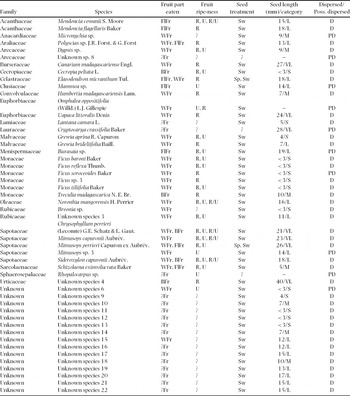
The lemurs consumed the fruit of 34 species (60% of 57 food plants). Twenty-seven (79%) of the 34 species consumed as fruit were eaten ripe, 19 (60%) were consumed unripe and a further six (18%) becoming ripe. Sixteen species occur in more than one category as they were consumed continually as fruits ripened. The lemurs were observed swallowing the seeds of 30 (88%) of the 34 species of which they ate the fruit; poor visibility precluded determining seed treatment for the remaining four species. Fruits were rarely dropped or discarded. There were two tree species the lemurs spat the seeds of as well as swallowed but this was the exception rather than the rule. Overall, 51% of a total 787 feeding observations were on nectar; 36% on fruit; 7.5% other/unknown; 6.1% leaves; and 0.6% flowers. See Appendix 1 for full list of consumed fruits and their treatment.
Average home-range size was 92 ha (group one: 102 ha; group two: 82 ha); average daily path length was 1.6 ± 0.6 km (range: 0.4–2.8 km) (group one: 1.8 ± 0.5 km; group two: 1.2 ± 0.6 km). Daily movements were rarely unidirectional, typically following a circuitous and/or convoluted path.
Dispersal quantity
The lemurs dispersed the seeds of 40 different species. This figure comprises 25 consumed species (74% of all species consumed as fruit) of which intact seeds were found in droppings and a further 15 unidentified species, seeds of which were found only in droppings. It was possible to identify 26 dispersed species to at least family level. The remaining species were distributed between 14 other families. Ten further species were possibly dispersed.
With an average of 11.6 seeds per deposition and nine depositions per day, individual lemurs dispersed an estimated 104 seeds d−1 and 3120 seeds mo−1. With an average group size of 3.5 at Manombo, each lemur group dispersed on average 364 seeds d−1 and 10920 seeds mo−1. With an average home range of 92 ha, then, these groups dispersed on average 4 seeds ha−1 d−1 and 120 seeds ha−1 mo−1. Population density at Manombo is 0.4–2.5 individuals km−2 (Vasey Reference VASEY, Goodman and Benstead2003). Using a midrange value of 1.45 individuals km−2, this population is estimated to disperse 151 seeds km−2 d−1 and 4530 seeds km−2 mo−1.
Dispersal distance and gut passage
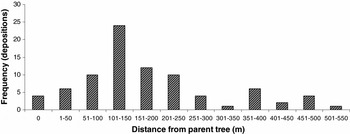
Requirements for estimating dispersal distance were met in 85 cases (31 trees of 19 species). A significant proportion (35%) of these were represented by Chrysophyllum perrieri; 14% of cases came from a single Chrysophyllum perrieri tree. Only 4.7% of seeds for which dispersal distance was estimated were deposited near (<15 m) to the parent tree; the majority were dispersed some distance away (Figure 1). Half of the seeds were transported distances greater than 148 m and 78% were taken over 100 m. Average dispersal distance was 180 ± 127 m, with an interquartile range of 103–217 m and a maximum distance of 506 m. It was possible to estimate gut passage time in 77 cases. Seeds were passed in, on average, 4.4 ± 2 h (N = 77); the longest passage time recorded was 8.5 h.
Seed dispersal curve for Varecia variegata (frequency distribution of straight distances (m) seeds were dispersed from parent trees); N = 85 seeds.

Effects of gut passage
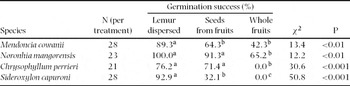
Lemur-passed seeds of all species germinated and no negative effects of gut passage were observed. Moreover, gut-passed seeds generally germinated more successfully than controls. Significant differences in germination success were found between treatments in all species (Table 1). Post hoc tests found highly significant differences between lemur-dispersed seeds and seeds within whole fruits for all species, and between lemur-dispersed seeds and seeds taken from fruits for two species. Differences were also observed between controls for three species.
Germination success (percentage of seeds from which a shoot emerged) of four species planted in germination trials and chi-squared results for differences between treatments. Superscript letters indicate results of post hoc tests: treatments that share a letter were not significantly different. ‘Lemur dispersed’ = seeds defecated by Varecia variegata; ‘Seeds from fruits’ = seeds with fruit pulp removed; ‘Whole fruits’ = seeds within intact, whole fruits.

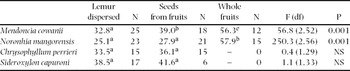
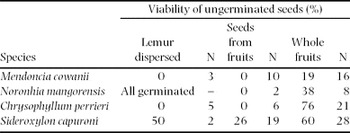
Differences in latency period are shown in Table 2. There were significant differences between lemur-dispersed seeds and controls for three species. Significant differences were found between all comparisons for Mendoncia cowanii. While no significant difference between latency period of lemur-dispersed seeds and seeds from fruits was observed in Noronhia mangorensis, lemur-passed seeds did sprout significantly more quickly than seeds in whole fruits. No seeds in whole Sideroxylon capuroni and Chrysophyllum perrieri fruits germinated. Consequently, only comparisons between lemur-dispersed and seeds from fruit were possible, and no significant differences were found. With the exception of Sideroxylon capuroni, ungerminated lemur-dispersed seeds and seeds from fruits were not viable; at least 19% of seeds within whole fruits were still viable (Table 3).
Mean latency periods (number of days from planting to radicle emergence) for germination trials of four species planted in germination trials and ANOVA results. Superscript letters indicate results of post hoc Tukey tests: treatments that share a letter were not significantly different. As no seeds within whole Sideroxylon capuroni and Chrysophyllum perrieri fruits germinated, only comparisons between ‘lemur dispersed’ and ‘seeds from fruit’ were possible. ‘Lemur dispersed’ = seeds defecated by Varecia variegata; ‘Seeds from fruits’ = seeds with fruit pulp removed; ‘Whole fruits’ = seeds within intact, whole fruits.

Percentage of ungerminated seeds that were still viable for four species used in germination trials. Viable = intact embryo still within seed. Unviable = aborted or rotten seeds. ‘Lemur dispersed’ = seeds defecated by Varecia variegata; ‘Seeds from fruits’ = seeds with fruit pulp removed; ‘Whole fruits’ = seeds within intact, whole fruits.

Characteristics of depositions
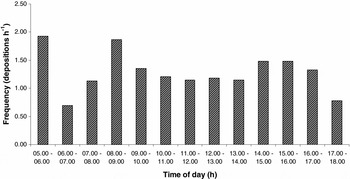
Study animals deposited, on average, 9.0 ± 3.5 droppings per daytime observation period per individual (range 1–15; N = 28 d). Droppings were made throughout the day (Figure 2) and 70% of droppings contained seeds (N = 250). Each deposition contained an average of 11.6 ± 26.4 seeds (range: 0–201) and 1.2 ± 0.9 species (range: 0–6). Seeds were passed intact through the gut and no evidence of habitual seed predation was observed for any species; only four of 3252 (0.1%) passed seeds showed signs of any visible damage. Faecal clumps were very loosely held together and, after falling through the often thick vegetation to the forest floor, were highly scattered.
Temporal distribution of depositions made by Varecia variegata (N = 445 depositions). Frequency of depositions is per hour of observation, and was corrected for the uneven spread of observation hours across the day.

Characteristics of dispersed seeds
Excluding seeds <3 mm, which could not be measured, seeds of dispersed species had an average length of 14 ± 8 mm (N = 382). The largest seed dispersed (unidentified liana species, Urticaceae) was 42 mm long. 38.5% of dispersed species were ‘large’; 12.5% ‘very large’ 30.0% ‘small’; and 20.0% ‘medium’. Sixty percent were elongate, 37.5% round and 2.4% ‘other’. The category ‘other’ is represented by one species, Elaeodendron micranthum (Celastraceae), which had a surprisingly variable seed shape and was categorized in a separate class.
DISCUSSION
Dispersal patterns and dispersal effectiveness
This study found evidence that the black-and-white ruffed lemur is an effective seed disperser, and may be a particularly important disperser of large seeds, at least at this study site and at this time of year. While the brief study period and small sample sizes present major limitations, there are nevertheless important ramifications of these results.
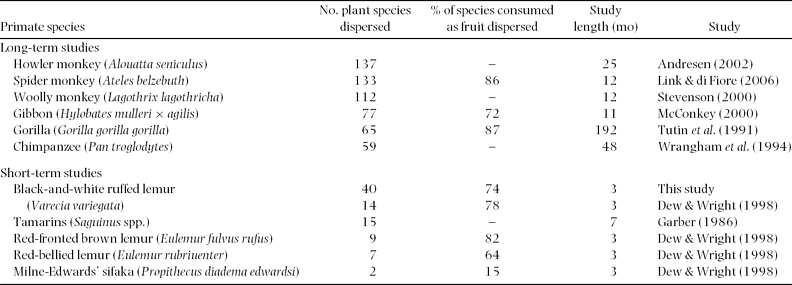
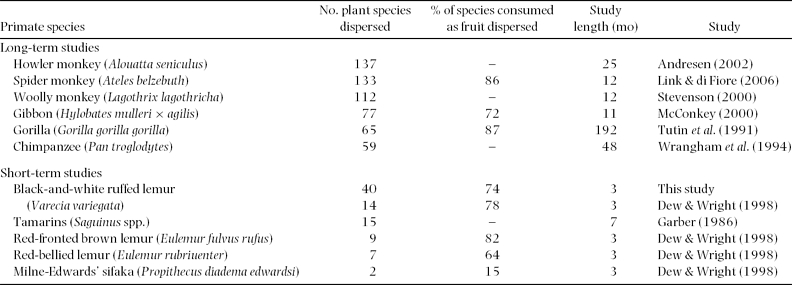
The lemurs had a highly diverse diet in general, and dispersed a high diversity of species. The number of species dispersed approached those reported from long-term studies of other primate species and was considerably higher than studies of a similar length (Table 4). With its role in dispersing seeds of such a wide variety of plant species, Varecia variegata may be of high importance in maintaining forest diversity and structure (Harms et al. Reference HARMS, WRIGHT, CALDERON, HERNANDEZ and HERRE2000, Terborgh et al. Reference TERBORGH, PITMAN, SILMAN, SCHICHTER, NUNEZ, Levey, Silva and Galetti2002). Unripe fruit was often consumed, however, which could destroy or disperse immature seeds, potentially reducing the quality of the dispersal service provided by these lemurs to some species. Varecia variegata habitually swallowed almost all fruits whole and very rarely damaged seeds or dropped them beneath parent plants, suggesting that it provides a reliable dispersal service and is capable of dispersing large quantities of seeds away from parent plants (Schupp Reference SCHUPP1993).
Diversity of plant species dispersed by primates in long- and short-term studies and the proportion of species consumed as fruit that were dispersed. (–) = Figure not reported.
Estimates of dispersal quantity for individual lemurs (104 seeds km−2 d−1) are within the range of those reported for Neo- and Palaeotropical primates (e.g. Cercopithecus spp.; Pan troglodytes; Lagothrix lagothricha: 3–866 seeds km−2 d−1, Stevenson Reference STEVENSON2000, Wrangham et al. Reference WRANGHAM, CHAPMAN and CHAPMAN1994) and group dispersal capabilities across home ranges (120 seeds ha−1 mo−1) greatly exceeds that of the gibbon Hylobates mulleri × agilis (14 seeds ha−1 mo−1, McConkey Reference MCCONKEY2000), often described as high-quantity dispersers (Chapman & Russo Reference CHAPMAN, RUSSO, Campbell, Fuentes, MacKinnon, Stumpf and Bearder2007, Link & Di Fiore Reference LINK and FIORE2006, McConkey Reference MCCONKEY2000). However population dispersal quantity is relatively low due to Manombo's low population density (1.45 individuals km−2). Varecia variegata occurs at densities of up to 53.4 individuals km−2 elsewhere (Vasey Reference VASEY, Goodman and Benstead2003), where their impact at a population level would be higher (Dew Reference DEW2001, Wrangham et al. Reference WRANGHAM, CHAPMAN and CHAPMAN1994). Note that temporal variability in feeding and movement behaviour and fruiting phenology can significantly affect numbers of seeds consumed and monthly figures may vary between months and years. Year-round data over multiple years are required to make firmer dispersal quantity estimates.
Studies have shown that distance from the parent plant and conspecifics is positively correlated with seed survivorship and recruitment probability (Augspurger Reference AUGSPURGER1984, Augspurger & Kelly Reference AUGSPURGER and KELLY1984, Jansen et al. Reference JANSEN, BONGERS and Van Der MEER2008). The distance required to escape the high mortality factors associated with parent trees differs across tree species and life stages, but 15 m appears to be generally sufficient (Hubbell et al. Reference HUBBELL, AHUMADA, CONDIT and FOSTER2001, Schupp Reference SCHUPP1988). Ninety-five per cent of seeds were deposited >15 m from their parental trees by Varecia variegata in this study, enabling them to escape these mortality factors and thereby increasing chances of survival and recruitment. Furthermore, with seeds distributed at distances of up to 506 m, the likelihood of seeds encountering favourable conditions for colonization of new or vacant sites may also be increased (Howe & Smallwood Reference HOWE and SMALLWOOD1982).
The average distance seeds were dispersed by Varecia variegata (180 m) is however relatively low in comparison to many other primates. Studies of New World primates have reported mean dispersal distances in the range of 151–390 m and Old World primates between 220–3000 m (reviewed by Chapman & Russo Reference CHAPMAN, RUSSO, Campbell, Fuentes, MacKinnon, Stumpf and Bearder2007). Ruffed lemurs lie at the lower end of this spectrum. Contributions made by seed dispersers vary over time (Schupp Reference SCHUPP1988); it is possible that results of this short study underestimate year-round dispersal patterns of this primate species. Alternatively, this dispersal distance may be of typical magnitude for lemurs. The two lemur species for which mean dispersal distance data are available (Varecia variegata: 180 m, this study; Eulemur fulvus rufus: 128 m, Spehn & Ganzhorn Reference SPEHN and GANZHORN2000) are two of the largest lemur species. Other lemur species may be expected to disperse seeds over shorter distances, due to their smaller body sizes and home ranges, which have been shown to be positively correlated with dispersal distance (Bowman et al. Reference BOWMAN, JAEGER and FAHRIG2002, Sutherland et al. Reference SUTHERLAND, HARESTAD, PRICE and LERTZMAN2000).
This predicted ‘spatially restricted dispersal’ may be related to prevalent lemur energy conservation strategies, proposed adaptations to the low fruit productivity and high unpredictability that characterize Madagascar's forests (Jolly Reference JOLLY1966, Reference JOLLY and Small1984; Wright Reference WRIGHT1999) and contrast with other tropical rain forests where fruiting occurs throughout the year (Wright Reference WRIGHT1999). Energy conservation strategies are unlikely to be compatible with long dispersal distances.
Current data suggest that passage through the gut of ruffed lemurs may be of benefit to seeds through increased germination success and reduced latency period, corresponding with the observations of Dew & Wright (Reference DEW and WRIGHT1998). Frugivore ingestion may affect seeds’ germination capabilities through the mechanical action of pulp removal and mechanical and/or chemical effects on seed coats (scarification) (Traveset et al. Reference TRAVESET, ROBERTSON, RODRIGUEZ-PÉREZ, Dennis, Schupp and Green2007). Patterns observed during this study suggest that pulp removal mediates beneficial effects more consistently than scarification: significant differences were consistently found between lemur-passed seeds and seeds in whole fruits, and between control seeds in whole fruit and with pulp removed. Thus ‘deinhibition’ – frugivore-mediated release of seeds from the inhibitory micro-environment of pulp – may be an important service provided by Varecia variegata for dispersed species.
These results are limited by the small sample sizes and short experiment duration that was insufficient to allow germination of all viable seeds (Table 3). Nonetheless, these data do show that lemur-passed seeds of these species germinate, and that gut passage can expedite germination in the first 10 weeks after deposition, when seeds are most likely to be predated upon. This may increase parent plant fitness by reducing chances of exposure to predation and disease, where these risks are significantly limiting factors, and ultimately translate into increased recruitment of adult trees (Lambert Reference LAMBERT2001).
Results suggest that dispersal patterns generated by Varecia variegata are characterized by low occurrence of depositions beneath parent trees, a majority transported over 100 m, with seeds deposited in low-density defecations in a scattered distribution. Droppings not only had low numbers of seeds and species per deposition, which may minimize inter- and intraspecific competition and density-dependent mortality (Connell Reference CONNELL, den Boer and Gradwell1971, Janzen Reference JANZEN1970, Loiselle Reference LOISELLE1990), but were loosely held together and broken up further by falling through vegetation to the ground. Separation of seeds from faecal matter in this manner may provide seeds with a means to avoid the attention of seed predators (who can detect seeds in faeces by olfaction) and density-dependent mortality (Andresen Reference ANDRESEN2002).
Dispersal of large seeds
Dispersed seeds were of a wide range of sizes, but most were large or very large. The only other frugivorous lemurs comparable in size to Varecia variegata (3.65 kg, Dew & Wright Reference DEW and WRIGHT1998) are Eulemur spp. (0.9–2.5 kg, Overdorff & Johnson Reference OVERDORFF, JOHNSON, Goodman and Benstead2003) of which one (Eulemur cinereiceps) is present at this site. The maximum reported seed size swallowed by the largest Eulemur species (Eulemur fulvus) is 20 mm (Ganzhorn et al. Reference GANZHORN, FIETZ, RAKOTOVAO, SCHWAB and ZINNER1999). Seeds of five species dispersed by Varecia variegata exceeded 20 mm, up to a maximum of 42 mm, demonstrating this species’ ability to disperse extremely large seeds that other frugivores cannot swallow. The only other potential disperser of such large seeds is the bush pig (Potamochoerus larvatus F. Cuvier), though it is thought to destroy most of the seeds it consumes (Ganzhorn et al. Reference GANZHORN, FIETZ, RAKOTOVAO, SCHWAB and ZINNER1999). The largest-seeded tree species have highly restricted assemblages of dispersers (Wheelwright Reference WHEELWRIGHT1985). Thus species at Manombo producing the largest seeds may depend exclusively upon ruffed lemurs for endozoochorous dispersal, suggesting this species plays a critical role within the ecological community.
Implications for conservation and forest structure and dynamics
Varecia variegata is particularly sensitive to disturbances and is often the first lemur species to disappear following human encroachment upon their habitats (Ratsimbazafy Reference RATSIMBAZAFY2002, White et al. Reference WHITE, OVERDORFF, BALKO and WRIGHT1995). If large dispersers such as Varecia variegata are lost, tree species producing large seeds may be left without a means of disseminating their seeds; this has already been reported for some Malagasy tree species (Dransfield & Beentje Reference DRANSFIELD, BEENTJE, Goodman and Benstead2003, Ratsirarson Reference RATSIRARSON, Goodman and Benstead2003). Disrupted dispersal caused by the loss of vertebrate dispersers – particularly those that disperse large seeds – could ultimately result in plant communities dramatically altered in diversity, biomass, structure and dynamics, through shifted selection for small-seeded and/or non-zoochoric dispersed species (Cramer et al. Reference CRAMER, MESQUITA and WILLIAMSON2007, de Melo et al. Reference DE MELO, MARTÍNEZ-SALAS, BENÍTEZ-MALVIDO and CEBALLOS2010, Harms et al. Reference HARMS, WRIGHT, CALDERON, HERNANDEZ and HERRE2000, Wright et al. Reference WRIGHT, ZEBALLOS, DOMINGUEZ, GALLARDO, MORENO and IBANEZ2000). These changes can diminish the carbon storage capacity of forests (Bunker et al. Reference BUNKER, DECLERCK, BRADFORD, COLWELL, PERFECTO, PHILLIPS, SANKARAN and NAEEM2005, Foley et al. Reference FOLEY, ASNER, COSTA, COE, DE FRIES, GIBBS, HOWARD, OLSON, PATZ, RAMANKUTTY and SNYDER2007), with negative consequences for the global climate (Malhi & Grace Reference MALHI and GRACE2000). It is therefore critical that key seed dispersers such as primates and their habitats are protected, for the benefit of all life on Earth.
ACKNOWLEDGEMENTS
Many thanks are due to: Jonah Ratsimbazafy for initiating this project; Mialy Razanajatovo for invaluable field assistance; Daniel Austin for endless support; field guides Jeannot, Faly, Getia, Johnny, Tranga, Kosinisy and Ferdinand; Tsaratia and Andry; Fidi Ralainasolo; the people of Sahamahitsy for their hospitality; Mary MacKenzie and Peter Shaw for assistance with GIS and statistics; Salvador; Ken and Lorna Gillespie; Mike and Rojo Wilson; Larry Dew; The Ministere de l'Environment, des Forêts et du Tourisme for permission to work at Manombo and the Madagascar Institut pour la Conservation des Ecosystèmes Tropicaux for logistical assistance.
Species dispersed (ripe fruit consumed and intact seeds identified in faeces) or possibly dispersed (only unripe fruits consumed/whole ripe fruits consumed but seeds not found in faeces) by Varecia variegata at the Manombo forest between September and December 2009. WFr = Whole fruit; BFr = Bite of fruit taken; FlFr = Flesh of fruit consumed; ?Fr = Unknown fruit treatment (treatment not visible at time of feeding or not observed feeding, i.e. seeds found in faeces only). R = ripe fruit consumed; U = Unripe fruit consumed; R/U = ‘becoming-ripe’ fruit eaten. Sw = Seeds swallowed; Sp = Seeds spat or dropped. D = seeds dispersed; PD = Seeds possibly dispersed. Seeds were measured at their greatest dimension (i.e. length). Categories are as follows: S = small (<5 mm); M = medium (5–10 mm); L = large: (11–20 mm); VL = very large (>20 mm); – = data not available. Seeds <3 mm were not measured.