Introduction
In recent years, the world has been rocked repeatedly by terrorist attacks. In the days after September 11, 2001, America mourned for some 3,000 casualties of the attacks on the Twin Towers in New York, the Pentagon in Virginia, and the crash of United Airlines Flight 93 near Shanksville, Pennsylvania, USA. In the aftermath, more than 2,000 injured people needed urgent medical care.Reference De Cauwer, Somville, Sabbe and Mortelmans 1 These events immediately raised awareness of civil and government vulnerabilities and led to discussions about preparedness and the necessity of reconsidering and rewriting existing contingency plans.
Worldwide, there has been an increase in the number of terrorist attacks, their scale, and the scope of targets since 9/11. Just a few examples include: the attack in 2002 on Paddy’s Bar and Sari Club in Bali, Indonesia, resulting in 202 deaths (a third bomb was detonated in front of the US consulate, though no one was injured in that attack); the bomb explosion in a Moscow (Russia) metro in 2004, resulting in around 41 deaths; the series of attacks in Madrid (Spain) in 2004, resulting in 191 casualties and 1,460 wounded; and the 2005 London (United Kingdom) bombings targeting the public transport system, resulting in 52 deaths and more than 700 wounded.Reference De Cauwer, Somville, Sabbe and Mortelmans 1 - 3
In Sharm el-Sheikh in 2005, a car bomb targeted a tourist hotel resulting in scores of deaths and injuries. In Mumbai, India in 2008, a series of 12 coordinated shooting and bombing attacks lasting four days gained global attention. The attacks targeted two international hotels, a Jewish center, cafes, and a hospital.Reference De Cauwer, Somville, Sabbe and Mortelmans 1 Some sources state that the number of non-state terrorist attacks across the globe have quadrupled since 2001. 4
In 2015, a sharp increase in attacks occurred and the world had to mourn more innocent victims. These included the attack on the Editorial Board of Charlie Hebdo in Paris (France); the attack on a tourist resort in Tunisia; the bomb explosion in a Russian tourist airliner over Egypt that was most likely a terrorist attack; the assault in Lebanon; and the series of attacks on Friday, November 13, 2015 in Paris.Reference De Cauwer, Somville, Sabbe and Mortelmans 1 , 5
Belgium mourned for 32 casualties and more than 300 wounded after a series of bombing attacks on Brussels International Airport and Brussels Metro on March 22, 2016. This was the most deadly attack in Belgium thus far.Reference Topham, Weaver and Luhn 6
All these examples illustrate that very public areas increasingly are being targeted in terrorists’ plans, especially locations where many people gather. This is only a limited list; a comprehensive open-access Global Terrorism Database is available online, being maintained by the National Consortium for the Study of Terrorism and Responses to Terrorism at the University of Maryland (College Park, Maryland), United States.Reference De Cauwer, Somville, Sabbe and Mortelmans 1
Given that the scale of attacks and the scope of terrorists’ targets are evolving, an important question to ask becomes: Are emergency services (both intra-hospital and mobile emergency services) and hospitals also a target for terrorism?
Report
Preparing Hospitals for Terrorist Attacks
Since 9/11, many governments worldwide have focused their attention on dealing with wide-scale terror and the impact of terrorist attacks on the delivery of medical care. Hospitals were urged to be prepared for an influx of victims of terrorist attacks. Especially after 9/11, but also in response to natural disasters such as Hurricane Katarina (New Orleans, Louisiana USA) and various epidemics (eg, SARS, avian flu, and Ebola), both civil authorities (eg, Federal or Local Public Health Agencies and the Centers for Disease Control and Prevention [Atlanta, Georgia] in the USA) and military arms of governments (eg, United States Army Medical Research Institute for Infectious Diseases [Frederick, Maryland USA]) have developed various strategies to cope with different threats, have worked on planning for responses to attacks, and have advised entities in carrying out appropriate preparedness planning and training. In 2008, the Belgian Public Health Administration (BPHA; Brussels, Belgium) advised all hospitals to make preparations to ensure the continuity of services in the event of an attack, without providing the necessary funding.Reference Heylen and Huyghebaert 7
Despite the increased awareness of a lack of preparedness and the governmental admonition to make changes, studies demonstrate that there still is much work ahead for different types of disasters that threaten health services. For example, in 2007, shortcomings of the different European national strategic plans for pandemic influenza were revealed and policy recommendations were made. 8 The same applies for other disaster scenarios. Repeated practice of appropriate responses to disaster scenarios is an essential requirement if one wants to guarantee adequate medical response. However, repeated practice in simulation means little in the absence of appropriate infrastructure to carry out a response.
Research shows that the availability of necessary equipment and facilities (eg, personal protective clothing, decontamination rooms, antidotes, and anti-viral drugs) in hospitals clearly is insufficient.Reference Mounier-Jack, Jas and Coker 9 - Reference Loutfy, Wallington and Rutledge 12 The problem of secondary contamination due to a lack of decontamination facilities and personal protective equipment was illustrated following the 1995 Tokyo (Japan) Sarin attack.Reference Mounier-Jack, Jas and Coker 9 , Reference Rosenfeld, Fitzgerald and Kossmann 13
In the case of pandemics or chemical, biological, radiation, or nuclear incidents, there is a high level of willingness to respond, but obstacles exist that could significantly reduce the workforce during a disaster. For example, chronically high absenteeism may be a crucial factor affecting medical surge capacity.Reference Okumura, Takasu and Ishimatsu 14 - Reference Mortelmans, De Cauwer, Van Dyck, Monballyu, Van Giel and Van Turnhout 17
Are Hospitals a Possible Target?
According to the US government, there are 16 critical infrastructure sectors considered so vital to the US that their incapacitation or destruction would have a debilitating effect on security, national economic security, national public health, and safety. Among them are the emergency services sector, health care delivery, and the public health sector in general.Reference O’Boyle, Robertson and Secor-Turner 18 The full range of possible targets and who is responsible for securing those targets against attacks is increasingly being discussed.
Not only do government authorities consider the medical and emergency sectors to be capital targets, both domestic and international terrorists also consider these sectors to be possible targets. This point is clear when considering proactive alerts issued by governmental authorities and intelligence information released to the public. For example, in November 2002, the US Federal Bureau of Investigation (FBI; Washington, DC USA) distributed a general awareness alarm for hospitals in San Francisco (California), Houston (Texas), Chicago (Illinois), and Washington because of intelligence gathered about a vague terrorist threat dealing some way with the medical sector. In 2004, the FBI and US Department of Homeland Security (DHS; Washington, DC USA) stated that interrogations of Al Qaeda suspects revealed specific information that attacks on shopping centers and hospitals were rehearsed in the terrorist training camps. The goal: targeting as many innocent victims as possible. Also, in November 2005, the police arrested two men in London suspected of planning a bomb attack. Among all the evidence, a note was found written in Arabic that contained the phrase “hospital=target.” The same year, the FBI and DHS investigated incidents of imposters posing as hospital accreditation surveyors. This information prompted the Joint Commission (Oakbrook Terrace, Illinois USA; formerly, the Joint Commission on Accreditation of Healthcare Organizations/JCAHO) to send security alerts to hospitals. 19 , Reference Rogers 20 This US authority accredits more than 21,000 health care organizations and programs in the United States. Clearly, US hospitals are targets. However, it also is increasingly clear that this new focus on the health care sector is not limited geographically.
History teaches that health care workers and physicians often are targeted in both political or religious conflicts and wars. Highly regrettable, many recent examples exist of health care workers being kidnapped and/or killed by perpetrators of various ideologies/groups: in 2002, it was revealed that over a period of five years, more than 270 doctors were killed in Pakistan, most of them in Karachi. Nine volunteer Pakistani polio workers, six of whom were young women, were killed in 2012. 21 , Reference Khan 22 Around 10 years ago, sectarian violence in Iraq resulted in killing doctors, professors, and teachers and others fleeing the country.Reference Bhutta 23 In the Syrian conflict, both Islamic State and the regime have been reported to detain or kill health care workers or to remove patients from hospitals preventing doctors from helping injured people.Reference Steele 24 , Reference Arie 25
In 2002 in Colombia, both left rebels and right-wing paramilitary groups reportedly killed patients in ambulances, closed down hospitals, and kidnapped or murdered physicians.Reference Gardham 26 Anti-abortion violence in the Unites States and Canada, consisting of (attempted) murders on physicians or abortion clinic employees, kidnappings, bombings, and assaults left many injured or killed.Reference Johnson 27
During the November 13, 2015 attacks in Paris, a coordination unit was set up at the Paris Service d’Aide Médicale Urgente (SAMU) in Necker Hospital, Paris. The SAMU building was secured by police because the risk of an attack on the coordination unit had been identified. 28 In the aftermath of the 2015 Paris attacks, the BPHA warned fire departments, ambulance services, and emergency wards about possible intruders during an intervention whose aim would be to disrupt medical emergency services or to steal emergency vehicles. This warning came 12 years after a study revealed the vulnerability of the ambulance system for possible hijacking for terrorism purposes. 29 Thus, this class of threat has been generally known for some time now: most hospitals could be targets. But a question arises: Are planned responses sufficient?
Are the Current Plans Adequate?
The emergency department (ED) is accessible to community members 24 hours a day/seven days a week, making it especially vulnerable. An assault on the ED potentially could result in many victims: doctors, nurses, and paramedics; patients; and accompanying relatives. The psychological impact on the hospital and larger community also would be immense.
Controlling access to the ED, therefore, is a prerequisite in any hospital preparation/response plan for a terrorist attack. In many hospitals, there already is an access control point at the reception desk. It also is necessary to limit access to the hospital ambulance dock (to prevent car bomb attacks) and to check for handguns, knives, and other weapons. Metal detectors rarely are used presently, despite the frequency of violent incidents in some communities, and especially more frequently now at the ED.Reference Alves and Bissell 30 , Reference Simon, Khan and Delgado 31 Given these facts, it may be that many hospitals’ plans are not adequate to deal with a direct attack.
Besides issues relating to attack preparedness, hospitals also must be aware that according to labor and civil law, they have the duty to guarantee a safe workplace for their employees, patients, and visitors. Hospitals could be held legally responsible if it turned out that prevention had failed, or that plans were woefully inadequate. Hancock and Johnson highlight that the United Kingdom Nation Health Service (London) hospitals are prepared to deal with victims of a terrorist attack, but when they themselves were to be the target of a terrorist attack, they consider this infrastructure to be incredibly vulnerable.Reference Kansagra, Rao and Sullivan 32
Could It Happen at Your Hospital? Physical and Psychological After-Effects of an Attack
Hospitals, and the ED in particular, are vulnerable and are real “soft” targets for terrorists aiming to destabilize society. Historically, one would think that one’s hospital would not be targeted by international or domestic terrorists. After all, who would consider attacking a hospital with innocent patients, visitors, and staff? Boaz Ganor and Miri Halperin Wemli reviewed worldwide terrorist attacks on hospitals in the period 1981-2013 and collected data of approximately 100 attacks, altogether resulting in 775 casualties in 43 countries. They concluded that many health care workers have already been confronted with terrorism as a victim. The motives of the terrorists were diverse, ranging from ideas derived from nationalistic to communist to Islamic beliefs.Reference Hancock and Johnson 33
Imagine a terrorist attack targeting an ED in a large urban hospital with a suicide bomber, or with an assault using war arms; medical staff are taken as hostages. In this scenario, perhaps the disaster plans could not be implemented because of inability to use the medical infrastructure (eg, the ED or ambulances). The staff also would be unavailable (killed, injured, or taken hostage). The long-term effect will be detrimental for the ED. After the 9/11 attacks, for example, 343 rescue workers (341 firefighters and two paramedics) responding to the disaster were killed. Trying to rescue as many civilians as possible, the rescue workers themselves were trapped in the Twin Towers of the World Trade Center in New York. As a result of many casualties, the capability of the New York City Fire Department (FDNY; New York USA) to respond to further attacks or disasters was severely degraded.Reference Ganor and Halperin 34 Another example is the recent incident in San Bernardino, California. After the December 2015 attack on a holiday party of the San Bernardino Department of Public Health (California USA), where 14 people were killed and 26 injured, the Governor of California declared a state of emergency in response to the loss of key personnel. 35 Specifically, the attack left San Bernardino County with very few health inspectors to do critical work.
Attacks on hospitals also could cause long-term effects: hospital units could be unavailable for a long time; for example, having to decontaminate rooms after attacks with low-level nuclear materials or chemicals. Replacing staff could take several months, further compounding hospital operations. Hospital staff could suffer from posttraumatic stress disorder (PTSD) and may be unable to be deployed for emergency duties.Reference Worland 36 For example, in the aftermath of the 9/11 attacks, longitudinal studies of large samples of New York firefighters and Pentagon staff revealed a significant increase in PTSD prevalence.Reference Neria, DiGrande and Adams 37 , Reference Berninger, Webber and Niles 38 Similar findings on anxiety were revealed in a survey of Pentagon personnel: 26.9% of the respondents screened positive for general anxiety disorder approximately one to four months post 9/11.Reference Grieger, Waldrep, Lovasz and Ursano 39
By contrast, shortly after the London metro and bus bombings in 2005, the London ambulance service did not report higher levels of probable PTSD and psychological distress in their employees compared to the general London population. However, four percent reported PTSD and 13% reported substantial distress. Probable PTSD was more common in those involved in the bombings (six percent overall), those working at the disaster scene, and in particular, at one of the incident locations where 50% of all employees with probable PTSD worked.Reference Jordan, Hoge, Tobler, Wells, Dydek and Egerton 40
Physical illnesses in the aftermath of disasters also are detrimental to health care services. During the 11 months after the 9/11 attacks, the number of medical leave incidents for respiratory illnesses increased. The high incidence of respiratory problems and related medical leave among FDNY rescue workers demonstrates the need for adequate respiratory protection.Reference Ganor and Halperin 34 After 9/11, a significant increase in accidental disability retirements (1,402 were associated with 9/11-related injuries or illnesses) also was observed, mostly due to respiratory-related illnesses. Additional increases were attributed to psychological-related illnesses and musculoskeletal injuries incurred at the World Trade Center site of the 9/11 attacks. Pension benefits also produced an increased financial burden on the FDNY pension system.Reference Misra, Greenberg, Hutchinson, Brain and Glozier 41 Thus, the physical and psychological after-effects of a terrorist attack endure much longer than the first few weeks after the incident and can affect more than those people directly involved.
Beyond Physical Threats: Cyber-Terrorism and Hospitals
Recent numerous cyber-attacks on hospitals, resulting mainly in the perpetrators gaining unauthorized access to personal data of patients and hospital employees and/or medical files, have alerted the health care sector.Reference Niles, Webber and Gustave 42 , 43 In one case, the computer hacker group “Anonymous” was believed to be responsible for repeated cyber-attacks against the web site of the Boston Children’s Hospital (Boston, Massachusetts USA). The attack apparently was related to a child-custody case involving 15-year-old Justina Pelletier.Reference Crosby 44
Besides theft of personal information, cyber-attacks also can affect proper functioning of hospitals. In January 2005, a botnet attack crippled computers at Northwest Hospital and Medical Facility in Seattle, Washington in the US, affecting the hospital’s systems in numerous ways. Doors to the operating rooms did not open, doctors’ pagers failed to work, and computers in the intensive care unit shut down.Reference Rocheleau 45 Safety of patients also could be directly compromised by outsiders taking unauthorized control of medical devices. This vulnerability increases as medical devices or systems like picture archiving and communication increasingly are connected to the Internet, hospital networks, and to other medical devices.
The US Federal Drug Administration (FDA; Silver Spring, Maryland USA) warns about cyber security threats. The FDA states that manufacturers, hospitals, and facilities must work together to manage the risks of cybercrime. Recently, the FDA issued two safety communications discussing cyber security vulnerabilities of two Hospira Infusion Pump Systems. This was prompted by the revelation that it was possible to access the Symbiq Infusion System remotely through a hospital’s network.Reference Lichtenfels 46 As a result of these attacks, the DHS and the Director of National Intelligence in the US declassified information about cyber threats and disseminated it quickly to the appropriate stakeholders, including hospitals; this action executed Presidential Policy Directive 21: Critical Infrastructure Security and Resilience. 47
Hospitals also should be aware that employees or former employees are capable of violating protocol, and thus can pose a real security threat. For example, Jesse William McGraw, a former contract security guard at the North Central Medical Plaza in Dallas, Texas USA, was sentenced to 110 months in prison after admitting to hacking into that hospital’s computer systems, including a nurses’ station computer and a heating, ventilation, and air conditioning computer located in a locked room. 48 The lessons learned according to the FBI: Do not underestimate the insider threat, ensure strong access controls, and run background checks on all personnel.
The Enemy from Within: Hospital Personnel?
Wrongfully and prejudicially, some believe that all terrorists are uneducated people with no future and that suicide bombers are really just suicidal maniacs. On the contrary, many highly-educated people from well-to-do families (eg, doctors) constitute a disproportionate number of terrorist leaders. Perhaps heralding this situation is the fact that more than seven percent of all German non-Jewish physicians in Germany became a member of the Nazi SS during World War II, compared to less than one percent of the general population. 49 Other more recent examples include Osama Bin Laden’s second-in-command, Ayman-Al-Zawahiri; George Habash, the founder of the Popular Front for the Liberation of Palestine; Fathi Shikaki, co-founder of Palestinian Jihad; and others; all of these individuals were medical doctors. The list even includes higher-level medical personnel. Ikuo Hayashi, former head of Circulatory Medicine at the National Sanatorium Hospital in Tokai, Japan, resigned his job in 1990 and left his family to join Aum, ultimately becoming Minister of Health of the Japanese doomsday cult. He was convicted for his participation in the 1995 Tokyo subway Sarin gas attack.Reference Colaianni 50 Besides illustrating that terrorists can be highly-educated individuals, this list also shows that leaders of terrorist organizations do not necessarily originate from the fringes of society or only from the Middle East.
The enemy from within also can be natural-born citizens of Western countries, who are highly integrated in those societies and who are medical professionals. Nidal Malik Hassan, the son of Palestinian immigrants, was born and raised in the US and became progressively radicalized while practicing medicine at Walter Reed Army Medical Center in Washington, DC, a medical center that serves all three branches of the US military and which is involved in delivering medical care to soldiers injured in Afghanistan and Iraq.Reference Sibley 51 In 2013, Dr. Hassan was convicted for the 2009 Fort Hood mass shootings.
Another recent example of a medical professional involved in terrorism is Bilal Talal Samad Abdullah, who after his training in Baghdad, Iraq, was employed as a doctor in a National Health Services hospital in Scotland. Dr. Talal is now serving a life sentence for his active involvement in car bombings in London and at the Glasgow Airport (Paisley, Scotland) in 2007.Reference Demaria 52
This phenomenon of medical professionals being involved in terrorist activities appears to be growing unabated and may be emerging at earlier points in the individuals’ training. Several medical students of Sudanese origin—including British, Canadian, and American citizens—joined Islamic State fighters in Iraq and Syria after being recruited by a Jihadi preacher at Khartoum University (Khartoum, Sudan).Reference Burleigh 53 Another example in this category is Farid Benyettou, the former “emir” of the Buttes Chaumont cell and the man who allegedly radicalized the Kouachi brothers involved in the 2015 Charlie Hebdo shootings in Paris. Mr. Benyettou was a nursing intern in the accident and emergency unit of the hospital where victims of the shootings were taken. 54
Since 2008, the British Medical Journal (London, United Kingdom) published a personal view relating to radical Muslim doctors by Irfan Al-Alawi and Stephen Schwartz of the Centre of Islamic Pluralism and some commenting letters illustrating the different views within Muslim community; after all, all authors recognized the enormous contribution that British Muslim doctors made for the National Health Services and agreed that it was important to strengthen the anti-extremist trends in the Muslim communities, and that radicalized doctors who were involved in terrorist attacks were only criminals who happened to be doctors. It also was stated that most doctors who left for Syria in order to help had no terrorist affiliations or tendencies at all; although, some sporadic cases are mentioned of doctors involved in Islamic State, Taliban, or Tamil Tigers.Reference Cook 55 - Reference Dyer 62
Moreover, in the time Christian fundamentalism denied science at the European Continent, the Islamic medical schools preserved medical tradition.Reference Dyer 63
The aforementioned medical professionals represent a short list of the many other doctors or paramedics worldwide that have joined or led terrorist groups. The question arises: How does a hospital guard against the “enemy from within?”
The Role of Prior Information
The foregoing discussion suggests that prior information (ie, a member of the medical community) held by responsible authorities does not always translate into preparedness. That being said, prior information also is not completely useless. Three distinct types of terrorists are defined: (1) right-wing, lone-actor terrorists; (2) Al Qaeda-inspired lone actors; and (3) radicalized individuals joining terrorist factions. All three have their own characteristics and behaviors. This makes risk assessment extremely difficult.
The reasons for radicalization seem to be related to grievances about social and health inequalities, discrimination, poverty, poor education, mental health problems, and lack of political engagement; however, these describe only a sub-group. Of the Al Qaeda-inspired lone actors, religious converts accounted for 36%; 21% were in a relationship. These were significantly younger than right-wing or those lone actors not inspired by Al Qaeda (26 versus 36 years old, respectively). More frequently, they had university degrees (17% versus five percent) and they were radicalized when living away from home (38%; eg, while students at university).
Right-wing lone actors, by contrast, were significantly more frequently unemployed or had lost their jobs recently, had low educational attainment, and had significantly more previous criminal convictions. Plots of most lone-actor terrorists include acts that are to take place in public spaces, whereas plots of terrorist factions include acts against military targets. In 24% of cases, the offender had a previous history with the location of the terror incident. For example, they were an employee or former employee. This was the case of the December 2015 San Bernardino attack. Other important red flags for the majority of lone actors are being socially isolated and experiencing problems in personal relationships, changing address recently, having financial problems, and experiencing long-term stress. Thirty-six percent had family members or relatives involved in political violence or criminal activity. One-third also had tried to recruit others for their terrorist action. In fact, in a vast majority of cases, family and friends or co-workers were aware of the grievances, extremist ideology, or intent to engage in violence; however, they did not report this to authorities.
Only recently have lone-actor terrorists become radicalized through their interaction with Internet web sites operated by Jihadi preachers. This is the case for the 2009 Fort Hood shooter.Reference Carta, Moro and Bass 64 - Reference Post 68
Hospital human resources officers and co-workers play an important role in the assessment and recognition of radicalization red flags in order to help them cope with frictions with co-workers and with negativity, getting them on the right track again and thus avoiding the transition to violent behavior.
Discussion
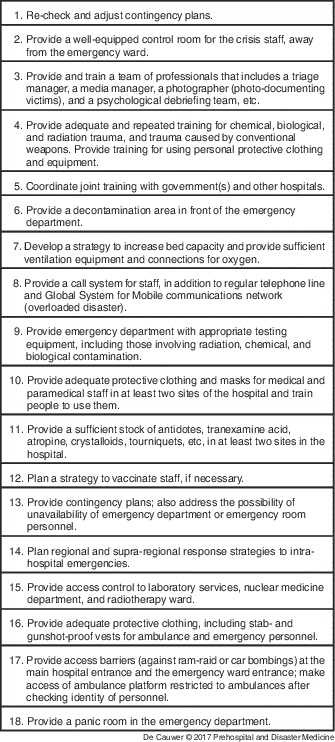
After two years of developing treatment protocols and field exercises for prehospital damage control, the French emergency services were able to cope with the unforeseen multiple shootings and hostage taking at Bataclan, Paris. 69 Ironically, the very morning of the November 13th Paris attacks, French emergency services had conducted a simulation exercise in order to practice and organize a response to multiple-site assaults. However, not every hospital is ready for such a disaster. Regional health care systems or national contingency plans are not always adequate and have not been practiced over and over again. Thus, many may not be ready to cope with multiple casualties.Reference Hirsch, Carli and Nizard 70 If every hospital and ED has to be prepared to cope with such a disaster, proper planning such as making protocols, conducting thorough training of hospital staff, and instituting regular rehearsal of disaster plans are imperative (Table 1). If those in the health services sector want to be ready for unforeseen threats and hazards, adequate and repetitive training; adapting contingency plans; enhancing communication between hospital departments, authorities, and hospital staff; and developing proper disaster facilities (eg, antidotes, decontamination rooms, protective clothing, and detection equipment such as radiation detectors) are all necessary. And even if a hospital is confronted with a large-scale disaster, it is important to avoid saturation of emergency services and to keep emergency teams in reserve for other attacks that may occur soon after the first one, and for more crisis sites that have to be dealt with during the unfolding of a terrorist attack.
Recommendations for Enhancing Hospitals’ Preparation Against Terrorism

Conclusion
In recent years, the world has been rocked repeatedly by terrorist attacks. This special report deals with different aspects of hospital policy and disaster response planning that interface with terrorism. History teaches that many hospitals and ED’s were insufficiently prepared to cope with terrorist attacks (eg, multi-site attacks) and that proper planning such as making protocols, thorough training, and regular rehearsal of disaster plans are imperative. In this special report, it also was demonstrated that hospitals themselves are at risk for terrorist attacks as terrorist factions increasingly aim at soft targets. Moreover, health care professionals are especially aimed for in order to destabilize health care system and thus society; the immediate and long-term detrimental effects of terrorist actions against hospitals also were discussed.
On the other hand, physicians and other hospital employees have shown to be involved in terrorism too. As history teaches that some offenders had a previous history with the location of the terror incident, the possibility of hospitals being targeted by insiders and the radicalization red flags are discussed.