INTRODUCTION
During recent decades, many researchers have claimed that during shared book-reading – a context extensively documented as highly facilitative of language and early literacy acquisition (Justice, Kaderavek, Bowles, & Grimm, Reference Justice, Kaderavek, Bowles and Grimm2005; Ninio, Reference Ninio1983; Reese & Cox, Reference Reese and Cox1999; Snow & Goldfield, Reference Snow and Goldfield1983) – the fostering of language development is affected not only by the quality of the conversational support provided by the adult, but also by the active participation of the child (e.g., Crowe, Norris, & Hoffman, Reference Crowe, Norris and Hoffman2004; Pigem & Blicharski, Reference Pigem and Blicharski2002; Yaden, Reference Yaden, Van Kleeck, Stahl and Bauer2003).
Regardless of the close relationship with the quality of the adult's support, the child's engagement in conversation during shared book-reading turns out to be hindered when children present delay or impairment in their language abilities. Several studies have shown that children with specific language impairment (SLI) are less conversationally responsive than typically developing (TD) children: compared with the latter, they were observed to ask fewer questions (Sulzby & Kaderavek Reference Sulzby and Kaderavek1996), to provide more unintelligible (Barachetti & Lavelli, Reference Barachetti and Lavelli2011) and more minimal verbal responses (Crowe, Reference Crowe2000), such as yes/no responses and ellipsis (Johnston, Miller, Curtiss, & Tallal, Reference Johnston, Miller, Curtiss and Tallal1993), and to be less compliant with the mother's solicitations (Rabidoux & MacDonald, Reference Rabidoux and MacDonald2000; Skibbe, Moody, Justice, & McGinty, Reference Skibbe, Moody, Justice and McGinty2010). This weakness of conversational participation may provide the parents with fewer opportunities for recasting their children's utterances. In addition, it might induce the parents to use ‘toddler-directed speech’ toward preschoolers with SLI and, consequently, to provide a less rich linguistic environment than that offered to TD peers (Girolametto, Bonifacio, Visini, Weitzman, Zocconi, & Pearce, Reference Girolametto, Bonifacio, Visini, Weitzman, Zocconi and Pearce2002). Furthermore, the number of linguistic errors and the amount of inappropriate content provided by children with SLI during conversations may be sources of miscommunications which, in turn, may lead to conversational breakdowns between mothers and their children (Conti-Ramsden, Hutcheson, & Grove, Reference Conti-Ramsden, Hutcheson and Grove1995; Yont, Hewitt, & Miccios, Reference Yont, Hewitt and Miccios2002).
However, some studies have suggested that children with SLI can use gesture to compensate for their expressive language difficulties, and when gestures accompany their speech they can express information that is not present in their speech. In particular, Evans, Alibali, and McNeil (Reference Evans, Alibali and McNeil2001) used a series of Piagetian conservation tasks to assess the relationship between gesture and speech in explanations of seven- to nine-year-old children with SLI and severe phonological working memory deficits compared with conservation judgement-matched TD children; results revealed that children with SLI expressed information uniquely in gesture significantly more often than did the TD children, suggesting that the relationship between gesture and speech may be different in children with SLI (who often have deficits in phonological working memory) and TD peers. In a later study (Mainela-Arnold, Evans, & Alibali, Reference Mainela-Arnold, Evans and Alibali2006), the same team found contrasting results, but more recently – investigating the understanding of mathematical equivalence in eight- to eleven-year-old children with expressive SLI (E-SLI), expressive and receptive SLI (ER-SLI), and TD – their analyses revealed that children with E-SLI, but not children with ER-SLI, expressed more advanced knowledge in gestures (Mainela-Arnold, Alibali, Ryan, & Evans, Reference Mainela-Arnold, Evans and Alibali2011). In another study, Blake and colleagues (Blake, Myszczyszyn, Jokel, & Bebiroglu, Reference Blake, Myszczyszyn, Jokel and Bebiroglu2008) investigated the types and timing of gestures accompanying speech in five- to ten-year-old children with SLI and TD children matched on chronological age and language age, in two narration tasks. Results showed that, in both tasks, children with SLI produced more iconic gestures and used them to replace words more frequently than matched comparison children. Still more recently, Iverson and Braddock (Reference Iverson and Braddock2011) examined gesture production and its relation to language in preschoolers clinically referred for LI and in age-matched TD children, during two picture narration tasks. Their results revealed that, compared with TD peers, preschoolers with LI used gestures at a higher rate and produced greater proportions of gesture-only communications, conventional gestures, and gestures that added unique information to co-occurring verbal utterances; furthermore, only within the LI group was poorer expressive language related to more frequent gesture production.
On the whole, these studies suggest that gesture may act as a compensatory or scaffolding device for children with SLI. This issue, though, is still controversial because the available data are not all consistent. For instance, it has also been shown that the quality of representational gestures produced by children with SLI is more immature or poorer than in TD age-mates (Hill, Bishop, & Nimmo-Smith, Reference Hill, Bishop and Nimmo-Smith1998); late bloomers, but not late talkers who went on to develop a language disorder, were found to use more communicative gestures than language-matched controls (Thal, Tobias, & Morrison, Reference Thal, Tobias and Morrison1991); children with SLI and TD children were not always found to differ in their gesture production (see Mainela-Arnold et al., Reference Mainela-Arnold, Evans and Alibali2006; Mainela-Arnold et al., Reference Mainela-Arnold, Alibali, Ryan and Evans2011). Furthermore, except for the study conducted by Iverson and Braddock (Reference Iverson and Braddock2011), the few other works suggesting a ‘gestural advantage’ of children with SLI have focused on school-age children, and none of them (Iverson and Braddock's included) has considered spontaneous gesture production in a naturalistic context such as parent–child conversation.
We therefore designed the present study first to examine the relationship between gesture and speech in preschool-age children with expressive SLI and in TD children, age- and language-matched, in a common situation, namely shared book-reading with their mothers.
Recently, within the current debate about the relationship between gesture and speech – that is, about how gesture is involved in language production and comprehension – in LI populations, stronger associations were indicated between gesture and language in children with SLI than for their TD peers, not only in production but also in comprehension processes. Botting and colleagues (Botting, Riches, Gaynor, & Morgan, Reference Botting, Riches, Gaynor and Morgan2010) examined sentence comprehension errors produced by four- to seven-year-old children with SLI and by TD peers in a speech–gesture integration task. Analysis showed that children with SLI made more gesture-based errors, revealing a preference for gestural – rather than spoken – cues when integration of speech and gesture information broke down. Conversely, TD peers were more likely to use spoken cues to guess the meaning of the sentences. To date, however, we do not know whether this preference of children with SLI for gestural cues is also observable within the context of spontaneous parent–child interaction, nor whether parents of children with SLI use more gestures during interaction with their children than do parents of TD children.
From an interactionist perspective on language development (see Chapman, Reference Chapman2000, for a review), a bi-directional influence between individual factors and input characteristics represents the key not only to understand how children with SLI comprehend and produce language, but also to investigate how the social context can support their language acquisition. In this regard, several studies conducted with both TD children and children with SLI have indicated that one of the most important sources of individual differences in language acquisition is the child's exposure to language input (Chapman, Reference Chapman2000; Tomasello, Reference Tomasello, Damon, Lerner, Kuhn and Siegler2006). In particular, parental communicative and linguistic input addressed to children with SLI during shared book-reading has been studied extensively because of its potential key role in encouraging, supporting, and repairing the child's responsiveness. The results showed that, compared with mothers of age-matched TD children, mothers of children with SLI carry a greater portion of the conversational load, initiate more conversational turns, and tend to control much of the discourse production of their children by using yes/no questions and non-verbal directives (Conti-Ramsden, Reference Conti-Ramsden1990; Evans & Schmidt, Reference Evans and Schmidt1991; Hammett, van Kleeck, & Huberty, Reference Hammett, van Kleeck and Huberty2003; Justice & Kaderavek, Reference Justice and Kaderavek2003). However, little is known about the frequency and types of gestures used by mothers of children with SLI, the relationship between gesture and speech in maternal communicative modalities used during shared book-reading, or about the effectiveness of using bimodal utterances (i.e., utterances in which gestures co-occur with speech) on their children's responsiveness. With regard to the controversial question of the effectiveness of the conversational strategies used by parents of children with SLI, it has been shown that when mothers provide children with SLI with emotional (Skibbe et al., Reference Skibbe, Moody, Justice and McGinty2010) and instructional support, particularly with repairs including crucial information and semantically contingent and familiar topics, as mothers of younger TD children do (Barachetti & Lavelli, Reference Barachetti and Lavelli2011), children are more likely to be active participants and to produce appropriate responses. The potential effectiveness of gestures accompanying caregivers' speech during interaction with children with SLI is still unexplored, although the presence of ‘gestural motherese’ used by mothers of children with other kinds of impairment (specifically, Down Syndrome) to reinforce the verbal message and to scaffold their children's weak attention to the object of conversation has been documented (Iverson, Longobardi, Spampinato, & Caselli, Reference Iverson, Longobardi, Spampinato and Caselli2006).
Therefore, the current study also addressed these unexplored issues, that is, frequency and types of gestures produced by mothers of children with SLI during shared book-reading, and the potential effectiveness of gestures accompanying maternal speech on children's responsiveness.
Aims and hypotheses of the current study
The present study focused on comparing spontaneous gesture and speech produced by both preschool-age children with expressive SLI and their mothers during shared book-reading, with spontaneous gesture and speech produced by age-matched and language-matched TD children and their mothers in the same context.
The study had three main aims:
1. To examine the relationship between gesture and speech produced by children with SLI compared with age-matched and language-matched TD children during shared book-reading with their mothers. Frequency and types of gestures, and the functions of gestures in relation to co-occurring speech produced by children with SLI relative to the two groups of comparison children, were also examined. Considering that (a) gesture and speech can be regarded as a unified system of communication (Kendon, Reference Kendon2004; McNeill, Reference McNeill2005), and (b) research has suggested that gesture may act as a compensatory device for children with SLI (see above), we expected that children with SLI would produce greater proportions of gestures co-occurring with speech and/or without speech than their TD age-mates, but not significantly different proportions of gestures and speech as compared with language-matched younger children. Furthermore, we expected children with SLI to produce greater proportions of gestures that convey information not expressed in speech, than the TD comparison children.
2. To examine the relationship between gesture and speech in maternal communicative strategies used with children with SLI and with age- and language-matched TD children during shared book-reading. Frequency and types of gestures produced by mothers of children with SLI relative to the mothers of comparison children were also examined. On the basis of the literature documenting that parents adapt their communication to their children's language abilities (see above), we expected that mothers of children with SLI behaved similarly to mothers of language-matched younger children; specifically, that compared with mothers of TD age-mates, they used more gestures accompanying their speech to scaffold their children's comprehension and linguistic production, and to regulate the ongoing conversational interaction.
3. To explore the potential effectiveness of gestures accompanying maternal speech on the conversational responsiveness of children with SLI, by examining possible links between mothers' communicative modalities – particularly bimodal (speech with co-occurring gesture) vs. unimodal spoken utterances – and production of initiatives or adequate answers (i.e., answers without content – or linguistic errors, even if inaccurate) by their children during shared reading conversation. Considering that children with SLI might be more sensitive to gestures than comparison children (see Botting et al., Reference Botting, Riches, Gaynor and Morgan2010), we expected to find some signs of effectiveness of maternal bimodal utterances.
METHOD
Participants
Participants were forty-five Italian preschool-age children with their mothers, divided into three groups.
Fifteen children (9 males and 6 females) with expressive specific language impairment (SLI group), ranging in age from 3;5 to 5;6 (M = 4;6, SD = 0;9), were identified through Departments of Child Neuropsychiatry located in the northeastern provinces of Italy and referred for participation in the study by certified speech–language therapists. The professionals used standardized tests along with their clinical judgment for the classification of the children. The children with expressive SLI met the following criteria: (a) expressive language ability more than 1 SD below the normative mean on at least two subtests of the Test di Valutazione del Linguaggio (TVL) – Livello prescolare (Linguistic Evaluation Test – Preschool level; Cianchetti & Sannio Fancello, Reference Cianchetti and Sannio Fancello1997); the subtests included a sentence repetition test, an expressive vocabulary test, and an elicited production test to check phonology and syntax; (b) receptive language ability within 1 SD from the mean on the word and sentence comprehension subtests of the TVL (Cianchetti & Sannio Fancello, Reference Cianchetti and Sannio Fancello1997); (c) non-verbal IQs of above 85, as assessed by the Italian Standardization of the Wechsler Preschool and Primary Scale of Intelligence (Wechsler, Reference Wechsler1969); (d) no evidence of sensory-neural hearing loss, neurological or genetic syndromes, or physical or behavioral impairments.
Expressive-only SLI was selected for this study to limit the qualitative differences of the impairments within the group. In addition, children with expressive SLI exhibit less severe linguistic limitations than children with expressive and receptive SLI, therefore they may participate for a longer period in shared reading conversation. Nine children exhibited moderate expressive language deficits; six children exhibited severe extended expressive language deficits. At the time of their participation in the study, eleven of the fifteen children with expressive SLI were attending weekly support meetings with speech–language therapists; however, the program did not involve any instruction to the children about the use of gestures, nor any direct parental instruction.
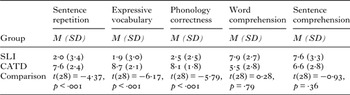
Fifteen TD children (8 males and 7 females) were individually matched to the children with SLI on chronological age ±3 months (CATD control group). These children ranged in age from 3;8 to 5;3 (M = 4;4, SD = 0;6), and no differences were found between the CATD group and the SLI group in age (t(28) = 0·76, p > ·05). In order to exclude the presence of any linguistic impairment in the CATD group, the language abilities of the age-matched children were evaluated by the TVL (Cianchetti & Sannio Fancello, Reference Cianchetti and Sannio Fancello1997). All children showed abilities within 1 SD from the normative mean in all of the subtests of language production and comprehension. T-tests performed on the scores obtained by children with SLI and age-matched TD children in the different subtests of the TVL confirmed that the two groups differed significantly in their expressive language abilities (see Table 1), but not significantly in their receptive language abilities.
Expressive and receptive language scores on subtests of the TVL (Cianchetti & Sannio Fancello, Reference Cianchetti and Sannio Fancello1997) for SLI and CATD groups

Fifteen TD children (7 males and 8 females) were individually matched to the children with SLI on linguistic abilities (LATD control group), in particular, on MLU in words and lexical production (tokens, i.e., total number of words produced per min). The MLU and the tokens were calculated on the first 100 utterances spontaneously produced by each child during 15 min of free play with her/his mother. The mean MLU was 1·79 (DS = 0·69) for the SLI group and 1·77 (DS = 0·74) for the LATD group (t(28) = 0·09, p > ·05). The mean tokens per min were 19·07 (DS = 5·93) for the SLI group and 17·07 (DS = 5·20) for the LATD group (t(28) = 0·98, p > ·05). These younger language-matched TD children ranged in age from 1;10 to 3;5 (M = 2;7, SD = 0;6). In order to exclude the presence of any linguistic impairment among them, their language abilities were evaluated by the questionnaire Primo Vocabolario del Bambino (PVB) – Words and Sentences short form (Caselli, Pasqualetti, & Stefanini, Reference Caselli, Pasqualetti and Stefanini2007) – i.e., the Italian version of the McArthur Communicative Development Inventories (Fenson, Dale, Reznick, Thal, Bates, Hartung, et al., Reference Fenson, Dale, Reznick, Thal, Bates, Hartung, Pethick and Reilly1993; Fenson, Pethick, Renda, Cox, Dale, & Reznick, Reference Fenson, Pethick, Renda, Cox, Dale and Reznick2000) – administered to the parents of these children. The scores obtained by all of the children in both lexical and grammatical abilities were close to or above the normative data (word production M = 82·4, SD = 14·7; sentence production M = 10·8, SD = 1·9).
The mothers and children of the two control groups were recruited through preschools and nurseries in the northeastern provinces of Italy. All mothers participating in this study were native Italian-speaking, ranging in age from thirty to forty-five (SLI group M = 36·9; CATD group M = 39·3; LATD group M = 36·2). In the SLI group, five mothers were middle school educated, eight were high school educated, and two were college graduates. In the CATD group, two mothers were middle school educated, nine were high school educated, and four were college graduates. In the LATD group, three mothers were middle school educated, nine mothers were high school educated, and three were college graduates. No significant differences were found in maternal years of education between the SLI group (M = 11·87, SD = 3·14) and the comparison CATD group (M = 13·67, SD = 2·99) (t(28) = –1·61, p > ·05), and LATD group (M = 12·80, SD = 2·96) (t(28) = –0·84, p > ·05). Most of the mothers routinely read to their children (from once a week to once a day), as documented by the mothers' answers to a questionnaire.
Procedure
Videotaping
Each mother–child dyad was videotaped during two sessions of shared book-reading (the second a week after the first) in a naturally occurring context at their home. Each time, the dyads read an unfamiliar non-fiction book on animals, with illustrations and just a few lines of descriptive text on each page. These features were selected to encourage mother–child conversation (Hammet Price, van Kleeck, & Huberty, Reference Hammet Price, van Kleeck and Huberty2009). Since the books for preschoolers were not suitable for younger children, books of the same genre and content, but with less, and simpler, text were used for dyads with children under age 2;6 in the LATD group. Although in these books the propositions were shorter, often of one word only, their number was similar to that of the other books. The mothers were instructed to read with the child as they usually did. The camera was situated on a tripod and the dyads were left alone to minimize intrusion. No limitations were given regarding the setting or the duration of the activity. The average duration of the sessions was 12:20 (min:s, range = 6:29–22:55) for the SLI group, 11:02 (range = 5:47–16:25) for the CATD group, and 11:00 (range = 5:30–20:46) for the LATD group.
During the first visit, mothers were also invited to complete a questionnaire concerning sociodemographic information, and their habitual practices in reading books with their children. Specifically, the questionnaire gathered information about the shared reading habits of the dyads (frequency, duration, and favorite genre of book), maternal reading habits, and maternal beliefs about shared book-reading (“Why do you read with your child?”).
Transcription and coding
All interactive sessions were entirely transcribed according to the Child Data Exchange System (CHILDES; MacWhinney, Reference MacWhinney2000). Each line of transcription included just one utterance. According to Cresti and Moneglia's criterion (Reference Cresti, Moneglia, Bortolini and Pizzuto1997), an utterance is a production unit representing a comprehensive intent indicated by intonation and/or pause. All the lines of the transcriptions were used for multiple coding, because all utterances produced by the children and the mothers were coded according to their communicative modalities – including gesture types when gestures were present – and communicative functions. Coding was done directly from the videotapes, because of the focus on gestures and the relationship between gesture and speech produced by the different groups of children and their mothers.
Communicative modalities
All child and maternal utterances were coded according to whether they consisted of speech with no accompanying gesture, speech with co-occurring gesture, or gesture with no accompanying speech, into three mutually exclusive categories: ‘Unimodal Spoken’, ‘Bimodal’ (speech+gesture), and ‘Unimodal Gestural’, respectively.
Gesture types
All child and maternal gestures occurring in Bimodal and Unimodal Gestural utterances were coded according to a classification similar to that used by Iverson et al. (Reference Iverson, Longobardi, Spampinato and Caselli2006), and Stefanini, Recchia, and Caselli (Reference Stefanini, Recchia and Caselli2008), into three mutually exclusive categories:
1. ‘Deictic gestures’ express the communicative intent to draw the partner's attention to a specific object among others present in the context; they include pointing, showing, and giving. Pointing was defined as an extension of the index finger (or other fingers or the palm of the hand) either directed at or touching or patting a specific picture in the book, or an object in the immediate context. Showing was defined as an extension of an arm toward the partner while holding an object in the hand. Giving was defined as an extension of an arm intended to transfer an object held in the hand to the partner.
2. ‘Representational (or ‘Iconic’) gestures’ express the communicative intent to depict through hand, body, and/or facial movements a main attribute or an action typically performed by a specific referent (e.g., an animal represented in the book); meaning does not change across different contexts (e.g., raising and moving forward the hands with fingers shaped as claws and widening the mouth for lion; crawling waving an extended index finger for snake).
3. ‘Conventional+Beat gestures’ included all gestures that could not be classified as deictic or representational, mainly Conventional gestures, that is, gestures that have forms and meanings that are culturally defined (e.g., shaking the head for no; nodding the head for yes; clapping the hands for bravo), and Beat gestures. The latter, which neither have specific semantic contents or referents nor are linked to specific forms, are hand or arm movements which follow the rhythm of, or highlight aspects of, accompanying speech or new contents introduced into the conversational interaction (e.g., moving the hand in the air while pronouncing a particular word). Beat gestures were grouped with the Conventional ones – despite their different forms and functions – because they were only rarely used by children and their mothers (regardless of the group), and because they were not observed in all dyads.
Functions of gestures in relation to speech
All child gestures occurring in Bimodal utterances were coded further into three mutually exclusive categories according to the relationship between the information conveyed in gesture and that conveyed in speech (see also Iverson & Braddock, Reference Iverson and Braddock2011, and Özçalişkan & Goldin-Meadow, Reference Özçalişkan and Goldin-Meadow2005): (1) ‘Reinforcing’ was coded when gesture conveyed information that was redundant with speech (e.g., pointing to a picture of a donkey in the book while saying Donkey); (2) ‘Disambiguating’ was coded when gesture clarified the referent of a demonstrative or locative word (e.g., pointing to a picture of a donkey in the book while saying Here), or attention-directing verbal expression (e.g., pointing to a picture of a shark in the book while saying Look!); (3) ‘Adding’ was coded when gesture provided semantic information to the message conveyed in speech (e.g., pointing to a picture of a donkey in the book while saying Alone to indicate that the donkey is alone while the other animals are pictured with their young).
Communicative functions
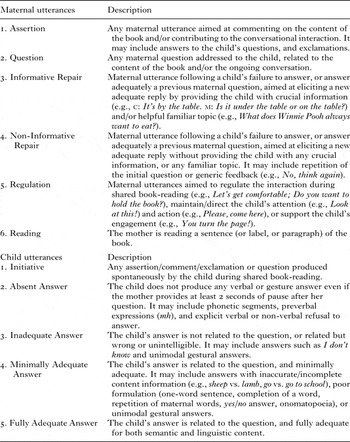
All maternal and child utterances were also coded according to their communicative functions. Maternal utterances were coded into six mutually exclusive categories: ‘Assertion’, ‘Question’, Repair coded as ‘Informative Repair’ vs. ‘Non-Informative Repair’ according to the presence vs. the absence of support provided to elicit adequate answer from the child, ‘Regulation’, and ‘Reading’. Child utterances were coded as ‘Initiative’ or ‘Answer’, and Answers were coded according to language productivity and content appropriateness, into four mutually exclusive categories: ‘Absent’, ‘Inadequate’, ‘Minimally Adequate’, and ‘Fully Adequate’. Detailed descriptions of the categories of maternal and child communicative functions are given in Table 2.
Categories of maternal and child communicative functions during shared book-reading

Reliability
Inter-observer reliability for the coding of child and maternal communicative modalities, types of gestures, communicative functions, and functions of child gestures in relation to co-occurring speech was calculated on a random sample of 20% of the transcripts, for each of the three groups. The average Cohen's kappa was ·95 (range from ·87 to 1) for communicative modalities, ·89 (range from ·78 to ·96) for types of gestures, ·83 (range from ·70 to ·94) for functions of child gestures in relation to co-occurring speech, and ·91 (range from ·81 to 1) for communicative functions.
RESULTS
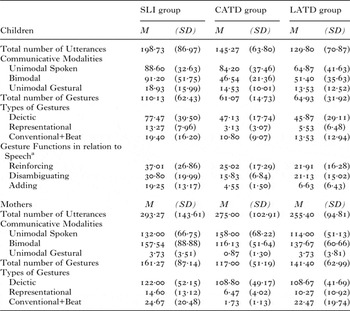
Descriptive statistics for children's and mothers' spoken and gestural production during shared book reading are reported in Table 3.
Descriptive statistics for children's and mothers' spoken and gestural production during shared book-reading

note:a The total number of gestures coded for functions in relation to co-occurring speech does not correspond to the number of Bimodal utterances, because for a few deictic gestures it was not possible to identify the referent.
Because of inter-dyad differences in the duration of the sessions and in the number of communicative behaviors, and because of the difference in the amount of text read with the youngest children in the LATD group, for aims 1 and 2 the data were analyzed in terms of percentages of the different types of: (a) communicative modalities on the total number of utterances; (b) gestures on the total number of gestures produced, respectively, by each child and each mother; and (c) functions of gesture in relation to co-occurring speech on the total number of Bimodal utterances produced by each child during interaction. Results were compared with results from analyses conducted on raw counts, controlling for the overall number of utterances produced by children and by mothers in each group: no differences were found, except for a minor one in a comparison between functions of gestures produced by children with SLI and younger children in the LATD group (see end of next subsection).
Children's production of gesture and speech (Aim 1)
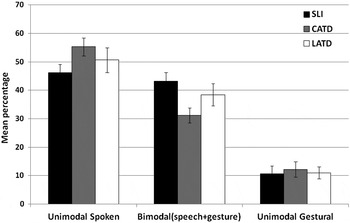
A one-way MANOVA: group (3) and LSD post-hoc tests were calculated on the different types of communicative modalities used by children during shared book-reading to assess differences between the groups in the relationship between gesture and speech. The means for this analysis are depicted in Figure 1. The MANOVA showed a significant main effect for group in Bimodal utterances (F(2,42) = 3·48, p = ·04, η p2 = ·14); LSD post-hoc tests revealed that, relative to chronological-age-matched typically developing (CATD) children, children with SLI produced a significantly higher percentage of utterances with gesture accompanying speech (M SLI = 43·14, SD = 11·81; M CATD = 31·19, SD = 10·02; (I–J) = 11·95, p = ·012, d = 0·55). No significant differences were found in communicative modalities between children with SLI and younger language-age-matched typically developing (LATD) children.
Mean percentage of Unimodal Spoken, Bimodal, and Unimodal Gestural utterances produced by children in the three groups. Error bars represent standard errors.

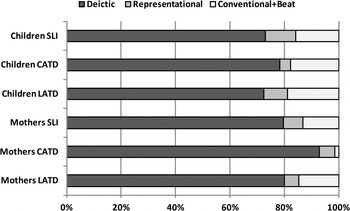
In the light of the inter-dyad differences in the duration of the sessions and the number of communicative behaviors, the frequency of gestures produced by children during shared book-reading was calculated as frequency per min. The comparison between the SLI group and each of the other groups showed that children with SLI produced a significantly higher number of gestures per min than CATD children (M SLI = 9·04, SD = 3·09; M CATD = 5·89, SD = 2·30; t(28) = 3·17, p = ·004, d = 0·58). The difference was not significant in comparison to LATD children (M LATD = 6·80, SD = 5·11). With regard to the types of gestures, Deictic gestures were the gestures most frequently produced (over 70%) by all groups, as shown in Figure 2. Conventional+Beat gestures, and particularly Representational gestures, were produced in lower proportions by children of the three groups. Nevertheless, a one-way MANOVA: group (3) calculated on the gesture types showed a significant main effect for group related to the production of Representational gestures (F(2,42) = 3·61, p = ·036, η p2 = ·15); LSD post-hoc tests revealed that, relative to their TD age-mates, children with SLI produced a significantly higher percentage of Representational gestures (M SLI = 11·07, SD = 6·49; M CATD = 4·01, SD = 4·99; (I–J) = 7·06, p = ·011, d = 0·61). No significant differences were found between children with SLI and younger LATD children on the proportion of Representational gestures produced.
Mean percentages of the different types of gestures produced by children and mothers in the three groups.

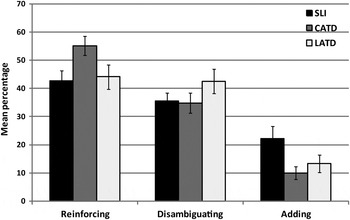
Finally, with regard to the functions of gestures in relation to co-occurring speech produced by children in the three groups, the function of Reinforcing the information conveyed by speech was the most frequently observed in all groups, as shown in Figure 3. However, a one-way MANOVA: group (3) calculated on the functions of gestures in Bimodal utterances showed a significant main effect for group for the gesture function of Adding unique information to the message conveyed in speech (F(2,42) = 3·41, p = ·043, η p2 = ·14). LSD post-hoc tests revealed that children in the SLI group produced gestures that conveyed information not expressed in their speech in significantly greater proportions than children in the CATD group (M SLI = 22·16, SD = 17·51; M CATD = 10·02, SD = 8·59; (I–J) = 12·14, p = ·015, d = 0·46), and in greater proportions (approaching a significant difference) than children in the LATD group (M LATD = 13·35, SD = 11·79; (I–J) = 8·81, p = ·064, d = 0·30). The difference between the SLI group and the LATD group is statistically significant when assessed on the number on gestures Adding unique information (controlled for the overall number of utterances) produced by children in each group (EstimatedM SLI = 19·26, SE = 2·92; EstimM LATD = 6·62, SE = 2·85; (I–J) = 12·64, p = ·004).
Mean percentages of gestures Reinforcing, Disambiguating, and Adding unique information to co-occurring speech produced by children in the three groups. Error bars represent standard errors.

Mothers' production of gesture and speech (Aim 2)
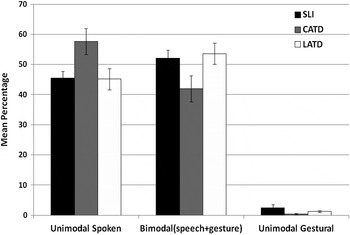
A one-way MANOVA: group (3) and LSD post-hoc tests were calculated on the different types of communicative modalities used by mothers during shared book-reading, to examine the relationship between gesture and speech addressed to children with SLI compared with gesture and speech addressed to CATD and LATD children. The means for this analysis are depicted in Figure 4. The MANOVA showed a significant main effect for group in maternal Unimodal Spoken utterances (F(2,42) = 4·22, p = ·021, η p2 = ·17), and an almost significant effect in Bimodal utterances (F(2,42) = 3·09, p = ·05, η p2 = ·13). LSD post-hoc tests revealed that, similarly to their children, mothers of children with SLI, as the mothers of younger LATD children, used more Bimodal utterances (M SLI = 52·07, SD = 10·47, and M LATD = 53·57, SD = 13·57) than mothers of CATD children (M CATD = 41·96, SD = 16·94; (M SLI-M CATD) = 10·10, p = ·053, d = 0·37; and (M LATD-M CATD) = 11·61, p = ·027, d = 0·38). Conversely, mothers of CATD children used the Unimodal Spoken modality (M CATD = 57·63, SD = 16·48) significantly more than the other mothers (M SLI = 45·53, SD = 8·87, and M LATD = 45·17, SD = 13·65), (M CATD-M SLI) = 12·10, p = ·017, d = 0·48, and (M CATD-M LATD) = 12·46, p = ·014, d = 0·41).
Mean percentage of Unimodal Spoken, Bimodal, and Unimodal Gestural utterances produced by mothers in the three groups. Error bars represent standard errors.

With regard to the frequency of gestures produced by mothers of children with SLI relative to the mothers of comparison children, no significant differences were found, although the number of gestures per min produced by these mothers (M SLI = 13·46, SD = 5·45) and by mothers of younger LATD children (M LATD = 13·34, SD = 5·32) was higher than that of mothers of TD age-mates (M CATD = 10·92, SD = 4·70). With regard to the types of gestures, Deictic gestures were the gestures most frequently produced also by mothers in all groups, as shown in Figure 2. However, a one-way MANOVA: group (3) calculated on maternal gesture types showed a significant main effect for group for both Deictic (F(2,42) = 7·65, p = ·001, η p2 = ·27) and Conventional+Beat gestures (F(2,42) = 15·02, p < ·001, η p2 = ·42). LSD post-hoc tests revealed that, relative to mothers of CATD children, mothers of children with SLI and mothers of younger LATD children produced a significantly lower percentage of Deictic gestures (M SLI = 79·62, SD = 11·42; M LATD = 79·92, SD = 13·42; M CATD = 92·78, SD = 4·63; (M SLI-M CATD) = −13·16, p = ·001, d = 0·82; and (M LATD-M CATD) = −12·86, p = ·002, d = 0·71), and a significantly higher percentage of Conventional+Beat gestures (M SLI = 13·17, SD = 7·65; M LATD = 14·76, SD = 9·40; M CATD = 1·57, SD = 4·63; (M SLI-M CATD) = 11·61, p < ·001, d = 1·10; and (M LATD-M CATD) = 13·19, p < ·001, d = 1·07) (see Figure 2). No differences were found in the frequency and types of gestures between mothers of children with SLI and mothers of LATD children.
Relationship between maternal communicative modalities and child conversational responsiveness (Aim 3)
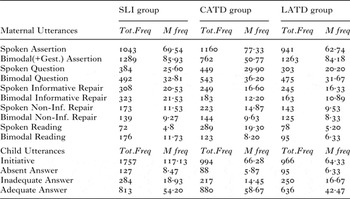
In order to explore the potential effectiveness of gestures accompanying maternal speech in eliciting conversational responsiveness (i.e., initiatives and adequate answers, regardless of accuracy) from children with SLI, a sequential analysis (GSEQ; Bakeman & Quera, Reference Bakeman and Quera1995) was performed between maternal utterances, coded into joint categories of communicative functions and modalities, and child utterances, coded for communicative functions. Sequential analysis provides an empirical assessment of the extent to which a child's behavior, e.g., a certain type of child's answer, is at any point of the interaction a function of the preceding behavior of her mother, and, inversely, the extent to which a maternal behavior, e.g., a certain type of maternal repair, is at any point a function of the preceding behavior of her child. Given the large number of categories of maternal and child utterances, some categories were merged with others (Unimodal Gestural with Bimodal, Regulation with Assertion, Minimally Adequate with Fully Adequate Answers) before sequential analysis was performed. The counts of utterances in each of the resulting categories are reported in Table 4.
Counts (total and mean frequencies) of maternal and child utterances in each of the categories used in sequential analysis

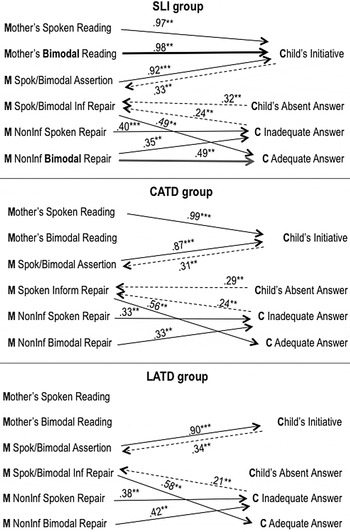
The analysis was performed by using pooled data across the dyads in each of the three groups: SLI group, CATD group, and LATD group. The significance of the temporal associations (transitional probabilities) between maternal and child utterances was assessed by the adjusted residuals statistic. After a preliminary analysis, both maternal Spoken and Bimodal Assertions, and maternal Spoken and Bimodal Informative Repairs were merged because they were found to show the same kinds of significant associations with, respectively, the child's Initiatives, and the different types of child's Answers in all groups. Figure 5 synthesizes the associations found to be significant within each group.
Mean transitional probabilities between maternal and child utterances during shared book reading. Only transitional probabilities found to be significant are included (** p < ·01; *** p < ·001). M = Mother; C = Child; Spok/Bimodal = Spoken or Bimodal (gesture + speech); Inf = Informative; NonInf = Non-Informative.

Figure 5 shows that the presence of maternal comments (Assertions), either Spoken or Bimodal, during shared book-reading affected the occurrence of child Initiatives which, in turn, elicited further maternal Assertions, contributing to an enriching of the mother–child conversation regardless of the group of dyads. The child's Initiatives were also stimulated by maternal Reading in both the SLI and the CATD groups, but it was only in the group with children with SLI that maternal Reading accompanied by gestures had a significant probability of being followed by a child's Initiative. With regard to the associations between the types of maternal repairs and the types of child answers, in all groups the child's Inadequate or Absent Answers were significantly followed by maternal Informative Repairs (i.e., repairs including crucial information) which, in turn, elicited the occurrence of Adequate Answers from children; conversely, the presence of maternal Non-Informative Repairs increased the occurrence of child Inadequate Answers. Nevertheless, it is interesting to observe that it was only in the SLI group that when maternal Non-Informative Repairs were accompanied by gestures, they also had a significant probability of eliciting Adequate Answers from children.
To shed light on this particular result, the functions of gestures in relation to co-occurring speech produced by mothers of children with SLI in their Bimodal Non-Informative Repairs were further analyzed through descriptive statistics and a repeated-measure ANOVA with gesture functions in 3 categories (Reinforcing, Disambiguating, and Adding) as repeated measure. No significant effect of gesture functions in relation to co-occurring speech was found. Descriptive statistics show that gestures Reinforcing speech were produced in a higher percentage (M perc = 40·99, SD = 33·84) than gestures Disambiguating (M perc = 36·81, SD = 28·86) or Adding information to speech (M perc = 22·20, SD = 19·99), although the total proportion of gestures conveying information supplementing (either Disambiguating or Adding) the information conveyed by speech was higher than that of gestures Reinforcing speech.
DISCUSSION
This study was designed with two aims: (a) to examine the relationship between gesture and speech produced by preschoolers with expressive SLI and their mothers during shared book-reading, as compared with age- and language-matched TD children and their mothers in the same context; and (b) to explore the potential effectiveness of gestures accompanying maternal speech on conversational responsiveness of children with SLI. To achieve these aims, we first analyzed similarities and differences in speech and gestures produced by both children and mothers, and in the functions of gestures in relation to co-occurring speech produced by children in the different groups. Then we focused on the relationship between mothers' communicative modalities and children's initiatives and adequate answers, comparing the three groups of dyads.
Relationship between gesture and speech in children with SLI and their mothers
On the whole, the results support the hypothesis of a ‘gesture advantage’ in children with expressive SLI, suggesting– in line with other studies (Blake et al., Reference Blake, Myszczyszyn, Jokel and Bebiroglu2008; Iverson & Braddock, Reference Iverson and Braddock2011; Mainela-Arnold et al., Reference Mainela-Arnold, Alibali, Ryan and Evans2011) – that these children may use gestures to compensate for their expressive language difficulties. In fact, children with SLI not only made use of gestures accompanying speech significantly more than their TD age-mates but, relative to the latter, they also produced a significantly higher proportion of gestures Adding unique information to the message conveyed in co-occurring speech. Interestingly, the gestures Adding unique information produced by children with SLI were also significantly more than those produced by younger LATD children.
These findings may be interpreted in the light of the fact that children with SLI are more likely to be successful in communicating when gestures accompany their speech than when they use speech alone, in other words, to experience gesture as an efficient and effective way of communicating when oral language needs a lot of efforts and is partially unintelligible. It is suggested that this is common among toddler and younger TD children, because control over the manual system needed for gesture develops before and faster than the articulatory and phonological systems needed for speech (Acredolo & Goodwyn, Reference Acredolo and Goodwyn1988; Capone, Reference Capone2007; Iverson & Braddock, Reference Iverson and Braddock2011). This explanation is supported by the result that no differences were found between children with SLI and younger LATD children in either the relationship between gesture and speech in terms of Bimodal utterances produced, or the relationship between the information conveyed in gesture and co-occurring speech.
Another explanation for the higher proportion of gestures and gestures Adding semantic information to speech produced by preschoolers with SLI considers that for children with phonological working memory deficits, such as children with SLI (Bishop, North, & Donlan, Reference Bishop, North and Donlan1996; Gathercole & Baddeley, Reference Gathercole and Baddeley1990), the weakness of links between phonological representation and embodied meaning makes the formulation of a verbal utterance particularly effortful, because speech is encoded sequentially. Gestures may therefore facilitate the expression of meaning because, in contrast to speech, they convey meaning as a whole through a synthetic visual representation (Capone, Reference Capone2007; Iverson & Braddock, Reference Iverson and Braddock2011; Iverson & Goldwin-Meadow, Reference Iverson and Goldwin-Meadow2005; McNeill, Reference McNeill1992), as in the case of Representational gestures, or through offering an immediate link with the referent of a verbal message, as in the case of Deictic gestures.
The finding that children with SLI also produced a higher proportion of Representational gestures than their TD age-mates further supports the hypothesis that these children rely on gestures to convey meaning more than their TD peers. This may not exclusively be in order to compensate for their language difficulties: indeed, Representational gestures were used to reinforce information – as well as add to it – in relation to speech, just as Deictic gestures have been used to add information, to disambiguate, and to reinforce the message conveyed in speech.
Most of the differences found in communicative modalities of children with SLI compared with TD children were mirrored in maternal communication. Mothers of children with SLI, similarly to mothers of younger LATD children, produced fewer only Spoken and more Bimodal utterances than mothers of TD age-mates. These findings suggest that mothers of preschoolers with SLI are able to tune their input to their children's linguistic limitations, just as mothers of younger TD children do because of their children's still limited language abilities. Indeed, co-speech gestures may provide both an additional channel for conveying information, and a communicative modality that seems to be particularly accessible for children with SLI. The use of gesture accompanying speech has been documented by studies of teacher–student interactions to be more effective than speech alone in facilitating learning both in TD children (Valenzeno, Alibali, & Klatzky, Reference Valenzeno, Alibali and Klatzky2003), and in children with Down Syndrome, because of the concrete visual cues added by gesture to the information conveyed in speech (Wang, Bernas, & Eberhard, Reference Wang, Bernas and Eberhard2001). Another reason why the use of co-speech gestures may be particularly accessible and effective for children with SLI – as revealed by sequential analysis (see the following subsection) – might be that, given their language processing limitations (Leonard, Reference Leonard1998), they tend to be more sensitive than TD age-mates to the different communicative stimuli (visual and verbal) provided by their partners, just as they tend to be more dependent than CATD children on linguistic input (Conti-Ramsden, Reference Conti-Ramsden1990; Riches, Faragher, & Conti-Ramsden, Reference Riches, Faragher and Conti-Ramsden2006). In a similar way, the similarities between communicative modalities used by mothers and children with SLI during shared book-reading could also indicate a process of bidirectional influence between mother and child. On the one hand, mothers would adapt their communication to their children's linguistic limitations, consistently with what Barachetti and Lavelli (Reference Barachetti and Lavelli2011) found; on the other hand, children would tend to use communicative–linguistic information immediately available in maternal input.
Other questions relevant to the interpretation of the higher proportion of gestures accompanying speech produced by mothers of children with SLI than by mothers of CATD children, are how and by whom the book was held during shared reading in the different groups, to see to what extent the mothers' hands were free to gesture. From a qualitative inspection of videos, it was interesting to observe that while most mothers of CATD children held the book for most of the reading, several mothers of children with SLI and mothers of younger LATD children tended to share the holding of the book with their child, for instance by leaving the book on the child's lap when the child was crouched between her mother's legs. This also suggests that these mothers were particularly concerned to facilitate the engagement of their children in interaction during the shared reading.
The mothers' attention to facilitate and support their children's engagement in the conversation is further suggested by the higher proportion of Conventional co-speech gestures used by both mothers of children with SLI and mothers of younger LATD children compared with mothers of CATD children. Considering that Conventional gestures convey specific, concrete information, this finding suggests that mothers of children with SLI used these gestures together with spoken language to support their children's linguistic processing, because co-speech gestures allow two different sort of representational systems, visual and verbal, to share the processing load (McGregor, Rohlfing, Bean, & Marschner, Reference McGregor, Rohlfing, Bean and Marschner2009; Goldwin-Meadow, Reference Goldin-Meadow2000). In addition, the mothers of children with SLI and the mothers of younger TD children may have used Conventional gestures to regulate the interaction during shared book-reading with their children, in other words, to address a need that arises especially when children's language limitations hinder their participation in the shared activity.
Maternal co-speech gestures and conversational responsiveness of children with SLI
Sequential analysis provided empirical evidence of the effectiveness of gestures accompanying maternal speech in eliciting conversational responsiveness from children with SLI: it was only in the SLI group that maternal Reading accompanied by gestures had a significant probability of being followed by a child's Initiative, and when maternal Non-Informative Repairs were produced combining speech with gesture, they had a higher probability of eliciting Adequate Answers from children.
In interpreting these results, we need to remember that in the LATD group some dyads read books with shorter propositions, often labels that mothers integrated in their comments; thus, in this group maternal Assertions (either spoken or accompanied by gesture) had higher probabilities than maternal Reading of eliciting the child's Initiative. However, the findings are consistent with results from Kirk, Pine, and Ryder (Reference Kirk, Pine and Ryder2011), who found that, in a task of pragmatic comprehension, language-impaired children correctly answered significantly more questions than TD peers when verbal scenarios were accompanied by gestures, and they were more likely to reproduce the observed gestures in correct rather than incorrect answers. In Kirk et al. (2011), speech was accompanied by gestures which conveyed semantic information complementary to the spoken message. In the present study, further analysis of the functions of gestures in relation to speech produced by mothers of children with SLI in Non-Informative Repairs did not show any significant difference in the proportion of gestures Adding semantic information not included in maternal speech, of gestures Disambiguating information, or of gestures Reinforcing information conveyed in speech. This suggests that – regardless of the relationship between the information conveyed in gesture and that conveyed in speech – children with SLI are more sensitive to gestural cues than TD children, as previously hypothesized. This is consistent both with the stronger associations between gesture and language found by Botting and colleagues (2010) in both production and comprehension processes of children with SLI compared to TD peers, and with a preference for gestural cues reported by the same authors for children with SLI in a speech–gesture integration task, whereas TD peers prefer relying on spoken cues.
A second hypothesis – a complementary one rather than an alternative – considers that mothers of preschoolers with SLI, aware of their children's linguistic difficulties, pay more attention than the other mothers to selecting the most salient elements of the pictures, and then to using gestures as pointing to draw the child's attention to a salient feature – that is, to a key/visual cue representing a crucial aspect of the requested or communicated meaning – in order to support the production of an adequate answer from the child, or to highlight the link word/referent during reading or conversation. Indeed, the use of Deictic gestures (pointing in particular) displayed by mothers of children with SLI also during the Reading of short sentences from the book, allowed them to single out specific referents from the other objects depicted in the picture-book and to make more salient relationships between referents and accompanying speech, thereby facilitating the child's linguistic processing and engagement in conversation. Finally, the fact that in several Bimodal Repairs produced by mothers of children with SLI, pointing was used in combination with Conventional gestures, such as emphatic nodding, provides further support to the hypothesis that particular attention is paid by these mothers to encouraging and helping their children to produce Adequate Answers.
CONCLUSIONS
This study makes an original contribution on the relationship between gesture and speech in children with SLI, by assessing spontaneous gesture and speech produced by both preschoolers with expressive SLI and their mothers during interaction in a naturalistic context such as shared book-reading, and making a detailed, direct comparison of the same factors with age- and language-matched TD children and their mothers. The use of sequential analysis allowed us to examine the relationship between mothers' communication modalities and children's conversational responsiveness in the different groups of dyads. On the whole, the results support the hypothesis that gesture may act as a scaffolding device for children with SLI. Compared with TD age-mates, these children not only used more co-speech gestures, particularly Representational gestures, but also more gestures that – regardless of type – added unique information to the message conveyed in speech. Furthermore, children with SLI were more sensitive than TD children to gestures and gestural cues in maternal communication, as revealed by sequential analysis. The similarity found between children with SLI and their mothers in the greater use of Bimodal utterances suggests both that mothers are able to tune their input to their children's linguistic limitations, but also, possibly, a process of bidirectional influence between children and mothers. Furthermore, the empirical evidence that gestures accompanying maternal speech may be effective in fostering conversational responsiveness from children with SLI, taken together with the other results, indicates that the relationship between gesture and speech in children with SLI seems to be stronger than in TD children.
Future research could deepen our understanding by including a more detailed, qualitative examination of gestures produced by children with SLI and their mothers, and by extending the analysis of the informational relationship between gesture and speech to all bimodal utterances produced by mothers in the different groups. In addition, though our sample was not small, the sample size needs to be enlarged to assess the consistency of our findings.
Finally, this study has implications for educational and clinical practice. The findings suggest that the use of gesture scaffolding with children with SLI could not only be a useful clinical practice used by speech therapists (Capone, Reference Capone2007), but also a conversational strategy to be included in interactions with these children within family and preschool educational contexts. On the one hand, caregivers and preschool teachers of children with SLI would need to be aware that the child's gestures accompanying unintelligible words or poor speech are communicative acts that could be expanded with a spoken language model (Capone, Reference Capone2007; Iverson & Braddock, Reference Iverson and Braddock2011). For instance, when the child points to a picture of a rabbit eating carrots and says Eats, the adult could reply with Yes, the rabbit is eating carrots. Expansions like this were shown to support language acquisition in young TD children (Goldin-Meadow, Goodrich, Sauer, & Iverson, Reference Goldin-Meadow, Goodrich, Sauer and Iverson2007), as well as in children with SLI (Proctor-Williams, Fey, & Loeb, Reference Proctor-Williams, Fey and Loeb2001). On the other hand, caregivers and preschool teachers could increase the use of gestures in their communication with children with SLI in order to prompt higher levels of engagement in conversation and to support the production of adequate answers from children. This would be consistent with the literature – scant though it is – showing that children with SLI are likely to learn more new words when iconic gestures accompanying speech are provided during instruction (Ellis Weismer & Hesketh, Reference Ellis Weismer and Hesketh1993). Therefore, the use of gesture scaffolding could be one of the conversational strategies to suggest in intervention programs addressed to parents of children with SLI.