


Introduction
Cover crops provide valuable ecosystem services such as building soil organic matter, improving soil physical structure, reducing soil erosion, suppressing pests and capturing excess nutrients (Blanco-Canqui et al., Reference Blanco-Canqui, Shaver, Lindquist, Shapiro, Elmore, Francis and Hergert2015). Cover crops are currently seeded in a variety of ways, including drilling, broadcasting, aerial seeding and frost seeding, among others. However, timing of cover crop sowing, especially after summer annual crops, remains a challenge due to labor constraints, narrow temporal windows between cash crop harvest and frost, and unsuitable weather and soil conditions (Myers and Watts, Reference Myers and Watts2015). These barriers to timely cover crop planting can lead to poor stands and low biomass production, which can reduce the benefits provided by cover crops.
One option for avoiding the challenge of post-harvest cover crop establishment is to interseed cover crops into planted or established cash crops. The idea is that cover crop seeds will germinate and emerge beneath the cash crop canopy and remain small until after harvest when they will grow larger and provide desired ecosystem services. However, there are two potentially negative outcomes of the interseeding approach. First, cover crops can grow too large during cash crop growth and compete for resources and reduce yield (Uchino et al., Reference Uchino, Iwama, Jitsuyama, Yudate and Nakamura2009); or conversely, cover crops beneath a dense crop canopy may lack sufficient resources (primarily light) to sustain vigorous growth until senescence and harvest of the cash crop, resulting in reduced stand density and related ecosystem services (Baributsa et al., Reference Baributsa, Foster, Thelen, Kravchenko, Mutch and Ngouajio2008).
One solution to address these challenges is to interseed a cover crop species with the capacity for delayed seed germination. Delayed germination can be achieved using polymer seed coatings, as has been demonstrated in corn, soybean and canola (Johnson et al., Reference Johnson, Miller, Blackshaw, Gan, Harker, Clayton, Kephart, Wichman, Topinka and Kirkland2004; Gesch and Archer, Reference Gesch and Archer2005; Gesch et al., Reference Gesch, Archer and Spokas2012), or by leveraging existing seed dormancy traits in select species. Preliminary research on polymer seed coatings on rye (Secale cereale L.) and mustard (Guillenia flavescens L.) cover crop seed revealed many technical barriers to implementation (e.g., difficulty in achieving a uniform coating due to the non-uniform surface of rye seed; Arendt and Zannini, Reference Arendt, Zannini, Arendt and Zannini2013); however, a candidate cover crop species with a seed dormancy trait already exists. Field pennycress (Thlaspi arvense L.) is a cool season annual herbaceous plant that typically emerges in the fall or early spring. Pennycress possesses many ideal traits of an interseeded cover crop species including: an after-ripening seed dormancy of approximately 1 month; a phytochrome-mediated seed dormancy that inhibits germination when exposed to scattered far-red light that is typically beneath a crop canopy (Hazebroek and Metzger, Reference Hazebroek and Metzger1990); and a low-profile rosette growth habit during vegetative growth (Best and McIntyre, Reference Best and Mcintyre1975); all traits that would serve to minimize competition with the cash crop.
Pennycress is already being researched as a possible oilseed crop (Sedbrook et al., Reference Sedbrook, Phippen and Marks2014) or cover crop (Eberle et al., Reference Eberle, Thom, Nemec, Forcella, Lundgren, Gesch, Riedell, Papiernik, Wagner, Peterson and Eklund2015) in the Midwest USA. However, these domestication efforts often aim to remove the seed dormancy traits that could make pennycress useful as an interseeded cover crop. Thus, the objective of this study was to demonstrate proof-of-concept for using pennycress as an interseeded cover crop in a summer annual cropping system. Compared to interseeded rye and mustard cover crops, I hypothesized that pennycress would germinate later, compete less with the cash crop, and provide comparable winter soil cover and biomass the following spring.
Methods
A field experiment was conducted in 2016/17 and 2017/18 to determine the potential for pennycress as an interseeded cover crop in a summer annual cash crop. The experimental area was located at the University of Nebraska – Lincoln research farm in Lincoln, NE (40°50′10″ N, 96°39′50″ W, 351 m elevation), and the experiment was conducted in different, but adjacent, fields at the farm in each year. The dominant soil texture in these fields was silty clay loam [pH = 6.2 (1:1 dilution method); OM = 3.4%]. A randomized complete block experimental design was used and cover crop treatments included: (1) a no cover crop control (NC; ambient, fallow weeds allowed to grow); (2) interseeded pennycress (I-PEN); (3) interseeded mustard (I-MUST) and (4) interseeded rye (I-RYE).
Edamame (cv. Envy) seed was planted on 13 July 2016 and 27 May 2017 with a target population of 370,000 plants ha−1. Plots were 4.6 m long by 3 m wide and there were four crop rows per plot spaced 76 cm apart. Weeds between rows were controlled with a rolling cultivator and hand-hoeing. Cover crop seeds for the I-PEN, I-MUST and I-RYE treatments were broadcast by hand evenly throughout the area of each plot on 10 August 2016 and 27 June 2017. Cover crop seed was partially incorporated in soil with a rolling cultivator immediately after seeding in 2016, but not in 2017.
Seeding rate for pennycress was 22 kg ha−1, mustard was 11 kg ha−1 and rye was 110 kg ha−1. Pennycress seed was collected from a ‘weedy’ accession near Urbana, Illinois, USA in May 2016 and refrigerated at 3°C until seeding in each year. Mustard (variety not stated) and winter rye (variety not stated) cover crop seed was sourced commercially (Johnny's Selected Seeds; Maine, USA). To document the timing of cover crop emergence in each treatment, cover crop plant populations were monitored five times in 2016 between 22 August and 25 October, and one time in 2017 (14 July). At each sampling interval, two 0.37 m2 quadrats were placed randomly between two interior crop rows of each plot and all emerged cover crop plants were counted.
Edamame pods were harvested from a 2 m subsample area divided across two interior crop rows within each plot on 22 September 2016 and 9 August 2017. Dry pod weights were recorded in 2016 and fresh pod weights were recorded in 2017. Dry pod weights were measured after drying at 60°C until samples reached constant mass, whereas fresh pod weights were measured within 48 h upon removal from the field.
Ground cover provided by cover crops in each experimental unit was estimated via two methods including: a green soil cover measurement software application (Canopeo; Oklahoma State University, Stillwater, OK); and visual ratings by the same individual using a range of 0–100% (e.g., a rating of 60% meant that 60% of the soil was not visible due to the presence of cover crop or weed vegetation). Green soil cover estimates via Canopeo were based on aerial images of the interior 2.3 m width of each plot; similarly, visual ratings were determined after walking and assessing the interior 2.3 m width of each plot. Fall ground cover was measured on 26 October 2016 and 26 October 2017 using Canopeo, and spring ground cover was measured on 7 April 2017 and 11 April 2018 using Canopeo and visual ratings. Spring cover crop biomass of each treatment was determined on 24 May 2017 and 16 May 2018 by harvesting all aboveground plant tissue (including weeds) from two 0.37 m2 quadrats placed randomly within the plot (between rows of edamame from prior year). Aboveground biomass was dried at 60°C to constant mass and weighed.
All data were analyzed with a generalized linear mixed model ANOVA using the ‘glimmix’ procedure in SAS (v9.3, SAS Institute, Cary, NC). Cover crop treatment, year and their interaction were the fixed effects and replicate block was the random effect for analysis of edamame yield and cover crop biomass data. For cover crop soil cover data, season (fall or spring) was included as a fixed effect (along with all possible two- and three-way interactions among factors) and a repeated effect in the model. Assumptions for ANOVA, including homogeneity of variance and normally and independently distributed errors, were assessed using the ‘univariate’ procedure in SAS. The Tukey–Kramer multiple comparisons test was used to assess treatment differences at a significance level of α = 0.05.
Results and discussion
Cover crop establishment
Cover crop emergence was first observed in I-RYE and I-MUST treatments 5 days after seeding in 2016 (15 August), and final densities were 103 ± 16 plants m−2 and 75 ± 6 plants m−2 (mean ± standard error), respectively. In contrast, I-PEN emergence was not observed until 28 days after seeding (7 September 2016) and reached a final fall density of 47 ± 4 plants m2 [emergence likely continued during the spring (Royo-Esnal et al., Reference Royo-Esnal, Necajeva, Torra, Recasens and Gesch2015), but was not measured]. In 2017, cover crop emergence was first observed in I-RYE and I-MUST 6 days after seeding (3 July 2017). Pennycress emergence was not observed until 56 days after seeding (22 August 2017). Seedling density of I-RYE and I-MUST were measured one time (14 July 2017) and were 94 ± 16 plants m−2 and 56 ± 12 plants m−2, respectively. Reduced I-MUST stand density compared to 2016 may have resulted from the elimination of soil incorporation of seed in 2017, although rye was largely unaffected by this management change. Delayed emergence of pennycress until late-August (2017) and early-September (2016) in edamame supports the hypothesis that seed dormancy traits of pennycress (Hazebroek and Metzger, Reference Hazebroek and Metzger1990) can be used to better synchronize emergence of interseeded cover crops with maturity and harvest of summer annual cash crops.
Edamame yield
Edamame yield was not affected by interseeded cover crop treatments in either year (P = 0.64). Mean dry pod yield in 2016 was 2.4 ± 0.1 Mg ha−1 and mean fresh pod yield in 2017 was 9.6 ± 0.2 Mg ha−1. Assuming a fresh pod moisture of 55% (Rao et al., Reference Rao, Bhagsari and Mohamed2002), the adjusted mean dry pod yield in 2017 was 4.3 ± 0.1 Mg ha−1 – nearly two times greater than yields in 2016. Not surprisingly, delaying planting date of edamame (July compared to May) reduced pod yield, which is consistent with results in grain soybean (De Bruin and Pedersen, Reference De Bruin and Pedersen2008).
More important than the annual yield differences was the lack of yield loss caused by interseeded cover crops, regardless of species or emergence timing. This result was somewhat surprising given that the critical weed-free period in soybean ranges from 30 to 60 days after crop emergence (Van Acker et al., Reference Van Acker, Swanton and Weise1993; Eyherabide and Cendoya, Reference Eyherabide and Cendoya2002) and cover crops emerged 33 and 38 days after planting edamame in this study. Uchino et al. (Reference Uchino, Iwama, Jitsuyama, Yudate and Nakamura2009) reported soybean yield loss of up to 29% when interseeding a rye cover crop into soybean at the time of soybean planting (compared to planting rye after soybean harvest). The lack of observed yield loss in this study was likely due to the later interseeding date [relative to Uchino et al. (Reference Uchino, Iwama, Jitsuyama, Yudate and Nakamura2009)], which served to better mitigate resource competition with cover crops. This is consistent with Hively and Cox (Reference Hively and Cox2001), where cover crops were broadcast-seeded into standing soybeans approximately 1.5 months after planting without any negative effects on yield.
Cover crop soil cover and biomass
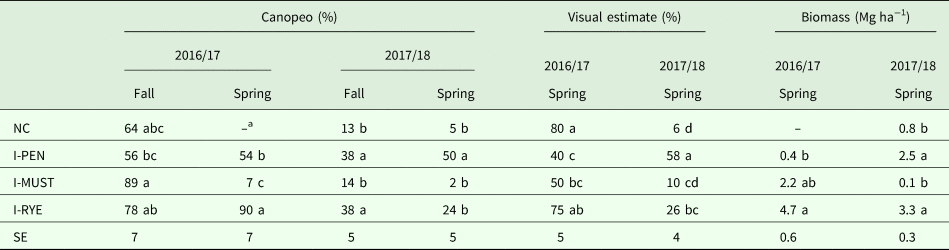
Green soil cover, estimated via Canopeo, was influenced by the three-way interaction of treatment by season by year (P < 0.0001). In fall 2016, green soil cover was greatest in I-MUST and lowest in I-PEN, but by spring 2017 green soil cover was greatest in I-RYE and lowest in I-MUST due to winterkill (the 7% green soil cover in I-MUST was ambient weeds, primarily Lamium amplexicaule L.; Table 1). The I-PEN treatment provided 54–56% green soil cover in both fall and spring of the 2016/17 season. Visual estimates of soil cover were also influenced by the interaction of treatment by season by year (P < 0.0001). Visual estimates accounted for living (green) and dead (brown) plant residues, which was useful for documenting the presence of potentially beneficial winter-killed mustard plant residues (50% visual soil cover observed in spring 2017); otherwise, results were consistent with estimates of green soil cover (Table 1).
Effects of cover crop species and seeding strategy on green soil cover (Canopeo %), visual estimates of total spring soil cover (%) and spring cover crop biomass (Mg ha−1)

NC, no cover crop control; I-PEN, interseeded pennycress (T. arvense L.); I-MUST, interseeded mustard (G. flavescens L.); I-RYE, interseeded rye (S. cereale L.).
Different letters within columns indicate significant differences according to the Tukey–Kramer multiple comparisons test (α = 0.05). All data in 2017/18 included analysis of four replicates of each treatment (n = 4), but two replicates were analyzed in 2016/17 due to plot damage (n = 2).
a Canopeo estimate of green cover in spring 2017 was inaccurate due to nearly uniform cover of purple flowers from henbit (L. amplexicaule L.) in control plots.
Spring cover crop biomass was influenced by the interaction of treatment and year (P = 0.0007). In spring 2017, cover crop biomass was greatest in I-RYE, followed by I-MUST, and lowest in I-PEN. The combination of green soil cover and low biomass productivity could make pennycress an attractive cover crop species for farmers interested in reducing soil erosion, scavenging residual nutrients and providing spring floral resources for pollinators (Eberle et al., Reference Eberle, Thom, Nemec, Forcella, Lundgren, Gesch, Riedell, Papiernik, Wagner, Peterson and Eklund2015; Wortman, Reference Wortman2016), without the potential drawbacks associated with higher-residue cover crops like rye (e.g., insect pest and pathogen problems and nitrogen immobilization in subsequent crops; Wells et al., Reference Wells, Reberg-Horton, Smith and Grossman2013).
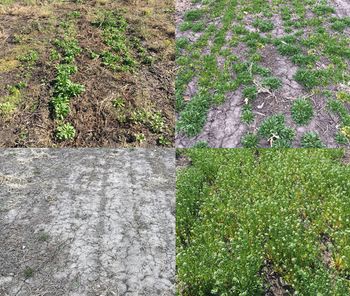
Fall green soil cover in 2017 was greatest in I-RYE and I-PEN, and lowest in I-MUST and NC (Table 1). However, by spring 2018, green soil cover was greatest in I-PEN, followed by I-RYE, NC and I-MUST treatments (Fig. 1). Visual estimates in spring 2018 were greatest in I-PEN and similar to green soil cover estimates. Cover crop biomass in spring 2018 was greatest for I-RYE and I-PEN, and lowest in NC and I-MUST treatments. Cover crop soil coverage and biomass trends in 2017/18 were different from the prior season due in large part to the earlier planting date of edamame (May vs July) and cover crops (June vs August). The earlier edamame planting date resulted in a longer period of vegetative growth and duration of light interference for interseeded cover crop seedlings emerged beneath the crop canopy. Hively and Cox (Reference Hively and Cox2001) reported a range of 0.1–1.1 Mg ha−1 spring cover crop biomass from interseeded clovers (Trifolium spp.), alfalfa (Medicago sativa L.), creeping red fescue (Festuca rubra L.) and annual ryegrass (Lolium multiflorum L.) in soybean, which is considerably less than range of biomass achieved in this study with I-PEN (0.4–2.5 Mg ha−1) and I-RYE (3.3–4.7 Mg ha−1).
Pennycress ground cover on 16 October 2017 (top left), 11 April 2018 (top right) and 27 April 2018 (bottom right), compared to a no cover crop control on 11 April 2018 (bottom left).

Opportunities and limitations of using pennycress as a cover crop
The rapid germination and emergence of cover crop seed, normally an asset, can be a liability in an interseeded cover cropping system due to intense light interference and subsequent stand loss (Hively and Cox, Reference Hively and Cox2001). In contrast, pennycress, with its inherent dormancy mechanisms (Hazebroek and Metzger, Reference Hazebroek and Metzger1990) and narrow germination windows (Royo-Esnal et al., Reference Royo-Esnal, Necajeva, Torra, Recasens and Gesch2015) is well-adapted to interseeding in summer annual cash crops. There are ongoing efforts to domesticate and improve pennycress as a cash crop and cover crop, but in many cases this genetic improvement leads to an intentional loss of seed dormancy traits (Sedbrook et al., Reference Sedbrook, Phippen and Marks2014). However, this study demonstrates the potential utility of seed dormancy traits for increasing flexibility of seeding dates and methods in summer annual cash crops.
One additional benefit of pennycress, when assessed as a cover crop, is its ability to reseed itself. In Nebraska, pennycress flowers in April (Fig. 1) and can reach physiological maturity by late-May. If cover crop termination was delayed until after maturity of the pennycress, the seed dormancy trait and seed chilling requirements would mitigate potential competition with the subsequent crop in rotation. In fact, it is unlikely that seeds from that population would begin to germinate until the following spring or fall (due to seed chilling requirements), and any seedlings that emerged in the spring (which is not uncommon for some local accessions; Royo-Esnal et al., Reference Royo-Esnal, Necajeva, Torra, Recasens and Gesch2015) could be managed chemically or mechanically along with other ambient weeds.
Potential pitfalls of this ecological cover cropping approach, outlined in Wortman (Reference Wortman2016), include limitations on crop rotation diversity (due to seed accumulation and persistence in the seedbank), potential for the evolution of herbicide resistance in pennycress and competition for water or nutrients in resource-limiting environments. However, despite evidence that supports the diversification of Midwest USA cropping systems with winter annual grains and perennial forages (Davis et al., Reference Davis, Hill, Chase, Johanns and Liebman2012), the landscape is still dominated by summer annual crops that would not be negatively affected by the proposed pennycress interseeding system. There are currently no documented cases of herbicide resistance in pennycress accessions of the Midwest USA, due in large part to a lack of cropping systems’ diversification and selection pressure from herbicide applications in winter annual crops (Heap, Reference Heap2019). Moreover, because pennycress completes its life cycle by late-May, chemical control prior to planting summer annual crops may not be necessary. Last, concerns about pennycress contributing to resource competition or pest problems in subsequent crops are not different from management concerns related to any cover crop species. In fact, pest problems in subsequent crops should be reduced in pennycress given its limited capacity for biomass productivity and low residue remaining on the surface (maximum of 2.5 Mg ha−1 pennycress compared to a maximum of 4.7 Mg ha−1 rye observed in this study).
While this study was focused on cover crop establishment and soil cover (and the inferred ecosystem services of nutrient recovery and reduced erosion), growers will also be interested in the effects of pennycress on soil biota, weeds and pollinators. As a member of the Brassicaceae family, it is unlikely that pennycress roots will be colonized by arbuscular mycorrhizal fungi (Regvar et al., Reference Regvar, Vogel, Irgel, Wraber, Hildebrandt, Wilde and Bothe2003), but its relationship to other soil biota and soil health more generally are unknown. Similarly, Brassicaceae cover crops are often chosen for their glucosinolate levels that can be leveraged for biofumigation of soil-borne pathogens or allelopathic control of weed seed germination (Haramoto and Gallandt, Reference Haramoto and Gallandt2005). Field pennycress does contain glucosinolates (Tolrà et al., Reference Tolrà, Pongrac, Poschenrieder, Vogel-Mikuš, Regvar and Barceló2006), but its utility as a biofumigant or weed suppressive cover crop residue will also depend on its biomass potential (which appears somewhat limited; 0.4–2.5 Mg ha−1 observed in this study). Eberle et al. (Reference Eberle, Thom, Nemec, Forcella, Lundgren, Gesch, Riedell, Papiernik, Wagner, Peterson and Eklund2015) demonstrated the capacity for flowering pennycress to increase pollinator activity, but additional research is needed to assess the environmental and economic tradeoffs of allowing the time for a pennycress cover crop to reach flowering in a summer annual cropping system. Overall, the effects of an interseeded pennycress cover crop on agronomic and ecosystem services are largely unknown and represent an important area of future research.
Conclusions
Results of this 2-year preliminary study suggest that interseeding cover crops into edamame 1 month after planting does not limit crop yield, but prolonged shading beneath the crop canopy can result in reduced cover crop biomass and fallow soil cover. Pennycress seedling emergence was better synchronized with edamame maturity and harvest (compared to rye and mustard), which resulted in more consistent establishment and soil cover. This study demonstrates the utility of pennycress as an interseeded cover crop, but perhaps more importantly, highlights the potential value of seed dormancy traits in cover crops. Acknowledging this value will require a shift in how we prioritize future cover crop breeding efforts.
Author ORCIDs
Sam E. Wortman, 0000-0001-5021-0899
Acknowledgements
I wish to acknowledge Tomie Galusha for his field technical support in completing this research. This project is based on research that was partially supported by the Nebraska Agricultural Experiment Station with funding from the Hatch Act (accession 1014303) through the USDA National Institute of Food and Agriculture (NIFA).