Introduction
Echinococcus multilocularis is a two-host parasite whose cycle in Europe includes mainly red fox (Vulpes vulpes) as definitive host, and grassland voles (Microtus arvalis and Arvicola terrestris) as intermediate hosts (Rausch, Reference Rausch, Thompson and Lymbery1995). Its larval form is responsible for alveolar echinococcosis (AE), the most potentially lethal parasitic infection in humans in non-tropical areas of the northern hemisphere (Vuitton et al., Reference Vuitton, Zhou, Bresson-Hadni, Wang, Piarroux, Raoul and Giraudoux2003). An apparent prevalence rise has been observed in fox populations within endemic areas, possibly linked to red fox population density increases (Romig et al., Reference Romig, Bilger, Dinkel, Merli and Mackenstedt1999a; Raoul et al., Reference Raoul, Michelat, Ordinaire, Décoté, Aubert, Delattre, Deplazes and Giraudoux2003; König et al., Reference König, Romig, Thoma and Kellermann2005; Duscher et al., Reference Duscher, Pleydell, Prosl and Joachim2006). Moreover, parasitological surveys, undertaken in several European fox populations, led to the identification of new endemic areas that are contiguous with those known historically, even if this apparent range expansion could be, at least partly, due to an increase in field investigations (Romig et al., Reference Romig, Dinkel and Mackenstedt2006). Following Pleydell et al. (Reference Pleydell, Raoul, Vaniscotte, Craig, Giraudoux, Morand, Krasnov and Poulin2006): ‘These current trends are naturally of public health concern although it is currently unclear how emergence in wildlife and human populations might be linked’. Studies in highly endemic areas are thus needed to identify the respective importance of the ecological and biological factors involved in the transmission of E. multilocularis.
Small mammal intermediate host population dynamics, with their consequences for fox diet, have been shown to impact transmission (Saitoh & Takahashi, Reference Saitoh and Takahashi1998). Furthermore, worm burden is known to be highly aggregated in fox populations and is supposed to lead to a very aggregative distribution of E. multilocularis eggs in the field (Hansen et al., Reference Hansen, Tackmann, Jeltsch, Wissel and Thulke2003; Guislain et al., Reference Guislain, Raoul, Poulle and Giraudoux2007). Additionally, multi-annual, seasonal and age-dependent variations of E. multilocularis prevalence have been shown in earlier studies (Tackmann et al., Reference Tackmann, Löschner, Mix, Staubach, Thulke and Conraths1998; Morishima et al., Reference Morishima, Tsukada, Nonaka, Oku and Kamiya1999; Romig et al., Reference Romig, Bilger, Dinkel, Merli and Mackenstedt1999a; Hofer et al., Reference Hofer, Gloor, Muller, Mathis, Hegglin and Deplazes2000; Berke, Reference Berke2001; Duscher et al., Reference Duscher, Pleydell, Prosl and Joachim2006). Infection rate of foxes depends on the fox immunity system (Eckert et al., Reference Eckert, Rausch, Gemmell, Giraudoux, Kamiya, Liu, Schantz, Romig, Eckert, Gemmell, Meslin and Pawloswki2001b; Gemmell et al., Reference Gemmell, Roberts, Beard, Lawson, Eckert, Gemmell, Meslin and Pawloswki2001). Thus one can hypothesize (Fromont et al., Reference Fromont, Sager, Léger, Bourgmestre, Jouquelet, Stahl, Pontier and Artois2000) that immunological condition is not independent of the health and nutritional condition of individual foxes.
The Doubs and the Ardennes, two north-eastern regions of France, can be considered as highly endemic because the cumulative AE incidence rate in these regions ranged from 1 to 10 cases per 100,000 inhabitants during the period 1988–2005 (Craig, Reference Craig2003; Piarroux et al., Reference Piarroux, Bresson-Hadni, Capek, Knapp, Watelet, Dumortier, Abergel, Minello, Gérard, Beytout, Piarroux, Kantelop, Delabrousse, Vaillant, Vuitton and FrancEchino2006). Several studies have been conducted for more than 20 years in the Doubs, since this region has been known to be hyper-endemic for several decades (Bresson-Hadni et al., Reference Bresson-Hadni, Laplante, Lenys, Rohmer, Gottstein, Jacquier, Mercet, Meyer, Miguet and Vuitton1994; Vuitton et al., Reference Vuitton, Zhou, Bresson-Hadni, Wang, Piarroux, Raoul and Giraudoux2003). The prevalence of E. multilocularis in fox populations has been estimated to vary from 20 to 60%, with a higher prevalence recorded in the intermediate plateau, between 600 and 900 m above sea level (Raoul et al., Reference Raoul, Nonaka, Piarroux, Vuitton and Giraudoux2001a; Giraudoux et al., Reference Giraudoux, Delattre, Takahashi, Raoul, Quéré, Craig, Vuitton, Craig and Pawlowski2002). There, the presence of large patches of permanent grassland favours population outbreaks of arvicolid grassland rodents, i.e. M. arvalis and A. terrestris (Giraudoux et al., Reference Giraudoux, Craig, Delattre, Bao, Bartholomot, Harraga, Quéré, Raoul, Wang, Shi and Vuitton2003). During the high-density phase of these outbreaks, foxes specialize and feed almost exclusively on these prey, which may enhance transmission (Weber & Aubry, Reference Weber and Aubry1993; Giraudoux et al., Reference Giraudoux, Delattre, Takahashi, Raoul, Quéré, Craig, Vuitton, Craig and Pawlowski2002). Moreover, in the Doubs region, the incidence of human AE was higher where outbreaks of A. terrestris were more frequent, suggesting an important role of this species in transmission (Viel et al., Reference Viel, Giraudoux, Abrial and Bresson-Hadni1999).
Results from the Doubs, but also from Hokkaido (Japan), western and central China, and Alaska, where population outbreaks of rodents (Arvicolinae and Cricetinae sub-families) and/or lagomorphs (Ochotonidae family) occur regularly, outlined the importance of population dynamic patterns of a focal intermediate host (or a group of hosts), dominant in terms of biomass, in the transmission of E. multilocularis (for reviews, see Giraudoux et al., Reference Giraudoux, Delattre, Takahashi, Raoul, Quéré, Craig, Vuitton, Craig and Pawlowski2002, Reference Giraudoux, Craig, Delattre, Bao, Bartholomot, Harraga, Quéré, Raoul, Wang, Shi and Vuitton2003). However, few data are available on the role of fox predation on E. multilocularis transmission. The prevalence of E. multilocularis in foxes can be directly correlated with fox predation on an intermediate host species (Tanner et al., Reference Tanner, Hegglin, Thoma, Brosi and Deplazes2006). Furthermore, the relationship between intermediate host density variations and their proportion in fox diet (i.e. fox functional response) on E. multilocularis transmission is a key point in understanding variations in transmission intensity (Saitoh & Takahashi, Reference Saitoh and Takahashi1998; Hegglin et al., Reference Hegglin, Bontadina, Contesse, Gloor and Deplazes2007). In western Europe, most of the studies dealing with E. multilocularis transmission have been conducted in mountainous areas, and no data are available on the relationships between intermediate and definitive hosts of E. multilocularis in areas of lower altitude with different landscapes and small mammal population dynamics, such as in the Ardennes, which is another endemic area of eastern France.
The aim of our study was to estimate the respective importance of ecological (extrinsic) and biological (intrinsic) factors involved in the transmission of E. multilocularis in the French Ardennes. We attempted to: (1) estimate the variation of the relative abundance of Microtus sp. and A. terrestris, the main intermediate hosts in Europe; (2) link their respective occurrence in the fox diet to their abundance in the field; (3) determine E. multilocularis prevalence in fox populations and the distribution of the worm burden in foxes; and (4) explore the effects of individual parameters (sex, age class, and health and nutritional condition) and the multi-annual and seasonal variations of E. multilocularis prevalence and intensity of infection in foxes.
Material and methods
Study area
The study was conducted from 2001 to 2005 on a 900 km2 area located in north-eastern France, corresponding to the south-eastern part of the French Ardennes region. The altitude in the study area ranges from 200 to 300 m above sea level. Climate is sub-continental with average temperatures lower than 6°C for 5 months of the year, and precipitation is regular all the year long, with an average of 60 mm per month. The landscape is composed of 60% agricultural land and 35% forests. Arable land and grassland represent 46 and 53%, respectively, of the agricultural land (http://ddaf.ardennes.agriculture.gouv.fr). The human population density is very low (10 inhabitants/km2) and is spread out in very small villages. Red fox population density estimates ranged from three to four foxes per km2, with no significant differences between years (Henry et al., Reference Henry, Poulle and Roeder2005; Guislain et al., Reference Guislain, Raoul, Poulle and Giraudoux2007).
Estimation of intermediate host relative density
The relative densities of the main intermediate host species were estimated by index methods (Giraudoux et al., Reference Giraudoux, Pradier, Delattre, Deblay, Salvi and Defaut1995; Delattre et al., Reference Delattre, de Sousa, Fichet-Calvet, Quéré and Giraudoux1999; Quéré et al., Reference Quéré, Raoul, Giraudoux and Delattre2000) usually employed for the large-range estimation of small mammal relative density (Hansson, Reference Hansson1979; Delattre et al., Reference Delattre, de Sousa, Fichet-Calvet, Quéré and Giraudoux1999; Fichet-Calvet et al., Reference Fichet-Calvet, Jomaa, Giraudoux and Ashford1999; Quéré et al., Reference Quéré, Raoul, Giraudoux and Delattre2000). The relative abundances of Microtus sp. (corresponding mostly to M. arvalis, but one cannot exclude sporadic confusion with the rarer M. agrestis, the two species displaying similar ground indices in hedgerows and fallows) and of A. terrestris were determined along a line across the study area. The transect line was subdivided into 10 paces intervals (approximately 10 m) and a strip of land 5 m wide and centred on the transect line was observed. The presence or absence of vole indices was recorded for each interval. The relative abundance of each species was calculated as the ratio of the number of positive intervals to the total number of intervals. Five transect sessions were performed: March 2004, October 2004, December 2004, March 2005 and October 2005 when vegetation was at its shortest. Transects were walked in forest, arable land, pasture, meadow, lower-height vegetation edge, medium-height vegetation edge, hedge and bank, in five sites within a 90 km2 area.
Estimation of fox diet
All carnivore faeces found during transects, and identified as fox faeces on the basis of their odour and shape, were collected. They were individually labelled, decontaminated at − 80°C, and then stored for further content investigation. Faeces were washed with water above a sieve (500 μm mesh size) to isolate macroscopic undigested remains. Specific identification of mammal remains was carried out, examining teeth (when present) for rodents (Erome & Aulagnier, Reference Erome and Aulagnier1982) and/or examining hairs (Debrot et al., Reference Debrot, Fivaz, Mermod and Weber1982). Food categories taken into account were: Microtus sp. and A. terrestris (grassland rodents), Apodemus sp. and Clethrionomys glareolus (forest rodents), mammals other than rodents, birds, invertebrates and fruits. Microtus arvalis and M. agrestis, as well as Apodemus flavicollis and A. sylvaticus, could not be easily differentiated because of the low quality of bones and teeth remains in fox faeces. Following the recommendations of Ciucci et al. (Reference Ciucci, Boitani, Pelliccioni, Rocco and Guy1996) the frequency with which each food item occurred was expressed as a percentage of the total number of occurrences of all food items.
Detection of E. multilocularis in foxes
From January 2001 to March 2005, 149 fox carcasses, most of them trapped, hunted, or killed by traffic, were collected from trappers, hunters and some inhabitants of the study area. The seven carcasses collected in 2001, the 25 carcasses collected in 2002 and the 18 carcasses collected in 2003 were pooled together. A total of 63 and 36 carcasses were collected in 2004 and 2005, respectively. Period of collection was divided into winter (January–March), spring (April–June), summer (July–September) and autumn (October–December) for further data analysis. Carcasses were stored at − 20°C until necropsy. Foxes were sexed and their age was estimated following Chalon et al. (Reference Chalon, Brochier, Bauduin, Mosselmands and Pastoret1998), by determining the closing degree of the tooth pulp cavity and counting annual cementum rings on a canine of the inferior jaw. A health and nutritional condition (healthy, weak or sick) was attributed to each fox, based on weight, adiposity and observed lesions. One of the following age classes was also attributed to each fox: ‘pup’ (from 0 to 6 months old), ‘subadult’ (from 6 to 24 months old), ‘adult’ (from 2 to 5 years old) and ‘old adult’ (more than 5 years old).
Stomachs and intestines were tied with a double ligature and stored at − 80°C during at least 1 week for decontamination (Eckert et al., Reference Eckert, Gottstein, Heath, Liu, Eckert, Gemmell, Meslin and Pawloswki2001a). Stomachs were preserved for further diet study. Their contents were analysed and identified in the same way as the faeces collected along transects. The intestines were inspected with the sedimentation and counting technique (SCT, Eckert, Reference Eckert2003), following the recommendations of Raoul et al. (Reference Raoul, Defaut, Michelat, Montadert, Pépin, Quéré, Tissot, Delattre and Giraudoux2001b), looking for the presence of E. multilocularis and to quantify worm burden. Furthermore, inspection was made in accordance with safety procedures recommended by Eckert et al. (Reference Eckert, Gottstein, Heath, Liu, Eckert, Gemmell, Meslin and Pawloswki2001a). Identification of worms was based on morphological criteria, in particular the differential diagnosis between E. multilocularis and some small tapeworms belonging to the genus Amoebotaenia, both found commonly in the small intestine of red foxes (Petavy & Deblock, Reference Petavy and Deblock1980). Identification of E. multilocularis worms was confirmed by fragment analyses of EmsB microsatellite target if necessary (Bart et al., Reference Bart, Breyer, Gottstein, Romig and Piarroux2003; Knapp et al., Reference Knapp, Bart, Glowatzki, Ito, Gerard, Maillard and Piarroux2007).
Statistical analysis
The distributions of food item frequencies between faeces and stomach contents were compared using Pearson's χ2, exact χ2 was used for expected values lower than ten when comparing rodent species frequencies (StatXact software). The relationship between Microtus sp. or A. terrestris relative densities in the field per session – obtained by pooling the results of all transects walked during the given session – and the corresponding frequencies of occurrences of these two species in the faeces was tested using Spearman's rank correlation (Siegel & Castellan, Reference Siegel and Castellan1988). The influence of variables on fox prevalence was tested using logistic regression. Models were built successively incorporating the variables ‘sex’, ‘year’, ‘season’, ‘age class’ and ‘condition’ (this last corresponding to the health and nutritional condition). Models were compared using the information theoretic method outlined by Burnham & Anderson (Reference Burnham and Anderson2002), and were presented according to Anderson et al. (Reference Anderson, Link, Johnson and Burnham2001). Worm burden was modelled using a negative binomial distribution (Hudson et al., Reference Hudson, Rizzoli, Grenfell, Heersterbeek and Dobson2002). Analyses were done using R 2.2.1 (R Development Core Team, 2005) and pgirmess 1.2.5 package (Giraudoux, Reference Giraudoux2006).
Results
Intermediate host relative densities
From 3855 to 3943 transect intervals were walked per season. Microtus sp. relative density increased over time from 3.3% (3.3 positive intervals per 100 walked intervals) in March 2004, to 4.0% in October 2004, 8.4% in December 2004, 9.5% in March 2005 and 10.7% in October 2005. Arvicola terrestris relative density was always lower, varying slightly from 0.2% in March 2004 to 1.0% in October 2004, 1.2% in December 2004, 1.4% in March 2005 and 2.6% in October 2005.
Fox diet in relation to intermediate host densities
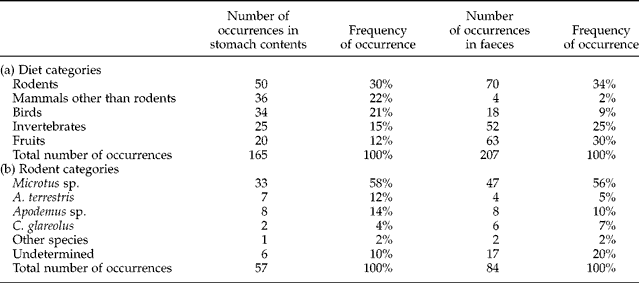
We collected 26, 49 and 23 stomach contents in 2001–2003, 2004 and 2005, respectively, and 60, 29, 24, 22 and 9 fox faeces in March 2004, October 2004, December 2004, March 2005 and October 2005, respectively. From the 98 stomach contents containing at least one nutritive item, 165 food items were analysed, and 207 food items were analysed from the 144 faeces collected in the field. The frequencies of the food categories differed significantly between stomach contents and faeces (χ2 = 64.64, P < 0.001). Remains of mammals other than rodents and birds were more frequent in stomach contents than in faeces, whereas remains of invertebrates and fruits were more frequent in faeces (table 1). In contrast, frequencies of rodents did not differ significantly between stomach contents and faeces (χ2 = 0.519, P = 0.471).
Number and frequency of occurrences of (a) diet categories from the total number of stomach contents (N=98) and faeces (N=144) analysed, (b) rodent categories from the total number of stomach contents (N=50) and faeces (N=70) containing rodent items.
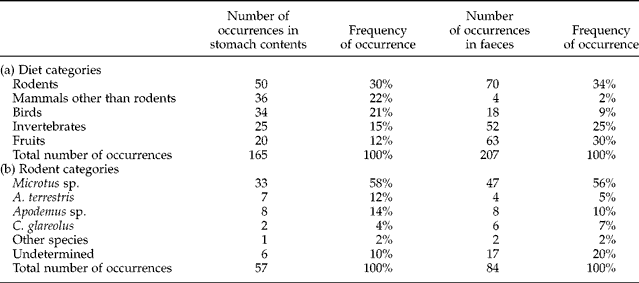
Rodents appeared in 51% of the stomach contents, where they represented 30% of the food items, whereas they appeared in 49% of the faeces where they represented 34% of the food items. The majority of identified rodent remains belonged to Microtus sp., A. terrestris and Apodemus sp. (table 1). The frequencies of these three species did not differ significantly between stomach contents and faeces (χ2 = 2.160, P = 0.3546; table 1). Apodemus sp. and C. glareolus were little consumed since they only represented 4–14% of the occurrences. Arvicola terrestris was detected in only 7% of the stomach contents and 3% of the faeces (table 1). Microtus sp. was the most consumed rodent since it occurred in 34% of the stomach contents, where it represented 58% of the rodent occurrences, and was present in 33% of the faeces, where it represented 56% of rodent occurrences (table 1).
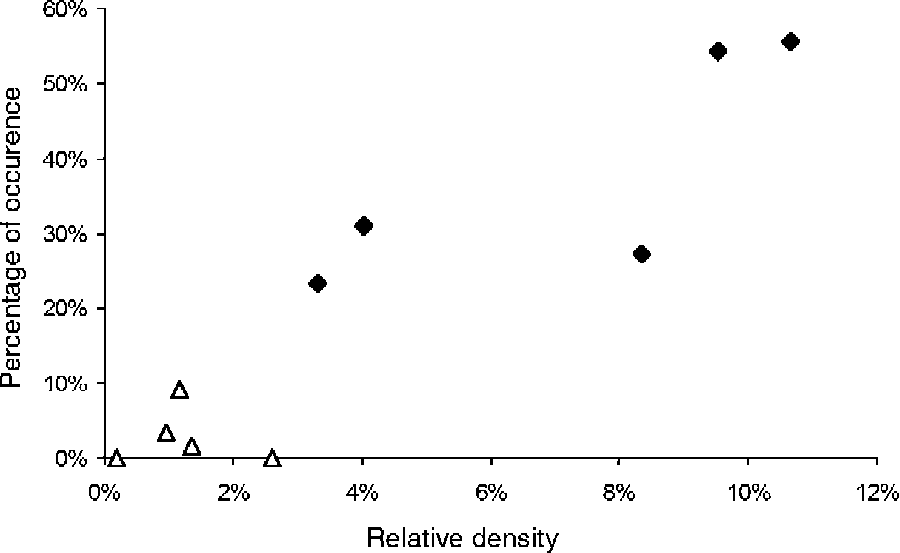
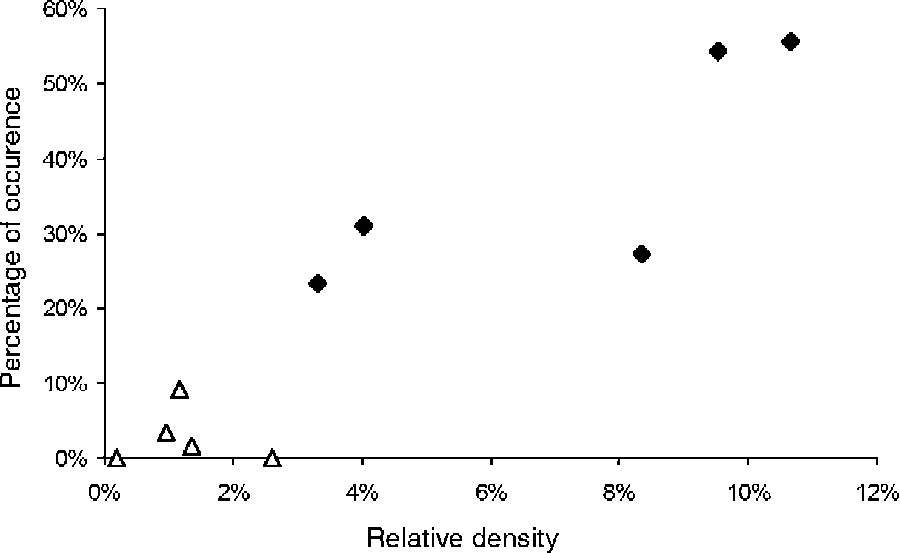
The frequency of occurrence of A. terrestris in fox faeces collected along transects was not correlated with the relative density of A. terrestris in the field (r s = − 0.1; n = 5, P = 0.435) (fig. 1). By contrast, the frequency of occurrence of Microtus sp. in faeces was significantly correlated to the relative density of Microtus sp. population in the field (r s = 0.9, n = 5, P = 0.019) (fig. 1).
Relationship between relative densities of Microtus sp. (♦) and Arvicola terrestris (△) estimated from transect sessions and percentage of occurrence of those voles in faeces collected during these sessions (transect sessions: March 2004, October 2004, December 2004, March 2005, October 2005).
Prevalence and intensity of infection of E. multilocularis in the fox population
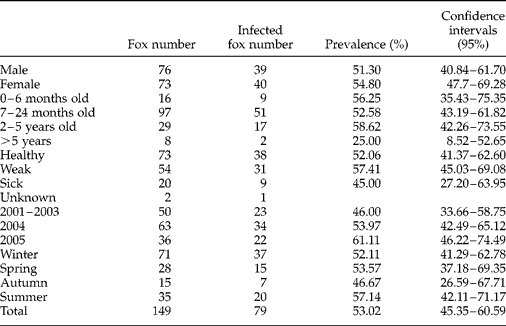
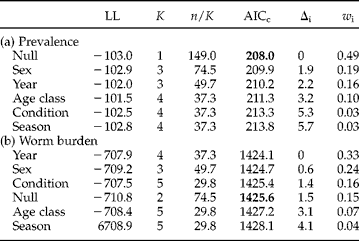
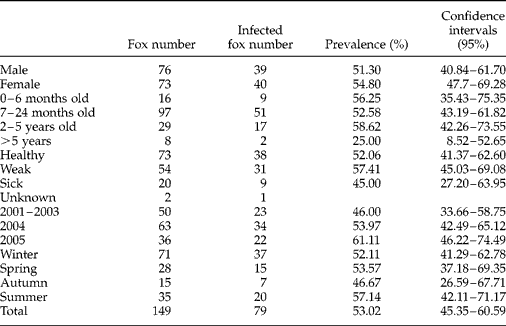
Seventy-nine out of the 149 necropsied foxes harboured E. multilocularis, corresponding to a prevalence of 53% (95% confidence interval (CI) 45.4–60.6%). Table 2 shows the prevalence according to sex, age class, health and nutritional condition, year and season. Annual prevalence varied from 46 to 61%. Estimates of worm burdens varied from 2 to 73,380 worms per fox, with a total parasitic biomass of 270,270 worms. Worm burdens were distributed heterogeneously: 7.6% of sampled foxes harboured 71.7% of the total worm burden (table 3). For both prevalence and worm burden, the models with the lowest AICc and in accordance with parsimony were the null models, indicating that no effect of the explanatory variables could be detected (table 4).
Fox number, number of foxes infected with E. multilocularis, corresponding prevalence and confidence intervals in the fox population from the Ardennes, according to host sex, host age class, health and nutritional condition of the host, year of collection and season of collection.
Number of infected foxes, percentage of the total number of infected foxes, E. multilocularis (E.m.) biomass (sum of the number of E.m. specimens harboured by foxes belonging to the given category) and percentage of the total E. multilocularis biomass, relative to worm burden categories (number of worms present in a fox intestine).

Comparisons of models for (a) E. multilocularis prevalence in fox population and (b) worm burden (intensity of infection) on fox population, using the following variables: host sex (Sex), year of collection (Year), host age class (Age class), health and nutritional condition (Condition), and season of collection (Season).
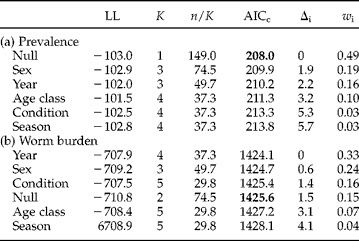
LL, maximized log-likelihood; K, number of estimated parameters; n/K, number of observations/K; AICc, second-order Akaïke Information Criterion; Δi, difference between AICc and the lowest value of AICc; w i, Akaïke weight. Bold characters, best AICc.
Discussion
Our study provides the first information on the sylvatic cycle of E. multilocularis in the Ardennes region, where cases of human contamination with alveolar echinococcosis have been reported for more than 20 years (Depaquit et al., Reference Depaquit, Gallego, Usseglio, Liance and Favriel1998; Piarroux et al., Reference Piarroux, Bresson-Hadni, Capek, Knapp, Watelet, Dumortier, Abergel, Minello, Gérard, Beytout, Piarroux, Kantelop, Delabrousse, Vaillant, Vuitton and FrancEchino2006). We estimated the prevalence in the fox population to range between 45.4 and 60.6%, a value similar to those recorded in the Doubs region, France (Raoul et al., Reference Raoul, Defaut, Michelat, Montadert, Pépin, Quéré, Tissot, Delattre and Giraudoux2001b), the city of Zurich, Switzerland (Hofer et al., Reference Hofer, Gloor, Muller, Mathis, Hegglin and Deplazes2000), the Swabian Jura, Germany (Romig et al., Reference Romig, Kratzer, Kimmig, Frosch, Gaus, Flegel, Gottstein, Lucius, Beckh and Kern1999b) and the Voralberg and Tyrol regions, Austria (Duscher et al., Reference Duscher, Pleydell, Prosl and Joachim2006), all regions where human cases have been detected in the past. In our study, less than 8% of foxes carried more than 72% of the parasite biomass, individual burdens ranging from 1 to more than 73,000 worms. This confirms the very heterogeneous distribution of the parasitic biomass in the red fox population, already described by Hofer et al. (Reference Hofer, Gloor, Muller, Mathis, Hegglin and Deplazes2000), Raoul et al. (Reference Raoul, Defaut, Michelat, Montadert, Pépin, Quéré, Tissot, Delattre and Giraudoux2001b), Yimam et al. (Reference Yimam, Nonaka, Oku and Kamiya2002) and Fischer et al. (Reference Fischer, Reperant, Weber, Hegglin and Deplazes2005).
We failed to detect any significant effect of individual factors (sex, age, health and nutritional condition) on prevalence rate in foxes and on fox worm burden. Although host sex could induce different prevalence rates (Wilson et al., Reference Wilson, Bjørnstad, Dobson, Merler, Poglayen, Randolph, Read, Skorping, Hudson, Rizzoli, Grenfell, Heesterbeek and Dobson2002), our results agree with those of Kritsky & Leiby (1978) and Yimam et al. (Reference Yimam, Nonaka, Oku and Kamiya2002) who did not detect age- or sex-related differences in prevalence and worm burden. Fischer et al. (Reference Fischer, Reperant, Weber, Hegglin and Deplazes2005) did not detect a sex effect but found that young foxes ( < 1 year old) carried higher worm burdens. Morishima et al. (Reference Morishima, Tsukada, Nonaka, Oku and Kamiya1999), Hofer et al. (Reference Hofer, Gloor, Muller, Mathis, Hegglin and Deplazes2000), Yimam et al. (Reference Yimam, Nonaka, Oku and Kamiya2002) and Losson et al. (Reference Losson, Kervyn, Detry, Pastoret, Mignon and Brochier2003) also reported a significantly higher prevalence in cubs. Lower prevalence and worm burden in adults are supposed to be the result of acquired immunity following repeated ingestion of contaminated rodents (Tackmann et al., Reference Tackmann, Löschner, Mix, Staubach, Thulke and Conraths1998). We also failed to detect any significant effect of multi-annual and seasonal variations on fox infection rate and worm burden, perhaps due to a short time course and too small a seasonal sample size.
The final transition in the life cycle of E. multilocularis is from protoscolex to adult, and this requires that a fox ingests an infective rodent. This prey–predator relationship is governed by many factors, including the spatial distribution of fox faeces, as well as fox and small mammal population densities, making transmission intensity higher. Furthermore, although such interactions in the field have yet to be documented, the parasite could have an impact on host mobility, making infected small mammals more likely to be eaten (see Pleydell et al., Reference Pleydell, Raoul, Vaniscotte, Craig, Giraudoux, Morand, Krasnov and Poulin2006). The role of rodent density on infection rate in foxes has already been demonstrated in Japan (Saitoh & Takahashi, Reference Saitoh and Takahashi1998), as well as a direct role of fox intermediate host consumption on E. multilocularis prevalence in foxes (Tanner et al., Reference Tanner, Hegglin, Thoma, Brosi and Deplazes2006). Predation patterns of foxes are thus the key influences behind transmission. In general, relationships were found between large densities of some species in a small mammal community, the dominance of these species in fox diet, and intensive parasite transmission to foxes and to humans (Rausch, Reference Rausch, Thompson and Lymbery1995; Viel et al., Reference Viel, Giraudoux, Abrial and Bresson-Hadni1999; Hofer et al., Reference Hofer, Gloor, Muller, Mathis, Hegglin and Deplazes2000; Gottstein et al., Reference Gottstein, Saucy, Deplazes, Reichen, Demierre, Busato, Zuercher and Pugin2001; Raoul, Reference Raoul2001). This is the case, for instance, for Microtus oeconomus in St Lawrence Island, M. arvalis and A. terrestris in the Jura massif in France and Switzerland, A. terrestris in the city of Zurich (Hegglin et al., Reference Hegglin, Bontadina, Contesse, Gloor and Deplazes2007) and Clethrionomys rufocanus in Hokkaïdo, Japan. In our study area, fox contamination via predation on forest rodents, C. glareolus and Apodemus sp., is thus unlikely, since those species were shown to be little consumed by foxes, as already described elsewhere by MacDonald (Reference MacDonald1977), Poulle (Reference Poulle1991) and Ferrari & Weber (Reference Ferrari and Weber1995). The abundance index of A. terrestris in the field never exceeded 3% during the study period, whereas it reached more than 40% in Zurich (Hegglin et al., Reference Hegglin, Bontadina, Contesse, Gloor and Deplazes2007) and more than 75% locally during population peaks in the Doubs department (Raoul, Reference Raoul2001). In the present study, we found A. terrestris at a low rate in the fox diet, with no correlation between frequency in the diet and relative density in the field. This may suggest that A. terrestris plays a limited role in E. multilocularis transmission in our study area, as also observed by Tanner et al. (Reference Tanner, Hegglin, Thoma, Brosi and Deplazes2006) in the alpine canton of Grisons, Switzerland, in a geographically heterogeneous habitat.
In contrast, voles from the genus Microtus were the main prey items in the fox diet, although the relative abundance of Microtus was relatively low (3.3–11.7%) when compared to abundances sometimes reaching 80% during outbreaks in Franche-Comté (Delattre et al., Reference Delattre, Giraudoux, Baudry, Quéré and Fichet1996, Reference Delattre, de Sousa, Fichet-Calvet, Quéré and Giraudoux1999). Additionally, we found that Microtus frequency in the diet was correlated to relative abundance in the field. The strong preference of the red fox for the genus Microtus is known (for a review, see Artois, Reference Artois1989). Interestingly, in our case, this behaviour may explain why a large prevalence of E. multilocularis was observed in the fox population in the context of relatively low small mammal density. Fox infection was quite stable over the whole study period and this provides evidence of intense transmission on a regional scale in a context where no grassland rodent population outbreaks could be recorded. Moreover, in contrast to previous studies from regions where A. terrestris (alone or with M. arvalis) was suspected to play a key role (Viel et al., Reference Viel, Giraudoux, Abrial and Bresson-Hadni1999; Raoul et al., Reference Raoul, Defaut, Michelat, Montadert, Pépin, Quéré, Tissot, Delattre and Giraudoux2001b; Hegglin et al., Reference Hegglin, Bontadina, Contesse, Gloor and Deplazes2007), our data suggest that E. multilocularis transmission in wildlife in western Europe can be sustained at a high rate with Microtus alone acting as the most probable key species.
Earlier studies cited above (Viel et al., Reference Viel, Giraudoux, Abrial and Bresson-Hadni1999; Raoul et al., Reference Raoul, Defaut, Michelat, Montadert, Pépin, Quéré, Tissot, Delattre and Giraudoux2001b; Hegglin et al., Reference Hegglin, Bontadina, Contesse, Gloor and Deplazes2007) showed decreasing gradients of prevalence between grassland areas with higher densities of small mammals and cultivated areas where outbreaks were unlikely. Our study documents what may be a usual pattern of transmission in western Europe, providing the first quantitative description of high E. multilocularis prevalence in foxes associated with fragmented grasslands and a low and quite stable level of intermediate host population without major outbreaks. This study raises questions, still to be clarified, regarding the reasons for a shift from transmission systems mostly controlled by small mammal densities to systems that may be controlled by other factors (e.g. long-term fox density increase).
Acknowledgements
Financial and logistic support for this study was provided by the French ‘Direction Régionale à la Recherche et à la Technologie’, the ‘Conseil Régional Champagne-Ardenne’, the ‘Communauté de Communes de l'Argonne Ardennaise’. We would like to thank the ‘Fédération départementale des Chasseurs des Ardennes’, as well as local hunters and inhabitants for their help in fox collection. We also thank Christophe Caillot, from ASSFA-LERRPAS, for ageing some of the autopsied foxes.