Healthcare-acquired infections (HAIs) due to Staphylococcus aureus are an important complication among infants admitted to neonatal intensive care units (NICUs).Reference Polin, Denson and Brady 1 – Reference Patrick, Kawai and Kleinman 4 Staphylococcus aureus is the second leading cause of HAIs in NICUs, with an annual estimated incidence of 44.8 invasive infections per 10,000 infants nationally.Reference Ericson, Popoola and Smith 5 Colonization precedes the development of most infections with S. aureus.Reference Gordon and Lowy 6 Critically ill infants and children colonized with MRSA are at a >20-fold increased risk for developing an invasive infection.Reference Zervou, Zacharioudakis, Ziakas and Mylonakis 7 Infants with a HAI caused by S. aureus frequently develop disseminated disease and require prolonged hospital length of stays (LOS) with increased associated healthcare costs.Reference Song, Perencevich, Campos, Short and Singh 8
Controlling the transmission of S. aureus within the NICU environment has proven challenging given the high prevalence of asymptomatic carriage within the community and the ability of staphylococci to contaminate environmental surfaces.Reference Katsuse Kanayama, Takahashi, Yoshizawa, Tateda, Kaneko and Kobayashi 9 – Reference Al-Tawfiq 14 Since its initial description in hospitalized neonates in 1980, the epidemiology of methicillin-resistant S. aureus (MRSA) within NICUs has been well studied with prematurity, low birth weight, and need for invasive medical procedures identified as risk factors for acquisition.Reference Price, Brain and Dickson 15 – Reference Washam, Woltmann, Haberman, Haslam and Staat 22 More recently, increased attention has been given to methicillin-susceptible S. aureus (MSSA) because infected infants have similar outcomes as infants infected with the methicillin-resistant phenotype.Reference Graham, Morel and Zhou 23 – Reference Romano-Bertrand, Filleron and Mesnage 27
Antecedent LOS itself is a risk factor for acquiring HAIs in hospitalized patients, which can complicate the interpretation of risk factors.Reference Delgadorodriguez, Buenocavanillas and Lopezgigosos 28 , Reference Freeman and Mcgowan 29 Within the NICU, an infant’s odds of MRSA colonization has been shown to increase 29% per 10 days in LOS.Reference Maraqa, Aigbivbalu and Masnita-Iusan 30 Date regarding the impact of LOS on previously identified risk factors for S. aureus acquisition in the NICU are limited. The objective of our study was to determine risk factors for MRSA and MSSA acquisition in a level IV referral NICU independent of LOS.
METHODS
Study Setting
We performed a retrospective matched case–case-control investigation of risk factors for acquisition of S. aureus within the NICU at Cincinnati Children’s Hospital Medical Center (CCHMC).Reference Kaye, Harris, Samore and Carmeli 31 CCHMC houses a quaternary care NICU which consists of 59 beds divided into 6 multibed pods (6–7 beds per pod) and 2 single-bed units (10–11 beds per unit). An active surveillance screening program has been in place since 2012 to identify infants colonized with S. aureus. Nares cultures (chromID MRSA and chromID S. aureus agar, bioMérieux, Marcy l’Etoile, France) are obtained on admission and once weekly during an infant’s hospitalization. Infants who acquire MRSA are placed in Contact Precautions for the remainder of their hospitalization. The NICU at CCHMC does not perform routine decolonization with intranasal mupirocin of infants colonized with MRSA. Chlorhexidine bathing is performed on infants with indwelling central venous catheters regardless of colonization status. This study was approved by the Institutional Review Board at CCHMC.
Study Design
Infants who were admitted to CCHMC’s NICU between January 1, 2014, and March 30, 2016, were eligible for inclusion in the study. Infants with a known history of S. aureus colonization or infection prior to transfer were excluded. Additionally, infants were excluded if their admission screening culture was positive for S. aureus or if a clinical culture was positive for S. aureus before hospital day 3. These excluded infants were included in colonization pressure calculations, however. The remaining infants were considered at-risk for acquisition and were included in the study. Infants who acquired S. aureus identified during a follow-up screening culture or a clinical culture obtained ≥ hospital day 3 were included as case patients. As infection prevention practices differed by resistance phenotype, cases were categorized as either MRSA or MSSA. Phenotypes for clinical isolates were determined using the Vitek 2 antimicrobial susceptibility testing system (bioMérieux, Marcy l’Etoile, France). Cases in infants who had cultures positive for both MRSA and MSSA during their admission were classified based on the first phenotype identified. The exposure time for each case was defined as the duration from admission to the date that the positive S. aureus culture was obtained. To control for LOS, matched controls were randomly selected from the at-risk population for each case using the exposure time as matching criteria in the primary analysis. Risk-set sampling was used to minimize bias associated with the retrospective design. Eligible controls for a case were the pool of infants who were hospitalized at least as long as the case patient’s exposure time and who either (1) never acquired S. aureus or (2) acquired S. aureus and had a longer exposure time than the case patient. As the exposure time varied per case patient, the pool of eligible controls differed between cases.
Data Collection
Clinical data on potential risk factors were abstracted from the electronic medical records for the case patients and controls, including maternal and infant demographics, complications of pregnancy, and birth information. For the exposure time, NICU level data were also collected for each case and control including surgical operations, bed location, days intubated, central-line days, and antibiotic use. Antibiotics were classified as anti-Staphylococcal β-lactams (anti-staphylococcal penicillin, penicillin plus β-lactamase inhibitor combination, cephalosporins, carbapenems), non–anti-staphylococcal β-lactams (eg, penicillin, ampicillin, amoxicillin), systemic anti-MRSA (eg, vancomycin, clindamycin), aminoglycosides, or other. The CCHMC’s Infection Prevention Program provided data on hand hygiene compliance within the NICU.
Statistical Analysis
In the primary analysis, MRSA cases were matched 3:1 and MSSA cases were matched 2:1 to detect an effect size of odds ratios ≥2.3 (MRSA) and ≥1.7 (MSSA) with 80% power and type I error of 5%. Average unit-wide hand hygiene compliance and colonization pressure (defined as the percentage of infants in the NICU who were either colonized or infected with MRSA or MSSA) were calculated for each case and control during the exposure time. Variables with an unadjusted P <.10 on bivariate conditional logistic regression along with variables determined a priori (ie, gestational age, birth weight, operation performed, colonizing pressure, and hand hygiene compliance) were included in the initial multivariate model. Stepwise conditional logistic regression was performed to determine the final adjusted effect sizes. Because LOS was controlled for as a matching variable in the primary analysis, a secondary post hoc analysis was performed on statistically significant variables identified in the final multivariate model, defined as P<.05, using Cox regression with the entire cohort of at-risk infants. As S. aureus transmission increases with colonization pressure >10%, clinical significance was defined as a 10% difference in hazard curves for the secondary analysis.Reference Popoola, Carroll, Ross, Reich, Perl and Milstone 32 All analyses were performed using STATA version 14.1 software (StataCorp, College Station, TX).
RESULTS
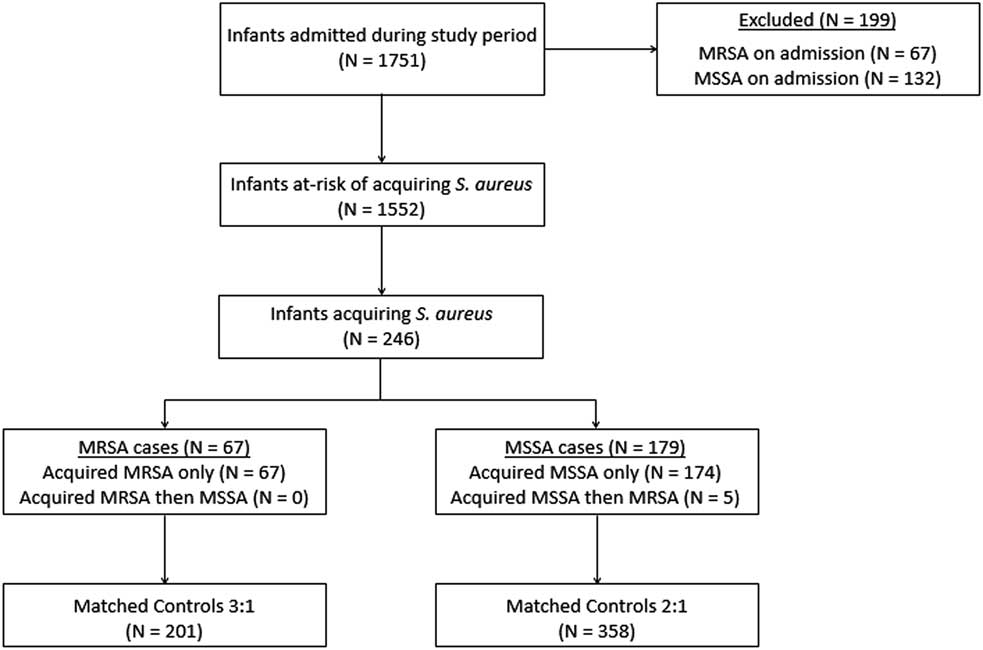
The distribution of infants admitted to the NICU at CCHMC during the study period is displayed in Figure 1. Across the entire cohort, LOS was associated with increased S. aureus acquisition (odds ratio [OR], 1.15 per weekly screening interval; 95% confidence interval [95% CI], 1.11 – 1.20). Of the 1,751 infants admitted during the study period, 1,552 (89%) were neither colonized nor infected with S. aureus at admission and were eligible for inclusion. Overall, 246 infants (15.9%) acquired incident S. aureus during their hospitalization at CCHMC’s NICU, including 67 (4.3%) with MRSA and 174 (11.2%) with MSSA alone. An additional 5 (0.3%) infants acquired both MRSA and MSSA; these infants were categorized as cases based on the first isolate identified (all 5 were MSSA cases). The 67 MRSA cases were matched with 201 controls. The 179 total MSSA cases were matched with 358 controls.
Flow diagram of infants admitted during the study period.

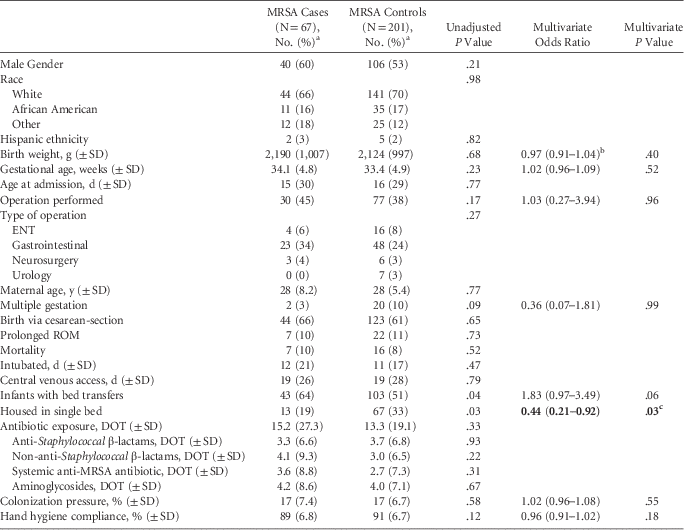
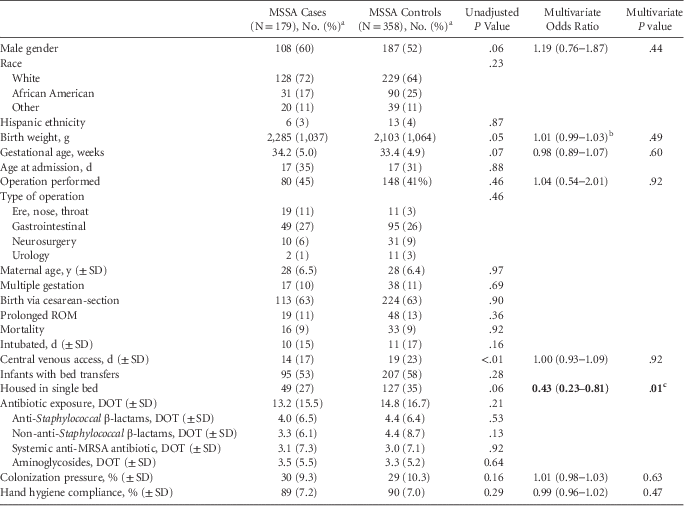
The results of the matched case-control analyses are displayed in Table 1 for MRSA and Table 2 for MSSA. After matching for exposure length, infants who were housed in the single-bed unit had lower odds of acquiring both MRSA (OR, 0.44; 95% CI, 0.21–0.92) and MSSA (OR, 0.43; 95% CI, 0.23–0.81) on multivariate analysis. Infants admitted to single-bed units had older postnatal ages compared to infants admitted to multibed pods (26 days vs 13 days; P<.01); however, the inclusion of postnatal age at admission in the multivariate analyses did not change the effect size noted for either MRSA or MSSA acquisition.
Potential Risk Factors Investigated for Methicillin-Resistant Staphylococcus aureus (MRSA)

NOTE. MRSA, methicillin-resistant Staphylococcus aureus; ENT, ear, nose, and throat; ROM, rupture of membranes; DOT, days-of-therapy.
a Unless otherwise specified. Controls matched by exposure time to cases 3:1 from the at-risk population.
b Per 100 grams.
c P<.05 was considered statistically significant.
Potential Risk Factors Investigated for Methicillin-Susceptible Staphylococcus aureus (MSSA)

NOTE. MSSA, methicillin-susceptible Staphylococcus aureus; ROM, rupture of membranes; DOT, days of therapy.
a Unless otherwise specified. Controls matched by exposure time to cases 2:1 from the at-risk population.
b Per 100 grams.
c P<.05 was considered statistically significant.
Infants who acquired MRSA had a nonsignificant increased exposure to systemic anti-MRSA antibiotics compared with controls (3.6 vs 2.7 days of therapy; P=.31). There were no significant differences between antibiotic exposure for infants acquiring MSSA and controls (P=.21). In addition, there were no significant differences between cases and controls in gestational age or birth weight for either MRSA (P=.52; P=.40) or MSSA (P=.60; P=.49). Furthermore, there was no difference in operations performed or central venous access utilization for infants who acquired MRSA (P=.96; P=.79) or MSSA (P=.92; P=.92).
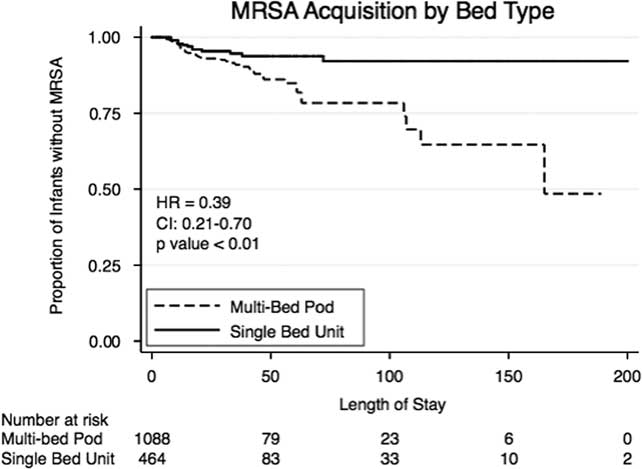
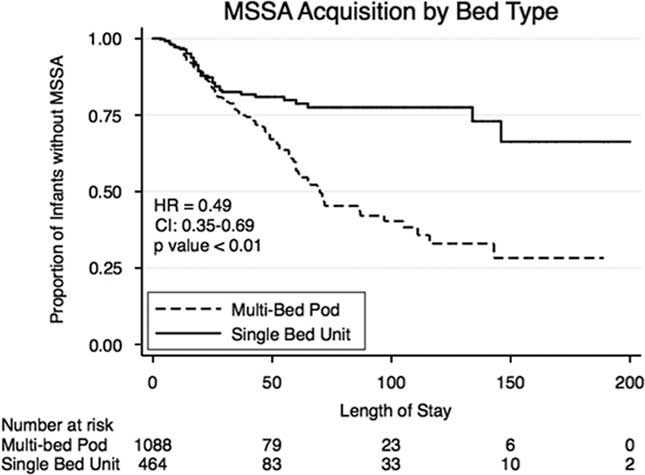
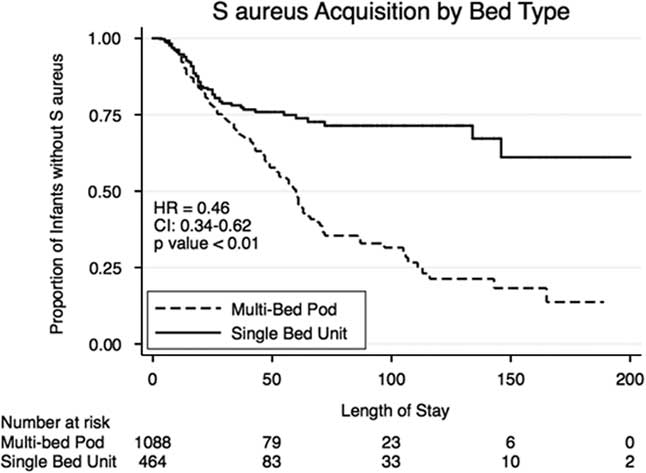
Because LOS was controlled in the primary analysis, a post hoc secondary analysis was performed on at-risk infants to determine rates of S. aureus acquisition stratified by room type across time. There was a significantly lower acquisition of both MRSA (hazard ratio [HR], 0.39; 95% CI, 0.21–0.70) and MSSA (HR, 0.49; 95% CI, 0.35–0.69) in infants housed in the single-bed units compared with the multibed pods for the cohort, which were similar to the effect sizes observed on matched analysis (Figure 2a and 2b). Pooling all S. aureus acquisition yielded a combined HR of 0.46 with a 95% CI of 0.34–0.62 (Figure 2c). A 10% area under the curve difference in S. aureus acquisition occurred between the 2 room types at hospital day 14, with a 10% point difference occurring at hospital day 41. Statistical deviation of the hazard curves occurred at hospital day 42.
Proportion of infants acquiring methicillin-resistant Staphylococcus aureus (MRSA) stratified by bed type.

Proportion of infants acquiring methicillin-susceptible Staphylococcus aureus (MSSA) stratified by bed type.

Proportion of infants acquiring Staphylococcus aureus stratified by bed type.

DISCUSSION
Infants admitted to the NICU are highly vulnerable to developing HAIs due to S. aureus.Reference Clark, Powers, White, Bloom, Sanchez and Benjamin 2 , Reference Giuffre, Bonura, Cipolla and Mammina 33 Prolonged LOS in the NICU increases the risk of acquiring S. aureus in hospitalized infants.Reference Maraqa, Aigbivbalu and Masnita-Iusan 30 Effect modification by LOS may alter the true effect size of many previously identified risk factors for S. aureus acquisition in the NICU, including lower gestational age and birth weight, central-venous catheterization, and endotracheal tube intubation.Reference Delgadorodriguez, Buenocavanillas and Lopezgigosos 28
A moderate incidence of S. aureus acquisition occurred in our quaternary-care referral NICU during the study period of approximately 15%. Controlling for LOS on both the matched case-control and cohort analyses identified infants housed in single-bed units as significantly less likely to acquire either MRSA or MSSA compared with infants housed in multibed pods. Clinically significant deviation occurred as early as 2 weeks of hospitalization with statistical deviation at 6 weeks of hospitalization. Colonization pressure did not differ between pod and single-bed units to account for this association. No other maternal or infant demographic, pregnancy or birth, or NICU level exposure risk factors differed among infants who acquired MRSA or MSSA.
As no outbreaks of S. aureus were identified during the study period, our data suggest that LOS and NICU bed design are key factors in the endemic transmission among infants. Previous data have shown no association with MRSA colonization incidence rates and bed configuration within a mixed bed NICU.Reference Julian, Burnham and Sellenriek 34 Potential reasons for our discordant findings include both an increased burden of MRSA (4.3% vs 2.7% incidence rate) and an increased proportion of multibed pods within our NICU (64% vs 51%). Additionally, LOS distributions may have differed across studies.
Single-bed units may facilitate infection-prevention interventions designed to reduce transmission, such as increasing adherence with appropriate hand hygiene and use of contact precautions. As overall hand hygiene compliance was high at 90%, our results suggest that there may be additional reasons for the reduced transmission in single-bed units as well. These reasons potentially include differing total numbers of direct and indirect encounters with healthcare workers for infants within single-bed rooms compared with infants in multibed pods as well as differing common areas within the NICU that may facilitate transmission by families and other nonhealthcare workers.
In NICUs with mixed bed types and high S. aureus prevalence, infants with anticipated prolonged hospitalizations longer than 2–4 weeks may benefit from room placement into single-bed units to reduce both the infant’s risk of S. aureus acquisition and unit-wide transmission risk. Broader strategies to reduce transmission should start in the architectural design phase of NICUs with increased emphasis on single-bed units to mitigate transmission. Additionally, multidisciplinary efforts to reduce premature birth rates would decrease the need for many prolonged NICU hospitalizations and help interrupt S. aureus transmission.
Our study has several limitations, including the retrospective design and inability to control for unit-specific hand hygiene compliance. Residual confounding of variables not included in the analysis, such as the colonization status of healthcare workers, families, and visitors, may have impacted the observed results. Additionally, our study was not powered to determine small effect sizes. Including additional study sites would improve the external validity of our findings. Future studies incorporating whole genome sequencing data will help in defining risk factors specific for direct infant-to-infant S. aureus transmission within the NICU.
ACKNOWLEDGMENTS
The authors wish to acknowledge the Infection Prevention Program and the Data Warehousing Team at CCHMC for assistance with data retrieval.
Financial support: No financial support was received for this study.
Potential conflicts of interest: All authors report no conflicts of interest relevant to this study.