Although there are no precise prevalence estimates of child maltreatment (including physical abuse, sexual abuse, emotional abuse, neglect, and exposure to intimate partner violence), there is widespread agreement and evidence that child maltreatment is a major public health issue. Maltreatment is associated with unique developmental trajectories in the form of adverse outcomes in several different domains (Afifi & MacMillan, Reference Afifi and MacMillan2011). Children exposed to maltreatment are at greater risk for behavioral problems (e.g., aggression and violence; Gershoff, Reference Gershoff2002; Lansford et al., Reference Lansford, Dodge, Pettit, Bates, Crozier and Kaplow2002), being involved in serious delinquent activities (Mersky, Topitzes, & Reynolds, Reference Mersky, Topitzes and Reynolds2012), risky sexual and substance use-related behaviors (Norman, Byambaa, Butchart, Scott, & Vos, Reference Norman, Byambaa, De, Butchart, Scott and Vos2012), poor academic performance (Lansford et al., Reference Lansford, Dodge, Pettit, Bates, Crozier and Kaplow2002), and higher rates of psychopathology (e.g., mood, anxiety, eating, and personality disorders; Cutajar et al., Reference Cutajar, Mullen, Ogloff, Thomas, Wells and Spataro2010; Gillbert et al., Reference Gilbert, Widom, Browne, Fergusson, Webb and Janson2009). Maltreated children are also at greater risk for developing physical health problems such as obesity, diabetes, cardiovascular disease, and cancer (Gillbert et al., Reference Gilbert, Widom, Browne, Fergusson, Webb and Janson2009; Kendall-Tackett, Reference Kendall-Tackett2003). Given these findings, it is not surprising that maltreated individuals are known to utilize the healthcare system and require medications and physical therapy at a greater rate than nonmaltreated individuals (Rogosch, Dackis, & Cicchetti, Reference Rogosch, Dackis and Cicchetti2011), and reportedly experience decreased health-related quality of life (Corso, Edwards, Fang, & Mercy, Reference Corso, Edwards, Fang and Mercy2008).
While there is evidence that females are generally at greater risk for depression across the life span (American Psychiatric Association, 2013), females exposed to child maltreatment appear particularly vulnerable, as females are more likely to experience depression compared to males (MacMillan et al., Reference MacMillan, Fleming, Streiner, Lin, Boyle, Jamieson and Beardslee2001). Given negative psychological and physical effects associated with childhood maltreatment, it is important to explore how different factors influence developmental trajectories of children exposed to child maltreatment.
Personality Precursors and Correlates of Adaptive Functioning
Two broad-level dimensions of personality, extraversion and neuroticism, have been identified as precursors and correlates associated with adaptive functional outcomes, emotional risk, and well-being. For example, Eysenck's (Reference Eysenck1967) personality dimensions of extraversion and neuroticism have been linked to mental health outcomes, risk-taking behavior, and academic performance. Extraversion is a positive correlate of subjective well-being and positive affect (Rusting & Larsen, Reference Rusting and Larsen1997), but this personality characteristic also has been associated with disinhibited approach-related behaviors, including higher levels of risk-taking behaviors, which are important antecedents to addiction and crime (Hoyle, Fejfar, & Miller, Reference Hoyle, Fejfar and Miller2000; Wood, Pfefferbaum, & Arneklev, Reference Wood, Pfefferbaum and Arneklev1993). Moreover, extraversion has been differentially associated with academic achievement: extraversion is positively related to academic achievement in elementary school, but negatively associated with achievement in college (De Raad & Schouwenburg, Reference De Raad and Schouwenburg1996; Laidra, Pullmann, & Allik, Reference Laidra, Pullmann and Allik2007).
Neuroticism is a robust correlate of mental and physical health disorders (Lahey, Reference Lahey2009), negative affect (Rusting & Larsen, Reference Rusting and Larsen1997), and a negative correlate of subjective well-being (Costa & McCrae, Reference Costa and McCrae1980). Individuals high in neuroticism appear to have greater difficulty regulating their emotions (Kokkonen & Pulkkinen, Reference Kokkonen and Pulkkinen2001). Similar to extraversion and school achievement, neuroticism is differentially associated with school achievement during development: neuroticism is positively associated with achievement in middle school, but negatively associated with achievement later on in school (De Raad & Schouwenburg, 1996; Laidra et al., Reference Laidra, Pullmann and Allik2007).
Given the association between Eysenck's personality dimensions of extraversion and neuroticism and adaptive functional correlates and outcomes, it is important to determine factors that might influence the trajectories of these two personality characteristics among maltreated individuals. This information might shed light on identification of behaviors that portend psychiatric problems.
Psychophysiology of Extraversion and Neuroticism
Nearly 70 years ago, Eysenck (Reference Eysenck1950) proposed a two-factor model of personality in which he argued that individual differences in extraversion and neuroticism had a biological basis. Extraversion was the first proposed dimension of Eysenck's personality theory, and referred to an individual's tendency toward being sociable, outgoing, and risk-taking rather than being shy, reserved, and risk averse. Neuroticism was a second personality dimension of his theory, presumed to reflect an individual's tendency toward negative affect, worry, fearfulness, and overall emotional reactivity. Eysenck (Reference Eysenck1967) later proposed that extraversion was maintained by chronic underarousal, and this underarousal motivated and facilitated approach-related behaviors, while neuroticism was largely maintained by overarousal, and this overarousal motivated and facilitated avoidance-related behaviors.
There is a long and rich extant literature from a variety of biological measures providing empirical evidence for Eysenck's theoretical arousal hypothesis on different levels of peripheral and central nervous system activity in, primarily, adult and nonclinical populations. For example, extraversion and impulsivity have been linked to lower arousal in independent samples of adults (Hagemann et al., Reference Hagemann, Hewig, Walter, Schankin, Danner and Naumann2009; O'Gorman & Lloyd, Reference O'Gorman and Lloyd1987; Stenberg, Reference Stenberg1992), and this relatively lower arousal has been reported using multiple biological measures indexing different levels of the central and peripheral nervous systems. Extraverts are known to display a smaller skin conductance response compared to introverts when listening to the same auditory stimuli (Stenberg, Reference Stenberg1992), and extraverts are less vigilant toward detecting visual stimuli (Gange, Geen, & Harkins, Reference Gange, Geen and Harkins1979). Extraverts are known to have a smaller initial response with respect to skin conductance (Nielsen & Petersen, Reference Nielsen and Petersen1976) and habituate more quickly to stimuli (Mangan & O'Gorman, Reference Mangan and O'Gorman1969), consistent with the underarousal hypothesis of extraversion. Similar results of underarousal have been found among extraverts on a cortical level using EEG measures (e.g., Gale, Coles, & Blaydon, Reference Gale, Coles and Blaydon1969; O'Gorman & Mallise, Reference O'Gorman and Mallise1984). A review of the literature by Stelmack (Reference Stelmack1990) led to the conclusion that extraverts display lower levels of reactivity or arousability compared to introverts.
There is also empirical evidence for the overarousal hypothesis of neuroticism on different psychophysiological measures indexing central and peripheral physiological levels. For example, Schmidt (Reference Schmidt1999) and Schmidt and Fox (Reference Schmidt and Fox1994) found lower overall frontal EEG alpha power (i.e., relatively higher overall frontal activity; alpha power is inversely related to activity) at rest and in response to social stress in adults who were classified as high on neuroticism-related traits such as shyness. Neuroticism is also positively associated with greater skin conductance reactivity to emotionally evocative pictures and time required to recover to baseline following presentation of these pictures in a nonclinical population (Norris, Larsen, & Cacioppo, Reference Norris, Larsen and Cacioppo2007). Further, individuals with generalized anxiety disorder and shy individuals (correlates neuroticism) have lower respiratory sinus arrhythmia (RSA; an index of physiological dysregulation; Kollai & Kollai, Reference Kollai and Kollai1992; Schmidt & Fox, Reference Schmidt and Fox1994). Similarly, in a sample of children with recurrent abdominal pain, neuroticism was again negatively associated with RSA (Olafsdottir, Ellertsen, Bertad, & Fluge, Reference Olafsdottir, Ellertsen, Berstad and Fluge2001). Psychologically, it has been reported that following life stressors, neuroticism is positively associated with greater distress and depressive symptoms (Creed, Muller, & Machin, Reference Creed, Muller and Machin2001; Gallant & Conell, Reference Gallant and Connell2003), and that neurotic individuals are more susceptible to negative mood states (Larsen & Ketelaar, Reference Larsen and Ketelaar1991). Although these studies utilize different populations, the results provide convergent support for Eysenck's hypothesis regarding overarousal and sensitivity underlying neuroticism in nonclincial adult samples.
Resting Frontal EEG Activity and RSA: Disparate Brain–Heart Measures of Stress Vulnerability
The frontal region of the brain has long been considered important in Eysenck's (Reference Eysenck1967) conceptualization of extraversion and neuroticism. Some studies have shown that individual differences in resting relative frontal EEG alpha activity are associated with approach-avoidance personality characteristics (e.g., extraversion and neuroticism); specifically, greater relative left frontal activity is associated with approach-related tendencies (e.g., extraversion and sociability), and greater relative right frontal activity is associated with avoidance-related tendencies (e.g., neuroticism and shyness; Amodio, Master, Yee, & Taylor, Reference Amodio, Master, Yee and Taylor2008; Davidson, Reference Davidson2000; Fox, Reference Fox1991; Harmon-Jones & Allen, Reference Harmon-Jones and Allen1997, Reference Harmon-Jones and Allen1998; Schmidt, Reference Schmidt1999).
While examining overall brain electrical activity (EEG) in the frontal hemispheres has been useful in testing the over- and underarousal hypothesis of extraversion- and neuroticism-related traits, respectively (Schmidt, Reference Schmidt1999; Schmidt & Fox, Reference Schmidt and Fox1994; Stelmack, Reference Stelmack1990), we can also examine absolute activity in the left and right frontal regions independently (Fox, Reference Fox1994). For example, Henriques and Davidson (Reference Henriques and Davidson1990) found that individuals who were depressed displayed greater relative right frontal EEG activity at rest, and this was a function of left hypoactivation. That is, there was reduced absolute activity in the left frontal hemisphere among depressed compared with nondepressed adults. Schmidt (Reference Schmidt1999) also found that differences in absolute activity in the left frontal hemisphere distinguished two types of shyness. While young adults classified as “conflicted shy” and “avoidant shy” both exhibited greater relative right frontal EEG activity at rest, the conflicted subtype (characterized by high approach and high avoidance) showed relatively higher absolute activity in the left frontal hemisphere compared with the avoidant subtype.
While the pattern of frontal asymmetry at rest may reflect the valence of emotional experience, with left frontal asymmetry associated with positive emotion and approach-related personality styles and right frontal asymmetry associated with negative emotion and avoidance-related personality styles (see, e.g., Davidson, Reference Davidson2000; Fox, Reference Fox1991; Reznick & Allen, Reference Reznik and Allen2018), others have argued that absolute activity in the left and right frontal hemispheres might reflect the intensity of the emotion experience, with less activity reflecting a less intense emotional experience (see, e.g., Dawson, Reference Dawson1994; Fox, Reference Fox1994; Henriques & Davidson, Reference Henriques and Davidson1990; Schmidt, Reference Schmidt1999; Schmidt & Trainor, Reference Schmidt and Trainor2001). Accordingly, individual differences in resting absolute activity in the left approach-related and right avoidance-related frontal region may have different psychological meaning, and should be theoretically implicated in individual differences in extraversion and neuroticism, respectively.
RSA at rest is a peripheral physiological measure that refers to the variability in heart rate that occurs with respiration (Porges, Reference Porges2007). RSA is thought to be an observable measure of the parasympathetic nervous system's influences on the heart through the vagus nerve. Porges (Reference Porges2007) proposed that RSA acts as a regulating factor by allowing parasympathetic influences on the heart to inhibit physiological fight/flight systems, facilitating adaptive and flexible responses to environmental challenge. As such, RSA has been proposed as a window into the brain. It is important to note, however, that some researchers have questioned the link between RSA and self-regulation, as several meta-analyses have reported significant but small effect sizes (Holzman & Bridgett, Reference Holzman and Bridgett2017; Zahn et al., Reference Zahn, Adams, Krohn, Wenzel, Mann, Gomille and Kubiak2016; see also Beauchaine, Reference Beauchaine2012; Beauchaine & Thayer, Reference Beauchaine and Thayer2015, for reviews on RSA and dysregulation).
RSA also can be used to index individual differences in personality such as extraversion and neuroticism and vulnerability in relation to emotion dysregulatory processes (Butler, Wilhelm, & Gross, Reference Butler, Wilhelm and Gross2006; Oveis et al., Reference Oveis, Cohen, Gruber, Shiota, Haidt and Keltner2009; Porges, Doussard-Roosevelt, Portales, & Greenspan, Reference Porges, Doussard-Roosevelt, Portales and Greenspan1996; Schmidt & Fox, Reference Schmidt and Fox1994). Individual differences in RSA are known to predict individual differences in behavior, particularly in areas related to self-regulation (Blair & Peters, Reference Blair and Peters2003; Porges et al., Reference Porges, Doussard-Roosevelt, Portales and Greenspan1996; Station, El-Sheikh, & Buckhalt, Reference Staton, El-Sheikh and Buckhall2008). Higher resting RSA is hypothesized to be associated with more positive outcomes and better self-regulation because there is more flexibility for changes in RSA if potential environmental changes arise (Schmidt & Fox, Reference Schmidt and Fox1994; Skowron, Cipriano-Essel, Gatzke-Kopp, Teti, & Ammerman, Reference Skowron, Cipriano-Essel, Gatzke-Kopp, Teti and Ammerman2014).
Psychophysiology and Personality in Maltreated Populations
To date, relatively few studies have examined whether patterns of individual differences in central (EEG) and peripheral (RSA) activity at rest influence the trajectories of personality characteristics, and whether there are associations between these physiological measures and personality in maltreated individuals. Among studies that used nonmaltreated samples, Avenevoli, Swendsen, He, Burstein, and Merikangas (Reference Avenevoli, Swendsen, He, Burstein and Merikangas2015) found that higher RSA during mother–child interaction was predictive of decreases in surgency over time in a sample of typically developing 4- to 7-year-old children. Surgency reflects one component of extraversion, and the two are highly correlated (Watson & Clark, Reference Watson, Clark, Hogan, Johnson and Briggs1997). More recently, using a four-wave prospective longitudinal design, Poole, Santesso, Van Lieshout, and Schmidt (Reference Poole, Santesso, Van Lieshout and Schmidt2019) found that typically developing early school-age children with right frontal brain activity (EEG) at rest at Time 1 displayed an increased trajectory of social avoidance-related tendencies across 2 years, and children with left frontal brain activity (EEG) at rest displayed a stable trajectory of social approach-related tendencies across the same time period. Social-avoidance tendencies are likely at least in part to be associated with low extraversion because of the relatively low motivation for social affiliation underlying introversion (Eysenck, Reference Eysenck1950).
Among studies of maltreated samples, two recent studies have examined individual differences in resting frontal EEG activity and resting heart rate separately in relation to personality among adolescent females exposed to child maltreatment. Lahat et al. (Reference Lahat, Tang, Tanaka, Van Lieshout, MacMillan and Schmidt2018) found that adolescent females exposed to child maltreatment who exhibited greater relative right frontal brain activity (EEG) at rest also displayed higher shyness than controls exhibiting greater relative right frontal brain activity (Lahat et al., Reference Lahat, Tang, Tanaka, Van Lieshout, MacMillan and Schmidt2018). Using the same sample of adolescent females exposed to child maltreatment, Poole, MacMillan, and Schmidt (Reference Poole, MacMillan and Schmidt2018) recently found that maltreated individuals with stable low heart period had higher levels of shyness compared to individuals with stable high heart period.
Although research on psychophysiological correlates of maltreatment has increased over the past two decades, it has been largely cross-sectional and has largely ignored personality factors (e.g., Blanchard et al., Reference Blanchard, Hickling, Buckley, Taylor, Vollmer and Loos1996; Lackner et al., Reference Lackner, Santesso, Dywan, O'Leary, Wade and Segalowitz2018; Orr et al., Reference Orr, Lasko, Metzger, Berry, Ahern and Pitman1998; Oshri, Liu, Duprey, & Mackillop, Reference Oshri, Liu, Duprey and Mackillop2018). Given the paucity of research, it remains unclear whether the findings regarding individual differences in resting measures of central and peripheral psychophysiology known to affect the developmental trajectory of approach-avoidance personality characteristics in typically developing populations extends to maltreated samples. We were particularly interested in examining measures of central and peripheral physiology within the same study as each measure may account for unique variance in stress-vulnerability indices. For example, Miskovic and Schmidt (Reference Miskovic and Schmidt2010) found that patterns of greater relative right frontal EEG asymmetry and relative lower RSA at rest uniquely predicted attention biases to threat (i.e., a measure of stress vulnerability) in a nonclinical sample of young adults.
The Present Study
The goal of the present study was to extend the examination of Eysenck's (Reference Eysenck1967) model of under- and overarousal on central (frontal EEG alpha power) and peripheral (RSA) psychophysiological measures to adolescents exposed to child maltreatment using the sample recently reported elsewhere (Lahat et al., Reference Lahat, Tang, Tanaka, Van Lieshout, MacMillan and Schmidt2018; Poole et al., Reference Poole, MacMillan and Schmidt2018) Using a three-wave, short-term prospective design, we examined whether resting measures of central (left and right frontal EEG absolute alpha power) and peripheral (RSA) physiology at Visit 1 influenced the trajectory of extraversion and neuroticism across 1 year in this sample.
We were particularly interested in resting EEG alpha power in the frontal brain region, given the strong links between the frontal cortex and individual differences in personality and the role of individual differences in resting absolute frontal alpha power in predicting individual differences in personality (e.g., Harmon-Jones & Allen, Reference Harmon-Jones and Allen1998; Schmidt, Reference Schmidt1999; Schmidt & Fox, Reference Schmidt and Fox1994; Stelmack, Reference Stelmack1990). It is important to note that while evidence suggests that greater relative left frontal EEG activity is associated with extraversion-related traits and greater relative right frontal EEG activity with neuroticism-related traits (Amodio et al., Reference Amodio, Master, Yee and Taylor2008; Davidson, Reference Davidson2000; Fox, Reference Fox1991; Harmon-Jones & Allen, Reference Harmon-Jones and Allen1997, Reference Harmon-Jones and Allen1998; Schmidt, Reference Schmidt1999; Schmidt & Fox, Reference Schmidt and Fox1994; Stelmack, Reference Stelmack1990), we were also particularly interested in testing Eysenck's arousability hypothesis underlying individual differences in personality using absolute EEG alpha power separately in each hemisphere.
We tested the following four predictions. First, given that the left frontal region is related to approach-related behaviors, and that underarousal is thought to underlie extraversion, we predicted that individuals who had relatively lower resting activity (i.e., higher EEG absolute alpha power) in the left frontal region would exhibit increasing trajectories of extraversion. We reasoned that while the left frontal region may reflect the motivation direction of extraversion, higher power (i.e., lower activity) in the left frontal region may reflect the inability to experience positive emotion (e.g., Henriques & Davidson, Reference Henriques and Davidson1990) characteristic of maltreated individuals. Second, given that the right frontal region is associated with avoidance-related behaviors, and that overarousal is thought to underlie neuroticism, we predicted that individuals who had relatively higher resting activity (i.e., lower EEG alpha power) in the right frontal region would display increasing trajectories of neuroticism. Third, given that RSA is a peripheral physiological correlate of emotion dysregulation, we also predicted that individuals with relatively lower resting RSA (i.e., overarousal) would display increasing trajectories of neuroticism, and fourth, individuals with relatively higher resting RSA (i.e., underarousal) would exhibit increasing trajectories of extraversion.
Method
Participants and sample overview
This study was part of a larger investigation examining the relations between child maltreatment exposure with stress reactivity and internalizing problems among 12- to 16-year-old adolescent girls (see MacMillan et al., Reference MacMillan, Georgiades, Duku, Shea, Steiner, Niec and Schmidt2009). Only females were included in the larger investigation because they are more likely to develop internalizing problems (Avenevoli et al., Reference Avenevoli, Swendsen, He, Burstein and Merikangas2015). Female adolescents were recruited through three local child protection agencies. The full investigation included 67 girls, but for the purposes of the present study, we collected psychophysiological and personality data on 55 females (M age = 14.07 years; SD = 1.13) at Visit 1. Individuals in the maltreated group were assessed again 6 and 12 months after their first visit. Of the original participants, 49/55 (89%; M age = 15.49 years, SD = 1.10) were seen at Visit 2 and 44/55 (80%; M age = 15.93 years, SD = 1.02) were seen at Visit 3 and had completed personality data.
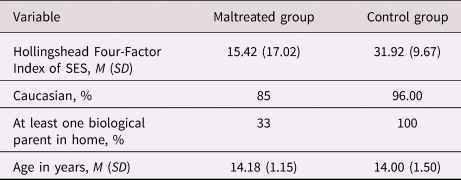
A sample of 25 adolescent females served as a control group (M age = 14.00 years, SD = 1.50). These control participants were recruited from a database in the Department of Psychology, Neuroscience & Behaviour at McMaster University, which included information on mothers who had previously agreed to be contacted for participation in research studies. Control participants were born full-term with no history of pre- or postnatal mental or physical health problems. Control participants were matched with maltreated participants on age, sex, handedness, and postal code (a proxy for socioeconomic status). Age was matched at the group level versus an individual level: all control participants were recruited at age 14, which was the mean age of the individuals in the maltreatment group at the time of control participant recruitment. Controls were never involved with child protection agencies and did not report maltreatment based on administration of two measures: the Childhood Trauma Questionnaire (Bernstein & Fink, Reference Bernstein and Fink1998) and the Childhood Experiences of Violence Questionnaire (Walsh, MacMillan, Trocmé, Jamieson, & Boyle, Reference Walsh, MacMillan, Trocmé, Jamieson and Boyle2008). Control participants were seen in the laboratory on only one occasion. Table 1 includes demographic information for the maltreated and control participants. Data for the laboratory visits reported here were collected between the years of 2003 and 2004.
Sociodemographic characteristics of maltreated and control youth. Maltreatment group (N = 55); control group (N = 25)

Note: SES, socioeconomic status. M, mean. SD, standard deviation.
Procedure
All participants were tested in the Child Emotion Laboratory at McMaster University. Upon arrival to the laboratory, study procedures were explained to the participants and informed consent was sought. Consent to participate in the study for youth in the care of the state was provided by the child protection agency; parental consent was provided for those in the care of their parents. Youth 16 years of age provided their own consent, and those less than 16 years provided assent. The present research was approved by the Hamilton Health Sciences and the McMaster University Research Ethics Boards. Participants received $25 for each visit. Procedures were identical for all three laboratory visits and are described in detail below. Resting baseline regional EEG and electrocardiogram (ECG) measures were collected first, and then the participant completed a self-reported personality measure.
Psychophysiological data collection
EEG recording
Regional EEG was collected using a lycra stretch cap (Electro-Cap International, Eaton, OH). EEG measures were collected continuously during 2 min of resting baseline (1 min eyes open [EO] and 1 min eyes closed [EC]). Two minutes of continuous resting EEG has been shown to provide reliable estimates of EEG power (Allen, Urry, Hitt, & Coan, Reference Allen, Urry, Hitt and Coan2004; Miskovic, Schmidt, Georgiades, Boyle, & MacMillan, Reference Miskovic, Schmidt, Georgiades, Boyle and MacMillan2009; Theall-Honey & Schmidt, Reference Theall-Honey and Schmidt2006). The cap electrodes were positioned according to the 10/20 system of the International Federation (Jasper, Reference Jasper1958). The experimenter used the blunt end of a Q-tip in combination with an abrasive gel (Omni-prep) and gently abraded each electrode surface. Each electrode site was then filled with a small amount of electrolyte gel, which served as a conductor. Electrode impedances below 10,000 ohms per site and within 500 ohms between homologous sites were considered acceptable. EEG was recorded from the left and right anterior, midline, and posterior regions of the scalp (i.e., midfrontal: F3, F4; central: C3, C4; parietal: P3, P3; occipital: O1, O2). EEG was collected in posterior sites to ensure the effects were specific to the frontal region. All active EEG sites were referenced to Cz during acquisition. The nine channels were amplified by individual bioamplifiers (32-Channel Custom SA Instrumentation Bioamplifiers, San Diego, CA), with filter settings for all channels set at 0.1 Hz (high pass) and 100 Hz (low pass). The data from all nine EEG channels were digitized online at a sampling rate of 512 Hz.
ECG data recording
RSA was recorded during a continuous 2-min resting (1-min EO, 1-min EC) condition using two disposable heart rate electrodes applied to the left and right sides of the adolescent's chest in line with the heart. A separate SA Instrument Bioamplifier was used to amplify the signal, with the bandpass filters set at 0.1 Hz (high pass) and 100 Hz (low pass). The data were digitized online at a sampling rate of 512 Hz.
Psychophysiological data reduction and analyses
EEG data reduction and quantification
The electrode array used in the present study was extensive enough to justify the use of an average reference (Marshall, Bar-Haim, & Fox, Reference Marshall, Bar-Haim and Fox2002). The EEG data were re-referenced to an average reference in software and visually scanned for artifact due to movement (e.g., eye blinks or body movements) and artifacts were edited out using software developed by the James Long Company (EEG Analysis Program, Caroga Lake, NY). If an artifact was present in one channel, then data in all channels were excluded. All artifact-free EEG data were analyzed using a discrete Fourier transform, with a Hanning window of 1-s width and 50% overlap. Regional EEG power (in microvolts) was derived in the alpha (8 to 13 Hz) frequency band separately for the EO and EC conditions. It is well documented that this EEG frequency band is linked to individual differences in stress vulnerability (see Coan & Allen, Reference Coan and Alllen2004; Davidson, Reference Davidson2000). A natural log (ln) transformation was performed on the EEG power values in order to reduce skewness. Data were excluded from individual channels if the ln transformed power values for a given frequency band exceeded 3 SD. Because EEG power in the EO and EC conditions was highly related for each of the sites (rs > .60, ps < .01), a composite measure of resting EEG alpha power was computed separately for each EEG site by averaging power in the EO and EC conditions. This aggregate measure is known to produce a more reliable estimate of EEG power than separate EO and EC conditions (see Tomarken, Davidson, Wheeler, & Kinney, Reference Tomarken, Davidson, Wheeler and Kinney1992). The two study groups did not differ in the amount of EEG artifact data removed or in the amount of artifact-free EEG data used in the analyses. There were usable EEG data on 53 participants in the maltreated group at Visit 1 and 23 control participants during their only visit; 2 maltreated and 2 control participants were missing data due to equipment failure.
ECG data reduction and RSA quantification
A file of interbeat intervals (IBIs) was created for each participant for the baseline condition, after running a four-pass self-scaling peak detection algorithm. The IBI data were visually edited for artifact (missing or spurious R waves) and analyzed using software developed by the James Long Company (ECG Analysis Program, Caroga Lake, NY). This program calculated the standard deviation of the mean heart period (i.e., global heart period variability) measures. Next, the edited IBI series was prorated into equal time intervals of 125 ms. We employed a spectral analysis approach in order to isolate vagal regulation of cardiovascular function (Montano et al., Reference Montano, Porta, Cogliati, Costantino, Tobaldini, Casali and Iellamo2009). The prorated time series IBI data were detrended using a high-pass filter with a period of 10 s. A discrete Fourier transform analysis, with a 32-s Hanning window and 50% consecutive overlap, was then applied to quantify the amount of variability (ms2) within the .15 to .50 Hz range. This is a commonly used high-frequency range of heart rate variability that reflects primarily vagal efferent activity in adolescents and adults (Montano et al., Reference Montano, Porta, Cogliati, Costantino, Tobaldini, Casali and Iellamo2009). High-frequency power values were transformed using a natural log (ln) transform to normalize the distribution. Data points were excluded from analyses if the ln transformed power values exceeded 3 SD. The EO and EC conditions were combined into an aggregate baseline condition of RSA. There were usable RSA data on 40 participants in the maltreated group at Visit 1 and 24 control participants during their only visit. The remaining 15 maltreated participants and control participant had missing ECG data due to poor signal, equipment failure, or electrode detachment. Those with usable compared with nonusable data did not differ on any of the study measures.
Psychophysiological groups
Guided by a person-oriented approach, in the maltreated sample we created psychophysiological groups separately for the resting left and right frontal EEG alpha power measures and the resting RSA measures using a median split: high (n = 27) and low (n = 26) left frontal (F3) EEG power; high (n = 26) and low (n = 27) right frontal (F4) EEG power; and high (n = 19) and low (n = 21) RSA groups, in order to examine the influence of individual differences of resting frontal EEG alpha power and RSA on the trajectories of personality. Person-oriented approaches are useful in identifying groups of individuals who share common characteristics (see Bergman & Trost, Reference Bergman and Trost2006; Coplan, Wilson, Frohlick, & Zelenski, Reference Coplan, Wilson, Frohlick and Zelenski2006, for reviews). Previous research on personality has illustrated the utility of using a person-oriented approach when studying behavior (Coplan et al., Reference Coplan, Wilson, Frohlick and Zelenski2006; Nelson, Reference Nelson2013; Poole & Schmidt, Reference Poole and Schmidt2019; Schmidt, Reference Schmidt1999).
Self-report measures
Eysenck Personality Questionnaire—Revised Short Form
Extraversion and neuroticism were measured across each visit using the revised short form of the Eysenck Personality Questionnaire, EPQ-RS, a 48-item measure used to assess the personality dimensions of extraversion, neuroticism, psychoticism, and a lie scale. Of particular interest to the present study were self-reported extraversion (e.g., “Can you usually let yourself go and enjoy yourself at a lively party?”) and neuroticism (e.g., “Are you a worrier?”). All of the items are answered either yes (1) or no (0), and higher scores on each respective scale are indicative of greater extraversion and neuroticism. The extraversion (α = .77 to .84) and neuroticism (α = .83 to .87) subscales demonstrated good internal consistency in this study for the maltreated sample at all three visits. The internal consistency for the extraversion (α = .89) and neuroticism (α = .84) was also good for the control participants during their single visit.
Tanners Scales of Pubertal Development
Participants completed a self-reported questionnaire asking about their pubic hair and breast development (Peterson, Crockett, Richards, & Boxer, Reference Petersen, Crockett, RIchards and Boxer1988).
Statistical analyses
At each visit for the maltreated individuals and during their only visit for control participants, partial correlations were utilized to determine the association between extraversion and neuroticism, controlling for age and pubertal status (as estimated by breast and pubic hair development) for the maltreated individuals and just age for the control participants as we only had information about the maltreated individuals’ pubertal development. We also compared maltreated and control individuals concurrently during their only visit on resting left and right frontal EEG power, RSA, extraversion, and neuroticism using a one-way analysis of variance, controlling for age.
Trajectories of personality were estimated using growth curve analysis where repeated measures (i.e., extraversion and neuroticism) were regressed on the visit number to estimate rates of change at an individual level. Three waves of longitudinal data contributed to the models described below. Growth curve analysis provides estimates pertaining to variability in baseline extraversion and neuroticism (i.e., intercept variance) and the possibility that individuals’ levels of extraversion and neuroticism change at different rates (i.e., slope variance; Delucia & Pitts, Reference DeLucia and Pitts2005).
Before testing the conditional models where predictor variables are specified, unconditional growth curve models were tested for extraversion and neuroticism. Unconditional models contain no predictor variables, and their purpose is to determine the influence of time on changes in outcome variables. In our first set of models, we included either left or right frontal EEG alpha power at rest predicting extraversion and neuroticism separately. It is important to note that all analyses were also conducted with left and right power in posterior sites to ensure results were specific to the frontal region, and all ps were > .10 for posterior sites. We adjusted for child's age during their first visit, their pubertal status, and their lifetime presence of a major depressive episode as covariates. In our second set of models, we included RSA at rest and extraversion or neuroticism, and again adjusted for the same covariates as in the first models.
Full information maximum likelihood was used to account for missing data in the growth models to present unbiased estimates, and participants with at least one extraversion or neuroticism data point were modeled (Delucia & Pitts, Reference DeLucia and Pitts2006; Ferro, Reference Ferro2014). This approach uses all available raw data to simultaneously account for the missing data and estimates model parameters and standard errors simultaneously (Graham, Reference Graham2009). Little's missing completely at random test indicated that all data were missing completely at random (ps > .05). Of note, personality data were missing due to loss to follow-up for three participants between Visits 1 and 3. All statistical analyses were performed using SPSS Version 24.0, with significance levels set at α = .05.
Results
Descriptive statistics
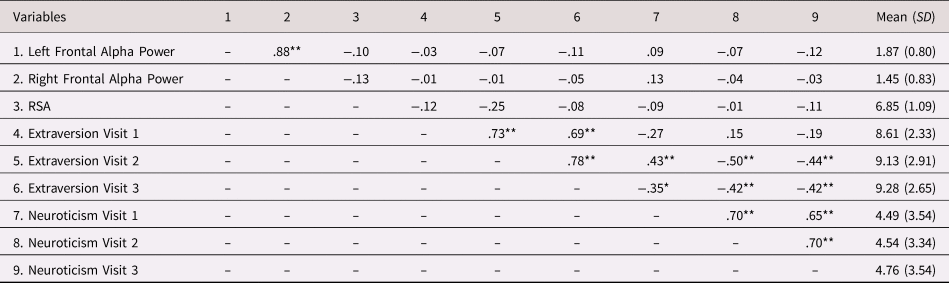
Table 2 includes uncorrected correlations among study variables, means, and standard deviations for maltreated participants. At Visit 1, extraversion and neuroticism were not significantly correlated in the maltreated participants (r = –.27, p = .08). At Visits 2 (r = –.50, p = .001) and 3 (r = –.42, p = .007), extraversion and neuroticism were negatively and modestly correlated. Extraversion and neuroticism were also modestly correlated in control participants at Visit 1 (r = –.56, p = .004).
Pearson correlations, means, and standard deviations (SD) for continuous left and right frontal EEG alpha power and respiratory sinus arrhythmia (RSA) at Visit 1 and extraversion and neuroticism at each of the three visits among the adolescent females exposed to child maltreatment

Note: EEG power values reflect natural log. *p ≤ .05. **p ≤ .01.
We also found that left (r = –.10, p = .54) and right (r = –.13, p = .42) frontal alpha power were not significantly correlated with RSA at Visit 1 in the maltreated participants, suggesting that left and right frontal power and RSA were tapping different physiological systems. A similar pattern was evidenced in the control participants as left (r = –.23, p = –.29) and right (r = –.19, p = –.39) frontal alpha power were not significantly correlated with RSA.
There was no significant difference between the maltreated and control groups based on extraversion, F (1, 65) = 1.16, p = .29, neuroticism, F (1, 63) = 0.97, p = .33, left frontal alpha power, F (1, 59) = 0.46, p = .50, and right frontal alpha power, F (1, 59) = 0.09, p = .77, at Visit 1. However, maltreated participants had significantly lower RSA at rest (M = 6.54, SE = 0.18) compared to control participants (M = 7.35, SE = 0.23); F (1, 63) = 1.29, p = .007; d = 0.72, as reported originally by our group (see Miskovic et al., Reference Miskovic, Schmidt, Georgiades, Boyle and MacMillan2009).
Unconditional growth curve models
Extraversion
The unconditional growth curve models for extraversion revealed that the intercept was significantly different than zero, B = 8.52, p < .001, 95% confidence interval (CI) [7.66, 9.39], and that the slope was not significant, B = 0.24, p = .12, 95% CI [–.0.06, 0.54].
Neuroticism
The unconditional growth curve model for neuroticism revealed that the intercept was significantly different than zero, B = 4.10, p < .001, 95% CI [2.89, 5.31], and that the slope was not significant, B = 0.24, p = .62, 95% CI [0.35, 0.57].
Resting frontal alpha power in predicting personality trajectories
Extraversion
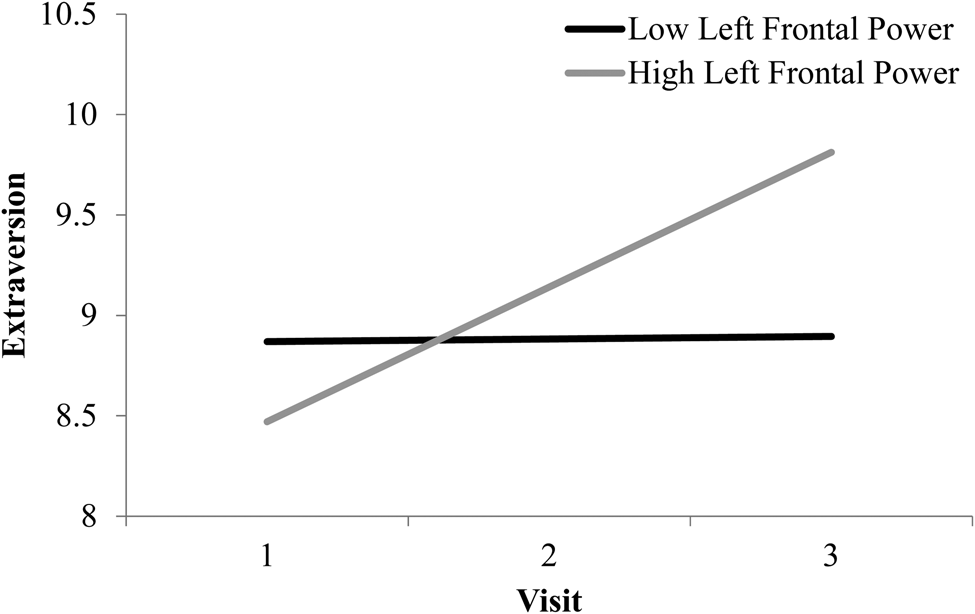
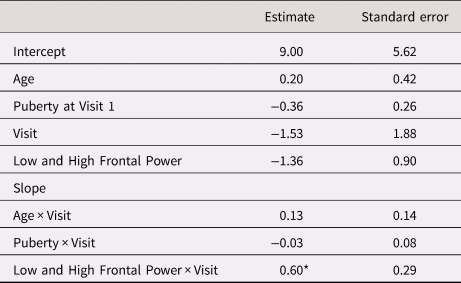
Individuals with relatively high versus low left resting frontal EEG alpha power had similar levels of extraversion at Visit 1, B = –1.36, p = .13, 95% CI [–3.72, 19.48]. In addition, as predicted, individuals in the high left frontal power (i.e., low left frontal activity) group showed increases in extraversion across time, B = 0.59, p = .04, 95% CI [–0.02, 1.17], relative to the low left frontal power group (i.e., high left frontal activity; Table 3; Figure 1). As well, individuals with relatively high versus low right resting frontal EEG alpha power had similar levels of extraversion at Visit 1, B = 0.63, p = .48, 95% CI [–1.14, 2.41], and similar trajectories of change in extraversion across time, B = –0.43, p = .15, 95% CI [–1.03, 0.17].
Trajectories of extraversion among adolescent females exposed to child maltreatment predicted by high and low resting left frontal EEG absolute alpha power groupings, controlling for age and pubertal status at Visit 1. Alpha power is inversely related to activity, so higher power reflects lower activity.

Adjusted growth curve model for self-reported extraversion across three laboratory visits over 1 year as a function of low and high left frontal EEG alpha absolute powera at rest among adolescent females exposed to child maltreatment

a High coded as 1, low coded as 2. *p ≤ .05.
Neuroticism
Individuals with high versus low left resting frontal EEG alpha power had similar levels of neuroticism at Visit 1, B = –1.87, p = .14, 95% CI [–1.63, 3.47], and similar trajectories of change in neuroticism across time, B = 0.37, p = .43, 95% CI [–0.86, 1.14]. Similarly, individuals with high versus low right resting frontal EEG alpha power had similar levels of neuroticism at Visit 1, B = –0.91, p = .48, 95% CI [–4.41, 0.59], and contrary to prediction, similar trajectories of change in neuroticism across time, B = 0.16, p = .74, 95% CI [–0.59, 1.28].
Resting RSA in predicting personality trajectories
Extraversion
Individuals with high versus low resting RSA had similar levels of extraversion at Visit 1, B = 0.77, p = .45, 95% CI [–1.26, 2.79], and similar trajectories of change in extraversion across time, B = –0.12, p = .71, 95% CI [–0.75, 0.51].
Neuroticism
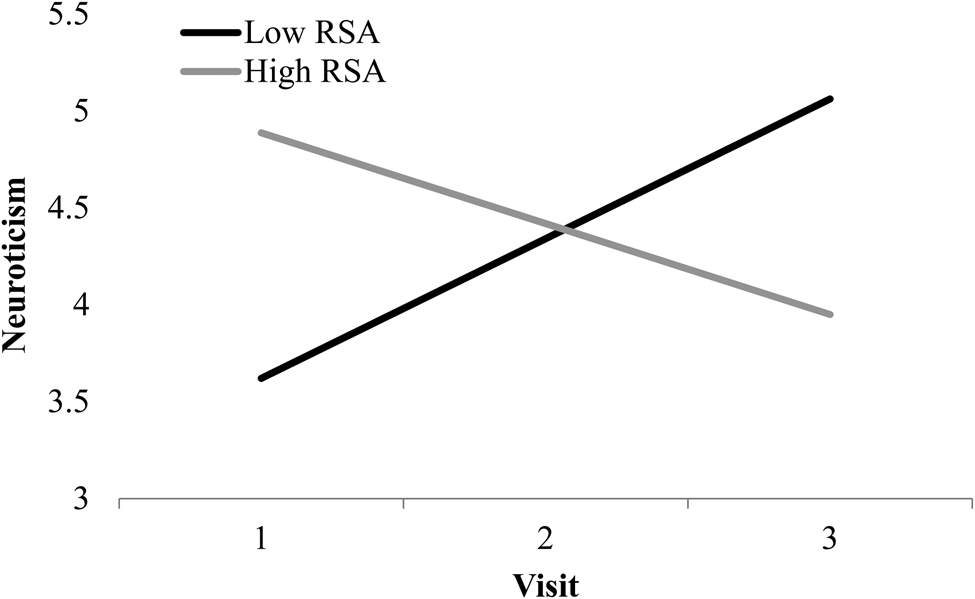
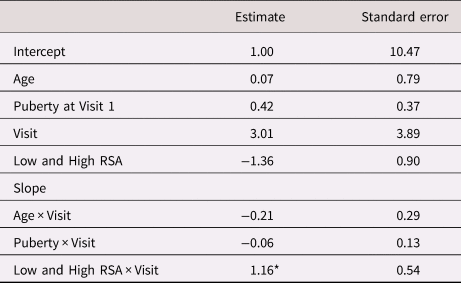
Individuals with high versus low resting RSA had similar levels of neuroticism at Visit 1, B = –2.35, p = .11, 95% CI [–5.13, 0.51]. As predicted, individuals in the low RSA group showed increases in neuroticism across time, B = 1.15, p = .04, 95% CI [0.06, 2.24], relative to high RSA group (Table 4; Figure 2).
Trajectories of neuroticism among adolescent females exposed to child maltreatment predicted by high and low resting respiratory sinus arrhythmia (RSA) groupings, controlling for age and pubertal status at Visit 1.

Adjusted growth curve model for self-reported neuroticism across three laboratory visits over 1 year as a function of low and high respiratory sinus arrhythmia (RSA)a at rest among adolescent females exposed to child maltreatment

a Low coded as 1, high coded as 2. *p ≤ .05.
Discussion
Using a three-wave, short-term prospective study, we examined the influence of individual differences in resting central and peripheral psychophysiological measures on the trajectories of personality dimensions of extraversion and neuroticism in adolescent females exposed to child maltreatment. We found that while relatively higher versus lower left resting frontal EEG alpha power did not influence extraversion at Visit 1, as predicted, individuals who had relatively higher left frontal EEG alpha power (i.e., lower left frontal activity) had increasing trajectories of extraversion across visits. Individuals who had relatively lower left frontal power (i.e., higher left frontal activity) remained stable across visits. We also found that while relatively higher versus lower resting RSA did not influence neuroticism at Visit 1, as predicted, individuals who had relatively lower resting RSA had increasing trajectories across visits, while individuals with relatively higher resting RSA remained stable across visits.
The finding that individuals who were maltreated and had relatively lower left frontal activity exhibited increasing trajectories of extraversion is consistent with the larger body of the personality literature, suggesting that extraversion is related to chronic underarousability (Brebner & Cooper, Reference Brebner and Cooper1974; Eysenck, Reference Eysenck1967; Green, Reference Green1984; Hill, Reference Hill1975). Individual differences in left versus right frontal activity at rest have been linked to differences in individual's motivational tendencies (e.g., tendency to approach and withdrawal), as well precursors for how individuals process emotion (Fox, Reference Fox1991; Harmon-Jones, Lueck, Fearn, & Harmon-Jones, Reference Harmon-Jones, Lueck, Fearn and Harmon-Jones2006; McManis, Kagan, Snidman, & Woodward, Reference McManis, Kagan, Snidman and Woodward2002; Schmidt & Trainor, Reference Schmidt and Trainor2001). Specifically, although the left frontal region has been associated largely with approach-related motivational tendencies (Fox, Reference Fox1991), within an affective explanation, a reduction of left alpha power has been interpreted to reflect an inability to experience positive affect (e.g., Henriques & Davidson, Reference Henriques and Davidson1990).
Our finding from a sample of maltreated adolescences that only individuals with relatively higher left frontal power (i.e., lower frontal activity) displayed increasing trajectories of extraversion supports Eysenck's underarousal hypothesis and some aspects of motivation/emotion models of frontal activation (e.g., Davidson, Reference Davidson2000; Fox, Reference Fox1991). That is, the relatively lower arousal in the left frontal hemisphere may maintain the disinhibition of approach-related behaviors (i.e., risk taking) and the anhedonia (i.e., depression) characteristic of individuals exposed to maltreatment.
To the extent that RSA indexes physiological activation and self-regulation, and neuroticism represents negative affect and high reactivity, the finding that maltreated individuals with relatively lower resting RSA exhibited increasing trajectories of neuroticism also fits within the larger body of personality and psychophysiological literature. RSA has been positively associated with neuroticism and neuroticism-related traits in nonclinical populations (Haug et al., Reference Haug, Svebak, Hausken, Wilhelmsen, Berstad and Ursin1994, Kollai & Kollai, Reference Kollai and Kollai1992; Oveis et al., Reference Oveis, Cohen, Gruber, Shiota, Haidt and Keltner2009; Schmidt & Fox, Reference Schmidt and Fox1994). A recent meta-analysis by Koenig, Kemp, Feeling, Thayer, and Kaess (Reference Koenig, Kemp, Feeling, Thayer and Kaess2016) found that individuals diagnosed with borderline personality disorder had relatively lower RSA compared to healthy controls, further implicating RSA as an important contributor to emotion dysregulation. In addition to providing support for Eysenck's overarousability hypothesis of neuroticism, our results extend these findings to a sample of adolescent females exposed to child maltreatment and suggest that relatively lower RSA may be a biological precursor to increasing trajectories of neuroticism in this population.
One important consideration in this study is the relatively short time between visits, given how little, if any, personality is expected to change over the course of 6 months to 1 year. Although extraversion and neuroticism have long been regarded as traitlike qualities and are thought to be very stable across the life span (e.g., McCrae & Costa, Reference McCrae and Costa1994), there is a large body of literature in life span development suggesting that personality does continue to develop well into adulthood and old age (see Roberts, Walton, & Viechtbauer, Reference Roberts, Walton and Viechtbauer2006, for a meta-analysis). Some of these changes are thought to reflect changes in an individual's reward and punishment systems during adolescence and young adulthood, as well as changes in environmental factors such as decreased reliance on parents (Urosevic, Collins, Muetzel, Kim, & Luciana, Reference Urošević, Collins, Muetzel, Lim and Luciana2012). These factors may be particularly relevant when considering personality in a maltreated sample, given the profound impacts maltreatment is known to have on the brain, and the socioemotional stressors and household chaos associated with maltreatment (Cox, Kotch, & Everson, Reference Cox, Kotch and Everson2003; De Bellis et al., Reference De Bellis, Keshavan, Shifflett, Iyengar, Beers, Hall and Moritz2002). Our findings provide support for the notion that personality, while relatively stable, is not immune to change and modification throughout adolescence. Our results suggest that these changes may be subtle and influenced by resting central and peripheral psychophysiology measures during adolescence.
Why were extraversion trajectories predicted by a central physiological measure, and neuroticism trajectories predicted by a peripheral physiological measure? The nature of these personality characteristics and physiological measures provides insight into this question. As highlighted, differences in left and right alpha power (a central measure) have been understood in the context of approach and avoidance (Fox, Reference Fox1994), with the left underlying approach-related behaviors and the right underlying avoidance-related behaviors. RSA (a peripheral measure), in contrast, has been proposed as an index of individuals’ propensity to regulate their emotions and their behavior (Porges, Reference Porges2007). To the extent that high approach underlies extraversion and high reactivity and low regulation underlies neuroticism, it follows that extraversion and neuroticism trajectories were differentially predicted by central and peripheral measures, respectively. Our finding that frontal power and RSA were uncorrelated provides support for the assertion that these measures are tapping separate systems. Further, although correlations between extraversion and neuroticism ranged from medium to high, central and peripheral physiological measures were differential predictors of the trajectories of each personality factor. This suggests that, although extraversion and neuroticism may share some overlap, they represent distinct personality constructs that are uniquely influenced by central and peripheral psychophysiological measures.
In addition to providing support for Eysenck's (Reference Eysenck1967) theory of personality in general, our results have implications for research in maltreated populations in particular. To date, much of this research has focused on comparing broad dimensions of personality in individuals exposed and not exposed to maltreatment (e.g., Rogosch & Cicchetti, Reference Rogosch and Cicchetti2004, Reference Rogosch and Cicchetti2005). While this approach is a necessary first step, it largely ignores individual differences in personality. Our results demonstrate that there is significant heterogeneity in personality characteristics of maltreated individuals and that central and peripheral psychophysiological factors influence the trajectory of broad-level personality factors of approach-avoidance over time. It is important to demonstrate this heterogeneity and identify modifying factors with respect to extraversion and neuroticism because these personality dimensions have been implicated in some of the negative outcomes for which maltreated individuals are at greater risk, such as disinhibition, risk-taking behaviors, and mental health difficulties such as depression (Eysenck, Reference Eysenck1967; Lahey, Reference Lahey2009; Rusting & Larsen, Reference Rusting and Larsen1997). Identifying physiological factors that influence heterogeneity in personality characteristics in individuals exposed to maltreatment may ultimately therefore shed light on risk and resiliency processes in this population.
Strengths and limitations
The present study utilized a short-term prospective sample of youth exposed to maltreatment, determined by child protective agency's validated reports during adolescence, a key developmental window in which many psychiatric problems begin to develop. We provided support for Eysenck's long-standing model utilizing both self-report and psychophysiological methods in this unique sample. Further, we utilized two disparate psychophysiological measures that index central and peripheral levels within the same study.
Despite these strengths, the present study should be interpreted with the following limitations in mind. Data were collected at only one time point from the control participants. Ideally, we would have been able to determine whether there were differences between maltreated and control participants in the influence of physiology on the trajectory of personality characteristics if data had been collected across visits on the control participants. Although we were unable to analyze trajectories in the control populations, we were able to examine cross-sectional group differences with respect to all study variables. Having control participant data at only one time precluded analyses that would help determine whether the reported results were largely due to individual differences in personality or due to the effects of maltreatment. Future studies should include multiple assessments of a control group in order to determine the influence of maltreatment versus individual differences in personality.
Another limitation is that coming to the laboratory may have been more stressful for some individuals than others. Although the maltreated and control groups did not differ on frontal EEG power measures at Visit 1, they did differ on the resting RSA measure, which may have reflected differences in level of anxiety in response to the laboratory context.
Finally, while a sample size of 55 females is a relatively small sample, it was adequate for a psychophysiological prospective study of this vulnerable population. Nevertheless, a larger sample size will also allow for latent class growth curve analyses, which would allow for more data-driven group construction. Future studies should determine whether these results hold in a similar sample with a greater time interval between visits, over a longer time point, with a larger sample size and a control group that is also followed prospectively.
Conclusions
We utilized a short-term, prospective design and a sample of maltreated adolescent females to determine whether individual differences in two disparate measures of resting physiology (left and right frontal EEG absolute alpha power and RSA at rest) were associated with different trajectories of two personality dimensions characterized by approach-avoidance characteristics: extraversion and neuroticism. We found that adolescents exposed to child maltreatment with relatively lower, versus higher, left frontal EEG brain activity at rest exhibited increasing trajectories of extraversion. We also found that adolescents exposed to child maltreatment with relatively lower, versus higher, RSA at rest displayed increasing trajectories of neuroticism. Our findings highlight the importance of testing long-standing theoretical models of personality development on an empirical level using multimethod analyses in a vulnerable population to identify potential biological factors ultimately informing risk and resiliency.
Financial support
This study was supported by an Independent Investigator Award from NARSAD and the Charles Johnson Charitable Fund awarded to HLM. While conducting this research, HLM held a Faculty Scholar Award from the William T. Grant Foundation and the Wyeth Canadian Institutes of Health Research (CIHR) Clinical Research Chair in Women's Mental Health. Further support was provided by the CIHR Institutes of Gender and Health; Aging; Human Development, Child and Youth Health; Neurosciences, Mental Health and Addiction; and Population and Public Health awarded to HLM, and the Natural Sciences and Engineering Research Council of Canada and the Social Sciences and Humanities Research Council of Canada awarded to LAS.
Acknowledgments
We are very grateful to the Hamilton Children's Aid Society, the Hamilton Catholic Children's Aid Society, and the Halton Children's Aid Society. We wish to thank the participants for their participation, and Lindsay Bennett, Sylvia Nowakowski, Caroline Parkin, Diane Santesso, Masako Tanaka, and Emily Vella for their help with data collection and data entry. We are also grateful to the research assistants and nurses who assisted with this project.