Introduction
Oxygen electrocatalysis is one of the key processes limiting the efficiency of energy conversion devices such as fuel cells, electrolysers, and metal–air batteries.[ Reference Cheng and Chen 1 , Reference Lee, Xu, Cano, Kashkooli, Park and Chen 2 ] In particular, the oxygen reduction reaction (ORR) is commonly associated with slow kinetics, requiring high overpotentials, and high catalyst loadings. Current research activities are also focused on the development of non-noble metal electrocatalysis such as transition metal oxides.[ Reference Li, Feng, Chen, Shi, Xiong, Ding, Qi, Hu, Wei, Wan and Xia 3 , Reference Hardin, Mefford, Slanac, Patel, Wang, Dai, Zhao, Ruoff, Johnston and Stevenson 4 ] A number of studies have shown that Mn-based transition metal oxides are among the most catalytically active for the ORR in alkaline solutions.[ Reference Suntivich, Gasteiger, Yabuuchi, Nakanishi, Goodenough and Shao-Horn 5 – Reference Ge, Sumboja, Wuu, An, Li, Goh, Hor, Zong and Liu 8 ] However, the parameters determining the reactivity of Mn sites in this complex systems remain a subject of discussion.
In the case of perovskites oxides (ABO3), the key active site is determined by the B-cation. A multiplicity of parameters have been linked to electrocatalytic activity such as the nature of the A-site, d-orbital occupancy in the B-site, oxidation state, A-site surface segregation, oxygen vacancies, particle size, and morphology.[ Reference Li, Feng, Chen, Shi, Xiong, Ding, Qi, Hu, Wei, Wan and Xia 3 , Reference Hardin, Mefford, Slanac, Patel, Wang, Dai, Zhao, Ruoff, Johnston and Stevenson 4 , Reference Calle-Vallejo, Inoglu, Su, Martinez, Man, Koper, Kitchin and Rossmeisl 9 , Reference Lee, Han, Chen, Cai and Yildiz 10 ] Suntivich et al. proposed that single occupancy of e g orbital gives the highest ORR activity,[ Reference Suntivich, Gasteiger, Yabuuchi, Nakanishi, Goodenough and Shao-Horn 5 ] which appears to be supported by DFT studies reported by Calle-Vallejo et al.[ Reference Calle-Vallejo, Inoglu, Su, Martinez, Man, Koper, Kitchin and Rossmeisl 9 ] However, recent studies by Celorrio et al. showed that the B-site orbital occupancy may change under operational conditions, concluding that Mn-sites are uniquely active as they undergo changes in the oxidation state in the region close to the formal ORR potential.[ Reference Celorrio, Dann, Calvillo, Morgan, Hall and Fermin 11 ] This point has also been recognized by other groups.[ Reference Ryabova, Napolskiy, Poux, Istomin, Bonnefont, Antipin, Baranchikov, Levin, Abakumov, Kéranguéven, Antipov, Tsirlina and Savinova 12 , Reference Hong, Risch, Stoerzinger, Grimaud, Suntivich and Shao-Horn 13 ] The orbital occupancy of Mn can be influenced by the cations occupying the A-site, which might lead to tuning the activity of the catalysts.[ Reference Celorrio, Calvillo, Dann, Granozzi, Aguadero, Kramer, Russell and Fermin 7 ] Celorrio et al. also demonstrated that increasing the amount of Ca2+ in La1−x Ca x MnO3 not only increases the Mn oxidation state, but also decreases the average activity.[ Reference Celorrio, Calvillo, Dann, Granozzi, Aguadero, Kramer, Russell and Fermin 7 ]
In this study, we investigate tellurium (Te)-doped lanthanum manganite as an ORR catalyst for the first time. The rational of Te doping is based on the studies by Yang et al., showing that La1−x Te x MnO3+δ lead to high ratio Mn2+/Mn3+.[ Reference Yang, Song, Ma, Zhang and Sun 14 ] La1−x Te x MnO3 is synthesized from a versatile ionic liquid precursor, yielding nanoparticles with size ranging between 40 and 68 nm. At a fixed catalyst loading, the overall performance appears to decrease upon Te doping with respect to LaMnO3. However, normalization of the activity by the number density of electroactive Mn sites reveals a significant improvement of the B-site activity upon 10% Te doping of the A-site.
Experimental
La1−x Te x MnO3 were synthesized employing an ionic liquid precursor based on the methodology described in previous studies.[ Reference Celorrio, Calvillo, Dann, Granozzi, Aguadero, Kramer, Russell and Fermin 7 , Reference Celorrio, Dann, Calvillo, Morgan, Hall and Fermin 11 , Reference Green, Glatzel, Collins, Patil and Hall 15 ] Firstly, ~9 mL 69% HNO3 was added to a glass vial containing TeO2 (0.001 mol) and heated to 80 °C under stirring for 3 h, until the TeO2 had completely dissolved. The colorless solution was diluted to 10 mL with deionized water to give a 0.1 M solution of Te4+ in aqueous HNO3. Later, 0.029 g ethylenediaminetetraacetic acid (EDTA) (0.01 mmol, 1:1 molar ratio of metal precursors:EDTA) was added to 1 mL 1-ethyl-3-methylimidazolium acetate stirred at 80 °C. Then, 0.1 M aqueous Mn(NO3)2.4H2O, La(NO3)3.6H2O and the 0.1 M Te4+ solution in aqueous HNO3 were added to the ionic liquid in the appropriate stoichiometric ratio. The total volume of aqueous solution added was 1 mL. Solutions were dehydrated by heating at 80 °C under stirring for 3 h. Following dehydration, the mixture was transferred to an alumina crucible containing 100 mg microcrystalline cellulose. After 10 min of stirring at ~80 °C, a slightly viscous homogeneous gel was obtained. The crucible was transferred to a furnace, and calcined at 850 °C for 4 h with a temperature ramp rate of 5 °C/min. This temperature enabled the formation of phase pure La1−x Te x MnO3 with x-values below 25%.
Powder x-ray diffraction (XRD) was carried out on a Bruker D8 Advance using Cu K α radiation. Experiments were run between 10° and 80°, using a step size of 0.02°. The XRD patterns were refined by the Rietveld method using the FULLPROF program.[ Reference Rodríguez-Carvajal 16 , Reference Rietveld 17 ] The following parameters were refined: scale factor, background coefficients, zero-point error and positional coordinates. The isotropic thermal factors for all the atoms were fixed to a standard value of 1 Å2. No cation deficiency was detected in the case of LaMnO3; thus the occupancy factors were fixed to 1. For La1−x Te x MnO3, the occupancy factors for La and Te were also refined. Scanning electron microscopy (SEM) was carried out on a JEOL SEM 5600LV scanning electron microscope. Transmission electron microscopy (TEM) was carried out on a JEOL JEM-1400Plus instrument.
X-ray photoelectron spectroscopy (XPS) was carried out at the Bristol NanoESCA Facility equipped with an Argus spectrometer working at a base pressure of 4.0 × 10⁻¹¹ mbar. Core-level photoemission spectra were acquired in grazing incidence, i.e. 45° between the sample surface and the normal of the electron analyzer, with a monochromatic Al K α (1486.7 eV), pass energy of 20 eV at room temperature. The binding energy scale was referenced to the carbon C1s photoemission line.
Cyclic voltammetry was carried out in argon saturated 0.1 M KOH solution using a glassy carbon working electrode, graphite counter electrode, and Hg/HgO reference electrode. Linear sweep voltammetry employing a rotating ring-disk electrode (RRDE) were carried out in O2-saturated 0.1 M KOH solution using an ALS rotation controller, and an Ivium compactstat potentiostat. A glassy carbon disk (0.126 cm2) and a Pt ring were used in all experiments. Working electrodes were prepared via a two-step drop-casting process. First, an aqueous Vulcan/Nafion suspension was dropped onto the surface of the electrode, followed by an aqueous suspension of the metal oxide nanoparticles. The sample loading on the electrode surface was 50 µgvulcan/cm2, 50 µgnafion/cm2, and 250 µgoxide/cm2.
Results and discussion
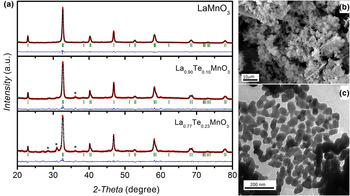
Figure 1(a) shows the XRD patterns of LaMnO3, La0.90Te0.10MnO3, and La0.77Te0.23MnO3 as well as the result of the Rietveld refinement employing a rhombohedral lattice with the space group R3-c. LaMnO3 and La0.90Te0.10MnO3 are characterized by high degree of phase purity, whereas La0.77Te0.23MnO3 exhibit a small peaks associated with an unidentified secondary phase. Ionic liquid precursors incorporating higher Te content yield multiple phases, in agreement with previous studies.[ Reference Yang, Song, Ma, Zhang, Zhao, Sheng, Zheng, Dai and Sun 18 ] Structural parameters were obtained by the Rietveld method and can be found in online Table S1 of the Supporting information. The results show a minimum in the unit-cell volume with increasing Te content (changes below 0.2%), while the Mn–O bond length increases by approximately 0.1% in La0.77Te0.23MnO3. These changes in structural parameters appear consistent with previous studies.[ Reference Zheng, Sun, Zhu and Song 19 ]
(a) XRD patterns of LaMnO3, La0.90Te0.10MnO3, and La0.77Te0.23MnO3. Red dots correspond to the experimental values while the black thin line corresponds to the Rietveld refinement. The thin blue line shows the difference between experimental and refined patterns. The green bars correspond to the positions of the allowed Bragg reflections for the main phase. (b) SEM and (c) TEM images of as-prepared LaMnO3.

Figure 1(b) shows a representative SEM image of LaMnO3, illustrating the typical porous microstructure of the synthesized materials, while the TEM image in Fig. 1(c) shows the nanoscale dimensions of the particles (SEM and TEM images of the other oxides can be found in online Figs S1 and S2 of the Supporting Information, respectively). Particle size distributions obtained from measuring at least 80 particles can be found in online Fig. S3, revealing a slight increase in mean particle size with increasing Te content, from 39.9 ± 11.3 nm for LaMnO3 to 67.9 ± 38.3 nm for La0.77Te0.23MnO3 (see online Table S2).
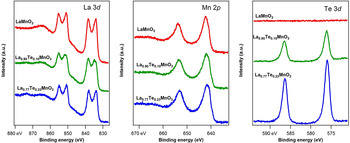
XPS spectra of LaMnO3, La0.9Te0.10MnO3, La0.77Te0.23MnO3 are displayed in Fig. 2, showing the La 3d (left), Mn 2p (middle) and Te 3d (right) regions. The characteristic double peak associated with La 3d 5/2 (834.0–834.9 eV) and La 3d 3/2 (851.0–851.9 eV) are observed, with the La 3d 5/2 binding energy consistent with a La3+ oxidation state.[ Reference Celorrio, Calvillo, Dann, Granozzi, Aguadero, Kramer, Russell and Fermin 7 , Reference Celorrio, Dann, Calvillo, Morgan, Hall and Fermin 11 , Reference Sunding, Hadidi, Diplas, Løvvik, Norby and Gunnæs 20 – Reference Bolwin, Schnurnberger and Schiller 22 ] The peak at 874 eV, visible for the Te-containing samples has been assigned to the Te Auger MNN. The Te 3d photoemission lines involve the Te 3d 5/2 at 576 eV and Te 3d 3/2 at 586.6 eV. These values are consistent with a Te4+ oxidation state.[ Reference Christie, Sutherland and Walls 23 , Reference Farrow, Dennis, Bishop, Smart and Wotherspoon 24 ] Finally, the photoemission line associated with Mn 2p 3/2 peak centered at 642 eV shows an interesting trend as function of Te content. This line contains contribution from Mn2+ (640.9 eV) and Mn3+ (641.9 eV) oxidation state.[ Reference Di Castro and Polzonetti 25 ] Focusing on this narrow emission range (online Fig. S4), we can see a slight shift of the Mn 2p 3/2 peak towards lower binding energy as the Te content increases. However, given the small differences in binding energies for the two oxidation states, we shall refrain from attempting to estimate Mn2+/Mn3+ ratio from these data.
Photoemission spectra of La 3d (left panel), Mn 2p (middle panel) Te 3d (right panel) of the various La1−x Te x MnO3 oxides taken in grazing incidence using a monochromatic Al K α x-ray source.

Analysis of the relative composition of La, Te, and Mn, after normalization of the individual photoemission lines by their sensitivity factor and inelastic mean-free path, show a significant A-site surface enrichment. We obtained an A:B ratio of 62:38 for all three materials, broadly in agreement with data reported for other lanthanides.[ Reference Celorrio, Calvillo, Dann, Granozzi, Aguadero, Kramer, Russell and Fermin 7 , Reference Druce, Tellez, Burriel, Sharp, Fawcett, Cook, McPhail, Ishihara, Brongersma and Kilner 26 ] We have also estimated La:Te ratios of 82:18 and 71:29 for La0.90Te0.10MnO3 and La0.77Te0.23MnO3, respectively. This analysis shows both La and Te substantially segregate to the surface, with a slight increase in Te content with respect to the bulk values.
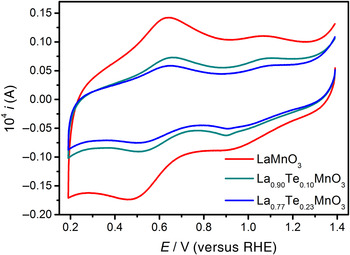
Figure 3 shows cyclic voltammograms recorded in an argon-saturated 0.1 M KOH solution, revealing a two-step reduction from the initial Mn oxidation state to Mn2+.[ Reference Celorrio, Calvillo, Dann, Granozzi, Aguadero, Kramer, Russell and Fermin 7 , Reference Celorrio, Dann, Calvillo, Morgan, Hall and Fermin 11 , Reference Ryabova, Napolskiy, Poux, Istomin, Bonnefont, Antipin, Baranchikov, Levin, Abakumov, Kéranguéven, Antipov, Tsirlina and Savinova 12 ] The position of the peak centered at 0.90 V remains almost unaffected, while the second reduction peak is slightly shifted toward higher potentials upon increasing Te content. The most striking difference is in the current densities, with both Te-doped materials showing significantly lower responses than LaMnO3. Considering that the catalyst loading is identical (i.e., 250 µg × cm-2), this behavior indicates a decrease in the number density of electrochemically active Mn-sites at the electrode surface. The faradaic charges associated with the anodic and cathodic peaks are very similar, and the responses remain stable in the studied potential range, suggesting that the stability is not significantly compromised within the timescale of these experiments. Integration of the cathodic current peaks in the range of 0.2–1.2 V enables an estimate of the effective number density of electroactive Mn sites (ΓMn).[ Reference Celorrio, Calvillo, Dann, Granozzi, Aguadero, Kramer, Russell and Fermin 7 ] In order to calculate ΓMn, two limiting cases can be can be assumed with regard to the initial Mn oxidation state: the oxidation state is determined by the mean oxidation state of the A-site taking La3+ and Te4+ (case 1), or fixed Mn oxidation state of +3 independently of the A-site composition (case 2). Case 1 implicitly ignores changes in the oxygen content of the oxide, while case 2 assumes that variations in the mean A-site charge is compensated by changes in oxygen stoichiometry. Our previous studies investigating La1−x Ca x MnO3,[ Reference Celorrio, Calvillo, Dann, Granozzi, Aguadero, Kramer, Russell and Fermin 7 ] in which the mean Mn oxidation state is directly estimated by XANES, confirms case 1 as a valid approximation. In any case, online Table S3 shows that both limiting cases provide values within the same order of magnitude.
Cyclic voltammograms of LaMnO3, La0.90Te0.10MnO3, and La0.77Te0.23MnO3 supported on Vulcan-carbon in Ar-saturated 0.1 M KOH electrolyte solution at 0.01 V/s. Electrode loaded with 50 µg/cm2 nafion, 50 µg/cm2 vulcan, and 250 µg/cm2 oxide.

The data in online Table S3 show the ΓMn is 40%–60% smaller in the Te-doped samples. In view of the similar extent of A-site surface segregation, the smaller ΓMn values in the case of the Te containing particles is mainly linked to the smaller specific surface area. Although the mean particle size increases with increasing Te content, we see statistically similar ΓMn in both Te containing oxides. This is due to the fact that size dispersion also increases in substantial fashion as shown in online Fig. S3. It should also be mentioned that ΓMn in LaMnO3 prepared at 850 °C (this report) is lower than those prepared at 700 °C from the same ionic liquid precursor,[ Reference Celorrio, Calvillo, Dann, Granozzi, Aguadero, Kramer, Russell and Fermin 7 , Reference Celorrio, Dann, Calvillo, Morgan, Hall and Fermin 11 ] confirming that calcination temperature is an important parameter to determining A-site segregation.
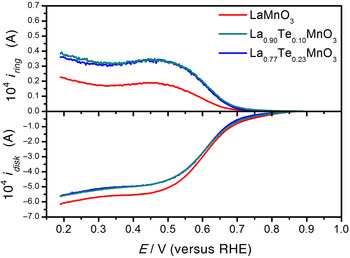
Figure 4 compares the current measured at the disk (i DISK, bottom panel) and the ring (i RING, top panel) of carbon-supported LaMnO3, La0.90Te0.10MnO3, and La0.77Te0.23MnO3 electrodes at 1600 rpm in O2-saturated 0.1 M KOH solution. The responses obtained from the Vulcan carbon support under the same experimental conditions are shown in online Fig. S5. All of the catalysts show significantly larger currents than the carbon support, while the ORR onset potential is over 100 mV more positive. LaMnO3 exhibit larger cathodic current at the disk, with smaller ring current across the potential range. Current-potential curves recorded for La0.77Te0.23MnO3 particles at various angular rotation rates are displayed in online Fig. S6. Both Te-doped oxides exhibit rather similar current–potential characteristics.
RRDE responses of the various La x Te1−x MnO3 nanoparticles supported at Vulcan layer at 1600 rpm in O2-saturated 0.1 M KOH at 0.010 V/s. The Pt ring was held at a constant potential of 1.10 V. The oxide content in each electrode was 250 µg/cm2.

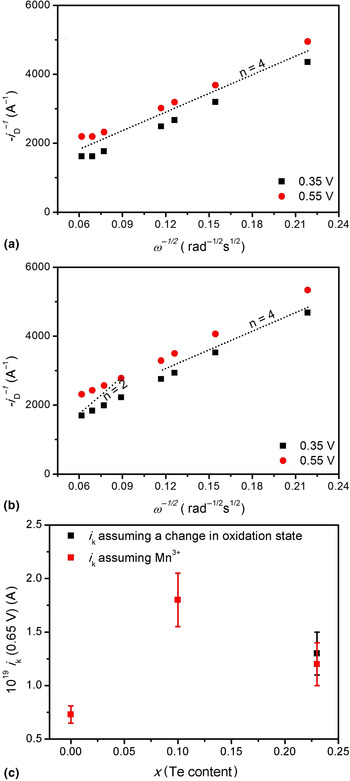
Figure 5 illustrates the dependence of i DISK with the inverse of the angular rotation rate in the case of LaMnO3 [Fig. 5(a)] and La0.77Te0.23MnO3 [Fig. 5(b)], which follows the Koutecky–Levich relationship:
 $$\displaystyle{1 \over {i_{{\rm DISK}}}} = \displaystyle{1 \over {i_{\rm k}}} + \displaystyle{1 \over {i_{\rm L}}} = \displaystyle{1 \over {i_{\rm k}}} + \displaystyle{1 \over {0.62nAFcD^{2/3} \nu ^{ - 1/6} \omega ^{1/2}}}, $$
where n is the number of transferred electrons, A is the disk geometric area, F is the Faraday constant, c is the bulk oxygen concentration (1.2 × 10⁻⁶ mol/cm3),[ Reference Bard, Bard and Faulkner 27 ] D is the oxygen diffusion coefficient (1.9 × 10⁻⁵ cm2/s), ν is the kinematic viscosity (0.01 cm2/s), and ω is the angular rotation of the electrode. i k and i L are the kinetically and mass-transport limiting currents, respectively. It can be observed that LaMnO3 [Fig. 5(a)] shows a linear dependence, with a slope consistent with n = 4.[ Reference Celorrio, Calvillo, Dann, Granozzi, Aguadero, Kramer, Russell and Fermin 7 , Reference Celorrio, Dann, Calvillo, Morgan, Hall and Fermin 11 ] In the case of La0.77Te0.23MnO3 [Fig. 5(b)], only a slight deviation from n = 4 is observed at high rotation rate.
Koutecky–Levich plots of (a) LaMnO3 and (b) La0.77Te0.23MnO3 electrodes in O2-saturated 0.1 M KOH at 0.55 and 0.35 V. Dotted lines represent the limiting slopes for the two and four-electron processes. (c) Kinetically limited current at 0.65 V normalized by the effective number of electroactive Mn atoms (î k).

The HO2 − yield (two-electron process) as a function of potential was calculated from the ring and the disk current values at 1600 rpm [online Fig. S7(a)]. The Vulcan support shows almost 100% HO2 − yield between 0.2 and 0.6 V, while LaMnO3 and both Te-doped catalysts exhibit <30%. The pathway selectivity can also be described in terms of the effective number of electrons shown in online Fig. S7(b). The Vulcan support yields values close to 2, increasing to values above 3.4 upon introduction of the oxide catalysts.
These findings suggest that LaMnO3 exhibits better performance than the Te-doped under the specific catalyst formulation used, i.e., at equivalent mass loading. However, it should also be considered that mean particle sizes and size dispersion are composition dependent, which have an effect on the overall catalysts performance. Furthermore, XPS data shows an increase in the A-site segregation in the presence of Te, although the surface composition remains dominated by La3+. In order to account for these parameters, the kinetically limiting current can be normalized by ΓMn, i.e., î k = i k/(A × ΓMn).[ Reference Celorrio, Calvillo, Dann, Granozzi, Aguadero, Kramer, Russell and Fermin 7 ]
Figure 5(c) illustrates the variation of î k at 0.65 V as a function of the Te content, obtained from at least three different samples from various synthesis batches. The contribution of the carbon support to the overall current at this potential is negligible in comparison with the oxide loaded catalysts (see online Fig. S4). Two sets of data are plotted based on the two limiting cases used for calculating ΓMn. It is interesting to see the performance of electrochemically active surface Mn sites increases on average in the presence of Te. Surface Mn sites in materials containing 10% Te appears twice more active than surface Mn-sites in LaMnO3. The performance seems to slightly degrade for larger Te content.
We rationalize this early trend in terms of changes in the electron density at Mn sites. Incorporating 10% Te in the A-site, most probably in a 4+ oxidation state, effectively increases the electron density at the B-site, leading to an enhancement in the catalytic activity for ORR. Indeed, the slight shift in the binding energy of the Mn 2p 3/2 peak suggests a decrease in the oxidation state on Mn sites in the presence of Te (Figs 2 and S4). A similar correlation have been recently reported in the case La1−x Ca x MnO3.[ Reference Celorrio, Calvillo, Dann, Granozzi, Aguadero, Kramer, Russell and Fermin 7 ]
In conclusion, these studies reveal an increase in the mean activity of surface Mn sites upon Te4+ doping in the A-site. The most active surface Mn sites were obtained upon 10% replacement of La3+ by Te4+, leading to an increase of the electron density at the Mn site without compromising the coordination structure. To confirm this hypothesis, a number of parameters should be systematically explored such as the effect of low oxidation state cations with different sizes as well as the activity of different LaMnO3 phases. In any case, our studies demonstrate the need of establishing universal descriptors, such as î k, which uncovers the mean activity of surface Mn sites, independently of the particle size, dispersion quality, and complex phenomena such as A-site segregation.
Supplementary material
The supplementary material for this article can be found at https://doi.org/10.1557/mrc.2017.22.
Acknowledgment
The authors acknowledge Dr. Devendra Tiwari and Gael Gobaille-Shaw for the fruitful discussions. V. C. and D. J. F. are thankful to the UK Catalysis Hub (EPSRC grants EP/K014706/1 and EP/K014714/1) for resources and support. L. J. M. and D. J. F. are also grateful to the EPSRC Centre for Doctoral Training in Catalysis for the financial support. SEM/EDX and TEM studies were carried out in the Chemistry Imaging Facility at the University of Bristol with equipment partly funded by EPSRC (EP/K035746/1 and EP/M028216/1). Authors acknowledge access to the Bristol NanoESCA Facility under EPSRC Strategic Equipment Grant EP/M000605/1. D. J. F. also acknowledges the University Research Fellowship (2015–2016) provided by the Institute of Advanced Studies of the University of Bristol.