Introduction
Founded in 2001, the Institute of Aging now plays its full role within the Canadian Institutes of Health Research (CIHR). Over the years, the Institute has successfully built a vibrant community of researchers – in a field that is, paradoxically, young – and has successfully taken the necessary steps to ensure the expansion of research on aging in order to enhance the health and wellness of the Canadian public. Over this period, the proportion of CIHR’s total investment that is devoted to research on aging has nearly doubled, to 13 per cent from 7 per cent, and the Institute’s strategic activities have had major impacts to enhance the health and wellness of Canadians.
In 2011, the Institute of Aging underwent a review by an international team of experts. This review underscored the relevance of the Institute’s initiatives and congratulated the Institute on successfully galvanizing a community of researchers on aging, on introducing new collaborations and initiatives including internationally, and, lastly, on launching the Canadian Longitudinal Study on Aging.
The 2013–2018 strategic plan, previewed here, marks a new phase in which, while building on past achievements, the Institute of Aging will place emphasis squarely on the health and wellness of older Canadians. The Institute’s activities in the coming years will focus on identifying tangible solutions that will make a real difference for Canada’s aging population.
Context
Unquestionably, the Canadian population is aging and living longer than past generations. Indeed, improving the quality of life for current and future generations of older people is becoming a research priority.
In 2011 the number of people aged 65 and over in Canada reached a record high: five million, or 14.8 per cent of the total population. More than demonstrating the current state of aging and longevity, this figure shows the acceleration of aging that will take effect as the baby boomers, born between 1946 and 1965, reach age 65, with the first boomers in Canada having reached age 65 in 2011.
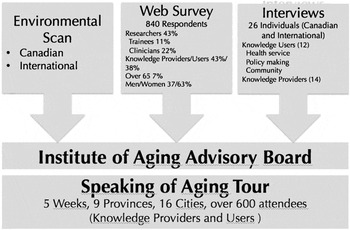
Graphic representation of the consultation process to establish the 2013– 2018 Strategic Plan of the CIHR-Institute of Aging

According to the World Health Organization, the world population of people aged 60 and over will be more than two billion by 2050, with the same trend of substantial growth occurring in the oldest age groups (who.int/ageing/en/index.html). Consequently, it is of great importance that the Institute of Aging seize the opportunities and face the challenges that these demographic changes present.
Canadians can now expect to live longer, and they can do so while optimizing health and wellness. Living longer can be achieved by people’s taking steps based on, and following a comprehensive approach to, their anticipated life course.
Our Vision in Action
The mandate of the Institute of Aging features a central goal: to optimize health and wellness over the entire trajectory of aging, for both individuals and society in general. Between now and 2018, the Institute of Aging will strive to further expand the pool of scientific knowledge in response to the needs of the population. The Institute will more broadly disseminate new research findings, as well as existing knowledge, to the main stakeholders: government policy makers, health professionals, industry, and all other interested parties. Included in this group of stakeholders, of course, are older people themselves: the Institute will strive to ensure that this new knowledge has a real impact on the interventions, services, and products that can promote older people’s health and wellness.
An Overview of the Research Priorities
In 2012, to identify the gaps where new knowledge is needed, the Institute of Aging conducted wide-ranging consultations with researchers, health professionals, policy makers, industry representatives, and representatives of seniors’ associations (see Figure 1). When asked about the opportunities and challenges facing Canadian society with respect to aging, these stakeholders identified a number of research needs. These needs were then analyzed by the Institute Advisory Board, validated through a series of town hall–style meetings across Canada, and grouped into two broad themes:
• Optimizing population health and wellness over the trajectory of aging
• Addressing the complex health challenges of older adults
Following the consultation process, the Institute Advisory Board defined five research priorities around these two themes (strategic directions). These priorities are the basis of the Institute’s 2013–2018 Strategic Plan.
FIRST STRATEGIC DIRECTION: Optimizing Population Health and Wellness over the Trajectory of Aging
Over the course of people’s lives, many factors (some of which can be modified) interact and influence the trajectory of aging. They include not only those determinants that let people live longer but also the conditions that let them “add life” to these additional years – in other words, enable them to live better while living longer.
The 2011 Expert Review Team Report for the Institute of AgingFootnote 1 underlined the importance of considering both life course and holistic approaches in the trajectory of aging; these are the guiding principles for this strategic direction.
Priority 1: The Life Course Trajectory as a Determinant of Active and Satisfying Aging
Furthering our understanding of the determinants of health and wellness is crucial to optimizing health along the life trajectory.
Aging of the Individual
The Institute of Aging supports and promotes activities aimed at preventive strategies and lifestyle interventions. In the Institute’s view, these activities must integrate the biological, psychological, social, and environmental determinants of health and wellness, while shedding light on the trajectory of aging in the individual. We therefore also need to innovate boldly, exploring new perspectives and new sources of inspiration by, for example, studying the trajectory of aging over decades.
An Integrative Approach
The Institute will encourage an integrative approach in the aging trajectory that encompasses biological, psychological, and social dimensions. The Institute will also take into consideration other dimensions including, but not restricted to, the environment. An integrative approach is crucial in order to fully describe the individual impact of each of those determinants, as well as their dynamics and interaction.
Priority 2: Adding Life to the Late Years
Individual Conditions
Since the last century, scientific knowledge has led to increased survival rates at birth, as well as to higher life expectancy. Healthier lifestyles, better control of infections, and better management and treatment of certain chronic diseases are just some examples of advances that are enabling us to live longer than past generations.
Living longer, however, does not make old age satisfying. Quality of life and the genuine ability to continue actively participating in society are both fundamental. We must therefore increase our knowledge of the factors and conditions that allow people to live not only longer but better. In seeking this knowledge, we must consider the diversity of needs of older people as individuals as well as the diversity of society as a whole.
Social and Environmental Conditions
Improving older adults’ quality of life also means giving them the opportunity to choose their home environment and to have a built environment that is designed to meet their needs. These conditions include not only physical aspects of how and where they live (e.g., urban or rural environment) but also the work environment as well as the social environment (e.g., ageism, abuse).
SECOND STRATEGIC DIRECTION: Addressing the Complex Health Challenges of Older Adults
As people age, their health status is often marked by the presence of several interrelated chronic diseases and acute health problems. Combined with the vulnerability of older people’s biological, psychological, and social systems, these complex problems contribute to the frailty seen in many older people. Taken as a whole, these factors require multifaceted solutions.
The Institute believes that the complexity of older people’s state of health requires a holistic approach. Such an approach must both deliver and ensure the continuity of care and services that meet the needs of frail older people.
The 2011 Expert Review Team Report for the Institute of Aging made recommendations that are perfectly aligned with this strategic direction. They emphasized that addressing issues related to the complexity of older people’s state of health – and, in particular, co-morbidity and health services research as well as end-of-life care – could be developed further.
Priority 3: Interventions Appropriate to the Complexity of Older People’s State of Health
All of the stakeholders who participated in the consultations agreed on the overall direction of the main steps to be taken:
• Ensure that interventions take a holistic, integrated approach to understand the conditions specific to older adults and the impact these conditions have on older adults’ physical and mental health, and hence on their wellness.
• Find solutions to one of the most feared health problems of older adults: neurodegenerative diseases that have an impact on cognition and which lead to dementia. The Institute of Aging will continue to co-lead the CIHR Signature Initiative “International Collaborative Research Strategy for Alzheimer’s Disease” in order to ultimately improve the quality of life and the quality of services both for those having to live with the effects of neurodegenerative diseases affecting cognition and for their caregivers.
• Establish a continuum of integrated services, from preventive support to medical care, considered as a whole.
• Allow for the diversity of caregivers and their needs, and innovate in terms of support and intervention.
The Complexity of Older People’s State of Health
Older adults often face multiple health challenges that interact with one another and with the very processes of aging. That is why the actions to be undertaken by the Institute will always include an integrative approach: in terms of (a) basic biomedical research; (b) psychological and social mechanisms underlying older people’s health problems; and (c) the translation of knowledge into concrete measures.
Cognitive Impairment
Neurodegenerative diseases that cause cognitive impairment are, as mentioned, among the most feared health conditions. The biological, psychological, and social aspects of such diseases, optimal interventions, care and services, and the continuity of care in particular are dimensions of these diseases that affect older people. Generating new knowledge and translating that knowledge into real impacts must be the goal of activities taking a holistic approach.
Caregivers’ Health and Wellness
The well-being of many older people who are dealing with chronic health conditions, including cognitive impairments, depends on the caregivers who support them. The health and wellness of older people’s caregivers are of capital importance. Whether these caregivers are professionals, health workers, or friends/family, their support is indispensable to older people’s wellness. That is why the Institute is committed to pursuing those activities that maintain and improve the health and wellness of these caregivers, in harmony with their distinctive personal and cultural characteristics.
Priority 4: Health Care and Services that Combine and Integrate Continuity, Innovation, and Efficiency
If the specific needs of older adults are to be properly met, then creative, efficient solutions for delivering the required care and services are imperative. Therefore, every effort must be made to develop innovative solutions that will
• Make appropriate and efficient health services available, including primary care and acute care as well as rehabilitative care, long-term care, and end-of-life care.
• Adapt the health care system to older people’s needs, so that it is oriented towards managing chronic diseases with services available in their communities.
• Support families, caregivers, professionals, and policy makers with regard to treatment decisions and end-of-life issues.
A health care system that is appropriate to meet the needs of older people must be able to support them in their home environment of choice, ensure continuity in their care, and encourage each person to participate in their own care.
Delivering Innovative, Effective, Efficient Health Services and True Continuity of Care
To deliver these health services, the Institute has four objectives:
• Focus research efforts on the most effective and efficient health services and systems
• Apply the most creative preventive and therapeutic interventions, as well as the most appropriate technological solutions
• Deliver the entire continuum of services, from prevention to care, in the context of an integrated, holistic approach
• Encourage the participation of knowledge users
Supporting End of Life
The importance of providing older people with quality palliative and end-of-life care makes it imperative to take concrete steps in this area. Palliative care includes the care and management of patients nearing the end of life, the reduction of suffering throughout the illness, and, in the case of family, the period of mourning. It is therefore essential to consider actions for better approaches (models and programs) that provide evidence on the following:
• Support families and caregivers while considering end-of-life issues in an inclusive environment facilitating informed decisions. These issues involve the various care and treatment options as well as the ethical and legal aspects of these decisions.
• Make it possible not only to deal with the final stages of the trajectory of aging, but also to prepare for these stages throughout life.
Priority 5: Ensuring the Conditions for a Positive Impact on Older People’s Health and Wellness
The Institute’s last research priority emphasizes the importance of fostering favourable conditions so that the programs, solutions, and models developed through research will have real, sustainable effects on health and wellness. The Institute will implement strategic actions to address four key areas:
• A community of researchers that can meet the challenges
• Empowerment of individuals to secure the conditions they need to maintain better health and wellness across the life trajectory
• Health workers and health professionals training
• Knowledge sharing with the public and stakeholders
A Strategy Grounded in Reality
To implement the Institute of Aging’s strategic plan, a five-year Action Plan will be developed by the Advisory Board. Yearly plans will also be developed and will focus on the following:
• Aligning and leveraging CIHR’s signature and strategic initiatives
• Making an optimal contribution to all initiatives in which the Institute plays a leading role
• Capitalizing on new opportunities that have recently emerged
• Mobilizing partners and the stakeholder community around these actions
• Incorporating CIHR’s Performance and Outcome Measurement Framework into measuring outcomes and impacts of actions
The Institute of Aging will (a) develop partnerships to enable concrete solutions to the needs expressed, (b) encourage integrative research, (c) optimize past investments, and (d) synergize with other CIHR priorities to enhance the excellence of Canada’s capacity for research on aging.
Understanding Today to Prepare for Tomorrow
The twenty-first century will be characterized by active aging which is why the health and wellness of older people are, and must remain, a priority.
Building on its past achievements, the Institute of Aging will continue to support and promote the excellence and relevance of research on health and aging in order to respond to expressed needs and to achieve tangible impacts. In both the areas of prevention and of care and services, the Institute will continue to support and assist research and the scientific community in the development of creative, effective solutions, emphasizing impacts that can have a positive influence on the life course and the trajectory of aging.
Through its vision, its values, and its research priorities, the Institute will make a difference by ensuring that scientific knowledge is translated into innovations that enable policy makers to make informed decisions. Canadian society has everything to gain from this, from the youngest to the oldest along the life trajectory.