Central line–associated bloodstream infections (CLABSIs) remain a serious and potentially deadly consequence of hospitalization. Use of central venous catheter (CVC) bundles that include avoidance of femoral sites for CVC insertion, strict adherence to hand hygiene, use of full barrier precautions, chlorhexidine skin preparation, and removal of unnecessary catheters can dramatically reduce CLABSI incidence in hospitalized patients.Reference Pronovost, Needham and Berenholtz 1 However, despite widespread adoption of these bundles in US hospitals, CLABSI still remains prevalent with rates exceeding 1 case per 1,000 catheter-days. 2
Prior to the widespread adoption of these bundles, identified CLABSI risk factors included prolonged hospitalization before catheterization, femoral catheterization, internal jugular catheterization, longer catheterization duration, neutropenia, use of total parenteral nutrition, extensive catheter manipulation, and reduced nurse:patient ratio.Reference Marschall, Mermel and Classen 3
However, these risk factors reflect practices from an arguably bygone era.Reference Marschall, Mermel and Classen 3 Few data are available on CLABSI risk factors in the bundle era. Those data that are available are limited by very small cohorts,Reference Berenholtz, Lubomski and Weeks 4 not addressing clinical risk factors,Reference Lukenbill, Rybicki and Sekeres 5 examination only of CLABSIs related to peripherally inserted central catheters,Reference Pongruangporn, Ajenjo and Russo 6 or examination of very specific populations (surgical intensive care unit patients).Reference Saman, Kavanagh and Johnson 7 At our medical center, we adopted the CLABSI prevention bundle in 2009. Compliance with bundle elements was high and reduction in CLABSI incidence followed. However, because CLABSIs continued to occur, we wanted to understand patient and clinical characteristics and care processes associated with CLABSI after bundle adoption. Because CVC bundles focus largely on insertion, we hypothesized that access factors could be additional risk factors.
Methods
We retrospectively examined data from January 1, 2011, through December 31, 2012, at Harbor-UCLA Medical Center, a 400-bed tertiary care county hospital. During this period, besides using bundle processesReference Pronovost, Needham and Berenholtz 1 we used daily chlorhexidine bathing for all intensive care unit patients. Cases were defined as inpatients in adult wards and adult intensive care units with a CLABSI defined using National Healthcare Safety Network definitions. 8 We excluded children because the number of CLABSIs in children in our institution was very small and CLABSIs in this population (especially neonates) may result from processes of care not pertinent to care in adults. Controls were chosen randomly, using a random number generator, from the population of patients with CVCs placed during the same period who did not have CLABSI. The date of CLABSI for controls was chosen as the day of CVC removal. To augment our study’s power, we performed 1:2 case:control sampling.
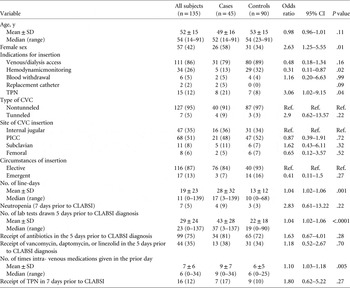
Hypothesized CLABSI risk factors were chosen a priori from a review of the literature on CLABSI risk factors and using investigators’ clinical judgment (Table 1). The study was approved by the institutional review board at LABioMed at Harbor-UCLA Medical Center.
Factors Associated with Central Line–Associated Bloodstream Infections

Note. Data are number (%) unless otherwise indicated. CLABSI, central line associated bloodstream infection; CVC, central venous catheter; PICC, peripherally inserted central catheter; Ref., referent group; TPN, total parenteral nutrition.
Data were analyzed using SAS, version 9.3 (SAS institute). Bivariate analysis was used to examine associations with potential CLABSI risk factors from the medical chart abstractions. Bivariate analysis was assessed by calculating odds ratios (OR), 95% CIs, and P values using χ2 or Fisher exact tests, as appropriate. All variables with a P<.20 in the bivariate analysis were included in a multivariate logistic regression analysis. Multivariate modeling procedures were performed to predict CLABSIs. Multicollinearity for the logistic regression model was assessed by condition indices and variance decomposition proportions. Backwards elimination was performed using the likelihood ratio test to find the best model. Models were examined for goodness of fit using the Hosmer-Lemeshow statistic. All variables were considered significant at the α=.05 level.
Results
In total, we had 45 cases and 90 controls. In bivariate analysis, CLABSI was associated with female sex, triple lumen catheters, total parenteral nutrition as the insertion indication, number of lab tests, number of intravenous medications given in the day prior to CLABSI diagnosis, and number of line-days (Table 1).
In our multivariate analysis, independent predictors of CLABSI were line-days (OR, 1.04 [95% CI, 1.03–1.08], P=.009), and number of lab tests drawn (OR, 1.05 [95% CI, 1.03–1.08], P=.0001). Hemodynamic monitoring as the CVC indication was inversely associated with CLABSI (OR, 0.21 [95% CI, 0.05–0.92], P=.04). The number of times intravenous medication was given in the prior day was not shown to be an independent predictor in our multivariate analysis (OR, 1.04 [95% CI, 0.95–1.13], P=.42).
Discussion
CLABSI continues to be a threat to patient safety even in the CLABSI prevention bundle era. Contemporary data on risk factors have limitations in terms of generalizability.Reference Lukenbill, Rybicki and Sekeres 5 – Reference Saman, Kavanagh and Johnson 7 , Reference Lissauer, Leeka and Preas 9 We found independent predictors of CLABSI included duration of CVC presence and more frequent CVC access—specifically, higher number of lab tests drawn. Although we found an association between number of intravenous medications given and CLABSI in bivariate analysis, this association was not seen in our multivariate analysis, possibly owing to limited power. Our identified associations are arguably expected because catheterization duration and increased CVC access were risk factors identified in the pre-bundle era.Reference Berenholtz, Lubomski and Weeks 4 Because bundle processes are focused on insertion, reducing further risk appears likely to involve improving processes related to CVC maintenance. However, the associations with higher amount of CVC access suggests that in the bundle era, further reductions of CLABSI incidence may be achieved by focusing on accessing lines in a sterile fashion. We did see an association with female sex. However, because of the lack of biologic plausibility we did not put sex in our multivariate model. Hemodynamic monitoring as a CVC insertion indication may be protective for CLABSIs because usually monitoring requirements are relatively brief.
The lack of protective effect of antibiotics is surprising but may reflect limited study power. We did not find an association between CLABSI and either neutropenia or total parenteral nutrition. Interestingly, femoral site of insertion was not associated with CLABSI, which may reflect our hospital policies that emphasize avoiding femoral insertion sites and, if femoral sites are used, removing the femoral CVC as soon as possible.
Our investigation has limitations. First, our data are from a single center, although as a tertiary care center in Los Angeles County we have a wide range of patient ethnicities, medical and surgical specialties, and underlying illnesses (however, we are not a transplant center, other than kidney transplant). Second, we had only CLABSI cases, which limits the power to detect relationships. That said, as hospitals get better at preventing CLABSIs, studies of CLABSI risk factors become more difficult because cases become less common. A strength of our investigation is that we did evaluate a diverse range of CVC types and patients as opposed to other investigations that focused on peripherally inserted central catheters,Reference Saman, Kavanagh and Johnson 7 surgical intensive care unit patients, 8 or bone marrow transplant patients.Reference Lukenbill, Rybicki and Sekeres 5
In conclusion, we found that independent CLABSI risk factors in the bundle era include increased use of CVCs for blood draws and longer catheter duration. Our data support use of interventions aimed at optimizing processes relating to catheter access, such as “scrub the hub” campaigns that focus on disinfection when accessing catheter hubs and daily assessments of catheter need for the purpose of CVC removal at the earliest possible time.Reference Lockman, Heitmiller, Ascenzi and Berkowitz 10 Further studies should be performed in other populations in the bundle era to evaluate interventions that may be included in a maintenance bundle, including strict adherence to hub disinfection.
Acknowledgments
We thank Jenifer Ramsay, RN, for her assistance with identifying cases and controls.
Financial support. None reported.
Potential conflicts of interest. All authors report no conflicts of interest relevant to this article.