Introduction
Social and economic changes have considerably increased the uncertainty and complexity of career development, and those entering the labor market face many challenges. Many employees report dissatisfaction with their working conditions (Kwon & Sohn, Reference Kwon and Sohn2017; Narayan, John-Stewart, Gage, & O'Malley, Reference Narayan, John-Stewart, Gage and O'Malley2018) and insecure about their job prospects (Voßemer, Gebel, Täht, Unt, Högberg, & Strandh, Reference Voßemer, Gebel, Täht, Unt, Högberg and Strandh2018), including the likelihood of becoming redundant. Nonetheless, few researchers have examined the underlying processes by which dissatisfaction manifests.
Research on career adaptability is broadly concerned with positive career-related outcomes (Johnston, Luciano, Maggiori, Ruch, & Rossier, Reference Johnston, Luciano, Maggiori, Ruch and Rossier2013). There is clear the assertion that adaptability in one's career is linked to a host of positive vocational and well-being outcomes (Merino-Tejedor, Hontangas, & Boada-Grau, Reference Merino-Tejedor, Hontangas and Boada-Grau2016), such as career optimism, career decision self-efficacy, career calling, and a sense of meaning in life. Career adaptability has also been linked to positive job performance ratings, life satisfaction, hope, and general well-being (Hirschi, Herrmann, Nagy, & Spurk, Reference Hirschi, Herrmann, Nagy and Spurk2016). Nonetheless, McKenna, Zacher, Ardabili, and Mohebbi (Reference McKenna, Zacher, Ardabili and Mohebbi2016) claimed that it is difficult to determine whether career adaptability influences career satisfaction, or vice versa. Zacher (Reference Zacher2015) also reported that it would be necessary to identify the mediating and moderating factors in order to discuss career adaptability and career satisfaction in a meaningful way. For instance, the process of attaining satisfaction involves self-regulating one's psychological state in order to cultivate a positive attitude toward job/career duties. Our objective in this study was to understand the mechanism by which career adaptability affects career satisfaction. The current study is based on the hypothesis that career adaptability, person–job fit, job uncertainty, and career satisfaction are psychosocial resources that connect an individual to his/her work environment.
Based on Hobfoll's (Reference Hobfoll1989) conservation of resources (COR) theory, individuals with abundant resources (e.g., career adaptability) are more likely to feel hopeful, optimistic, and satisfied. From a resource point of view, career adaptability is seen as the energy that an individual has to develop work-related competencies (i.e., psychology capital). Individuals who are adaptable in terms of their career are more likely to possess a sense of self-worth and self-confidence, and also tend to have the energy required to overcome difficulties.
Previous studies have also shown that employees who have the skills required to fit their job demands perform better at work (Blau, Reference Blau1981) and feel more satisfied with their jobs (Lauver & Kristof-Brown, Reference Lauver and Kristof-Brown2001). Oh et al. (Reference Oh, Guay, Kim, Harold, Lee, Heo and Shin2014) reported that person–job fit is related to issues associated with job demands. The skills required for a job are related to the employees' own intrinsic energy. Thus, from the perspective of resource conservation, we suggest that exploring the impact of person–job fit on career satisfaction is necessary.
One of the primary stresses in the workplace is job uncertainty; that is, an individual's perception of suspicion or instability concerning self-evaluation, values, and environment (Jang, Shen, Allen, & Zhang, Reference Jang, Shen, Allen and Zhang2018; Van den Bos, Reference Van den Bos2001). The proponents of uncertainty management theory claim that individuals must make predictions about their environment and cope with multiple situations of uncertainty (interpersonal or non-interpersonal) in the workplaces (Van den Bos & Lind, Reference Van den Bos and Lind2002). COR theory posits that individuals seek to acquire and retain resources, including objects, conditions, and energy (Carnevale, Huang, & Harms, Reference Carnevale, Huang and Harms2018; Hu, Schaufeli, & Taris, Reference Hu, Schaufeli and Taris2016). Experiencing uncertainty affects an individual's cognition, emotions, and behavior, and even decreases an individual's ability to recognize one's self as a distinct entity. COR theory further suggests that individuals strive to obtain, retain, and protect resources, by asserting themselves proactively to build resource reservoirs. Reducing an individual's control over the environment undermines their sense of security leading to aversion and discomfort.
This study focuses on the inner resources that enable a person to adapt and take charge of his/her feelings of career satisfaction. The contributions of this research are threefold. First, this study provides a test of the assertion that career adaptability or person–job fit is directly linked to career satisfaction. Second, we examined how people adapt to and cope with environmental changes from the perspective of career adaptability and COR theory. Thus, we illustrate how resource availability can affect the way that employees utilize resources to further organizational career trajectories in accordance with their own plans and values within an uncertain environment. This study examines how career adaptability is linked to person–job fit and the availability of resources. Third, this study was an attempt to explain the negative effects of job uncertainty on career satisfaction by considering how it affects one's ability to distribute their own resources.
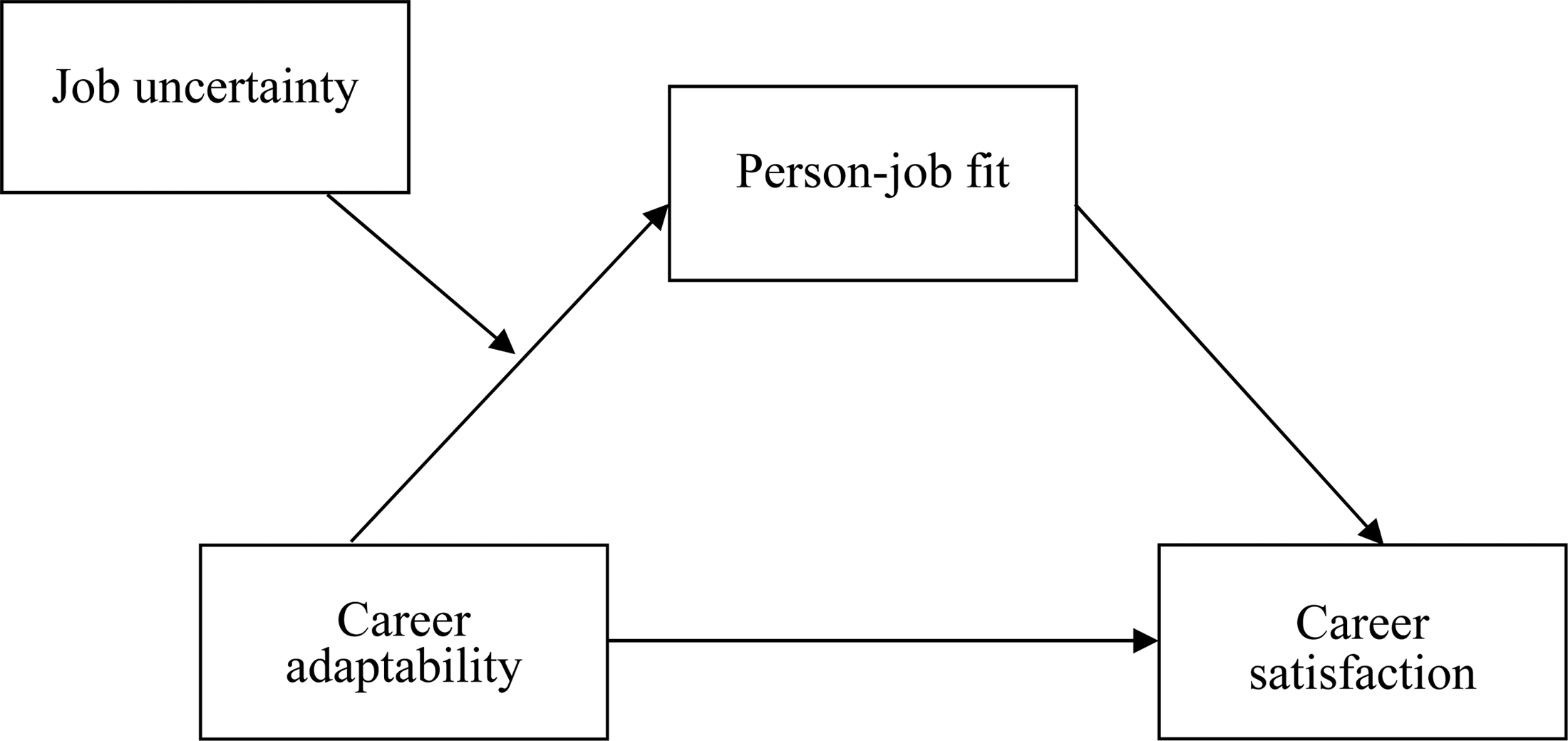
The current study advances the body of knowledge on career adaptability and the perceptions of person–job fit, job uncertainty, and career satisfaction. Figure 1 presents our theoretical framework in which we empirically explore the means by which person–job fit mediates the relationship between career adaptability and career satisfaction. We also examined the moderating effect of job uncertainty on this mediation process. Finally, we outline the principles of COR theory (Hobfoll, Reference Hobfoll1989) in an attempt to chart a model showing how job stress affects satisfaction, as shown in Figure 1.
Model proposed in this study

Theory and Hypothesis
Main effects of career adaptability on career satisfaction
Savickas (Reference Savickas1997) described career adaptability as a complex meta-competence and the ability to respond to changes in one's career. It has also been theorized that career adaptability allows an individual to deal with professional crises, particularly those that are unfamiliar or complex (Ebberwein, Krieshok, Ulven, & Prosser, Reference Ebberwein, Krieshok, Ulven and Prosser2004). Individuals vary in their career adaptability. Career adaptability emphasizes an individual's psychological readiness and intrinsic ability to make changes that would bring them closer to the current social reality. Thus, career adaptability has been described as ‘a readiness to cope with the predictable tasks of preparing for and participating in the work role and with the unpredictable adjustments prompted by the changes in work and work conditions' (Savickas, Reference Savickas1997). Career adaptability is a central construct in career preparation (Skorikov, Reference Skorikov2007). This concept consists of four psychosocial resources or transactional competencies: looking ahead to one's future (concern), knowing what career to pursue (control), looking around at options (curiosity), and having the self-efficacy to undertake activities required to achieve career goals (confidence). Crucially, these four resources are viewed as competencies that can be acquired (Savickas & Porfeli, Reference Savickas and Porfeli2012). Thus, career adaptability resources are expected to be malleable rather than fixed.
The malleability of resources suggests that career adaptability can increase one's chances of finding a suitable job, thereby enhancing career success and well-being (Skorikov, Reference Skorikov2007). Collectively, the studies mentioned above describe career adaptability as a set of psychological resources that enable individuals to cope with the difficulties and challenges they face in their professional development (Savickas, Reference Savickas1997). The term satisfaction refers to one's evaluation of whether the results of one's efforts are compensated by the gain (Sheth & Parvatlyar, Reference Sheth and Parvatlyar1995). This means that satisfaction is a function of the relationship between effort and gain or agreement between expected and actual results. Dorfman (Reference Dorfman1979) suggested that total satisfaction can be interpreted as the sum of one's satisfaction with all distinguishable factors in the environment. One's feeling of satisfaction varies with time and place; that is, it depends on an individual's current situation as well as their preferences and expectations. It follows that career satisfaction refers to the emotion stemming from a positive evaluation of one's advancement toward well-defined career-associated objectives. This evaluation is based on one's subjective accomplishments in one's career, including income, advancement, and well-being (Joo & Ready, Reference Joo and Ready2012). Several studies have reported that employees with superior adaptability are more likely to report feelings of satisfaction with their careers (Duffy, Douglass, & Autin, Reference Duffy, Douglass and Autin2015; Karatepe & Olugbade, Reference Karatepe and Olugbade2017; Santilli, Nota, Ginevra, & Soresi, Reference Santilli, Nota, Ginevra and Soresi2014). Tolentino, Garcia, Lu, Restubog, Bordia, and Plewa (Reference Tolentino, Garcia, Lu, Restubog, Bordia and Plewa2014) and Zacher (Reference Zacher2014a) reported that adaptable individuals tend to feel a deeper sense of satisfaction with their career development, based on a sense of empowerment to realize their desired career. Career satisfaction captures an individual's satisfaction with his/her career over the long term (Seibert & Kraimer, Reference Seibert and Kraimer2001). Taken together, it would be reasonable to assume that career adaptability enhances employees' perceptions of career satisfaction. Thus, we propose Hypothesis 1, as follows:
Hypothesis 1
Career adaptability is positively related to career satisfaction.
Mediating role of person–job fit
The aspect of the model that is of particular interest is the mediating role of person–job fit in explaining the distal relationships between career adaptability and career satisfaction. We argue that career adaptability influences career satisfaction by altering the fit of employees within their work roles and the work environment. The importance of career adaptability in the career theory can be attributed to theory work adjustment proposed by Dawis and Lofquist (Reference Dawis and Lofquist1984). Career adaptability refers to the ability of employees to prepare for predictable tasks and job roles as well as unforeseen difficulties in the workplace. Adaptation implies balance or harmony between an individual's internal requirements and the external environment such as the workplace (Savickas, Reference Savickas2005). It has therefore been suggested that researchers address the issue of positive affection in studying the processes underlying career adaptability and career satisfaction as well as affective processes underlying the mediation model (Zacher, Reference Zacher2015). Within an organizational setting, person–environment fit refers to the perceived compatibility or congruence between the characteristics of the employee and of his/her associated work settings (Sortheix, Chow, & Salmela-Aro, Reference Sortheix, Chow and Salmela-Aro2015). This is the ideal psychological state pursued by most individuals. The adaptability of employees, as a psychological resource (Wingerden, Bakker, & Derks, Reference Wingerden, Bakker and Derks2016), facilitates integration into one's job, which subsequently enhances one's sense of career satisfaction (Metin, Taris, Peeters, van Beek, & Van den Bosch, Reference Metin, Taris, Peeters, van Beek and Van den Bosch2016). Person–environment fit is a broad concept encompassing a wide range of lower-level constructs at the nexus between the individual and his/her environment (Chuang, Hsu, Wang, & Judge, Reference Chuang, Hsu, Wang and Judge2015). Person–job fit in the workplace has been operationalized at the work level. Research on person–environment fit calls for a more specific matching of fit with the criteria and context of research (Chuang et al., Reference Chuang, Hsu, Wang and Judge2015; Lauver & Kristof-Brown, Reference Lauver and Kristof-Brown2001; O'Reilly, Chatman, & Caldwell, Reference O'Reilly, Chatman and Caldwell1991). Likewise, we focused on the person–job fit that is most relevant to our analysis in the context of work. Edwards (Reference Edwards1991) described person–job fit as a state in which the needs, desires, or preferences of employees are met by the jobs that they perform. This type of fit (referred to as needs–supply or supply–values fit) has been the emphasis of various theories pertaining to adjustment, well-being, and satisfaction. Lauver and Kristof-Brown (Reference Lauver and Kristof-Brown2001) defined person–job fit as the degree to which the abilities of an individual fit the demands of a job or as the needs/desires of an individual and the benefits provided by a job. O'Reilly, Chatman, and Caldwell (Reference O'Reilly, Chatman and Caldwell1991) explicitly examined the relationship between multiple types of fit among existing employees. Their results indicated that person–job fit could be measured as the degree of correlation between an employee's skills and job requirements. Consistent with these established findings, we focused on person–job fit to discuss the mechanism underlying mediation. The fact that no previous study has examined career adaptability in the context of person–job fit, means that the mediating role of person-fit job in explaining career adaptability and career satisfaction has not been demonstrated.
We propose that COR theory could be used as a basis by which to evaluate the influence of career adaptability on person–job fit. COR theory stipulates that career development is a resource-related process driven by the need to adapt to career and work-related settings with the aim of achieving person–job integration (Valcour, Ollier-Malaterre, Matz-Costa, Pitt-Catsouphes, & Brown, Reference Valcour, Ollier-Malaterre, Matz-Costa, Pitt-Catsouphes and Brown2011). In this process, the resources that contribute to career adaptability (e.g., concern, control, curiosity, and confidence) can guide the thoughts and perceptions of employees at work. Guan et al. (Reference Guan, Deng, Sun, Wang, Cai, Ye, Fu, Wang, Zhang and Li2013) argued that these self-regulatory resources make it possible for employees to perceive the presence of person–job congruence. For example, career concern motivates employees to spend time and energy planning how to fit within a particular work setting (Zacher, Reference Zacher2014b). In this situation, career control assists them in dealing with professional matters through careful decision making and conscientious behavior (Hirschi, Herrmann, & Keller, Reference Hirschi, Herrmann and Keller2015). Career curiosity facilitates exploration of the self and the environment. Finally, career confidence ensures that employees persist in the face of difficulties encountered when seeking to find a fit in a new organization (Ohme & Zacher, Reference Ohme and Zacher2015). Psychological processes related to fit may be powerful determinants of satisfaction and success. Specifically, those individuals who present a good person–job fit are supported by the members of the organization and the system, while those who do not are ignored and ostracized. Thus, the former individuals are more likely to receive the support they need to perform well, thereby facilitating the likelihood that their performance will lead to extrinsic indicators of success, such as pay increases and promotions to a higher position. They also are likely to encounter more comfortable and supportive working environments than those who do not fit and are therefore likely to feel greater satisfaction. The psychological resources embedded in career adaptability play important roles in the process of person–job integration, thereby increasing the likelihood that employees will find a good match between their personal attributes and the characteristics of the job. Empirical studies have demonstrated that overall career adaptability is positively related to perceptions of person–job fit among university graduates in the pre-entry stage (Negru-Subtirica & Pop, Reference Negru-Subtirica and Pop2016).
COR theory may also be applicable to the influence of resources on positive behavior and affective processes of employees. A sense of satisfaction is generally regarded as a desirable career experience (Upadyaya & Salmela-Aro, Reference Upadyaya and Salmela-Aro2015) capable of inducing personal confidence and a sense of hope. Previous research has shown that career satisfaction is an inherent psychological state associated with achievement and well-being (Zacher, Reference Zacher2015). Person–environment fit theory posits that congruence between an employee and his/her job leads to positive career experiences (Chuang et al., Reference Chuang, Hsu, Wang and Judge2015). Researchers have also shown that person–job fit is a key characteristic of career satisfaction capable of promoting the feeling that an employee's role in the workplace is meaningful (Tian & Fan, Reference Tian and Fan2014).
The above empirical findings support theoretical assertions that relationships exist between career adaptability and perceptions of fit as well as between perceptions of fit and career satisfaction. This suggests that perceptions of fit could serve as a mediating factor in the relationship between career adaptability and career satisfaction. Specifically, career adaptability and person–job fit are related to the COR, thereby positively mediating the influence on career satisfaction. Thus, we propose Hypothesis 2, as follows:
Hypothesis 2
Person–job fit mediates the relationship between career adaptability and career satisfaction.
Moderating role of job uncertainty
Although we have argued that the relationships between career adaptability and career satisfaction are mediated by person–job fit, we expected the strength of this relationship to differ across employees who are situated in different job contexts. Many researchers have been examining the means by which individuals continue their careers in the face of change and uncertainty. We posit that understanding the responses of employees to changes in their career could be as important as exploring the person–job fit. Hobfoll (Reference Hobfoll1988) indicated that the way a task or situation influences an individual depends on his or her particular vulnerabilities, capabilities, and preoccupations. Developmentally, it is of considerable importance that people make strenuous efforts to avoid the burden of a loss orientation. According to Gifford, Bobbitt, and Slocum (Reference Gifford, Bobbitt and Slocum1979), uncertainty is an aversive state created by a lack of sufficient information, or the inability to discriminate between relevant and irrelevant information. Lipshitz and Strauss (Reference Lipshitz and Strauss1997) reported that uncertainty is strongly associated with risk, ambiguity, and equivocality. It would follow therefore that unpredictable changes in one's career could lead to uncertainty and corresponding sense of stress. Wood and Bandura (Reference Wood and Bandura1989) indicated that change situations lead to psychological states such as anxiety, uncertainty, and resistance to change, which inhibit task performance. Uncertainty involves an individual's perceived inability to accurately predict the consequences of choices or decisions (Milliken, Reference Milliken1987). Specifically, uncertainty pertains to environmental conditions that are viewed as ambiguous, sporadic, unexpected, and unpredictable. For example, the threat of layoffs, downsizing, and organizational changes can cause anxiety and stress among employees. Therefore, job uncertainty is a subjective assessment as well as an unpleasant experience evoked by stressful unpredictable events or conditions. Martens (Reference Martens1987) described how individuals that recognize a state of imbalance between their abilities and the requirements of the environment feel a sense of pressure. We expected that change in the job would increase the attentional demands that are needed to manage the uncertainty as well as the stress induced by the uncertainty. For example, uncertainty can increase demands on resources and attention to develop new strategies for the management of change. A failure to develop such strategies could also lead to additional stress. Thus, the joint effects of resource depletion and stress would be more substantial during changes in uncertainty. More specifically, we argue that the combination of resource appraisal and changes in uncertainty would be detrimental to person–job fit.
In fact, uncertainty is actually more stressful than predictably negative results. When results are difficult to predict, the optimal behavior is geared toward preservation. COR theory posits that specific critical events can be sources of stress (Hobfoll & Lilly, Reference Hobfoll and Lilly1993). Drach-Zahavy and Erez (Reference Drach-Zahavy and Erez2002) indicated that ‘stress may be appraised as either challenge or threat. Challenge is experienced when there is an opportunity for self-growth with available coping strategies, whereas threat is experienced when the situation is perceived as leading to failure with no available strategies to cope with it.' Blascovich (Reference Blascovich and Elliot2008) noted in his review of the challenge and threat research, ‘prior to a task, individuals evaluate the demands of the task (demand evaluation) and whether they possess the necessary resources to cope effectively with these demands (resource evaluation).' The threat of rapid resource loss, such as job uncertainty, can be highly stressful. Actual or even potential resource losses can lead to dissatisfaction, depression, anxiety, and/or physiological tension. Many people who experience stress associated with job uncertainty report resource loss. This means that the consumption of resources, which could otherwise be used to deal with work demands, may be a consequence of uncertainty within the organization. Thus, job uncertainty should be associated with the means by which resource loss interferes with one's ability to fulfill job demands. Feelings of uncertainty that interfere with one's work must be eliminated through the COR. The COR model (Valcour et al., Reference Valcour, Ollier-Malaterre, Matz-Costa, Pitt-Catsouphes and Brown2011) stipulates that draining resources from one role and thereby hindering one's ability to fulfill another role can negatively affect one's state of being as it pertains to both roles. Specifically, pressure increases with job uncertainty, which can narrow the focus of attention and resources on the threat.
In career construction theory, adaptation refers to flexibility and a willingness to change as well as the ability to respond appropriately in the face of instability or career transformation (Savickas & Porfeli, Reference Savickas and Porfeli2012). Therefore, from the perspective of resource conservation, career adaptability could be regarded as an inner energy resource (i.e., a cognitive ability), which reflects the readiness of an individual to respond to resource depletion in the work environment (Carless, Reference Carless2005). Career adaptability gives one the ability to prepare for future work demands and adjust to unpredictable changes in work conditions through the exercise of resource conservation capabilities and a positive response to stress. Uncertainty tests an individual's coping flexibility and resource integration ability, which depend on adaptability (i.e., the accumulation of personal resources). Greater adaptability gives one the personal resources required to find solutions, cope with difficulties, and react flexibly to challenges.
Thus, we expected that under high job uncertainty, career adaptability cues for the person–job fit would be constrained by the threat of rapid resource loss. In this manner, job uncertainty can interfere with the relationship between career adaptability and job adaptation. In other words, when an employee experiences uncertainty in the workplace, they tend to divert resources (e.g., career adaptability) in response to stressful situations. In so doing, they deplete the energy required for person–job fit. Thus, we propose Hypothesis 3 as follows:
Hypothesis 3
Job uncertainty moderates the relationship between career adaptability and person–job fit, such that the strength of the relationship is inversely proportional to the degree to which job uncertainty is perceived.
Unlike many previous studies, the current research was not intended to measure the degree to which employees are satisfied in their careers. Rather, our focus was on the issues that may contribute to or diminish satisfaction. One of the main factors affecting satisfaction is stress, which can be characterized by three essential elements: environment, individual perceptions, and the psychological reactions to those perceptions.
Job stress is often confused with challenge; however, these concepts are not the same. The current study argued that when employees take the pressure of job uncertainty as a challenge, motivating them to learn new skills and master one's job. In some circumstances, challenge is an important element in satisfaction and productivity. However, in other circumstances, the challenges are too much for the individual to deal with. In this situation, the sense of accomplishment would change to exhaustion and a sense of satisfaction would change to feelings of stress. This paper stresses the fact that the subjective appraisal of stress is crucial to one's sense of satisfaction. We argue that the availability of resources could affect how individuals react to satisfaction (gain of resources) or stress (loss of resources).
We argue that a complete understanding of the predictors of career satisfaction requires that the interactive roles of future work self and career adaptability be taken into account. We further argue that job uncertainty could interfere with the mediation model linking career adaptability, person–job fit, and career satisfactions. This would mean that under stressful conditions (e.g., coping with job uncertainty), individuals must react positively to the stress of uncertainty even as they struggle to meet demands of their job. Balancing the two needs could deplete their existing resources, and thereby undermine their sense of satisfaction.
Our proposed model based on the COR theory considers job stress as well as job change events on the allocation of resources and attainment of satisfaction. COR theory is particularly useful in explaining the means by which job uncertainty reduces an individual's capacity for job satisfaction. Hobfoll (Reference Hobfoll1989) indicated that ‘resource-oriented model is based on the supposition that people strive to retain, protect, and build resources and that what is threatening to them is the potential or actual loss of these valued resources.' Thus, we adopted COR theory to explain the influence of job uncertainty on the mediation model. The possession of some essential resources often makes it possible to gain other resources (Hakanen, Perhoniemi, & Toppinen-Tanner, Reference Hakanen, Perhoniemi and Toppinen-Tanner2008); however, the opposite also holds true. A loss of some essential resources can lead to the loss of other resources, which can be perpetuated in a vicious circle. COR theory also helps to explain the moderating role of the proposed mediation model in which a focus on job uncertainty decreases (rather than increases) one's capacity to acquire resources.
Job uncertainty depletes the energy that an individual might otherwise use to explore the workplace for resources applicable to job demands. It also creates stress and narrows an individual's perceptual field to the issue of job uncertainty (Dries, Forrier, De Vos, & Pepermans, Reference Dries, Forrier, De Vos and Pepermans2014). In this situation, an individual might seek to discover other opportunities for career growth and development to achieve career satisfaction. This would divert their career adaptability resources from the current job (causing person–job fit decline), and weaken the mediated effect on career satisfaction. Thus, we propose Hypothesis 4, as follows:
Hypothesis 4
Job uncertainty moderates the strength of the mediated relationship between career adaptability and career satisfaction via person–job fit, such that the mediated relationship is weaker under high job uncertainty than under low job uncertainty.
Methods
Participants and procedures
Data were collected from 234 full-time workers at Taiwanese firms in the fields of finance, services, insurance, and electronics. Participants were assured that their responses would be treated with confidentiality and the results would be used only for this research. We collected data surveys at two time points. In the first wave of data collection (Time 1), participants were asked to provide demographic information and rate their levels of adaptability as well as their levels of person–job fit and job uncertainty. In the second wave of data collection (Time 2: one month after Time 1), participants rated their levels of career satisfaction. Data collection was conducted during work hours with the help of human resources personnel from the firm as well as EMBA students. A cover letter instructed all employees that their participation was voluntary, and their responses would remain anonymous. When we initially contacted the 280 EMBA students and employees to request their participation, we received a response rate of 83.5% (234). Forty-six percent were male, and their average age was 35 years. Most respondents (53%) held a university or college degree. The most common business sectors were finance, banking, and manufacturing, with 31% employed in the administrative sector.
Measures
Career adaptability
The Career Adapt-Ability Scale (CAAS)-Taiwan Form (Tien, Wang, Chu, & Huang, Reference Tien, Wang, Chu and Huang2012) was used to assess the career adaptability of respondents. As with the international version of the CAAS (Savickas & Porfeli, Reference Savickas and Porfeli2012), the CAAS Taiwan comprised four subscales with six items respectively measuring concern, control, curiosity, and confidence, as adaptive resources for career development. The example items pertaining to ‘concern’ were as follows: ‘Thinking about what my future will be like,’ ‘Realizing that today's choices shape my future,' and ‘Planning how to achieve my goals.’ The example items pertaining to ‘control’ were as follows: ‘Making decisions by myself,’ ‘Taking responsibility for my actions,’ and ‘Doing what's right for me.' The example items pertaining to ‘curiosity’ were as follows: ‘Exploring my surroundings,’ ‘Looking for opportunities to grow as a person,’ and ‘Investigating options before making a choice,’ The example items pertaining to ‘confidence’ were as follows: ‘Performing tasks efficiently,’ ‘Taking care to do things well,’ and ‘ Working up to my ability.’ Each item was rated on a 6-point scale ranging from 1 (not strong) to 6 (strongest). The total score for the career adaptability has a reported reliability of .95, which is higher than the subscale scores of concern (.896), control (.890), curiosity (.895), and confidence (.897).
Person–job fit
Person–job fit was measured using six items developed in a previous study (Cable & DeRue, Reference Cable and DeRue2002), which has been verified as reliable in the context of a Chinese society. We measured person–job fit is operationally defined as ‘needs–supply fit’ (N–S fit; whether an employee's needs are fulfilled in his work) and ‘demand–ability fit' (D–A fit; whether an employee's characteristics meet the demands or requirements of his work). Needs–supplies fit and demands–abilities fit were complementary, to ensure that the combination of person and situation would be more comprehensive. For this reason, we added items based on the methods outlined by Kristof (Reference Kristof1996) and Edwards (Reference Edwards1991). The items pertaining to needs–supplies fit included the following: ‘There is a good fit between what my job offers me and what I am looking for in a job,' ‘The attributes that I look for in a job are fulfilled very well by my present job,’ and ‘The job that I currently hold gives me just about everything that I want from a job.’ We based the items pertaining to demands–abilities fit on past research by Cable and Judge (Reference Cable and Judge1996), as follows: ‘The match is very good between the demands of my job and my personal skills,’ ‘My abilities and training are a good fit with the requirements of my job,’ and ‘My personal abilities and education provide a good match with the demands that my job places on me.’ Items pertaining to person–job fit were ranked using a 6-point Likert-type scale ranging from 1 (strongly disagree) to 6 (strongly agree). These items included questions related to needs–supplies and demands–abilities. We included questions pertaining to skills as well as personality because they have both been shown to affect person–job fit (Kristof, Reference Kristof1996). Cronbach's α for person–job fit was .90.
Career satisfaction
Career satisfaction was measured using five items (Greenhaus, Parasuraman, & Wormley, Reference Greenhaus, Parasuraman and Wormley1990) to assess the degree to which employees were satisfied with their career life. The survey items included the following: ‘I am satisfied with the success I have achieved in my career,' ‘I am satisfied with the progress I have made toward meeting my overall career goals,’ ‘I am satisfied with the progress I have made toward meeting my goals for income,’ ‘I am satisfied with the progress I have made toward meeting my goals for advancement,’ and ‘I am satisfied with the progress I have made toward meeting my goals for the development of new skills.’ Employees responded to items using a 6-point Likert scale ranging from 1 (strongly disagree) to 6 (strongly agree). Cronbach's α for career satisfaction was .90.
Job uncertainty
Job uncertainty was measured using four items developed in previous studies (Colquitt, LePine, Piccolo, Zapata, & Rich, Reference Colquitt, LePine, Piccolo, Zapata and Rich2012). The items make no reference to any particular target, such as supervisors, because the theory clearly states that its focal construct should be very general. The survey items included the following: ‘There is a lot of uncertainty at work right now,' ‘Many things seem unsettled at work currently, ‘If I think about work, I feel a lot of uncertainty,’ and ‘I cannot predict how things will go at work.’ Employees responded to items using a 6-point Likert scale ranging from 1 (strongly disagree) to 6 (strongly agree). Cronbach's α for job uncertainty was .85.
Control variable
We considered person–supervisor fit and person–organization fit as the control variable. Person–supervisor fit, person–organization fit, and person–job fit be mutually reinforcing, and person–supervisor fit, person–organization fit has been found to be positively related to satisfaction (Hunt, Reference Hunt2014; Liu, Liu, & Hu, Reference Liu, Liu and Hu2010). Thus, we include person–supervisor fit and person–organization fit as control variables. Demographic variables, such as age, gender, education, and organizational tenure, may be related to satisfaction (Armstrong-Stassen & Ursel, Reference Armstrong-Stassen and Ursel2009), person–job fit (Lee & Antonakis, Reference Lee and Antonakis2014), and job uncertainty (Diekmann, Barsness, & Sondak, Reference Diekmann, Barsness and Sondak2004), we thus included these variables in the analyses. Moreover, according to Podsakoff, MacKenzie, Lee, and Podsakoff (Reference Podsakoff, MacKenzie, Lee and Podsakoff2003) recommend that researchers use techniques that test and control for measurement error by measuring directly the important sources of common method bias. Thus, we have included measures of social desirability in the survey.
Confirmatory factor analysis
Four versions of the measurement model were evaluated, ranging from the one factor model to a model using four factors: career adaptability, person–job fit, career satisfaction, and job uncertainty. The four factor model provided the best fit to the data (χ2(692) = 1866.40, RMSEA = .05, SRMR = .06, NFI = .90, NNFI = .92, CFI = .93, IFI = .93, GFI = .94).
Results
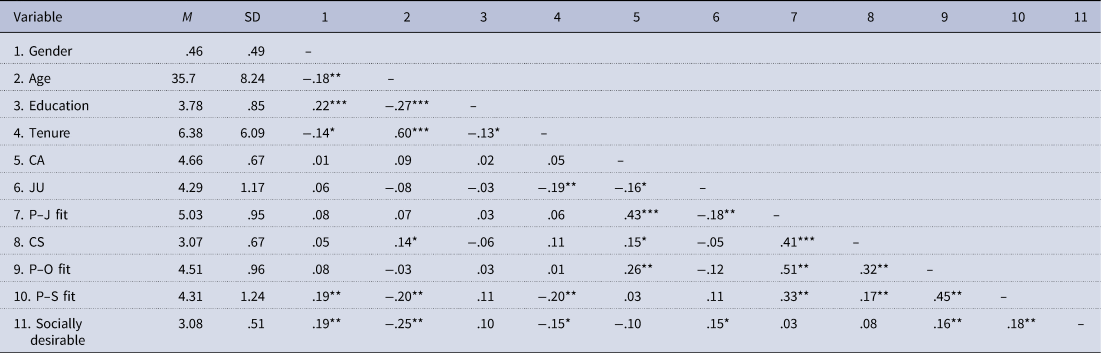
Table 1 lists descriptive statistics, bivariate correlations, and Cronbach's α values for all of the variables. All variance-inflation factors in the regressions were below 2, which indicates that multicollinearity was not an issue in this study.
Descriptive statistics and bivariate correlations

Not:. *p < .05, **p < .01, ***p < .001.
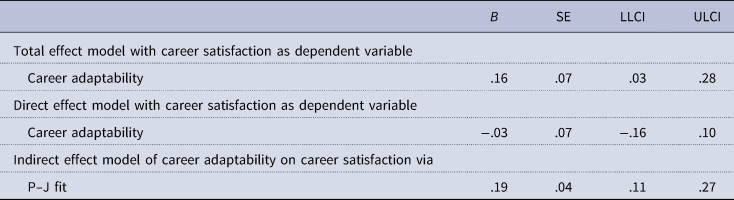
As demonstrated in Table 1, correlational analyses showed that career adaptability was positively and significantly related to career satisfaction (r = .15, p < .05), supporting Hypothesis 1. An important indication of mediation when using the analysis of Preacher and Hayes (Reference Preacher and Hayes2004) procedure is the significance level of the indirect effect from career adaptability to career satisfaction via the P–J fit, as indicated by the p-value or the bias corrected bootstrap intervals. In response to the normal distribution hypothesis, we adopted the bootstrapping method. We used SPSS macro PROCESS to conduct this analysis. As shown in Table 2, the total effect of career adaptability on career satisfaction was significant (β = .16, with a 95% confidence interval [CI] [.03, .28]). Furthermore, the indirect effect of career adaptability on career satisfaction via the P–J fit was also significant (β = .19, with a 95% CI [.11, .27]). Given that none of the CIs contained zeros, these results suggest partial support for Hypothesis 2. Moreover, given that the direct effects of career adaptability on career satisfaction was nonsignificant (β = −.03, with a 95% CI [−.16, .10]), the combination of indirect effects noted above suggest the possibility of full mediation.
Bootstrapping using a mediation model

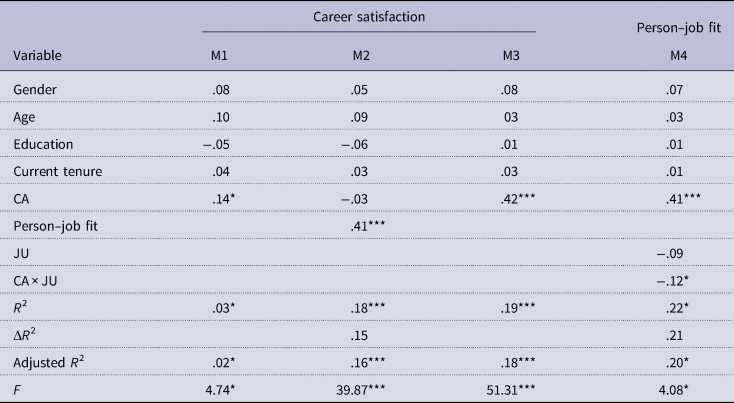
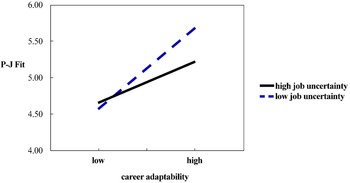
Hypothesis 3 predicts that career adaptability would have a stronger effect on person–job fit among employees presenting lower scores for job uncertainty. To test the moderating effects of adaptability, we added the two-way interaction with uncertainty to our analysis using the M4 model. As shown in Table 3, after controlling for demographic data, the interaction of job uncertainty with career adaptability was significant (β = −.12, p = .018). Thus, Hypothesis 3 is supported.
Regression results for testing moderation

CA = career adaptability; JU = job uncertainty.
*p < .05, **p < .01, ***p < .001.
Hypothesis 4 predicts that the indirect effect of overall fit on the relationship between career adaptability and career satisfaction would be strengthened by low job uncertainty. Preacher, Rucker, and Hayes (Reference Preacher, Rucker and Hayes2007) recommended two methods to assess the significance of conditional indirect effects. First, researchers can examine the magnitude of the indirect effect (via the mediator) of the independent variable on the dependent variable within a range of values of the moderator (typically using the mean and one standard deviation above and below the mean). Another option is to use bootstrapping techniques to generate confidence intervals for the magnitude of the indirect effects and assess the significance using the confidence intervals. Table 4 presents the estimates, standard errors, z statistics, significance values of the conditional indirect effects, and moderator's range of values (presenting the trend of indirect effects).
Moderated mediation results for career satisfaction based on the level of job uncertainty

The results of our analysis revealed that for job uncertainty, the conditional indirect effects of career adaptability were nonsignificant among employees with higher job uncertainty (conditional indirect effect = .06, p = .10) but stronger (slightly significant) among those with low job uncertainty (conditional indirect effect = .07, p = .03), thereby supporting Hypothesis 4. This relationship can be more easily grasped from Figure 2.
Moderating effects of job uncertainty on the relationship between career adaptability and person–job fit

Discussion
Findings and theoretical implications
Our findings verify the role of career adaptability in promoting career satisfaction. They also indicate that the person–job fit promotes career satisfaction. The results of this study shed new light on the value of incorporating potential mediators within the theoretical framework to disentangle correlations and elucidate the relationship between career adaptability and career satisfaction.
Most previous COR studies have focused on ‘condition’ resources; relatively little work has focused on ‘energy’ resources. Our growing understanding of person–job fit has expanded research based on COR theory while enhancing our knowledge of career satisfaction. This extends the implications of COR theory, which postulates that adaptability resources equip individuals with self-regulatory capacities to deal with the various situations encountered in the workplace (Rusu, Măirean, Hojbotă, Gherasim, & Gavriloaiei, Reference Rusu, Măirean, Hojbotă, Gherasim and Gavriloaiei2015). In other words, employees who are highly adaptable in their work and careers are more likely to experience positive psychological states (e.g., satisfaction), due to their possession of self-regulatory resources (Coetzee & Schreuder, Reference Coetzee and Schreuder2018; Coetzee & Stoltz, Reference Coetzee and Stoltz2015).
Our empirical analysis revealed the mediation mechanism (based on person–job fit) that underlies the influence of career adaptability on career satisfaction. This provides a possible explanation regarding the means by which career adaptability supports career satisfaction. Our findings (based on COR theory) indicate that the link between career adaptability and job requirements is related to person–job fit extending the current literature, which focused primarily on the gain and fit of work resources as predictors of satisfaction outcomes. Our mediation results highlight the relevance of person–job fit in career and work settings (Keller & Semmer, Reference Keller and Semmer2013). Our findings suggest that person–job fit links employee career adaptability to career satisfaction, by integrating an exploration of the self with that of the environment (Edwards, Caplan, & Harrison, Reference Edwards, Caplan, Harrison and Cooper1998). This underlines the importance of person–job fit in directing the resources of career adaptability to facilitate career satisfaction.
The proposed mediation path integrates COR theory (Hakanen, Perhoniemi, & Toppinen-Tanner, Reference Hakanen, Perhoniemi and Toppinen-Tanner2008) with person–environment theory (Edwards, Caplan, & Harrison, Reference Edwards, Caplan, Harrison and Cooper1998) to explain the psychological processes involved in deriving satisfaction at work from resources applicable to self-regulated adaption. More importantly, this mediation path extends models based on COR theory (Xanthopoulou, Bakker, Demerouti, & Schaufeli, Reference Xanthopoulou, Bakker, Demerouti and Schaufeli2009) by validating that there is indeed a path linking adaptability and adaptation constructs from the perspective of person–job integration. This finding provides a straightforward answer to the ongoing discussion regarding the sequence of effects associated with career-related satisfaction.
Most previous studies emphasized the value of intrinsic motivation for employees, while disregarding the impact of external circumstance contextualization. As predicted by the COR model, we show that the negative state of job uncertainty is associated with a desire to minimize this loss of resources, which would otherwise undermine career satisfaction (Keller & Semmer, Reference Keller and Semmer2013). Individuals facing resource loss react defensively in an attempt to remain above a minimal resource threshold (in part objective, in part perceived) (Hobfoll & Lilly, Reference Hobfoll and Lilly1993). They strongly resist any attempts to tamper with their fragile balance of resources. It is important to consider how individuals interact with the organization when there is a lack of consistency in their goals pertaining to resource conservation. Conflict pertaining to work resources and job uncertainty interferes with person–job fit, which can manifest itself as distress about the job. Therefore, employees experiencing job uncertainty, tend to experience stress and consume intrinsic resources. This has a direct bearing on the relationship between career adaptability and person–job fit, which in turn affects career satisfaction.
It appears that stress associated with job uncertainty eclipses the degree to which career adaptability and person–job fit influence career satisfaction. This underlines the importance of stable employment (Carless, Reference Carless2005). These factors do not necessarily lead to satisfaction; however, they could be used to prevent performance losses caused by self-limits on work output and prevent the occurrence of ‘negative incentives.’ This issue deserves greater attention in future research on resource integration.
In seeking to explain this issue, we offer two complementary explanations respectively in line with COR theory. First, one's experiences in their career (including the demands they face and the resources they are able to draw upon to meet their responsibilities) inform their impressions of the extent to which the person–job fit balances their efforts to integrate the loss/gain of resources. Second, job uncertainty factors affect the depletion and preservation of valued resources that are instrumental to meeting the demands of work and personal conditions. For instance, career adaptability can enhance the control that employees have over resources used to meet work demands (Hirschi, Herrmann, & Keller, Reference Hirschi, Herrmann and Keller2015). This is a powerful resource that facilitates their ability to perform well in multiple roles and enables them to avoid the drain on resources associated with job uncertainty. It is important to keep in mind the complementary mechanisms of adaptability and resource development/conservation in formulating future studies on this topic. The integration of COR theory provide a model by which interventions could be guided.
Practical implications
Similar to previous research (Ginevra, Pallini, Vecchio, Nota, & Soresi, Reference Ginevra, Pallini, Vecchio, Nota and Soresi2016), our results emphasize the role of career adaptability in managing career-relevant situations (e.g., a meaningful and satisfying career status). Career adaptability comprises a variety of psychological resources, which facilitate self-regulation in the process of vocational development. It is possible that career counselors could use such resources, such as concern, control, curiosity, and confidence (Savickas & Porfeli, Reference Savickas and Porfeli2012), to enhance an individual's career satisfaction. For example, counselors could guide clients to think positively about their professional futures, to practice tasks aimed at developing decision-making skills, to participate in activities that spur inquisitive behaviors, and to motivate themselves to overcome career difficulties. These assistive strategies could be integrated within management techniques, given that individuals may need multiple adaptability resources to deal with undesirable psychological states.
Furthermore, our findings provide insight into the psychological pathways that connect career adaptability and career satisfaction. Managers should consider how an employee's intrinsic condition (e.g., the psychological resources of career adaptability) as well as the compatibility between employee and his/her career contexts affects their success (Zacher, Reference Zacher2014a). It is also important to consider the congruence of the employees with their job status when implementing assistive strategies aimed at desirable vocational experiences, such as career satisfaction. It has been posited that one's experiences strengthen person–job fit and promote career satisfaction (Bui, Bui, Zeng, Zeng, Higgs, & Higgs, Reference Bui, Bui, Zeng, Zeng, Higgs and Higgs2017). The current study contributes to managerial practice by identifying multiple leverage points for organizations wishing to be seen by their employees as truly supporting career satisfaction. Our discovery that career adaptability influences perceptions of job uncertainty underlines the need to manage resources, an often-overlooked component of organizational strategies aimed at promoting person–job fit.
Our results suggest that resource loss can undermine perceptions of support for career satisfaction, even for employees who have abundant resources for career adaptability. COR theory explains much of the variance in the employee responses to person–job fit and job uncertainty, suggesting that employers should focus on improving employee–job fit. These actions would be a clear demonstration of an employer's commitment to career development and ensure that supervisors are aware of the degree to which intrinsic resources can be depleted by job uncertainty. An understanding of the effects of job uncertainty could prompt managers to get involved in promoting the condition resources of employees and increasing their satisfaction. Placing employees in a stable job environment can enrich their intrinsic resources (e.g., psychological capital) to meet the demands of the job, which can give them a sense of achievement as well as opportunities for promotion. This would also tend to enhance work engagement, resulting in greater career satisfaction.
Limitations and directions for future research
This study has a number of limitations that should be addressed in future research. First, the cross-sectional design used in this study prevented further inferences pertaining to the causal relationships among career adaptability, person-fit perception, and career satisfaction with job uncertainty. Despite the fact that the proposed mediation paths have a strong theoretical foundation, the cross-sectional design cannot exclude the possibility of reciprocal effects among study variables. Future researchers could use experimental or longitudinal studies to confirm causality. Second, the questionnaires were presented in a self-report format at two time points, which may have led to common method bias (Podsakoff et al., Reference Podsakoff, MacKenzie, Lee and Podsakoff2003). Our CFA results slightly alleviated this concern; however, future research should include the collection of multi-source data to address common method bias. Third, this study operationalized person–environment fit as person–job fit in the workplace in accordance with previous research (Lauver & Kristof-Brown, Reference Lauver and Kristof-Brown2001). Nonetheless, recent research has identified more person–environment fit constructs in the work setting, such as person–organization, person–supervisor fit, and person–coworker fit (Kristof-Brown, Zimmerman, & Johnson, Reference Kristof-Brown, Zimmerman and Johnson2005). Different types of person–job fit (e.g., needs–supply fit and demand–ability fit) have also been reported in the literature (Guan et al., Reference Guan, Deng, Sun, Wang, Cai, Ye, Fu, Wang, Zhang and Li2013). Merely considering overall person–job fit may be insufficient to fully capture the mechanism underlying the relationship between career adaptability and career satisfaction. Future research should consider person–environment fit constructs in the context of work and conduct more nuanced analysis. Finally, this study examined only a single type of career satisfaction; therefore, future research should also incorporate inner as well as hierarchical satisfaction in order to gain a deeper understanding of the means by which career adaptability could be used to foster career satisfaction.
Hung-Chieh Yen is a PhD candidate in Business Administration at the National Taiwan University of Science and Technology. His current research interests include abusive supervision, career management, and person–job fit. His work has been published in Topco Scientific Thesis Symposium.
Jen-Wei Cheng is a professor of Business Administration at the National Taiwan University of Science and Technology. His research interests include leadership, voice behavior, and leading change. His work has been published in Knowledge-based System, Military Psychology, Asia Pacific Journal of Human Resources, International Journal of HRM, Journal of Psychology: Interdisciplinary and Applied, Industrial Management & Data Systems, Service Industries Journal, Journal of Management & Systems, NTU Management Review, and Chiao Da Management Review.
Chin-Tien Hsu is an associate professor in the Department of Counseling and I/O Psychology, Ming Chuan University and teaches human resource management, organizational behavior, managerial psychology, and business ethics. He received his PhD degree from the Graduate Institute of Business Administration, National Taiwan University. His research areas include organizational behavior, human resource management, and ethical leadership.
Kuo-Ching Yen is an assistant professor of Graduate School of Resources Management and Decision Science at National Defense University. His current research interests include creativity, leadership, team processes, and justice issues. His work has been published in Journal of Human Resource Management and NTU Management Review.