




No CrossRef data available.
How Solid is Mass Support for Democracy—And How Can We Measure It?
Published online by Cambridge University Press: 25 April 2017
Abstract
A decade has passed since the Third Wave of democratization brought an avalanche of new, relatively unstable democracies into being, raising the question, “How solid is support for democracy in these countries?” In the intervening years, public support for democracy has faded in some countries, many of which are democratic in name only. It is unclear how long even the pretense of electoral democracy will survive in the Soviet successor states, apart from the Baltics (Brzezinski 2001). The prospects for democracy in Islamic countries seem particularly poor, with some writers arguing that the basic values of Islamic publics may be incompatible with liberal democracy (Huntington 1993, 1996). This article examines this claim, using the 1999–2001 wave of the World Values Survey, which includes 10 Islamic countries, making it possible for the first time to compare the Islamic world with other major cultural zones. We find surprisingly widespread support for democracy among Islamic publics—at least by conventional measures.
Information
- Type
- FEATURES
- Information
- Copyright
- 2003 by the American Political Science Association
Introduction
A decade has passed since the Third Wave of democratization brought an avalanche of new, relatively unstable democracies into being, raising the question, “How solid is support for democracy in these countries?” In the intervening years, public support for democracy has faded in some countries, many of which are democratic in name only. It is unclear how long even the pretense of electoral democracy will survive in the Soviet successor states, apart from the Baltics (Brzezinski 2001). The prospects for democracy in Islamic countries seem particularly poor, with some writers arguing that the basic values of Islamic publics may be incompatible with liberal democracy (Huntington 1993, 1996). This article examines this claim, using the 1999–2001 wave of the World Values Survey, which includes 10 Islamic countries, making it possible for the first time to compare the Islamic world with other major cultural zones. We find surprisingly widespread support for democracy among Islamic publics—at least by conventional measures.
Several major empirical research programs are monitoring public support for democratic institutions, including the New Democracies Barometer, the New Russia Barometer, the LatinoBarometer, the AfroBarometer, the European Values Survey, and the World Values Survey. Some degree of consensus has developed concerning which items are most effective, so that certain questions, measuring overt support for democracy, are regularly utilized in these surveys. These questions seem well designed, and they demonstrate internal consistency: people who support democracy on one indicator, tend to support democracy on other indicators. But our faith in these measures rests primarily on their face validity: no one has demonstrated that a high level of mass support for these items is actually conducive to democratic institutions.
Conceivably, other factors could be even more important than overt support for democracy. A massive literature argues that interpersonal trust plays a crucial role in democracy (Putnam 1993; Warren 1999; Norris 1999). Furthermore, Gibson (1998) has argued convincingly that tolerance of outgroups is essential to democracy: civil liberties and legitimate opposition require tolerance and forbearance toward groups with whom one disagrees and dislikes. Moreover, three decades of time-series data demonstrate an intergenerational shift toward Postmaterialist values, linked with rising levels of economic development (Inglehart 1977, 1997; Inglehart and Abramson 1999). Since Postmaterialists give high priority to protecting freedom of speech and to participation in making important government decisions, this trend should bring growing mass demands for democratization. Finally, economic success seems to help legitimate democratic institutions. The fall of Germany's Weimar Republic was linked with its failure to provide economic security during the Great Depression; conversely, the success of democracy in Germany after World War II was linked with the postwar economic miracle, causing democratic institutions to be associated with economic and social wellbeing. Accordingly, high levels of subjective well-being among the public are closely correlated with democracy (Inglehart 1997).
All of these qualities—tolerance of outgroups, interpersonal trust, the Postmaterialist emphasis on civil rights and political participation, and a sense of subjective well-being—may contribute to the emergence and flourishing of democracy, but the questions that measure them make no explicit reference to democracy. By contrast, questions that measure overt support for democracy have an obvious face validity, which may be one reason why the various programs that monitor support for democracy focus mainly on measuring overt support. Until now, no one has determined whether the various indicators of mass attitudes are actually linked with democracy at the societal level.
This article examines that question. We will measure how strongly the individual-level responses to given survey items are linked with high (or low) levels of democracy. The World Values Survey/European Values Survey (WVS/EVS) now provide data from more than 70 societies, ranging from authoritarian regimes to established democracies, enabling us to analyze the empirical linkages between individuallevel survey responses within each society, and a society's level of democracy, as measured by the Freedom House political rights and civil liberties scores.
Our findings are unambiguous. Although overt lip service to democracy is almost universal today, it is not necessarily an accurate indicator of how deeply democracy has taken root in a given country. The extent to which a society emphasizes a syndrome of tolerance, trust, political activism, and Postmaterialist values is a much stronger predictor of stable democracy. This syndrome has been labeled “Self-expression values:” a society that ranks high on one of these qualities tends to rank high on all of them; societies that rank low on all of them, emphasize “Survival values.” The Survival vs. Self-expression dimension is a major axis of crosscultural variation, and it is closely linked with economic development, which brings a shift from emphasis on Survival values to growing emphasis on Self-expression values (Inglehart and Baker 2000). This helps explain why economic development is conducive to democracy: by themselves, high levels of wealth do not necessarily bring democracy (if they did, Kuwait would be one of the world's leading democracies). But in so far as economic development brings rising levels of tolerance, trust, political activism, and greater emphasis on freedom of speech (the components of Self-expression values) it leads to growing mass demands for liberalization in authoritarian societies, and to rising levels of direct mass participation in societies that are already democratic.
The Survival/Self-expression dimension was not developed for analysis of democracy; it emerged as one of two major dimensions in an analysis of crossnational cultural variation, and is closely linked with the rise of post-industrial society. Although Inglehart and Baker (2000) present strong evidence that economic development brings a shift from Survival to Self-expression values, they are silent about an important aspect of this shift: it is—to a remarkable degree—linked with the extent to which a society has democratic institutions.
Overt support for democracy seems a necessary but not sufficient condition for democratic institutions to emerge. Unless mass pressures for democracy are present, power-hungry elites are unlikely to give publics the power to remove them from office. Today, overt support for democracy is widespread among publics throughout the world. But favorable attitudes toward the general idea of democracy are not sufficient. For democratic institutions to survive in the long term, they need a mass culture of tolerance, trust, participatory orientations, an emphasis on self-expression, and reasonably high levels of subjective well-being. To a striking degree, societies whose publics rank high on self-expression values show high levels of democracy.
Empirical Evidence
In country after country throughout the world, a clear majority of the population endorses democracy. This is the good news that emerges from the latest wave of the WVS/EVS surveys, covering over 80% of the world's population.1
The World Values Surveys and European Values Surveys are available from the ICPSR survey data archive and other survey data archives. For more detailed information about the World Values Surveys, see the WVS web sites, <http://wvs.isr.umich.edu> and <http://worldvaluessurvey.com>. For further information about the European Values Surveys, see the EVS web site, <http://evs.kub.nl> and the EVS sourcebook: Loek Halman (2001), The European Values Study: A Third Wave. Sourcebook of the 1999/2000 European Values Study Surveys . Tilburg: EVS, WORC, Tilburg University.

At this point in history, democracy has an overwhelmingly positive image throughout the world. This has not always been true. In the 1930s and 1940s, fascist regimes won overwhelming mass approval in many countries; and for many decades, communist regimes had widespread support. But in the past decade, democracy has become virtually the only political model with global appeal. Although Francis Fukuyama may have exaggerated in calling this “The End of History,” we do seem to be living in a genuinely new era in which the main alternatives to democracy have been discredited.
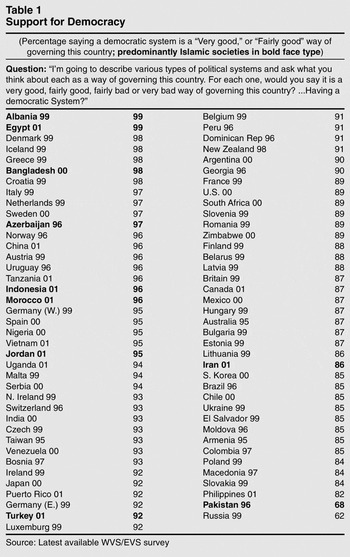
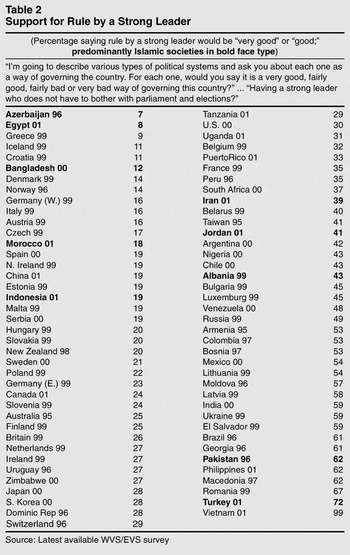
Today almost everyone gives lip service to democracy. But when one probes deeper, one finds disturbing evidence that mass support is not nearly as solid as Table 1 suggests—especially in the new democracies. Table 2 shows the responses to whether rule by “a strong leader who does not have to bother with elections or parliament” is a good way of governing one's country. In none of the stable democracies (continuously under democratic government for the past 30 years) did a majority endorse this option. But in 18 other societies, a majority supports this authoritarian option.

In many of the new democracies, peoples' first-hand experience with democracy has been unfavorable. In the former Soviet Union, the emergence of democratic government was accompanied by economic collapse. There, and in many other new democracies, a large share of the public say that under democracy the economic system runs badly. Ethnic conflict, rising crime rates and widespread corruption have accompanied the transition to democracy in many countries. Support for democracy is low in Russia, and the last two waves of the WVS/EVS surveys show dramatic declines in pro-democratic attitudes in Nigeria, Romania, Turkey, Bangladesh and much of Latin America. Here again, most Islamic societies rank relatively high: among the publics of Azerbaijan, Egypt, Bangladesh, Morocco, and Indonesia, rule by a strong leader who doesn't have to bother with elections, is endorsed by less than 20%, as compared with 30% in the U.S. Overall, most people have a positive image of democracy today, but the solidity of their support varies a great deal—and different questions convey different impressions of how solidly democracy is entrenched. Which indicators should we take most seriously?
Does Political Culture Matter?
The early research on political culture was motivated by the assumption that pro-democratic attitudes are conducive to democratic institutions. If this is true, democracy should be most prevalent in countries where pro-democratic attitudes are widespread. But is this the case? Most previous research on political culture was done in single countries or small numbers of countries, making it impossible to carry out statistically significant tests of the impact of mass attitudes on democracy. The WVS/EVS surveys now cover over 70 societies, providing enough cases for statistically significant analyses of the linkages between mass attitudes and a society's actual level of democracy. The results indicate that mass responses to the questions just examined are correlated with democracy at the societal level, but they are relatively weak predictors.
Table 3 shows how strongly given responses are correlated with societal-level democracy, as measured by the Freedom House ratings of political rights and civil liberties. Overwhelming majorities agree that “Having a democratic political system is a good way of governing this country,” but this item turns out to be a weak predictor of societal-level democracy, showing correlations of only .072 and .224 with the short-term and long-term measures of actual democracy in Table 3. The Albanians are more likely to agree with this item than are the Swedes or the Swiss.

We cross-validated each of the variables in Table 3 by two separate criteria: the society's level of democracy in 1995 (other recent years produce similar results), and its level of democracy during the period from 1981 to 2000 (the last year for which ratings were available at this writing). The correlations between mass attitudes and democracy are systematically higher when we use the longer period because political culture is a better predictor of the longterm stability of democracy than it is of a society's level of democracy at any given point in time. A society's level of democracy can fluctuate dramatically from year to year, for reasons unrelated to its underlying political culture: a military coup can bring sudden changes in a society's level on the Freedom House scales. But a society is unlikely to maintain democratic institutions over the long term, unless democracy has solid support among the public.
The Freedom House scores for any one year do not reflect the solidity of democracy in a given society. In the 1997 Freedom House ratings, Slovenia, Hungary, Poland, Latvia, South Africa, and Uruguay all got exactly the same scores as Britain, France, Germany, and Belgium—but no informed observer would consider democracy in the first group to be as firmly established as in the second. Political culture consists of relatively deep-rooted and enduring orientations. It cannot explain short-term fluctuations in a society's level of democracy, but it is important in determining whether democracy survives over the long term. Consequently, a society's level of democracy over a relatively long period such as 1981–2000 reflects the impact of political culture on democracy far more faithfully, than do the scores for any one year. Thus, the proportion of the public saying “democracy is better than any other form of government” is not significantly correlated with the society's level of democracy in 1995—but it is significantly linked with the society's level of democracy during the period from 1981 to 2000.
Public support for rule by experts shows a similar pattern. It is negatively correlated with a society's level of democracy in 1995, but not at a statistically significant level. But it does show a statistically significant correlation with a society's long-term level of democracy. If a high proportion of the population endorses rule by experts, or rule by a strong leader, that country's level of democracy tends to be low, and the linkage is relatively strong.
Moreover, a well-designed multi-item index has stronger explanatory power than any one item, as the Democracy/Autocracy index (shown in bold face) demonstrates. Based on the first four items in Table 3, it is a stronger predictor of a society's long-term level of democracy than any of its constituent items, showing a .506 correlation with long-term democracy. Countries that rank high on support for democracy and rejection of authoritarian rule tend to be stable democracies.
But certain other items that do not explicitly mention democracy at all, are even stronger predictors of stable democracy. The bottom half of Table 3 deals with five components of the Survival/Self-expression values dimension. The extent to which a society has an underlying culture of tolerance, trust, political activism, well-being, and the extent to which its people value freedom of speech and self-expression is an even more powerful predictor of stable democracy than is overt support for democracy. Materialist/Postmaterialist values (a key component of the Survival/Self-expression dimension) are a strong predictor of how democratic a society is. Postmaterialists value democratic freedoms highly, and do not support democracy only in so far as it is linked with prosperity and physical security. Thus, Materialist/Postmaterialist values show a .750 correlation with a society's level of democracy from 1981–2000—a far stronger linkage than any of the items that measure explicit support for democracy, including the four-item Democracy/Autocracy index.
And surprising as it may seem, tolerance of homosexuality is a considerably stronger predictor of stable democracy than any of the items that tap overt support for democracy. Gibson (1998) argues that tolerance is a crucial prerequisite of democracy. The very essence of democracy is that the government tolerates the opposition and allows it to advocate its views; and the crucial test of democracy is when one tolerates views one heartily dislikes. Consequently, Gibson ascertained which group was most disliked in a given society, and then asked whether members of that group should be allowed to hold public meetings, teach in schools, and hold public office. Today, homosexuals constitute the most-disliked group in most societies. Relatively few people express overt hostility toward other classes, races, or religions but rejection of homosexuals is widespread—making attitudes toward them an effective litmus test of tolerance.
Many writers have argued that interpersonal trust plays a crucial role in democracy. Democratic institutions depend on trust that the opposition will accept the rules of the democratic process. One must view political opponents as a loyal opposition who can be relied on to govern within the laws, and to surrender power if they lose the next election. Trust is indeed linked with the survival of democratic institutions, showing a modest but statistically significant correlation with long-term democracy.
High levels of subjective well-being are also closely linked with stable democracy, the indicator used here being the individual's reported happiness level. Political economy research demonstrates that if the economy is good, support for the incumbents increases. Support for a democratic regime reflects deeper long-term processes. When people feel that life has been good under a given regime, they develop feelings of legitimacy and diffuse support for that regime . Legitimacy is helpful to any regime, but authoritarian systems can survive through coercion; democratic regimes must have mass support or, like the Weimar Republic, they can be voted out of existence. Thus, societies with happy publics are relatively likely to remain democratic in the long term (r = .540).
The “Survival vs. Self-expression values” syndrome including tolerance of out-groups, Postmaterialist values, political activism, trust, and subjective wellbeing is an even more powerful explanatory variable than overt support for democracy. The Democracy/Autocracy index shows a correlation that would explain about 25% of the variance in levels of democracy from 1981 to 2000. But a society's mean score on Survival/Self-expression values accounts for almost 69% of the variance in democracy. While overt support for democracy is a good thing, self-expression values seem even more crucial.
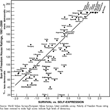
Figure 1 illustrates the relationship between scores on the Survival/Self-expression dimension, and the levels of democracy found in given countries from 1981 to 2000. The levels of democracy in the 76 countries analyzed are very closely linked with their scores on the Survival/Self-expression dimension, with only a few outliers. China, Vietnam, and Iran have lower levels of democracy than their publics' values would predict: a determined elite, in control of the military, can repress mass aspirations. And Hungary, India, and Portugal show higher levels of democracy than their publics' values would predict: pro-democratic elites can sometimes accelerate the pace of democratization. But overall, the linkage between political culture and political institutions is remarkably strong, producing a .83 correlation.

Self-expression Values and Democratic Institutions. r=.83, N=76, p<.000
The global trend of the past several centuries has been toward economic development. Economic development tends to give rise to growing mass emphasis on self-expression values—providing social and cultural conditions under which democracy becomes increasingly likely to emerge and survive. The evidence in Figure 1 suggests that a number of societies may be closer to democracy than is generally suspected. For example, Mexico's position on the Survival/Self-expression values axis is only slightly lower than that of Argentina, Spain, or Italy. Probably by no coincidence, Mexico made the transition to democracy in 2000, shortly after the Mexican survey was carried out. A number of other societies are also in this transition zone, including Turkey, the Philippines, Slovenia, South Korea, Taiwan, Poland, Peru, Chile, and South Africa. Both China and Vietnam are experiencing rapid economic growth, which tends to bring a shift toward Self-expression values. The communist elites of these countries are committed to maintaining one-party rule, and as long as they retain control of the military they should be able to remain in power. But their people show a cultural predisposition toward democracy that is inconsistent with their political institutions' very low rankings on the Freedom House ratings. In the long run, repression of a people's aspirations for self-expression is likely to exert growing costs.
Authoritarian rulers of some Asian societies have argued that the distinctive “Asian values” of these societies make them unsuitable for democracy. In fact, the position of most Asian countries on Figure 1 is about where their level of economic development would predict. Japan ranks with the established Western democracies on both the Self-expression values dimension, and on its level of democracy. And Taiwan and South Korea's positions on both dimensions are similar to those of other relatively new democracies such as Poland, the Philippines, Chile or Slovenia. The publics of Confucian societies may be more ready for democracy than is generally believed.
Despite the strong overt support for democracy found among Islamic publics in Tables 1 and 2, all of the Islamic societies rank below the midpoint on the Survival/Self-expression dimension. The goal of democracy may be attractive, but their levels of tolerance, trust, and well-being, and the priority they give to self-expression and political participation, fall short of what is found in all established democracies. But we do not find an unbridgeable chasm between Islamic societies and the rest of the world. The belief systems of these Islamic countries fall roughly where one would expect, on the basis of their level of economic development. The most developed Islamic country, Turkey, is now in the transition zone along with such countries as South Africa and Slovenia; and the public of the second richest of these Islamic countries, Iran, shows a surprisingly pro-democratic political culture: in the last two national elections, overwhelming majorities of the Iranian public voted for reform-oriented governments, only to have their aspirations thwarted by a theocracy that controls the army and secret police.
What Comes First—a Democratic Political Culture or Democratic Institutions?
The extent to which people emphasize self-expression values is closely linked with the flourishing of democratic institutions. But what causes what? We suggest that economic development and other historical factors lead to growing emphasis on Survival/Self-expression values. These values, in turn, shape a society's prospects for democracy. Thus, we postulate the following causal sequence:
economic development
higher levels of self-expression values
higher levels of democracy
To demonstrate that these causal linkages hold true empirically would require a complex analysis that is beyond the scope of this article. But some work has already been done. Burkhart and Lewis-Beck (1994) analyzed the direction of the causal relationship between economic development and democracy, using empirical data from 131 countries. On the basis of Granger tests, they conclude that economic development causes democracy, but that democracy does not cause economic development. Helliwell (1993) reaches similar conclusions.
Building on these findings, Welzel, Inglehart, and Klingemann (2003) examine why economic development goes with democracy, hypothesizing that cultural changes provide the link between development and democratization. They first test the impact of self-expression values at Time 1, on subsequent levels of democracy at Time 2. They find that a society's mean score on the Survival/Self-expression dimension has by far the most powerful influence on its level of democracy. Although economic development is at the root of this causal sequence, it is important mainly in so far as it contributes to the emergence of Self-expression values.
They then test the reverse causal model: that democratic institutions cause a shift from Survival values to Self-expression values. Since these values show a .83 correlation with democracy, if one used democracy alone as a predictor of these values, it would “explain” most of the variance. But when economic development is also included in the regression, they find that democratic institutions explain only an additional 2% of the variance in Self-expression values, beyond what was explained by economic development and religious heritage. Culture seems to shape democracy far more than democracy shapes culture.
Theoretical considerations also suggest that the strong linkage between self-expression values and democracy shown in Figure 1 reflects, at least in part, the impact of political culture on democracy. One way to explain the strong linkage we have observed between political culture and democracy, would be to assume that pro-democratic attitudes are caused by the presence of democracy, emerging through “habituation” or “institutional learning” from the use of democratic institutions. Confronted with the evidence in Figure 1, proponents of this view would argue that democratic institutions give rise to the self-expression values that are so closely linked with them. In other words, democracy makes people tolerant, trusting, and happy, and instills Postmaterialist values. This interpretation is appealing and suggests that we have a quick fix for most of the world's problems: adopt a democratic constitution and live happily ever after.
Unfortunately, the experience of most Soviet successor states does not support this interpretation. Since their dramatic move toward democracy in 1991, the people of most of these societies have not become more trusting, more tolerant, happier, or more Postmaterialist: for the most part, they have moved in exactly the opposite direction, with the sharp decline of their economy and society (Inglehart and Baker 2000). Evidence of declining support for democracy is also striking in Latin America. From 1995 to 2001, support for democracy declined among the publics of all 17 Latin American countries surveyed, with an average decline of 12% (LatinoBarometer report, July 2001). Clearly, sheer experience with democratic institutions does not necessarily bring them growing acceptance and legitimacy.
A related school of thought argues that democratization is mainly a matter of elite bargaining: if the elites are sufficiently skillful, they can establish democracy in virtually any setting. This is an appealing thought, since it assumes that democratization is really pretty easy—all you need to do is persuade the elites to adopt the right constitution. This approach has difficulty coping with the fact that democratic institutions are not equally likely to emerge in rich and poor countries. Today, almost all rich countries have democratic institutions; but among the 64 “low-income” countries (as classified by the World Bank), India is the only one in which democratic institutions have survived continuously for more than a decade. Shall we assume that the elites of rich countries are almost always skillful bargainers who design good institutions—while low-income countries almost always have incompetent elites? It seems unlikely.
Our interpretation of Figure 1 is that economic development leads to growing emphasis on self-expression values, a syndrome of tolerance, trust, a participatory outlook, and emphasis on freedom of expression. Again, we will not attempt to prove causality here, but the correlation between per capita GDP and Self-expression values is extremely strong (r = .78). The emergence of the Self-expression syndrome is conducive to democratic institutions—the institutions that offer the widest opportunities for self-expression. Although the extent to which this syndrome is present varies greatly from one society to another, no cultural zone seems immune. Despite a tradition of “Asian values,” or an Islamic cultural heritage, the emergence of post-industrial society is conducive to rising emphasis on self-expression, which in turn brings rising mass demands for democracy.
References
Brzezinski Zbigniew2001 Ten Years after the Soviet Breakup: The Primacy of History and Culture Journal of Democracy 12 20 26Google Scholar
Burkhart Ross E.Michael S. Lewis-Beck1994 Comparative Democracy: The Economic Development Thesis American Political Science Review 88 (December)903-10Google Scholar
Gibson James L.1998 A Sober Second Thought: An Experiment in Persuading Russians to Tolerate American Journal of Political Science 42 (July)819 850Google Scholar
Huntington Samuel P.1996 The Clash of Civilizations and the Remaking of World OrderNew YorkSimon and Schuster
Inglehart RonaldPaul Abramson1999 Measuring Postmaterialism American Political Science Review (September)665 677Google Scholar
Inglehart RonaldWayne Baker2000 Modernization, Cultural Change and the Persistence of Traditional Values American Sociological Review 65 (February)19 51Google Scholar
Inglehart Ronald1997 Modernization and Postmodernization: Cultural, Economic and Political Change in 43 SocietiesPrincetonPrinceton University Press
Norris Pippa1999 Critical Citizens: Support for Democratic GovernmentNew YorkOxford University Press
Putnam Robert1993 Making Democracy WorkPrincetonPrinceton University Press
Warren Mark1999 Democracy and TrustCambridgeCambridge University Press
Welzel ChristianRonald InglehartHans-Dieter Klingemann2003 Human Development as a Theory of Social Change European Journal of Political Research forthcomingGoogle Scholar

Self-expression Values and Democratic Institutions. r=.83, N=76, p<.000
 You have
Access
- 207
- Cited by