Introduction
Radical right parties’ (RRPs) electoral success across the European continent has made this party family well-known among the electorate; particularly for their nativist views and their populist critique of the elite for ignoring the people’s grievances. A wealth of research has studied the radical right, however, social scientists have mostly devoted attention to studying the causes of their popularity (Arzheimer and Carter, Reference Arzheimer and Carter2006; Inglehart and Norris, Reference Inglehart and Norris2016; Kitschelt and McGann, Reference Kitschelt and McGann1995; Mudde, Reference Mudde2007, Reference Mudde2013; Rydgren, Reference Rydgren2007) and have only recently begun investigating their consequences (Abou-Chadi and Krause, Reference Abou-Chadi and Krause2020; Bischof and Wagner, Reference Bischof and Wagner2019; Bohman and Hjerm, Reference Bohman and Hjerm2016; Castanho Silva, Reference Castanho Silva2017; Harteveld et al., Reference Harteveld, Kokkonen, Linde and Dahlberg2021a; Harteveld et al., Reference Harteveld, Mendoza and Rooduijn2021b). Most research within this latter tradition have primarily studied the effects of the success of RRPs for mainstream parties policy positioning (e.g. Abou-Chadi and Krause, Reference Abou-Chadi and Krause2020; Krause et al., Reference Krause, Cohen and Abou-Chadi2022), while there has been less focus on their effects on public opinion. Yet, a close reading of the literature suggests that these radical parties erode trust and solidarity within modern democracies when they construct immigrants and the elite as scapegoats harming societal cohesion (Muis and Immerzeel, Reference Muis and Immerzeel2017; Wodak, Reference Wodak2015). However, this causal relationship has not been clearly stated in the existing literature.
Studying the link between RRPs and public attitude formation has only become more pertinent after the radical right has gone from the fringes of politics to gaining representation in most national parliaments in Europe; and in some cases even participating as junior coalition partners in right-wing governments (Röth et al., Reference Röth, Afonso and Spies2018, p. 331). Yet, current evidence for RRPs’ impact on public opinion in the wake of their election to parliament is mixed. Bohman and Hjerm (Reference Bohman and Hjerm2016) did not find empirical support for their hypotheses that the radical right’s representation in national parliaments strengthened or polarized public opposition towards immigration (see also Dunn and Singh, Reference Dunn and Singh2011). However, others have demonstrated that the first time entrance of RRPs into parliament ideologically polarized voters both in the short (Bischof and Wagner, Reference Bischof and Wagner2019, pp. 892–896) and long terms (Bischof and Wagner, Reference Bischof and Wagner2019; Castanho Silva, Reference Castanho Silva2017).
In this paper, I add to the existing literature on radical right parties’ impact on public opinion by investigating whether these parties’ parliamentary representation has led to an erosion of trust and solidarity within modern mass-scale democracies. My core assumption is that parliamentary representation brings additional resources and better opportunity structures that radical right parties’ elites can draw on to disseminate their populist and nativist messages. As an outcome of this diffusion of anti-immigration and anti-establishment rhetoric, these parties may erode trust and solidarity between citizens, between ethnic groups, and towards political and legal institutions (Golder, Reference Golder2016; Mudde, Reference Mudde2007; Sprague-Jones, Reference Sprague-Jones2011). This conjecture echoes concerns that the radical right are dangerous adversaries in the development of inclusive policies (Sprague-Jones, Reference Sprague-Jones2011).
To test the overall research question, I merge all nine rounds of the European Social Survey (European Social Survey ERIC (ESS ERIC), 2020) with election data from the Parliament and Governments database on the vote and seat share of radical right parties at every national election spanning the years 1999 to 2020 (Döring and Manow, Reference Döring and Manow2021). As an identification strategy, I run two-way fixed effects models on the 17 countries (118 country-years) in the dataset that either elected a RRP to parliament after the first ESS round (treated countries) or that did not experience a RRP in the national parliament during the study period (untreated comparison countries). These models estimate the conditional difference of a radical right party winning representation in a national parliament in country j at election t on the attitudinal indicators of trust and solidarity. I use measures of anti-immigration sentiment, support for redistribution, welfare chauvinism, institutional trust, and social trust as indicators. To boost the study’s internal validity and generalizability, I replicate the main analysis using survey data from the International Social Survey Programme (ISSP Research Group, 1992, 1999, 2008, 2018), survey data from the Integrated Values Study (EVS, 2021; Haerpfer et al., Reference Haerpfer, Inglehart, Moreno, Welzel, Kizilova, Diez-Medrano, Lagos, Norris, Ponarin and Puranen2021), and using a regression discontinuity design (RDD) where treatment status is defined as radical right parties passing a country-specific voting threshold.
I find that a RRPs representation in parliament is associated with ca. 18% of a standard deviation lower level of public support for the redistribution of income differentials between rich and poor. Additional analyses further provide tentative evidence that the radical right’s parliamentary representation is also associated with higher levels of welfare chauvinism and that the negative relationship between RRP’s political representation and public support for a redistributive welfare state is stronger in contexts with weaker integration policies. However, to the contrary, I find no association between RRPs’ political representation and societal levels of anti-immigration sentiments, institutional trust, or social trust, thus, questioning the political representation of these radical parties’ overall influence on attitudes of trust and solidarity beyond issues related to the welfare state.
Theoretical background
The radical right
I begin by defining radical right parties to derive, from this characterization, conjectures about why this party family has the potential to erode trust and solidarity in European societies. For one, it is crucial to distinguish the radical right from the extreme right as these party families are often conflated in the literature. While the extreme right is anti-democratic, radical right parties do acknowledge the democratic process even though they are anti-establishment (Betz, Reference Betz1994; Ignazi, Reference Ignazi2003, p. 32). Second, because populism and nativism shapes the radical right’s views, I follow existing literature arguing that these concepts provide the most fitting characterization of the radical right (Ennser-Jedenastik, Reference Ennser-Jedenastik2016; Mudde, Reference Mudde2007). From these ideational concepts, I then derive the theoretical link between RRPs’ parliamentary representation and a societal decline in trust and solidarity.
Cas Mudde (Reference Mudde2004, p. 543) defines populism as the belief that society is by and large separated in two antagonistic groups, ‘the pure people’ and ‘the corrupt elite’, and that politics should express the ‘pure people’s’ general will. The ‘pure people’ can be imagined in different ways, but always refers to a homogenous group such as the working class or the nation (Anderson, Reference Anderson1983). Populists also reject pluralists attempts to make divisions within the people and criticize the elite for ignoring the people’s grievances (Golder, Reference Golder2016). Because populists desire popular sovereignty, they are critical of the way liberal democracy, through checks and balances, minority rights, and bargaining, constrains a direct expression of the general will of the people (Canovan, Reference Canovan1982; Rooduijn et al., Reference Rooduijn, van der Brug and de Lange2016).
Immigration is another grievance that right-wing populists mobilize on (Ivarsflaten, Reference Ivarsflaten2008). While left-wing populists ascribe to an inclusive form of populism, the radical right express an exclusive form of populism through appeals to nativism (Mudde and Kaltwasser, Reference Mudde and Kaltwasser2013). Nativism is the view that a democratic society should be limited to only one group with a shared identity and culture defined by a common ethnicity, history, religion, race, and/or language and that individuals that do not fulfill these membership criteria should be excluded from the people (Mudde, Reference Mudde2007, p. 22).
In the following sub-sections, I present my theoretical arguments about how radical right parties erode trust and solidarity in democratic societies through their nativism and populism. However, before I can present these arguments, I first clarify how I assume the parliamentary presence of the radical right deteriorates trust and solidarity, how I define trust and solidarity, and which indicators I use to capture these phenomena.
Mechanism: Parliamentary representation
When a political party enters the national parliament it is provided with political legitimacy and monetary, strategic, and symbolic resources (Abou-Chadi and Krause, Reference Abou-Chadi and Krause2020; Dinas et al., Reference Dinas, Riera and Roussias2014). This paper assumes that a radical right party uses these additional political assets as part of its vote-seeking strategy. Here, it is important to clarify two points. First, the radical right addresses not only their supporters but all citizens belonging to the ‘pure people’ (Mudde, Reference Mudde2007). Some scholars even argue that radical right supporters are least affected by RRPs’ national representation, since they are most predisposed to intolerance to begin with (e.g. Dunn and Singh, Reference Dunn and Singh2011). Second, established parties may differ in their treatment of the radical right after they have won representation in parliament, from deploying a cordon sanitaire to a strategy of accommodation; however, this should not influence the nativist and populist strategies RRPs use to influence public opinion.
The literature points to at least four possible mechanisms explaining how RRPs’ political representation could affect citizens’ levels of trust and solidarity. First, the radical right’s entrance into the national parliament may legitimize the party’s views, thereby making it more socially acceptable to express more radical attitudes and opinions (Bohman, Reference Bohman2011; Bursztyn et al., Reference Bursztyn, Egorov and Fiorin2017; Valentim, Reference Valentim2021). However, this may also simultaneously lead to an attitudinal backlash, where ideological opponents respond by expressing conflicting views and move further towards the other ideological extreme (Bishin et al., Reference Bishin, Hayes, Incantalupo and Smith2016). Second, RRPs may shape how voters view a certain issue through persuasion and elite cueing (Bohman and Hjerm, Reference Bohman and Hjerm2016; Broockman and Butler, Reference Broockman and Butler2017; Murakawa, Reference Murakawa2002). Third, RRPs may act as issue entrepreneurs and challenge the status quo by offering a novel position on an issue (Hobolt and de Vries, Reference Hobolt and de Vries2015, p. 6). Fourth, they may increase the salience of an issue (Akkerman, Reference Akkerman2015, Reference Akkerman2018).
Trust and solidarity
Drawing on the work of Lewis and Weigert (Reference Lewis and Weigert1985), I conceptualize trust as a relational attitude towards other actors (horizontal) or towards institutions (vertical) about the reliance on a trustee to manage a trustor’s expectations about future events or actions despite an unavoidable risk. This process has both an emotional and cognitive component making it distinguishable from blind faith (Lewis and Weigert, Reference Lewis and Weigert1985, pp. 970–972). Solidarity is then the binding of individuals into a cohesive and cooperative collective based on common interests, norms, and goals (Hechter, Reference Hechter2015, p. 6). In this paper, I consider five factors that capture aspects of trust and solidarity in a society. I consider anti-immigration attitudes as an indicator of trust and social solidarity between ethnic groups, as high levels of ethnic threat and prejudice towards immigrants is associated with lower levels of interethnic cooperation and interethnic trust (Dinesen et al., Reference Dinesen, Schaeffer and Sønderskov2020; van der Meer and Tolsma, Reference van der Meer and Tolsma2014). I use support for the redistribution of income differentials and welfare chauvinism as indicators of social solidarity between socio-economic groups and between natives and immigrants (Andersen, Reference Andersen2006; Jæger, Reference Jæger2006). Institutional trust captures trust towards both partisan (e.g. the national parliament) and impartial order institutions (e.g. the courts) (Rothstein and Stolle, Reference Rothstein and Stolle2008; Rothstein and Teorell, Reference Rothstein and Teorell2008). Finally, social trust encapsulates the positive expectation about the trustworthiness of the generalized other, differentiating it from trust towards salient groups (Dinesen et al., Reference Dinesen, Schaeffer and Sønderskov2020; Dinesen and Sønderskov, Reference Dinesen and Sønderskov2015; Robinson and Jackson, Reference Robinson and Jackson2001).
In the following, I propose that RRPs that have won national representation use populist and nativist messages to influence public attitudes of trust and solidarity in the following ways: An increase in (H1a) or polarization of (H1b) anti-immigration sentiments, a reduction in support for a redistributive welfare state (H2a) and/or growing welfare chauvinism (H2b), and a deterioration of both institutional (H3) and social trust (H4).
Nativism and anti-immigration attitudes
Bohman and Hjerm (Reference Bohman and Hjerm2016) argue that radical right parties’ nativist discourse on immigration may strengthen citizens’ opposition towards immigration in the wake of their election to parliament. Recent research on the legitimizing effect of the radical right underpin this expectation by demonstrating that a radical party’s election to parliament may legitimize the expression of radical views that have traditionally breached existing social norms (Valentim, Reference Valentim2021). Restating the argument forwarded by Bohman and Hjerm (Reference Bohman and Hjerm2016), I formulate the following hypothesis:
H1a: The presence of a radical right party in the national parliament increases anti-immigration attitudes.
Yet, cross-national research have not found evidence in favor of this hypothesis (Bohman and Hjerm, Reference Bohman and Hjerm2016; Dunn and Singh, Reference Dunn and Singh2011). In fact, a single-country study by Carlsson et al., (Reference Carlsson, Dahl and Rooth2021) report a negative effect of the Sweden Democrats winning seats in municipal councils on anti-immigration sentiment among Swedes. This finding suggests that the Sweden Democrats representation at the local level led to an attitudinal backlash, which the authors attributed to negative coverage in local newspapers and higher levels of politician turnover in local politics (Carlsson et al., Reference Carlsson, Dahl and Rooth2021, pp. 11–13). A political backlash effect entails that voters, ideologically opposed to the radical right, respond by moving further towards the other ideological extreme (Bishin et al., Reference Bishin, Hayes, Incantalupo and Smith2016). A strong backlash effect, however, seems unlikely in a cross-national context, since RRPs have enjoyed continuous electoral growth ever since their emergence as fringe parties (Abou-Chadi and Krause, Reference Abou-Chadi and Krause2020; Bohman and Hjerm, Reference Bohman and Hjerm2016; Röth et al., Reference Röth, Afonso and Spies2018). Instead, RRPs’ national representation may polarize anti-immigration attitudes (Bohman and Hjerm, Reference Bohman and Hjerm2016).
Because RRPs’ nativism represent one extreme of the ideological spectrum, some scholars have argued that their election to national parliament could polarize public opinion by reinforcing alternative views among some and legitimization among others (Bischof and Wagner, Reference Bischof and Wagner2019, pp. 890–891). Two studies found that the entrance of a RRP into parliament polarizes the public on the left-right dimension (Bischof and Wagner, Reference Bischof and Wagner2019; Castanho Silva, Reference Castanho Silva2017). However, we do not know if the radical right’s representation in parliament also polarizes views associated with this party family. Using the same cross-national dataset as this study, Bohman and Hjerm (Reference Bohman and Hjerm2016) did not find an association between RRPs’ parliamentary presence and a polarization of anti-immigration attitudes. However, my empirical analysis differs from theirs as they use a different outcome, country-level sample selection criteria, and modeling framework (see data and methods and appendix A-B in the online supplements). Testing the competing polarization argument, I restate another of Bohman and Hjerm’s (Reference Bohman and Hjerm2016) hypotheses:
H1b: The presence of a radical right party in the national parliament polarizes attitudes towards immigration.
Nativism and support for redistribution
The modern welfare state was a central part of the nation-building process and its legitimacy therefore rests on the fundamental assumption of mutual trust and solidarity between co-citizens with a shared national identity and culture (Brubaker, Reference Brubaker1992; Kymlicka, Reference Kymlicka2001; Kymlicka and Banting, Reference Kymlicka and Banting2006). Because of solidarity boundaries with non-co-nationals, scholars have argued that growing immigration can potentially undermine the welfare state (Brady and Finnigan, Reference Brady and Finnigan2014). Kymlicka and Banting (Reference Kymlicka and Banting2006) have conceptualized this inverse relationship as a tradeoff between inclusive integration policies and a sustainable welfare state model. Alesina and Glaeser (Reference Alesina and Glaeser2004, p. 166) have argued that radical right elites play a central role in the negative framing of the consequences of immigration by portraying immigrants as ‘welfare tourists’ and ‘anti-social free riders’. By persuading citizens into thinking that the provision of welfare is associated with non-contributing immigrants, they evoke the concern that European welfare systems are unable to sustain similar levels of generosity alongside continuing immigration (see also Schmidt-Catran and Spies, Reference Schmidt-Catran and Spies2013). From this argument, I propose the following hypothesis:
H2a: The presence of a radical right party in the national parliament reduces public support for redistribution.
Recent research have refined this hypothesis by showing that RRPs do not necessarily advocate for an overall reduction in the provision of welfare, but instead mobilize on a welfare chauvinistic agenda (Eger and Valdez, Reference Eger and Valdez2015, Reference Eger and Valdez2019; Ennser-Jedenastik, Reference Ennser-Jedenastik2016; Keskinen, Reference Keskinen2016). Welfare chauvinism is the belief in a two-headed and ethnocentric welfare state that reserves welfare benefits for native citizens, while restricting or excluding immigrants’ access to social protection (Andersen and Bjørklund, Reference Andersen and Bjørklund1990; Kitschelt and McGann, Reference Kitschelt and McGann1995, p. 22). In response to continuing immigration, welfare chauvinism has become a salient public opinion, entered national politics, and in some countries even been added to social policies (Careja et al., Reference Careja, Elmelund-Præstekær, Klitgaard and Larsen2016; Carney and Boucher, Reference Carney and Boucher2009; OECD, 2017, 2018). I hypothesize that:
H2b: The presence of a radical right party in the national parliament increases welfare chauvinism.
I note that the two arguments presented here, related to welfare attitudes, are not competing: If the radical right, in the wake of their parliamentary representation, triggers support for welfare chauvinistic beliefs alongside reduced public support for redistribution, it supports the conjecture that RRPs’ welfare chauvinist agenda has succeeded in associating immigrants with welfare state exploitation.
Populism and institutional trust
It is well-established in the literature on populist voting that citizens who are discontent with the political and legal institutions of liberal democracies are more likely to vote for a radical right party (Billiet and Witte, Reference Billiet and Witte1995; Hooghe et al., Reference Hooghe, Marien and Pauwels2011; Ziller and Schübel, Reference Ziller and Schübel2015). Disenchanted voters are drawn to the radical right’s critique of the political establishment’s abandonment of the people’s interests in favor of elite interests (Golder, Reference Golder2016). Yet, there is reason to believe that the causal direction also flows in the opposite direction (Rooduijn et al., Reference Rooduijn, van der Brug and de Lange2016). The benefits of parliamentary representation may expose more voters to the radical right’s anti-establishment messages and fuel citizens distrust in liberal democratic institutions (Rooduijn et al., Reference Rooduijn, van der Brug and de Lange2016; van der Brug, Reference van der Brug2003). In accordance with the above argument, I hypothesize that:
H3: The presence of a radical right party in the national parliament decreases trust in political and legal institutions.
Heinisch (Reference Heinisch2003) notes that elected RRPs are more inclined to spread populist messages when they are in political opposition because it is part of their vote-seeking strategy. Contrary to this, RRPs participating in a coalition government are more likely to moderate their use of anti-establishment messages to accommodate coalition partners.
Nativism, populism, and social trust
To protect the interests of ‘the people’, RRPs’ create divisions in society by constructing certain groups, such as the elite and immigrants, as threats to societal cohesion (Wodak, Reference Wodak2015). Politically represented RRPs’ may thus disseminate nativist and populist messages to evoke distrust between people in European democracies. I argue that the radical right’s nativism reduces cooperation and trust between ethnic groups (Ennser-Jedenastik, Reference Ennser-Jedenastik2016; Keskinen, Reference Keskinen2016) while their populist strategy decreases trust between groups whom the radical right has an antagonistic relationship with (Mudde, Reference Mudde2007). The literature echoes the conjecture that the radical right’s nativist and populist messages reduce trust between various groups. For example, when the radical right accuse the elite for being corrupt and to blame for the ‘pure people’s’ status loss (Mudde, Reference Mudde2004, p. 543), when they criticize immigrants for taking advantage of the welfare state (Alesina and Glaeser, Reference Alesina and Glaeser2004, p. 166), when they blame leftists for embracing multicultural policies that disunite the people (Kymlicka and Banting, Reference Kymlicka and Banting2006; Sprague-Jones, Reference Sprague-Jones2011), and when they disapprove of pluralists support for bargaining and compromise (Golder, Reference Golder2016). In accordance with this overall argument, I hypothesize that RRPs erode social trust in the wake of their election to parliament:
H4: The presence of a radical right party in the national parliament decreases social trust.
Data and methods
Sample
I use all nine waves of the European Social Survey (ESS) to empirically investigate the proposed hypotheses (European Social Survey, 2020). This pooled cross-sectional dataset consists of nationally representative random samples collected from 2002 to 2020 in 38 countries. Even though the ESS country-panel is unbalanced across waves, it is still, arguably, the most suitable comparative survey data available for this type of analysis. Most importantly, it contains the longest cross-national time-series on the analyzed outcomes and it applies rigorous cross-national quality standards for both the translation of questionnaires and data collection processes (Jowell et al., Reference Jowell, Fitzgerald, Eva and Roberts2007; Jowell and Fitzgerald, Reference Jowell, Fitzgerald and Harkness2010). To measure the relationship between a RRP’s parliamentary representation and the different indicators of trust and solidarity, I integrate the ESS sample with election data from the Parliaments & Governments (ParlGov) database (Döring and Manow, Reference Döring and Manow2021). ParlGov contains information on RRPs’ vote and seat shares for all national elections that took place during the study period. I merge the two data sources by matching individual survey records from ESS with information from ParlGov on a RRP’s electoral performance during the closest preceding national election in country j at time t. Because the analysis models variation across country-years, I confine the sample to the 30 countries on the European continent that participated in more than one survey wave (see detailed information on country-selection in the online appendix A).
Variables
Outcomes
I use five separate outcome variables that reflect the proposed hypotheses: Anti-immigration attitudes, support for redistribution, welfare chauvinism, institutional trust, and social trust. Support for redistribution and welfare chauvinism are based on single survey items, while the other variables are estimated using principal component analyses. I refer to online appendix B for a detailed operationalization of the outcome variables. Yet, two points are important for clarification. First, since there is no agreed upon measure of polarization in the literature, I use the two most common measures in peer-reviewed research on the polarization of attitudes: The squared distance of an individual’s level of anti-immigration sentiment in country j at time t from the country-year mean and a rescaled version of Van der Eijks (Reference Van Der Eijk2001) agreement measure (see Bischof and Wagner, Reference Bischof and Wagner2019; Bohman and Hjerm, Reference Bohman and Hjerm2016; Castanho Silva, Reference Castanho Silva2017). In the article, I present the results using the squared deviation from the mean measure, however, Table C1 in the online supplement shows a substantially similar result if I, instead, use Van der Eijks (Reference Van Der Eijk2001) polarization measure. Second, readers should regard the results of the welfare chauvinism analysis as tentative since the survey question is only included in two ESS waves. All the outcomes are z standardized for easy comparability of coefficient estimates as standard deviations.
Predictor
To account for the differential timing of RRPs’ parliamentary entrance across the sample, I construct a dichotomous predictor variable that takes on the value 1 if a radical right party is elected to the national parliament in country j at time t and 0 otherwise. To capture first-time entrance, I code the value of this indicator as 1 at every subsequent election irrespective of whether a RRP has seats in the parliament at that later point in time (See Bischof and Wagner, Reference Bischof and Wagner2019 for use of a similar measure). The predictor is measured at the country-year level, so the main unit of analysis is on this level.
Controls
I include several individual-level control variables in the regression models to adjust for potential impacts of compositional changes within countries over time that may be associated with the indicators of trust and solidarity. In all the analyses, I control for a person’s gender, age (in years), household size, educational attainment (primary, lower-secondary, upper-secondary, post-secondary, and tertiary), employment status (employed, student, unemployed, not in labor force), religious attendance (regularly, rarely, never), a dummy indicating whether the respondent was born in the country of residence or not, a dummy signaling minority status, a dummy indicating right to vote at national elections, and survey response distance to the preceding election.
Since the predictor is measured at the country-year level, it is crucial to also control for contextual characteristics that may confound the effect of parliamentary representation on trust and solidarity. We know that changes to the environment in the form of economic shocks or immigration is associated with perceived threat from immigration (e.g. Meulemann et al., Reference Meulemann, Davidov and Billiet2018), public support for redistribution (Soroka and Wlezien, Reference Soroka, Wlezien, Bartels and Bermeo2014; Stevenson, Reference Stevenson2001), institutional trust (Torrente et al., Reference Torrente, Caïs and Bolancé2019), and social trust (Dinesen et al., Reference Dinesen, Schaeffer and Sønderskov2020; van der Meer and Tolsma, Reference van der Meer and Tolsma2014). Empirical support for the link between immigration and public support for redistribution is more disputed, however I cannot rule out that it confounds the studied relationship (e.g. Brady and Finnigan, Reference Brady and Finnigan2014). As contextual indicators, I use logged GDP per capita (in USA dollars), logged unemployment rate as the share of the total labor force, population density, the Gini coefficient (disposible income), and the percentage foreign born. Data on GDP per capita, the unemployment rate, and population density are from the World Bank (World Bank, 2021a, 2021b, 2021c), data on the Gini coefficient comes from the standardized world income inequality database (Solt, Reference Solt2020), and information on the foreign-born population is from OECD (OECD, 2021). All continuous covariates are z standardized.
Estimation strategy
Any causal interpretation of the impact of a radical right party’s representation in parliament on the formation of attitudes related to trust and solidarity is not straightforward because of the non-randomness of the intervention. In an ideal setting, I would compare the entry of a RRP in country j at time t with its counterfactual, the absence of entry into parliament in country j at the same point in time t. However, because of the fundamental problem of causal inference, that is, both can never be observed simultaneously, I rely on a two-way fixed effects framework to approximate a counterfactual for each country. If I include always-treated countries in the analysis, I risk negative weighting bias and misrepresentation of the control group trajectory (Ludwig and Brüderl, Reference Ludwig and Brüderl2021, p. 475). Therefore, I confine the sample to people living in the 17 countries (118 country-years) that either experienced a RRP enter parliament after the first ESS round (treated countries) or that did not observe a RRP enter the national parliament during the study period (untreated comparison countries). Appendix A in the supplementary material provides a detailed description of the sample including the case-selection procedure. Equation (1) describes the statistical model used to test the hypotheses:
 $${y_{ijt}} = {\beta _{parliament}}parliament{_{jt}} + {x_{ijt}}{\beta _x} + {\delta _{jt}}{\beta _\delta }\; + {C_j} + {T_t} + {\varepsilon _{ijt}}$$
Where
 ${y_{ijt}}$
is the outcome of interest,
 ${x_{ijt}}$
is a vector of individual-level control variables,
 ${\delta _{jt}}$
is a vector of country-year level control variables,
 ${C_j}$
and
 ${T_t}$
are country and year fixed effects respectively, and
 $\varepsilon $
is the error term. This type of regression model relies on within-country variation for coefficient estimates and uses fixed effects to wipe out unobserved time-invariant country characteristics and temporal changes commonly affecting all countries (Abou-Chadi and Finnigan, Reference Abou-Chadi and Finnigan2019). The main predictor variable
 $parliamen{t_{jt}}$
takes on the value 1 in country j at time t if a radical right party was previously elected to the national parliament and zero otherwise. The coefficient estimate
 ${\beta _{parliament}}$
is the parameter of interest and measures the conditional difference in the outcome in the wake of a RRP’s entry into the national parliament. To model the relationships net of RRPs representational strength, I control for RRP vote share in all the models I run.
The results of the two-way FE models should be interpreted with caution since the models are underpowered (see sensitivity analysis in appendix L) and the research design does not guarantee that the assumption of parallel pre-treatment trends holds. Therefore, I also conduct a regression discontinuity design (RDD) to compare the estimated local average treatment effects (LATE) from the RDD with the coefficients estimated from the two-way FE procedure (Dunning, Reference Dunning2012; Lee and Lemieux, Reference Lee and Lemieux2010). I exploit that 28 electoral systems (174 country-years) in the data require that political parties standing for election pass a nationwide voting threshold, defined either mathematically or by electoral law, to win one seat in parliament. The institutional designs of the political system is exogenous to party behavior before the election, thus, eliminating this as a potential confounder (Abou-Chadi and Krause, Reference Abou-Chadi and Krause2020). The results of the RDD analysis should also be interpreted with caution because it is underpowered with the available data (see sensitivity analysis in appendix L). Equation (2) describes the RDD:
 $${y_{ijt}} = \tau {D_{jt}} + {\beta _1}\left( {{x_{jt}} - {c_j}} \right) + {\beta _1}\left( {{x_{jt}} - {c_j}} \right)*{D_{jt}} + \;{x_{ijt}}{\beta _x} + {\delta _{jt}}{\beta _\delta }\; + {C_j} + {T_t} + {\varepsilon _{ijt}}$$
where
 $\tau $
is the local average treatment effect (LATE) and
 ${x_{jt}} - {c_j}$
is the RRP vote share distance relative to the country-specific electoral threshold. Like the two-way fixed effects models, I control for individual- and country-year specific characteristics that may be associated with the outcome of interest and country and year fixed effects as well. In line with standard practice, I rely on both parametric estimations using second- and third-order polynomials and a non-parametric local linear regression for different bandwidths (h).
The validity of a regression discontinuity design necessitates that in country-years, where a RRP barely managed to enter parliament, are similar to country-years where the radical right barely lost representation, so, the only change that occurs at the point of discontinuity is the shift in treatment status (de la Cuesta and Imai, Reference de la Cuesta and Imai2016, p. 377). Figure H1 in the online supplementary material shows that treated and untreated units are balanced on all the observed covariates except for population density and the foreign-born population, which therefore constitute important controls in the estimated models. Even though I do not eliminate the possibility of unobserved confounding, it strengthens the causal interpretation of the results. For reasons of brevity, I refer to appendix A in the online supplementary material, where I define the country sample and explain the RDD’s assumptions in more detail.
In all the models, I use ESS post-stratification weights that are adjusted by a weighting factor that divides the total weights for the whole sample by the weights for each country-year thus giving each country-year equal weights (see Abou-Chadi and Finnigan, Reference Abou-Chadi and Finnigan2019 for use of a similar weighting procedure). To allow for between-individual correlation within countries, I cluster standard errors at the level of countries. As weighting introduces heteroscedasticity, I report robust standard errors (Winship and Radbill, Reference Winship and Radbill1994). The regression models have 78 (Two-way FE) and 121 (RDD) model degrees of freedom respectively. For a two-tailed t-test with a significance level at
 ${\rm{\alpha }} = \;0.05$
the critical value is
 $t = 1.998$
(Elff et al., Reference Elff, Heisig, Schaeffer and Shikano2021). Besides relying on p-values to conclude on the hypothesis tests, I also use Bayes factors that quantify support for the null hypotheses against the alternative hypotheses (Dienes, Reference Dienes2014). I follow previous research in the social sciences and approximate Bayes factors from the Bayesian information criterion (BIC). This procedure works well within an otherwise frequentist statistical approach because it does not require the specification of priors (Liebst, Reference Liebst2019). Also, BIC has attractive properties because it penalizes the inclusion of parameters that contribute little to explaining the variance in the outcome, thus favoring model parsimony (Raftery, Reference Raftery1995).
Results
Main findings
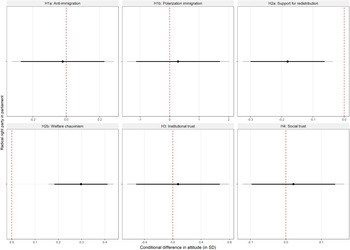
Does the entry of the radical right into national parliament erode societal levels of trust and solidarity in European societies? Figure 1 displays the main insights from the linear 2-way FE models. From left to right, the two first panels echo the null-results from Bohman and Hjerm (Reference Bohman and Hjerm2016) and Dunn and Singh (Reference Dunn and Singh2011) by displaying no change in anti-immigration attitudes after the election of a RRP to the national parliament. The two last panels also show that RRPs’ representation in parliament does not deteriorate societal levels of institutional or social trust, despite radical right politicians’ pitting the ‘pure people’ against political and legal institutions and against the elite and immigrants. Bayes factors reported in Table L1 in the online supplements show that in all four cases, a non-association is much more probable than an association, given the data. However, the third panel exhibits a statistically significant negative association between a RRP’s representation in a national parliament and public support for income redistribution. In country-years where a radical right party has entered parliament before, we observe a lower support for redistribution of ca. 18% of a standard deviation (p-value = 0.01927). I note that the 95% confidence bounds [−0.32; −0.03] are wide, indicating an uncertain estimate. However, Bayes factors suggest that, given the data, an association is much more likely than a non-association. The fourth panel substantiates this finding by displaying exploratory evidence that the radical right’s national representation is also associated with growing welfare chauvinistic beliefs in a European democracy. Model uncertainty notwithstanding, these empirical insights support the argument that radical right elites have succeeded in portraying non-co-nationals as welfare state abusers.
Results of 2-way FE Models.
Note: Point estimates and associated 90% and 95% (two-tailed) confidence intervals (thin gray and thick black lines) are based on a series of weighted linear two-way fixed effects models with cluster-robust standard errors and individual- and country-year controls.

In this paragraph, I briefly summarize additional results that assess the robustness and external validity of the main findings. Figure D1 in the online supplementary material show that the insights from Figure 1 persist if I adjust the sample definition to either countries with proportional representational systems or countries with legally defined electoral thresholds. Table E1 and Figures E1-2 show that the observed negative association between a RRP’s national representation and public support for redistribution is robust to removing entire countries from the analysis or influential country-years. In online appendix F, I raise the concern that the radical right may have affected public attitudes prior to their entry into the national political arena, for example through subnational representation. A flexible model with pre- and post-event dummies displays no anticipation effect on public support for redistribution (see Figure F1). In fact, Figure F2 shows that the negative association lasts at least 3 electoral terms roughly equivalent to 12 years in parliament. Finally, online appendix J and K replicate the analysis on public support for redistribution using data from the International Social Survey Programme (ISSP) (ISSP Research Group, 1992, 1999, 2008, 2018) and for the trust variables, using integrated values study data (IVS) (EVS, 2021; Haerpfer et al., Reference Haerpfer, Inglehart, Moreno, Welzel, Kizilova, Diez-Medrano, Lagos, Norris, Ponarin and Puranen2021). I note that the ISSP estimate is close to the size of the ESS estimate shown in Figure 1 (ISSP estimate ∼ −12% of a SD vs. ESS estimate ∼ −18% of a SD), however, it is noisier and fails to reach statistical significance at conventional levels (p-value = 0.1706 & 95% CI [−0.30;0.06]). Yet, the number of country-years for this replication study is also considerably lower; hence, the results, can still be argued to reflect the initially observed negative relationship between a RRPs entrance into parliament and support for redistribution.
Supplementary analysis: Passing a voting threshold
The 2-way FE models support the hypothesis that radical right parties’ national representation erodes public support for redistribution. Yet, the causal interpretation of the results of this identification strategy rests on the crucial assumption that we, prior to the entry of a RRP in parliament, can observe parallel trends in public support for redistribution in countries where a RRP eventually attains national representation and in countries that did not elect a RRP into the national parliament during the studied period.
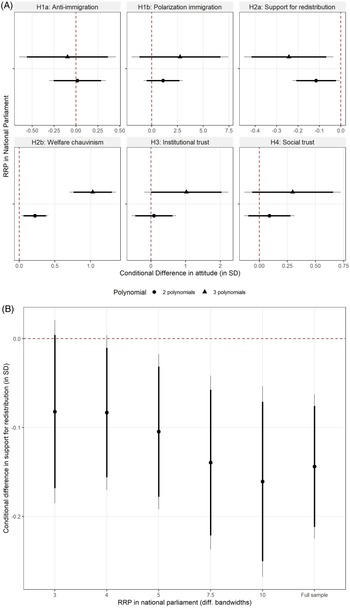
As a way of addressing this issue, I replicate the analysis using a regression discontinuity design, where treatment status is determined by being on either side of a legally or mathematically defined nationwide threshold. Appendix A in the online supplementary material thoroughly describes the RDD framework and its assumptions. Panel A in Figure 2 displays LATEs derived from both parametric and non-parametric estimation procedures. The coefficients indicate that, all else being equal, countries where a RRP passed the electoral threshold have a lower level of public support for redistribution. The non-parametric estimation, shown in panel B, finds less precise estimates for the smallest bandwidths; however, all the models report a negative estimate of similar magnitude to the two-way FE model specification. In appendix H in the online supplementary material, I show that the results replicate when I run the same analysis only on countries with a legally defined nationwide electoral threshold and when I conduct a fuzzy RDD that accounts for the few cases in the data where the threshold does not completely determine treatment status. In sum, the RDD validates the findings from the two-way FE approach.
Results of regression discontinuity design.
Note: Point estimates and associated 90% and 95% (two-tailed) confidence intervals (thin gray and thick black lines) are based on a series of weighted linear regression models with cluster-robust standard errors and individual- and country-year controls.

Exploratory analysis: The integration policy context as a moderator
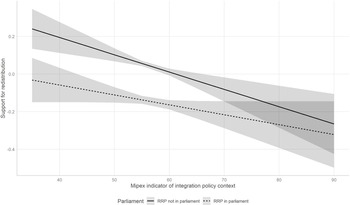
The empirical findings in this article show that RRPs’ political representation in the national parliament is associated with reduced public support for redistribution; however, the magnitude of this relationship may still vary by context. In an exploratory endeavor, I propose the conjecture that a country’s migrant integration policy context moderates the studied relationship. I consider whether the negative association between RRPs’ parliamentary representation and public support for redistribution is stronger in countries with weak migrant integration policies. My theoretical claim is that poorer integration conditions for immigrants provides fertile ground for radical right elites to construct immigrants as welfare state abusers that do not contribute to society. To explore this expectation further, I use data from the migrant Integration Policy Index that assigns a score between 0 and 100 as an indicator of the quality of migrant integration policies in country j at time t (Solano and Huddleston, Reference Solano and Huddleston2020). The overall score assigned to each country-year is the mean of six sub-indices measuring the quality of labor market integration policies, family reunification policies, political participation, residence opportunities, citizenship rights, and anti-discrimination legislation. Because I cannot identify a country-year combination for cases in the ESS sample before 2007, I conduct the analysis on a reduced sample. Figure 3 supports my speculation; country-years with weaker immigrant integration policies and where a RRP is represented in parliament have lower levels of public support for redistribution. Appendix I in the online supplement displays similar results for each of the sub-indices except in the case of citizenship rights.
The migrant integration policy context as a moderator.
Note: The linear prediction and associated 95% (two-tailed) confidence intervals (ribbon) is based on a weighted linear two-way fixed effects model with cluster-robust standard errors and individual- and country-year level controls.

Conclusion
This study has investigated whether radical right parties’ representation in national parliaments erodes attitudes of trust and solidarity in European democracies. I have theorized that parliamentary presence grants nationally represented RRPs additional resources and better opportunity structures to disperse their nativist and populist agenda. I have further argued that radical parties’ spread of nativism and populism has the potential to trigger a decline in trust and solidarity in mass-scale democracies.
To test this hypothesis, I combined pooled cross-sectional survey data across European countries with panel data on national elections for a period of more than 20 years (1999–2020). Results of two-way fixed effects models and a supplementary regression discontinuity design reveal that RRPs’ national representation, net of their vote share, is associated with a decrease in public support for the redistribution of income differentials by ca. 18% of a standard deviation, however the estimated effect size is highly uncertain with large 95% confidence bounds ranging from −0.32 to −0.03 of a SD. Additionally, I find tentative evidence of higher societal levels of welfare chauvinism in the wake of a RRP’s election to parliament. Contra theoretical expectations, I do not find evidence supporting my initially proposed hypotheses; that the radical right has deteriorated trust in institutions and eroded social trust after their election to parliament. Also, I do not find any indications that nationally elected RRPs’ nativist messages have strengthened or polarized anti-immigration attitudes, which paraphrases existing null-findings in the literature (Bohman and Hjerm, Reference Bohman and Hjerm2016; Dunn and Singh, Reference Dunn and Singh2011).
In sum, I find empirical support for the conjecture that RRPs’ nativist strategies have reduced welfare state solidarity in European democracies; a relationship that is stronger when the integration policy context is weaker and seems to run parallel to growing societal levels of welfare chauvinism. These results suggest that the radical right’s nativist strategy concerning the welfare state has been more successful than their populist strategy at influencing public opinion in the wake of their election to parliament.
This study has limitations that future studies should address. First, due to unbalanced panel data and low power to detect small effect sizes, I am cautious to definitively conclude that RRPs’ national representation has deteriorated public support for a redistributive welfare state. To increase the study’s validity and generalizability, I encourage future research to replicate my analysis using a longer time-series that can include countries where a RRP entered parliament before the start of the first wave of the European Social Survey. Second, a recent study on the welfare views of the radical right show that the welfare state policy position of radical right parties is multifaceted (Abts et al., Reference Abts, Dalle Mulle, van Kessel and Michel2021). Alongside welfare chauvinism, the radical right also places a concomitant emphasis on welfare producerism: that individuals earn their rights to welfare provisions by being responsible, productive, and grateful citizens. Future studies should look for ways to disentangle these two distinct but interrelated aspects of the radical right’s welfare agenda and investigate how they each influence public opinion on the welfare state. Third, this study found tentative evidence that the observed negative relationship between RRPs’ representation in parliament and public support for redistribution is strongest in countries with weak migrant integration policies. To further test under which contextual conditions elected RRPs erode public support for redistribution, I advise researchers to examine how other contextual factors (e.g. the introduction of exclusionist policies) moderate the focal relationship. Lastly, I urge others to investigate how the actions of elected RRPs’ have led to a reduction in welfare solidarity in European democracies, as my findings suggest.
The radical right has become a force to be reckoned with in the political landscape due to their exclusionist and ethno-nationalist views and their anti-establishment agenda (Golder, Reference Golder2016; Mudde, Reference Mudde2007). However, this study did not find evidence supporting the conjecture that a radical right party’s entry into the national parliament has had a noteworthy impact on a European democracy’s levels of anti-immigration sentiments, institutional trust, or social trust. Yet, I find that the radical right’s national representation is associated with a reduction in overall public support for a redistributive welfare state. While this finding withstood a range of robustness checks and alternative model specifications (see online appendix D-L), I acknowledge that my results are still contingent on issues of statistical power, potentially diverging pre-trends in support for redistribution among treated and untreated countries in the sample, and unobserved confounding. These threats to identification, means that I am cautious to definitively conclude that there exists a causal relationship between RRPs’ political representation and declining support for a redistributive welfare state.
Supplementary material
To view supplementary material for this article, please visit https://doi.org/10.1017/S1755773922000467.