During the tumultuous presidential election campaign of 2012, Republican presidential candidate Mitt Romney was captured on a video arguing that the Democrats could count on 47% of the electorate because of the “presents” they provide.Footnote 1 Romney suggested he was aiming to win enough of the remaining 53% to win the presidency. Of course it was Barack Obama who surprised Romney and many pollsters by winning 53% of the vote and a comfortable majority of the Electoral College to earn reelection. Although the results for the election of the 113th Congress were mixed in that Democrats failed to regain control of the House of Representatives, they did manage, however, to keep the Senate in Democratic hands. This would prove to be crucial for staffing the judiciary, clearly a major objective of the president’s domestic agenda.Footnote 2
Indeed when President Obama was interviewed by Jeffrey Toobin for a major article in The New Yorker focusing on Obama’s judicial appointments, the president made it clear that diversification of the bench was an important component of the legacy of his administration (Toobin Reference Toobin2014). The president noted, “I think there are some particular groups that historically have been underrepresented—like Latinos and Asian-Americans—that represent a larger and larger portion of the population. And so for them to be able to see folks in robes that look like them is going to be important. When I came into office, I think there was one openly gay judge who had been appointed. We’ve appointed ten” (24).
However, just as during the first term, Republican obstruction and delay in the Senate during the 113th Congress, despite the Democratic majority, made the confirmation of judges an obstacle course, particularly for the district courts, taking obstruction to levels not seen before the Obama presidency (see table 2 below). Such obstruction notwithstanding, because of a leadership brokered agreement reached early in the congressional session regarding the processing of district court nominees and the consequences of the so-called nuclear option invoked by the Democratic majority in late 2013 during the battle over the DC Circuit (events more fully elaborated on in part 2), the 113th Congress turned out to be a watershed one for the selection of judges. With the change in Senate rules, only a majority was needed to move lower-court nominations forward, thus effectively ending filibustering of district and appeals court nominees.
Our attention in this article is on Obama’s lower federal court appointments during the 113th Congress (corresponding to the calendar years of 2013 and 2014). As in earlier articles of ours on the Obama appointments, we look at selection and confirmation processes (although confirmation processes are the main focus of part 2 of this study; Goldman, Slotnick, and Schiavoni Reference Goldman2011, Reference Goldman2013). The central concern here is on those appointed during the 113th Congress. We will then examine the backgrounds and attributes of those confirmed during the 113th, looking at the appointees to the district and appeals courts separately. To place our findings in a broader context, we present a composite portrait of the first 6 years of Obama’s appointees and compare that portrait to those of the appointees of Obama’s four immediate predecessors in office.
Our study is based on in-depth interviews with the major players and observers of judicial selection. Interviews were conducted with officials in the Office of Legal Policy of the Department of Justice, with the White House Counsel’s office, and with knowledgeable Senate staff personnel. We also spoke with interest group representatives spanning the ideological spectrum.Footnote 3
For the statistics found in the tables, we utilized various sources. A major source was the questionnaires completed by all judicial nominees for the Senate Judiciary Committee and the Office of Legal Policy, newspaper articles accessible online, and various websites on the Internet. For data on political party aside from the just-mentioned sources, we contacted registrars of voters or boards of election. In a few instances judges kindly responded to our queries.
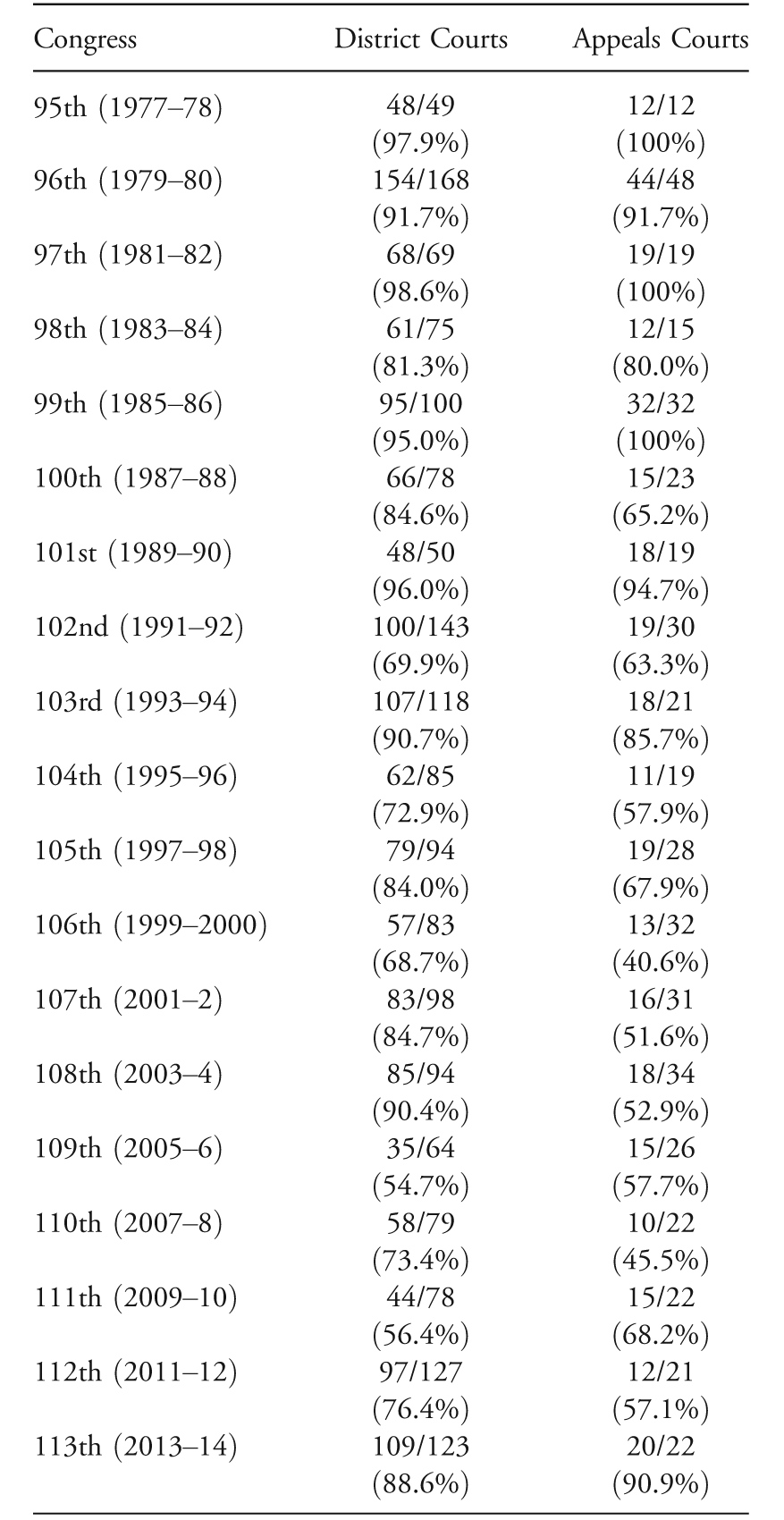
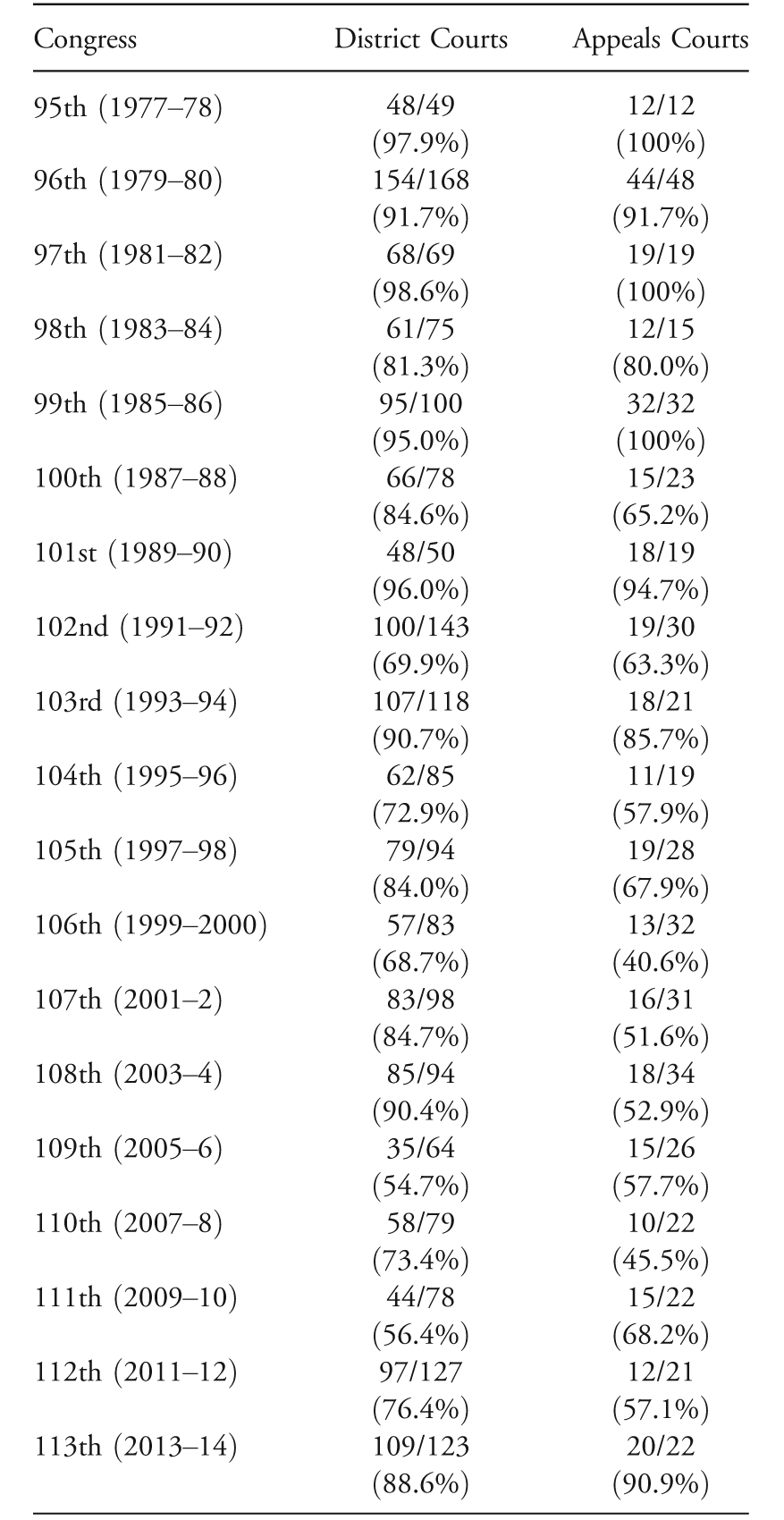
An initial assessment reveals that during the life of the 113th Congress, 109 out of 123 district court nominees were confirmed as were 20 out of 22 appeals court nominees. For both, the proportion of those confirmed, as shown in table 1, was at a level not seen for 10 years for the district bench and at least 20 years for the appeals bench. Thus by the end of his first 6 years in office, President Obama had successfully made lifetime appointments to fill 250 district court and 47 appeals court positions on courts of general jurisdiction (note that limited tenure territorial district judges and courts of specialized jurisdiction including the US Court of Appeals for the Federal Circuit are not included in our statistics and analyses).
Judicial Selection within the Obama Administration
We now turn to a description of the processes utilized by the Obama administration for selecting judicial nominees, focusing in particular on the roles played by the White House Counsel’s Office and the Office of Legal Policy (OLP) in the Department of Justice (DOJ). Such a description was given extensive focus in our two earlier articles on judicial selection during President Obama’s first term in office published by Judicature in 2011 and 2013. In our earlier article focusing on the first 2 years of Obama’s presidency, considerable attention was placed on the conventional wisdom at the time that criticized the administration for what was perceived to be its relative lack of prioritization of the judgeship issue, particularly by the White House Counsel’s Office (Goldman et al. Reference Goldman2011). To the extent that characterization was fair, it is important to point out that the extraordinary effort expended in filling two Supreme Court vacancies during that time frame would have to be considered a mitigating circumstance. Indeed, as Deputy Counsel to the President Christopher Kang sees it, “If we had not had those Supreme Court vacancies in the first 2 years, the entire narrative could have been different.” If those vacancies had occurred later, “then there surely would have been a lot more nominees earlier. … Much of this criticism that the administration didn’t care enough about judicial nominees is because the president didn’t nominate as many judges in the first year.” In assessing the relatively low number of nominations and confirmations to the district courts and courts of appeals in the first half of the president’s first term, Kang concluded, “some people look at those numbers and assume they reflect a lack of priority—a perceived problem that I continue to believe was never an issue in the first place” (interview with Christopher Kang, January 6, 2015).
However one characterizes the Obama record through the midway point of his first term, most importantly, as we concluded when we revisited the administration’s judicial selection machinery at the end of that term, “concerns about the work of the Counsel’s Office and OLP appear to have largely disappeared” (Goldman et al. Reference Goldman2013, Reference Goldman14). While there has been one significant change in administration personnel working in the judicial selection domain during the 113th Congress, with White House Counsel Kathy Ruemmler returning to private practice being replaced by W. Neil Eggleston in spring 2014, by all accounts the transition has been seamless, with support for and commitment to judicial appointments success continuing unabated. Indeed, returning to the field at the midway point in President Obama’s second term, our conclusions remain the same. Commentary on the collegial and highly efficient operation of the administration’s selection processes, still headed by Christopher Kang in the White House Counsel’s Office, working in close collaboration with the OLP and, in particular, Principal Deputy Assistant Attorney General Elana Tyrangiel and Deputy Assistant Attorney General Michael Zubrensky, remains extremely laudatory among our sources in Senate offices on both sides of the aisle as well as among representatives of advocacy groups working for both liberal and conservative interests active in the judicial selection arena.Footnote 4
Further, we have been advised by both Kang and the OLP that our depiction of their work in 2013 was accurate and that little has changed in the nature of that work or their division of labor since we last wrote, notwithstanding the extraordinary record pace of judicial confirmations during the 113th Congress that we analyze here. Our conversations with OLP highlighted “a lot of stability on our staff … that has made it a lot easier.” OLP addressed the enhanced workload with “a flexible approach” in which they “have always been able to get the resources necessary to accomplish what we needed to do.” Kang agreed that “we’ve benefited from the fact that there’s been a lot of stability in the day-to-day personnel. By and large the process has been the same.”
As a consequence of these realities, particularly the minimal changes seen in the operation of the OLP and the White House Counsel’s Office in judicial selection, we have chosen in our present study to offer a truncated version of the administration’s selection processes during the 113th Congress, the fifth and sixth years of the Obama presidency, relying heavily on our earlier work, updated as appropriate with observations gleaned from our 2015 interviews. For those seeking a more detailed elaboration, we refer readers to our 2013 Judicature analysis (Goldman et al. Reference Goldman2013).
We start by noting that throughout the Obama years, as in past administrations, the name generation and “political” phases of the lower federal court judgeship selection process, most notably the interactions with senators regarding judicial vacancies within their home states, are handled predominantly by the White House, through its Counsel’s Office and Office of Legislative Affairs. In due course, for those eventually nominated, these interactions extend to efforts to assure that the home state senators return to the Judiciary Committee the Blue Slips, discussed primarily in part 2 of this study, that are required by committee practice before a nominee moves forward to a confirmation hearing. Earlier in the process, however, for district court judgeships, the White House prefers, but does not always receive, three recommendations from the relevant senator or senators for each vacancy. Once names—whether multiple recommendations or just one—have surfaced for a vacancy, preliminary vetting is done through the Counsel’s Office to ensure that the administration’s qualifications standards are met. Once that vetting has occurred, the names of viable potential nominees are forwarded to the Justice Department, where a much more elaborate vet occurs in the OLP. That vet, which generally takes about a month’s time, usually, but not always, is limited to a single nominee per vacancy. When more than one prospective nominee is vetted, the vacancy at issue is almost always at the circuit court level.
The OLP vet has, as its ultimate and fundamental role, to provide complete and accurate information about each prospective nominee. Toward that end, the OLP seeks exhaustive information including looking at everything that prospective nominees have written, from judicial opinions, if they have been judges, to law review articles and letters to the editor, as well as everything that they have ever said in speeches, presentations, and interviews. Extensive professional reputation phone calls (25–60, with circuit court candidates generally falling at the higher end of this range) are made to seek a more comprehensive view of the candidate. Kang estimates that an average of approximately 60 (generally for district court) to 80 (generally for circuit court) hours are spent in the professional evaluations undertaken by the OLP. That evaluation will include consideration of seemingly limitless factors to include the candidates’ background and personal experiences, their career history, their reputation, and their temperament—all the things that one would want to know when making a decision about whether someone is an appropriate candidate for the federal bench. The OLP vet attempts to generate information and identify things that could be issues for a nominee in the confirmation process—things that might be asked about. It is then primarily the job of the White House and the home state senators to decide what issues might become confirmation hurdles as the decision is being made about going forward with a candidate.
After the OLP vetting, prospective district and circuit court nominees move forward to an interview. Participants in those interviews are not set in stone but virtually always include, from the OLP, the Deputy Michael Zubrensky, senior and any other DOJ personnel who were involved in the vet, Christopher Kang, and additional personnel from the White House Counsel’s Office. Following that interview, according to Kang, “we go back over the thorough vetting, we go over the interview, and at that point we make a decision whether or not to send them to the next stage in the nomination process … the ABA [American Bar Association] professional evaluation [and] the FBI [Federal Bureau of Investigation] background investigation.” These decisions are best characterized as jointly made, though, clearly, the political facets of such decisions, the “issues” alluded to above, lie chiefly with the White House. Once the external ABA and FBI evaluations are put into play, the formal vetting roles of the Counsel’s Office and OLP are largely done. That said, these offices continue to be involved further, as appropriate and as needed, in gathering information and generating responses to developments that may arise in the external evaluative reviews. Also, sometimes the external ABA and FBI evaluations are conducted concurrently with the OLP vetting instead of consecutively.
In any instance in which a home state Republican senator has not yet been consulted about a prospective nominee, the White House, through the Counsel’s Office and Office of Legislative Affairs, will initiate consultation with the Republican senator. That consultation, like the ABA and FBI evaluations themselves, is held to this point in the process because, as Kang notes, “We don’t want to waste anybody’s time and resources. … When we send somebody to the ABA and FBI, we feel comfortable enough that if the ABA rating comes back positive, if the background investigation comes back clean, then that person likely will be nominated.” Thus, it is only after the joint White House/OLP interview with the candidate and the completion of ABA and FBI evaluations that the OLP and the Counsel’s Office will informally sign off on a nomination. From this point, just prior to the formal nomination and through the Senate Judiciary Committee hearings, it is the OLP that prepares the paperwork to send up to the Hill and works with the prospective nominee on preparations for the confirmation hearing to come. While a letter is sent from the attorney general to the president formally recommending that a nomination go forward, operationally, it is the White House Counsel’s decision memo to the president that offers the substantive counsel endorsing the candidate. On the day of a candidate’s actual nomination, Kang reports,
We almost always give the home state senator who made the recommendation the courtesy of making the phone call to let the candidate know that, today, he or she is going to be nominated. In part, it’s a senatorial courtesy. … We also want senators to feel invested in their recommended candidates. That’s going to serve everyone well through the entire process. After making these calls, many senators issue a press release praising the nominations. They introduce the nominees at the committee hearing. They may issue a press release when they’re reported by the committee and then work to get them confirmed. And many senators attend the formal investiture ceremonies. As much as these nominees are, obviously, the president’s nominees, I think there’s a great benefit in having the senators feel ownership of their recommended candidates throughout the process.
As has been the case throughout this administration as well as earlier presidencies, nomination and subsequent confirmation processes can be a good deal more complicated in settings in which there are home state senators involved from the nonpresidential party, in this instance, Senate Republicans (Binder and Maltzman Reference Binder2009; Steigerwalt Reference Steigerwalt2010). Thus, as part of our analysis in part 2, we will be exploring selection stalemates and their ultimate outcomes, to date, in states such as Texas, Georgia, Arizona, Alabama, and Florida. While each such state, with one or two Republican senators, has its own story, even in instances in which both home state senators are from the Republican Party, Kang asserted that “to varying degrees we will solicit recommendations from them, and some of them suggest multiple, consensus candidates who they also feel comfortable with. But some are more rigid in their recommendations, so that’s a little bit more difficult to navigate.”
If there is one characteristic that has distinguished the Obama judicial selection team from all others we have studied in recent presidencies, it continues to be the lack of a formalized “Judicial Selection Committee” with regularized, at times weekly, formal meetings including broad continuing representation from personnel beyond the White House Counsel’s Office and the OLP. Certainly it continues to be the case, including in the eyes of the participants themselves, that the collaborative effort that we have described centering on the Counsel’s Office and the OLP, featuring ongoing informal interactions among the players, in particular the often multiple daily conversations between Michael Zubrensky of the OLP and Christopher Kang at the White House, colleagues who at one point jointly served on the staff of Senator Dick Durbin of Illinois, continues to serve the Obama selection process very well. Indeed, as we have documented in the past, early on in the administration, a more formal conventional structured process with scheduled meetings was in place. At some point, as Kang has observed, “Honestly, we lost the meetings and weekly phone calls because we thought it was inefficient. It’s much easier to pick up the phone and call on a rolling basis and say, ‘What’s your advice on this?’ or ‘Let’s follow up on that,’ rather than saying, ‘Let’s hold all of this stuff until next Monday and we’ll discuss it.’” To the extent that there are any vestiges of a “regularized” meeting structure, it remains the case that the “constant coordination” of the principals in the process will include their getting together for consultations either right before or immediately after the interviews of prospective nominees that take place, generally, at the White House.
Clearly, the process we have described is a highly collaborative one among a working group that now has long-term experience in following this choreography. At the broadest level of generalization, again, the White House is dominant in the political facets of evaluation and advocacy, particularly in working directly with the senators, while the work of the DOJ/OLP participants is more focused on professional evaluation of a candidate’s qualifications, a distinction that we have seen since the Carter administration’s selection processes.
An Overview of Judicial Selection in the 113th Congress: A Tale of Two Sessions
Any effort to assess presidential performance in selecting and seating federal judges during the sweep of a 2-year congressional session can be a difficult enterprise. Many metrics can be chosen to gauge appointment success, each of which tells only a part of a complex series of events that capture the flow of nomination and confirmation processes during the session while, at the same time, allowing for alternative and often competing narratives. Often, analysts and pundits seeking to evaluate presidential success in seating judges fall back on “the numbers,” which, in and of themselves, can often be used to tell different stories. Frequently, such numbers are utilized by an administration, on the one hand, and presidential critics and foes, both inside and outside the Senate, to spin different narratives without offering the rich context through which such narratives are best understood.Footnote 5 Here, in our introductory overview, we will offer a set of metrics of the president’s success in seating judges during the 113th Congress that, viewed collectively, begin to offer a nuanced portrait of his relative success. It will largely be the burden of the second part of our article, to be published in the next issue of the Journal, to offer the richness of context and the “story” of judicial confirmation processes in the 113th Congress that lies behind these numbers. For now, however, there is much to be gleaned from an overview that will include several comparative metrics. These include
-
• comparing President Obama’s record in the 113th Congress to his record in the 111th and 112th Congresses,
-
• comparing President Obama’s record in the first half of his second term to that of George W. Bush in the first half of his second term,
-
• comparing President Obama’s record after 6 years of his presidency to that of George W. Bush at the same 6-year mark,
-
• comparing President Obama’s record across the two “sessions” of the 113th Congress.
At the outset, as table 1 reveals clearly, federal judgeship confirmations in the 113th Congress far outpaced, by any measure, the record compiled by the president during his first term. Thus, for example, at the district court level, 44 judges were confirmed during the first half of the president’s first term (the 111th Congress) while more than double that number, 97 district court judges, were seated in years 3 and 4 of that term (the 112th Congress), an astonishing improvement from a disappointing first 2 years, which, however, included filling successfully two Supreme Court vacancies. During the 113th Congress, 109 district court judges were confirmed, the most in a single congressional session since 154 trial court nominees of Jimmy Carter were confirmed by a Democratic Senate in the 96th Congress (1979–80). The extraordinary Carter numbers, it should be noted, are an outlier for such confirmations in a single congress reflecting, as they do, the unusual number of vacancies the president enjoyed as a result of the historic Omnibus Judgeship Act passed by a Democratic Congress that expanded the size of the federal bench by roughly one-third with the creation of 152 new judgeships, 117 of which were at the district court level.
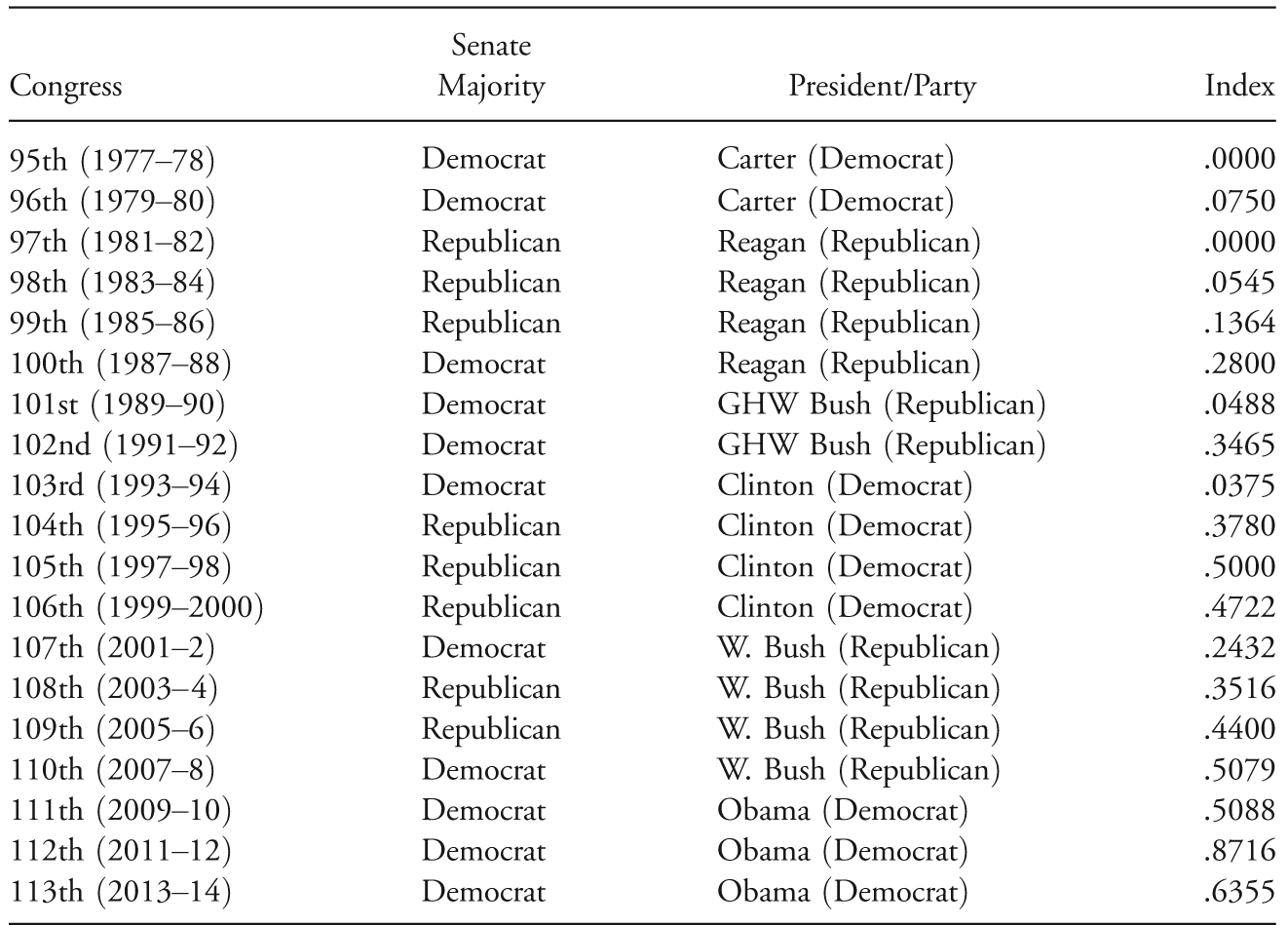
An alternative view of these numbers shows a robust success rate (88.6%) for Obama’s district court nominees in the 113th Congress, with 109 out of 123 nominees confirmed, a proportion that well outdistances the overall rate for the Obama first term (68.7%). This is not to suggest that the president’s district court nominees had smooth sailing. Indeed, as table 2 documents, the Index of Obstruction and Delay, a simple measure reflecting the percentage of a president’s nominees who remained unconfirmed or whose confirmation took over 180 days from nomination to confirmation in a congressional session, measured nearly two-thirds (0.6355), the second-highest obstruction measure we have witnessed at the district level, only surpassed by the historic obstruction and delay level (0.8716) the Obama district nominees endured during the previous congressional session, the 112th, a period during which the Republicans held out hope that they would recapture the presidency in 2012.Footnote 6
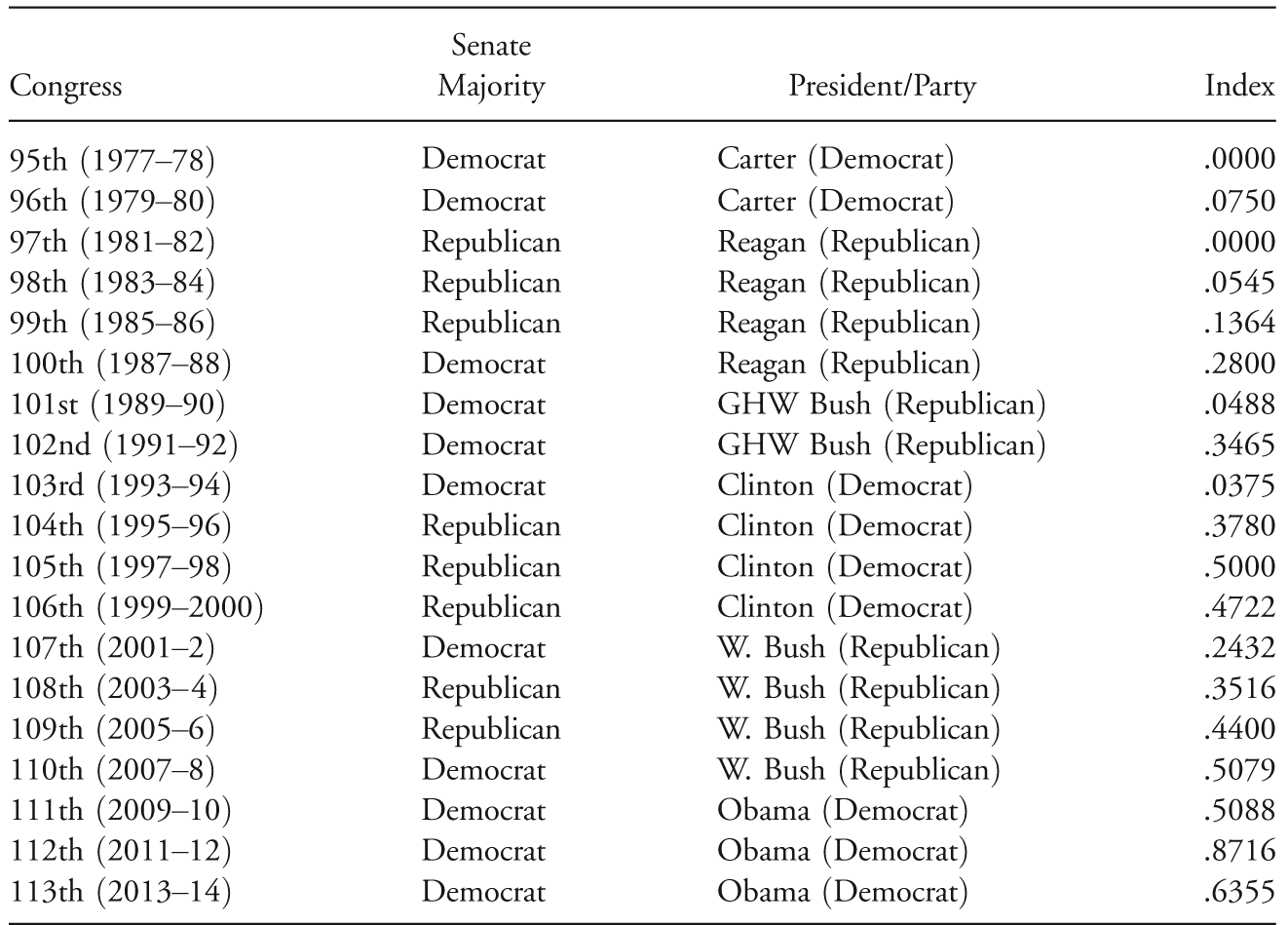
Note.—The index is only for nominations to lifetime appointments to the district courts. Territorial district courts with set terms are excluded. The index is calculated as the number of nominations unconfirmed plus the number of nominations that took more than 180 days from nomination to confirmation. It ranges from .0000, which indicates the complete absence of obstruction and/or delay, to 1.0000, which indicates complete obstruction and/or delay. Nominations made after July 1 of the second session of each congress are excluded from the index.
Thus, the marked improvement in the number of Obama district judges confirmed occurred in tandem with only a relative improvement in the obstruction and delay that they faced, an improvement associated with a limited bipartisan rules reform agreed to in January 2013 that offered an expedited path to confirmation for district court judgeship nominees. Under the agreement, which expired at the end of the congressional session, if cloture was invoked on a district court nominee, the required postcloture debate time was reduced from 30 hours to 2 hours equally divided, which was effectively 1 hour since the Democrats generally ceded their allotted time. As a practical matter, the rules change allowed district court nominees to be confirmed with only a fraction of precious Senate floor time compared to the former rules that required the “burning” of literally dozens of hours before a confirmation vote could be held.Footnote 7
Reflecting on the unsurpassed obstruction and delay that President Obama has faced, particularly in the 112th and 113th Congresses, in not having district court nominees confirmed in relatively swift and efficient processes, it is easy to conclude that the politicization of district court judicial selection has come to more resemble the greater contentiousness and concern over factors such as nominee ideology that are sometimes seen in appeals court and, of course, Supreme Court confirmation battles. In our view, while such increased polarization reflects, to some degree, an increased ideological focus on the district courts at the nomination and confirmation stages, it is, to an even greater degree, reflective of the state of the contemporary partisan divide in the Senate.
As described by Kyle Barry, legislative counsel for the liberal advocacy group the Alliance for Justice, “A lot of what we saw … was not about individual nominees that they were concerned about. It was about time wasting for the sake of putting on a show. There weren’t many sincere real disputes over most judicial nominees filling district court seats” (interview January 6, 2015). In fact, of the 250 Obama district court nominees during the 111th, 112th, and 113th Congresses, 232 were confirmed by one of four means: unanimous vote, voice vote, unanimous consent agreement, or supermajority. This means that, when it came to a vote, the actual possibility of a “sincere real dispute” was limited to only 18 (7%) of the nominees.
Reflecting on the bipartisan agreement that helped move district court appointment processes along, Deputy White House Counsel Christopher Kang shared similar thoughts. “I thought that it certainly was a reform, but hopefully, that we would never need it … because how many district court nominees would be filibustered and need a cloture vote and postcloture debate? It turned out all of them last year!” While the ultimate outcomes were, of course, pleasing to Kang in terms of numbers, the way in which they were arrived at remained a cause for concern. “It shouldn’t have taken both the filibuster reform and the reduction to two hours of postcloture debate on district court nominees for these noncontroversial nominees to be confirmed in a timely fashion. On the one hand, our confirmation numbers are better than I thought they would be. On the other hand, those expectations were tempered by how much obstruction this president has faced.”
Taking a similar view of the president’s record for confirming courts of appeals judges to courts of general jurisdiction, thus excluding the Federal Circuit, in the 113th Congress when contrasted to his first term success at the appellate level, offers a somewhat similar portrait and stark contrasts. During the course of his entire first term, the president appointed successfully 27 circuit court judges with 43 nominations, a “success” rate of confirming slightly fewer than two of every three of his nominees (62.8%). At the midway point in his second term, corresponding to the 113th Congress, he has appointed 20 courts of appeals judges (out of 22 nominees) with a confirmation rate of 90.9%. The 20 confirmations were surpassed only by the 44 circuit judge appointments enjoyed by Jimmy Carter in the 96th Congress, once again reflective of the unique opportunity afforded by the unprecedented expansion in the size of the federal bench brought about by the Omnibus Judgeship Act and the 32 confirmations enjoyed by Ronald Reagan in the 99th Congress after his landslide reelection in 1984. Obama’s success rate of seating over nine out of 10 circuit nominees was last matched during the 101st Congress (1989–90) when a Democratic Senate confirmed George H. W. Bush’s appellate nominees at a 94.7% rate. It is interesting to note that H. W. Bush had an even higher success rate of 96.0% at the district court level (with correspondingly low levels of obstruction and delay at both court levels) during the 101st Congress.
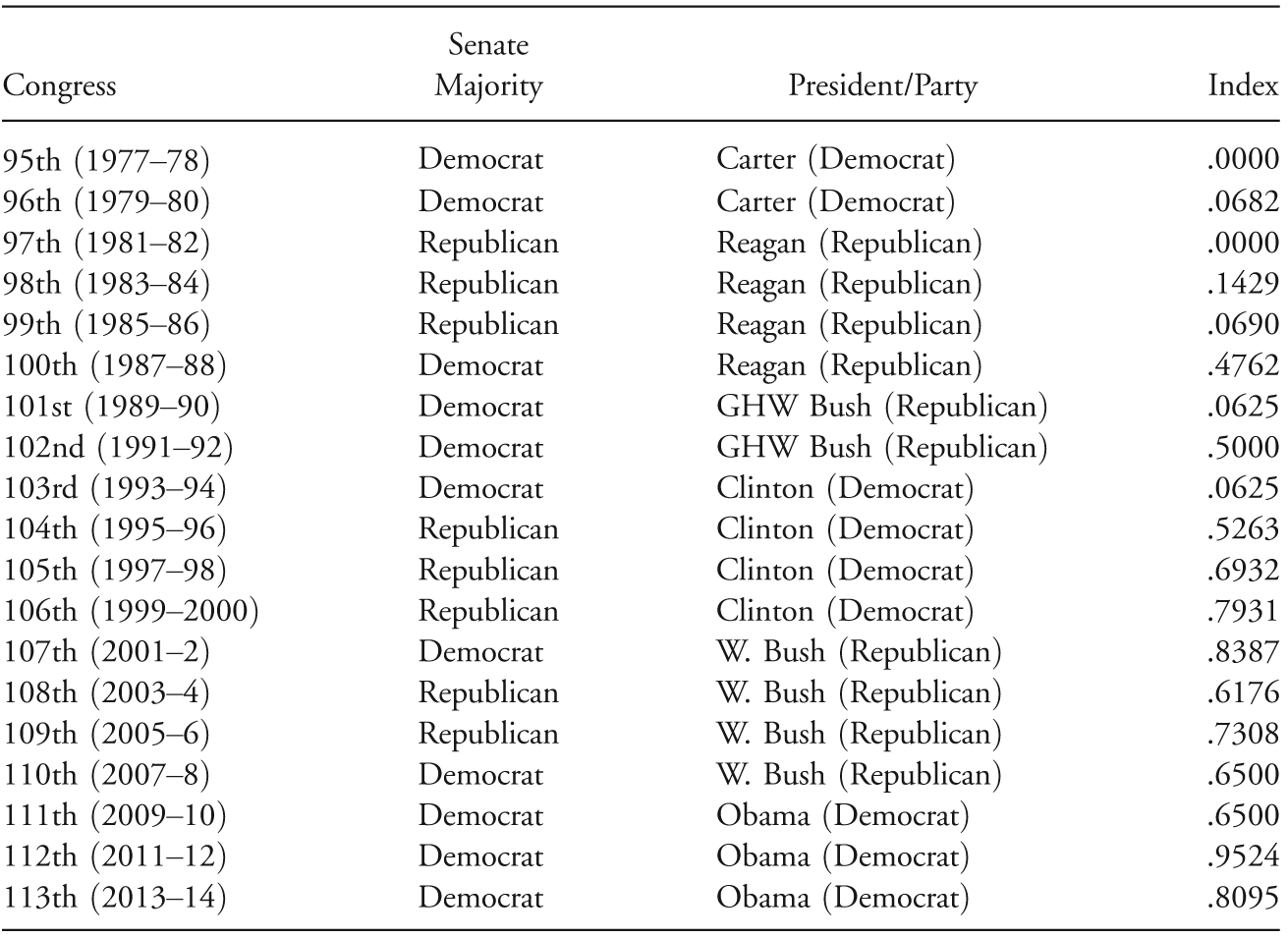
Further examination of the obstruction and delay data in tables 2 and 3 shows that the data are suggestive of interesting historical phenomena. For one, credence is given to the view that the lower-court judicial selection battles so common today appear to have been “started” by the Democrats in the 100th Congress during President Reagan’s last 2 years in office. While President H. W. Bush saw a return to the prior “normalcy,” even with a Democratic Senate in the 101st Congress, sharp increases in the obstruction and delay of lower federal court nominees returned during the 102nd Congress corresponding to H. W. Bush’s last 2 years in office. While a continuing increase in obstruction and delay of lower federal court nominees has not been linear, the partisan battles that such obstruction and delay underscore have become only more strident through the years, reaching their pinnacle during the Obama presidency.
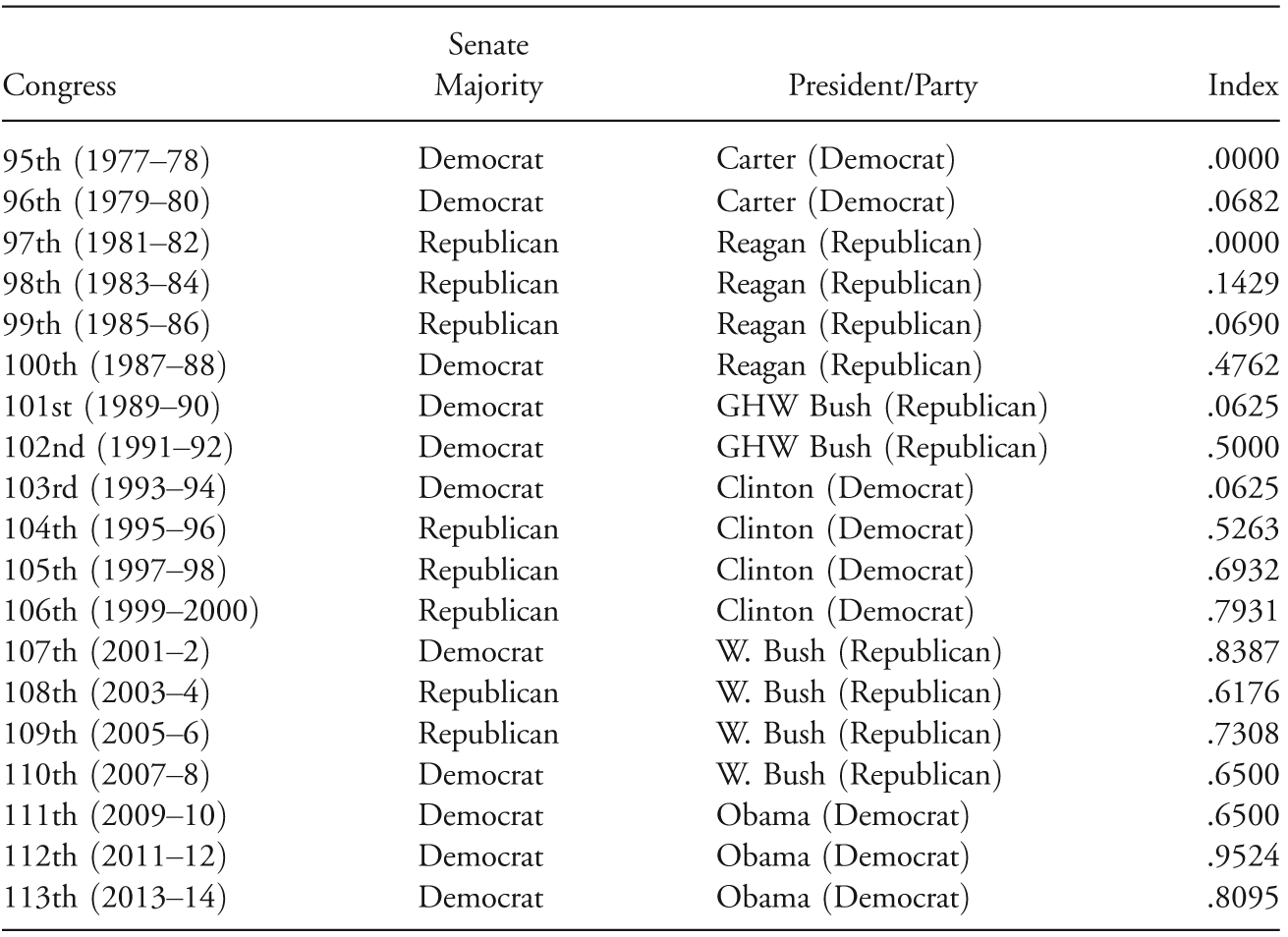
Note.—The index is only for nominations to courts of appeals of general jurisdiction. This means that the US Court of Appeals for the Federal Circuit is excluded. The index for the 107th Congress excludes the nominations made by President Clinton shortly before leaving office that were subsequently withdrawn by President Bush. The index is calculated as the number of nominations unconfirmed plus the number of nominations that took more than 180 days from nomination to confirmation. It ranges from .0000, which indicates the complete absence of obstruction and/or delay, to 1.0000, which indicates complete obstruction and/or delay. Nominations made after July 1 of the second session of each congress are excluded from the index.
It is in this ongoing context of remaining robust levels of obstruction and delay that the strong Obama numbers and ultimate success rate in the 113th Congress, especially at the appellate level, can best be understood through the eyeglasses of the invocation of the so-called nuclear option (called “filibuster reform” by its advocates) by Senate Majority Leader Harry Reid and his Democratic colleagues on November 21, 2013. Only the “institutionalist” Democratic Senators Manchin, Pryor, and Levin broke the unanimity of the Democratic caucus in bringing about this historic filibuster reform. We will be focusing in great detail on the nuclear option and its consequences in part 2 of our study. For now, suffice it to note that the rules change permitted both district and circuit court nominees to attain cloture, thereby breaking any filibuster effort, with a simple majority instead of 60 votes. This allowed for the confirmation of several appellate judges, particularly three to the critical DC Circuit Court of Appeals, who might not otherwise have been confirmed. In part 2 of our study we will also be taking an extended view of the DC Circuit Court confirmation battle during the Obama years.
To this point, we have been analyzing President Obama’s record of success in the first half of his second term largely by comparing the results during the 113th Congress with the record compiled during the two previous congressional sessions, in effect evaluating the president’s most recent record by comparing him to himself in his earlier years. Two additional comparative reference points can help illuminate further the Obama record. First, how would one compare the Obama record in the first half of his second term with that of his immediate predecessor, George W. Bush, during the same slice of his two-term presidency, and more broadly, how does the Obama record stack up against that of W. Bush after 6 years in office?
The absolute numbers of confirmations and the relative success rates of Presidents Obama and W. Bush in the first half of their second terms, coupled with their comparative metrics for obstruction and delay, all of which can be gleaned in tables 1–3, lend further support to our analysis. First, just as President Obama did markedly better in the 113th Congress when compared to his first-term record, in terms of absolute numbers and his success rate, he also widely outdistanced W. Bush when compared to the latter’s fifth and sixth years in office. Thus, President Obama’s 109 district court confirmations in the 113th Congress represented more than three times as many as W. Bush enjoyed (35) in the analogous 109th Congress with its Republican Senate majority, while Bush’s confirmation success rate (54.7%) lagged more than 30 percentage points behind Obama’s. That said, when considered from the standpoint of obstruction and delay alone, the Obama district court confirmees were treated considerably worse, generating an index metric nearly 20 points higher than those confirmed in the Bush cohort. Similar findings emerge at the courts of appeals level, where Obama seated 20 circuit judges, a full third more than W. Bush’s 15, while posting a success rate more than 33 points higher than that registered by the W. Bush nominees (57.7%). Holding to form, however, the obstruction and delay of the Obama appellate judges, as was the case with his trial court nominees, remained higher than that of W. Bush’s nominees, albeit by a much lower 7-point difference on our index.
Some context is helpful for understanding these numbers, both in absolute terms and, especially, regarding the seeming discrepancy between our obstruction and delay metrics and what appear to be the counterintuitive corresponding presidential success rates. For one, the wide difference in the absolute number of judges confirmed by Presidents W. Bush and Obama in the first 2 years of their second terms is reflective, in part, of vastly different circumstances. Just as President Obama’s lower-court appointments record was affected by the effort it took to fill two Supreme Court vacancies, during his first 2 years in office, President W. Bush faced a similar circumstance in filling two Supreme Court vacancies, including the chief justiceship, during the first half of his second term.
With regard to our presidential success measure, note that we treat nominations as discrete events in each instance in which a nominee must be resubmitted by the president in a new congressional session, if a president chooses to do so, after they have been returned to him without congressional action. Thus, it is possible that individual nominees will “count” as several nominations in our success measure, while the same nominee’s confirmation can occur only once. Thus, a nominee whose name is submitted multiple times, whether or not ultimately confirmed, is going to affect negatively a president’s success rate on our metric. To the extent that a president resubmits nominees a number of times, especially when those nominees stand little chance of ultimate confirmation, their success rate will be affected significantly. At times, proceeding with such nominations can be done to make or score a political point with one’s base, as may have been the case in some instances during the W. Bush presidency, a phenomenon that would negatively affect his confirmation success rate. On the other hand, in several instances, it appears that the Obama administration chose discretion as the better part of valor (with Caitlin Halligan a prominent exception with five nominations to the DC Circuit before her candidacy was withdrawn), choosing not to renominate or withdrawing nominations and moving on to nominees who could and would be confirmed.
Viewed collectively, our data continue to underscore a picture of great success, in any relative or absolute sense, by the Obama team in confirming lower federal court judges in the 113th Congress, both when judged by the president’s first-term record and when compared to the record of President W. Bush during the first half of his second term. That said, the 113th Congress remains characterized by historically high levels of obstruction and delay, surpassed only by the president’s earlier nominees at the district court and circuit court levels in the previous congressional session (112th), as well as the courts of appeals nominees of President W. Bush, when he faced a Democratic Senate, during his first 2 years in office (2001–2) during the 107th Congress. It should be noted that W. Bush’s treatment followed on the heels of the then-highest historic level of obstruction and delay that met President Clinton’s circuit court nominees during his final 2 years in office corresponding to the 106th Congress (1999–2000). And, of course, as already noted, despite the obstruction and delay faced by President Obama’s nominees, his overall success rate was greatly enhanced by both the agreement reached for limiting postcloture debate for district court nominees and the invocation of the nuclear option that greatly affected the successful seating of appellate nominees in the congressional session.
While the president’s appointment success did, indeed, reach both near-record numbers and proportional success for a congressional session in 2013–14, one final comparative reference point should be examined. That is, what does the Obama record look like after 6 years in office when compared to the record compiled by President George W. Bush through the sixth year of his presidency? It is certainly the case that the Obama administration received a good deal of criticism during the president’s first term for lagging behind W. Bush’s record of judicial selection successes, most particularly during Obama’s first 2 years in office. What, then, does such a comparison look like after year 6?
Looking first at the absolute number of lower federal court appointments combining the district and appeals court confirmees of Presidents George W. Bush and Barack Obama reveals that not only has Obama caught up to Bush after falling behind during the first 2 years of his presidency, but he has now surpassed him, having seated 297 judges compared to W. Bush’s 252 after 6 years. This record was compiled with 46 more nominations made by Obama while, in the aggregate, both presidents have enjoyed similar confirmation rates, 72.6% for Bush and 75.6% for Obama. Breaking down the data, however, into its district and circuit court components offers a more nuanced look at the 6-year performance figures. Thus, for example, the absolute advantage enjoyed by President Obama is based exclusively on his having seated 250 district court judges, with a 76.2% confirmation rate, compared to Bush’s seating of 203 trial court judges with a slightly higher (79.3%) confirmation rate. The Obama advantage reflects having made 72 more district court nominations than W. Bush through year 6.
When we move to viewing circuit court appointments through 6 years, the absolute numbers of confirmations come together with 47 for Obama and 49 for Bush. What is somewhat surprising is that W. Bush’s appointments were based on 91 appellate nominations with a success rate of only 53.8%. While Obama has had two fewer courts of appeals judges confirmed as of the end of year 6, he has actually made 26 fewer circuit court nominations than W. Bush and has a considerably higher success rate of 72.3% at the appellate level. Thus, the data offer further evidence of the impact on the Obama record to date of its unusual level of successful confirmations in the 113th Congress predicated, at least in part at the circuit level, by the invocation of the nuclear option. And, as we have seen in our alternative cuts at the data, despite Obama’s absolute level of success, his confirmations nevertheless have been subjected to higher levels of obstruction and delay, dramatically so at the district court level, a phenomenon that marks a significant difference in judicial selection processes during the Obama years. Thus, if we treat the three congressional sessions of W. Bush’s first 6 years (107th–109th) and the three congressional sessions of the Obama presidency to date (111th–113th) as fungible and calculate a mean score for obstruction and delay across the three sessions, the W. Bush and Obama cohorts have been treated pretty much the same at the circuit level, with 72.9% of Bush’s nominees “obstructed or delayed” utilizing this metric as compared to 75.0% of Obama’s nominees. At the district court level, however, stark and dramatic differences emerge, with approximately a third (34.5%) of the W. Bush nominees suffering from obstruction and delay compared to twice as great a proportion, more than two-thirds (67.2%) of the Obama nominees, being treated in this fashion.
The outstanding question that remains to be addressed, of course, is how these two presidencies will compare after the completion of the Obama years when viewing the complete judicial selection records of W. Bush and Barack Obama. It must be noted that W. Bush continued to seat judges at a “steady” rate in the last 2 years of his administration (Goldman, Schiavoni, and Slotnick Reference Goldman2009). Thus, W. Bush appointed 58 district court judges (with a 73.4% confirmation rate) and 10 US Courts of Appeals judges (with a 45.5% confirmation rate) in the 110th Congress with a Senate controlled by the Democrats. This brought W. Bush’s 8-year record to 320 confirmations, with 261 district court judges and 59 circuit court appointees. Bush’s 68 lower-court confirmations appear to be a somewhat low record for presidents serving their final 2 years in office, even in a Senate controlled by the opposition party. In the 100th Congress, with a Democratic Senate, President Reagan had 81 confirmations, with 15 at the appellate level. Four years later, a Democratic Senate in the 102nd Congress seated a remarkable 119 judges nominated by George H. W. Bush, with 19 on the circuit courts. Eight years later, a Republican Senate confirmed 70 Clinton nominees in the 106th Congress, 13 of whom were seated on the appellate bench.
Thus, even were President Obama to match the more modest lame-duck appointment successes of Presidents Bill Clinton and W. Bush, in his final 2 years in office with the Senate of the 114th Republican Congress, he would need to secure somewhere in the neighborhood of 70 confirmations including 10 or so appellate appointments. Reaching such numbers would put Obama comfortably ahead of W. Bush in the absolute number of federal judges he appointed as well as in the number of district judges seated. The number of judges W. Bush and Obama would appoint to the circuit courts in such a scenario would be approximately equal.
Such a projection, however, reflects a world in which the past is prologue, not necessarily the postnuclear option Senate in which the president’s nominees must gain confirmation. To date, writing 5 months into the 114th Congress, it remains unclear how the Obama nominees will fare. Eighteen nominations have been submitted to the Senate, one of which is for the eight current circuit court vacancies. Of the 42 current district court vacancies, 17 nominations have been submitted and four judges have been confirmed. The story of the 114th Congress in the judicial appointment realm, which is yet to be written, will depend on how the president will fare in a Republican Senate with a Judiciary Committee now chaired by Senator Charles Grassley, and where the vast majority of the vacancies that presently exist on the federal bench are in “red” states, especially Texas, a topic that we will explore in the second part of this article.
It also must be noted that nomination and confirmation records tell only a part of the story of judicial selection during a presidency. Just as important, perhaps more so, for the administration of justice as presidential success rates and the number of judges a president sees confirmed are the vacancy rates he inherits and the state of the judiciary when he leaves office, a point driven home by Deputy White House Counsel Christopher Kang in our discussions. Thus, while President Obama’s judicial selection “numbers” are strong measures of his success in appointing judges 6 years into his presidency, were many existing vacancies to remain unfilled, while new vacancies continued to arise during the president’s last 2 years in office, it is certainly conceivable that the president could leave office with a greater number of vacant judgeships than he inherited 8 years earlier. Were that circumstance to occur, it would certainly have an impact on an assessment of the president’s judicial selection legacy, his numbers and contribution to enhancing greatly the diversity of the federal bench notwithstanding.
We have subtitled this section of our analysis “A Tale of Two Sessions,” a characterization we have yet to address head-on in this overview. While, thus far, we have treated the 113th Congress as a unit for analysis, one must also recognize that this unusual congress must be seen as being composed of roughly two distinct “halves,” with the dividing line drawn on November 21, 2013, when the Democratic majority invoked the nuclear option. While early 2013 saw, as we have noted, a bipartisan agreement that led to a potentially swifter path to confirmation for district court nominees, it remains important to underscore that this reform was not utilized prior to the November 21 date because no district court nominees had required a cloture vote. Indeed, only 22 district court judges were confirmed in 2013 prior to that date. Remarkably, 19 of those nominees had first been nominated prior to the 113th Congress.
The overwhelming majority of the district court nominees who were confirmed in the 113th Congress were seated after the invocation of the nuclear option and in 2014. Similarly, at the circuit court level, only six courts of appeals judges were seated prior to November 21, 2013, although Judges Patricia Millett and Cornelia Pillard were confirmed to the DC Circuit Court of Appeals in 2013 after, and as a direct consequence of, the critical filibuster rules change. An additional 10 circuit court judges, including Robert Wilkens, a third DC Circuit nominee, were confirmed in 2014. The deployment of the nuclear option and the battle over the DC Circuit will, of course, be prime focal points for part 2 of our study.
Taking the broadest view of judicial selection in the first 2 years of President Obama’s second term, it is difficult to avoid the conclusion that a sea change had taken place in the president’s record and a new patina had been placed on his performance, challenging earlier assessments. Thus, for example, Curt Levey of the conservative Committee for Justice observed that, “There’s been a real change in the conventional wisdom and the media coverage of Obama. Last time we talked I think we’d all agree that he was not a failure on judges, but not living up to expectations. There’s been a rash of stories over the last six months about how Obama has remade the judiciary” (interview, January 8, 2015). For Levey, that was seen as “inevitable when you’re a two-term president. The Senate, in the end, is not going to stop all but a small fraction of your nominees.” Granting Levey’s point, without the accommodation reached on district court nominee processing in early 2013 and the invocation of the nuclear option at the end of the year, it is difficult to see how the confirmation record of the 113th Congress could have been attained.
Certainly no one among the liberal advocacy groups whom we interviewed foresaw such remarkable outcomes. As noted by Michelle Schwartz, Director of Justice Programs at the Alliance for Justice, “The past year has far exceeded any expectations that we dreamed we could have with the numbers of confirmations” (interview, January 8, 2015). Marge Baker, Executive Vice President for Policy and Program at People for the American Way, similarly opined, “I think we’re in a phenomenally better place than we ever could have hoped to be 2 years ago” (interview, January 7, 2015), while Vincent Eng, CEO of the public affairs consulting firm the VENG Group, added, “I think there’s a lot of recognition by Republicans and conservatives that this president has done a lot better on judicial nominations than anyone expected. Given the adversity that was shown the president’s nominees in term one, I think that where he is now is remarkable” (interview, January 7, 2015). Indeed, even Christopher Kang admitted, “Sitting here two years ago, given the unprecedented obstruction we had faced, there is no way that I could have foreseen where we are now, with over 300 confirmations [including the US Court of Appeals for the Federal Circuit] and having the DC Circuit filled.”
Demographic Portrait of Obama Appointees
District Courts
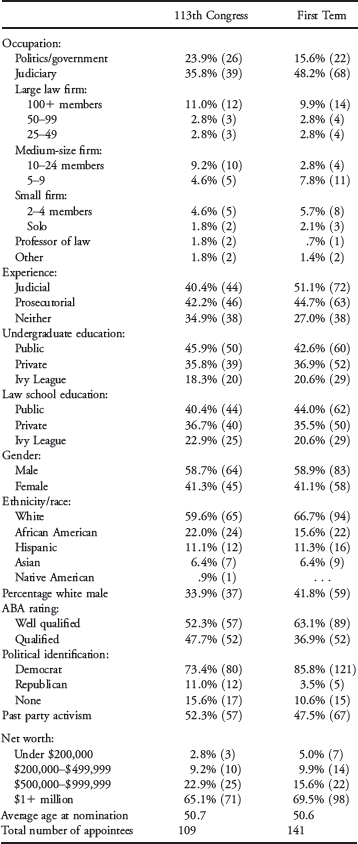
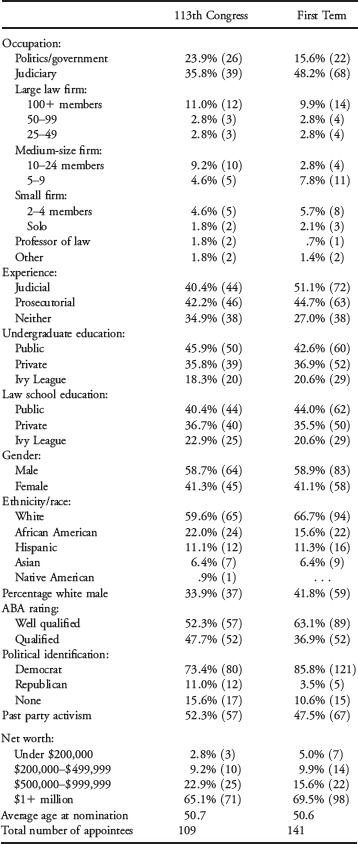
When the 113th Congress adjourned, and thanks to a breath-taking ending (recounted in detail in part 2) that added an additional 12 confirmations, a total of 109 out of 123 Obama-nominated federal district judges were confirmed. Table 4 compares those confirmed by the 113th Congress to those confirmed during President Obama’s first term.
Note.—Numbers of appointees are in parentheses.
It appears that the administration was more concerned about achieving experiential diversity than in the previous 4 years.Footnote 8 This is hinted at upon examination of the figures for occupation at the time of appointment. We see here that the proportion of those who were serving in the judiciary at the time of their appointment decreased from close to half to close to one-third. On the other hand, those who were in the politics/government category, mostly as lawyers working for government, increased from about one in six to close to one in four. And of these, most served as prosecutors, but some were public defenders. Likewise, there was some increase from the first term of those in private practice, particularly from medium- and large-size law firms. Two appointees were law school professors as compared to one during the first term.
As suggested above, fewer of the most recent cohort had judicial experience: four in 10 compared to five in 10 for the first term. There was also an increase in the proportion with neither judicial nor prosecutorial experience reflecting in part the increased number coming from medium-size law firms. Indeed, about one-third had neither judicial nor prosecutorial experience compared to about one-fourth of the first-term appointees.
When we consider undergraduate and law school education, the more recent cohort was similar to the first-term cohort. Roughly one in five received an Ivy League undergraduate and law school education.
The proportions of men to women were similar for both cohorts, reaching significantly higher proportions of women than the record of previous administrations. Two in five of those appointed to the federal district courts were women. The racial/ethnic breakdown saw a significant increase in the proportion of African Americans appointed: from about one in six to over one in five for the cohort confirmed by the 113th Congress. The bottom line was another historic milestone: only about one in three appointees were white males, down from the first-term proportion of two in five. Although we will be discussing diversity at greater length in part 2, suffice it to note that there is a growing recognition that diversity indeed matters for judicial outcomes (Sunstein et al. Reference Sunstein and Ellman2006; Epstein, Landes, and Posner Reference Epstein, Landes and Posner2013; Haire and Moyer Reference Haire and Moyer2015).
The proportion of appointees from the most recent cohort with the highest ABA ratings was somewhat lower than the proportion for the first-term cohort. But unlike the appointees of George W. Bush and Bill Clinton, none of the appointees had a rating of not qualified.
The proportion of the recent cohort identified with the Democratic Party decreased and the proportion identified with the Republican Party increased—a function largely of the White House negotiating and accommodating Republican senators from states with two Republican senators. A total of 12 Republicans were confirmed for district court positions by the 113th Congress. The proportions of both cohorts with past party activism were close (52.3% to 47.5%).
Both cohorts had a roughly similar net worth. Approximately two out of three appointees from both groups had a net worth of more than $1 million. And both were almost identical in terms of average age at the time of nomination.
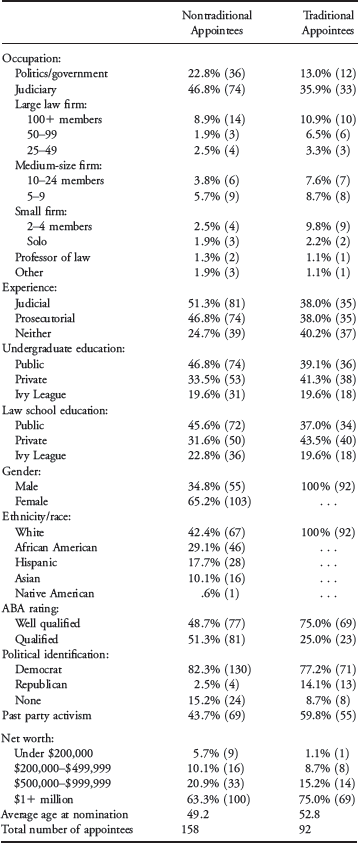
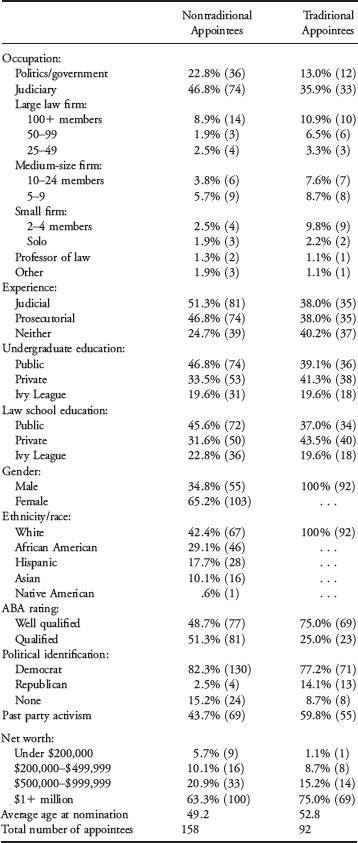
We now turn to a comparison of the portrait of all the nontraditional appointees (whose proportions and numbers set new historical records) to that of the traditional appointees. Table 5 examines the differences and similarities between all of President Obama’s nontraditional appointees and his traditional (i.e., straight white males) appointees as of the beginning of his seventh year in office. A total of 158 nontraditional judges were appointed over 6 years compared to a total of 92 traditional judges.Footnote 9 In general, the findings suggest somewhat different career paths and credentials of the nontraditional appointees as compared to the traditional appointees.Footnote 10
Note.—Numbers of appointees are in parentheses.
With occupation at the time of appointment, table 5 indicates that there were higher proportions of nontraditional judges than traditional judges holding government office including prosecutors and public defenders, as well as holding judicial positions. Traditional appointees had higher proportions of those in private practice.
Considering judicial and prosecutorial experience, traditional appointees had less such experience and were more likely than the nontraditional appointees to have neither judicial nor prosecutorial experience.
When we examine law school education, nontraditional appointees had a slightly higher proportion who earned law degrees at prestigious Ivy League law schools. If prestigious non–Ivy League law schools are factored in, the difference becomes even greater: 40% of traditional but 46% of nontraditional appointees had a prestige legal education.Footnote 11
Of the nontraditional appointees, about two-thirds were women. In terms of race, about four in 10 were white, about three in 10 African American, one in six Hispanic American, and about one in 10 Asian American. One Native American was also appointed.
When we look at ABA ratings, about five in 10 nontraditional appointees had the highest rating of well qualified as compared to about three in four traditional appointees. These figures provide grist for the mill of critics who argue that nontraditional appointees on the whole were not among the most qualified for appointment (as compared to traditional appointees). But such a conclusion is justified only if the ABA ratings are considered dispositive of quality and if critics discount the greater professional experience of the nontraditional group and their overall larger proportion of degrees earned at prestigious law schools. It may well be that the ABA ratings are more accurate in terms of quality for white males than they are for nontraditional appointees, whose career paths tend to be somewhat different from those of traditional appointees. It might also be that biases may subtly and even subconsciously come into play particularly in some parts of the country.
Over eight in 10 nontraditional appointees were Democrats, a slightly higher proportion than for the traditional appointees. The proportion of nontraditional candidates who had no affiliation with any party was almost double that of the traditional appointees. The proportion of Republicans was over fourfold for the traditional appointees compared to the nontraditional appointees, with about one in seven traditional appointees who were Republican. About three in five traditional appointees had a background of past party activism while only about two in five nontraditional appointees had such a background. Being a financial contributor to the party and its candidates as well as some level of campaign activity may have been more important for the advancement of traditional candidates ultimately succeeding in being nominated than for nontraditional candidates, although the differences in proportions are not startling.
The net worth of the traditional appointees was substantial: three out of four had a net worth in excess of $1 million. The proportion for nontraditional appointees was lower but still constituted a large majority: over three in five.
The nontraditional appointees were, on average, about 3 1/2 years younger than were the traditional appointees.
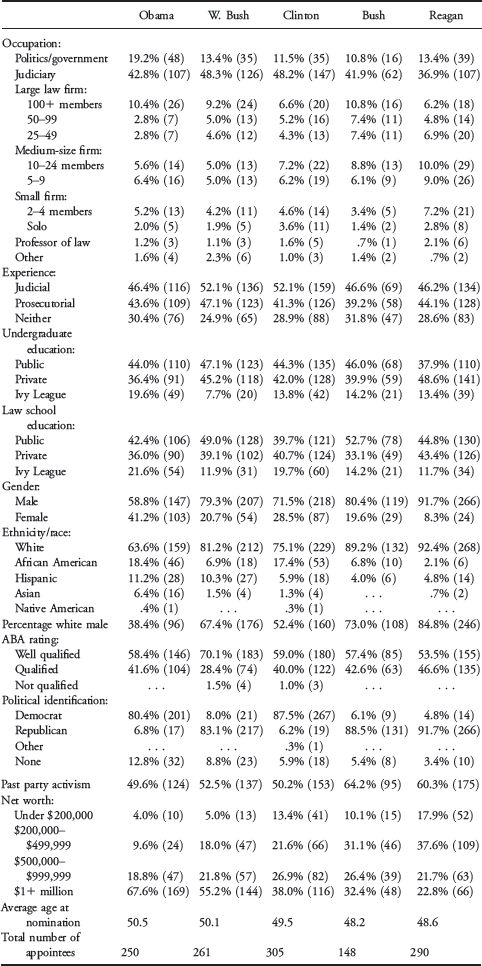
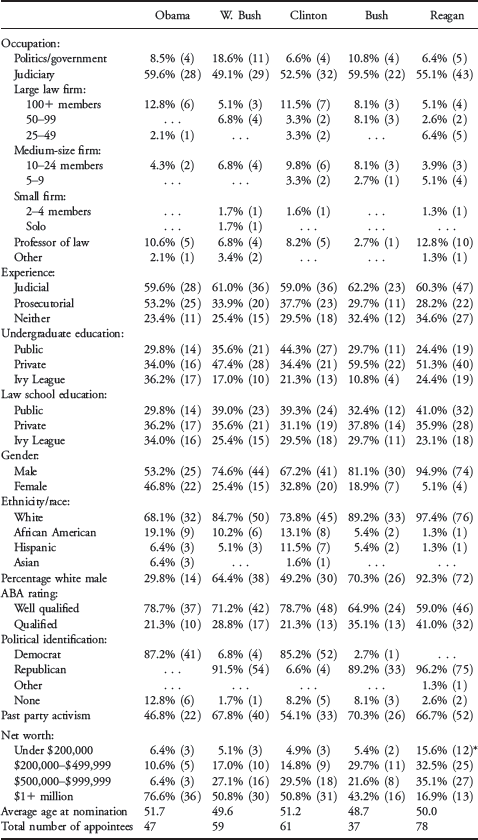
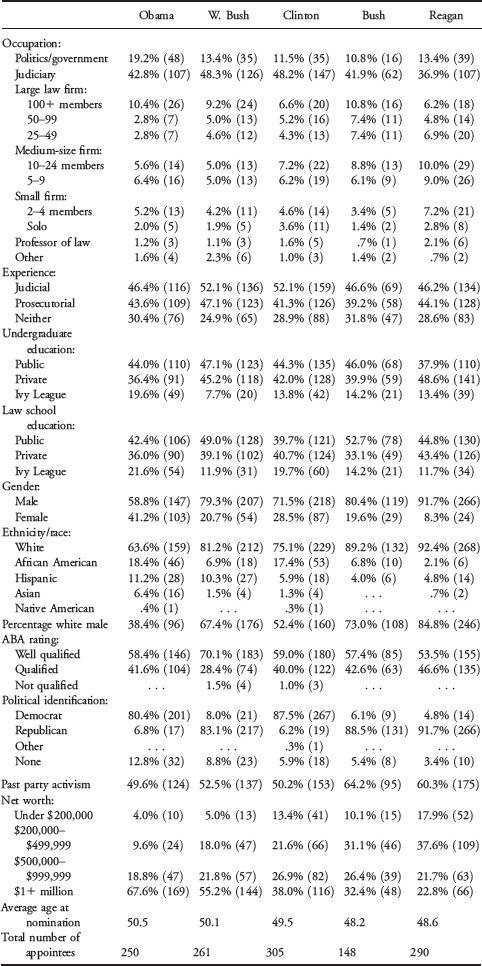
When all of the Obama appointees over 6 years are considered compared to the appointees of his four predecessors in office, we see in table 6 a number of remarkable findings, most notably the great diversity of his appointees not only in terms of gender and race/ethnicity but also experientially. We also see continuities from the appointee portraits of the previous four presidents.
Note.—Numbers of appointees are in parentheses.
In terms of occupation at the time of appointment, there is the hint that there may be a change in progress concerning the judiciary as a source of recruitment. We noted in earlier articles that starting with the Carter administration, there was evidence of a growing professionalization of the bench in that through the Clinton years increasing numbers and proportions of appointees held judicial office at either the state or local level or at the federal level as US magistrates or in a few instances as US bankruptcy judges (Goldman et al. Reference Goldman2011, Reference Goldman2013). About half the Clinton, W. Bush, and first-term Obama appointees held judicial office at the time of their appointment to the federal district bench. Similarly, over half the Clinton, W. Bush, and first-term Obama appointees had judicial experience in their professional backgrounds taking into account those with judicial service who left the bench for primarily private practice. But as we saw in table 4, the most recent cohort of Obama appointees reversed this trend, suggesting a greater emphasis by the administration on experiential diversity. This shows up in the proportions of those holding nonjudicial governmental positions including public defenders and those in private practice.
Overall, the proportion of Obama appointees with judicial experience was slightly greater than the proportion of those with prosecutorial experience, the smallest gap since the Reagan appointees, and the most recent Obama-appointed cohort actually had a higher proportion with prosecutorial over judicial experience. The proportion with neither judicial nor prosecutorial experience was the highest since the first Bush administration.
The professionalization of the bench seemed to be reflected in the proportions of appointees elevated from primarily those who were US magistrates with a few from the ranks of US bankruptcy judges. President Ronald Reagan’s proportion of those elevations was about 5%, the first President Bush’s proportion was 11%, Clinton’s was 12%, W. Bush’s was close to 17%, and the first-term Obama cohort was close to 21%. The most recent cohort, however, was down to about 12% (the 6-year total is about 16%). It is too early to draw any conclusions about whether the trend of increasing recruitment and elevation of judges from primarily the federal magistrate courts has ended. There may be limits to an American career judiciary given the political nature of judicial recruitment; thus comparisons to the European career judiciary may be inapposite.
Table 6 shows that the Obama appointees had the highest proportions of all five administrations with those receiving an Ivy League undergraduate and law school education. The Ivy League schools are among the most selective institutions, and their graduates along with other selective colleges and universities are considered among the best and the brightest. It is noteworthy that the Obama law school graduates had the highest proportion of all five administrations with an Ivy League law degree (over one in five). If to this we add graduates from prestigious law schools, about 43% of the Obama appointees had a prestige legal education. W. Bush’s appointees’ proportion with a prestige legal education was about 31% and Clinton’s appointees’ proportion was about 38%.
It is, of course, in the gender and racial diversity categories that the Obama record is unprecedented. The numbers and proportion of women appointed by Obama to the federal district bench shatter all previous records. Over two in five appointees were women (a total of 147). The proportion of African Americans edged out the previous record by Clinton, although in absolute numbers Clinton still has the lead. The record of Hispanic American appointments, however, is precedent shattering in both numbers and proportions, although the number and proportion of W. Bush’s Hispanic Americans are a close second. The record for appointment of Asian Americans is clearly historic, with four times the number and proportion of Asian Americans than Obama’s two immediate predecessors. One full-blooded Native American was also appointed. The Obama administration appointed the lowest number and proportion of white males (under two in five) than any previous administration in American history.
The proportion of Obama appointees with the highest ABA ratings exceeded that of the Reagan and Bush 1 appointees and came close to the Clinton proportion. Only W. Bush’s appointees had the markedly higher proportion, a proportion that might have reflected the unusual circumstances of the ABA being eliminated from the prenomination stage by Bush.Footnote 12 Unlike the W. Bush and Clinton appointees, none were rated not qualified.
About eight out of 10 Obama appointees were identified with the president’s political party. Historically, the proportion of those identified with the appointing president’s party was about nine out of 10 (Goldman Reference Goldman1997, 351–52). That proportion began edging toward eight out of 10 starting with the Bush 1 presidency until reaching the eight out of 10 level for the Obama appointees. Similarly, the proportion of those without any party association went up from the Reagan appointees to the current Obama level of over one in 10. For the first time, the proportion without any level of past party activism dipped below the 50% mark (Goldman Reference Goldman1997, 352).
The record for net worth is set by the Obama appointees: about two out of three had a net worth in excess of $1 million. The W. Bush cohort first showed a majority of appointees with that high a level of net worth. Although net worth inflation over the years may well account for this, these figures may also suggest that the relatively low compensation of federal judges compared to that of talented lawyers in the private sector might discourage some of the most qualified lawyers from aspiring to federal judgeships. This is something that Chief Justices Rehnquist and Roberts warned about in their annual state of the judiciary addresses (Rehnquist Reference Rehnquist2001; Roberts Reference Roberts2008). A consequence of relatively low salaries is that the judiciary becomes increasingly a preserve of the relatively rich or upper-middle class. That is, these figures reflect a reality that those who can financially afford to go on the bench will be more likely than those who cannot to become candidates for judgeships.
The Obama judiciary, 6 years in, had the highest average age of all five administrations, although the difference between W. Bush’s appointees was close. The biggest differences were with the Reagan and Bush 1 appointees, whose average age was about 2 years younger than that of the Obama appointees.
Appeals Courts
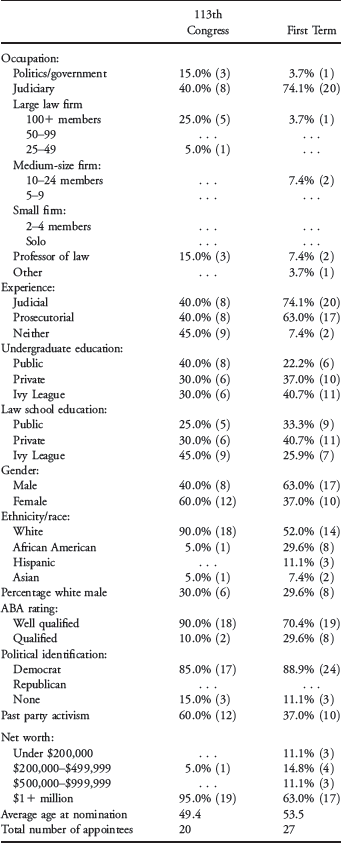
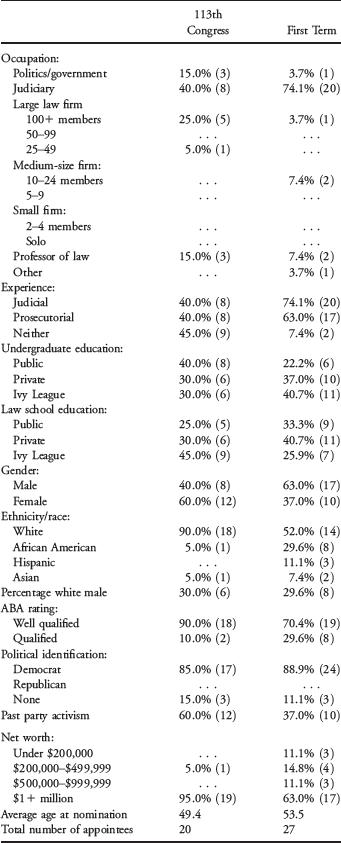
As noted earlier, as a result of the so-called nuclear option, the confirmation rate for the president’s appeals court nominees in the 113th Congress was the highest in about 25 years: 20 of the 22 named to appeals courts of general jurisdiction (not including the US Court of Appeals for the Federal Circuit, a court of specialized jurisdiction) were confirmed. Table 7 compares the backgrounds of those 20 confirmed by the 113th Congress to 27 confirmed during Obama’s first term.
Note.—Note that statistics are for lifetime appointments to courts of general jurisdiction. Numbers of appointees are in parentheses.
Just as we saw in table 4 for the district courts, the most recent cohort of appeals court appointees differs from the first-term cohort in terms of those who were serving in the judiciary at the time of their appointment. About three out of four first-term appointees were holders of other judgeships, with about two-thirds being elevated from federal district court positions. Only about two in five appeals court appointees confirmed by the 113th Congress were serving as judges on other courts. Of these, half were elevations from the federal district courts and one-quarter were from the US magistrate’s bench. The most recent cohort had the same proportion with judicial experience as were serving on the bench at the time of appointment (two in five). The same was true for the first-term appointees. This means that their career paths did not take the appointees from the bench to other pursuits.
The same proportion of the most recent cohort to have judicial experience had prosecutorial experience. And this proportion was lower than for the first-term appointees. The proportion of the most recent cohort with neither judicial nor prosecutorial experience was a startling 45%. Clearly the profile of the most recent cohort differs from the first-term profile: more appointees coming to the bench from the large law firms in particular. The most recent cohort included three law professors. The first-term cohort included two.
Just as with the district courts, the findings for gender and race/ethnicity are of historic proportions. Table 7 shows that the most recent cohort had a larger proportion of women appointments (three out of five) than the first-term appointees (two out of five). But the most recent cohort was overwhelmingly white with few nonwhites appointed. Overall, the proportion of white males for both cohorts was the lowest ever recorded: about three in 10.
The ABA ratings of the most recent cohort were overwhelmingly “well qualified,” the highest rating (nine out of 10 received this). The figure for the first-term cohort was seven out of 10.
The large majority of both cohorts were Democrats. But the most recent cohort had higher levels of past party activism. All but one of the most recent appointees had a net worth in excess of $1 million. This compares to about two out of three of the first-term cohort.
The most recent cohort was, on average, 4 years younger than the first-term cohort. One can speculate that had the Democrats retained control of the Senate, there would have been a very different (and younger) group of judges appointed in the 114th Congress, whose record of confirmation at the time of this writing is almost total obstruction.
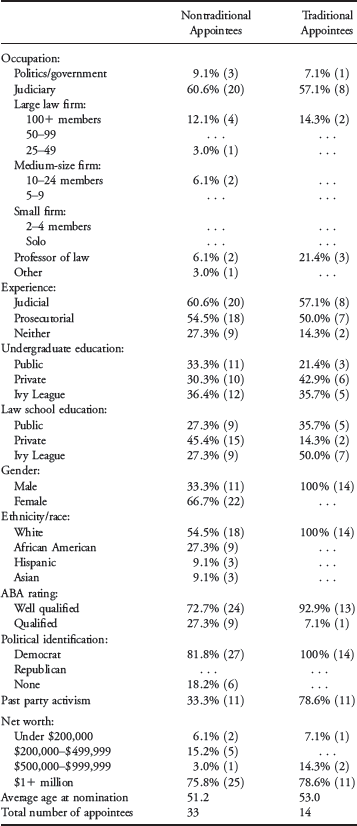
Table 8 scrutinizes the nontraditional appointees compared to the traditional appointees. There were 33 nontraditional appointments over Obama’s first 6 years and 14 traditional appointments. Because of the relatively small number of traditional appointments, the differences in percentages must be treated cautiously.
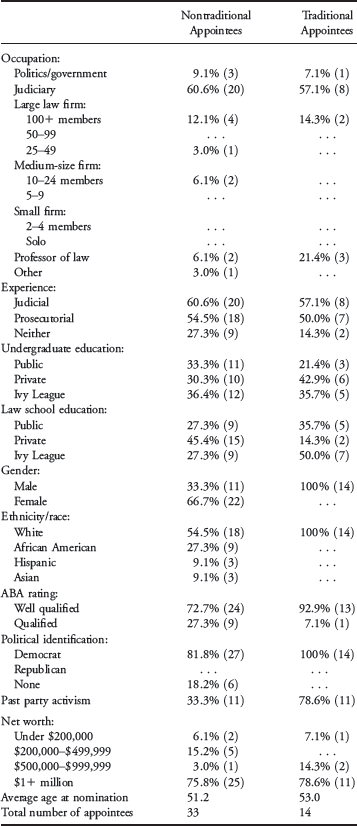
Note.—Note that statistics are for lifetime appointments to courts of general jurisdiction. Numbers of appointees are in parentheses.
Interestingly, in terms of occupation at time of appointment, both groups of appointees have similar profiles, although more professors of law (three) were found in the traditional cohort as compared to the nontraditional cohort (with two law professors). With judicial and prosecutorial experience, both cohorts were similar, but the nontraditional cohort had a larger proportion with neither judicial nor prosecutorial experience.
Half of the traditional cohort were graduates of Ivy League law schools, but only about one-quarter of the nontraditional cohort were so trained. When prestigious non–Ivy League law schools are factored in, the total proportion of nontraditional appointees with a prestige legal education was about 45%. The proportion of traditional appointees, however, was 64%.
Two-thirds of the nontraditional appointees were women. In terms of race and ethnicity, about one-fourth were African American, with Hispanic Americans and Asian Americans constituting approximately 9% each. A clear majority were white.
In terms of ABA ratings, all but one of the traditional appointees received the highest rating of well qualified. About seven in 10 of the nontraditional appointees received the highest rating. None were deemed not qualified.
All of the traditional appointees were Democrats. Four of the five nontraditional appointees were Democrats. The balance were unaffiliated. No Republican was appointed to the appeals courts. As for a record of past party activism, only a third of the nontraditional appointees had such a record compared to the large majority of traditional appointees.
About three out of four of each cohort had a net worth in excess of $1 million. The nontraditional appointees, on average, were almost 2 years younger than the traditional appointees.
Table 9 offers a comparison of all the Obama appeals court appointees over the first 6 years to the collective portrait of the appointees of the previous four presidents. Looking at the composite portrait of all Obama appeals court appointments, we do not see pronounced differences from previous presidents’ appointees. About six in 10 were on the bench when nominated to the appeals court as compared to about five in 10 Bush and Clinton appointees. But both the Bush and Clinton cohorts had more judicial experience than their figures for occupation at time of appointment suggest. In terms of judicial experience, all five presidential cohorts are roughly similar.
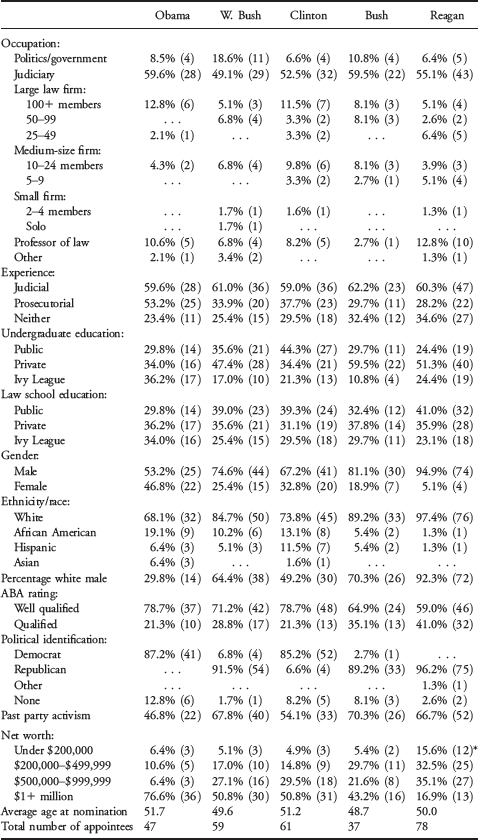
Note.—Two recess appointments by W. Bush and one by Clinton are not included in the statistics. Statistics are for lifetime appointments to courts of general jurisdiction. Numbers of appointees are in parentheses.
* Net worth was unavailable for one appointee.
Table 9 suggests that, on the whole, the Obama cohort had the highest proportion of all five cohorts with prosecutorial experience (roughly one in two appointees). Of the last three cohorts including the Obama cohort, about one in four had neither judicial nor prosecutorial experience. For the Reagan and Bush 1 appointees that figure was closer to one in three.
The Obama appointees had the largest proportion of appointees who received their undergraduate education at the selective and prestigious Ivy League institutions. In terms of law school education, the Obama cohort also had the largest proportion who graduated from Ivy League institutions. If we include non–Ivy League prestigious law schools in our figures, approximately 51% of the Obama cohort had a prestige legal education. This is similar to the percentages for the W. Bush and Clinton cohorts. The Bush 1 and Reagan cohorts had lower percentages in the lower 40% range.
The results suggest that the Obama appeals courts appointees are not exceeded by any other presidential cohort in outstanding professional experience. The proportions for the ABA ratings seem to underscore this evaluation. Almost eight out of 10 Obama appointees received the highest ABA rating—in terms of percentages, tied with the Clinton appointees.
Of course it is with gender and race/ethnicity that the Obama cohort stands out. About seven in 10 Obama appeals court appointees were nontraditional, a historic record. About one in five were African American, thus making Obama the president with the highest absolute numbers and percentages of African American appeals court appointees. The same was true for Asian American appointees. The percentage of Hispanic Americans to the appeals court was second only to that for the Clinton cohort, but of course, the Obama administration gets full credit for appointing the first Hispanic American to the Supreme Court. Given the burgeoning literature supporting the conclusion that race and gender affect judicial behavior, Obama’s influence on the diversification of the bench is especially noteworthy (Brudney, Schiavoni, and Merritt Reference Brudney and Merrit1999; Farhang and Wawro Reference Farhang2004; Peresie Reference Peresie2005; Sunstein et al. Reference Sunstein and Ellman2006; Chew and Kelly Reference Chew and Kelley2009; Boyd, Epstein, and Martin Reference Boyd and Martin2010; Epstein et al. Reference Epstein, Landes and Posner2013; Haire and Moyer Reference Haire and Moyer2015; Farhang, Kastellec, and Wawro, Reference Farhang, Kastellec and Wawroforthcoming).
In terms of party identification, close to nine out of 10 of the Obama cohort were Democrats. There were no Republicans, but there was the highest number and percentage of those not associated with a political party. Of all five administrations, the Obama cohort had the lowest proportion of previous party activism (under half). The other four presidential cohorts had large majorities with previous party activism.
Of all five cohorts, the Obama cohort had the largest proportion with a net worth in excess of $1 million (some three out of four). The implications of these findings were discussed earlier in relation to similar findings for the district court appointees.
Although table 7 suggested that the Obama cohort from the 113th Congress was markedly younger than those appointed in the first term, the overall figures in table 9 show only that the age gap for Obama appointees has lessened. What it will look like at the end of his presidency is highly speculative and depends on whether the Republican Senate leadership will process Obama nominees.
Concluding Thoughts and Looking Ahead
We have covered much ground in our overview of judicial selection processes and their outcomes during the tenure of the Senate of the 113th Congress, corresponding to the first 2 years of President Obama’s second term in office; much remains to be explored in greater detail in the second part of our analysis to be published in the next issue of the Journal. In this installment we have documented the selection processes utilized by the Obama administration while describing their extraordinary record of success in seating judges at both the district and appeals court levels in 2013–14. While doing so, they continued to build on a historical record of appointment diversity along ethnic, racial, and gender lines while also making some strides in addressing the vexing issue of experiential or professional diversity, a construct that can easily be tapped in characterizing a prospective judge at the time of his or her nomination but one that is considerably more difficult to assess for an individual’s entire lifetime. The unusual record of appointment success enjoyed by the Obama administration in the 113th Congress did not come easily. Indeed, Obama’s nominees continued to labor under and be met by near-historic levels of obstruction and delay despite the Democratic Senate majority, a phenomenon that continued to be particularly noteworthy at the district court level given the fact that, historically, such trial court appointments have been relatively consensual in nature and noncontroversial. Clearly, such obstruction and delay underscored the unusual partisan divide during the Obama years that continued to plague the 113th Congress, a gulf that was both signaled and likely exacerbated by the change in filibuster rules initiated by the Democrats’ deployment of the so-called nuclear option in November 2013.
In part 2 of our analysis we will focus in depth on the lead-up to the nuclear option, particularly as that played out as part of the administration’s efforts to fill three vacant seats on the critical US Court of Appeals for the DC Circuit. While analytically separable from the nuclear option, part of the “fallout” from its creation of a filibuster-proof Senate in which the Democrats’ simple majority could now ensure district and courts of appeals judicial confirmations was a renewed emphasis on the Judiciary Committee’s Blue Slip system as a mechanism for the minority Republicans to impose obstruction and delay. Thus, in part 2 we shall explore the operation of the Blue Slip system and its continuing role in the judicial selection process.
The confirmation process during the 113th Congress, as has been the case with every 2-year slice of federal judicial selection we have analyzed through the years, contained its share of judicial selection focal points that took place on somewhat smaller stages than, perhaps, those occupied by the DC Circuit confirmation struggles and the nuclear resolution that dominated the congressional session. These included, for example, illustrative nomination and confirmation politics as played out in states such as Texas, with multiple long-term vacancies on its district courts as well as on the 5th Circuit Court of Appeals that served the state. Other “red” states that can further serve to illustrate the complexities of judicial selection politics in a “blue” administration include Georgia and Arizona, where solutions for filling long-term vacancies characterized by obstruction and delay were negotiated successfully. Similar success can also be seen in confirmations gained in “purple” states such as Florida. All of these states’ “stories” will be the subject of some description and analysis in part 2 of our study.
Finally, in the second half of this article, our attention will turn to a number of topics that have always been given focused consideration in our studies. These will include a discussion of the role of “advocacy” groups in nomination and confirmation processes as well as extensive focus on two topics that, after 6 years of the Obama presidency, have come clearly into focus. Specifically, we will take a deeper look at the administration’s historic contribution to enhancing diversity on the federal bench across the district and circuit courts and, as well, make a similar assessment of the impact of the Obama appointments on the partisan makeup of the federal bench on the district courts and across the appellate circuits. We will conclude our study on an “informed speculative note,” assessing what the remainder of the Obama administration’s time in office will hold for federal judicial selection, from a vantage point several months into what has transpired, to date, in the Senate of the 114th Congress.