I. Introduction
Much has been said about Bram Stoker's Dracula (1897), the out-of-tradition exemplar of the Gothic which, perhaps, has had a more pervasive effect on our understanding of life and death, gender roles and identity, and sex and perversity than any other work of the genre. The vampire from the so-called dark ages has become a symbol standing for the uncontrollable powers acting on us and also for all the discarded, uncanny phenomena in human nature and history. The work, however, has usually been taken by the critics of Gothic literature as “a paradigmatic Gothic text” (Brewster 488) representing the social, psychological, and sexual traumas of the late-nineteenth century. Hence, it has been analysed as a work “breaking [the] taboos, [and in need of being] read as an expression of specifically late Victorian concerns” (Punter and Byron 231). The text has also been seen as “reinforc[ing] readers’ suspicions that the authorities (including people, institutions and disciplines) they trust are ineffectual” (Senf 76). Yet, it has hardly ever been taken as offering an alternative Weltanschauung Footnote 1 in place of the decaying Victorian ethos. True, Dracula is a fin-de-siècle novel and deals with the turbulent paradigmatic shift from the Victorian to the modern, and Stoker, by creating the lecherous vampire and his band as the doppelgängers of the sexually sterile and morally pretentious bourgeois types (who are, in fact, inclined to lascivious joys), reveals the moral hypocrisy and sexual duplicity of his time. But, it is also true that by juxtaposing the “abnormal” against the “normal” he targets the utilitarian bourgeois ethics of the empire: aware of the Victorian pragmatism on which the concept of the “normal” has been erected, he, with an “abnormal” historical figure (Vlad Drăculea of the House of Drăculești, 1431–76) who appears as Count Dracula in the work, attacks the ethical superstructure of Britain which has already imposed on the Victorians the “pathology of normalcy” (Fromm 356). Hence, Stoker's choice of title character, the sadistic Vlad the Impaler, who fought against the Ottoman Empire in the closing years of the Middle Ages, and his anachronistic rendering of Dracula as a Gothic invader of the Early Middle Ages are not coincidental (Figure 8). In the world of the novel, this embodiment of the early and late paradigms is the antagonistic power arrayed against the supposedly stable, but in reality fluctuating, fin-de-siècle ethos. However, by turning this personification of the “evil” past into a sexual enigma for the band of men who are trying to preserve the Victorian patriarchal hegemony, Stoker suggests that if Victorian sterile faith in the “normal” is defeated through a historically extrinsic (in fact, currently intrinsic) anomaly, a more comprehensive social and ethical epoch that has made peace with the past can be started.
“Duality: the Vampiric and the Victorian.” Illustration by Barış Emre Alkım.

Stoker brings together the ungendered vampire of the primitive past with the bourgeois males and females of the civilized world whose thwarted, sterile sexuality is the main target of the vampire. Ironically, however, the vampire helps them release their repressed sexual energies and lets them enjoy uncanny delights: by sexualizing Jonathan, Lucy, and Mina through abnormal ways, and by metamorphosing the rest into anomalous sexual beings, the vampire plans to found a new (but also the old) world of sexual freedom in contrast to the empire built on patriarchy and its subsequent gender and power relations. In fact, the medieval vampire's bite transforms the gendered bourgeois stereotypes into ungendered characters with anomalous sexualities, and Stoker suggests that this is not an evil mutation. On the contrary, it is through these “abnormal” figures that the fabricated bourgeois ethics on sex and gender can be challenged to pave the way for the construction of a more inclusive sexual superstructure with individuals free from the gendering, sexually limiting influence of Victorian moral ideology. Therefore, Stoker's Dracula, if it is considered as offering an alternative paradigm, relies on the clashing norms of the past and present from which emerges a new understanding of the “normal” and the “moral.”
Through such a clash, Stoker does voice his interest in the historical and cultural heritage of Europe, and by extension, in the paradigmatic shift the empire is facing. He sees the past world as more straightforward than the repressive, hypocritical Victorian ethos, and wishes to evoke a comparable awareness through generating sexual epiphany in the work. For him, this late period of the Victorian Age is still half in love with rationalism, denying, therefore, the need for the magical and the mysterious and the existence of the irrational forces in men and women. Hence, by introducing a faux-medieval setting (Transylvania in Romania), which stands for the European past, and by reconstructing the western folkloric vampire through homoerotic language and imagery, which signifies the arousal of the buried or eruption of the repressed, he draws out the reasons for the denial of the natural and illustrates the resultant hypocritical understanding of sex, gender roles and relations, and the widespread social and individual anomaly in fin-de-siècle Britain. He points out the major problems of his age, yet he is hardly optimistic about the evolution of the Victorian culture to a better form: although Dracula brings the Victorian pathology to the surface, the defeat of the Count at the end of the novel signifies both the incurability of the actual disease and Stoker's cynicism concerning the emergence of a new and a better paradigm.
II. Dracula the Vampire Demolishing the “Glamorous” Façade of Victorianism
Contrary to the conventional Victorian novelists, who usually deal with the dichotomy between the upper and the lower classes in urbanising Britain, Stoker is more concerned with history, and with the lack of interaction between the ancient and the modern. In fact, Dracula compares and contrasts the “barbaric” past with the “civilised” present over representative settings and characters: feudal Transylvania and modern London are pitted against each other through the vampiric and the Victorian characters. The novel opens with the young English solicitor, Jonathan Harker, traveling to the still feudal and sinister Transylvania on the periphery of Europe, where Count Dracula's ancient castle, which, for centuries encountered the violent attacks of foreign invaders, is located. This in-betweenness of Transylvania separating the civilised and the barbaric (or the European and the non-European), and the crumbling castle where the undead Count resides with his vampire wives, are the evocative geographical and historical allusions used by Stoker to reveal that, though discarded, the past as an amalgam of the rational and irrational powers still prevails over the present. Hence, Jonathan's visit to the medieval castle in Transylvania does not only explain the author's wish to create a surprise effect and uncanniness for the character and the reader; by juxtaposing the sterile, stereotypical bourgeois male of the contemporary late Victorian world with the noble, passionate, and androgynous Dracula from the Middle Ages, Stoker reverses the clichéd conception of the past as a dead, foreign country. The ancient Dracula is far more alive, and far more familiar than the modern Victorians.
According to Stoker, the undead Count residing in his ancient abode is a metaphor not only for the ghostly incarnation of the “dark ages” affecting the present but also for lost bodily freedoms, and for chivalry and wisdom. In fact, he and his she-vampires demonstrate “dangerous subversive desires which disrupt Victorian moral and sexual codes” (Mighall 63). The first Victorian whose moral unity is disrupted by such desires is Jonathan: he “falls victim” to the aggravated perverse sexual assaults of the three women who “threw no shadow on the floor,” and whose “piercing eyes . . . seemed to be almost red when contrasted with the pale yellow moon” (Stoker 44; ch. 3). The Count, however, “saves” him from the she-vampires, telling them that “this man belongs to [him and that] . . . when [he is] done with him [they] shall kiss him at [their] will” (46; ch. 3). In this way, through his insinuations aimed at the she-vampires and Jonathan, the Count reveals his androgynous sexual identity.
The young solicitor Jonathan Harker and his associates stand in the novel as the microcosmic society for the culturally diverse, yet gendered and sterile, bourgeoisie that replaced the sexual frankness of the previous aristocratic paradigm. Despite their diversity in origin, class, and nation, the characters of Dracula constitute the predominant bourgeois Weltanschauung: the young schoolmistress and Jonathan's fiancée, Mina Murray; the rich and flirtatious Lucy Westenra; Lucy's three suitors — the aristocrat Arthur Holmwood, the American adventurer Quincey Morris, and the asylum director Dr. John Seward; and finally the Dutch professor and metaphysician Abraham Van Helsing, who joins the group upon Seward's invitation and who organizes “the band of men” against Dracula. Though family-oriented, these elite of the bourgeois empire are hypocritical, venal, and ruthless. The Count, on the other hand, as the embodiment of the “dark ages,” is trying to re-establish the lost world of honour, courage, and venture. He is perhaps the only true aristocrat in the present world, and in Stoker's suggestion, “Dracula stands for lineage, the principle group of characters for family; Dracula for the wildness of the night, they for the security of day; Dracula for unintelligible and bitter passion, they for the sweet and reasonable emotions; Dracula for the physical and erotic, they for repressed and etherealised love” (Punter 18).
Trying to preserve “order, neatness, [and] reserve . . . which serve the purpose of quashing the libidinal fulfilment which would otherwise disrupt social and psychological organisation” (Punter 19), the band of men start fighting against the vampire's desire to bring the past upon the present. Through Lucy they have already learned that the vampire's bite inflicts “the passion which never dies”, and which is ultimately dangerous for the patriarchal structuring of the Victorian sexual polity. Afraid of losing hegemony over female bodies (and also over their own), they become the protectors of their perceived civilisation. The Count, on the other hand, as the ghostly embodiment of the “dark ages,” bestows on the rootless, yet complacent, bourgeoisie “the power of [his] noble ‘blood’” (Cranny-Francis 75). For Stoker, this act of the medieval vampire represents the invigorating power of the past over the present. The diabolical insurrection of the vampire expressed through his sexual paraphilia gradually turns into an archetypal action signifying not only the overt wish of Count Dracula to metamorphose the bourgeoisie, but also of Stoker's furtive desire to challenge the Victorian boundaries regarding illicit sex and gender inversions.
Stoker juxtaposes the bourgeois characters’ confusion in the face of the genderless undead, and their static and sterile personality traits with Dracula's passion and resolution and with the contagiousness of his abnormal (or androgynous) state of being. An immortal warrior from the bloody “dark ages,” he carries in his biology and personality the fearsome legacy of the discarded past. Coming from a period in history that is marked by pandemics — typhoid and especially “The Black Death which killed much of the ‘flower’ of a generation and left many of the survivors in psychological and moral crises” (Gottfried xiv) — Dracula is the carrier of the “disease” of vampiric bisexuality. Stoker suggests that the way vampirism spreads is analogous to the spread of syphilis, the dreaded, yet widespread venereal disease of the nineteenth century which infected “at least 10 percent of the population” in big cities (Carpenter 72). Biting, sucking, and blood transfusions are Stoker's metaphors for the queer (and illicit) sexual intercourses, the publicly rejected but surreptitiously enjoyed fleshly, possibly syphilitic and deadly, joys. Indeed, “much like syphilis, vampirism was used [by the early Victorian authors like Polidori, Planché, Le Fanu, et al.] as a symbol of social deviance, especially for out-of-the-ordinary behaviors related to sexuality . . . [depicting also] the grip of syphilis on society” (Shmaefsky 31–32). It was in fin-de-siècle literature that, “during a period of gender crisis, the iconography of syphilis pervaded English fiction” (Showalter 166). Analogously, Stoker in Dracula uses this “iconography” to depict vampirism as akin to this venereal disease, and with respect to the way syphilis invades and distorts the individual bodies. Hence, he makes it
the dominant pathological force in the novel. This theory has its roots in the suggestion made by Stoker's great nephew and biographer, Daniel Farson, that the author actually died of tertiary syphilis, probably contracted from the prostitutes he visited. The willingness of critics like Elaine Showalter, Robert Tracy and Jeffry L. Spear to accept this diagnosis reveals how useful it is as a means to read Dracula. (Byrne 130)
The vampire's depiction as analogous to a syphilitic transmitting the infection and the queer ways the vampire transfuses his bodily fluids with his victims’ make Dracula a figure representing the threat of ungendered, illicit sexuality. With his canine teeth and receptive mouth suggesting the male and female sexual organs (in fact a “toothed vagina,” both receptive and penetrating), Dracula is above the dichotomised gender roles, and neither the male nor the female is out of his reach. Seeing this duality in the vampire, and his attempt to spread “vampirism,” Van Helsing interprets him to be the embodiment of impossibility. He exclaims: “Which of us would have received such a possibility, in the midst of our scientific, sceptical, matter-of-fact nineteenth century?” (Stoker 287; ch.18). The initial reaction of the professor to the existence of the sexually and dangerously ungendered remains scientifically orthodox. However, when he scrutinizes Dracula unconventionally, he sees that the vampire is a contingent fact: he is a pestiferous being communicating the infection of the free, genderless sexuality of the discarded past. Professor Van Helsing is afraid that the androgynous vampire may blur the rigidly defined gender roles by “infecting” the normal Victorians, and may cause the collapse of the patriarchal ideology on which the empire stands.
Count Dracula's androgynous position also brings up the “anxieties over illicit ‘feminine’ desires in men . . . [reverberating] throughout the text to reveal anxieties about an inherent and subversive ‘feminine’ component in all ‘normal’ men” (Howes 104). To show the normalcy of this “‘feminine’ component,” and to justify the existence of what has already been denied in his age, Stoker constructs a sinister Transylvania that is both libidinal and faux-medieval, and which stands as a metaphor for the underground sex life in the Victorian period. As such, this voluptuous medievalism occupies, despite the prevalence of Victorian ethics in the work, a central role justifying for the Victorians the sexual queerness of the Count by distancing him from their respectable setting. Hence, the intersexual identity of Dracula, which is alluded to at the beginning of the text, through his homosexual innuendoes aimed at Jonathan, becomes an excusable sexual status so long as Dracula belongs to the foreign country of the Middle Ages.
As has been argued elsewhere, “Stoker's preoccupation with the narrow line between a real and assumed past continued to the end of his life . . . [and medievalism] proves a form of wish-fulfilment which compromises Stoker's claimed position as a detached historian” (Simmons 39). True, Stoker draws a distorted picture of the past, and a distorted portrait of Vlad III: he fuses the sexual politics of the Late Middle Ages with those of the anterior pagan culture. Yet, this comprehensive depiction of the past is more embracing and more insightful compared to a historian's scholarly synthesis. Besides, Stoker was not completely wrong in describing medieval Dracula as a bisexual since androgyny was so common in the Middle Ages that some men “found it convenient [sexual attitude] until they had a licit marital relationship . . . some men however, did not cease with marriage but continued to be accused of sex with boys into maturity and old age” (Karras 180). Such men were sometimes punished and sometimes ignored. To illustrate, at the beginning of the High Middle Ages, “Saint Anselm [of Canterbury] defended his reluctance to prosecute sodomy in 1102 with the argument that it was already so commonly practiced that people would have difficulty recognizing it, or themselves within that category” (Burgwinkle 200). However, “by the late thirteenth century, homophobic discourse was institutionalized and sodomy had taken on mythic dimensions within the works of some theologians. Sodomites were now demons as well as sinners” (32). Despite such news, they continued to exist in Church and in public, and their “sin,” which was too manifest a practise during the Middle Ages, was a source of pleasure while at the same time an act of dissent from the corrective attitude of Church and state.
The historical epithet of Vlad as the “impaler,”Footnote 2 and the usual imagery of impaler as being the one who impales “enemies by having a metal tipped stake driven up the anus” (Chirot 13) help Stoker form Dracula's stance as a sodomite of bisexual nature, trapping his “victims” first with oral sex. In Dracula's (and Stoker's) plan, the eradication of Victorianism will be possible through abnormally possessing those so called virtuous and sexually categorized Victorian women who are unaware of the iniquitous nature of sex, and through those ladies, the bourgeois gentlemen will also be captured. Once the band of men decide to destroy the place where Dracula resides, the vampire defies them saying that he has already had their beloved women: “My revenge is just begun! I spread it over centuries, and time is on my side. Your girls that you all love are mine already. And through them you and others shall yet be mine, my creatures, to do my bidding and to be my jackals when I want” (Stoker 370; ch. 23). Dracula's utterance of “revenge” which “is just begun” reveals his intention towards and abhorrence of the bourgeoisie (Figure 9). His hatred stems from the normative demeanour they assume as their identity; he knows that they have already hidden their “natural” impulses: though they are responsive to the impulse of sexuality, they pretend they are not. Hence, he is against the sort of propriety that generates, on account of the suppression of the natural, ignorance and hysteria. Moreover, he is infuriated with the widespread hypocrisy and with its recognition as “normalcy.” Thus, the vampire's boastfulness cannot only be taken as a display of his captivating influence on the bourgeois characters. Disgusted by those tantalizing Victorian males and females, and their fabricated rules of etiquette, he bluntly voices the fact that he has already illicitly and perversely possessed the decorous, yet sexually excitable, and supposedly unattainable, “virtuous” women of those “respectable” males. The vampire's bite, though deadly in the eyes of Victorians, is also the source of pleasure and new insight. By giving the male-dominated female figures what they need, and by making the hypocrisy in both genders blatant, the vampire is contagion personified, spreading the “illness” of freedom, mutability, and pleasure.
“Hovering Shadow of the Vampire over London.” Illustration by Barış Emre Alkım.

Stoker's depiction of Dracula, though on the literal level that of an evil medieval figure, is, however, mild enough on the metaphorical level, suggesting that the vampire is an uncanny, yet insightful, being. As he has developed an unempirical philosophy for life by means of his evolution throughout the ages into an androgynous being, he is already aware of the ambivalence in human nature (or the repressed existence of the anima in man and the animus in woman, in Jungian terms), and is thus superior to the temporality and narrow-mindedness of the Victorians. An alluring visitor from the historical and geographical periphery of feudal Europe who has lost his princedom (Wallachia), he is inquisitive about the moral dilemmas of the crumbling Victorian ethos. Hence, fin-de-siècle London where life is “for many an exhilarating heyday” (Abrams 935) is his new abode and where, he thinks, he can rebuild the past civilisation.
III. History Turned into Myth, or Myth Turned into History: Stoker's Transformation of Vlad Drăculea into the Dracula
Though made a unique predator by Stoker, Dracula the vampire is not a rootless archetypal villain. As the “self-portrait of the [human] instinct” (Jung, “Instinct” 183), the blood sucking (or soul consuming) vampire emerged in various cultures with names such as “vampir, vapir, upuir, the undead, and nostferatu” (Leatherdale 20), and “the vampire myth likely came to Europe from India, via Turkey and the Balkans” (Keith 62). Its presence in any period and any culture, however, is the result, not the cause of the disordered condition the specific society has come to suffer. Hence, “most likely the vampire and werewolf myths developed from mounting fear of a disease a community encountered daily” (62). Stoker's creation of the vampire is the result, not the cause, of growing ethical anarchy in the fin de siècle.
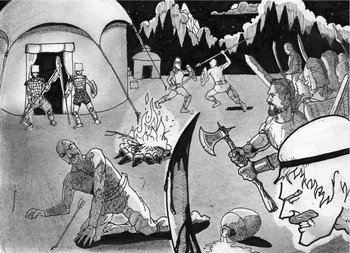
In Dracula, however, Stoker remoulds the already existing vampire archetype; he dresses him as both a rebellious prince and a genderless, blood sucking vampire. Surprisingly, however, the historicity of the Late Middle Ages is given through the mouth of this uncanny amalgam. Whenever Dracula speaks to Jonathan of his ancient house, he always says “we,” indicating that he considers present time and present people as the other, the opposite of his past, chivalric paradigm. He is a Szekely (a subgroup of Hungarian people), and Szekelys, the Count says, were a proud, conquering race whose roots can be found in “the whirlpool of European race” (Stoker 34; ch. 3). They acquired their “warlike fury” from the Huns, and “when the Magyar, the Lombard, the Avar, the Bulgar, or the Turk poured” (34; ch. 3) on their frontiers, they drove them back. But later, however, the Szekelys were defeated and enslaved by the Ottomans. For the Count this “great shame of [his] nation, the shame of Cassova [war (1389 AD)]” which made the flag of the country go “down beneath the Crescent” (35; ch. 3) came to an end when he “crossed the Danube [to] beat the Turk on his own ground” (35; ch. 3) (Figure 10).
“Night Attack to the Sultan's Camp.” Illustration by Barış Emre Alkım.

Stoker's explicit characterisation of the vampire as Vlad is further supported by Dracula's account of his surprise night attack on the Ottoman forces. The vampire's reference to “crossing the Danube” brings to mind Vlad's
most famous exploit [which] occurred early in the winter of 1462, when he crossed the Danube with a large army and carried out a surprise night attack on the sultan's own camp. The result was a bloody massacre, which removed the Ottoman threat to the Wallachian capital of Tirgovişte and forced the Ottoman Turks to retreat. (Sedlar 253)
By terrorizing the soldiers of Sultan Mehmed II (or Mehmed the Conqueror, 1432–81), and by forcing the Turks to retreat, Vlad acquired an awesome reputation as a great tactician and a warlord which inspired Stoker to depict the major character of his work as a bloodthirsty creature of the night. Dracula's coming to life at night is not only the reiteration of the leitmotif in folktales about vampires, but also the resurgence of Vlad's night raids on his enemy. Hence, the vampire's nocturnal existence in the novel acquires an additional meaning: the Count is awake, powerful, and aggressive during the night like his historical counterpart who attacked the enemy in the dark.
In his discourse with Jonathan, the Count also refers to another historical fact: his brother's (Radu cel Frumos, 1437–75 AD) siding with the Ottomans, which he sees as the cause of his defeat. Assuming the proud and chivalrous posture of a defeated woeful hero let down by his brother, Dracula says, “Woe was it that his own unworthy brother, when he had fallen, sold his people to the Turk and brought the shame of slavery on them!” (Stoker 35; ch. 3). The sincerity of his oration is noticeable in his excitement and from the speech can be discerned his self-respect, his loyalty to his people, and his upright stance against the Ottomans. He is a chivalrous, noble man, as Vlad, too, was an unbending prince, never accepting Ottoman control over himself and his country. When his father, Vlad II, gave him and his brother (Vlad being eleven and Radu seven then) to Sultan Murad II as a sign of his loyalty to the empire, the boys, in fact, “were [the] prisoners of Turkey . . . Radu [, however,] came to enjoy life in Turkey and fully assimilated to Turkish society. Dracula, [on the other hand,] proved to be a hostile ‘guest’ and was sometimes whipped by the Turkish guards for his stubbornness” (Kaplan 16–17). And when Vlad started a rebellion in Wallachia, Radu (also known by his Turkish name as Radu Bey) fought against his brother, and through a number of skirmishes, he finally defeated Vlad. The Ottomans used Radu, Vlad's nearest of kin, in order to vanquish the menacing prince. Choosing Radu to command the Turkish forces was the Sultan's (Mehmed II) clever tactic because Radu knew Vlad better than any other Ottoman commander.
As a devshirme,Footnote 3 Radu represented the Ottoman interests in disorderly Wallachia and was therefore, sent there to fight against the “villain.” Analogously, Dutch Professor Van Helsing, as a convert to fin-de-siècle Britain who knows Dracula better than the others, dedicates himself to serving the patriarchal ideology of the empire. For Dr. Seward, Van Helsing is a great professor,
a philosopher and a metaphysician, and one of the most advanced scientists of his day; and he has . . . an absolutely open mind. This, with an iron nerve, a temper of the ice-brook, an indomitable resolution, self-command and toleration exalted from virtues to blessing, and the kindliest and truest heart that beats — these form his equipment for the noble work that he is doing to mankind — work both in theory and practice, for his views are as wide as his all-embracing sympathy. (Stoker 135; ch. 9)
Dr. Seward's portrayal of the professor suggests a very bizarre combination: Van Helsing is both a “metaphysician” and an “advanced scientist” on the one hand, and a warrior of sorts with “an iron nerve” and with “all-embracing sympathy” on the other. “He is in a sense Dracula's alter ego, the leader of the crusaders opposing the vampire and the only one who fully understands the vampire nature. In his own way, he is as ruthless as Dracula” (Tracy 44). Hence, Stoker suggests that the Dutch professor, like the Wallachian Radu, is a combatant commanding the forces of the empire (the band of men including the American Quincey Morris) in order to protect it from the menacing monster.
Stoker's fictional Count Dracula is, however, more subtle and appealing than the notability of Vlad because the character is not only the incarnation of the Wallachian prince but also an amalgam of biology and mythology, or in other words, of instinct and archetype. Although “instinct belongs in the scientific, material world . . . [and] archetypes belong in the unconscious” (Ross 64), Stoker amalgamates in the vampire the two distinct realms and elicits a paradoxical being who is superior to the gendered, desexualized, yet fleshly, types. Although Dracula's “victims” are decorously asexual, they are more than ready to respond to the allure of sex. The vampire enchants, with terrifying pleasures (with perverse sex), the inhibited Victorians to his medieval realm and liberates them from their socio-moral bondages. He manages, for instance, to turn the pathology of passive “angelic” femininity of Lucy and later of Mina into active, voluptuous sexuality, and through the female vampires, the moral demeanour of Jonathan into lewdness.
Concurring with the bloody career of Vlad, Dracula's sucking blood or making others suck his blood constitutes both the central theme of the novel, and the distinctive idiosyncrasy of the major character. In his grievance to Jonathan that “blood is too precious a thing in these days of dishonourable peace,” Dracula compares the past with the present (Stoker 35; ch. 3). For Dracula, though bloody, the past, after all, had its codes of honour, and compared to the “peaceful” yet “dishonourable” present, it was more spirited and chivalrous. Now away from the past and its abundance of blood, he is in search of this “precious” life force in another land, in another time. He is an aristocrat, the last member of a dynasty, and he sees himself as constrained to the mission of arousing the moribund Victorian empire by way of merging his noble blood with the ignoble blood of the newly arisen bourgeoisie, or in other words, bestowing on the Victorians the spirit of the past.
Indeed, “legends of the dead returning to drink human blood . . . found in nearly every culture” (Leatherdale 16) signify cultural decadence, or they refer to a moribund paradigm that is about to metamorphose into a new shape. Likewise, though reminiscent of death and decay, Stoker depicts Dracula as an invigorating carnal figure; he is willing to be the initiator, through sexually transforming the gendered personalities, of a new species. Hence, with a new attribution of meaning to what he sucks or what his “victims” suck from him, Stoker modifies the meaning of blood: his suggestion is that blood signifies both the divine life within the human body (because the ones sucked by Dracula, and the ones who suck Dracula's blood, become immortal vampires) and semen. To illustrate, when Dracula banishes the she-vampires to save Jonathan's “blood” for himself, and when he makes Mina suck the spurting “blood” from a vein he opened for her, there emerges an additional meaning for blood. Recreating the a priori image of the vampire that has already been the “answer to otherwise unsolvable problems within culture” (Melton 506), and using this “blood” sucker-saturator as a motif of discarded past and its sexuality, Stoker's vampire assumes the role of a deity that represents all that the Victorian ethos has denied but surreptitiously enjoyed. Hence, through the metaphor of sucking blood, Stoker shows that Dracula is both the denied and the enjoyed being of divine nature.
Aware of the fact that Vlad has already been classified as an uncanny figure, Stoker accordingly composes his vampire as the doppelgänger of Victorian sexuality: he stands for the underground sex culture in Stoker's age. Although “Victorian society was generally puritanical and abjured sex, there was a dark side of this society in which wanton sex occurred, separated in certain districts of town, certain houses of ill repute, involving certain special people, the ‘other Victorians’” (Kelly 16). Residing in the miasmatic atmosphere of Carfax in London, and planning his sexual attacks there on Lucy and the others, the vampire is the defamiliarised version of the familiar “other Victorians,” and his abode is the familiar “house of ill repute.” Hence, Stoker suggests that Dracula is the illicit passion personified; he stands for “the endless desire of the unconscious for gratification, which has to be repressed . . . in order to maintain stable ideology” (Punter 19). And the vampire's blood transfusion conveys this prohibited passion to his “victims” who, oblivious to their gender roles, fall “victim” to the allure of forbidden joys.
IV. Dracula's Medieval Carnality Versus the Decorous, Yet Dubious, Victorian Sexuality
If explained in Foucault's words, “nineteenth-century ‘bourgeois’ society was a society of blatant and fragmented perversion . . . having tried to erect too rigid or too general a barrier against sexuality, society succeeded only in giving rise to a whole perverse outbreak and a long pathology of the sexual instinct” (47). This sexual “pathology” is defamiliarised in Dracula. Stoker's way to explain this “perverse outbreak” is through creating a blatant anomaly in the sexual identities of the medieval Count and the she-vampires. Coming from the discarded past, they signify the rejected (but still alive) unconscious of the fin de siècle. Stoker designs this medieval world and the vampires as representing sexual deviance because he believes that overcoming hypocrisy for the Victorians is only possible through their sexual encounters with the perverse vampires who help them elicit their forbidden desires.
To allegorize the hypocritical morality of the fin de siècle, Stoker needs to create the opposite of this paradigm in the form of the archaic. Though not of the gothic tradition which ended in the early-nineteenth century, he revives in Dracula the faux-medieval setting used by the early masters like Horace Walpole, Ann Radcliffe, Matthew Lewis, Charles Maturin, and Mary Shelley: he places feudal Dracula in a similar background (a mixture of pagan and medieval worlds) and describes, anachronistically, the Late Medieval Dracula as a non-Christian, invasive pagan warlord with pagan understanding of sexuality. A talented novelist and a historian who describes his work as “a story of a vampire — the old medieval vampire but recrudescent today” (Stoker, Letter 175), and whose notes are all “about ‘voivode Dracula’ . . . copied almost verbatim from [William] Wilkinson's ‘An Account of the Principalities of Wallachia and Moldavia’” (Eighteen-Bisang and Miller 284) he cannot have confused Dracula's medieval roots with the earlier pagan times. Yet, to Gothicise Dracula's stance, and to bestow on the character a strong sexual identity, he depicts the vampire in the form of a pagan deity “represent[ing] ‘the most carnal aspect of life’” (Varner 86). Hence, Stoker's faux-medieval world is an amalgam of the pagan and the medieval, and Dracula belongs more to the pre-Christian Weltanschauung, to the “golden age of free, fearless, pagan sexuality” (Dover 20).
Feeling neither guilt nor shame for their concupiscence, for “guilt about sex is part of Western mankind's religious heritage,” the vampires harass the bourgeois types for whom the only acceptable form of a “sexual union [is the one] that is blessed by church and society” (Bullough and Bullough 520). Hence, Count Dracula and the she-vampires’ fleshly indulgences function to trap those bourgeois people: they seduce, through oral sex, the Victorian ladies and gentlemen, triggering in them their repressed sides by exposing them to “perversity” (to which they have a propensity), thus revealing their natural but inhibited desires. When, for instance, Jonathan first encounters the three voluptuous vampires in Dracula's castle, he describes the position he assumed before them, saying,
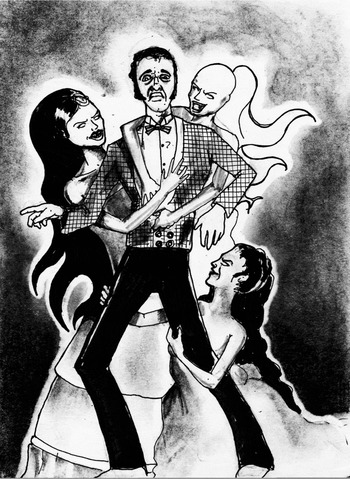
I lay quiet, looking under my eyelashes in an agony of delightful anticipation. The fair girl advanced and bent over me till I could feel the movement of her breath upon me . . . I was afraid to raise my eyelids, but looked out and saw perfectly under the lashes. The girl went on her knees, and bent over me simply gloating. There was a deliberate voluptuousness which was both thrilling and repulsive, and as she arched her neck she actually licked her lips like an animal . . . I closed my eyes in a languorous ecstasy and waited — waited with beating heart. (Stoker 45; ch. 3)
This carnal gesture of the “fair” vampire makes Jonathan feel both “honey-sweet” pleasure, and “bitter offensiveness, as one smells in blood” (Stoker 45; ch. 3). Although he declares this erotic act of the vampire to be “offensive,” he cannot, however, help revealing that he, in fact, is yearning for the perverse “oral” sexual act which is different from the accepted, orthodox type (Figure 11).
“Harker Mesmerized by the She-vampires.” Illustration by Barış Emre Alkım.

Similarly, Mina recounts her “oral” experience with Dracula, saying
he pulled open his shirt, and with his long sharp nails opened a vein in his breast. When the blood began to spurt out, he took my hands in one of his holding them tight, and with the other seized my neck and pressed my mouth to the wound, so that I must either suffocate or swallow some to the . . . Oh, my God! My God! What have I done? . . . I was bewildered, and, strangely enough, I did not want to hinder him. (Stoker 347; ch. 21)
Mina's and Jonathan's shock at being unable to stop the vampires is quite normal because for the first time they have experienced something new (but also archetypal) in sex with respect to their qualia. The she-vampires’ bending over Jonathan and kissing him with red lips while Jonathan is “looking under [his] eyelashes,” and Dracula's act of “pressing [Mina's] mouth to the wound” suggest oral sex, and for the people of Victorian decorum such a deed is abominable. Yet, neither Jonathan nor Mina want to hinder themselves from committing this act. Hence, the overt anomaly Dracula and his vampires demonstrate becomes a trap to hunt the bourgeois types who are predisposed to conceal from others their furtive, sinful desires. By bestowing on the bourgeois characters a new, yet archaic, medieval but pagan sexual identity that is completely different from the “modern,” insincere Victorian make-up, Dracula gives them the chance to assume individuality.
Although, in the novel, Dracula represents the medieval codes of loyalty and chivalry, he has no connection with religion or religious institutions. Hence, he does not fit the stereotypical definition of the ideal or archetypal lord of the Middle Ages, a time when “feudal aristocracy found itself obliged . . . to have recourse to the Catholic clergy, with whom it had close economic, religious, and family bonds, to legitimate the feudal regimen” (Maduro 56). On the contrary, he acts like a pagan, and the presence of Gypsies in the novel (the wild, nomadic people of Indian origin), who are the only allies of Dracula, is for the purpose of attributing heathenness to the Count. The collaboration between Dracula and these Romani people suggests the origins of his vampirism as well as his necromantic, non-religious position in the novel. Moreover, both Count Dracula and the Gypsies are the discarded and avoided people of the land.
Historically, during the reign of Vlad III in Wallachia,
Gypsies [had already] entered central Europe . . . Like the Jews, the Gypsies suffered appalling persecution for racial-religious reasons. In 1370, forty Gypsy families in Wallachia, Romania, were taken prisoners and given as slaves to the monastery of St Anthony at Voditza . . . it was a capital offence to be a Gypsy in England . . . Signs were erected on the roads into Bohemia, showing Gypsies tortured and hanged, with the slogan, Straff die Heiden (“Punish the Pagans”). In Holland, Gypsies were also called Heiden, and Heidenjachten (Pagan-hunts) were instituted to exterminate them. (Jones and Pennick 197–98)
Mentioned at the beginning and towards the end of the novel, these discarded people, however, are depicted as the caricatures of turpitude and cowardice. They have sided with the Count to serve his “villainy,” but they immediately leave him upon his death. As Van Helsing explains, “The gypsies, taking us as in some way the cause of the extraordinary disappearance of the dead man, turned, without a word, and rode away as if for their lives” (Stoker 453; ch. 27).
Van Helsing and his band, assuming the roles of “witch hunters [who] translated the ancient practices into Christian imagery of Satan and Evil” (Lundskow 83), find the tombs of the three voluptuous vampires in Dracula's castle. The professor kills them all despite their bodily appeal: mesmerised with the fleshly beauty of the she-vampires, he describes their attractiveness saying,
There were before me in actual flesh the same three women that Jonathan saw in the room . . . I knew the swaying round forms, the bright hard eyes, the white teeth, the ruddy colour, the voluptuous lips . . . so exquisitely voluptuous that the very instinct in me, which calls some of my sex to love and protect one of hers, made my head whirl with new emotion. (Stoker 444–45; ch. 27)
Standing as the archetypes of “beauty and excellence in the manifest world [in contrast to] the Christian contempt for the flesh” (Jones and Pennick 201), these women are described as representing the ideal corporal female magnificence. Hence, Dracula has built his kingdom on flesh and blood and on female beauty and sexuality as opposed to the male dominated, impotently ethereal core of the Christian creed. If the pagan concepts of beauty and womanhood are compared with those of the Victorians, pagan ideals appear to be more humane than the restricting, unsympathetic Christian bourgeois doctrines.
Indeed, “pagan ideas of womanhood stand in vibrant contrast to typical western images” (Tosh and Keenan 309) of the female, and neither “in the worlds of medieval Islam and Christianity, did women have the kind of sexual freedom men enjoyed. The fact that women might need sex did not mean they were allowed to have it” (Allen 13). Unlike the quintessential Christian (and also Victorian) idea of woman as the “angel in the house,” the archetypal depiction which aimed to suppress female sexual activity, the woman of the pagan world enjoyed more freedom in demonstrating sexual behaviour. In contrast to pagan understandings of sexuality, Christian and Islamic cultures saw female sexuality as a problem, and the physicians of these civilisations tried to find cures for this “problem” by using “herbs, medicinal diets, fumigations . . . and blood-lettings” (Allen 14) to soothe the sex instinct in the female. Using such methods, female sexuality was taken under control in the “holy” empires as opposed to the understanding of sexuality in pagan times.
In the castle of Dracula, however, the female vampires enjoy absolute freedom in expressing their sexuality. Not bound to any religious doctrine or any male domination there, they assert their bodily urges as did pagan women. Upon Mina and Van Helsing's arrival at castle Dracula (they are the first to reach the castle after the splitting up of the group into two in order to chase the vampire), they try to win Mina over to their side. As Van Helsing observes, “They smiled over at poor dear Madam Mina. And as their laugh came through the silence of the night, they twined their arms and pointed to her, and said in those so sweet tingling tones that Jonathan said were of the intolerable sweetness of the water glasses, ‘Come, sister. Come to us. Come!’” (Stoker 441; ch. 27). Moreover, Dracula's letting his blood be sucked by the Victorian ladies can be read as the opposite of the medieval “letting-blood” practise of the physicians and as having the purpose of bestowing on those women sexual passion. Accordingly, his sucking the blood of those ladies can be interpreted as the liberating act of the vampire: letting them have orgasm.
The sexual freedom the pagan Dracula and the female vampires enjoy is in direct contrast with the Victorians’ secretive attitude towards sexual intercourse. According to Foucault, in the Victorian Period, “sexuality was carefully confined; it moved into the home. The conjugal family took custody of it and absorbed it into the serious function of reproduction. On the subject of sex, silence became the rule . . . the rest had only to remain vague; proper demeanour avoided contact with other bodies” (3). In such a paradigm, bourgeois culture reshaped the concept of sexuality by finding out new ways to hinder women from this act. For Foucault, “at the beginning of seventeenth century a certain frankness was still common . . . [sexuality] had little need of secrecy . . . [and] codes regulating the coarse, the obscene and the indecent were quite lax compared to those of the nineteenth century” (3). With the rise of the Victorian bourgeoisie, however, sexuality was confined with the normative male and female sexual roles in marriage. Furthermore, “the body was at a discount; ‘repression’ and the new bourgeois world orders seemed to fit very comfortably together” (Lacqueur 103).
Count Dracula, used by Stoker as an “anthropomorphic archetype” (Jung, Archetypes 66) in the novel, is an attractive figure on account of the duality in his sexual identity. His mouth suggesting bisexuality (with his canine teeth and red lips), he transgresses the boundaries of male and female sexes; “luring at first with an inviting orifice, a promise of red softness, but delivering instead a piercing bone, the vampire mouth fuses and confuses . . . the gender-based categories of the penetrating and the receptive” (Craft 193). In other words, Dracula has both the male and female sexual organs which make the vampire assume the characteristics of a deity of sexuality. And, having the signs of both sexes, “he” is able to reach the men and the women of the rigidly defined and supposedly unchallengeable bourgeois decorum: the vampire is capable of stealing stealthily into the bourgeois culture founded by the fabricated set of norms and rules and protected by the same bourgeois criteria. To destroy the “normalcy” of this culture, the vampire bites and sucks, penetrates and takes in respectively.
V. Conclusion
Consequently, Count Dracula the vampire, as Stoker suggests, is the embodiment of the surreptitious Dionysian tendencies in the decaying Apollonian culture of the late Victorian age. Created at the turn of the century when “all the laws that governed sexual identity and behaviour seemed to be breaking down, [when] gender and country were put in doubt” (Fraser, Johnston and Green 187) and when “there [was] certainly increased open hostility to non-productive sexuality — masturbation and homosexuality” (Lacqueur 109), the vampire emerged as the epitome of all the discarded, repressed phenomena in history and human nature. The vampire is a medieval rebel of intermediate sex, the apotheosis of the interaction between primordial instincts in man and violence in history. Hence, in fin-de-siècle Britain, Dracula is barbarism at the gates triggering the repressed atavism to give way to its perverse eruption and thereby sexual anarchy.
Stoker, of course, was not alone in what today can be termed the “Foucauldian obsession with the discussion of sexuality.” There were other novelists, poets, painters, translators, social activists and artists searching for, by means of hovering the carnal shadow of the past over the present, the atavistic core of man. A. C. Swinburne, D. G. Rossetti, and W. Morris, the romantic medievalists of the late Victorian period and contemporaries of Stoker, had already expressed this atavism in visual arts and literature by harking back to a faux-medieval wonderland. Additionally, R. L. Stevenson's concern with medieval romances, alchemy, and bodily transformations; H. R. Haggard's exotic stories about the intersections among race, gender and sexuality; and George Egerton's radical feminist unveiling of female sexuality through androgynous heroines all demonstrated the strong tendency, during the paradigm shift and after, towards the carnal reality of man. These nonconformist artists would be joined, in the forthcoming decades, by the modernists like D. H. Lawrence, H. Miller, L. Durrell, et al., who would, like their predecessors, “idealize sin, romanticize illicit love, or glorify the mystique of sex” (Glicksberg 74) in order to challenge the conservative sexual politics of their times.
Influenced by the escapist artists of the late period who depicted for the Victorians a medieval utopia where lived a chivalrous race with their tolerance for the bizarre, Stoker, in a fashion similar to those of the revivalists, exalts the past over the present. However, unlike those dissenters, he also borrows, and borrows largely from a former literary genre, the gothic, which has interpreted the past as an uncanny land haunting the present. Accordingly, Stoker follows this cliché gothic scheme in Dracula but with a distinction: he depicts the past not as the irrational foreign country of passionate villains, but as the illuminating, the transforming other that the present paradigm needs to unite with. Hence, he replaces the insatiable villain of gothic works, who finally becomes the victim of his blind passion, with the rebellious historical figure from the fifteenth century who is made a genderless, blood sucking vampire planning to sexually revolutionize the empire. By dramatically juxtaposing Count Dracula's primordial sexual freedom with the institutionalised gender relationships and sexual restrictions of bourgeoisie, Stoker reveals the deficient perception of human nature and sexuality in the late period, and offers, through the metaphoric act of the vampiric penetration into the Victorians, an interaction between past and present paradigms. For Stoker, the vampire cannot be labelled guilty for his exchange of blood with the “poor” victims. On the contrary, the ones “trapped” by Dracula acquire a freedom beyond their gender and sexual boundaries because the vampire triggers the repressed other in both man and woman and, consequently, makes the deep rooted, uncanny life force (or sexuality) in each individual erupt. By making the repressed and forbidden blatant through the genderless vampire attacking the stereotypes of the empire, Stoker, in fact, strips off the glamorous façade of Victorianism and shows what is hidden beneath: a rationally categorized, gendered, yet “sexless,” being unable to comprehend his or her existence — the type of “individual” the utilitarian system perpetually creates and relies upon for its existence and survival.
A symbolic figure signifying unrestrained sexual indulgences, Dracula is freedom personified, releasing the repressed Victorians from their restrictive ethical bondages by way of bestowing on them the bodily freedom of the discarded past. This idolater of sterile, gendered sexuality is the hostile other of the fin de siècle, suggesting also the surreptitious coexistence of divergent powers in the “decent” bourgeois Weltanschauung. Yet, Stoker knows that the vampire is fighting against a well-equipped empire; against an invincible enemy. Although Dracula tries to spread his “vampirism” by biting, sucking, and making himself sucked in order to conquer the stereotypes of the system, his final defeat indicates the indestructability of the repressive and sexist bourgeois ethos. Finally, Stoker's Dracula, the culmination of ethical radicalism in the fin de siècle, still survives as an archetype for the release of the repressed, signifying the fleshly and the uncanny and the lost bodily freedom of man.