Throughout the 2016 U.S. presidential election, media outlets published myriad news stories about how the first woman to earn the presidential nomination of a major party inspired young girls across the nation to think about their own potential as political candidates (e.g., Itkowitz Reference Itkowitz2016). Although heartwarming, these stories tap into the underlying reality that men hold most political leadership positions in the United States and throughout the rest of the world. Women face many barriers from parties, voters, and donors when seeking political office (Bauer Reference Bauer2015; Crowder-Meyer and Cooperman Reference Crowder-Meyer and Cooperman2018), and there is a persistent gap between women and men in political ambition (Lawless and Fox Reference Lawless and Fox2010; Preece and Stoddard Reference Preece and Stoddard2015; Shames Reference Shames2015). The lack of female role models may also dampen the political engagement of young women and girls (Campbell and Wolbrecht Reference Campbell and Wolbrecht2006; Greenlee, Holman, and VanSickle-Ward Reference Greenlee, Holman and VanSickle-Ward2014; Preece Reference Preece2016).
Gender differences in political outlooks emerge in childhood and adolescence, when youngsters begin to receive political messages (Fridkin and Kenney Reference Fridkin and Kenney2007; Lay Reference Lay2017; Oxley Reference Oxley, Bos and Schneider2017). Children learn about appropriate roles for women and men from a wide variety of sources, including children's literature, news coverage, and popular culture (Diekman and Murnen Reference Diekman and Murnen2004; Murnen et al. Reference Murnen, Greenfield, Younger and Boyd2016). From Valentine's Day cards and video games to books and television programming, young people are routinely exposed to fewer examples of women leaders (Diekman and Murnen Reference Diekman and Murnen2004; McDonald Reference McDonald2009). Though the number of women and the amount of material about them in history books has increased over time (Clark, Allard, and Mahoney Reference Clark, Allard and Mahoney2004), women remain less prevalent than men in many school materials. And, while research indicates that mainstream newspapers cover men and women running for Congress in similar ways (Hayes and Lawless Reference Hayes and Lawless2015; but see Aaldering and Pas Reference Aaldering and Van Der Pas2018), we know far less about the types of coverage in other media sources. Given what we know about the importance of role models, underrepresentation of women in political content aimed at children can have long-term consequences for who participates in politics and who considers themselves an eligible candidate for political office. Thus, we aim to address this lack of knowledge about the level of women's representation in political material aimed at children.
We begin to fill this gap by examining all political content across six years of weekly publications of the popular children's magazine TIME for Kids, a widely used teaching tool in elementary classrooms across the United States. We start by testing whether women are underrepresented as political leaders compared with men and relative to the actual proportion of women political leaders in the world. We find that while women are underrepresented compared with their representation in the population, women leaders appear more frequently than women's representation in politics. These findings suggest that children are exposed to women political leaders through the social science curriculum.
But how are these women (and men) depicted? We know that many sources encountered by children perpetuate masculine gender roles for boys and feminine roles for girls (Diekman and Murnen Reference Diekman and Murnen2004; McDonald Reference McDonald2009) and that such gender-stereotypic portrayals shape children's views of gender roles in other subject areas (Ashton Reference Ashton1983; Scott Reference Scott1981). The “hidden curriculum” (Jackson Reference Jackson1968) contained in “unarticulated but powerful messages” (Cassese, Bos, and Schneider Reference Cassese, Bos and Schneider2014, 254) in curricular content can reinforce that girls should act like girls and boys like boys. Because early messages can shape children's thinking, it is critical to examine how political leaders, particularly women, are presented to children. Politics has long been considered a masculine domain, which can work to women's disadvantage if they are not considered masculine enough for the political world (Duerst-Lahti and Kelly Reference Duerst-Lahti and Kelly1995).
Coding the traits associated with the political leaders depicted in the TIME for Kids stories uncovers that women leaders, particularly when they are the focus of a story, are more likely to be described as having communal and feminine traits. Our results build on research on the persistence of gender stereotypes in society (Barnes and Beaulieu Reference Barnes and Beaulieu2014; Bauer Reference Bauer2015; Cassese and Holman Reference Cassese and Holman2018), the role of political socialization in the formation of attitudes and views of the world (Campbell and Wolbrecht Reference Campbell and Wolbrecht2006; Pacheco and Kreitzer Reference Pacheco and Kreitzer2016), and the importance of considering what messages people receive about political belonging.
SOCIALIZATION AND GENDER STEREOTYPES
Gender role socialization leads to the development of expectations about what constitutes appropriate behavior for men and for women (Eagly, Wood, and Diekman Reference Eagly, Wood, Diekman, Eckes and Trautner2000). Children receive messages that define the appropriate social roles women play in society from many agents of socialization during their earliest days and develop schemata about gender-appropriate behaviors and attitudes (Bem Reference Bem1978; Martin, Wood, and Little Reference Martin, Wood and Little1990). Social learning theory suggests that children learn and adopt social roles, including gender roles, by modeling their parents, teachers, and others, as well as by observing images in the media (Bandura Reference Bandura1977).
Internal and external rewards and punishments encourage women and girls to exhibit communal and feminine traits. Alternatively, men and boys are encouraged to demonstrate agentic and masculine traits. Feminine stereotypes portray women and girls as weak, passive, nurturing, indecisive, emotional, and irrational, while men and boys are thought of as strong, independent, assertive, competent, and aggressive (Eagly, Wood, and Diekman Reference Eagly, Wood, Diekman, Eckes and Trautner2000). Women are also more likely than men to adopt communal attributes, such as caring and nurturing, while men are more likely to adopt agentic attributes, such as competitiveness and independence (Eagly, Wood, and Diekman Reference Eagly, Wood, Diekman, Eckes and Trautner2000). The stereotypic traits associated with leadership overlap considerably with the traits associated with men, such that it is nearly automatic that people link men with politics (Eagly, Wood, and Diekman Reference Eagly, Wood, Diekman, Eckes and Trautner2000). As a result, women and girls tend to be more interested in communal civic activities, such as volunteering and activism, than in competitive elections and arguments about politics (Brinkman Reference Brinkman, Bos and Schneider2016; Diekman et al. Reference Diekman, Clark, Johnston, Brown and Steinberg2011). Further, women running for or holding political office may be punished if they do not engage in behavior that is consistent with their gendered social role (Cassese and Holman Reference Cassese and Holman2018).
Given the significance that society places on gender as a social category, Bigler and Liben argue that children “internalize the stereotypic beliefs explicitly communicated in their environment” (Reference Bigler and Liben2007, 166). Furthermore, ideas about gender roles and appropriate behaviors develop and are maintained with help from repeated exposure to stereotypical information in the media and in children's lives. For example, cues toward traditional feminine stereotypes and sexually submissive roles are prominent in girls’ Halloween costumes, Valentine's Day cards, and dolls and action figures (Murnen et al. Reference Murnen, Greenfield, Younger and Boyd2016). Children's media often portray women in stereotypically female occupations or as not working outside the home (McDonald Reference McDonald2009). Even children's books without explicitly sexist content still portray female-stereotypic personality traits (Diekman and Murnen Reference Diekman and Murnen2004).
Studies of children's literature show that gender-stereotypic portrayals of behavior increase children's beliefs about traditional gender roles, reinforcing beliefs about gender roles and consistent behaviors (Ashton Reference Ashton1983). If media portrayals of politics disseminated to children emphasize women as feminine and politics as masculine, girls may not develop a sense of political interest or agency. In short, it may be difficult for girls to see themselves occupying political leader roles or for boys to see girls and women as potential political leaders.
PRESENCE AND PORTRAYAL OF WOMEN IN CURRICULAR MATERIALS
Curricular materials used in schools provide another source of information about gender roles and stereotypes. Textbooks and other school materials shape students’ identities and attitudes toward others through the inclusion or exclusion of content (Freire Reference Freire1970). Pre-1980s studies of textbooks show significant underrepresentation of women and girls as main characters (Britton and Lumpkin Reference Britton and Lumpkin1977). Science textbooks are more likely to picture men (Rosser and Potter Reference Rosser, Potter and Rosser1990), and history books emphasize military and early political history—areas in which fewer women have participated (Cassese, Bos, and Schneider Reference Cassese, Bos and Schneider2014). The “malestream” curriculum emphasizes contributions of white upper-class men in American politics (Schocker and Woyshner Reference Schocker and Woyshner2013). Therefore, students are likely to see the inequality between women and men as normal, an “imbalance [that] grants legitimacy to the way our society is organized and helps to reinforce patriarchal rules which come to be perceived as common-sense rules” (Tetreault Reference Tetreault1986, 250).
Students with marginalized identities incorporate implicit gendered and racialized messages into their self-image and passively conform to group stereotypes; in this case, politics is a “man's game” (Nelkin Reference Nelkin1995). Alternatively, counterstereotypic examples can have a positive impact on gender socialization: more gender-equitable materials are associated with more flexible sex-role attitudes (Schau and Scott Reference Schau and Scott1984). Similarly, students exposed to information about women in leadership positions are less likely to hold gender-stereotypic beliefs (Dasgupta and Asgari Reference Dasgupta and Asgari2004). Bigler and Liben find that “teaching children directly about nonsexist criteria for determining who can do various activities and occupations, rather than simply … presenting counterstereotypic examples” can reduce sex-stereotypic dispositions (Reference Bigler and Liben1990, 1448). In politics, women and girls are more engaged and interested in politics when women are on the ballot or hold elected office and other leadership positions (Campbell and Wolbrecht Reference Campbell and Wolbrecht2007). Seeing women holding important political leadership positions, whether in educational materials or in “real life,” can inspire women and teach all students that individuals of any gender can succeed as leaders (Greenlee, Holman, and VanSickle-Ward Reference Greenlee, Holman and VanSickle-Ward2014; Rios, Stewart, and Winter Reference Rios, Stewart and Winter2010).
While the portrayal of men and women in children's social studies materials remains an open question, scholars have engaged in a robust inquiry as to how (adult) newspapers cover men and women in politics. Like studies of children's curricula, early evaluations of mainstream media coverage of men and women running for office found that women received less coverage (Kahn and Goldenberg Reference Kahn and Goldenberg1991) and were more likely to be covered around “hair, hemlines, and husbands” (Heldman, Carroll, and Olson Reference Heldman, Carroll and Olson2005). Recent studies of women and men running for Congress, however, find little evidence of systematic gender biases in media coverage (Hayes and Lawless Reference Hayes and Lawless2015; but see Aaldering and Pas Reference Aaldering and Van Der Pas2018; Conroy Reference Conroy2018). Our research provides an opportunity to examine how children's news magazines—a very different type of media with a different and important audience—might conform to or depart from findings regarding adult news coverage.
HYPOTHESES AND APPROACH
To examine the representation of women and men in social studies curriculum, this research analyzes TIME for Kids magazine for gendered messages that reinforce the stereotype that politics is a masculine field. TIME for Kids magazines are nonpartisan news sources designed to support classroom curriculum and inspire kids to “join the national discourse on current topics.” TIME for Kids has the third-highest circulation of any children's magazine in the United States, with subscriptions annually in 60,000 classrooms, which translates into 1.4 million students reading TIME for Kids in the 2018–19 school year.
Focusing on news literacy and critical thinking, TIME for Kids provides teachers and schools with lesson plans, worksheets, and assessment tools. TIME for Kids has also responded to the No Child Left Behind Act and Common Core standards by corresponding grade-level content to Common Core state standards. For example, in the 2018–19 school year, the grade 1–2 edition of TIME for Kids contained material to address the standards of the National Council of Social Studies in 11 of 28 issues. Kindergarten to sixth-grade teachers receive lesson plans for each TIME for Kids issue that benchmark the material in that week's issue against specific language arts and social studies Common Core standards. These efforts by TIME for Kids and the usefulness for teachers seeking to meet Common Core and other national standards suggest that the resource can be easily used in classrooms. In addition, TIME for Kids is not free; the magazine costs a minimum of $4.95 per student per year. Given resource constraints in school systems across the United States, that so many schools and teachers pay for the resource suggests its widespread use.
In this section, we describe our approach to coding the TIME for Kids material alongside our expectations for what we will find in that coded content. Our analysis focuses on all TIME for Kids material related to political leaders and the relationships between gender and the content. We began by reading every article in the grade 1–2 and grade 5–6 editions of the magazine for six years, from January 2011 to December 2017.Footnote 1 This period covers two presidential elections and several important national and international events. By selecting the entire population of articles during this period, rather than a sample, we are confident the analysis accurately captures the magazine's political content.
We selected every article for analysis that mentioned any public officer, including president, congressman/woman, or any other elected official, as well as all discussions of political leaders, political events, or historical figures involved in political causes, laws, national monuments, students engaging in political activities, or any information related to domestic or international politics. Four undergraduate students from three universities conducted the coding of the content of the articles. We then randomly selected 15% of the articles to be recoded by a second coder; responses were compared for reliability (see the supplementary material online for more information on the data collection, coding, and evaluation processes).
Political Leaders in the Text
Given that women are underrepresented in politics at every level of government in the United States and in most other countries and that news stories and curricular materials from the media are likely to reflect this underrepresentation, we expect women to make up the minority (less than 50%) of political leaders discussed in articles in magazines designed for elementary-aged children, such as TIME for Kids (H 1a).
It is unclear, however, whether women will be underrepresented in these publications relative to their percentage in actual political leadership roles (H 1b). There is also some evidence that curricular materials are changing. A recent study of Highlights children's magazine finds that although men are more likely to be discussed in science articles, women appear more often than would be expected given their representation in the field (Previs Reference Previs2016). An update of studies from the 1980s suggests that children's books are more equitable in their treatment of women and men than previous studies found (Gooden and Gooden Reference Gooden and Gooden2001). These changes suggest that children's media may work to ensure more equitable portrayals of men and women in their content.
To start our evaluation, coders assessed whether any political leaders were featured in the text of each article.Footnote 2 For each leader, we coded the leaders’ gender and their role in politics. To capture the portrayal of politics through visual imagery, we also coded the gender of political leaders represented in photos and captions.Footnote 3 Overall, we coded 233 total TIME for Kids articles, 91 articles from the grade 1–2 edition and 142 articles from the grade 5–6 edition. Just over half of the total focused on substantive political or issue content within the story, while the remainder (45%) focused on a political leader. Most articles (57.8%) focused on domestic politics. The unit of analysis for this material is the leader: each political leader in the article was coded separately; that is, if an article discussed both Donald Trump and Hillary Clinton, we coded the depiction of each leader separately. This results in a higher number of leaders than articles; across the 233 articles, 453 individual leaders were mentioned in the text and 207 individuals in photos.
Stereotypic Traits
It is not only whether women are portrayed that matters but also how they are portrayed. Older studies of textbooks show fewer depictions of women in occupational roles and negative portrayals of stereotypically feminine characteristics (Britton and Lumpkin Reference Britton and Lumpkin1977). Children's books tend to depict women as passive and dependent, while men are leaders, independent and active (Oskamp, Kaufman, and Wolterbeek Reference Oskamp, Kaufman and Wolterbeek1996). Both communal/agentic and feminine/masculine traits are established in the social roles literature as deeply linked to internal and external expectations, benefits, and punishments that both genders experience (Eagly, Wood, and Diekman Reference Eagly, Wood, Diekman, Eckes and Trautner2000). We expect that women and men will be portrayed primarily as having their respective gender-stereotypic traits (H 2).
We examine two sets of common traits: communal versus agentic and masculine versus feminine. More specifically, we coded whether the text of the TIME for Kids articles and the photographs and their captions depicted the political leaders as possessing any of these latent traits. As Diekman and Murnen note, “One of the most frequently explored aspects of sexism in children's literature is the stereotypic portrayal of characters’ personalities” (Diekman and Murnen Reference Diekman and Murnen2004, 374).
We start with communal and agentic traits, which, based on social role theory, form the foundation of expectations of political behavior of men and women (Eagly, Wood, and Diekman Reference Eagly, Wood, Diekman, Eckes and Trautner2000). We use communal and agentic classification schemes that have been tested and evaluated extensively in the psychology and political science scholarship (Bakir and Palan Reference Bakir and Palan2013; Diekman et al. Reference Diekman, Clark, Johnston, Brown and Steinberg2011; Diekman and Steinberg Reference Diekman and Steinberg2013; Schneider and Bos Reference Schneider and Bos2014; Schneider et al. Reference Schneider, Holman, Diekman and McAndrew2016). Communal traits denote that the leader is described as having traits associated with communal leadership, including helps others, cares for others, and works with people. Agentic traits denote that the leader is ascribed any of the following traits: seeks power, demonstrates competence, and seeks recognition.
We also capture a larger set of feminine and masculine traits; these form the foundation of expectations of behavior in and out of politics for men and women. Like Diekman and Murnen (Reference Diekman and Murnen2004), we use feminine and masculine gender-stereotypic personality characteristics (Bem Reference Bem1978). Feminine traits include the following: affectionate, cheerful, compassionate, gets things done, hardworking, honest, moral, compromises, emotional, family oriented, sensitive, talkative, trustworthy, warm, works well with others, and possesses interpersonal skills. Masculine traits include assertive, ambitious, articulate, rational, confident, leader, knowledgeable, tough, effective, competent, dynamic, ambitious, strong, forceful, can handle a crisis, and decisive.
We find evidence of construct validity in our measures (see Table A1 in the supplementary material), with low levels of correlation between agentic and communal or feminine and masculine measures and high levels of correlation between communal and feminine measures for both the appearance of the traits in the text and in photographs. Given the high level of internal cohesion of the measures and the low level of correlation between the measures, we are confident that there is both convergent validity and discriminant validity (Neuendorf Reference Neuendorf2011, 282).
Examples of the coding structure demonstrate the process. To start, in an article in the grade 1–2 edition about a woman who started a camp to train kids “who want to learn about government,” the woman was described as “caring” about others; this article was coded as featuring a woman leader and that woman leader as possessing both communal (cares for others) and feminine traits (interpersonal traits). Another article in the grade 5–6 edition focused on Theresa May “Bracing for Brexit.” The article quoted the former prime minister as saying that it is her job to lead the country to get the “right deal for Britain.” We coded this article as featuring agentic traits (seeks power, demonstrates competence), masculine traits (can handle a crisis, confident), and feminine traits (gets things done). Photos were similarly coded; in an article about a Girl Scout troop's effort to erect a statue of a real woman in Central Park, we coded a sidebar with a stone-faced photo of Elizabeth Cady Stanton and Susan B. Anthony (captioned with “These women fought for women's rights)” with masculine traits of forceful and tough. On the same page, the Girl Scout troop appeared in a photo, smiling and holding signs. The troop was described as being interested in making “a change in their community” and “working together”; thus, we coded for both communal (helps others) and feminine (gets things done, works well with others) traits.
Age and Socialization
Children's attitudes about gender roles often depend on their age. Preschool children, for example, tend to hold rigid stereotypes about what is appropriate for boys and girls (Drabman et al. Reference Drabman, Robertson, Patterson, Jarvie, Hammer and Cordua1981). Some studies suggest these attitudes become more flexible as kids enter middle childhood (ages 8–10) (Trautner Reference Trautner1992) and that girls have more flexible gender role attitudes than boys regardless of age (Henshaw, Kelly, and Gratton Reference Henshaw, Kelly and Gratton1992). Other research, however, shows that as knowledge of stereotypes increases with age, older children make more extreme stereotypic judgments than younger children (Martin, Wood, and Little Reference Martin, Wood and Little1990), and girls lose interest in some stereotypically male interests, such as science (Carli et al. Reference Carli, Alawa, Lee, Zhao and Kim2016; Rosser and Potter Reference Rosser, Potter and Rosser1990; Steinke Reference Steinke2005). We expect that curricular materials will differ for younger and middle-age children, but the direction of the effects is unclear (H 3).
Portrayal of Women as “Firsts”
Finally, if the article discussed a woman leader, we noted whether the article discussed her as the “first” woman to run for or hold a political position. Given that women have historically been underrepresented in political office, their presence is often marked by or celebrated as a “first” for women. The “first” depiction of women is important because such portrayals exaggerate the idea that women's success in politics is atypical and reduce female leaders’ perceived credibility (Carlin and Winfrey Reference Carlin and Winfrey2009), just as singling out “women scientists” denotes something out of the ordinary for both women and scientists (Nelkin Reference Nelkin1995). We expect that women political leaders will often be highlighted as the “first” in their role (H 4). Research shows that being the only member of one's race or gender in certain settings can be detrimental to performance (Thompson and Sekapuaptewa Reference Thompson and Sekapuaptewa2002).
RESULTS
We begin our analysis by focusing on the characteristics of individuals discussed in the politically focused TIME for Kids articles. Who is discussed in these articles—and how are they discussed? In our evaluation, we differentiate between leaders who are the focus of the article and those who appear in the article but are not the primary focus or who appear in photos. Less than half (42.4%) of all articles feature a woman as the main focus.
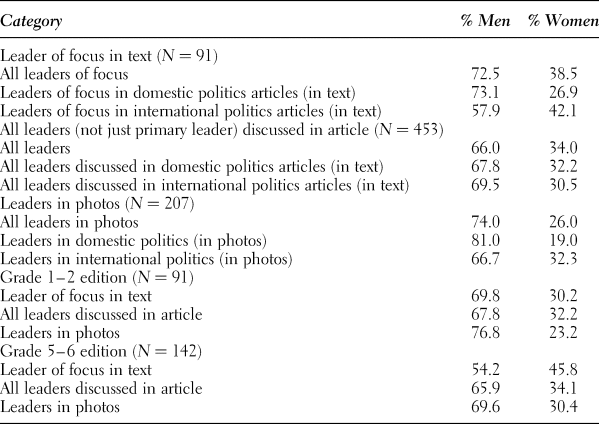
The evidence is consistent with our expectation (H 1a): women are underrepresented in TIME for Kids articles compared with women's representation in the general population. However, women leaders appear more often in these articles compared with their actual representation in the political world (H 1b). Table 1 provides the gender of leaders discussed in the articles and in photos and captions. Of the featured leaders, nearly 39% focus on women leaders, reflecting a level higher than women's representation in elected office worldwide or in the United States. Women hold 20% of congressional seats in the United States and about 22% of legislative seats across 192 nations (IPU 2018). Of the 207 individuals in photos, 26% are women.
Descriptive characteristics of leaders in articles

Notes: Data from coding 233 TIME for Kids articles. Table contains information on leaders discussed as main focus in text, any leader mentioned in text, and leaders in photos of articles. Articles focusing on both international and national politics or in which the level of country is unclear are less likely to feature women.
Trait Applications
In terms of traits, TIME for Kids attributed at least one stereotypically communal trait to 28% and at least one agentic trait to 8.5% of all individuals mentioned in the articles. The most common communal trait was helping others, while demonstrating competence was the most common agentic trait. When we look at the broader category of masculine and feminine traits, most texts applied one or more of these traits. More than half of the articles (58%) include an application of feminine traits, while 69% apply a masculine trait to a political leader. Leaders pictured in article photos were also attributed traits: 19% of photos exhibited a feminine trait, while 18% exhibited a masculine trait.
Gender * Trait Application
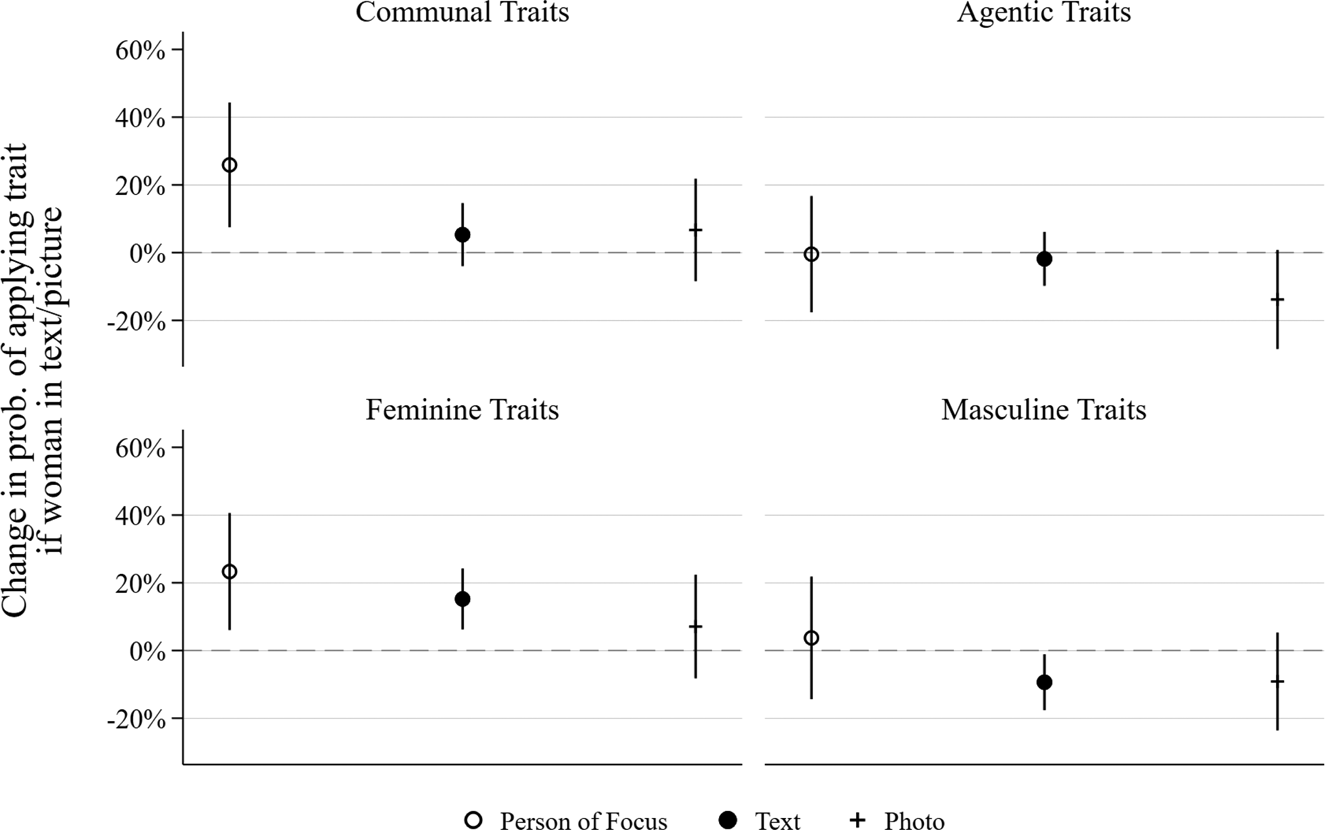
To examine which traits were more likely to be applied to men or women, we use a logistic regression model to evaluate the probability that any particular leader had a trait applied to them, using the leader's gender, the publication year, the classroom edition, and whether the article focused on domestic or international affairs as control variables. Starting with the narrower set of communal and agentic traits and then the broader set of feminine and masculine traits, we examine whether the trait was applied to someone who appeared to be the focus of the article, simply appeared in the article's text, or was featured in a photograph in the article. The substantive effect (calculated post-estimate using the margins command, keeping other variables at their means) of a having woman in an article is presented visually from each model in Figure 1. Male leader is the baseline category, representing zero in the figures. We first discuss communal and agentic trait applications (the top panel of Figure 1) and then feminine and masculine traits (bottom panel). Tables A1 and A2 in the supplementary material contain the full results.
Trait applications to leaders in TIME For Kids political articles. Results from logistic regression models that include controls for year of article, classroom edition, and domestic or international focus. “Person of focus” models only include articles featuring a particular leader. “Photo” models only include articles with a photo. Dotted line at zero represents the baseline category (men) in the articles. Each dot represents the post hoc predicted probability that a communal or agentic trait will be applied to a leader in the text or photo, given the gender of that leader. Full models are available in Table A2 in the supplementary material.

Consistent with our expectations for H 2, the results show that a woman appearing as the focus of an article increases the probability that a communal trait is applied to the leader by nearly 25%, but this is not true for women in the text or in photos. At the same time, women are not more or less likely to have agentic traits applied to them, except in photographs, where women's photos are 14% less likely to have agentic traits (p < .06). These findings run counter to gendered trait differences in other topic areas. One explanation is that the agentic nature of the political office shapes the application of these traits, regardless of the gender of the leader.
We next look at the broader set of masculine and feminine traits for leaders as the article's focus, in text, or in photos, using the same approach as earlier. We find similar effects, whereby an article is more likely to contain feminine traits if it features a woman (increasing the probability by 22%) or has a woman in the text (16%). An article featuring a woman is also 14% less likely to apply masculine traits to a leader in the text if that leader is a woman.
Variations across Time, Classroom Edition, and Focus
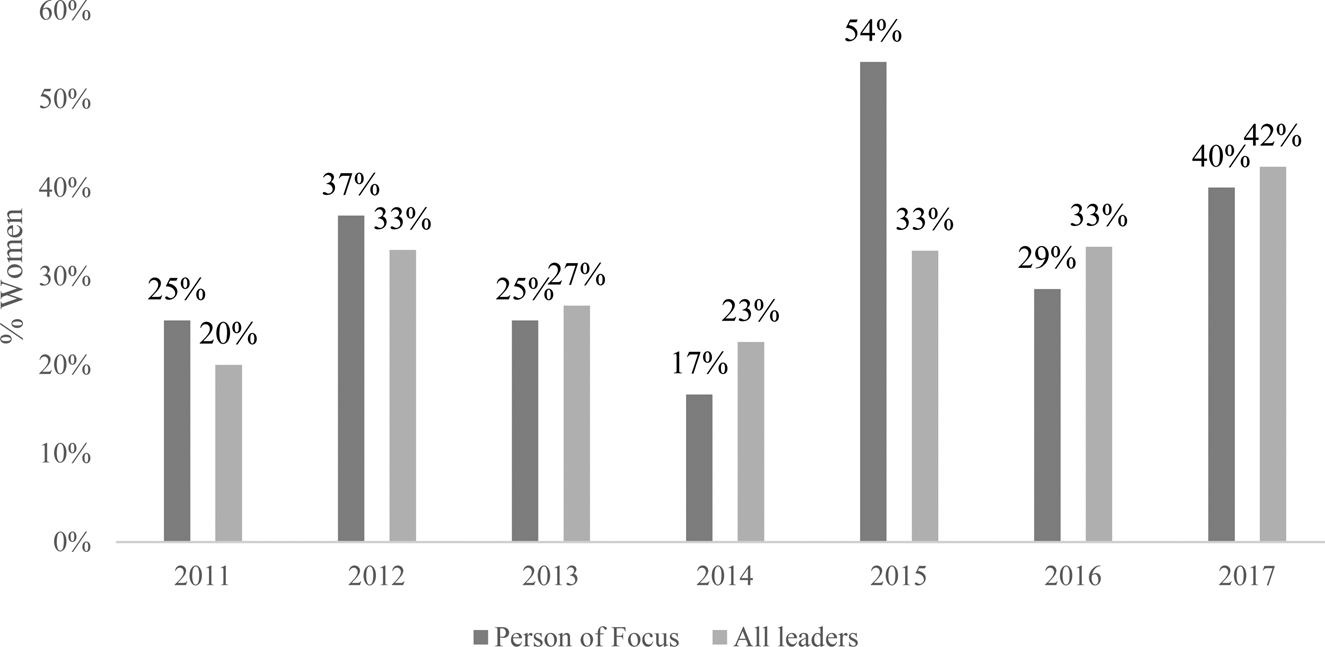
It is possible that Hillary Clinton and the 2016 campaign skew discussions of women in domestic politics in these data. We look both at articles about Clinton and at the data over time to assess whether her bid for the U.S. presidency represented a large portion of the stories involving women leaders. Clinton is either the subject of focus, mentioned in the text, or mentioned in a photo in 15 articles in the data set; this includes 1 article in 2012, 5 in 2015, 7 in 2016, and 2 in 2017. These descriptive evaluations suggest that Clinton is not the primary driver of discussions of women leaders in TIME for Kids. We then look at the data over time to evaluate whether differences emerge in election years or in 2016 that may be driving the results. The descriptive data over time are available in Figure 2, which shows an uptick in women as a share of the person of focus of the articles but few patterns up or down across the time period. The difference in the share of women in the articles, although not systematic, shows why it is important to control for the year of coverage in the other models presented.
Share of women by year of TIME for Kids editions. Data from coding 91 leaders of focus and 435 leaders in text in 233 TIME for Kids articles by year of the edition.

We then evaluate whether the overall level of women's representation across the different measures varies between the editions written for younger and older students (H 3). The difference in the number of articles (91 for the grade 1–2 edition and 142 for the grade 5–6) suggests more political content for the older students (see Table 1). When we look at the share of women leaders across the editions, we see that women are more likely to appear as the leader of focus in the older students’ edition (46%) than in the younger students’ editions (30%). Similarly, photos with women are more likely to be found in the grade 5–6 edition than in the grade 1–2 edition. Although we cannot test these data, we are concerned about the implications of these differences. In early grades, as young people first learn about politics, they see many fewer women in leadership positions; it is unclear whether the nearly equal representation that children see in the higher-grade version makes up for the disparities in the early content.
First Women
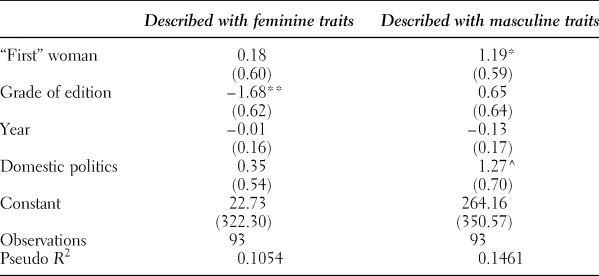
Finally, we examined whether TIME for Kids focuses on whether someone is the first woman to hold her role. These references were quite common: 31% of women were described as “the first” to hold or seek a political role or position. These include the first woman to sit on the U.S. Supreme Court, South Korea's first woman president, and the first American woman in space, all of whom are equally likely to be featured in domestic and international stories. This is consistent with our expectations in H 4: women in male-dominated spheres are often depicted as the “first” to engage in an action. We then examine the application of feminine and masculine traits to first women, finding that communal traits are not more likely to appear when a first woman is discussed in an article, but agentic traits are more likely, with the presence of a first woman increasing the probability of agentic traits appearing in the article by 16% (Table 2). This finding may suggest that the “first” women are described in ways that make their ascendency to a political position make more sense by shaping the women into more generic (i.e., masculine) leaders.
“First women” and masculine and feminine traits

Note: Results from logistic regression models include controls for year of article, classroom edition, and domestic or international focus.
CONCLUSIONS AND IMPLICATIONS
Because early childhood is a critical developmental period for the formation of gender stereotypes, the presentation of women as political leaders in school materials may have an important impact on children. In this study, we analyzed a common curricular resource used in elementary schools, TIME for Kids. Our results are mixed. As we expected, women are portrayed less commonly than men in stories about politics and across the early childhood and middle childhood editions. There are no systematic patterns across time, indicating that even the presence of Hillary Clinton as a candidate for the U.S. presidency in 2016 did not substantively change whether women are portrayed in political stories in this magazine. We also find that women are significantly more likely to be depicted in the grade 5–6 edition than in the early childhood version. On one hand, these later grades are a vital period in which children become more aware of societal gender roles; seeing that nearly half of the political leaders in the TIME for Kids stories are women may help prevent girls from losing interest in politics. On the other hand, by fifth grade, children have already been exposed to gender disparities in society and in school materials.
Despite being portrayed less often than men, women are overrepresented compared with their proportion in elected office in the United States and in the world. Nearly 40% of the articles featured a woman political leader, while women occupy only about 20% of the elected seats in the United States and around the world (although there is significant variation across countries, of course). These findings confirm Previs's Reference Previs2016 study, in which she finds that women are overrepresented in science stories compared with their rates in the profession. The two studies together may indicate that contemporary children's media have taken seriously the role they play in perpetuating stereotypes that can have a long-term impact on children's interests. These findings also correspond to Fox and Lawless's (Reference Fox and Lawless2014) work on the origins of the gender gap in ambition, in which they find that girls and boys are socialized through similar mechanisms, but simply at different rates. Increased exposure to women leaders through children's media may counteract these disparities.
Our analysis of the traits associated with political leaders moves beyond simply whether women appear in these stories. The findings here both confirm and depart from what we see in other types of media representations of women. Communal and feminine traits are more likely to be applied to political women featured in TIME for Kids stories. Scholars note the danger in reinforcing the association of women and girls with feminine stereotypes, as this may activate feminine stereotypes of women, reinforcing the gender role incongruity with the agentic nature of political office. It is possible that as children see more women leaders in their media and in real life, then they begin to associate feminine and/or communal stereotypes with politics. It is also possible that as men in public office begin to emphasize feminine traits, feminine traits may no longer be seen as in conflict with stereotypes of political leaders (Deason, Greenlee, and Langner 2015).
Finally, in almost one-third of their appearances, women political leaders are described as “firsts” to seek or hold that office. This emphasis on their novelty may communicate to girls and boys alike that women are not typical or natural political leaders and may further emphasize the masculine nature of the political world. However, masculine traits are more likely, and feminine traits are less likely, to be associated with “first” women, suggesting that although the magazine is singling the women out as unique, it is more likely to apply stereotypes with these women that emphasize their leadership characteristics. To the extent that these types of counterstereotypic representations interfere with stereotypic beliefs, then these stories may reduce gender biases.
Though we can only speculate about the implications for political socialization, we are encouraged that women represent such a substantial portion of the political leaders in TIME for Kids and that even though the magazine highlights their unique status as the “first” to hold their positions, they do so while applying the traits that are most commonly associated with effective leadership. There is much work to be done to connect these types of materials to the attitudes of children and their adult attitudes, but the first step, we believe, is to assess the contemporary landscape of how women and men are portrayed in political stories.
SUPPLEMENTARY MATERIAL
To view supplementary material for this article, please visit https://doi.org/10.1017/S1743923X19000540.
J. Celeste Lay is Associate Professor in the Department of Political Science at Tulane University: jlay@tulane.edu; Mirya R. Holman is Associate Professor in the Department of Political Science at Tulane University: mholman@tulane.edu; Angela L. Bos is Associate Professor in the Department of Political Science at the College of Wooster: abos@wooster.edu; Jill S. Greenlee is Associate Professor of Politics and Women's, Gender and Sexuality Studies at Brandeis University: greenlee@brandeis.edu; Zoe M. Oxley is Professor in the Department of Political Science at Union College: oxleyz@union.edu; Allison Buffett is a master of public health candidate in health policy and management in the Milken Institute School of Public Health at George Washington University: abuffett@tulane.edu