


1 Introduction and the phenomenon
Tigre is a Semitic language spoken in Eritrea by approximately 800,000 speakers. There is currently only one complete grammar, Raz (Reference Raz1983), which is based on the combination of Raz's collected data, an earlier short grammar (Leslau Reference Leslau1945) and data collected and documented by Littman (Reference Littmann1897, Reference Littmann1898–99, Reference Littmann1910–15). The main focus and achievement of Raz's grammar is the description of the morphology of the language. A more detailed version of the verbal morphology appears in Raz (Reference Raz1980).
All of the grammatical work mentioned above was conducted on the Mansaʕ dialect (a partial grammar of another dialect, Habab, is found in Elias Reference Elias2005). During 2012, I conducted fieldwork with a speaker of a third dialect, the Samhar dialect, data from which has never appeared in the literature, exploring the extent of the phenomena discussed in the present paper, which are only mentioned in passing in Raz's work. This paper is thus the first thorough presentation and analysis of the phenomena, and the first paper to be based to any extent on data from the Samhar dialect.
1.1 The Tigre verbal system
As in other Semitic languages, most items in Tigre are constructed by the matching of a prosodic and vocalic template and a ‘root’, i.e. a set of two or more elements, which are usually consonants. Thus a past form like [katba] ‘he wrote’ is derived through the combination of the set [k t b] and the template [QaTLa]. The elements that make up the root set are called ‘radicals’.Footnote 1
Verbs in Tigre, as in other Ethio-Semitic languages, are traditionally classified into ‘types’. As shown in (1), each type is characterised by a set of templates. For instance, Type A verbs have at least three distinct bases, with the prosody [QaT(a)La] in the perfective, [QTaL] in the jussive and gemination of the second radical (the second element of the set common to all the forms in the paradigm) in the imperfective. Type B verbs have gemination of the second radical in both their bases, which differ only in their vocalism. Type C verbs have a long first vowel in both their bases, which again differ only in their vocalism.Footnote 2
(1)

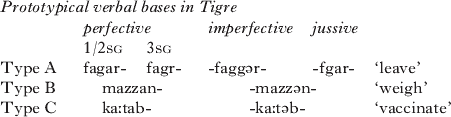
Morphologically, Ethio-Semitic ‘types’ are equivalent to the internally augmented binyanim of Arabic and Hebrew (note that Tigre seems to be closer to such languages than other Ethio-Semitic languages, in that a given root may appear in more than one type in Tigre, but in the rest of Ethio-Semitic a given root appears in one type only). Like these better-known languages, Ethio-Semitic also has affixally augmented forms. An example which will be important to this paper is the formation of causatives by prefixation of [ʔa-] to the verbal stem (sometimes with additional changes to the stem). Thus, the causative of a Type A verb [-faggər-] ‘leave’ is [-ʔafgər-] ‘make leave!’. Such formations are to a large extent dependent on the major types in (1); they are therefore not referred to as a types in their own right (unlike in central and northwest Semitic languages).
As the data in (1) shows, word formation in Tigre may manipulate the prosody (i.e. the syllabification and length) of the segments in a given type. In other words, the positioning of a given segment with respect to its phonological environment is less rigid than in the more familiar concatenative morphological systems of Indo-European languages. This lack of rigidity in segmental positioning is especially apparent in the phenomenon to be discussed in the present paper.
1.2 The phenomenon of templatic metathesis
The imperative form in Tigre is very similar to the jussive in (1), in that they take the same suffixes denoting the gender and number of the subject. However, the imperative does not contain the person prefix, which is signalled by the initial hyphen in (1) (cf. note 2). In Type A verbs, the omission of the prefix results in an initial cluster [QTaL]. Initial clusters are generally avoided in the language, hence the surface base form for the masculine singular, [QəTaL] (e.g. [wədaq] in (2)). The entire imperative paradigm for Type A is shown in (2): there are three other imperative forms, which are (in the Samhar dialect) [-i] (fem sg), [-o] (masc pl) and [-a] (fem pl).
(2)

Tigre also has a set of object suffixes, four of which are vowel-initial (all designate 3rd person): [-u] (masc sg), [-a] (fem pl), [-om] (masc pl) and [-ən] (fem pl). These can be added to the forms in (2) to yield the morphological sequence imperative+subject pronoun+object pronoun. In this sequence, the subject and object prefix interact with the imperative bases in a uniform and interesting fashion, which is presented in (3) for [-u] ‘him (masc sg)’. If the base is the unsuffixed masculine singular, then the final consonant is geminated; if the base carries a person suffix [-i], then this person suffix disappears, and the vowel of the base changes to long [eː]; the masculine plural suffix [-o] also disappears upon contact with a vowel-initial object suffix, and the stem vowel becomes long [oː]. The feminine plural imperative suffix [-a], in contrast, does not disappear in this context, but rather lengthens, and an [h] emerges between it and the object suffix.
(3)
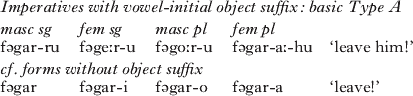
The same phenomenon, though slightly altered, appears in the causative imperative. As the reader will recall, such verbs are created by the prefixation of [ʔa-], which is sometimes accompanied by changes in the prosody and vocalisation of the stem. The imperative paradigm of Type A causatives without an object suffix is given in (4) for the same verbs as in (2) above. As the comparison with the non-causative form reveals, the vocalisation of the stem changes in the process. The important difference for our purposes is the quality of the second vowel of the stem: whereas the simple Type A base has [a], the second vowel of the corresponding causative base is [ə], a vowel which we saw functions as the epenthetic vowel of the language.
(4)

The causative Type A paradigm also interacts with vowel-initial object suffixes in an interesting way, which is similar but not identical to the interaction shown for basic Type A forms in (3). As shown in (5), if the base carries a person suffix [-i], then this person suffix disappears, and the vowel of the base changes to long [iː] (cf. long [eː] in (3)); the masculine plural suffix [-o] also disappears on contact with a vowel-initial object suffix, and the stem vowel becomes long [uː] (cf. long [oː] in (3)). The feminine plural imperative suffix [-a] behaves as in (3): it becomes long, and an [h] emerges between it and the object suffix.
(5)

The phenomenon in question is not limited to the imperative base: it is true of the jussive and imperfective bases, too. Raz (Reference Raz1980: 232) calls it ‘transposition’, because the imperative base seems to absorb the quality of the imperative suffix. I have found the same phenomenon in my fieldwork on the Samhar dialect.
While Raz mentions the phenomenon, he does not provide an account of why there is gemination only in the masculine singular imperative, why there is lengthening instead of transposition of the feminine plural suffix or why the alternations are those attested. In this paper, I will analyse Raz's ‘transposition’ as phonologically motivated metathesis. Several facts about Tigre phonology will be discussed along the way.
In the next section, I present the theoretical tools that will be used in the analysis. §3 contains the analysis of the phenomenon. §4 is an attempt to extend the analysis to guttural-final stems, which, as we will see, resist ‘transposition’, but display syncope instead. §5 concludes.
2 Theoretical background
The questions that are raised by the phenomenon under discussion belong to two realms: alternations in length and alternations in quality. This subsection will present the theories in terms of which the two types of alternations will be analysed.
The first type of alternation involves length, whether consonantal or vocalic. As we have seen, the final consonant of the masculine singular imperative is geminated when the vowel-initial object suffix is attached, e.g. [fəgar-ru] ‘leave (masc sg) him!’. In the same environment, the vowel of the feminine plural imperative suffix is lengthened, e.g. [fəgar-aː-hu] ‘leave (fem pl) him!’, as is the vowel of the stem if it is suffixed by [-i] or [-o] ([fəgeːr-u] ‘leave (fem sg) him!’ and [fəgoːr-u] ‘leave (masc pl) him!’ respectively). Alternations in length are best dealt with within a framework that includes timing slots in its representations. The complementarity of gemination on the one hand and lengthening (and possible ‘transposition’) on the other indicates that the number of timing slots is limited by the grammar. In other words, as is unsurprising in a Semitic language, there is a fixed ‘template’.Footnote 3
This paper will adopt Lowenstamm's (Reference Lowenstamm, Durand and Laks1996) theory of templates, which was inspired by McCarthy (Reference McCarthy1981) and Kaye et al. (Reference Kaye, Lowenstamm and Vergnaud1990), while differing in important aspects from both. In this framework, templates consist of a fixed number of strictly alternating CV units. The final V slot may remain empty in many languages as a parametric choice: this is evidently the case in Tigre. The representation of [fəgar] ‘leave (masc sg)!’, for instance, is as in (6a). The representation of the word [ʔənaːs] ‘man’ in (6b) illustrates how length is represented in strict CV theory.
(6)
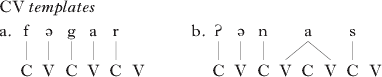
Lowenstamm's CV tier is an improvement on the tiers of the earlier theory of CV phonology (Clements & Keyser Reference Clements and Keyser1983) for several reasons, two of which I will mention here. The first reason is principled and methodological: Lowenstamm's view makes a universal claim about the alternation between C and V units, reducing the skeletal inventory to a single constituent, and thereby accounting for the relative rareness of clusters. Nothing in CV phonology rules out extremely marked skeletons such as CCCCV, CVVVC, etc. The second reason is practical. Consider the Tigre forms [fagra] ‘he left’ and [saʔala] ‘he asked’, both Type A (as shown by their jussive forms [-fgar] and [-sʔal]). CV phonology, as used by McCarthy (Reference McCarthy1981), is obliged to say that these two verbs have different templates in the past tense, because [fagra] has two vowels, whereas [saʔala] has three. Lowenstamm's theory is able to attribute the same CVCVCV template to both (at the cost of the additional burden of explaining why the second V slot is realised only in one case – this is achieved by appeal to the general notion of government; see (20) below).
In order to discuss alternations in quality, we must first consider the vocalic system of Tigre. Tigre is usually analysed as having six vowel phonemes, /i u e o a aː/, and one epenthetic vowel, [ə] (see e.g. Raz Reference Raz1983, Lowenstamm & Prunet Reference Kaye, Lowenstamm and Vergnaud1985). As the set shows, an underlying length distinction exists only for /a/. Phonetically, short /a/ may be realised as [ε], [ʌ], [æ], [o] or [a], depending on the environment, but it is always short; the rest of the vowels may be long or short (in certain environments), but their quality is unaltered; /aː/ always has the quality [a].Footnote 4
A note is in order regarding the representation of length. As we will see, the length of /aː/ may be phonetically reduced, but it is still recognisable as /aː/, because it does not alter its quality in the same environments as the short /a/. As a result, whether or not the length is phonetic, the vowel has to be represented as occupying two V slots. For vowels other than [a], there are no strict minimal pairs (i.e. two words that are equally complex morphologically) differing only in length. Thus, for these vowels length is not phonemic. However, as we will see, additional length is sometimes derived by templatic considerations. Only in such cases – that is, when they are phonetically long – will these vowels be represented as occupying two V slots. In other words, representations of /aː/ as long may be phonetically short, but when other vowels are represented as long, this reflects phonetic reality, because there is no underlying length distinction for these vowels.Footnote 5
For vowel quality, the analysis in this paper will follow Element Theory (Kaye et al. Reference Kaye, Lowenstamm and Vergnaud1985, Backley Reference Backley2011), which derives vocalic expressions through the combination of vocalic elements. In this theory, there are three basic elements, I, U and A. In a vocalic expression, each of the elements can function as either a head or a modifier. The vocalic system of Tigre can be described as in (7), where heads are underlined.
(7)

The system may be characterised by the following three statements: (i) I and U are always heads, (ii) only headed expressions may branch onto two timing slots and (iii) A must branch. The first statement formalises (rather than accounts for) the lack of [ε] and [ɔ] in the system, which would have the structures A+I and A+U respectively. The second and third generalisations cover the phonemic length distinction between the two /a/'s.Footnote 6
To conclude this section, let us give a more precise representation of the Type A imperative base. The first V position, which is realised as [ə], is empty. The second V position contains a short /a/, represented by a non-head element A.Footnote 7
(8)

3 Representations and analysis
This section provides the analysis of the phenomenon presented in §1. It begins with an account of the alternations in consonantal length, and moves on to motivate metathesis and its specific results. Finally, the cases where metathesis does not occur are explained.
Having established the templatic representation of the imperative base in (8), we can now move to that of the templatic material of the suffixes and its interaction with the base. This part of the analysis will have to explain the complementary distribution of gemination and ‘transposition’.
The data to be considered here constitute a near-minimal pair. When the object suffix /-u/ is attached to the base, gemination emerges, e.g. /fgar-u/→[fəgarru] ‘leave (masc sg) him!’, but when the person suffix /-i/, /-o/ or /-a/ is attached to the same base, the consonant remains ungeminated, e.g. /fgar-i/→[fəgari] ‘leave (fem sg)!’. Regardless of the reason for the ‘transposition’ attested when both the person and the object suffixes are attached, this difference must be explained.
I suggest that this difference is due to the number of skeletal positions that accompany the affix. Person suffixes such as /-i/ are not accompanied by a CV unit. They are associated to the final position of the stem, as illustrated for /i-/ in (9a). No gemination emerges. In contrast, the object suffix is accompanied by one CV unit (9b). The suffixal vowel occupies one V slot, and the first suffixal C slot is left empty. As a result, the final consonant of the stem spreads, and gemination occurs.Footnote 8
(9)
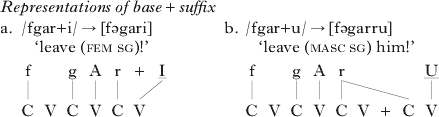
The two representations in (9) are a consequence of the minimal difference between the two words. Based on this difference between the two types of suffixes, we can begin our account of the attested metathesis. Their juxtaposition, we know, must result in ‘transposition’. Consider the representation of such a combination in (10), where both affixes are concatenated to the base.
(10)
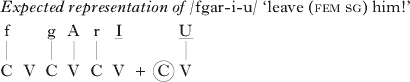
The problem with the representation in (10) is hiatus. Formally, an empty C slot intervenes between two V slots occupied by distinct elements (this C slot is circled in (10)). C slots which are not contained within a long vowel, and which are followed by an occupied V slot, must be associated. The most straightforward repair for this problem is the insertion of an epenthetic consonant. Tigre, however, evidently prefers to delink the last consonant of the stem from its original position and have it occupy the empty C slot.Footnote 9
(11)
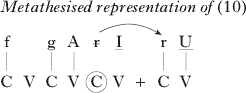
The simple templatic metathesis in (11) explains why there is no gemination in the ‘transposed’ forms: there is simply not enough templatic space for gemination. That said, the repair in (11) is problematic, since it only changes the location of the problem. With /r/ moved to prevent hiatus, another hiatus (circled in (11)) is created between the stem vowel and the person suffix.
There is nevertheless an important difference between the hiatus in (11) and the one in (10). Whereas both vocalic expressions in the hiatus in (10) are headed (I, U), the first vocalic expression in the hiatus in (11) is A, a non-head in this context. We know that the repair is different in this case: the two expressions are combined into long [eː]. I propose the rule in (12) to account for this different repair.
(12)
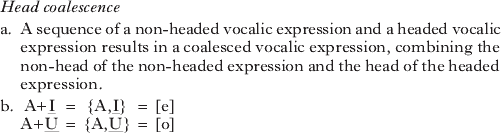
The length of the resulting expression need not be stated in the rule, because it is a function of templatic space. Secondly, several combinations become illicit in Tigre under this rule: I, U and A may not coalesce with a following vowel. This restriction rules out a coalescence resolution for cases such as /fgAr-I-U/ in (10), where, instead of metathesising, the person suffix would coalesce with the object suffix and yield *[fəgaryː].
The introduction of the rule in (12) produces the following, correct representations for /fgar-i-u/ ‘leave (fem sg) him!’ in (13a) and /fgar-o-u/ ‘leave (masc pl) him!’ in (13b). In both representations, the original final consonant of the stem prevents hiatus, as it occupies the C slot between the two vocalic suffixes. This results in another hiatus, which is resolved through coalescence, in accordance with (12). In both cases, the length is a result of templatic space, originating in the hiatus. In neither case is gemination of the last radical an option, since the templatic space is taken up by the vocalic expression. The coalescence in (13b), which we have not yet discussed, requires no further explanation: the person suffix /-o/ is the complex {A,U}, and its coalescence with the A of the stem will affect only its length.
(13)
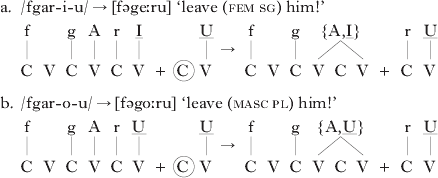
Recall now that, according to (12), the non-head element of the coalesced element is provided by the original non-headed expression. In (13b), for example, the non-head A of the resulting long [o] is the A of the original /a/, not that of the original suffix /-o/. In (13a), this makes little difference, but it is important for the understanding of the behaviour of causative Type A verbs in this configuration, given in (14), which combines the representations in (3) and (6), with their corresponding basic forms.
(14)
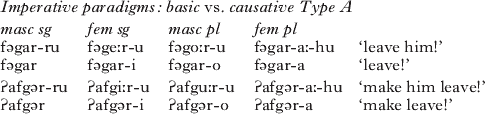
As can be seen in (14), there is an important difference between the bases of basic Type A forms and their causative counterparts: in the latter, the second stem vowel is [ə], not [a]. Recall further that in the present framework, [ə] signals an empty position with no head or modifier. This difference is paralleled by the difference in the quality of the stem vowels in the metathesised forms: whereas the basic stem exhibits the mid vowels [eː] and [oː] in the feminine singular and masculine plural respectively, the causative has the high vowels [iː] and [uː] in its paradigm. Especially revealing is the causative masculine plural [ʔafguːr-u], because, unlike the parallel causative feminine singular [ʔafgiːr-u], the coalesced vowel, [uː], is not identical to the vowel of the original suffix /-o/. Despite these differences, the analysis of basic stems developed above correctly accounts for both the geminated and the metathesised cases of the causative paradigms with no additional speculations, as shown in (15).
(15)
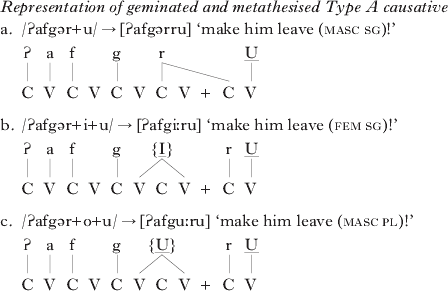
In (15a), [ʔafgərru] ‘make him leave (masc sg)!’, as in (9b), gemination results from the additional skeletal material of the object suffix. In (15b), [ʔafgiːru] ‘make him leave (fem sg)!’, the head I of the person suffix combines with the non-head of the stem – i.e. the empty set – and yields a vowel [i], which is lengthened by the templatic structure. This contrasts with the [e] quality derived in (13a) above, and proves that the original stem vowel is a relevant factor in the derivation of the output. In (15c), [ʔafguːru] ‘make him leave (masc pl)!’, as in (13b), the head U of the person suffix combines with the same empty set; the resulting [uː] illustrates the claim in (12) that only the head of the headed expression survives the coalescence. If this were not the case, we would expect *[ʔafgoːru].
One form remains to be explained: the feminine plural imperative, with or without object suffix. As seen in (14), without the object suffix, the vowel is a short [a], e.g. [fəgara]. When the object suffix is added, unlike the two other imperative suffixes, this vowel does not metathesise and coalesce with the stem vowel. Instead, the vowel is lengthened and the hiatus is broken up by [h]: [fəgaraːhu]. Two questions arise with respect to this form. First, what is the origin of the [h]? Is it epenthetic, or does it belong to the object suffix? And second, why is there no metathesis?
Because there is no general process of [h]-epenthesis in Tigre, it seems that the [h] in this case cannot be viewed as the result of a synchronic epenthetic process. Moreover, [h] is the initial segment of all independent 3rd person pronouns, which are [hətu] (masc sg), [həta] (fem sg), [hətom] (masc pl) and [hətən] (fem pl), and identical to the 3rd person object suffixes with a base [hət-]. The [t] in these pronouns is a late development; thus it is more likely that the [h] that separates the person suffix and the object suffix is part of an allomorph of the suffix specified for this context, preserving a more ancient form of the 3rd person pronoun.
Given this, why would the allomorph only be preserved in this context? I suggest that this is because metathesis is impossible in this context. It is impossible because, unlike the other person suffixes, the feminine plural contains long /aː/. That this is the case is proved by the length of [aː] when it precedes the object suffixes. Unlike the other long vowels we have encountered, whose length was accounted for by templatic considerations, the length of the vowel [aː] in [fəgaraːhu] cannot be attributed to the templatic space provided by the surrounding morphemes. Rather, it must be part of the underlying representation of the feminine plural suffix itself. With respect to length, the form to explain is rather the more basic [fəgara], without the object suffix, in which the vowel is not phonetically long.
But first consider why metathesis is impossible in [fəgaraːhu]. The representation of this form is given in (16). The suffix /-aː/, unlike the other person suffixes, is accompanied by a CV unit, because it has a head A, and a vocalic expression headed by A must branch. The object suffix is preceded by [h].
(16)
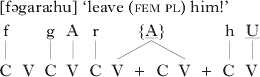
For delinking to apply here, the stem-final /r/ would have to migrate not one C slot, as in previous cases, but two. Moreover, such metathesis would leave the stem vowel extra-long: *[fəgaaːru]. These complications, I suggest, have resulted in the preservation of the original [h] of the object suffix, by which metathesis was rendered unnecessary.Footnote 10
The interpretation of /-a/ as underlyingly long A is further supported within the present analysis by the avoidance of a coalescence solution to the hiatus problem. If ‘leave (fem pl) him!’ were /fgar-A-U/, with an unheaded A, we would expect *[fəgaroː], for example, because rule (12) would apply to the two suffixes.Footnote 11
Returning to the form without the object suffix, we expect it to have the representation in (17). The fact that the suffix is not phonetically long can be attributed to a rule of loss of phonetic length word-finally, which is cross-linguistically very common. In Tigre, too, there are no length distinctions word-finally, even for the low vowel, which does contrast in underlying length elsewhere. As mentioned in the previous section, underlyingly long /aː/ may shorten phonetically, but if the quality [a] is retained, it is A, and must still be represented as underlyingly long. Thus, the fact that the quality [a] is retained in the feminine plural justifies a phonologically long representation.
(17)
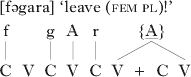
This last representation concludes the analysis of the data presented in §1. To summarise, I have applied an autosegmental analysis to ‘transposition’ in Tigre. The phenomenon turned out to be a special case of hiatus-resolving metathesis, followed by vowel coalescence. The CVCV template was shown to be adequate in predicting the complementary distribution of gemination and vowel coalescence, which proved to hold only under a well-defined condition.
The lack of metathesis in the feminine plural form was accounted for by the underlying length of the feminine plural imperative suffix, with reference to a rule of final shortening. The appeal to this rule was motivated on cross-linguistic grounds. Further motivation is provided in the next section, where I discuss a case where metathesis is absent from the entire paradigm.
4 Guttural-final verbs
Tigre has a set of four gutturals: two glottals [ʔ h] and two pharyngeals [ʕ ħ].Footnote 12 As Raz (Reference Raz1983: 60) mentions, guttural-final verbs in Type A have a special imperative paradigm. Instead of maintaining the stem /a/ throughout the paradigm, this vowel is syncopated whenever there is a suffix. Compare the guttural-final verb in (18a) to the ‘regular’ verb (i.e. one without any problematic consonants) in (18b).
(18)

There are two reasons to believe that the syncope in (18) is a phonological process, rather than a rote-learned fact about guttural-final verbs. First, syncope of short [a] before gutturals is found elsewhere in the language.Footnote 13 Second, this view suggests that the second vowel /a/ is absent from all suffixed forms, but present in the unsuffixed base [səmaʕ] ‘hear (masc sg)!’. The fact that the vowel is the same as the one in regular verbs becomes completely accidental. Note that we cannot claim that this [a] is epenthetic in the unsuffixed base, since [ə] is the epenthetic vowel before all word-final consonants, including pharyngeals. The syncope needs a phonological explanation.
In Government Phonology (Kaye et al. Reference Kaye, Lowenstamm and Vergnaud1990), syncope, i.e. the non-realisation of a nucleus, can only occur when that nucleus is ‘governed’ by the following nucleus. Governing nuclei must themselves be realised. To illustrate, this scenario is presented for Tigre [kaləb] ‘dog’ vs. [kalbu] ‘his dog’ in (19), and adapted to the CVCV version of Government Phonology adopted here. In (19a), the second V slot of the base is ungoverned, because the final V slot is empty. The V slot of the base must therefore be realised. In (19b), the same position is governed, and thus need not be realised.
(19)
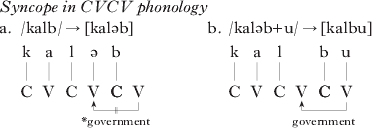
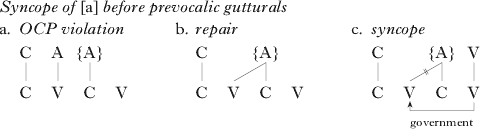
Returning to the verbal system, the syncope of [a] only before [ʕ] and other gutturals undoubtedly stems from the affinity between these segments (McCarthy Reference McCarthy and Keating1994, Rose Reference Rose1996, Vaux Reference Vaux1999). Informally, it seems that a short /a/ before a guttural is somehow perceived as a result of the adjacency of the guttural: the V slot itself is considered an extension which is otherwise empty, so that when syllabification does not require its realisation, it will not be realised.
How is this to be represented and analysed? I propose the representations in (20), which make use of the Obligatory Contour Principle (Leben Reference Leben1973, McCarthy Reference McCarthy1981). Guttural consonants contain an element A in their make-up: a guttural is represented by {A} attached to a C slot (see Bellem Reference Bellem2007 for the representation of gutturals in Element Theory). Whether the element is a head is irrelevant for the present purpose (it is probably a head only in pharyngeals). When such consonants follow a short /a/, the OCP violation in (20a) is created. As a result, the two non-heads are unified, with the consonantal A branching onto both positions, as in (20b). The vocalic position is now otherwise empty. If a vowel follows the guttural, the contents of the previous V slot become syllabically redundant, since it is governed from the following position (20c).Footnote 14
(20)
Interestingly, guttural-final stems exhibit neither ‘transposition’ nor gemination. Instead, all suffixed forms have the same [CəCG-] stem (where G is a guttural), and the hiatus resolved by metathesis in regular verbs is here resolved by glide epenthesis.Footnote 15
(21)

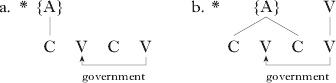
The unsuffixed [səmaʕ] ‘hear (masc sg)!’ syncopates when the object suffix is attached ([səmʕ-u]), whereas the parallel [fəgar] ‘leave (masc sg)!’ geminates ([fəgarr-u]). The lack of gemination in the guttural case is not surprising. Gutturals are never geminates in Tigre. This can be formalised by stating that gutturals may not be followed by governed nuclei (22a). Since geminates always involve government of their internal V slot (there are no final geminates in Tigre), the left branch of the geminate will always precede a governed nucleus: guttural geminates are thus excluded (22b). Notice that word-final gutturals are not excluded, since the final empty nucleus is not governed.
(22)
Now consider the representation of [səmʕ-u] ‘hear (masc sg) him!’ in (23). This form has exactly the same number of CV units as the parallel [fəgarru] ‘leave (masc sg) him!’: three for the base and one for the suffix. The guttural cannot geminate. Instead, it is the object suffix that comes to occupy the stem-final position. The vocalic position before the guttural is governed, and remains silent.
(23)
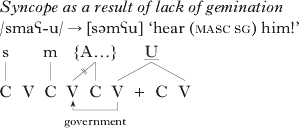
The final vowel in (23) is phonologically long. However, as stipulated in the previous section, phonologically long word-final vowels are phonetically short. That stipulation is now confirmed by the independent phenomenon of syncope in guttural-final verbs.
Moving on to forms with two vocalic suffixes, the predicted initial representation of /smaʕ-i-u/ ‘hear (fem sg) him!’ appears in (24a). The person suffix /-i/ occupies the stem-final position. As in the regular cases, a hiatus emerges with the vowel-initial object suffix. However, unlike the final consonants of the regular roots in (13) above, the guttural occupies both a consonantal and a vocalic position.
I propose that this is the reason why the guttural cannot metathesise. The metathesis scenario is presented in (24b). If the guttural metathesises, its vocalic branch will no longer be governed by the person suffix, because unlike coalescence, government can only hold across a realised consonantal slot. Coalescence is also ruled out, because the first vocalic position is linked to the guttural, which now follows the person affix. Association lines would cross, and the result would be ungrammatical. The solution, represented in (24c), is thus not to metathesise, but rather to spread the suffix vowel to occupy the problematic C slot, yielding the correct [səmʕiju].Footnote 16
(24)
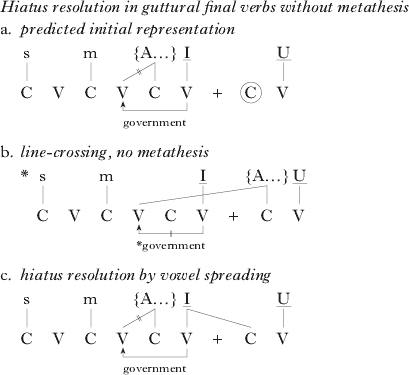
To summarise, guttural-final verbs represent a different state of affairs in the imperative paradigm. The difference results in neither metathesis nor gemination occurring in such verbs.
5 Conclusion
This paper has treated the phenomenon of metathesis (or ‘transposition’) in Tigre, as illustrated by several imperative paradigms. Metathesis was shown to be a strategy of hiatus avoidance. The limits of the phenomenon were shown to follow from underlying representations: gemination is in complementary distribution with long vowels because of templatic effects, the coalesced vowels result in a principled manner from metathesis and one suffix fails to metathesise because its vowel is underlyingly long. Finally, the complete absence of metathesis and the special stem syncope in guttural-final stems were shown to follow from the same principles.
The entire analysis was conducted within the CVCV theory of templates of Lowenstamm (Reference Lowenstamm, Durand and Laks1996) and Scheer (Reference Scheer2004), and the Element Theory of Kaye et al. (Reference Kaye, Lowenstamm and Vergnaud1985) and Backley (Reference Backley2011). Several of the tools of these theories were crucial in the analysis. For instance, the analysis of vowels in terms of elements and the constraints licensing their combinations as heads or non-heads was crucial in understanding why the quality of the vowel resulting from metathesis is different in the simple vs. causative cases. Empty nuclei and their licensing through government played an important role in the analysis of guttural-final stems. These are all independently motivated terms and tools which are unique to the theories used in this analysis. If the analysis is successful, it should be taken to testify to the validity of the tools that these theories offer.
A statement regarding hiatus resolution, which was also crucial in the analysis of syncope, is worth repeating because of its general scope.
(25)

It remains to be seen whether this principle can be applied to other cases of syncope and hiatus resolution, the two phenomena that have been the focus of this short paper.


